

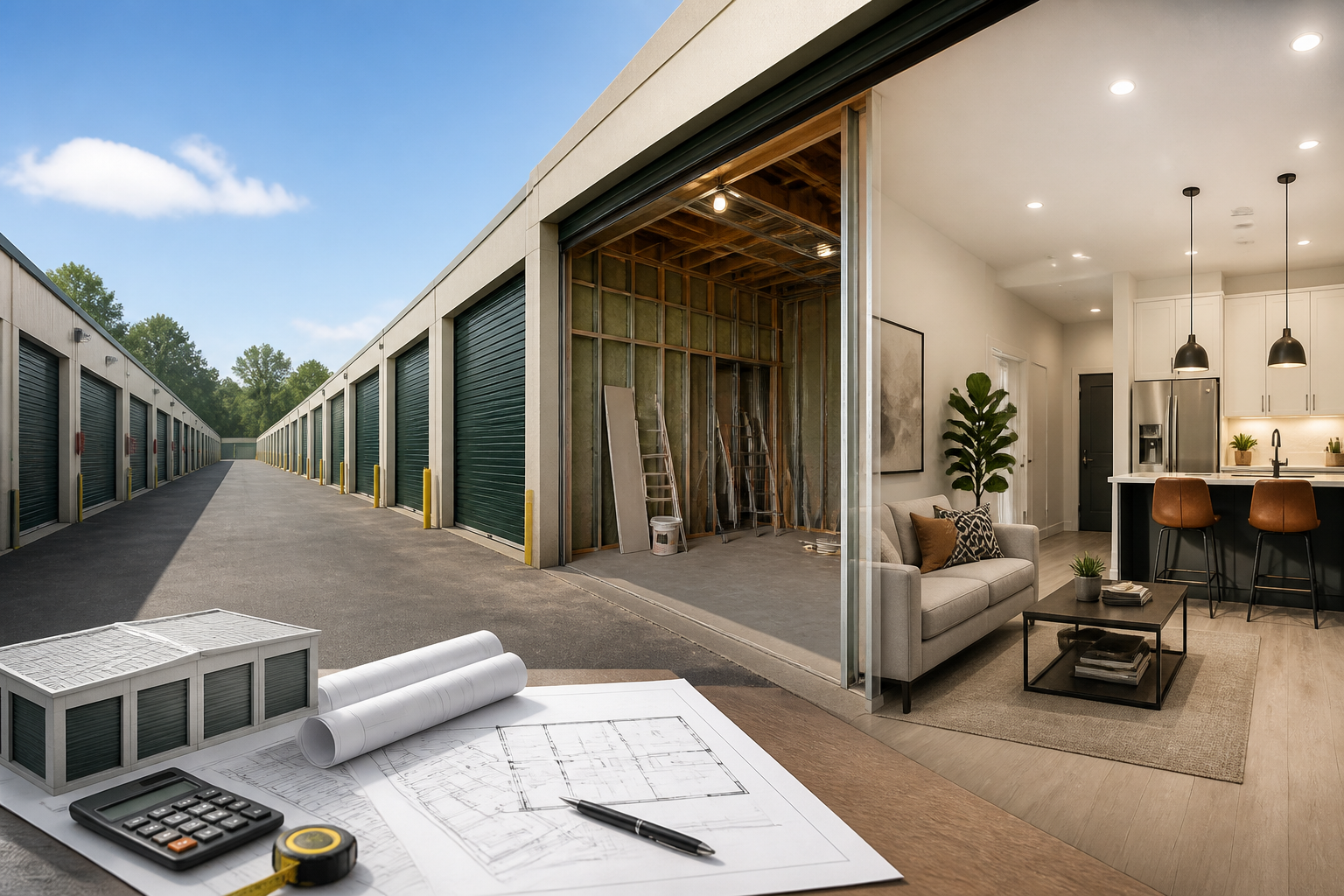
Learn self storage conversion costs, ROI benchmarks & execution strategies for converting retail, office & warehouse buildings into profitable facilities.
Table of Contents
- What Are Self-Storage Conversion Costs?
- Major Self-Storage Conversion Cost Categories
- Conversion Costs by Building Type
- Financial Analysis Framework for Conversions
- Cost-Saving Strategies for Conversions
- Hidden Costs and Risk Factors
- Conversion vs. Ground-Up Construction: Cost Comparison
- Real-World Conversion Cost Examples
- Hiring the Right Team for Cost Control
- Geographic Cost Variations
- Conclusion and Next Steps
- Frequently Asked Questions
Self-storage conversions are one of the most compelling value-add plays in commercial real estate right now. Ground-up construction? You're looking at $100+ per square foot in most markets. That's brutal. So smart investors are hunting for vacant big-box retailers, dead office buildings, and aging warehouses instead — they're cheaper entry points into a sector that's absolutely booming.
Here's the catch: self-storage conversion costs aren't predictable. Building type matters. Geography matters. The structure's condition matters. Local regulations matter. Each variable swings your numbers wildly. This guide walks you through every major cost bucket, gives you real dollar benchmarks, and shows you the financial framework you need to actually know whether a deal works.

What Are Self-Storage Conversion Costs?
Definition and Overview
Self-storage conversions take existing structures — retail boxes, office buildings, warehouses, industrial facilities — and repurpose them into climate-controlled or standard storage unit operations. You're starting with a shell that's already there. That cuts your land costs, structural expenses, and timeline dramatically compared to ground-up construction. But here's the catch: the building's current condition, layout, and code compliance status bring a whole different set of cost variables that new construction projects don't face.
The real difference comes down to risk. New construction? Blank slate, predictable costs, known timeline. But conversions offer lower entry prices and faster occupancy — while hiding surprises inside walls, under floors, and in twenty-year-old mechanical systems. One bad HVAC discovery can wipe out your entire margin if you haven't built in contingency reserves.
Why Conversions Are Popular
The last decade's been brutal for retail. Conversely, it's been golden for self-storage investors. We're talking 90%+ occupancy rates in solid markets, recession-resistant cash flow, and a fundamentals profile that outperforms most commercial asset classes. And right now? Dead retail real estate is trading at fire-sale prices. For investors who want self-storage exposure without the $8–15 million development burden of ground-up construction, conversions hit that sweet spot between capital intensity and execution risk.
Typical Cost Range by Building Type
Plan on spending somewhere between $25 and $75 per square foot for total all-in conversion costs (land acquisition excluded), though that swings hard based on building type, condition, and your metro. Climate-controlled projects in expensive markets regularly push past $90 per square foot — especially when you're adding sophisticated HVAC, elevators, or major interior buildout. We'll break these out by building type below with real numbers attached.
Back to topMajor Self-Storage Conversion Cost Categories
You need to know exactly where your capital goes. That's the foundation of underwriting that actually holds up. Here's what a typical mid-market conversion looks like by the numbers.
| Cost Category | % of Total Conversion Budget | Estimated Cost Range (per sq ft) |
|---|---|---|
| Structural Renovation | 20–30% | $8–$20 |
| HVAC Systems | 15–25% | $6–$18 |
| Electrical Upgrades | 10–15% | $4–$12 |
| Fire Suppression / Sprinklers | 8–12% | $3–$9 |
| Interior Buildout (Units/Corridors) | 20–30% | $8–$22 |
| Permitting and Zoning | 2–5% | $1–$4 |
| Architecture and Engineering | 5–8% | $2–$6 |
| Contingency (Recommended) | 10–15% | $4–$10 |
Structural and Renovation Costs

Structural work eats up 20–30% of your total budget. We're talking interior demolition, pulling down partitions, slab repairs, and any fixes to the building envelope — the roof, exterior walls, foundation. A roof that's already deteriorating or cracks in the foundation? That's an easy $200,000–$500,000 before you even frame a single unit. And that's why you always order a Phase I environmental assessment and a full structural engineering report before you close. No exceptions.
HVAC, Sprinklers, and Electrical Systems
This is where most conversions blow their budgets. Climate-controlled storage demands real HVAC capacity — packaged rooftop units plus ductwork running everywhere. You're looking at $6–$18 per square foot just for HVAC. Fire suppression? Required in virtually every jurisdiction. That runs $3–$9 per square foot depending on ceiling height and what you've already got in place. Then there's the electrical panel upgrades, lighting, and security wiring — add another $4–$12 per square foot. In older buildings, getting electrical systems up to code might be your single biggest line item. Don't assume it's cheaper than you think.
Permitting and Zoning Costs
Most investors underestimate permits. The fees themselves? Yeah, 2–5% of project costs. But here's the real killer: time. Zoning variances, conditional use permits, appeals — they can stretch your timeline by 6–18 months. On a $3M project carrying $15,000–$40,000 monthly, a 12-month delay costs you $180,000–$480,000 in holding costs. That's often more than the permit fees combined. Check zoning compatibility before you make an offer. Not after.
Design and Engineering Fees
You'll allocate 5–8% of your budget to architecture and engineering. For a self-storage conversion, that means a licensed architect pulling construction documents, a structural engineer certifying the building, a mechanical engineer designing your HVAC, and possibly a civil engineer for site work. Skipping this or going cheap backfires every time — failed inspections, expensive change orders, and liability you didn't bargain for.
Unexpected Infrastructure Issues
Buildings over 30 years old are ticking time bombs. Asbestos, lead paint, floors that can't handle the load you need, plumbing systems shot to hell, electrical that predates modern code. Budget 10–15% contingency on every conversion. For anything built before 1985? Bump that to 20%.
Back to topConversion Costs by Building Type

Here's the truth: not all conversion candidates pencil out the same way. Your building type determines your cost structure more than almost anything else you'll encounter in the deal.
| Building Type | Avg. Cost per Sq Ft | Key Cost Drivers | Conversion Complexity |
|---|---|---|---|
| Big Box Retail | $30–$55 | HVAC, sprinklers, interior build | Moderate |
| Office Building | $40–$70 | Demo, structural, HVAC redesign | High |
| Warehouse / Industrial | $25–$45 | Interior buildout, climate control | Low–Moderate |
| Historic / Older Buildings | $55–$90+ | Code compliance, remediation, structural | Very High |
Big Box Retail Conversions
You've seen them everywhere — shuttered Kmarts, abandoned Sears locations, mid-size grocery anchors sitting empty. These are often your sweet spot for conversions. Why? Clear-span floor plates, generous ceiling heights (20–28 feet is common), existing parking, and high-visibility corner locations that drive walk-up traffic. Budget $30–$55 per square foot for the work. HVAC systems for climate-controlled units, fire suppression, and that interior unit grid with corridors — those are your biggest line items.
Office Building Conversions
Most expensive. Most painful. Office-to-storage conversions run $40–$70 per square foot, sometimes higher. Multi-story office buildings demand serious demolition work — interior partitions, dropped ceilings, plumbing systems all coming out. Floor-to-floor heights in older office stock often can't accommodate efficient unit layouts. But here's the flip side: multi-story offices in urban infill locations can command premium rents for climate-controlled urban storage. If demand fundamentals support it, those conversion costs start looking reasonable.
Warehouse Conversions
Industrial and warehouse buildings are the low-hanging fruit. Clear spans, high ceilings, simple construction. Demo costs are minimal. You're looking at $25–$45 per square foot total. Interior unit walls, doors, corridors, and climate control systems if you're targeting that segment — that's where your money goes. The catch? Warehouse locations don't have retail visibility. Budget accordingly for signage and digital marketing to drive lease-up traffic.
Historic or Older Buildings
Handle with care. Historic buildings are marketing gold but conversion costs regularly hit $55–$90 per square foot or beyond. Code compliance, asbestos abatement, lead remediation, structural reinforcement, historic preservation requirements — it all stacks fast. You might qualify for historic tax credits that offset 20% of qualified rehabilitation costs at the federal level. The admin burden, though? Substantial. Only chase these deals if you've got specialized experience or a trusted team that does.
Back to topFinancial Analysis Framework for Conversions

Evaluating Submarket Demand
Don't run the numbers until you've validated local demand. That's your first move. Pull a 3-mile radius around the property and compare existing supply against population ratios—this is your trade area, and it's everything. Most markets support about 7–8 square feet of storage per capita nationally, but supply-constrained urban markets? They'll absorb 3–5 square feet per capita at premium rental rates. Yes, third-party demand studies from Radius+ or SpareFoot cost $500–$2,000. Worth it. You're not making a six-figure decision without solid data behind it.
Calculating Net Rentable Square Footage
Here's where most investors get sloppy. Net rentable square footage (NRSF) is what actually generates revenue—and it's never the same as gross building square footage. Interior corridors eat space. So do office areas, mechanical rooms, and loading zones. That's dead weight from a rental perspective. A well-executed conversion pulls 60–75% NRSF on single-story builds and 55–65% on multi-story. Take a 50,000 sq ft big-box retail shell. You're realistically looking at 32,000–37,500 NRSF after design optimization. Understanding this gap separates winning deals from money pits.
Estimating Income Potential
Once your NRSF is locked in, go find actual comps. Hit the ground—call competing facilities within your trade area and get their asking rates. Climate-controlled units in major metros run $1.50–$2.50 per square foot monthly on NRSF. You're modeling a 35,000 NRSF facility at $1.75/sq ft with 90% stabilized occupancy? That's roughly $661,500 in annual gross revenue. But don't ignore reality. Apply a 5–8% vacancy cushion and subtract operating expenses—typically 35–45% of effective gross income. What's left is your NOI. This is the number that actually matters.
Projecting Operating Expenses
Self-storage doesn't bleed cash like apartments or retail. Your typical expense mix breaks down like this: property management (6–8% of EGI), insurance (1–2%), property taxes (5–10%), utilities (3–5%), maintenance and repairs (2–4%), and marketing (2–4%). That lands you in the 35–45% OpEx range, which is clean compared to other commercial assets. But here's the catch—most developers underestimate lease-up. Budget 18–24 months to hit stabilized occupancy. Model your debt service coverage around that timeline, not some fantasy ramp-up. It'll keep you honest.
ROI and Payback Period
| Metric | Typical Range for Conversions | Notes |
|---|---|---|
| Stabilized Cap Rate | 5.5–7.5% | Varies by market and asset quality |
| Development Yield on Cost | 8–12% | All-in cost vs. stabilized NOI |
| Cash-on-Cash Return | 7–15% | Depends on use and financing terms |
| IRR (5-year hold) | 14–22% | Includes appreciation on exit |
| Payback Period | 6–10 years | From conversion completion to full cost recovery |
| Lease-Up Period | 18–30 months | Time to reach stabilized occupancy |
A stabilized cap rate of 5.5–7.5% is standard for conversions, and you should expect development yield on cost between 8–12%. Your cash-on-cash return lands in the 7–15% range depending on leverage and deal structure. Over a 5-year hold, you're looking at 14–22% IRR with appreciation factored in. Full cost recovery typically takes 6–10 years from project completion. And if you're considering self-directed retirement funds to capitalize this thing? Check out our complete guide to self-directed IRA real estate investing—it walks through how to deploy tax-advantaged capital into conversions without stepping on IRS rules.
Back to topCost-Saving Strategies for Conversions

Building Selection and Site Assessment
Pick the right building. That's your single biggest lever for controlling costs before you even break ground. Look for structures with adequate clear ceiling heights (14 feet minimum, 18+ feet is what you want), existing fire suppression systems, recent roof replacements, heavy electrical service already in place, and layouts that don't force expensive structural modifications. Every one of these you find already done saves you $3–$15 per square foot in conversion costs. That adds up fast.
And don't skip the due diligence. Commission a Phase I environmental assessment ($1,500–$3,500) and a structural assessment ($2,500–$6,000) before you go hard on your deposit. It costs money upfront, but it prevents disasters later.
Phased Construction Approaches
Build 40–60% of the space first. Open for business. Then use your early cash flow and lease-up data to fund the rest. This strategy cuts your initial capital requirements. It validates your demand assumptions before you're locked in. And it lets you adjust your unit mix based on what the market actually wants—not what you guessed.
You'll pay slightly higher per-unit construction costs, and operations will be messier during build-out phases. But if capital's tight, phasing is often the difference between a deal that pencils and one that doesn't.
Design Optimization
This is where experienced self-storage architects earn their fees. A tight layout maximizes your rentable ratio, eliminates corridor waste, and positions your high-demand units—the 10x10s and 10x20s—for best accessibility.
Here's the math: bump your rentable ratio from 60% to 70% on a 50,000 sq ft building and you've got 5,000 additional rentable square feet. At $1.50/month per sq ft, that's $90,000 in extra annual revenue at full occupancy. Design isn't a place to cut costs.
Negotiating with Contractors and Sellers
Get at least three competitive bids for every major trade package—general contractor, HVAC, electrical, fire suppression. Non-negotiable. Self-storage-specific contractors almost always deliver better value than general commercial shops because they actually know how to install unit systems efficiently.
On the acquisition side, quantify your conversion costs during due diligence. Use that data to renegotiate the seller price. Found $500,000 in environmental remediation you didn't budget for? That's a legitimate basis for price reduction—but only if you've done your homework before you close. Don't go in blind.
Back to topHidden Costs and Risk Factors
Environmental and Structural Issues
Environmental contamination can absolutely tank your deal. Petroleum storage tanks, industrial chemical residue, and asbestos-containing materials aren't theoretical concerns — they're deal-killers that cost anywhere from $50,000 for minor remediation to well over $1,000,000 when the problem's serious. Start with a Phase I environmental site assessment (typically $1,500–$3,500). That's your baseline due diligence. If Phase I turns up recognized environmental conditions (RECs)? You'll need a Phase II assessment ($5,000–$25,000+) that includes soil and groundwater sampling. Don't skip this step if you want to sleep at night.
Floor Load Capacity Problems
Most self-storage operations need at least 125 pounds per square foot. Here's the problem: older office buildings were never designed for that kind of loading. You discover the structural rating is 50 PSF, and suddenly you're looking at reinforcement costs of $15–$40 per square foot across the entire affected area. That number gets ugly fast on a 40,000 SF building.
Zoning and Permitting Delays
Self-storage gets conditional use or special exception permits in most municipalities. And don't underestimate community pushback — suburban neighbors especially hate storage facilities moving in next to their residential areas. Public hearings. Appeals. Regulatory delays that stretch for months or years. Budget conservatively: 3–6 months for straightforward permitting, 6–12 months if variances or conditional use permits are required, and 12–24 months in markets where opposition is organized or the regulatory environment is genuinely complex. Every single month of delay hits your carry costs, your financing, and your pro forma revenue. That's not theoretical — that's money out of your pocket.
Code Compliance Expenses
Older buildings have older bones. Bringing them current with ADA, fire code, energy code, and structural requirements isn't cheap or predictable. ADA compliance (accessible pathways, accessible restrooms, accessible signage) can run $50,000–$200,000 depending on the building layout. Fire code upgrades are their own beast — most jurisdictions won't grandfather older buildings, so you're looking at full sprinkler system installation even if some form of suppression already exists.
Contingency Planning
Build your contingency reserve using a tiered approach based on building age and condition: 10% for post-1990 buildings in solid shape, 15% for mid-vintage stock (1970–1990), and 20%+ for older or historic structures. Monitor your contingency burn month by month and replenish it if early surprises drain it before you're through construction. A contingency that hits zero mid-project forces bad decisions. And bad decisions during construction create operational problems and long-term liability exposure that'll haunt you.
Back to topConversion vs. Ground-Up Construction: Cost Comparison
| Factor | Conversion | Ground-Up Construction |
|---|---|---|
| Total Cost per Sq Ft (all-in) | $50–$110 | $90–$150+ |
| Construction Timeline | 8–18 months | 18–30 months |
| Land Acquisition | Often included in building purchase | Separate cost; competitive in most markets |
| Financing Availability | Moderate (lenders cautious on conversions) | More established lending products |
| Visibility / Location | Often superior (existing retail locations) | Depends on land availability |
| Cost Predictability | Lower (hidden conditions) | Higher (controlled environment) |
| Entitlement Risk | Moderate (existing use changes) | High (new development approvals) |
Conversions win on price. You're looking at a 20–40% lower all-in cost per square foot versus ground-up construction in the same market. And you're getting there faster—six to twelve months faster, which matters when you're counting carrying costs and lost lease-up time.
But here's the catch. That cost advantage disappears quick if you hit hidden structural problems, asbestos, or foundation issues during demo. It happens more often than developers like to admit.
Ground-up projects? They're boring from a cost perspective. Higher nominal PPSF—we're talking $90–$150+ all-in. But what you get is predictability. You control the variables. No surprises hiding in ninety-year-old walls. That's why institutions prefer them despite paying more upfront.
Back to topReal-World Conversion Cost Examples
Case Study: Big Box Retail Conversion
A 65,000 sq ft former Kmart in a secondary Midwest market. Acquisition price? $1.8M ($27.69/sq ft). The building came with an existing roof in good condition, adequate electrical service, and no environmental issues — basically a dream conversion candidate. Total conversion costs hit $2.9M ($44.62/sq ft). Here's where the money went: interior demolition and structural work ($420,000), HVAC for climate-controlled units ($680,000), fire suppression system installation ($290,000), electrical upgrades ($310,000), interior unit construction ($750,000), architecture and engineering ($155,000), permitting ($85,000), and contingency ($210,000). All-in project cost including acquisition came to $4.7M.
The real payoff showed up after stabilization. At 92% occupancy (month 22), the facility was generating $685,000 in NOI and a 14.6% yield on cost.
Case Study: Office-to-Storage Conversion
This one's a cautionary tale. A 3-story, 45,000 sq ft 1970s office building in an urban infill market went for $2.2M. But environmental due diligence found minor asbestos in the ceiling tiles — remediation added $85,000 to the bill. Then came structural work. Removing those load-bearing partitions to create efficient storage corridors? That required significant renovation you don't always budget for.
Total conversion costs: $3.6M ($80/sq ft). The initial estimate was $58/sq ft — you're looking at a substantial miss. Structural reinforcement ran $340,000 over budget, asbestos remediation came in $65,000 higher than expected, and an elevator modernization (required by the building department, naturally) wasn't in the original budget at all. That cost another $210,000.
And here's the lesson that matters: office building conversions demand more thorough pre-acquisition engineering assessment than any other building type.
Back to topHiring the Right Team for Cost Control

Working with Architects and Engineers
Self-storage isn't like a standard office or retail conversion. A generalist architect will burn through your budget with inefficient layouts, missed code requirements, and endless change orders that'll kill your deal economics. You need someone who's actually designed self-storage facilities before — ideally 3–5 completed projects in their portfolio. Same goes for your structural and mechanical engineers. Yes, you'll pay 15–20% more for that specialization. But you'll save 2–3x that amount by avoiding construction disasters and redesign costs that'll tank your cap rate.
Selecting Contractors and Vendors
Interior unit systems are where most conversions either succeed or fail. These modular walls, doors, and ceiling systems aren't something a generic metal building contractor can wing. Work with established self-storage system manufacturers — Janus International, Trachte Building Systems, or BETCO. They know how to optimize layouts and nail installation efficiency in ways that matter to your timeline and budget.
For general contracting, don't compromise. You need relevant self-storage experience, current licenses, adequate bonding ($3M minimum for projects over $1.5M), and verifiable references from comparable conversion projects. Period.
Project Management and Budget Oversight
Most conversion budgets drift because nobody's actually watching them month to month. Here's what actually works: establish a monthly budget-to-actual reconciliation process from day one. Before the first shovel touches soil, require your contractor to submit a detailed schedule of values. Then get on site weekly during active construction phases. You'll spot problems early.
Change order management is where deals die.
Require written approval for every change over $1,000. And negotiate your change order markup cap upfront — typically 10–15% for overhead and profit — right there in the construction contract before you sign it. Lock this down now or watch your ARV disappear.
Back to topGeographic Cost Variations
| Region | Labor Cost Index | Avg. Conversion Cost (per sq ft) | Avg. Rental Rate (per sq ft/month) |
|---|---|---|---|
| Northeast (NYC, Boston) | High (130–150) | $65–$95 | $2.00–$3.50 |
| West Coast (LA, SF, Seattle) | High (125–145) | $60–$90 | $1.80–$3.00 |
| Mid-Atlantic | Moderate-High (110–130) | $50–$75 | $1.50–$2.50 |
| Midwest | Moderate (90–110) | $35–$58 | $1.00–$1.75 |
| Southeast | Moderate (90–105) | $35–$60 | $1.10–$1.80 |
| Southwest (Phoenix, Dallas) | Moderate (95–115) | $38–$62 | $1.20–$1.90 |
Where you build matters. Labor eats up 30–40% of your conversion costs in high-cost coastal markets like NYC and the Bay Area, which obviously shifts your underwriting calculus. But here's the thing — those same markets command rental rates of $2.00–$3.50 per square foot per month that can absolutely justify the hit.
The real opportunity? Midwest and Southeast markets are where the spread works best. You're spending $35–$60 per square foot to convert while capturing $1.00–$1.80in monthly rent. That's the kind of margin that plays well for investors bootstrapping their BRRRR strategy or working with limited capital.
Back to topConclusion and Next Steps
Self-storage conversions work. You get a high-performing commercial asset at a fraction of ground-up construction costs — but only if you do the work. Rigorous due diligence, realistic underwriting, and a team that actually knows self-storage conversions aren't optional. The real money gets spent on HVAC and mechanical systems, interior buildout, structural work, and whatever surprises are hiding inside that old building. Budget conservatively. Build in real contingency. And validate demand before you write a check.
Don't rush this part. Your first move is identifying 3–5 conversion candidates in your target market right now. Order preliminary structural and environmental assessments on your top picks. Get a self-storage architect involved early — have them sketch a concept layout and run preliminary numbers. Then stress-test your financial model under 60%, 70%, and 80% occupancy scenarios. Go hard on an acquisition only after you've proven the numbers work under realistic conditions.
Running the numbers through multiple cap rate scenarios changes everything. Most investors underestimate how sensitive these deals are to a 25–50 basis point shift in market rents.
If you're looking to deploy retirement capital into self-storage, exploring how self-directed IRAs can be used for real estate investments might unlock additional financing options worth layering into your capital stack.
Pre-Acquisition Conversion Assessment Checklist
- Confirm zoning compatibility for self-storage use
- Order Phase I environmental site assessment
- Commission structural engineering evaluation
- Verify roof condition and remaining useful life
- Assess existing HVAC, electrical, and fire suppression systems
- Measure ceiling heights throughout the building
- Calculate theoretical net rentable square footage and rentable ratio
- Research local self-storage supply, vacancy rates, and rental rates
- Model conversion costs at $25/sq ft, $50/sq ft, and $75/sq ft scenarios
- Identify and interview at least two self-storage-experienced architects
- Establish preliminary conversations with lenders about conversion financing
- Build a 15% contingency into all preliminary cost models
Frequently Asked Questions
what's the average cost to convert a building to self-storage?
You're looking at $25–$75 per square foot of gross building area for most conversions—and that's before you factor in land acquisition. A warehouse? You'll land closer to the lower end. But office buildings and historic conversions? They'll run you toward $75+ and can easily blow past that in expensive markets.
Here's the real number: in San Francisco or New York, all-in costs for a climate-controlled urban facility can hit $150 per square foot or higher. High-cost labor markets just destroy your economics.
How long does a self-storage conversion take from acquisition to opening?
Plan for 12–24 months from closing to opening day. That includes permitting, design, and construction.
Straightforward warehouse flips in permitting-friendly areas? You might pull it off in 8–12 months. But if you're dealing with an office building conversion or fighting zoning variances in a restrictive municipality, don't be shocked if you're sitting at 24–36 months. And don't forget to budget your carrying costs and financing hits during that holding period.
Is it cheaper to convert an existing building or build self-storage from the ground up?
Conversions win on price. You're looking at 20–40% cheaper on a per-square-foot basis versus ground-up development, and you'll typically move 6–12 months faster. But here's the catch: conversions carry hidden cost risk from environmental conditions,
Back to top