

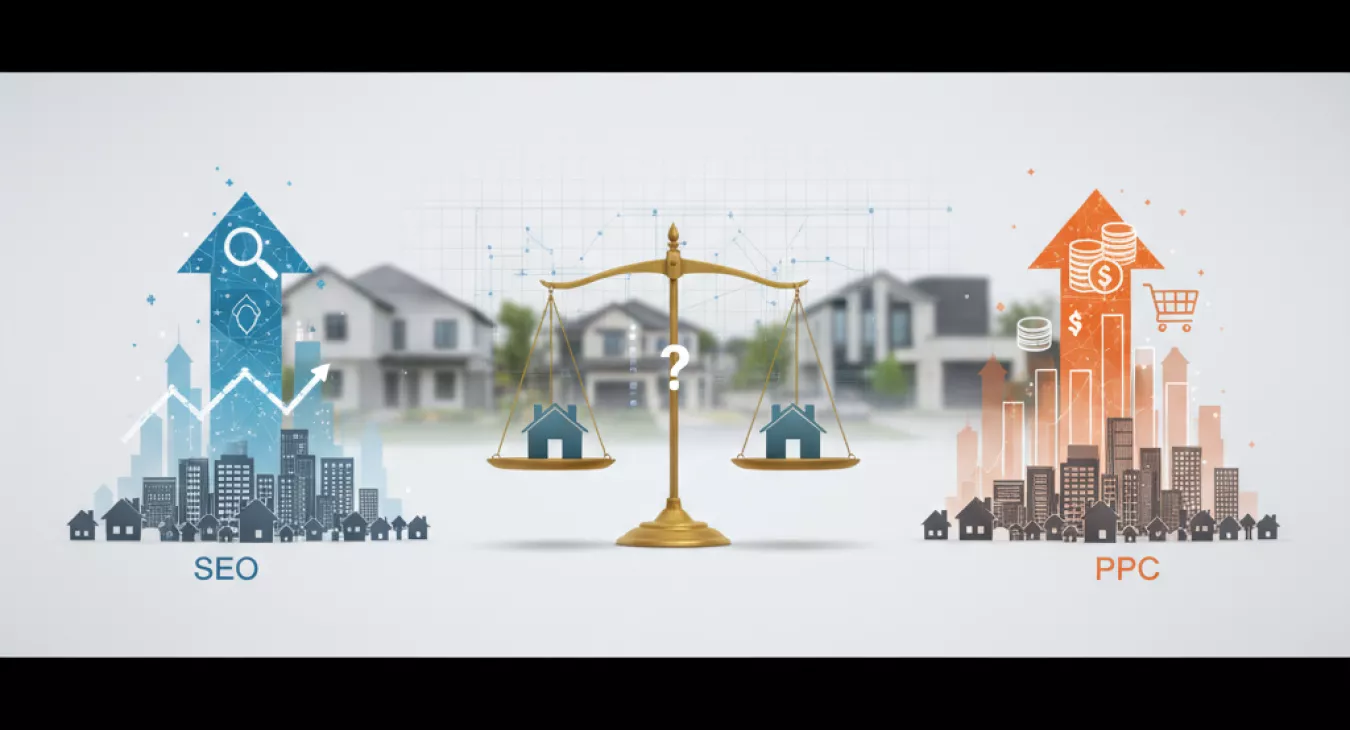
Compare SEO vs PPC for real estate investors. Learn which strategy wins for your budget, timeline, and ROI goals with honest data.
Products and Tools Mentioned in this Post

Table of Contents
- Quick Comparison: SEO vs PPC at a Glance
- How SEO Works for Real Estate Investors
- How PPC Works for Real Estate Investors
- SEO Benefits for Real Estate Investors
- SEO Disadvantages for Real Estate Investors
- PPC Benefits for Real Estate Investors
- PPC Disadvantages for Real Estate Investors
- The Real Numbers: Costs, ROI, and How Long This Actually Takes
- Industry Statistics: Real Estate Conversion Rates by Channel
- The Hybrid Approach: Using SEO and PPC Together
- Choosing the Right Strategy: A Decision Framework
- Real-World Results: What Investors Actually See
- Action Plan: Getting Started
- Conclusion: Which Strategy Actually Wins?
- Frequently Asked Questions
Every real estate investor hits this wall eventually. Google Ads or SEO? Pick wrong and you'll torch your marketing budget, kill your pipeline, or watch competitors steal your deals. But here's the thing — it's not either/or. The real money is in running both, strategically stacked. This guide walks you through the numbers, timelines, and decision framework so you can build a deal-generation machine that actually works for your stage, your cash, and your growth targets. We're talking SEO vs PPC for real estate investors — no fluff, just data.
New to finding deals? Start with our Guide to Finding Motivated Sellers.

Quick Comparison: SEO vs PPC at a Glance
Want to know which channel actually moves the needle for your business? Here's the breakdown that matters—straight data on what separates the two approaches:
| Feature | SEO | PPC |
|---|---|---|
| Speed to Results | 3–12 months | 24–72 hours |
| Long-term ROI | Excellent (compounds over time) | Good (requires ongoing spend) |
| Cost Control | Limited short-term, strong long-term | Precise daily/monthly caps |
| Targeting Precision | Keyword and local intent | Geographic, demographic, behavioral |
| Scalability | Scales with content and authority | Scales with budget |
| Required Expertise | High (technical + content) | High (bidding + optimization) |
| Consistency | Grows more stable over time | Consistent while budget is active |
| Brand Building | Strong authority signals | Limited organic trust |
Now let's dig in. Each channel has its own strengths and weaknesses—and for most real estate investors, it's not an either/or decision.
Back to topHow SEO Works for Real Estate Investors
The SEO Process and Timeline
SEO is earning organic (unpaid) rankings in Google without dropping cash on PPC. For you as a real estate investor, that means showing up when motivated sellers type "sell my house fast [city]" or "cash home buyers near me." You're optimizing your website's content, technical infrastructure, and backlink profile to earn that visibility. But here's the reality: SEO takes patience. You're looking at 3–6 months before you'll see meaningful traffic increases, then 6–12 months of consistent lead generation, and 12–24 months if you want to dominate your local market in a competitive area. It's a long-game investment — not a quick fix.
Local SEO Advantages for Real Estate
Real estate investors have a real advantage here. Local SEO is your territory. And it's where you'll beat the national players like Zillow who can't replicate hyper-local relevance the way you can. Optimize your Google Business Profile. Build local citations. Get reviews. That signals geographic authority that matters to Google. The local "3-pack" — those map listings at the top of search results — can dump inbound leads straight into your funnel without a single dollar spent on ads. When you pair that with a website optimized for "we buy houses [neighborhood]"? That's when your lead generation compound month after month.
Content Strategy for Real Estate Keywords
You need a deliberate content strategy that covers the entire seller decision funnel. Early awareness? Target "how to avoid foreclosure." Ready to sell? Hit them with "sell my house fast for cash." The smart move is building evergreen content — market guides, investor FAQs, neighborhood overviews — that keeps generating traffic years after you hit publish. Data-driven analytics tools let you spot keyword gaps your competitors are missing. That edge is what separates investors who copy competitor content from investors who actually win market share.
Back to topHow PPC Works for Real Estate Investors
Google Ads Fundamentals for Real Estate
Your listings hit the top of search results the moment your campaign goes live. We're talking above organic results, above the local pack—prime real estate on the SERP. You bid on high-intent keywords, lock in your geographic zones, and only pay when someone actually clicks. Want the full breakdown on campaign structure? Check out our Google Ads for Real Estate Investors: Campaign Setup Guide and our PPC for Real Estate Investors: Google Ads Guide.
Ad Targeting and Bidding Strategies
Here's where PPC gets dangerous in the best way. Surgical targeting. You're limiting ads to specific ZIP codes, serving them only during your business hours, tweaking bids by device, and layering in audiences of people who've already stalked your competitors' sites. Real estate CPCs swing hard depending on location. Rural markets? $5–$15 per click. Mid-tier cities hit $20–$45. And competitive urban markets like Los Angeles, Miami, and New York? You're looking at $50–$120+ per click. Once your data piles up, automated bidding strategies like Target CPA start earning their keep by optimizing your spend.
Landing Page Optimization for Conversions
Your PPC campaign lives or dies on the landing page. Period. Pages need to load in under 3 seconds—especially critical since 60%+ of real estate search traffic comes from mobile. Your value proposition has to be clear above the fold, no scrolling required. Keep your lead form simple. And test everything: headlines, form length, trust signals like investor testimonials and logos. A/B testing these elements can move your conversion rate significantly. Once you've got leads coming in, push them straight into a CRM built for real estate investors so nothing gets lost in the shuffle.
Back to topSEO Benefits for Real Estate Investors

Here's the real difference: PPC bleeds money forever. SEO builds an actual asset. Once you nail your technical SEO, create solid content, and earn quality links, your website's authority keeps working for you. That initial grind pays dividends because your cost per lead typically drops by 40–70% between Year 1 and Year 3 as organic traffic compounds. And there's something else — users trust organic results way more than paid ads. Research shows they click organic listings at 2–3x the rate of paid ads when they're researching or comparing options. PPC does win for transactional searches, but SEO's compounding return profile is what separates it.
The lead quality gap is huge, and most investors sleep on it. A seller who discovers you organically, reads your content, then checks your Google Business Profile with dozens of 5-star reviews? That person's already sold on you before they pick up the phone. Compare that to someone who clicked a generic PPC ad. Not the same animal. Many investors see organic leads converting to actual deals at 1.5–2x the rate of PPC leads. Brand credibility matters, and SEO builds it in ways that ads simply can't.
Back to topSEO Disadvantages for Real Estate Investors
SEO's biggest problem? Timeline. You need deals in 90 days. SEO won't get you there. Markets like Phoenix, Atlanta, Dallas, and Tampa are absolute bloodbaths — established local investors and national cash-buyer brands are all bidding on the same keywords. Want a top 5 organic ranking in one of these metros? Plan on 12–18 months of consistent work and spend before you see real traction.
Then there's the algorithm risk. Google's core updates in 2023 and 2024 wiped out real estate rankings across the board. Some investor sites lost 30–50% of their organic traffic overnight. And staying competitive means constant content refreshes, technical audits, and link monitoring — that's not a one-time setup. You're looking at $1,500–$5,000/month for ongoing agency work in competitive markets, or you need the expertise in-house to keep up with the grind.
Back to topPPC Benefits for Real Estate Investors

Speed. That's PPC's real superpower. A dialed-in Google Ads campaign will land your first motivated seller lead in 48–72 hours—sometimes faster. Compare that to SEO, which demands months of grinding before you see traction. If you're entering a new market, stress-testing a new acquisition angle, or your pipeline's running dry, PPC fills the gap immediately. And here's what really matters: you control the spend in real time. Pause a campaign that's bleeding money. Adjust your daily budget on a Tuesday afternoon. Double down on the zip codes converting best. SEO doesn't give you that flexibility.
But the real edge? Systematic testing. Run two ads side by side—one hitting "We close in 7 days," the other pushing "No repairs, no fees." See which one actually converts. Adjust. Test again next week. You're building data, not guessing. Pair this with a solid follow-up system, and you've got a conversion funnel you can see, measure, and improve week after week.
Back to topPPC Disadvantages for Real Estate Investors
Competitive markets kill PPC margins. When "sell my house fast" CPCs jump 40–60% in just three years—thanks to deep-pocketed iBuyers flooding the channel—your unit economics get ugly fast. You're looking at $80 per click. Throw in a realistic 3% conversion rate and you're burning $2,600 per lead before factoring in your actual close rate. Some urban markets? They're pushing $8,000–$15,000 cost-per-acquisition on closed deals. That's not scalable.
Here's the brutal truth about PPC: stop paying and your leads evaporate. There's no asset left behind. No list, no equity, nothing. And that's before you account for click fraud—competitors and bots gaming your budget for 14–20% of your spend in verticals like ours. But there's more. Ad blindness is real. Your repeat visitors? They've learned to ignore that little "Sponsored" label and scroll right past you.
Back to topThe Real Numbers: Costs, ROI, and How Long This Actually Takes
| Metric | SEO | PPC | Winner |
|---|---|---|---|
| Initial Setup Cost | $2,000–$5,000 (site audit, technical fixes) | $500–$2,000 (campaign setup) | PPC |
| Monthly Operating Cost | $1,500–$5,000 (agency/content) | $2,000–$10,000+ (ad spend + management) | SEO |
| Cost Per Lead (Month 1) | Very high (no traffic yet) | $400–$2,500 | PPC |
| Cost Per Lead (Year 1 Average) | $300–$800 | $500–$2,500 | SEO |
| Cost Per Lead (Year 2+) | $100–$300 | $600–$3,000 (rising CPCs) | SEO |
| Total 12-Month Investment | $20,000–$65,000 | $30,000–$120,000+ | SEO |
Industry Statistics: Real Estate Conversion Rates by Channel
| Market Type | SEO Conversion Rate | PPC Conversion Rate | Average CPC | Typical CAC |
|---|---|---|---|---|
| Motivated Seller Leads | 4–8% | 2–5% | $35–$80 | $800–$3,500 |
| Fix & Flip | 3–6% | 2–4% | $25–$60 | $700–$2,800 |
| Rental Property Acquisitions | 3–5% | 2–4% | $20–$50 | $600–$2,500 |
| Wholesaling | 4–7% | 2–5% | $30–$70 | $750–$3,000 |
| Competitive Urban Markets | 2–4% | 1–3% | $60–$120+ | $3,000–$15,000+ |
Look at these numbers and you'll notice something: real estate outperforms the broader digital marketing benchmarks. Organic search typically hits 2.8–6% across all industries. PPC runs 2–4% on average. But here's the thing—real estate investors operate in a different arena. High-intent deals. High stakes. People searching for off-market deals or fast closings aren't window shopping. That's why you're seeing conversion rates push toward the upper end, especially if you've built strong social proof and you're positioning yourself as a quick closer.


The Hybrid Approach: Using SEO and PPC Together

Skip the either/or debate. The best investors run SEO and PPC at the same time — and they do it deliberately. Here's the winning strategy: fire up PPC campaigns to pull in leads and cash flow immediately while you're building your SEO engine in the background. Then, once your organic rankings start delivering (usually around months 4–8), you shift dollars away from PPC and into content production and link building. Fast forward to month 12–18, and your organic channel is often generating leads for a fraction of what you're paying per click. That's when you can either cut total marketing spend or redirect that PPC budget into completely new markets.
And here's the thing — PPC actually makes your SEO better. The keywords crushing it in your PPC campaigns? Those become your SEO priority list. Your Quality Score (Google's way of grading how relevant your ads are) goes up when your landing pages are dialed in, which is exactly what Google's organic algorithm looks for anyway. There's real synergy between these channels. This dual-channel playbook works like portfolio diversification in real estate — you're running BRRRR deals alongside fix-and-flip strategies. Multiple streams mean lower risk and better overall returns.
Back to topChoosing the Right Strategy: A Decision Framework
| Business Situation | Best Choice | Secondary Strategy | Budget Focus |
|---|---|---|---|
| Startup with limited budget | SEO + Local SEO | Small PPC test ($500–$1K/mo) | 70% SEO / 30% PPC |
| Established business, competitive market | Hybrid (both) | Direct mail complement | 50% SEO / 50% PPC |
| New market expansion | PPC (immediate presence) | Begin local SEO simultaneously | 80% PPC / 20% SEO |
| Scaling existing operations | SEO (lower CAC) | PPC for overflow lead volume | 60% SEO / 40% PPC |
| Long-term market dominance | SEO (authority building) | PPC for competitive defense | 70% SEO / 30% PPC |
Your team's bandwidth matters just as much as your budget. PPC needs constant feeding — you're looking at weekly dives into search term reports, bid adjustments, pausing losers, the whole deal. Miss a week and your CAC climbs fast. SEO's different but not easier. You need steady content production and regular technical maintenance to keep ranking.
Here's what most lean operations miss: AI tools for real estate investors can cut your content production time in half. Seriously. That changes the math for SEO accessibility when you don't have a dedicated marketing person.
Back to topReal-World Results: What Investors Actually See
A Phoenix wholesaler ran Google Ads targeting "sell my house fast Phoenix" and pulled 18 leads in month one. Cost per click? $62. Their landing page converted at 4.1%, and they burned through $8,900 in ad spend to close 2 deals—netting roughly $24,000 in assignment fees. That's solid. But here's the catch: competitors kept bidding up the CPCs by 22% over the next quarter, which meant constant vigilance just to maintain ROI.
Now consider a Baltimore investor who went all-in on SEO instead. Fourteen months of neighborhood-specific landing pages, local media backlinks, and Google Business Profile optimization. The payoff? They're ranking top 3 for 31 motivated-seller keywords across 4 ZIP codes. Organic cost per lead sits under $180. And they're pulling 12–18 inbound inquiries monthly with zero active ad spend.
That's the organic advantage. But it doesn't tell the whole story.
A Dallas investment firm ran both channels simultaneously over 18 months and discovered something interesting: SEO delivered leads at $210 CAC while PPC stayed elevated at $1,850 CAC. Yet PPC leads closed in 19 days on average versus 34 days for organic. Speed matters when you're competing for deals. They kept both channels running because different parts of the pipeline needed different fuel. This kind of thinking—layering complementary channels—is exactly what savvy investors apply across the board, whether it's Google Ads, SEO, or something like direct mail marketing.
Back to topAction Plan: Getting Started
Here's where to start with SEO:
- Run a technical site audit with Screaming Frog or Ahrefs. You're looking for crawl errors, page speed problems, and missing metadata that'll tank your rankings.
- Claim your Google Business Profile and actually fill it out. Photos, service areas, review strategy—don't leave money on the table here.
- Build landing pages for your best markets. City and neighborhood targeting works because it's specific. Searchers know what they want.
- Publish 2–4 pieces of seller-focused content every month. Target long-tail keywords—that's where the motivated deals live.
- Watch your numbers monthly. Rankings, organic traffic, lead conversions. Use Google Search Console and Analytics.
For PPC, here's the playbook:
- Don't start broad. Pick 3–5 high-intent keywords and geo-target aggressively to your best areas.
- Each ad group gets its own landing page. Your homepage doesn't convert—a focused page does.
- Test with $1,500–$3,000/month for 60 days. That's enough to see if it works before you go all-in.
- Set up conversion tracking in Google Tag Manager from day one. You can't optimize what you don't measure.
- Check your search term report every week and kill waste with negative keywords. This alone cuts your cost per lead significantly.
Both channels only work if your backend is tight. You need solid legal structure—check out our guide to best LLC services for real estate investors—plus asset protection and a CRM that actually manages the leads you're about to generate.
Back to topConclusion: Which Strategy Actually Wins?
Here's the truth: neither SEO nor PPC wins on its own. Your timeline and budget determine which one—or both—makes sense for your business. Need deal flow in the next 30–90 days? PPC is your only real option. Building something you'll own for 5+ years? SEO is the move—highest ROI by far. And if you can afford to run both? That's when the real money happens. You get the immediate pipeline from PPC while SEO quietly compounds in the background, feeding you cheaper leads at scale.
The top investors in any market aren't choosing sides. They're burning PPC cash now to keep deals flowing while their SEO foundation quietly does the heavy lifting. In 18–24 months, that flipped equation saves them thousands every month. Start with what your cash and timeline require, track your numbers obsessively, and shift your mix as you scale.
Back to top
Frequently Asked Questions
How long does SEO take to generate real estate leads?
Three to six months. That's when most investors start seeing real organic traffic increases after consistent SEO work. But here's the catch: getting to a dependable 5–15 inbound leads per month? You're looking at 9–18 months in moderately competitive markets, and 18–24+ months if you're fighting it out in places like LA or Manhattan.
Local SEO (Google Business Profile optimization) moves faster. You could see results in 60–90 days, especially if you're not in a saturated market. The difference matters when you're managing cash flow and deal pipeline expectations.
what's a realistic cost per lead for real estate PPC?
It depends entirely on where you're operating. Rural and smaller markets? You're probably paying $200–$600 per lead. Mid-tier cities run $500–$1,500. Then you hit markets like Los Angeles, Miami, or New York and suddenly you're at $1,500–$5,000+ per lead.
Your landing page conversion rate, keyword targeting precision, and campaign optimization quality all move that needle. Don't blame the channel if your ads are poorly structured.
Does PPC or SEO produce better lead quality for real estate investors?
Organic SEO leads close at 1.5–2x the rate of PPC leads. Why? Because sellers who find you through search have already done their homework. They've researched options, compared competitors, and built some baseline trust in your brand before they ever contact you.
That said, PPC has its own advantage: speed. Those paid leads move through your pipeline faster, which matters if you're hungry for rapid deal flow. The real answer? Use both channels simultaneously and track close rates by source in your CRM. You'll find your market has its own sweet spot.
Can I run real estate PPC campaigns myself, or do I need an agency?
You can manage Google Ads in-house if you've got 5–10 hours weekly and the stomach to learn the platform.
But real estate PPC is brutally competitive and expensive. One bad campaign structure and you're bleeding thousands of dollars. Most investors hitting $500K+ in annual revenue outsource this to professionals charging $500–$2,000/month — and that fee pays for itself instantly through lower CPL and higher conversions. And don't overlook AI tools for real estate investors as a middle ground if you want to stay hands-on without drowning in platform mechanics.
Should I pause PPC once my SEO starts generating leads?
Don't do it.
Investors who kill PPC the moment organic traffic ramps up almost always hit a lead volume cliff during the transition. Instead, gradually scale down PPC spend as SEO delivers more volume — keep a modest PPC budget running as a safety net and for those high-value keywords your organic strategy hasn't owned yet. You'll also block competitors from bidding on your brand name, which happens constantly in competitive markets.
Back to top