

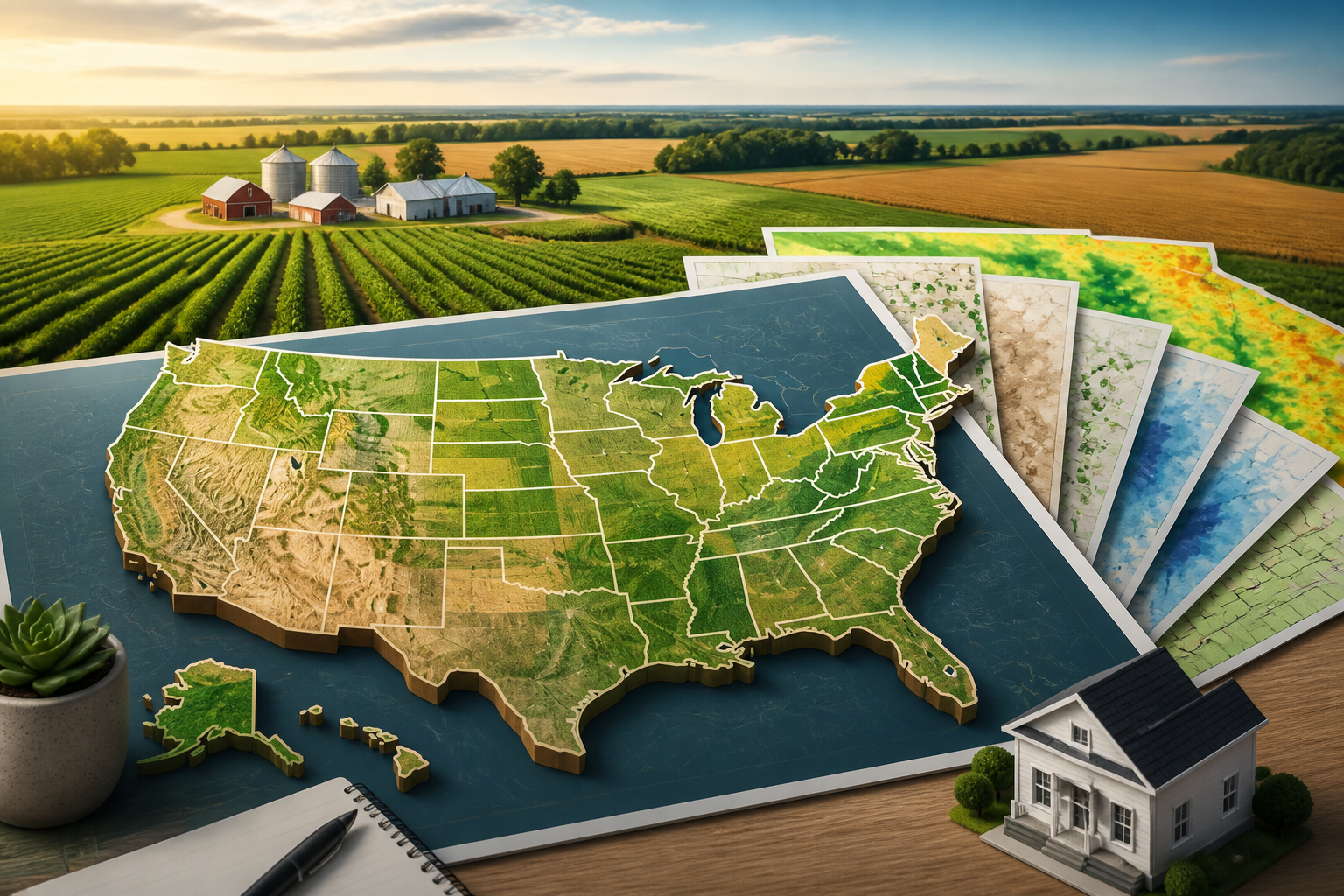
Discover the 7 essential maps to find best farmland USA. Data-driven strategies for evaluating soil, climate & investment potential.
Table of Contents
- Why Maps Are the Foundation of Smart Farmland Investment
- The 7 Essential Farmland Maps: Quick Comparison
- Map 1: USDA Web Soil Survey — The Gold Standard for Soil Quality
- Map 2: NOAA Drought Monitor Map — Weekly Climate Risk Intelligence
- Map 3: NOAA Annual Rainfall Map — Long-Term Precipitation Baselines
- Map 4: AcreValue Maps — Market Pricing and Productivity Intelligence
- Map 5: UNFAO Soils Map — Global Context for U.S. Farmland
- Map 6: American Farmland Trust (AFT) Threat Maps — Conservation and Development Risk
- Map 7: State Income Tax and Population Density Maps — Economic Viability Overlay
- Regional Farmland Quality Scorecard
- Step-by-Step Multi-Map Analysis Strategy
- Common Mistakes When Using Farmland Maps
- Conclusion: Build Your Map Stack Before You Buy
- Frequently Asked Questions
You can't find premium farmland with a quick glance at Google Maps and a broker's sales pitch. Not anymore. We're talking about 895 million acres of farmland across the US — with prime agricultural land running $10,000+ per acre in hot markets. That's serious capital at risk. Smart investors use layered mapping tools to dig into soil quality, climate resilience, economic fundamentals, and long-term land use patterns before they write a check. This guide walks you through the 7 essential maps to find the best farmland in the USA, complete with step-by-step access instructions, a comparison table, and a battle-tested multi-map analysis strategy that actually separates the pros from everyone else.

Why Maps Are the Foundation of Smart Farmland Investment
Farmland investment isn't simple. Soil productivity, precipitation, tax burden, urban encroachment risk, commodity market access—you've got to analyze all of it at once. Residential real estate? Location and comparables get you 80% of the way there. Farmland's different. No single data point wins the deal. That's why serious investors build a map stack—layered geographic resources that, when you cross-reference them, actually show you what a parcel's worth.
And here's the thing: most of the best farmland mapping tools in the U.S. are either free or dirt cheap. Federal agencies, nonprofits, commercial platforms—they've got you covered. But knowing which maps to pull, how to read them, and how to stack them into a real decision framework? That's where most investors get stuck. This guide fixes that. You're already skilled at finding motivated sellers in today's real estate market—apply that same data-driven approach to farmland mapping and you'll have a massive competitive advantage.
Back to topThe 7 Essential Farmland Maps: Quick Comparison
Here's your cheat sheet. Before you dig into each resource one by one, use this table to see what you're working with—the core features, what it'll cost you, and when you'd actually use it.
| Map Name | Primary Purpose | Data Type | Accessibility | Cost | Update Frequency | Best For |
|---|---|---|---|---|---|---|
| USDA Web Soil Survey | Soil quality classification | Spatial/tabular soil data | Public online | Free | Continuous | Identifying prime farmland parcels |
| NOAA Drought Monitor Map | Climate & drought risk | Drought severity indices | Public online | Free | Weekly | Assessing water stress risk |
| NOAA Annual Rainfall Map | Precipitation analysis | Historical climate normals | Public online | Free | Annual / 30-yr normals | Long-term crop viability planning |
| AcreValue Maps | Land valuation & market data | Sales comps, soil grades | Public & premium tiers | Free / Paid | Real-time / monthly | Market pricing & productivity scores |
| UNFAO Soils Map | Global soil classification | Harmonized soil database | Public online | Free | Periodic (multi-year) | Comparative & international context |
| American Farmland Trust Maps | Conservation & threat analysis | Land use change data | Public online | Free | Updated per major study | Identifying at-risk & protected land |
| State Income Tax / Population Density Maps | Economic & demographic context | Tax rates, census data | Multiple public sources | Free | Annual / decennial | Long-term economic viability |
Map 1: USDA Web Soil Survey — The Gold Standard for Soil Quality
Want to know what you're actually buying? The USDA Web Soil Survey (WSS) is maintained by the Natural Resources Conservation Service (NRCS) and it's the most comprehensive soil database available for U.S. farmland investors. The system classifies land using the Land Capability Classification (LCC) framework. Class I and Class II soils? Those are your money makers — they represent the highest-productivity prime farmland. And here's what matters: USDA-defined prime farmland has the soil quality, growing season, and moisture supply to produce sustained high yields of crops with minimal inputs.
Getting started is straightforward. Head to websoilsurvey.nrcs.usda.gov, define your Area of Interest (AOI) by drawing a polygon around your target parcel, then run a Soil Map report. You'll get dominant soil series, drainage class, flooding frequency, and an overall productivity rating. But here's the critical piece — focus on the Storie Index or NCCPI (National Commodity Crop Productivity Index) scores. Score above 60 on the NCCPI? That tells you the land's strong for corn and soybean production, which directly moves your lease rates and resale value.
Back to topMap 2: NOAA Drought Monitor Map — Weekly Climate Risk Intelligence
Every Thursday, the National Drought Mitigation Center drops an updated map in partnership with NOAA and USDA. The Drought Monitor Map shows you exactly what's happening with drought severity right now across the continental U.S. You're looking at ratings from D0 (Abnormally Dry) all the way up to D4 (Exceptional Drought). And here's what matters for your farmland deals: this tool does two things. First, it flags growing-season risk in real time. Second, it surfaces long-term water availability trends that'll tank your returns if you miss them.
Head to droughtmonitor.unl.edu. But the real edge? Dig into the historical archive. Pull 5- and 10-year drought frequency data for whatever region you're analyzing. Take the Southern Plains — Kansas, Oklahoma, Texas. Since 2011, they've been hammered with D3–D4 conditions repeatedly. That's not just background noise. It directly inflates crop insurance premiums and drives up irrigation infrastructure costs. Meanwhile, the Corn Belt states (Iowa, Illinois, Indiana) have stayed considerably more stable over that same decade. That climate difference is a major factor when you're choosing between regions.
Back to topMap 3: NOAA Annual Rainfall Map — Long-Term Precipitation Baselines
The NOAA Annual Rainfall Map at ncei.noaa.gov (under U.S. Climate Normals) does something the Drought Monitor can't: it gives you the 30-year precipitation baseline that actually determines whether crops will grow. The 1991–2020 Climate Normals are your current standard. And here's what matters for your underwriting — 20 to 40 inches annually? That's the sweet spot for dryland corn and soybean ops. Drop below 15 inches and you're looking at irrigation systems. That's $500–$2,000 per acre in hard costs before you plant a single seed.
But don't just look at the annual number. That's the mistake everyone makes. You need to know when that rain actually falls. Nebraska gets plenty of moisture overall, but here's the problem — too much of it arrives outside May–August, when crops are screaming for water. That growing season distribution matters more than the total. This is the difference between doing real farmland analysis and just glancing at a map.
Back to topMap 4: AcreValue Maps — Market Pricing and Productivity Intelligence
Want real-time market data without the corporate overhead? AcreValue (acrvalue.com) is hands-down the most investor-friendly commercial farmland mapping tool out there. It pulls USDA soil productivity ratings, county-level sales comps, and parcel-level intel into one interactive map. The free tier gets you soil grades and basic parcel info. But if you're serious, the premium subscription unlocks sales history, operator data, and detailed productivity scores that actually move the needle.
Here's what separates AcreValue from the noise: its Soil Productivity Score takes NCCPI data and condenses it into a single 0–100 rating per parcel. Compare across counties and states in minutes. A Champaign County, Illinois parcel might hit 78–85. Meanwhile, the same soil type in eastern Nebraska? You're looking at 55–62. That spread isn't random—it explains the $3,000–$5,000 per acre price gap between those two markets. And here's the play: free-tier AcreValue data surfaces undervalued deals before they ever list. It works the same way as finding motivated sellers without spending a dime—you just need to know where to look.
Back to topMap 5: UNFAO Soils Map — Global Context for U.S. Farmland
The United Nations Food and Agriculture Organization (UNFAO) Harmonized World Soil Database is basically the global playbook for soil classification. Here's why it matters: it shows you where U.S. farmland actually sits in the world's agricultural pecking order. Commodity traders and institutional investors building global ag portfolios live on this data. But there's something more useful for domestic investors. It explains why U.S. Mollisols—the Midwest Corn Belt's dominant soil type—command those premium valuations globally.
You can dive into the interactive viewer at fao.org/soils-portal. And here's the number that should stick with you: roughly 25% of the world's Mollisols—literally the most productive agricultural soils on the planet—are concentrated right here in the U.S. Midwest. That geographic concentration isn't random. It's the backbone of your long-term value thesis for Iowa, Illinois, and Indiana farmland. Commodity price cycles come and go. That soil concentration? It's permanent.
Back to topMap 6: American Farmland Trust (AFT) Threat Maps — Conservation and Development Risk
Go to farmlandinfo.org and you'll find the American Farmland Trust's Farms Under Threat mapping project. It's the most comprehensive database of farmland loss risk in the U.S. Their 2022 study hit hard: the country loses roughly 2,000 acres of agricultural land every single day to sprawl and low-density residential conversion. The maps show you what's already locked down under conservation easements and where the real threat zones sit for future development pressure.


Two questions matter most here. Is the land actually protected from development — or is it exposed to fragmentation that'll destroy your farm economics? And will urban sprawl push prices up through speculation, or will it strangle operations with taxes and service collapse before you can exit?
Land sitting within 25 miles of a metro boom area appreciates faster, sure. But you'll also get hammered by property tax creep and you'll lose local ag infrastructure when the consolidators leave. That's why understanding your 10–20 year exit environment matters as much as targeted marketing to motivated sellers. Know the game before you write the check.
Back to topMap 7: State Income Tax and Population Density Maps — Economic Viability Overlay
Here's the thing: your net-of-tax returns depend heavily on where you buy. The final map layer combines two critical resources—state income tax maps (grab these from the Tax Foundation at taxfoundation.org) and population density data—to reveal the real economic picture around your farmland deal. States with zero income tax or rock-bottom agricultural property tax rates hit different. Texas, South Dakota, and Nebraska? They've got favorable agricultural tax treatment built in. California and Illinois, though? They're crushing operators with some of the highest combined tax burdens in the country.
Why does this matter for your returns? Because taxes directly reduce your cap rate. Now layer in U.S. Census population density maps (census.gov) to stress-test labor availability, proximity to grain elevators and processing facilities, and long-term demand for locally consumed agricultural products. You'll spot the real issue with low-density rural counties—attractive entry prices, sure, but declining populations create serious problems. Farm operator succession dries up. Infrastructure maintenance gets underfunded. And that's when deals start falling apart. This economic layer is your final validation step before you commit capital to a location decision.
Back to topRegional Farmland Quality Scorecard
Before you zoom in on individual map tools, hit this regional scorecard first. It's your quick way to benchmark target areas and figure out where your capital's actually going to work hardest.
| Region | Soil Quality (1–10) | Climate Stability (1–10) | Economic Viability (1–10) | Development Pressure (Low/Med/High) | Overall Score (1–10) |
|---|---|---|---|---|---|
| Midwest Corn Belt (IA, IL, IN) | 9.5 | 8.0 | 8.5 | Low–Medium | 8.7 |
| Great Plains (NE, KS, SD) | 7.5 | 6.5 | 8.0 | Low | 7.3 |
| Mississippi Delta (MS, AR) | 8.0 | 7.5 | 6.5 | Low | 7.3 |
| Southeast (GA, AL, NC) | 6.0 | 7.0 | 7.0 | Medium–High | 6.5 |
| Pacific Northwest (OR, WA) | 7.0 | 7.5 | 6.0 | Medium | 6.8 |
| Northern Plains (ND, MT) | 7.0 | 5.5 | 7.5 | Low | 6.7 |
Step-by-Step Multi-Map Analysis Strategy
One map gives you data. Stack them together? That's where you find edge. Here's the workflow I use for every farmland deal:
- Start with USDA Web Soil Survey. You need Class I or II soils — NCCPI scores above 60, period. If the parcel has significant drainage problems or floods regularly, move on. Don't waste time on compromised ground.
- Layer in Climate Data. Grab 30-year NOAA rainfall normals and pull 10-year Drought Monitor history for that county. More than 3 years of D2+ drought in the last decade? That's a red flag worth investigating further.
- Validate Market Value on AcreValue. Check recent per-acre sales comps in the same county and compare them against the asking price. And here's the rule: anything priced more than 15% above the county median productivity-adjusted average needs serious extra digging.
- Check AFT Threat Maps. Make sure the parcel isn't sitting in a high-conversion-risk zone. Unless your play is explicitly speculative — betting on development pressure — this matters a lot.
- Apply Economic Overlay. State tax treatment. Population density trends. Do these things actually support long-term operator viability and farm service infrastructure in that region?
- Ground-Truth with Local Expertise. Maps are intelligence, not gospel. Talk to a county extension agent or local agricultural broker and validate everything before you cut the check. You need on-the-ground confirmation.
This layered approach is exactly what top residential investors do when identifying the best BRRRR properties — multiple data points, cross-referenced, risk reduced before you deploy capital.
Back to topCommon Mistakes When Using Farmland Maps
Even seasoned investors get caught in the same traps. The geographic data looks clean, but it'll mislead you if you're not careful. Here's what not to do:
- Over-relying on a single data source. AcreValue's productivity scores pull from USDA soil data — that's solid, but it won't show you recent drainage tile improvements or irrigation infrastructure that actually change what a parcel can produce. You need to dig deeper.
- Ignoring data currency. AFT threat maps and some UNFAO soil data get updated periodically, not continuously. What's the publication date? Always cross-check with current local market intel. Don't assume last year's data is still accurate.
- Misreading drought map snapshots. One week of D0 conditions means almost nothing. Look at 5–10 year drought frequency patterns instead. That's where the real risk lives, not in a single point-in-time snapshot.
- Confusing soil quality with productivity. High NCCPI scores assume the land's actually managed well. But an absentee-owned parcel? It might score great on paper and still underperform until you fix the management issues.
- Neglecting local zoning and water rights. No mapping tool on earth captures groundwater rights, irrigation district allocations, or county zoning overlays. Run a separate title and water rights review. It's non-negotiable due diligence.
Conclusion: Build Your Map Stack Before You Buy
You need these seven maps in your toolkit: USDA Web Soil Survey, NOAA Drought Monitor, NOAA Rainfall Normals, AcreValue, UNFAO Soils Map, American Farmland Trust Threat Maps, and State Tax/Population Density Maps. Together, they give you a complete 360-degree view of any parcel's real potential. No single map works alone — that's the mistake most investors make. But layered correctly, they eliminate the information asymmetry that crushes deals. You stop overpaying. You stop buying underperformers. And you actually find the best agricultural regions before everyone else does.
Here's what separates the winners: it's not deeper pockets. It's discipline. The farmland investors who consistently crush their targets build the most rigorous analytical process, then stick to it. Start with these seven tools. Run the multi-map workflow on every deal. Then get boots on the ground and talk to locals who actually know the land. Whether you're sourcing deals through direct outreach like finding motivated sellers on Craigslist or using commercial brokers, your mapping analysis is what separates a 6% cap rate from a 10% cap rate. Period.
Back to topFrequently Asked Questions
Which farmland map is the most important for a first-time investor?
Start here: the USDA Web Soil Survey. Everything else flows from soil quality. It's the foundational determinant of long-term farmland productivity and value — the variable that actually stays constant over your investment timeline. Once you've confirmed strong soil classification (Class I or II, NCCPI above 60), layer in climate and economic maps. But soil comes first. It doesn't change significantly across a human investment timeline, making it the correct starting point for any farmland due diligence process.
Are these mapping tools accurate enough to replace professional appraisals?
No. Don't treat them that way. Think of these tools as intelligence-gathering resources that sharpen your pre-acquisition analysis and strengthen your negotiating position. Any transaction above $500,000? You need a certified general appraiser with agricultural specialization (MAI or ARA designation) conducting a formal appraisal. Maps help you spot the right properties and ask smarter questions. Professional appraisals validate your conclusions with legally defensible data.
How do I identify motivated farmland sellers using these map tools?
AcreValue's premium tier includes operator data and ownership information. You can spot parcels owned by aging operators, absentee landlords, or estates — these are your motivated seller profiles. Layer that AcreValue parcel data with county assessor records and targeted outreach. It works. For broader motivated seller identification techniques, check out finding motivated sellers in today's real estate market and adapt those frameworks to agricultural land.
what's the difference between prime farmland and farmland of statewide importance?
Prime Farmland produces the highest yields with the least inputs — that's the sweet spot for soil quality, growing season, moisture, and drainage combined. Farmland of Statewide Importance is nearly as productive, but it's got limitations. Slight slope. Minor drainage issues. These reduce yields or bump up input costs marginally. From an investor's perspective, prime farmland commands higher per-acre prices and lease rates. It holds value more reliably through commodity price downturns too. Both classifications show up in the USDA Web Soil Survey's AOI reports.
Can I use these maps on a mobile device for field research?
Yes — but there's a catch. AcreValue has a mobile-optimized interface that works well in the field for parcel identification. The USDA Web Soil Survey is browser-based and functional on tablets, though smartphones aren't fully supported. For actual on-site field research, grab the USDA's Soil Survey app and ArcGIS Field Maps (free tier available). Both give you GPS-integrated soil and parcel data that's genuinely useful during property walkthroughs. Download relevant county data layers before you head to areas with spotty cellular coverage.
Back to top