

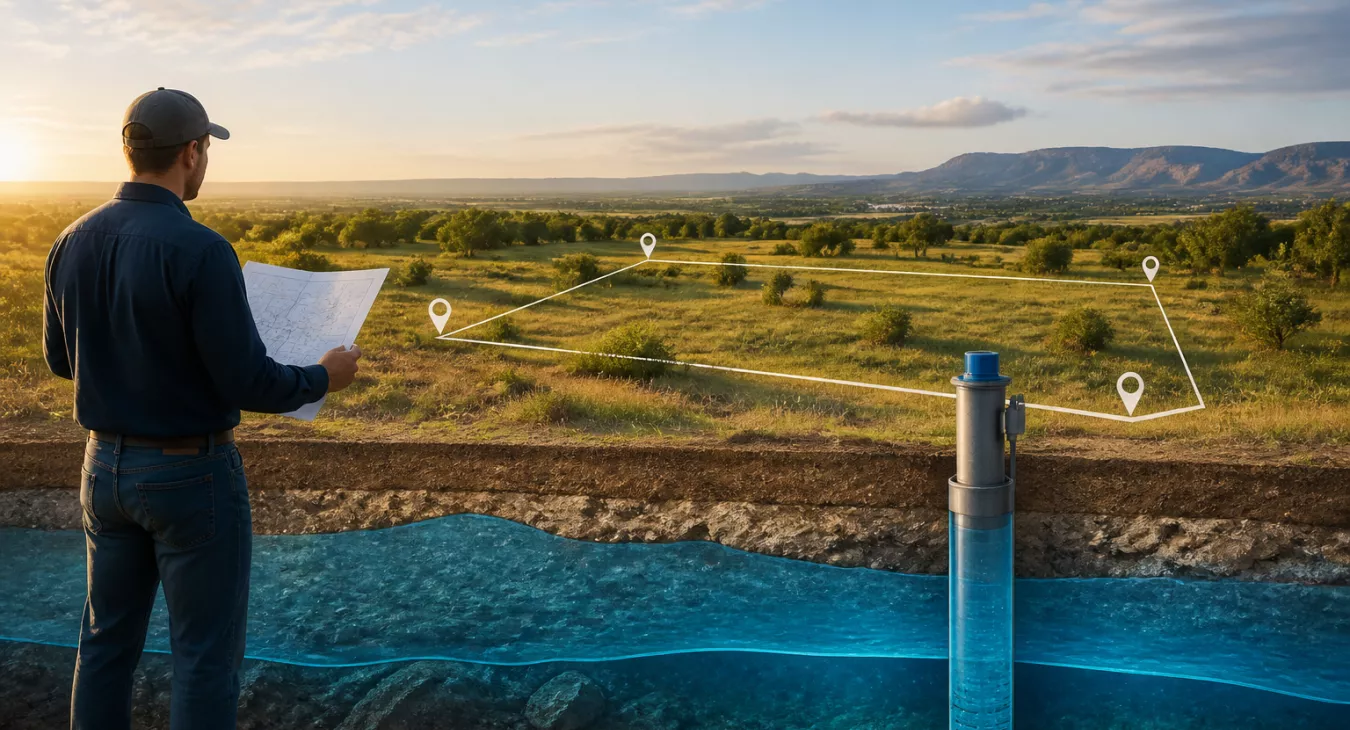
Learn how to find available water and aquifer access for land investments. Expert guide to groundwater research methods before buying.
Products and Tools Mentioned in this Post

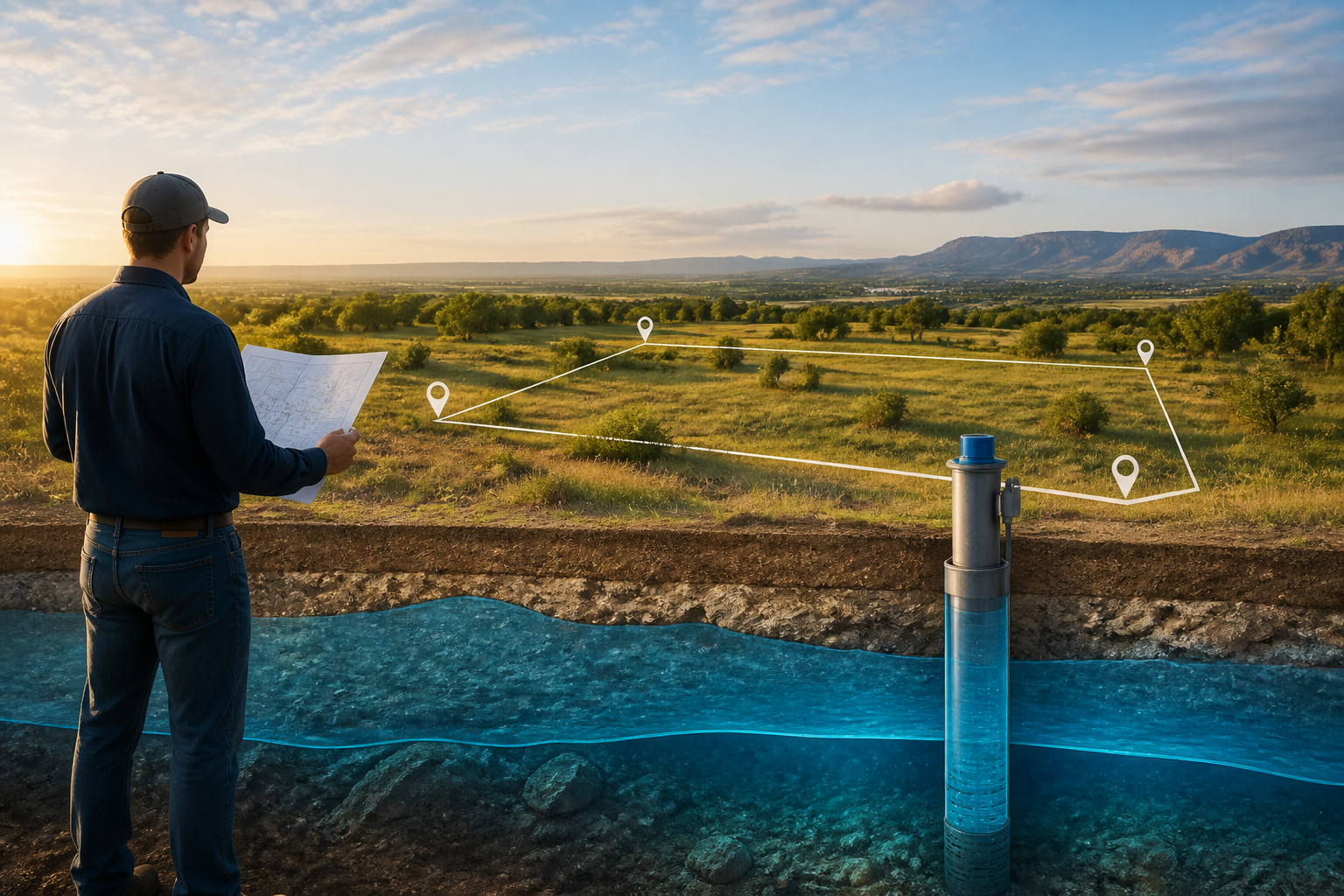
Water access can make or break a land investment. A 40-acre parcel with reliable groundwater might be worth three to five times more than an identical property with no proven water source — yet most investors skip aquifer research entirely until after closing. That's a costly mistake.
Whether you're looking at raw land for development, agricultural operations, or long-term appreciation, you need to understand how to find available water aquifer resources beneath your property before you sign anything. It's one of the most critical due diligence steps you can take, and it directly impacts your ARV and exit strategy. This guide walks you through every method available, from free USGS online databases to professional geophysical surveys. You'll know how to assess groundwater potential before committing a dollar to any land deal.

Understanding Aquifers and Water Availability

Water determines value. Most investors know that, but fewer understand the geology that actually determines whether usable water sits beneath your property. You need to know what you're looking for before you start digging — literally and figuratively.
What's an Aquifer?
An aquifer is an underground layer of permeable rock, sediment, or soil — such as gravel, sand, sandstone, or fractured limestone — that stores and transmits groundwater in quantities sufficient to supply wells and springs. Don't think of it as an underground lake. It's more like a saturated sponge: water fills the spaces between soil particles and rock fractures, and wells draw from that stored reservoir.
Groundwater supplies about 37% of the water that local water authorities deliver to homes, businesses, and farms across the United States, according to the U.S. Geological Survey (USGS). For rural land? The number jumps dramatically — most rural properties depend entirely on private wells tapping into local aquifer systems. More than 43 million Americans rely on private groundwater wells for their drinking supply, the National Ground Water Association estimates. That's how foundational aquifer access is to property utility and value.
Types of Aquifers: Confined vs. Unconfined
This distinction matters. Drilling depth, cost, water pressure, and long-term reliability all hinge on which type you're dealing with.
Unconfined aquifers (water table aquifers) are what you'll run into most often in land deals. The saturated zone has a free water surface — the water table — that rises and falls with precipitation, seasonal changes, and nearby withdrawals. They're typically shallower and more susceptible to surface contamination. But they're also more widely distributed and easier to access with standard well-drilling equipment.
Then there's confined aquifers. They're sandwiched between two layers of impermeable material (aquitards or aquicludes), which prevents direct recharge from above. The water sits under pressure from overlying geological formations. That means wells drilled into them are often artesian — the water rises in the casing above the aquifer top, sometimes flowing at the surface without pumping. Deeper wells. Better natural water quality because they're protected from surface contaminants. More reliable yield. The tradeoff? Higher drilling costs and potentially limited recharge rates.
| Aquifer Type | Confined/Unconfined | Typical Depth | Recharge Rate | Best Drilling Location |
|---|---|---|---|---|
| Unconsolidated Alluvial | Unconfined | 10–200 ft | High (rapid infiltration) | Near stream channels, valley floors |
| Consolidated Sedimentary | Confined or Unconfined | 50–2,000 ft | Moderate to slow | Structural lows, synclines |
| Volcanic Rock (Basalt) | Unconfined to Confined | 50–500 ft | Moderate (through fractures) | Lava flow contacts, fracture zones |
| Crystalline Rock (Granite/Gneiss) | Unconfined (fracture zones) | 50–400 ft | Low to moderate | Fault lines, fracture intersections |
| Karst (Limestone/Dolomite) | Unconfined (cavernous) | 20–600 ft | Very high but uneven | Sinkholes, stream sinks, fracture zones |
Why Finding Available Water Matters for Land Investment
Land with a permitted, productive well commands significantly higher prices than dry land. Period. This is a pure value multiplier in virtually every U.S. market. In western states like Texas, Colorado, New Mexico, and Arizona, where surface water rights are senior and scarce, groundwater may be the only reliable water source available — and its presence or absence determines whether the land is farmable, developable, or valuable at all.
And here's what trips up inexperienced investors: seasonal water table swings. A water table sitting 20 feet below the surface in March could drop to 60 or 80 feet by August in semi-arid climates. You need the full annual range. Pump system sizing. Irrigation infrastructure planning. Whether the water supply can actually support the property's intended use year-round. This isn't just about confirming water exists — it's about confirming enough water exists, consistently, for your highest and best use.
New to raw land evaluation? Read our overview of land investing: how to flip vacant land for profit first. It'll show you how water access fits into the broader value framework before you dig into the technical details.
Back to topMethods to Locate Available Water in Aquifers

You won't find a single magic method that works everywhere. The smart play is layering your approach — hit the free public databases first, then add site-specific investigations as the property value justifies it. We've broken down every major technique available to land investors below.
Using USGS Water Data Resources
Want to know what the government already knows about groundwater in your area? The U.S. Geological Survey runs the world's most comprehensive public groundwater database. For land investors, the USGS National Water Information System (NWIS) is genuinely your best free resource. Here's exactly how to use it:
- Go to waterdata.usgs.gov and head to the Groundwater section. Search by state, county, or GPS coordinates to find monitoring wells near your target property.
- Run a site search — enter the county and state, pick "Groundwater" as your site type, and hit "Get Sites." You'll get a full list of every monitoring well with historical data in that county.
- Dig into water level records for wells closest to your deal. The USGS has tracked depth-to-water over decades for thousands of wells, so you can spot seasonal swings and long-term trends.
- Check out the USGS Groundwater Atlas at pubs.usgs.gov/ha/ha730. It's got detailed regional maps and reports on aquifer systems. Absolutely worth reviewing if you want to understand the bigger aquifer picture.
- Use MODFLOW (USGS Water Resources Applications Software) if you're evaluating a larger or higher-value property and need groundwater flow modeling — though this one typically needs a hydrogeologist to translate.
Real-time data from thousands of active monitoring wells across the country is right there. In well-monitored areas, you'll often find wells within a mile or two of your property, giving you current water table depths and decades of historical trends. It's free, it's credible, and it should be step one every single time.
Accessing State Water Resources Maps
States with serious groundwater use have their own agencies. And they usually have better, more detailed data for their regions than USGS does, plus permit databases showing where wells already exist and what they're producing.
Most state water agencies offer online portals to search permitted wells by county, parcel, or coordinates. Texas's Water Development Board (TWDB) GIS viewer lets you pull up aquifer maps, groundwater availability models, and the exact location of every permitted well in the state — completely free. Same deal with Florida's FDEP Water Well Data portal, which includes drill logs, water-bearing zones, and actual production test results from completed wells.
When you're digging through state portals, focus on these specifics: aquifer extent maps (where's the water underground?), saturated thickness maps (how much water-bearing material do you have?), groundwater availability models (what can you sustainably pump?), and nearby well completion reports (what did they actually find when they drilled?).
Professional Well Drilling Consultants and Hydrogeologists
Groundwater is central to your investment thesis? Agricultural land, rural residential development, or uncertain aquifer distribution? Hire a professional. This is where money pays for itself.
Licensed well drillers bring real-world field experience and can eyeball your parcel based on local geology. Most will give you a free or cheap consultation — a professional opinion on likely depth, expected yield, and drilling costs. Local drillers often know exactly what they've found in specific areas over decades of work.
Licensed hydrogeologists operate at a different level. They synthesize USGS data, state agency records, and site geology into a formal water availability report — including aquifer type, estimated depth to water, recommended drilling locations, yield estimates, and water quality risk assessment. Budget $1,500 to $8,000+ depending on property complexity.
Ground Penetrating Radar and Geophysical Surveys
When existing data is thin or contradictory, geophysical surveys can image subsurface conditions without drilling a hole. Here are the most practical methods for groundwater work:
- Electrical Resistivity Tomography (ERT): Measures how electricity moves through soil — which changes based on water saturation and rock type. Maps the water table and water-bearing zones down to several hundred feet. Cost: $3,000 to $15,000 depending on survey size.
- Seismic Refraction: Sound waves image rock layers and pinpoint where water-saturated formations start. Great for bedrock depth and alluvial aquifers. Cost: $5,000 to $20,000.
- Electromagnetic (EM) Surveys: Ground-based or airborne — measures subsurface conductivity and works especially well for shallow aquifers and spotting saline water. Cost: $2,000 to $10,000.
- Ground Penetrating Radar (GPR): Best for shallow stuff (under 30 feet) — more useful for finding utilities than for deep aquifer hunting.
| Method | Cost | Time Required | Accuracy | Best For | Limitations |
|---|---|---|---|---|---|
| USGS Online Database Search | Free | 1–4 hours | Moderate (depends on nearby monitoring wells) | Initial screening, regional context | Data gaps in rural areas; not site-specific |
| State Water Agency Maps | Free to minimal | 2–6 hours | Moderate to high | Aquifer extent, permit research, well logs | Varies widely by state resources and data quality |
| Professional Hydrogeologist | $1,500–$8,000+ | 1–3 weeks | High | High-value land, development planning, legal documentation | Cost; findings are probabilistic, not guaranteed |
| Geophysical Surveys (ERT/Seismic) | $3,000–$20,000 | 2–7 days | High (with professional interpretation) | Sparse-data areas, large parcels, complex geology | Expensive; requires professional interpretation |
| Well Drilling Company Assessment | Free to $500 | 1–3 hours | Moderate (experiential) | Local formation knowledge, cost estimates | Not scientifically rigorous; potential bias toward drilling |
Finding Water Depth and Saturation Levels

An aquifer beneath your property? That's necessary. But it's not enough. You also need to know the depth to water, how thick the saturated zone actually is, and how both shift with the seasons. Get these variables wrong and your well becomes either a money pit or a dry hole.
Water Table Depth Variations
Water table depth swings wildly across the country, dictated by regional geology, climate, topography, and how aggressively locals are pumping. Florida's karst terrain? Water sits maybe a few feet down. The arid Southwest? You're drilling 400 to 600 feet through rock just to find usable water. Understanding what's normal in your region is where this analysis starts.
The USGS data tells a clear story. Gulf Coast states typically pull water from 10 to 50 feet below surface. Central Plains properties range from 50 to 300 feet. Rocky Mountain states without alluvial aquifers need 200 to 800 feet or deeper. Pacific Northwest volcanic basalt formations usually yield productive water between 100 and 400 feet. These patterns matter when you're sizing your drilling budget and evaluating development feasibility.
Seasonal Fluctuations
Here's what most land investors miss. A water level assessment done in April after snowmelt tells a completely different story than what you'll see in late August. That gap isn't small.
Seasonal swings of 10 to 30 feet are normal in many regions. Drought years? Water tables can drop 50 feet or more below the historical average. You need to see year-round data, not a single snapshot.
| Region | Winter Depth (ft) | Spring Depth (ft) | Summer Depth (ft) | Fall Depth (ft) | Average Annual Change |
|---|---|---|---|---|---|
| High Plains (Kansas/Nebraska) | 100–150 | 90–135 | 115–175 | 110–165 | 15–30 ft |
| Southeast (Georgia/Alabama) | 15–40 | 10–30 | 25–55 | 20–50 | 10–20 ft |
| Pacific Northwest (Oregon/Washington) | 20–60 | 15–45 | 35–80 | 30–70 | 15–25 ft |
| Southwest Desert (Arizona/NM) | 150–400 | 145–390 | 160–420 | 155–410 | 5–20 ft |
| Florida Peninsula | 5–20 | 3–15 | 8–25 | 7–22 | 5–12 ft |
| Texas Hill Country | 50–200 | 40–180 | 70–230 | 60–215 | 20–40 ft |
Potentiometric Surface Maps
Confined aquifers play by different rules. The water level inside your well doesn't show you the actual top of the aquifer—it shows you the pressure head, which can be way higher. That's the potentiometric surface (sometimes called the piezometric surface). It's an imaginary surface representing the pressure head in a confined aquifer, mapped by measuring water levels in wells that tap into that specific layer.
The USGS and state agencies publish these maps for all the major confined aquifer systems. They work like topographic maps. Contour lines show equal hydraulic head. Water flows from high head to low head. Lines bunched together signal recharge areas. Depressions show discharge zones or heavy pumping activity. If you're investing in properties over major confined systems—the Floridan, High Plains, Denver Basin—these maps are free and absolutely essential. Download them from USGS or your state agency before you commit capital.
Measuring Water Levels
Already have a well on the property? Measuring current water levels is simple. Two methods dominate:
- Electric water level meters (E-line meters): A weighted probe on a calibrated cable goes down the well until it hits water and completes a circuit. You get an audible or visual signal. Accuracy to within 0.1 feet. Buy one for $200–$800, or rent from equipment suppliers.
- Pressure transducers with data loggers: Electronic sensors installed in wells record continuous water level data over time. This is your best tool for capturing seasonal swings and pumping impacts. Expect $500–$2,000 in equipment costs, usually installed by a pro.
No well yet? Your best move is pulling completion records from nearby wells. State agency databases have them. Those reports show the driller's log (what rock formations appeared at each depth), the static water level when water first appeared, and initial production test results. This is your proxy for what you'll actually find.
Back to topState-by-State Aquifer Resources

Here's the thing: groundwater law doesn't follow state borders the same way aquifers do. What matters most is that regulatory agencies, legal frameworks, and data availability shift dramatically from one state to the next. This section breaks down the key resources for the biggest land investment markets and maps out the aquifer systems you'll actually encounter.
Finding Aquifer Information by Region
The research process is remarkably consistent, no matter where you're looking. Start national with the USGS National Water Information System. Then drill down to your state agency's portal for well records and aquifer maps. Finally—and this is crucial—hit up your county or regional groundwater management district. That's where you'll find the real data on local rules and actual availability.
| State | Primary Agency | Major Aquifer Systems | Online Resources | Contact Information |
|---|---|---|---|---|
| Texas | Texas Water Development Board (TWDB) | Ogallala (High Plains), Trinity, Edwards, Gulf Coast, Carrizo-Wilcox | twdb.texas.gov — GIS viewer, GAM models, well database | (512) 463-7847 |
| Colorado | CO Division of Water Resources | Denver Basin, Arapahoe, Laramie-Fox Hills, Alluvial (South Platte, Arkansas) | dwr.colorado.gov — well permit search, aquifer maps | (303) 866-3581 |
| Florida | FL Dept. of Environmental Protection (FDEP) + 5 Water Management Districts | Floridan (Upper and Lower), Surficial, Intermediate | floridadep.gov; SJRWMD, SWFWMD, SFWMD, NWFWMD, SRWMD portals | (850) 245-8336 |
| North Carolina | NC DEQ Division of Water Resources | Coastal Plain (Castle Hayne, Pee Dee, Black Creek), Piedmont/Mountain fractured rock | deq.nc.gov/gwinfo — well database, aquifer maps | (919) 807-6300 |
| California | CA Dept. of Water Resources (DWR) | Central Valley (Sacramento/San Joaquin), coastal basins, Sierra Nevada foothills | water.ca.gov — SGMA portal, CASGEM well monitoring | (916) 653-5791 |
| Kansas | KS Geological Survey + KS Dept. of Agriculture | High Plains (Ogallala), Dakota, Quaternary alluvial | kgs.ku.edu/Hydro/Geohydro — water level data, aquifer maps | (785) 864-3965 |
Major U.S. Aquifer Systems
The USGS has catalogued 62 principal aquifer systems across the United States. These account for over 90% of all groundwater withdrawals. If you're investing across multiple markets, you need to understand the major regional players.
Texas and the High Plains Aquifer (Ogallala): This aquifer is massive. It stretches across approximately 174,000 square miles, running from South Dakota all the way down to Texas, and it's the backbone of one of the world's most productive agricultural regions. In Texas alone, 16 Groundwater Conservation Districts manage the High Plains Aquifer, and each one sets its own pumping rules, managed depletion allowances, and development restrictions. Saturated thickness varies wildly—Nebraska's got over 300 feet in some spots, but parts of the Texas Panhandle have dropped below 50 feet due to decades of heavy irrigation. If you're evaluating High Plains agricultural land, get current saturated thickness maps from TWDB and verify which GCD has jurisdiction before you make an offer. Don't skip this step.
Colorado's Denver Basin and Alluvial Systems: Colorado's groundwater situation is split into two completely different worlds. The Denver Basin holds four primary aquifers (Denver, Arapahoe, Laramie-Fox Hills, and Dawson) running through the Front Range corridor. Here's what matters: they're classified as "non-tributary" aquifers under Colorado law. That means rights to them aren't tied to surface stream systems. You get to withdraw 1/100th of the estimated in-place supply per year. Outside the Denver Basin, you're dealing with alluvial aquifers along river corridors like the South Platte and Arkansas. These can be productive, but they're classified as tributary—which means your withdrawals are locked into Colorado's senior/junior water rights priority system. Big difference.
Florida's Major Aquifer Systems: Florida's sitting on one of the world's most productive aquifer systems, period. The Floridan Aquifer System (FAS) spans beneath the entire state and parts of Georgia, Alabama, and South Carolina. It's a carbonate aquifer that produces exceptional yields—municipal supply wells commonly pull 1,000 gallons per minute or more. North and Central Florida tap the Upper Floridan aquifer for most of their supply. South Florida relies more on the Surficial and Biscayne aquifers. And here's what trips up investors: Florida has five regional Water Management Districts, each with its own consumptive use permit (CUP) requirements for withdrawals above certain thresholds. Before you close on rural Florida land, confirm which WMD has jurisdiction and whether you'll actually need a CUP for your intended water uses.
North Carolina Principal and Minor Aquifers: Draw a line—the Fall Line, to be specific—and you've got two entirely different groundwater worlds. East of it, in the Coastal Plain, you find layered sedimentary aquifers: Castle Hayne, Pee Dee, Black Creek, and others. These produce good yields and clean water. West of it, the Piedmont and Mountain regions sit on fractured crystalline rock—granite, gneiss, schist. Well yields here are all over the map and depend entirely on whether your well hits a permeable fracture. The NC DEQ maintains a full well database online with county-level aquifer info. If you're looking at Piedmont land, dig through neighbor well records. Performance variability is significantly higher than what you'd see in the Coastal Plain.
Regional Water Development Boards and Local Water Authority Contact Information
State agencies paint with a broad brush. For real granularity, you need the regional level. Groundwater Conservation Districts in Texas, Water Management Districts in Florida, and similar organizations at the local level maintain the most current data on aquifer conditions in their areas. They set pumping rules, issue well permits, and publish annual reports tracking water levels and trends specific to their jurisdictions. Call them directly rather than just scrolling through state databases. For a high-stakes land deal, this investment of time pays off.
And don't overlook county extension offices. Texas A&M AgriLife Extension, UF/IFAS, NC State Extension—these outfits publish practical, region-specific guides to groundwater availability and well construction standards. They're free. They're written for actual landowners. They're often more useful than dense technical reports from the agencies.
Back to topPractical Steps to Assess Your Property


Ready to stop guessing and start analyzing? Here's your actionable workflow for assessing groundwater on any specific parcel. The strategy is smart: start free, then spend money only when the property value and your investment thesis justify it.
Initial Site Assessment
Before you set foot on the property, do a desktop review. A few hours of work. Zero cost.
- Pull USGS NWIS data for your county and surrounding counties. Find the nearest monitoring wells. Document their depth-to-water and historical trends. What aquifer system are you looking at?
- Access the state agency well database and search 1 mile out from your parcel. Download well completion reports for the three to five closest wells. Look for static water levels, formation logs, and reported yields.
- Review state aquifer maps. Is your parcel in a productive aquifer zone or buried in thin saturation and dead geology?
- Check groundwater management district rules. New permits being issued or frozen? Pumping caps? Can you move water off-parcel? These aren't academic questions — they determine whether your investment pencils.
- Review topography and surface geology using USGS topographic maps and the USGS National Geologic Map Database (ngmdb.usgs.gov). Valleys often sit atop alluvial aquifers. Limestone outcrops signal karst potential. Volcanic formations tell their own story.
Determining the Best Drilling Location
Once desktop research shows real aquifer potential and you're moving forward, pick your drilling spot. Geology and logistics both matter here:
- Topographic position: Low spots usually mean shallower water tables in alluvial terrain. But fractured rock plays by different rules — mid-slope positions sometimes out-yield valley bottoms because they hit more fractures.
- Distance from contamination sources: Septic systems, fuel tanks, chemical storage, feedlots. States mandate setbacks (usually 50 to 100 feet from septics), but bigger buffers protect your investment longer.
- Access for drilling equipment: Rotary rigs need road access and working room. Steep slopes, thick brush, or soft ground spike your drilling costs fast.
- Geological indicators: Known fracture zones show up as linear features on aerial imagery. Neighbor wells that produce strongly. Formation logs that match your expectations. These guide your decision.
- Future land use: Put that well uphill and upgradient from septic, livestock, and chemical storage. Plan ahead based on your actual development blueprint.
Evaluating Aquifer Capacity and Sustainable Yield
A well that flows today might tank in five years if the aquifer's depleting or tapped out regionally. And that's where sustainable yield matters — the amount of water you can actually count on, year after year, without mining the aquifer.
Back to top