

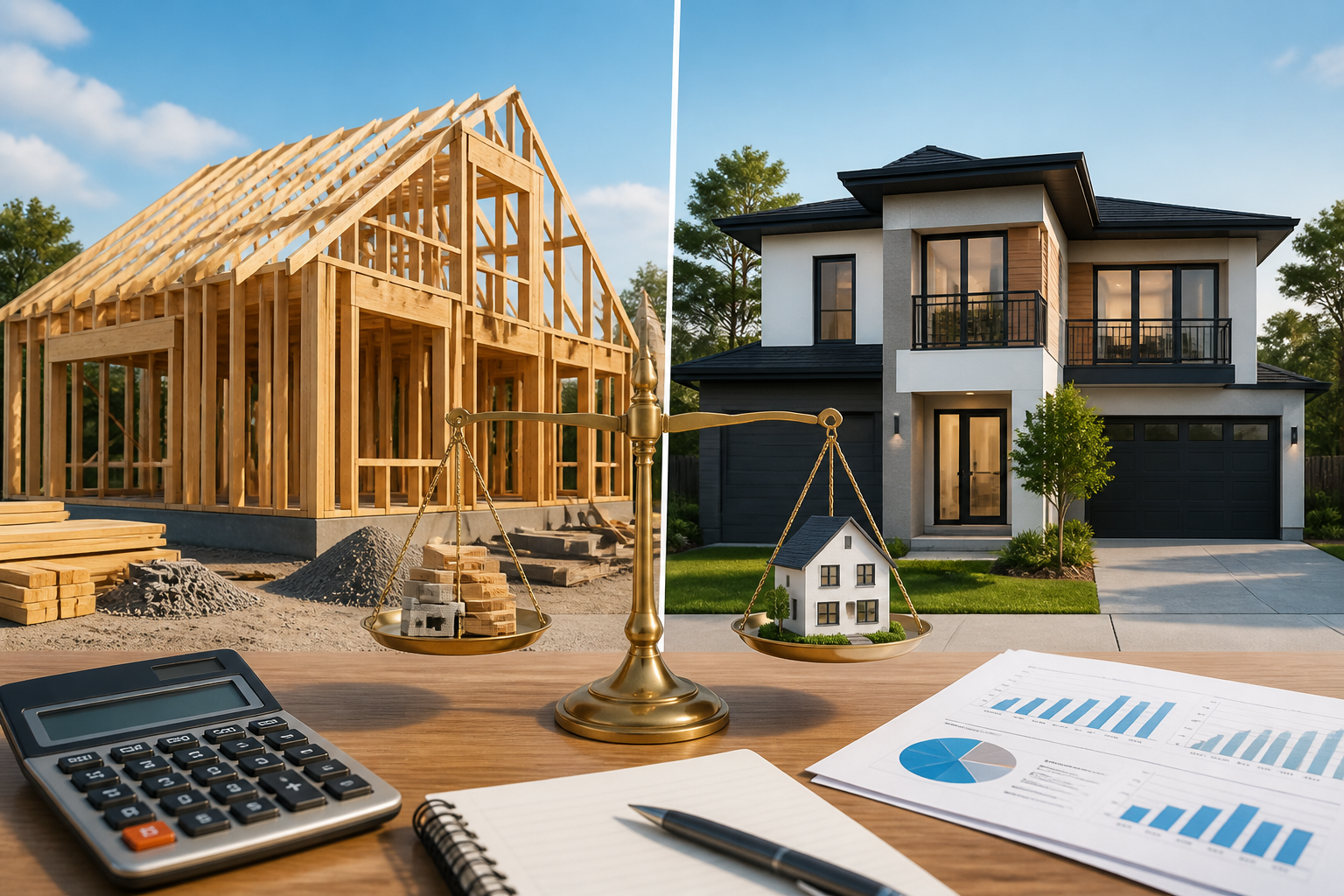
Compare building vs buying rental properties with financial analysis, ROI scenarios, and a clear decision framework to maximize returns.
Table of Contents
- Build vs. Buy: Understanding the Core Decision
- Financial Metrics That Matter
- The Case for Building New Rental Property
- The Case for Buying Existing Property
- Risk Comparison: Building vs. Buying
- Market Conditions and Timing Factors
- Property Type Considerations
- The Decision Framework: Key Questions to Ask
- Common Mistakes Investors Make
- Step-by-Step Decision Process
- Cost Breakdown Estimate
- Conclusion: Making the Right Call for Your Portfolio
- Frequently Asked Questions
Should you build new rental property or buy existing? This decision shapes your entire investment trajectory. Get it right, and you're looking at supercharged portfolio returns. Get it wrong, and you're fighting cost overruns, vacancy droughts, and a strategy that doesn't match your goals for years to come. This guide gives you the hard numbers, real scenarios, and a decision framework that actually works—so you can pick the path that aligns with your financial targets, your risk appetite, and what's actually happening in your market right now.
New to long-term rental? Start with our Long-Term Rental Investing Guide.

Build vs. Buy: Understanding the Core Decision

What Does Building Mean in Real Estate?
You're buying raw land and contracting out the entire construction of a new residential or commercial structure meant to be leased. Architects, permits, contractor management, logistics — it all falls on you until that first lease gets signed. The build-to-rent (BTR) model's become the big institutional play here. We're talking entire communities of single-family homes or townhomes specifically designed for the rental market. These are optimized for tenant retention and predictable, long-term cash flow.
What Does Buying Existing Mean?
This one's straightforward. You're acquiring a property that's already standing and, if you're smart about it, already making money. The numbers are right there — current rents, actual operating expenses, verifiable market data. You could be looking at anything from a beat-up value-add play to a stabilized multifamily complex with solid tenants already locked in.
Key Differences at a Glance
| Factor | Building New | Buying Existing |
|---|---|---|
| Initial Capital Required | High (land + construction + carrying costs) | Moderate (down payment + closing costs) |
| Time to Cash Flow | 12–24+ months | 30–60 days post-closing |
| Monthly Operating Costs | Lower (new systems, warranties) | Higher (aging systems, repairs) |
| Appreciation Potential | Strong in growth markets | Varies by condition and location |
| Tenant Demand | High for modern amenities | Proven in established areas |
| Risk Level | Higher (construction, market timing) | Lower (known quantities) |
| Customization Options | Full control of design | Limited without major renovation |
| Financing Complexity | High (construction loans, multiple draws) | Moderate (standard DSCR or conventional) |
Financial Metrics That Matter

The numbers don't lie. Before you pick a strategy—new build or existing property—you've got to run the same financial metrics every serious investor uses. Your gut might tell you one thing, but the data will usually tell you something different. Want a deeper dive? Check out How to Analyze a Rental Property: The 5 Numbers That Matter.
Cap Rate Analysis
Cap rate (Net Operating Income ÷ Property Value) is your fastest way to compare one deal against another. Here's what you're looking at: new construction in a booming Sun Belt market stabilizes around 5.5–6.5%, but a value-add existing property in that same market hits 6.5–8% right out of the gate. And that's after you factor in renovation costs.
Cash-on-Cash Return
Your actual dollars in versus annual pre-tax cash flow. That's what this metric tracks. Existing properties start printing money immediately. New builds? They bleed during construction—you're servicing loan interest while the units sit empty and unrentable. Once they lease up, though, the returns swing hard in the positive direction.
Debt Service Coverage Ratio (DSCR)
Most lenders won't touch an investment loan without a DSCR of 1.20–1.25 minimum. New construction kills this requirement until the project's fully leased. That's the core reason construction financing works completely differently than standard investment mortgages. Want to understand all your borrowing options? Read our breakdown of rental property financing here.
The 1% Rule and ROI Calculations
New construction almost never hits the 1% rule. A $350,000 property needs to pull in $3,500/month in rent to qualify—doable in hot markets, nearly impossible in most suburbs. Existing properties, particularly value-add deals, blow past this threshold far more often.
| Metric | Typical New Build | Typical Existing Property | Importance |
|---|---|---|---|
| Cap Rate | 5.0–6.5% (at stabilization) | 6.0–8.5% | High — core return gauge |
| Cash-on-Cash Return | Negative during build; 7–12% post-lease | 4–10% from month one | Critical for liquidity |
| DSCR | N/A during construction; 1.2–1.4 post | 1.1–1.5 at purchase | Required for financing |
| Average ROI Timeline | 5–10 years for full returns | 3–7 years | Shapes exit strategy |
The Case for Building New Rental Property

Long-Term Appreciation Potential
Population growth outpacing housing supply? That's your signal. Phoenix, Raleigh, Austin, and Nashville are textbook examples — and when you build purpose-built rentals in these high-growth corridors, you're capturing both rent growth and asset value appreciation simultaneously over a typical 7–10 year hold.
Modern Construction and Warranties
Here's what protects your downside: builder warranties. One year on workmanship, two years on mechanical systems, ten years on structural defects. This matters because it cuts your maintenance reserve requirements in the early years and gives you recourse if something breaks. And that's critical — unexpected capital expenditures are one of the fastest ways to tank returns on older properties.
Tenant Appeal and Rental Rates
Smart home features, energy-efficient appliances, modern layouts, open floor plans. What do they add up to? 10–20% rent premiums over comparable older stock. New construction also holds lower vacancy rates because quality-conscious tenants keep knocking on your door. Want to reduce turnover costs? This is it.
Energy Efficiency and Lower Operating Costs
Current energy codes deliver real savings. 20–30% lower utility costs versus pre-2000 properties. And if you're covering utilities or competing in a market where tenants watch their costs? It's a competitive advantage that actually sticks.
Customization for Rental Success
You own the design decisions. In-unit laundry. Extra storage. Low-maintenance LVP flooring. Additional bathroom outlets. Build it now, not later. Retrofitting these features into an existing property costs far more and kills tenant occupancy during construction — a cost you never fully recover.
Back to topThe Case for Buying Existing Property

Immediate Cash Flow Generation
Close in 30–45 days. Collect rent next month. That's the real draw here, and if you're relying on cash flow to fund your lifestyle or qualify for additional financing, it's not a nice-to-have — it's everything. Building a larger portfolio? Check out our guide on Building a Rental Portfolio: From 1 to 10 Doors.
Lower Entry Costs and Immediate Availability
Conventional investment loans ask for 20–25% down. Construction? You're looking at land (cash or a land loan), a construction loan with 20–30% down on the full project cost, plus a refinance or sale at the finish line. Your all-in capital for building typically runs 30–50% higher than buying the same square footage.
Established Rental Markets
Real rent comparables. Verified vacancy rates. Documented operating expenses. You get actual numbers, not projections. And that matters because you'll know what the market actually pays — not what some proforma swears it'll pay in 18 months.
Less Construction Risk
Material costs spike. Subcontractors ghost you. Permits crawl. Weather delays everything. None of it's your call. Even experienced developers see 15–25% cost overruns routinely. Buy existing and you sidestep that entire risk bucket.
Broader Inventory and Location Options
Finding buildable land in desirable, infill neighborhoods? Good luck — it's scarce and expensive. Existing properties hand you access to established areas with mature landscaping, walkable streets, and school districts that actually perform. That stability attracts the tenants you want — the ones who stay put. For long-distance investors especially, this matters. Site selection and local market knowledge make or break your strategy, which is why we built out a complete long-distance rental investing system.
Back to topRisk Comparison: Building vs. Buying
Construction Risks and Timeline Delays
Permitting alone? You're looking at 3–6 months added to your timeline in most jurisdictions. Supply chain disruptions, labor shortages, and material price swings have basically killed cost certainty in new construction. Every single month of delay extends your holding costs and pushes back that first rent check.
Market Risk for New Construction
New builds get hammered by market timing risk harder than anything else. You break ground during a boom, units deliver into a correction, and now you're leasing at falling rents with rising vacancy. And here's the kicker — new construction competes directly with other new developments in ways that stabilized properties in established neighborhoods simply don't.
Financing Challenges for Building
Construction loans are short-term, high-interest debt with draws tied to construction milestones. Then you've got to refinance into permanent financing after completion. That's two loan events, two closing cost hits, and rate risk sitting between them. Rates go up between breaking ground and opening? Your projections don't pencil anymore.
Hidden Costs in Both Scenarios
New construction eats you alive with land carrying costs, permit fees, architect fees running 3–8% of project cost, construction loan interest, landscaping, and often HOA setup costs on top. Existing properties hit you differently — deferred maintenance, environmental issues, aging roofing or HVAC systems, code compliance upgrades, and transaction costs add up fast. But here's the real difference: existing property surprises are generally predictable and insurable. New construction surprises? Not so much. Either way, understanding your rental property insurance needs is non-negotiable.
Back to topMarket Conditions and Timing Factors
Interest Rate Environment
Right now, in 2024–2025, you're looking at a brutal squeeze. Construction financing is expensive. And when those units stabilize, permanent financing is expensive too. High rates kill the deal math—the gap between what you pay to build and what you'll actually make shrinks to nothing. That's why existing properties win in this environment. But here's the thing: once rates normalize, the economics flip fast, and new construction becomes competitive again.
Local Market Saturation
Don't skip this step. Pull the local development pipeline before you break ground. Austin and Phoenix? They absorbed massive apartment supply in 2023–2024, and it hammered rents on new units. If your market's sitting on 12–18 months of supply already under construction, you're going to struggle to hit your modeled rents. That's reality.
2025–2026 Market Snapshot
The Sun Belt's overbuilt right now. All that recent construction is moderating rent growth across those markets. Meanwhile, the Midwest and Northeast have the opposite problem—actual housing shortages—so both building and buying work depending on the specific submarket.
Demographic pressure is real. Millennials are aging into family rental demand, and Gen Z's entering the rental market in volume. These tailwinds matter.
What's your move? Check local vacancy rates, absorption trends, and population growth before you choose between building and buying. The data will tell you which strategy works for your market.
Back to topProperty Type Considerations
Single-Family Homes
Want to build single-family rentals? You'll want land-rich suburban markets with real population growth behind them. Existing single-family homes are different—they work almost anywhere. That's why newer investors gravitate here. Lower entry price, simpler financing, less complexity overall.
Multifamily and Apartments
New multifamily construction isn't for everyone. You need developer-level expertise and serious capital. But the upside is real—forced appreciation and economies of scale that can move the needle significantly. Now, small multifamily is where the wealth actually gets built. Duplexes, triplexes, fourplexes. This is one of the most powerful strategies available to you right now. Want to understand it better? Check out The Ultimate Guide to Making Money with Multifamily Rentals and our companion guide on Small Multifamily Rentals: The Secret to Building Wealth in Real Estate.
Build-to-Rent Communities
Institutional capital has flooded into BTR for a reason. It solves something real—the tension between building and buying. You get institutional development discipline applied to purpose-built rental communities with professional management from day one. As an individual investor, you don't have to do all that work yourself. Co-invest in BTR developments through syndications or REITs instead. You get build-level returns. The simplicity of a buy.
Back to topThe Decision Framework: Key Questions to Ask

| Scenario | Build New | Buy Existing |
|---|---|---|
| You Want Immediate Cash Flow | No | Yes |
| you've Long Investment Timeline (10+ years) | Yes | Yes |
| Capital is Limited | No | Yes |
| You Want to Customize Property | Yes | No |
| You're Risk Averse | No | Yes |
| You're in a High-Growth Market | Yes | Yes |
What's Your Investment Timeline?
Building takes time. Need returns in 2–3 years? Don't build. But if you're sitting on a 10+ year horizon and chasing total return instead of quick cash flow, new construction might actually outperform the hell out of existing stock.
How Much Capital Can You Deploy?
Get honest with yourself here. We're talking land acquisition, architectural fees, permits, and hard construction costs plus carrying costs while you're waiting on stabilization. A 1,500 sq ft rental in most markets? You're looking at $400,000–$600,000 total deployed. Buy existing instead, and you're maybe dropping $80,000–$120,000 in down payment and closing costs. That's a massive difference.
Do You Have Construction Expertise?
Most first-time investors don't. You probably lack the contractor relationships, permitting playbook, and construction management chops to run this efficiently. And if you don't have that knowledge, you're hiring someone else to figure it out—which eats into your margins and introduces real risk to the deal. Do an honest gut check before you commit.
Back to topCommon Mistakes Investors Make

- Underestimating construction costs: Your contractor's hard bid? It's not enough. Tack on 15–20% for contingency. Material prices swing, labor costs spike, and something always goes wrong. You know this already.
- Overestimating new build appreciation: Here's the thing: new construction already bakes market expectations into the price. You need years of rental growth and favorable conditions to beat what you could've gotten buying an existing property at the right price today.
- Ignoring property management costs: And this one kills deals. Management runs 8–12% of gross rents, whether you're managing it yourself or paying someone else to handle it. Don't forget this line item when you're modeling returns. Check out our Self-Managing vs. Property Manager Decision Framework to figure out what makes sense for your portfolio.
- Failing to account for market saturation: Before you break ground, pull the local development pipeline. What's coming online in the next 24 months? Delivering units into an oversupplied market is a recipe for lower rents and higher vacancy.
- Financing without contingency planning: Construction loans have maturity dates. If your project isn't done when that loan comes due, you're forced into a refinance or sale—probably at the worst time and worst terms. Always have an exit strategy locked in.
Step-by-Step Decision Process
Step 1: Analyze Your Financial Position
Start here. Calculate your total investable capital, your required monthly cash flow, and your maximum acceptable negative cash flow period. Can you actually sustain 18–24 months without rental income from this deal? If the answer's no, building probably isn't right for you yet.
Step 2: Research Your Target Market
Pull local vacancy rates, average days on market for rentals, the development pipeline, and rent growth trends over the past 36 months. Then talk to local property managers. They know what tenants are actually paying—not what listings say. This intel is gold.
Step 3: Run the Numbers for Both Options
Model both scenarios in a spreadsheet. Land + construction cost versus acquisition price. Projected rents, operating expenses (management, insurance, taxes, reserves), financing costs, and net cash flow at months 1, 12, 36, and 84. A 7-year model always tells a different story than a 1-year snapshot.
Step 4: Evaluate Your Skills and Resources
Do you have a trusted general contractor? Understand local permitting? Have relationships with construction lenders? Your honest answers to these questions matter way more than your enthusiasm. New to this? Our Rental Property Investing for Beginners: Complete 2026 Guide gives you the foundational context you need.
Step 5: Make Your Decision
Use the data. Building shows a superior 7-year IRR, you've got the capital, and you either know construction or have a trusted GC? Build. Numbers favor buying, you need cash flow now, or construction risk scares you? Buy. Either move, executed with discipline, builds real long-term wealth.
Back to topCost Breakdown Estimate
Here's what you're actually looking at financially. This breaks down the real expenses—not the rosy projections—for each path.
| Cost Category | Building New | Buying Existing | Notes |
|---|---|---|---|
| Down Payment % | 20–30% of total project cost | 20–25% of purchase price | Construction loans require larger reserves |
| Closing Costs | 2–5% (plus loan fees on refi) | 2–5% of purchase price | Build requires two closings (construction + permanent) |
| Expected Timeline | 12–24 months to occupancy | 30–60 days to first rent | Delays add carrying costs |
| Holding Costs During Process | High (construction loan interest) | Minimal (fast close) | Can add $20,000–$60,000+ to build cost |
| Initial Repairs/Updates | None (new construction) | $5,000–$50,000+ depending on condition | Value-add can boost returns if managed well |
Notice the timeline gap? You're looking at 12–24 months before your new build throws off cash. With an acquisition deal, you're collecting rent in 30–60 days. That matters when you're calculating your actual ROI.
And here's the kicker—those holding costs during construction aren't optional. They'll eat $20,000 to $60,000 off your returns if you're not careful. Build them into your model upfront.
Back to topConclusion: Making the Right Call for Your Portfolio
Here's the thing: there's no universal answer to when to build new rental property vs buy an existing one. Your call depends entirely on your financial position, what your market's doing, your timeline, and how comfortable you are swinging a hammer (or managing people who do). Building rewards patient capital and investors who actually know construction. It works best in high-growth markets where supply's tight. Buying, on the other hand? That's for investors hunting immediate cash flow, predictable returns, and lower execution risk.
Most investors—especially those early in their careers or closing on their first few doors—should be buying existing properties. You'll hit cash flow faster. Your risk profile's more predictable. And you'll learn like hell. But here's what changes: as your portfolio thickens, your capital base grows, and your contractor Rolodex deepens, new construction becomes a serious wealth-building engine. The appreciation compounds beautifully. Many seasoned investors don't pick one strategy over the other—they stack both. New construction appreciation compounds while existing acquisitions pump immediate cash flow into the next deal.
Run the numbers. Don't skip this part. Know your market inside and out. And whatever you do, never let enthusiasm override the analysis.
Back to topFrequently Asked Questions
Is building or buying better for cash flow?
Here's the hard truth: buying wins on cash flow, hands down. Existing properties start generating rental income within 30–60 days of closing. New construction? You're looking at 12–24 months before you see a dime, and the whole time you're bleeding money on construction loan interest. If you need rental income to cover your expenses or you're banking on cash flow to qualify for future financing, there's no contest — buy existing.
Which option has better long-term returns?
It depends on your market and execution. New construction in high-growth markets with strong demographic tailwinds can crush it — rent premiums, maintenance that's basically zero in year one, plus appreciation on a modern asset over a 10+ year hold. But here's the thing: a solid value-add acquisition can match or beat those returns in plenty of markets, especially when you're buying properties with deferred maintenance that you can fix cheaply and effectively.
Can I build and buy simultaneously?
Absolutely. Smart investors do this all the time.
The play is straightforward: buy stabilized cash-flowing properties to fund operations while you're simultaneously developing new construction that'll deliver higher long-term appreciation. But there's a catch — you need enough capital to handle both without strangling your liquidity. And if construction timelines slip, that's when things get uncomfortable. Make sure you're stress-tested for delays.
What financing options exist for each approach?
Buying existing property gives you options. Conventional mortgages, DSCR loans, FHA for owner-occupied multifamily, portfolio loans — pick your poison. New construction is different. You'll need a construction loan (usually 12–18 months with a draw schedule), then you refinance into a construction-to-permanent or a standard mortgage at completion. Construction loans are tougher to qualify for, rates are higher, and the documentation is brutal. Want to dig deeper? Check out our guide on financing your first rental property.
How do I know when market conditions favor building vs. buying?
Build when these conditions line up: land's available and priced reasonably, local vacancy rates sit below 5%, population growth is strong and expected to stay that way, existing inventory is thin or obsolete, and interest rates won't tank your construction financing costs. Buy when the opposite's true. Existing inventory trades below replacement cost, construction financing rates are astronomical, or the local market's been flooded with new supply that's still getting absorbed. Don't guess. Validate your assumptions against actual local market data before you deploy capital.
Back to top