



Are you looking to make money quickly in real estate? Flipping houses is one of the quickest ways to do so, but it's not as easy as some people may think.
Table of Contents
- What flipping actually involves (and whether it fits you)
- Step 1: Choose a market you can actually work
- Step 2: Line up money before you look at houses
- Step 3: Build a small team early
- Step 4: Find properties that can work
- Step 5: Run the numbers with the 70% rule and a full budget
- Step 6: Make the offer, inspect, and close
- Step 7: Run the rehab like a project, not a hobby
- Step 8: Sell the finished house
- How flip profits are usually taxed (in plain terms)
- Common mistakes
- Where to go next
- All our house flipping articles
- Frequently asked questions
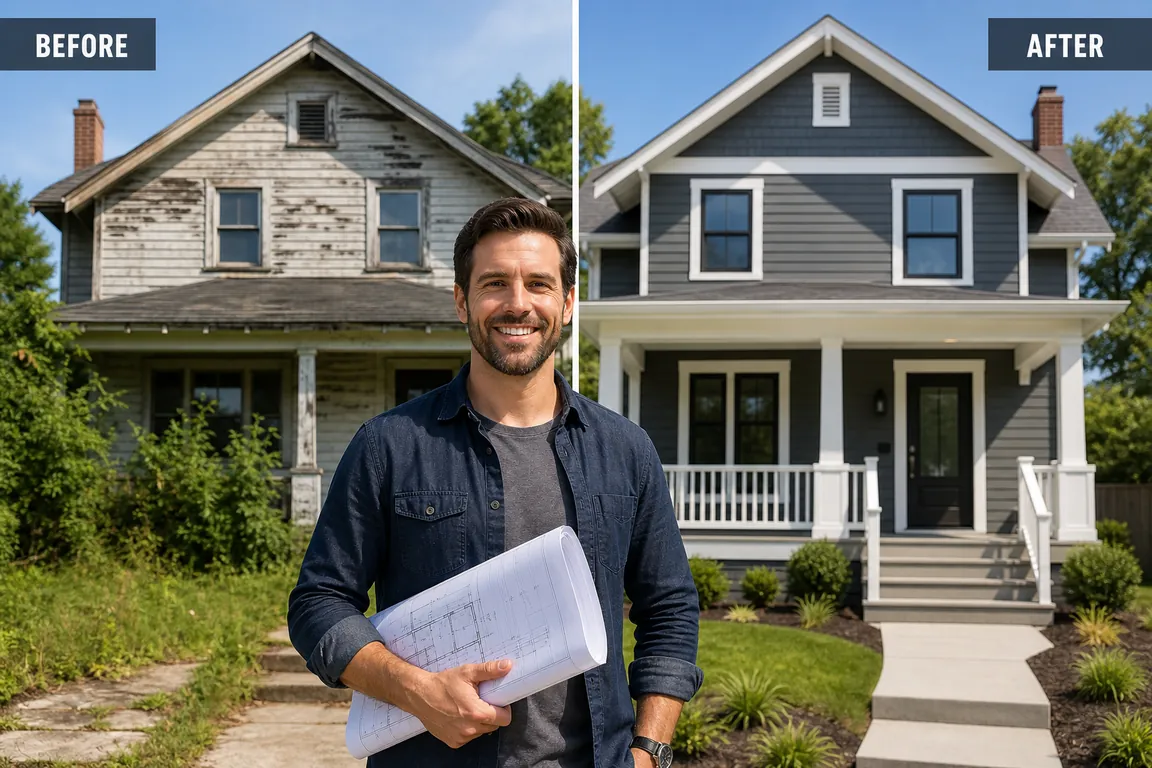
Flipping a house means buying a property below what it will be worth once fixed, improving it, and selling it to a retail buyer for more than the total you spent. The concept is simple. Making money at it depends on the details: what you pay, how accurately you estimate repairs, how long you hold the property, and what it costs to get out.
This guide covers the full process for a first flip. That includes choosing a market, arranging money, finding and analyzing deals with the 70% rule, accounting for every cost (holding and selling costs too), closing, overseeing the rehab, selling, and understanding how profits are usually taxed. It finishes with the mistakes that most often turn a planned profit into a loss.
Flipping suits people who have some cash reserves, are comfortable with numbers, can make decisions under time pressure, and can spend real hours each week managing contractors. It does not suit people looking for passive income or anyone who cannot absorb a deal that runs late or over budget. If that sounds like you, a rental or wholesaling path may be a better place to start.
Back to topWhat flipping actually involves (and whether it fits you)
A flip is a short-term business project. The profit comes almost entirely from forced appreciation, meaning the value you add by fixing what is wrong with the house. A rising market can help, but it is not something you control. Experienced flippers underwrite every deal as if prices will stay flat for the length of the project.
Unlike a rental, a flip produces no monthly income. You pay out money every month until the sale closes, and then you receive one lump sum. That structure shapes everything else. Speed matters, accurate estimates matter, and a surprise that adds three months to the project costs real money.
An honest self-check before you start
- Cash: Even with a lender, you will usually need money for the down payment, closing costs, loan fees, holding costs, and a contingency. Short on capital? Plan a partnership or a smaller project. Do not stretch.
- Time: Expect regular site visits, contractor calls, decisions about materials, and paperwork. This is hardest to manage alongside a demanding full-time job.
- Construction literacy: You do not have to swing a hammer. You do need to read a bid, spot missing line items, and recognize problems such as foundation movement, water damage, or outdated wiring.
- Risk tolerance: Some deals lose money. Can one bad project wipe you out financially? If so, the deal is too big or your reserves are too thin.
How flipping compares with nearby strategies
Flipping sits between wholesaling (getting a property under contract and assigning it to another investor without renovating) and buy-and-hold (renovating and renting for long-term income). Wholetailing is a lighter version: buy at a discount, clean up and make minor fixes, and sell quickly. For a side-by-side look at which to try first, see wholesaling vs. flipping vs. rental: which strategy first. If light-touch projects appeal to you, the wholetailing guide covers that approach.
Back to topStep 1: Choose a market you can actually work
For a first flip, buy close to home, ideally within a drive short enough to visit the site several times a week. Managing a renovation from far away is possible, but it multiplies the risk for a beginner.
Inside that area, look for neighborhoods with these features:
- Renovated homes sell steadily. Check recent sales of updated homes and how long they sat before going under contract. A neighborhood where renovated homes linger is a warning sign.
- Dated or distressed homes still exist. You need a supply of properties to buy, not only a strong resale market.
- The price gap is wide enough. The difference between the price of a dated house and a renovated one has to cover your repairs, costs, and profit. Where that spread is thin, flips do not work no matter how well you run them.
- The buyer pool is clear. Know who buys renovated homes there (first-time buyers, move-up families, downsizers) and what finishes they expect at that price point.
Price range matters too. Starter homes near the middle of your local market tend to have the most buyers and the most predictable renovation scopes. High-end flips carry bigger dollar risk and a thinner buyer pool. For broader context on where flipping conditions look favorable, read best markets for house flipping in 2026. Still verify everything at the neighborhood level.
Back to topStep 2: Line up money before you look at houses
Distressed sellers and listing agents favor buyers who can close quickly and reliably. Know how you will pay before you make offers, so you never get attached to a property you cannot fund.
Common funding options compared
| Source | How it works | Strengths | Watch out for |
|---|---|---|---|
| Cash (your own) | You pay for purchase and rehab yourself | Fastest close, no interest, strongest offers | Ties up capital; your money is fully at risk |
| Hard money loan | Short-term loan underwritten mainly on the property and the deal; rehab often funded in draws | Fast, designed for flips, available to newer investors | Higher interest and upfront points; short terms; extension fees if you run late |
| Private lender | Loan from an individual, usually someone in your network | Flexible terms, can be quick | Needs a written note and lien; a failed deal can strain the relationship |
| HELOC or home equity | Borrow against equity in a property you own | Often cheaper than hard money; flexible | Your own home becomes collateral for a business risk |
| Partnership or joint venture | A partner supplies capital (or skills) for a share of profit | Lets you start with less cash | Smaller share of profit; needs a clear written agreement |
| Conventional bank loan | Investment property mortgage | Lower cost when available | Slower, stricter on condition; often a poor fit for heavy rehabs |
Loan terms vary widely by lender, state, and your experience. Before you commit, ask every lender for these:
- What percentage of the purchase price and rehab budget they will fund, and whether they cap the loan at a percentage of after-repair value
- Interest rate, points, and every fee (origination, draw inspection, processing, extension)
- How rehab draws work: who inspects, how fast funds are released, and whether you must pay for work up front
- Loan term and the cost of extending it
- Prepayment penalties or minimum interest periods
For a fuller tour of options, see how to get money to flip a house and financing a fixer-upper: best loans and methods. If cash or credit is the obstacle, how to flip houses with no money and bad credit covers partnerships and other workarounds. It is honest about the trade-offs.
Back to topStep 3: Build a small team early
You need a few reliable people before you own anything. Waiting until closing day to find a contractor means hiring whoever is free, and that is rarely who you want.
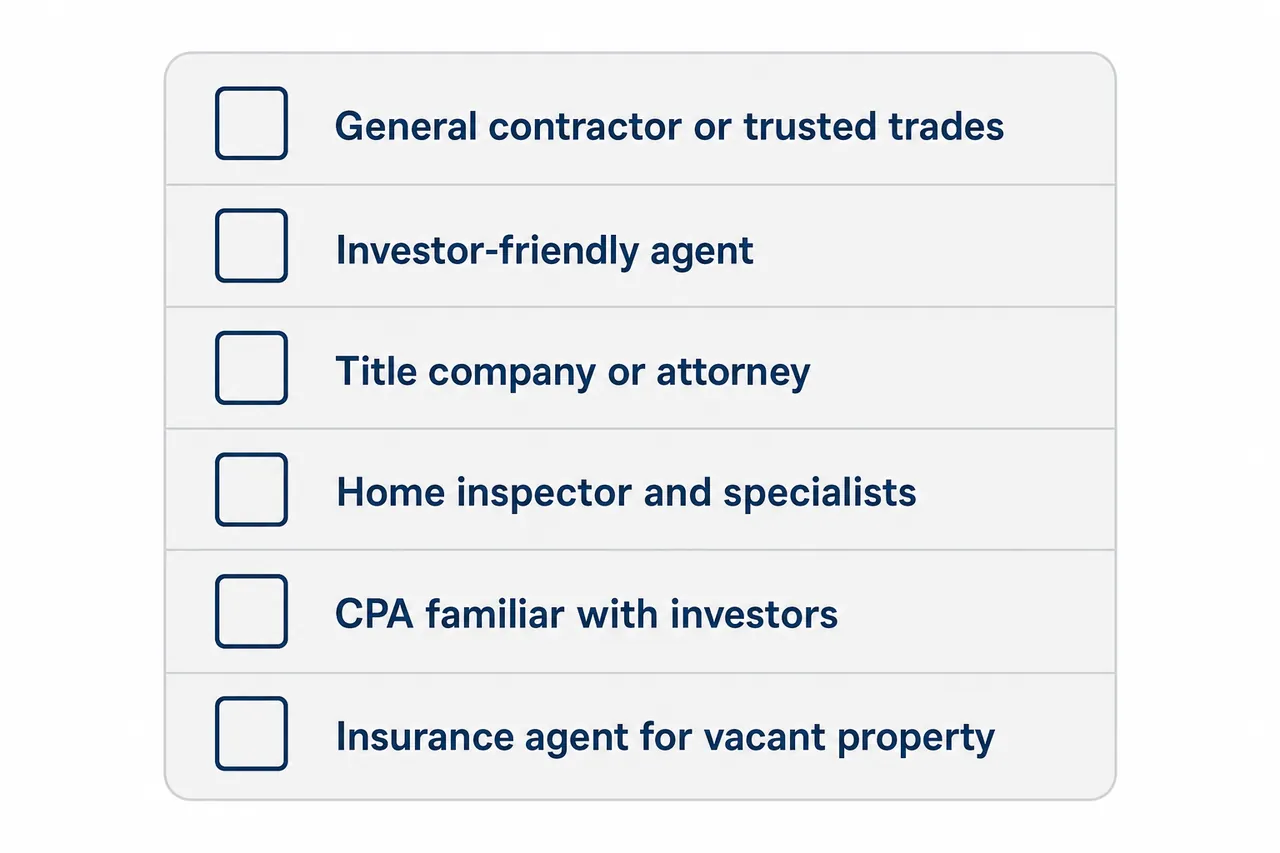
- A general contractor or a few trusted trades. Check licensing and insurance with your state or local licensing authority, call recent references, and visit finished projects if you can.
- An investor-friendly agent. You want someone who understands investor math, will submit low offers without taking it personally, can pull solid comparable sales, and ideally can list the finished house too.
- A title company or real estate attorney. Some states use attorneys for closings and others use title companies. Ask locally which applies.
- A home inspector and access to specialists (structural engineer, roofer, electrician, sewer scope) for specific concerns.
- A CPA familiar with real estate investors. Talk to one before your first closing, because how you hold title and track costs affects your taxes.
- An insurance agent who can quote vacant-property or builder's risk coverage. A standard homeowner's policy often does not cover a vacant house under renovation.
For a detailed vetting process, see finding contractors for flips: vetting, hiring, and managing.
Back to topStep 4: Find properties that can work
Good flip candidates are usually priced low because of their condition or the seller's situation, not because of the location. Common sources include:
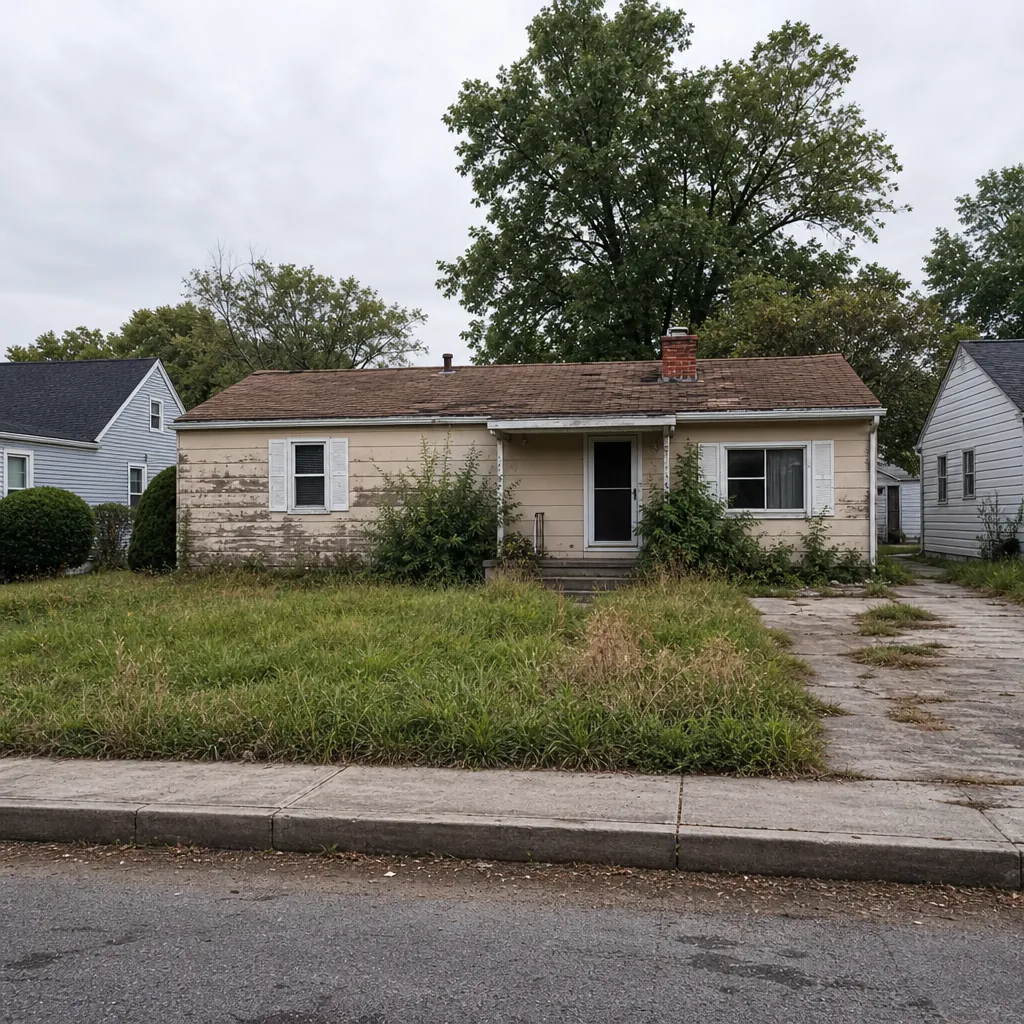
- The MLS: Filter for keywords like "as-is," "estate," "investor special," "cash only," or long days on market. Competition is heavier here, but it is the easiest place to start.
- Bank-owned (REO) and auction properties: Predictable processes, but often sold as-is with limited access before you buy. Auction rules vary by county and state, and some require cash at the sale.
- Probate and estate sales: Heirs who want a simple, quick sale of an inherited house.
- Tax-delinquent and code-violation lists: Usually public record through the county or city.
- Direct outreach: Mail, driving the neighborhood for visibly neglected houses, and networking with wholesalers.
Off-market deals often come with less competition, but marketing costs money and takes time to produce results. The guide to finding motivated sellers explains the main channels and how to approach owners respectfully.
Pick the right kind of project first
For a first flip, favor houses that need mostly cosmetic and mid-level work: paint, flooring, kitchen and bath updates, fixtures, landscaping, maybe a water heater or HVAC unit. Be cautious with these:
- Foundation problems (horizontal cracks, stair-step cracks in masonry, sloping floors, doors that will not close)
- Active roof leaks with damage to framing or ceilings
- Outdated or unsafe wiring that may require a full rewire
- Signs of mold, standing water in basements or crawl spaces, or sewer line problems
- Older homes where lead paint or asbestos may require licensed handling
- Unpermitted additions or conversions that the city may require you to legalize or remove
None of these automatically kills a deal. Each one adds cost and uncertainty, so price it in or walk away.
Back to topStep 5: Run the numbers with the 70% rule and a full budget
This is the step that decides whether you make money. Most flip losses are baked in at purchase, when someone paid too much or underestimated what the project would cost.
Estimate after-repair value (ARV) carefully
ARV is what the house should sell for once renovated, based on recent sales of similar, updated homes nearby. Use comparables that are close in location, size, age, bedroom and bathroom count, lot, and style, and that sold recently. Weight sold prices over list prices, and adjust for differences. Be conservative. An inflated ARV is the most common way beginners talk themselves into bad deals. For a walkthrough, see how to calculate ARV for beginners.
Estimate repairs line by line
Walk the property with your contractor and build a scope of work room by room and system by system. A single lump-sum guess is not enough. Price materials at the finish level the comparables have, no fancier. Then add a contingency on top. Many investors use roughly 10% to 20%, leaning higher for older houses or when access before purchase was limited.
Apply the 70% rule as a first filter
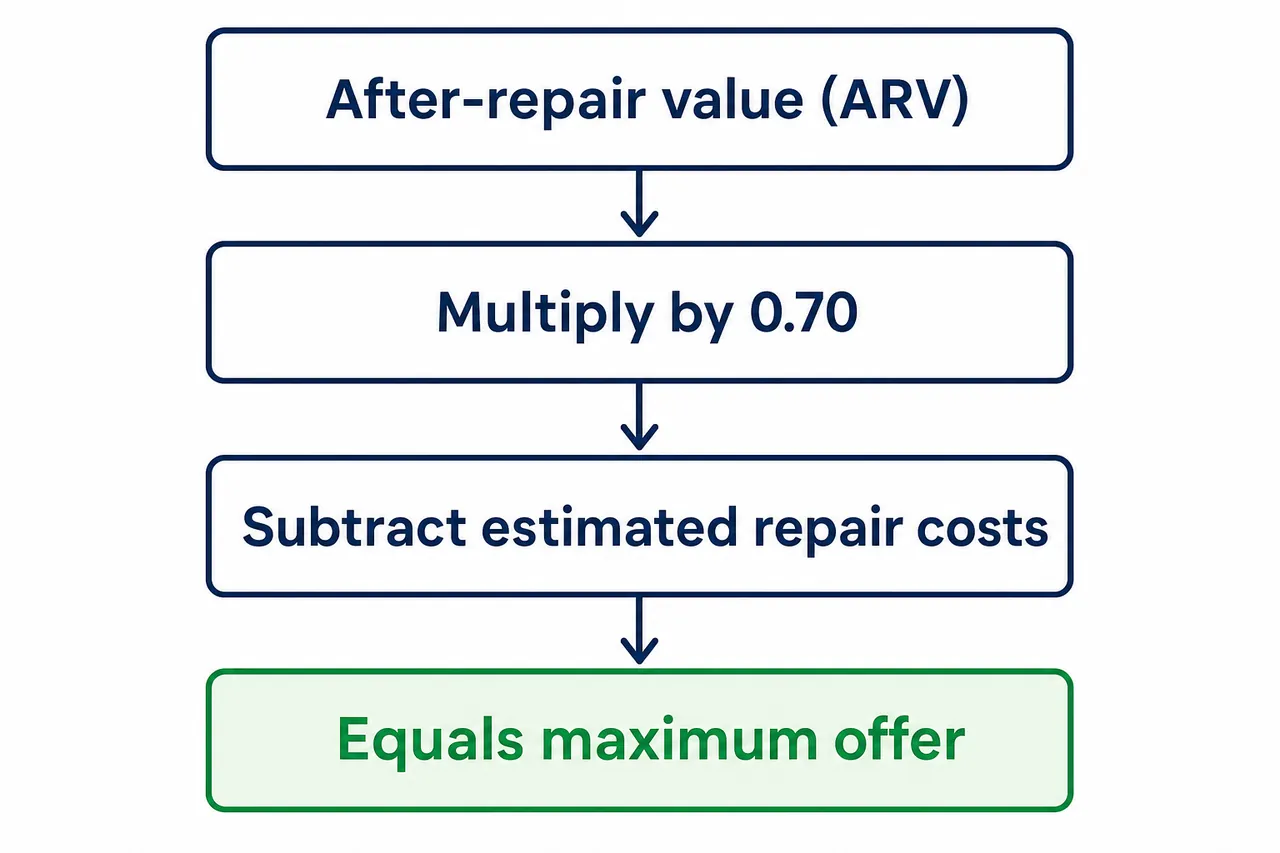
The 70% rule is a quick screening formula:
Maximum offer = (ARV × 0.70) − estimated repair costs
The 30% gap is meant to cover buying costs, financing, holding costs, selling costs, and profit. It is a rule of thumb, not a guarantee. In expensive markets, or on very cheap houses where fixed costs are a bigger share, 70% may be too loose or too tight. Use it to decide which deals deserve a full analysis, then run that full analysis. The 70 percent rule calculator gives a quick maximum allowable offer.
Then build a complete cost budget
A real budget includes every dollar from purchase to sale:
- Acquisition: purchase price, buyer closing costs (title, escrow or attorney, recording, lender fees), inspections
- Financing: points, interest for the whole hold period, draw fees, and possible extension fees
- Rehab: labor, materials, permits, dumpsters, contingency
- Holding: property taxes, insurance, utilities, HOA dues, lawn care or snow removal, security
- Selling: agent commissions (negotiable and they vary), seller closing costs, transfer taxes where applicable, staging, photos, and any concessions or repair credits to the buyer
The fix and flip calculator handles profit and ROI with these inputs. For tracking spending during the project, use the house flip budget template.
Example deal (illustrative numbers)
The figures below are assumptions chosen to show the math. They are not a forecast for any market. Plug in your own local numbers.
The setup: A dated three-bedroom house in a neighborhood where renovated comparables support an ARV of $300,000. The contractor's line-item scope (kitchen, two baths, flooring, paint, some electrical updates, landscaping) comes to $45,000.
70% rule check: ($300,000 × 0.70) − $45,000 = $210,000 − $45,000 = $165,000 maximum offer. The investor negotiates a purchase at $160,000.
Financing assumptions: A hard money lender funds 90% of the purchase ($144,000) plus 100% of the rehab ($45,000), for a loan of $189,000. Terms are 2 points and, for example, 11% interest-only. The investor plans a 6-month hold and, to be conservative, estimates interest on the full balance for the full period.
| Cost item | How it is calculated | Amount |
|---|---|---|
| Purchase price | Negotiated | $160,000 |
| Buyer closing costs | About 2% of purchase | $3,200 |
| Rehab (contractor scope) | Line-item estimate | $45,000 |
| Contingency | 10% of rehab | $4,500 |
| Loan points | 2% × $189,000 | $3,780 |
| Interest | $189,000 × 11% ÷ 12 × 6 months (rounded) | $10,400 |
| Taxes, insurance, utilities | About $600/month × 6 | $3,600 |
| Staging, photos, listing prep | Estimate | $2,500 |
| Agent commissions | Assumed 5% × $300,000 | $15,000 |
| Seller closing costs | About 1.5% × $300,000 (title, transfer tax, fees) | $4,500 |
| Total cost | $252,480 | |
| Sale price | ARV | $300,000 |
| Profit before tax | $300,000 − $252,480 | $47,520 |
Cash the investor actually puts in: $16,000 down payment + $3,200 buyer closing costs + $3,780 points + $10,400 interest + $3,600 holding + $4,500 contingency + $2,500 staging = $43,980. Commissions and seller closing costs come out of the sale proceeds. So roughly $44,000 of cash is at risk for about six months to earn about $47,500 before taxes, if everything goes to plan.
Now stress-test it. Suppose the house sells for 5% less ($285,000) and the project runs three months longer:
- Lower price: $15,000 less revenue, partly offset by $750 lower commission and $225 lower seller closing costs, for a net drop of $14,025
- Three extra months: about $5,200 more interest + $1,800 more holding costs = $7,000
- Revised profit: $47,520 − $14,025 − $7,000 = about $26,500
Two fairly ordinary setbacks cut the profit by almost half. Add a $20,000 surprise in the walls on top of that, and the deal is close to breakeven. This is why the 70% rule leaves a wide margin and why the purchase price matters so much. For a deeper version of this process, read the flip deal analysis walkthrough.
Back to topStep 6: Make the offer, inspect, and close
Writing offers that work
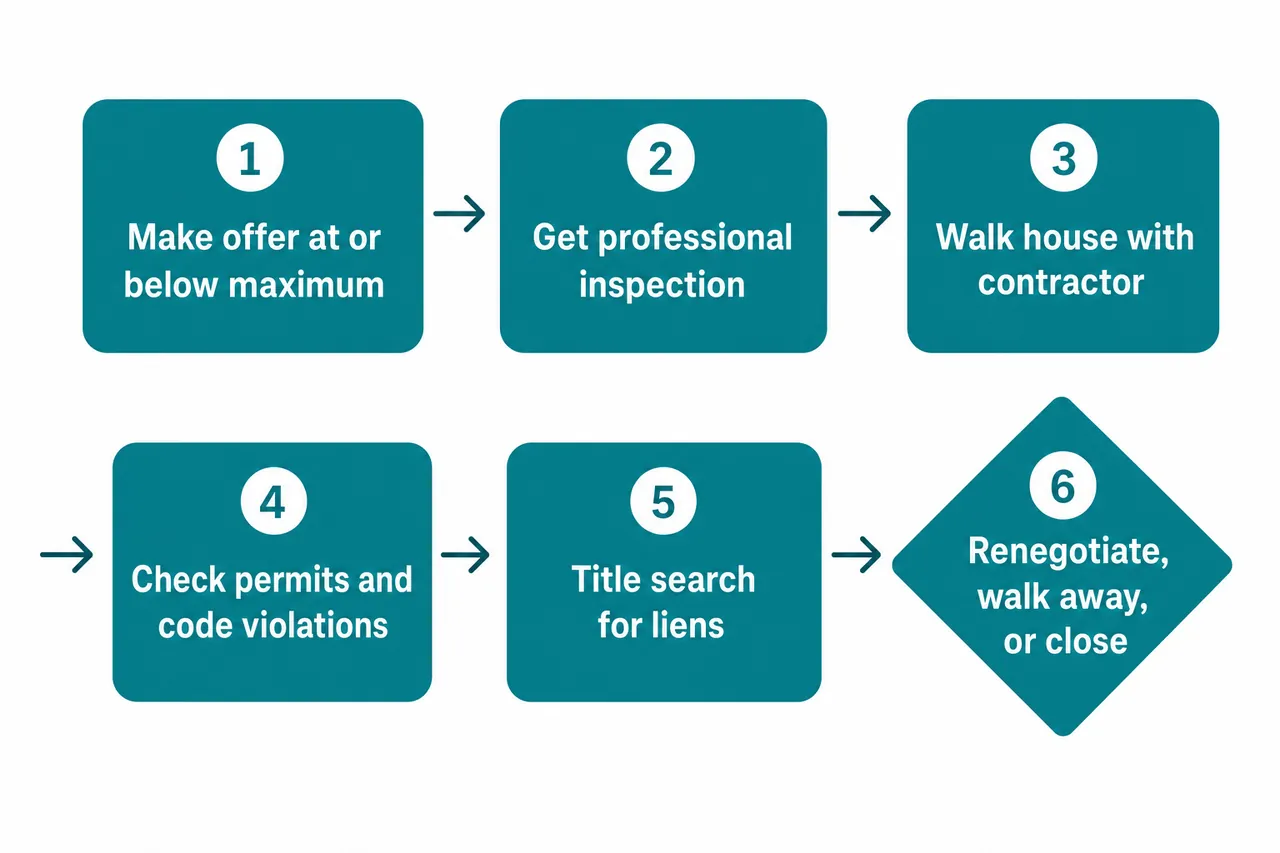
Offer at or below your maximum, and support the offer with comparables and your repair estimate when that helps. Your leverage with distressed sellers is often certainty and speed, not just price: a fast close, few contingencies, and proof of funds. Expect most offers to be rejected. That is normal. Never raise your maximum just to win a deal.
Due diligence before you are locked in
Even on an as-is purchase, try to get an inspection period. Use it to:
- Get a professional inspection, and bring in specialists for roof, foundation, sewer line, electrical, or HVAC concerns
- Walk the house again with your contractor and firm up the scope and bid
- Check permit history and open code violations with the city or county building department
- Confirm zoning and any local rules that affect your plan, such as historic district review
- Have the title company search for liens, unpaid taxes, and other title problems
If the findings change your numbers, renegotiate or walk away under the contract terms. Contract forms, contingency rules, and seller disclosure requirements vary by state. Have a local real estate attorney review your contract, especially on your first deals.
Closing
Coordinate early with your lender, title company or attorney, and insurance agent. Have insurance in place starting the day you take ownership. Decide with your attorney and CPA whether to buy in your own name or through an entity such as an LLC. That choice affects liability, financing, and taxes, and the rules vary by state.
Back to topStep 7: Run the rehab like a project, not a hobby
The renovation is where the money is spent and where most delays happen. Do the planning before work starts:
- Written scope of work with specific materials and finishes, so bids are comparable and change orders are rare
- Signed contract with a timeline, payment schedule tied to completed milestones (not large upfront deposits), and a holdback until the punch list and final inspections are done
- Permits pulled where required. Requirements vary by city and county, so ask the building department what your scope needs. Unpermitted work can surface during the buyer's inspection or appraisal and derail the sale.
- Materials chosen early so long-lead items don't stall the crew
During the project, visit often, compare spending to the budget weekly, and decide quickly when problems come up. Renovate to the standard of the neighborhood comparables. Spending beyond what buyers in that price range will pay for rarely comes back at sale.
Managing the rehab itself (sequencing trades, change orders, inspections, draws, punch lists) is covered in depth in the fix-and-flip guide. For a sense of how a well-run schedule fits together, see flip timeline: from purchase to sale in 90 days. Treat that pace as a target for simple projects, not a promise.
Back to topStep 8: Sell the finished house
The sale is where the profit is realized or lost. A few practices make a real difference:

- Price from fresh comparables, not from what you spent. Buyers do not care about your costs. Overpricing leads to longer holds, price cuts, and more interest paid.
- Present the house well: a thorough cleaning, good photos, and staging (even partial) when it suits the price point.
- Expect the buyer's inspection and appraisal. Have permits, warranties, and receipts organized. Fix items before listing that an inspector will obviously flag.
- Know your floor price before you list, so you can respond calmly to offers, repair requests, and concession requests.
- Have a backup exit. If the house does not sell, could you rent it until conditions improve? Would the rent cover the payment if you refinanced out of the short-term loan? Answer these questions before you buy.
Disclosure obligations apply to sellers, including investors, and vary by state. Ask your attorney or agent what you must disclose about the property and the work done.
Back to topHow flip profits are usually taxed (in plain terms)
Taxes are where many first-time flippers get an unpleasant surprise. The general picture is below. Rules change and depend on your situation, so confirm everything with a CPA before your first deal closes.
- Flipping is often treated as business income, not investment income. If you buy properties mainly to renovate and resell, tax authorities may treat you as a "dealer," and the properties as inventory. Profits are then generally taxed as ordinary income at your regular rates. They may also be subject to self-employment tax, depending on how the activity is structured.
- Even without dealer treatment, a quick flip is short-term. Property held one year or less produces short-term gain, which is taxed at ordinary income rates rather than the lower long-term rates.
- Your costs reduce your taxable profit. Purchase price, renovation costs, closing costs, and many holding and selling costs generally reduce the taxable gain. When a cost counts, and whether it is deducted or added to the property's basis, depends on your situation. Keep every receipt.
- A 1031 exchange usually does not apply. Like-kind exchanges are generally for property held for investment or business use, not property held mainly for resale.
- State and local taxes on income and on the transfer itself vary widely.
- Set money aside. Many flippers reserve part of each profit for taxes as soon as the sale closes, and ask a CPA whether estimated quarterly payments are needed.
To get a rough idea of how holding period and income affect the tax bill, the capital gains tax calculator for real estate can help. If your flip is likely to be taxed as ordinary business income, your CPA's estimate is the number to rely on.
Back to topCommon mistakes
- Inflating the ARV. Using the best sale in the area, list prices, or comparables from a nicer neighborhood. Use conservative, recent, nearby sold comparables.
- Treating the 70% rule as the whole analysis. It is a filter. Build the full budget, including financing, holding, and selling costs, before you commit.
- Skipping the contingency. Old houses hide problems. Every rehab budget needs a cushion.
- Underestimating time. Permits, inspections, contractor availability, and materials delays all add months, and every month adds interest and holding costs.
- Over-improving. Luxury finishes in a starter-home neighborhood rarely pay for themselves.
- Paying contractors too far ahead. Tie payments to completed work and hold back a final amount until the punch list and inspections are done.
- Taking on a structural or heavy-systems project first. Start with a scope you can estimate confidently.
- Ignoring permits and code issues. Unpermitted work and open violations can delay the sale or force expensive fixes.
- Running out of cash mid-project. Keep reserves beyond the contingency for surprises and a slow sale.
- Forgetting taxes. Plan for flip profits to be taxed at ordinary rates unless your CPA says otherwise.
- Trusting hype. Be skeptical of TV timelines, guaranteed-profit programs, and partners or sellers who will not show verifiable numbers. Put every partnership in writing, reviewed by an attorney.
For more examples and how to prevent each one, see common flip mistakes and how to avoid them.
Back to topWhere to go next
- Fix-and-flip guide: running the rehab itself, from scope and bids to draws, inspections, and the punch list.
- BRRRR investing guide: if you would rather renovate and keep the property as a rental instead of selling.
Run the numbers. Enter the price, rehab, ARV, holding time and loan to see your profit, cash needed and return. Free, no sign-up.
Back to top
Back to top
All our house flipping articles
House flipping articles on KDS Development, grouped so you can go deeper on any part of this guide. Newest first.
Guides and how-tos
- How to Start House Flipping: Your Complete Step-by-Step Guide
- How to Fund a Flip With Zero Dollars Out of Pocket
- The Beginner's Guide to Flipping Apartment Buildings
- Flip Deal Analysis: A Step-by-Step Walkthrough
- House Flip Budget Template: Track Every Dollar
- Common Flip Mistakes and How to Avoid Them
- How to Find Reliable Contractors for House Flips
- How to Calculate ARV: After Repair Value for Beginners
- How to get money to flip a house: exploring your options
- How to flip houses with no money and bad credit
Explainers
- CRM for House Flipping: Project Tracking & Contractor Communication
- Vacant Property Investing Strategy: Find & Flip Abandoned Homes
- House Flipping on Reddit: Real Investor Experiences & Lessons
- Best House Flipping Companies to Partner With or Learn From
- House Flipping With No Money Down: Creative Strategies and Funding Sources
- House Flipping Salary: How Much Do Successful Flippers Really Make?
- Best House Flipping Apps for Investors: Tools to Manage Your Pipeline
- House Flipping as a Couple: Partnership Strategies, Tax Implications & Pitfalls
- House Flipping Worksheet: Track Costs, ROI & Profitability
- House Flipping Calculator: Free Spreadsheet to Estimate Profits & Costs
- Is House Flipping Worth It? Real Numbers & Profitability Analysis
- House Flipping Profit Margins: Average Returns & What Affects Your Bottom Line
Comparisons
- Flipping vs. Renting: Financial Comparison & Strategic Decision Guide
- Best House Flipping Books 2026: Expert Strategies & Case Studies
- Best House Flipping TV Shows 2026: Learn Strategies from HGTV
- Best House Flipping Courses: Top Programs Compared & Reviewed
- Best Real Estate Wholesaling Software 2026: Tools for Wholesalers & Flippers
- Best Markets for House Flipping in 2026
- Wholesaling vs Flipping vs Rental: Which Strategy First?
- Best House Flipping Software 2026
Tool reviews
- Groundfloor Review 2026: Short-Term Real Estate Loans for Flips
- Flipster Pricing: Flipping Software Cost Breakdown
- FlipperForce Review 2026: House Flipping Project Management
Calculators
Frequently asked questions
How much money do you need to flip a first house?
It depends on local prices and financing terms. Even with a hard money loan, you typically need cash for the down payment, closing costs, loan points, holding costs, a repair contingency, and reserves for delays. Build a full budget for a realistic deal in your market to find your number. Partnerships can lower the cash you need, but they also reduce your share of the profit.
Is the 70% rule still useful?
Yes, as a quick screening tool. It tells you which deals deserve a full analysis. In high-priced markets, or on very low-priced houses, the right percentage may differ. Always follow it with a complete budget that includes financing, holding, and selling costs.
How long does a typical flip take?
Simple cosmetic projects can move from purchase to sale in a few months. Larger renovations, permit-heavy work, or slow markets can stretch to six months or more. Budget interest and holding costs for a longer timeline than you hope for.
Do you need a real estate license to flip houses?
Generally, no license is required to buy and sell property in your own name. A license can save on commissions and give you direct market access, but it also brings disclosure duties. Licensing and disclosure rules vary by state, so check with your state's real estate commission or a local attorney.
Are flip profits taxed as capital gains?
Often not at the favorable long-term rates. Frequent flipping is commonly treated as business income taxed at ordinary rates, possibly with self-employment tax. A single flip held a year or less is still short-term. A CPA can tell you how your specific situation is likely to be treated.
What should a first flip look like?
Ideally, a house close to home in a neighborhood where renovated homes sell steadily, needing mostly cosmetic and mid-level updates, bought at or below your maximum offer, with a contractor you have vetted and a backup plan such as renting if the sale stalls.
Back to top