

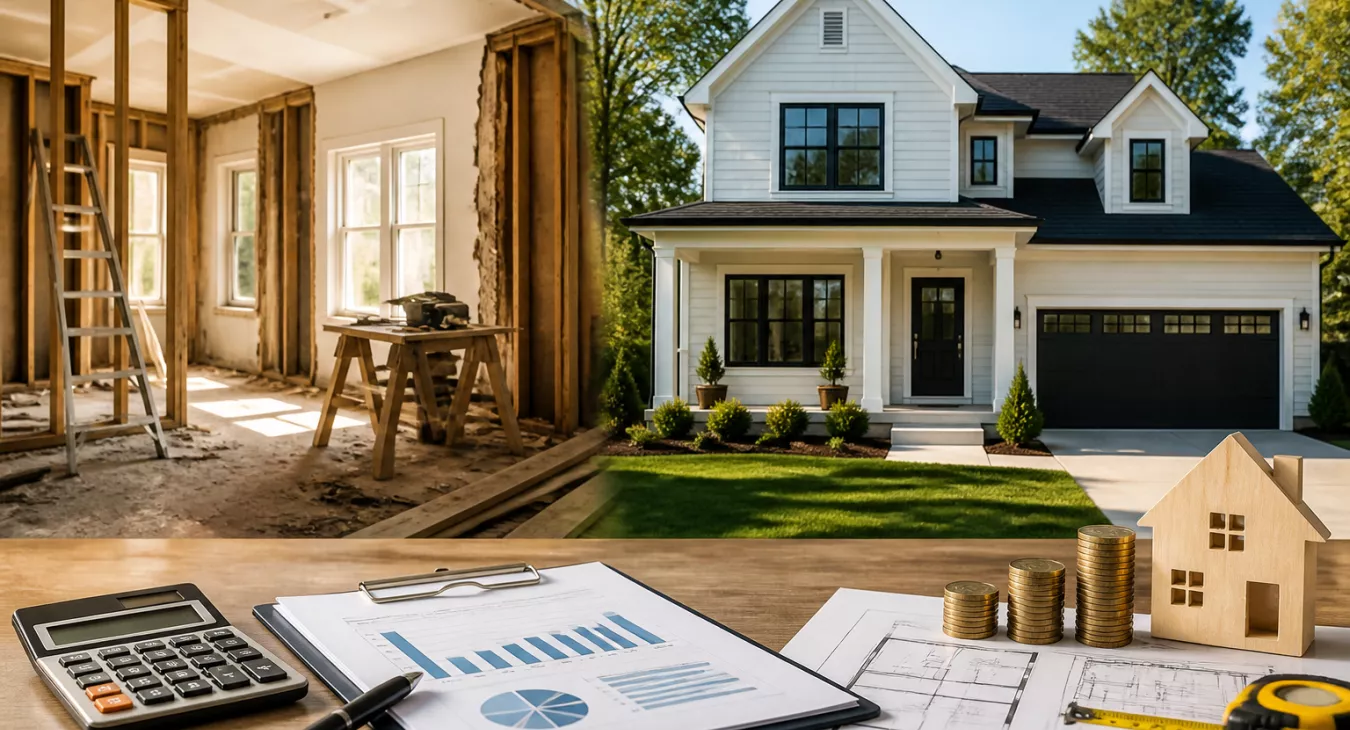
Learn the real house flipping average profit: $66K-$70K gross, but only $30K-$40K net. Discover what affects your returns and maximize margins.
Products and Tools Mentioned in this Post



Table of Contents
- Average House Flipping Profit: What You Really Need to Know
- National House Flipping Statistics for 2026
- Top 10 Most Profitable States for House Flipping
- The 70% Rule and Profit Margin Calculations
- Factors That Affect House Flipping Profits
- Complete House Flip Cost Breakdown
- How Holding Period Affects Net Profit
- How to Estimate Your House Flipping Salary
- Maximizing Profits in House Flipping
- House Flipping Profitability in 2026
- Risks and Challenges Affecting Profits
- Getting Started: From Beginner to Profitable Flipper
- Conclusion
- FAQ: House Flipping Profit Questions
House flipping's everywhere on HGTV, but the real money? That's a different story. You need hard data to separate the TV magic from what actually happens in your bank account. According to ATTOM Data Solutions, the average house flip profit lands around $66,000–$70,000 gross in the United States. But here's where it gets real: subtract holding costs, financing, renovation overruns, and transaction fees, and you're looking at $30,000–$40,000 net. That's a brutal gap. The investors who win understand this spread inside and out—they know what eats into their margin and they plan accordingly. Everyone else just runs a expensive hobby. This guide walks you through every number that matters: national averages, state rankings broken down, cost structures, and the actual strategies you need to protect your profit.

Average House Flipping Profit: What You Really Need to Know
Here's the thing most people get wrong: they lump gross profit and net profit into the same bucket. Your gross profit? That's just ARV minus acquisition cost. Clean math. But net profit—that's what actually hits your bank account after financing costs, holding costs, renovation spend, and selling fees get deducted. The media loves splashing those gross numbers because they look sexy. That's why so many flippers walk away shocked.
ATTOM Data Solutions pegged the national average gross profit at around $66,500 for 2025–2026. You're looking at a gross ROI of 26–29% on capital deployed. After everything? Net profit typically ranges between $30,000 and $42,000—and that assumes you know what you're doing with market selection, financing strategy, and project management. It's solid money. But only if you execute.
Don't ignore market conditions. They matter more than most investors admit. Phoenix and Nashville crushed it during 2021–2023 when ARVs kept climbing. And then 2024 happened. Higher rates. Fewer qualified buyers. Construction costs that won't drop. If you're still running numbers off 2022 assumptions, you're already underwater on deals you haven't closed yet. That's the painful reality for a lot of flippers right now.
Back to topNational House Flipping Statistics for 2026
Average Gross Profit by Year
2021–2022 was a goldmine. The post-pandemic price surge had flippers banking over $90,000 per deal in some markets. But then the market normalized, and gross profits came down. The good news? They've stabilized. Here's what the numbers actually show:
- 2021: ~$68,900 average gross profit (ROI: ~27%)
- 2022: ~$67,900 average gross profit (ROI: ~26%)
- 2023: ~$66,000 average gross profit (ROI: ~27.5%)
- 2024: ~$65,000 average gross profit (ROI: ~26%)
- 2025–2026 estimate: ~$63,000–$68,000 gross profit (ROI: ~25–28%)
Average Net Profit (After All Costs)
This is where most flippers get blindsided. You've got holding costs, financing charges, transaction fees—the full stack typically runs 15–20% of ARV. That eats into your bottom line fast. Say you gross $70,000 on a flip. Factor in $35,000 in total project costs, and you're left with $35,000 net. Still solid, but it's not the headline number.
Veteran flippers with systems in place and long-standing contractor relationships? They're hitting 15–20% of ARV in net margins. If you're just starting out, expect to land somewhere around 8–12%. Your overhead's higher, your efficiency's lower, and contractors know they can charge you more.
Median ROI for House Flips
ROI gets calculated one way: gross profit divided by total investment (purchase price plus renovation costs). The national median sits at 26–30% gross. And that's decent. But here's the reality check—when you account for every single cost, your net ROI typically bottoms out at 12–18% range.
Compare that to the S&P 500's historical ~10% annual return. Disciplined flipping still wins on paper. But don't forget—you're putting in real time and real sweat equity here, not just parking money in index funds.
Back to topTop 10 Most Profitable States for House Flipping

Highest Profit Markets
Geography matters. A lot. States crushing it right now share three things in common: strong job growth, housing inventory that can't keep up with demand, and median home values on the rise. Here's what the data shows us for 2025–2026, pulled from ATTOM, Zillow, and real investor portfolios:
| Rank | State | Average Profit | Average ROI % | Market Condition |
|---|---|---|---|---|
| 1 | New Jersey | $115,000 | 58% | High demand, low inventory |
| 2 | New York | $109,000 | 52% | Strong appreciation, high ARVs |
| 3 | Connecticut | $97,000 | 48% | NYC spillover demand |
| 4 | Maryland | $88,000 | 44% | DC corridor demand |
| 5 | Florida | $82,000 | 38% | High volume, competitive |
| 6 | California | $80,000 | 32% | High ARVs, high costs |
| 7 | Pennsylvania | $76,000 | 41% | Value markets, growing demand |
| 8 | Tennessee | $74,000 | 43% | Migration boom, rising ARVs |
| 9 | Texas | $68,000 | 35% | High volume, some saturation |
| 10 | Georgia | $65,000 | 37% | Atlanta-led demand |
Why These States Outperform
New Jersey and Connecticut? They're printing money. You've got high ARVs paired with aging housing stock—basically built-in value-add opportunities. The Northeast is still king for dollar amounts.
But the Sun Belt's playing a different game. Tennessee, Florida, and Georgia are riding a domestic migration wave that doesn't look like it's stopping anytime soon. Buyer demand stays strong even when the national volume cools. And that matters for your exit strategy.
Want the real breakdown on where your capital should go in 2026? Check out our full analysis of the best markets for house flipping in 2026.
Cost of Living Impact on Profits
Here's where most investors get it wrong.
California and New York spit out massive gross profits—$115K in Jersey, $109K in New York. But labor costs, material costs, and carrying costs? They're brutal. A contractor in Jersey runs $75–$95 per hour. Your financing costs are eating into margin too.
Tennessee and Georgia tell a different story. The gross profits are smaller—$74K and $65K respectively—but your net profit doesn't take the same hit. Renovation costs are 30–40% lower. Holding costs are lighter. In a down market or if your timeline stretches, that difference is everything.
Back to topThe 70% Rule and Profit Margin Calculations

How the 70% Rule Works
Here's the formula every flipper should know cold: Maximum Purchase Price = ARV × 70% − Estimated Renovation Costs. Let's say you're looking at a property with a $300,000 ARV and it needs $50,000 in repairs. Your absolute ceiling for acquisition? $160,000. That remaining 30% cushion covers your holding costs, financing, commissions, and hopefully—if you underestimated the work—keeps you profitable anyway.
Using It as a Ceiling, Not a Target
But here's what separates seasoned investors from rookies: the 70% rule isn't a magic number, it's a maximum. In expensive markets where hard money's running you 10–12% interest over 3–6 months, you might need to drop to 65% or 60% of ARV just to pencil. And in those lower-cost rural markets where you've got cash or a cheap line of credit and solid contractor relationships? You could stretch to 72–75%. Market dynamics matter. Understanding the fundamentals of flipping houses before you blindly apply any rule is non-negotiable.
Quick Math: Gross to Net Conversion
Let me show you where most flippers go wrong. You've got a $350,000 ARV property. You pay $190,000, spend $60,000 on rehab. Gross profit looks beautiful: $100,000. Then reality hits.
Hard money interest on a $250,000 loan for six months at standard rates? That's $18,000. Holding costs—insurance, property taxes, utilities while you're working—another $4,500. Selling costs run 7% of final sale price, which lands you at $24,500 in commissions and closing fees combined. Suddenly your net profit is $53,000. That's a 53% haircut from gross to net—and that's what a properly leveraged flip actually looks like.
Back to topFactors That Affect House Flipping Profits
Acquisition and Holding Costs
Your acquisition costs stack up fast. We're talking purchase price, buyer closing costs (1–3% of purchase), plus any assignment or wholesaler fees. But here's what actually tanks deals: holding costs. Most flippers severely underestimate these. Mortgage or hard money interest, property taxes, homeowner's insurance, utilities, HOA fees—they all add up month after month. Run the math on a $250,000 loan at 11% interest held for 5 months, and you're looking at ~$11,460 in interest alone. That's real money.
Renovation and Materials Expenses
Materials and labor bleed budgets dry. Since 2020, material costs jumped 15–25%, and labor's still tight in most metros. Kitchen renovations in particular require careful budget management if you want positive ROI. And don't skimp on contingency—you need a 10–15% buffer minimum. Cost overruns? They're not exceptions. They're the standard.
Market Timing and Sale Prices
Spring brings the money. March through June consistently delivers your highest buyer activity and strongest offer prices. List that flip in November or December? You'll watch your effective ARV drop 3–5% because buyers aren't competing as hard. That seasonal timing difference alone costs you $10,000–$15,000 on a mid-range flip.
Financing Costs and Interest Rates
Interest rates in 2025–2026 are crushing margins. This might be your single biggest profit killer right now. Hard money loans typically run 9–13% annually with 1–3 points upfront. Private money from individual investors can be cheaper. Cash deals? They eliminate this cost completely—but you need serious capital sitting around. Explore all your financing options for house flipping to find the structure that actually protects your returns.
Back to topComplete House Flip Cost Breakdown
You can't control what you don't measure. So here's exactly where your money goes on a $300,000 ARV property — using the 70% rule as your buying ceiling:
| Cost Category | Typical Amount | % of Total Costs | Notes |
|---|---|---|---|
| Purchase Price | $165,000 | 55% | Based on 70% rule − reno |
| Buyer Closing Costs | $3,300 | 1.1% | Title, escrow, inspections |
| Renovation Costs | $55,000 | 18.3% | Includes 10% contingency |
| Hard Money Interest | $14,400 | 4.8% | $180K at 11% for 8 months |
| Holding Costs (taxes, ins, util) | $5,200 | 1.7% | 8 months of ownership |
| Selling Agent Commission | $15,000 | 5% | 5% of ARV |
| Seller Closing Costs | $4,500 | 1.5% | Title, transfer taxes |
| Total Costs | $262,400 | 87.5% | |
| Net Profit | $37,600 | 12.5% | Of $300K ARV |
How Holding Period Affects Net Profit
Every month you're holding a property? That's money bleeding out. Interest, taxes, insurance, utilities—they all stack up fast and hammer your bottom line. Let's run the numbers on a realistic scenario: $220,000 loan at 11% annual interest, plus $1,200/month in carrying costs.
| Months Held | Total Holding Costs | Impact on Profit | ROI Impact % |
|---|---|---|---|
| 3 months | $9,700 | Baseline | Baseline |
| 5 months | $16,167 | −$6,467 | −2.9% |
| 7 months | $22,633 | −$12,933 | −5.9% |
| 9 months | $29,100 | −$19,400 | −8.8% |
| 12 months | $38,800 | −$29,100 | −13.2% |
See the pattern? Go from 3 months to 12 months and you've just lost $29,100 in profit. That's a 13.2% ROI hit on a deal that should've been solid.
And here's the thing—most flippers underestimate their timeline. Permit delays happen. Contractors disappear. Supply chain issues kill your schedule. That's exactly why project management matters so much. You need visibility into every phase. Want to see how the right software can actually keep you on track? Check out our deep dive on FlipperForce for house flipping project management. It's built for people who understand that time is literally your second biggest cost after acquisition.
Back to topHow to Estimate Your House Flipping Salary
Calculating Expected Profit Per Flip
Three things determine your take-home per flip: how good the deal is (acquisition price vs. ARV), how tight you keep renovation costs, and whether you're financing smart. If you're experienced, you're looking at $25,000–$50,000 net per deal. But here's the reality — beginners typically pocket $10,000–$25,000 on their first few deals. You'll lose money to the learning curve, sit on properties longer, and haven't built those contractor relationships yet.
Annual Income Potential
| Flips Per Year | Avg Net Profit Per Flip | Annual Gross Income | After Business Expenses |
|---|---|---|---|
| 2 | $30,000 | $60,000 | $45,000–$52,000 |
| 4 | $32,000 | $128,000 | $95,000–$110,000 |
| 6 | $35,000 | $210,000 | $155,000–$180,000 |
| 10 | $38,000 | $380,000 | $280,000–$320,000 |
| 15+ | $40,000 | $600,000+ | $440,000–$500,000 |
Scaling Your Flipping Business
Want to jump from 2 flips a year to 6+? You need systems. Lead generation. Deal analysis. Contractor management. Financing workflows. All of it has to run like clockwork. A real estate CRM that automates your deal pipeline is one of the smartest moves you can make at this stage. And the right house flipping software in 2026 cuts your admin time in half while making your underwriting faster and more accurate.
Back to topMaximizing Profits in House Flipping

Strategic Market Selection
By the time a market hits the national headlines as "hot," you're already too late. Competition's crushed the margins. Instead, hunt secondary and tertiary markets in strong states—places where ARVs are climbing but acquisition costs haven't caught up. You want neighborhoods within 10–15 miles of major employment hubs. They consistently outperform.
Cost Control During Renovation
Here's the truth: renovation cost control is your biggest profit lever. Build a solid relationship with 2–3 reliable GCs who actually understand investor economics and won't pad the estimate. Then get competitive bids anyway. Your scope should separate two things—cosmetic work (paint, flooring, fixtures) and structural work. One drives ROI. The other doesn't.
And focus your renovation dollars where it matters most: kitchens, bathrooms, and curb appeal. Buyers notice these first.
Timing Your Resale for Maximum Value
List between March and May. That's when your buyer pool is deepest. If you've got flexibility on timing, work backwards instead—pick your target list date, then schedule your acquisition around that. A flip you finish in October? Don't take a discount in November. Hold it and list in spring. The spread will shock you.
Using the Right Financing Strategy
Cash wins deals and kills interest costs entirely. But if you're using leverage, structure it right. Private money from individuals runs 8–9%. Hard money hits 11–13%. You do the math on every deal.
The BRRRR strategy (Buy, Rehab, Rent, Refinance, Repeat) lets you scale capital-efficiently. But it comes with real risks. Read our breakdown of BRRRR mistakes that kill your returns before you commit to that path.
And don't skip tax efficiency. Real estate tax strategies can move the needle on your after-tax income meaningfully.
Back to topHouse Flipping Profitability in 2026
Current Market Conditions
Mixed picture. That's what you're looking at right now if you're flipping in 2025–2026. Home values have stabilized across most markets after that brutal 2022–2023 correction, so your ARV estimates won't be moving around like they used to. The problem? Mortgage rates sitting at 6.5–7.5% for conventional buyers have shrunk the pool of qualified retail purchasers, which stretches your days-on-market and squeezes your sale price. It's still workable. Just not the same game as five years ago.
Interest Rate Impact
Rates hit you twice in a flip—once on the way in, once on the way out. Your hard money and bridge financing costs are still elevated. Meanwhile, retail buyers are getting crushed by their own carrying costs, and they know it. They're willing to pay less because the mortgage payment is killing them. The math shows margin compression of 3–5% compared to the 2020–2022 golden years. But here's the reality: flippers who can grab deals at 65% of ARV or lower, then move fast, are still printing strong returns. The bar is just higher now.
Inventory and Competition Trends
Most major metros still have inventory below historical averages. That works in your favor—it supports your ARVs and limits how far a completed flip can drop in value. Institutional buyers have stepped back from the feeding frenzy of 2021, so you've actually got room to negotiate at acquisition. And wholesale deal flow? It's picked up. More distressed sellers are sitting on rate-locked equity they desperately need to access. That's your opportunity.
Back to topRisks and Challenges Affecting Profits

Real talk: profitable house flips don't happen by ignoring risk. The wealth-destroying deals almost always share one thing in common—they get blindsided by one or more of these killers:
- Cost overruns: You'll find the hidden structural damage, the foundation that's shot, the mold, the electrical panel from 1987. That's $20,000–$50,000 gone instantly. Do thorough inspections before you close. And build contingency reserves into every single deal—no exceptions.
- Extended holding periods: Your flip was supposed to close in 4 months. But it's month 8 now, and your carrying costs are eating the entire margin. The contractor matters more than the initial bid price. Set milestone deadlines. Track progress weekly. This isn't optional.
- Market softening mid-project: Markets shift. While you're halfway through renovation, comps start dropping. Your ARV assumption? Overstated now. Do this right: build downside scenarios into deal analysis before you make the offer. What's your actual break-even ARV if values slip 10%?
- Overimprovement: You're tempted to put in the luxury finishes. But this is a B-class neighborhood, not a penthouse market. Your ARV caps out regardless of what you throw at it. Match your renovation quality to neighborhood comps. Not your personal taste.
- Overleveraging: Running three leveraged flips at once feels profitable on paper. Then one deal goes sideways or takes longer than planned. Suddenly you've got a liquidity crisis across your whole portfolio. Don't do this to yourself.
Getting Started: From Beginner to Profitable Flipper

Essential Skills and Knowledge
You need to nail three things before you close on deal number one: getting your ARV estimation right using comps, building realistic renovation budgets (and I mean walking through the property with a contractor), and doing the math on deal analysis that accounts for every single cost. Most new flippers blow up their first deal by overestimating what the property'll sell for or underestimating what the work actually costs. That's not because flipping doesn't work—it's because they skipped the fundamentals.
Finding Your First Flip
Start small. Smaller cosmetic flips in stable neighborhoods are your sweet spot—think 3-bedroom/2-bath homes that need paint, flooring, and kitchen or bath updates. Don't touch major structural or mechanical rehabs yet. You haven't built your contractor relationships. You don't have a cost database. Wait until you do. MLS listings, direct mail, and wholesalers all work as sourcing channels.
Building Your Investor Network
This is everything. Your network is worth more than your down payment. You need a reliable contractor (maybe two). A real estate attorney who gets investor transactions. A hard money lender who moves fast. An agent who actually understands what flippers need. And other flippers in your market who'll share intel without BS'ing you. Want to build this network fast? Show up to your local REIA meetings.
Back to topConclusion
Here's what the numbers tell us: the national house flipping average profit runs $63,000–$68,000 gross. Net? You're looking at $30,000–$42,000 if you're doing it right. But that's not random. The flippers banking those numbers aren't lucky—they're disciplined. They buy at the right price. They control renovation spend like their margins depend on it (because they do). They don't overpay for capital. And they pick markets where the math actually works.
2026 is brutal for sloppy operators.
Rates are still elevated. Prices have stabilized, which is good news if you know how to use it. The winners right now? They're the ones buying sharper than everyone else, closing faster, and crushing costs on the execution side. That's where deals get won and lost. Use the frameworks and data tables in this guide as your foundation—they'll keep you honest. But that's just the start. Build your deal-specific analysis skills. Learn to spot where *your* edge is in *your* market. That's how average flips become exceptional ones.
Run the numbers. Enter the price, rehab, ARV, holding time and loan to see your profit, cash needed and return. Free, no sign-up.
FAQ: House Flipping Profit Questions
What's a good profit margin for flipping houses?
You're looking at 10–15% of ARV on a leveraged deal. Cash deals? Bump that to 15–20%. But here's what really matters: most pros won't touch a deal unless they're clearing $25,000–$30,000 net. Anything less doesn't justify the time and capital you're committing.
How long does a typical house flip take?
Most flips run 4–6 months from closing to resale. Clean cosmetic work can wrap in 90 days. And then there's everything else — structural issues, electrical rewiring, plumbing overhauls. Those projects stretch to 7–10 months easily. Every extra month bleeds your margin through holding costs. Timeline management isn't optional if you want real profit.
What's the difference between gross profit and net profit in flipping?
Gross profit looks great on a napkin: sale price minus purchase price minus rehab. It's a lie.
Net profit is what actually hits your account after you subtract hard money interest, property taxes, insurance, utilities, agent commissions, and closing costs. The gap between gross and net? Often $20,000–$40,000. That's why deals that look like winners on paper can leave you disappointed.
Can you flip houses with no money down?
Not if you're brand new, but experienced investors do it all the time. The real strategies: partner with someone who has capital (they fund, you split profit), tap your private money network, or jump in as a co-investor on someone else's deal to build credibility. Hard money lenders want 10–20% down, though some bridge lenders will go higher LTV if you've got a track record.
How do current interest rates in 2026 affect house flipping profits?
Rates sitting at 6.5–7.5% conventional and 10–13% for hard money hit you twice. Your borrowing costs go up at acquisition. Buyer purchasing power tanks at sale. The result: your ROI compresses by 3–5% compared to the 2020–2022 free-money era. Smart flippers adapt by negotiating steeper discounts, cutting holding periods, and sourcing cheaper capital (private money or cash). That's how you stay profitable even when rates are ugly.
Back to top