


In today's real estate market, the fix and flip strategy has become a popular investment method offering potential high returns for savvy investors.
Table of Contents
- The five phases of a fix and flip project
- Write the scope of work before you close
- Build a rehab budget you can defend
- Hire contractors and pay them through draws
- Financing: hard money, private money and fix-and-flip loans
- Timeline and holding costs
- The profit math, worked through
- Selling the finished house
- Have a backup exit before you start
- Common mistakes
- Where to go next
- All our fix-and-flip articles
- Frequently asked questions
Getting a house under contract at a good price is only the first half of a fix and flip. The second half decides whether you make money: what you fix and what you leave alone, who does the work, how it gets paid for, how long the house sits, and what it actually sells for after commissions and buyer credits. Many flips that looked fine on paper lose money in that second half.
This guide walks through running the project once you have a deal. You will learn how to write a scope of work, build a rehab budget with a real contingency, hire contractors and pay them through draws, choose between hard money, private money and fix-and-flip loans, estimate holding costs month by month, and run the full profit math, including a stress test for when things go wrong.
It fits investors who can handle a project with many moving parts, have some cash reserves, and are comfortable with short-term risk. If you are still learning what flipping is, how to find deals, or what ARV means, start with the house flipping guide for beginners and come back here when you have a property in your sights.
Back to topThe five phases of a fix and flip project
Every flip moves through the same phases. Knowing them helps you see where time and money leak out.
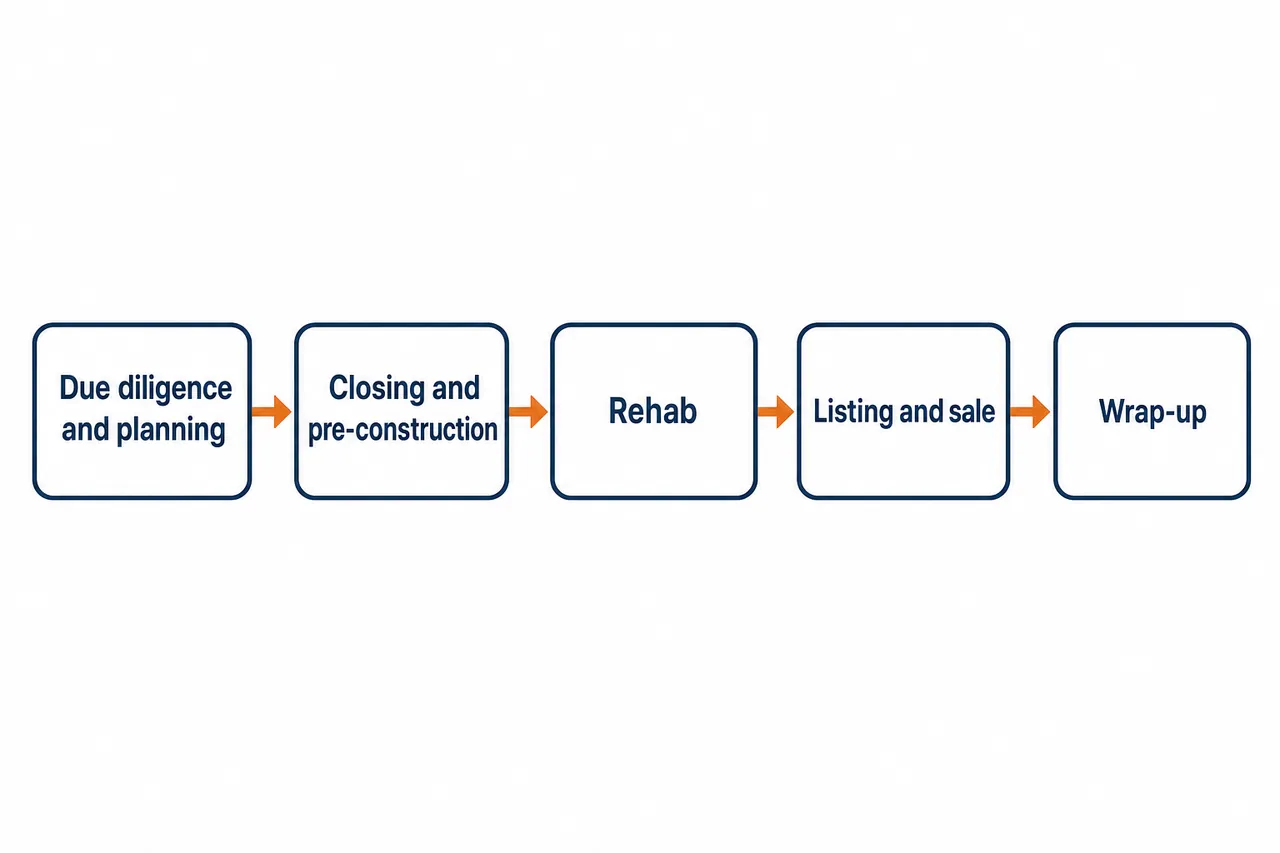
- Due diligence and planning (before closing): inspection, contractor walkthrough, scope of work, rehab budget, financing lined up, exit price confirmed with comparable sales.
- Closing and pre-construction: close on the purchase, insure the property, pull permits, order materials with long lead times, schedule trades.
- Rehab: demolition, rough work (structure, roof, plumbing, electrical, HVAC), inspections, finishes, punch list.
- Listing and sale: cleaning, staging, photos, pricing, showings, offer, buyer inspection and appraisal, closing.
- Wrap-up: pay off the loan, settle final invoices and lien waivers, record actual costs against your budget for the next deal.
The clock starts at closing, and every month costs interest, taxes, insurance and utilities. The more of phase one you finish before closing, the shorter phases two and three become.
Back to topWrite the scope of work before you close
The scope of work is a written list of every task the rehab includes, specific enough that two contractors would price the same job. Without it, bids are not comparable, change orders pile up, and you cannot hold anyone to a standard. A rehab scope of work template gives you a starting format.
Walk the house with the right people
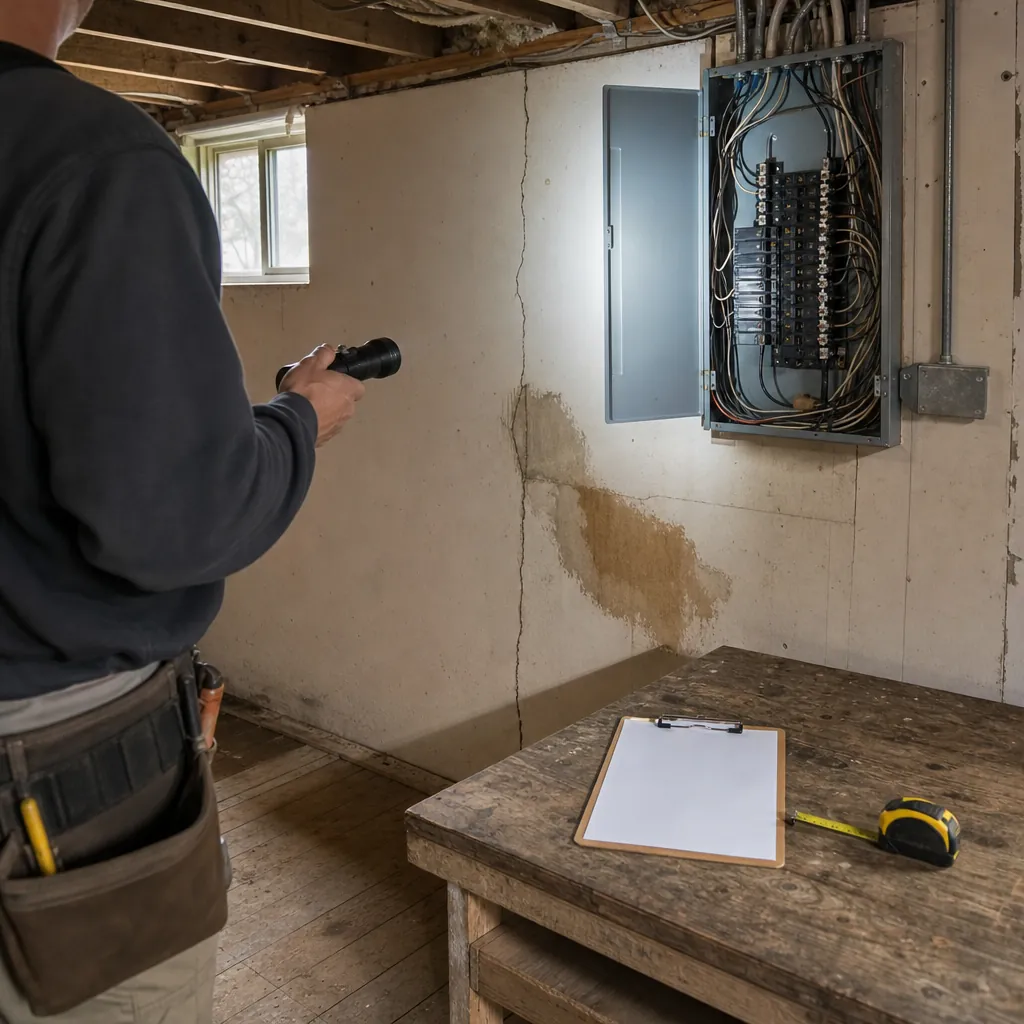
During your inspection period, walk the property with a contractor you trust or a general contractor who is bidding the job. If something looks serious, such as foundation cracks, sagging floors, an old electrical panel, a roof near the end of its life, or signs of water intrusion, bring in the relevant specialist before your contingency expires. A sewer line camera inspection is cheap compared with replacing a collapsed line after closing.
Organize the scope by system, then by room
Start with the systems that keep the house safe and sound, then move to rooms and finishes:
- Structure and envelope: foundation, framing, roof, gutters, siding, windows, exterior doors, grading and drainage.
- Mechanical systems: electrical panel and wiring, plumbing supply and drains, water heater, HVAC, sewer or septic.
- Rooms: kitchen, bathrooms, bedrooms, living areas, laundry, basement.
- Finishes throughout: flooring, paint, trim, interior doors, light fixtures, hardware.
- Exterior and curb appeal: landscaping, front door, porch, driveway, exterior paint.
Write each line with quantity and specification: "Replace 1,150 sq ft flooring with LVP, mid-grade, including removal of existing carpet and pad," not "new floors." Name the finish level for cabinets, counters, tile and fixtures so contractors price the same thing.
Decide what you will not do
A good scope is as much about restraint as improvement. Match the finished house to the comparable sales that support your ARV. If renovated homes in the neighborhood have laminate counters and builder-grade fixtures, quartz and custom tile rarely pay back. The kitchen and bathrooms deserve the most thought, because that is where buyers notice quality and where over-spending is easiest. See what to spend on a kitchen rehab and budget versus premium bathroom finishes before you lock in those lines.
Avoid the opposite mistake as well. Skipping a failing water heater or an outdated panel saves money now, but the buyer's inspector will find it and you will pay for it in credits or a lost sale.
Check permit requirements early
Permit rules vary by city and county. Structural changes, electrical, plumbing, HVAC replacement, roofing and window changes often require permits; cosmetic work often does not. Call the local building department or check its website before you finalize the timeline, because permit review times can add weeks. Unpermitted work can surface during the buyer's due diligence or appraisal and delay or kill the sale.
Back to topBuild a rehab budget you can defend
Once the scope is written, price every line. Early on, use cost guides and your own research; before closing, replace estimates with actual contractor bids where you can. The room-by-room rehab cost breakdown shows how to build line items from the ground up.
Price labor and materials separately
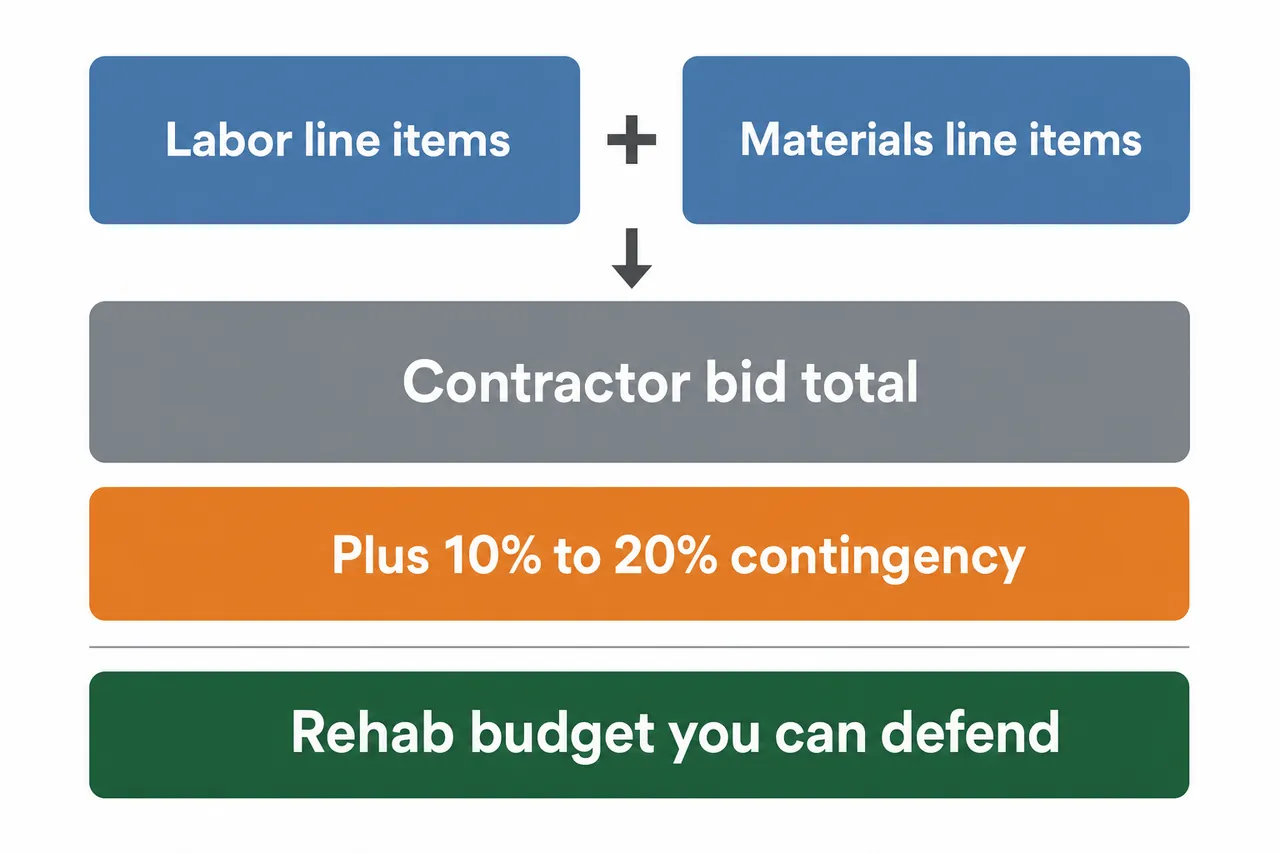
Ask contractors to separate labor and materials, or at least show which materials are included. This lets you compare bids fairly, decide whether to buy certain materials yourself, and spot a bid that quietly assumes the cheapest possible fixtures. If you supply materials, you also take on the risk of late deliveries and wrong orders, so only do it for items you can manage well.
Add a contingency that matches the house
Every rehab has surprises: rot behind tile, wiring that does not meet code once walls are open, a subfloor that has to go. Add a contingency line on top of the bid total. A common planning range is 10% to 20% of the rehab budget, toward the low end for a cosmetic job on a newer house and toward the high end for older homes, vacant houses with unknown history, or projects that open walls. The contingency is not extra money to spend on upgrades. It exists to absorb problems without destroying your profit.
Include the costs that are not construction
Rehab budgets often leave out permit fees, dumpster rentals, portable toilet rental, lockbox and security, final cleaning, and appliance delivery. Put them in the budget so they do not come out of your contingency on day one.
Back to topHire contractors and pay them through draws
Contractor selection and payment structure cause more flip losses than almost anything else. The goal is simple: never pay ahead of completed work, and always know what is left to finish and what it will cost.
General contractor or managing subs yourself
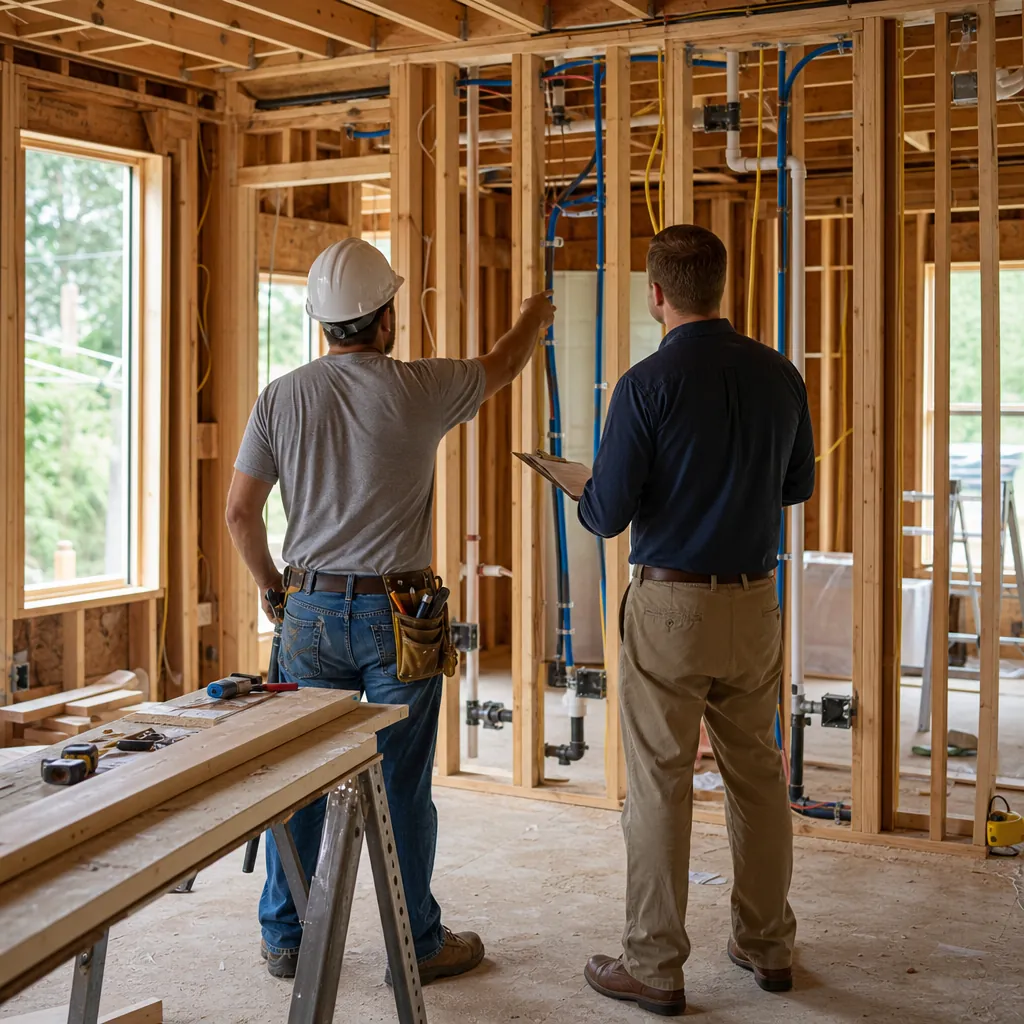
A general contractor (GC) schedules trades, handles permits, and takes responsibility for the whole job, and charges for that coordination. Managing subcontractors yourself can save money, but you become the scheduler, the problem solver and the person on site when the plumber does not show up. For a first or second flip, a reliable GC is usually worth the markup. Investors who run several projects a year often move to managing trades directly once they have proven crews. The investor guide to managing rehab crews covers both approaches.
Get comparable bids
Send the same written scope to at least three contractors. Ask for itemized bids, a proposed timeline, and proof of license and insurance where your state requires them (licensing rules vary by state and trade, so check with your state licensing board). Call references, ideally other investors, and look at a current job if possible. The lowest bid is not automatically the best; a bid far below the others often means something was left out. For tactics on getting better pricing without driving away good crews, see how to negotiate contractor prices on flips.
Put the important terms in the contract
- The full scope of work attached as an exhibit.
- Total price and a draw schedule tied to completed milestones, not dates.
- Start date, target completion date, and what happens if the contractor falls behind.
- A written change order process: no extra work is paid unless approved in writing with a price before it starts.
- Who pulls permits and who pays for them.
- Requirements for lien waivers with each payment.
- Cleanup responsibilities and warranty on workmanship.
Have a local real estate or construction attorney review your standard contract once; the cost is small compared with a dispute.
Structure the draw schedule
A draw schedule releases money in stages as work is completed. A typical structure might look like this:
- A small deposit or mobilization payment, if required (keep it modest; deposit limits vary by state).
- Demolition and rough framing complete.
- Rough plumbing, electrical and HVAC complete and passed inspection.
- Drywall, insulation and exterior work complete.
- Cabinets, counters, flooring and tile installed.
- Final finishes and passed final inspection.
- Punch list complete, with a retainage holdback (for example, 5% to 10%) released at the very end.
Before each draw, walk the property or get dated photos and video, confirm the milestone is truly finished, and collect conditional or unconditional lien waivers from the contractor and major suppliers as appropriate. Unpaid subcontractors and suppliers may be able to file mechanic's liens against your property, which can block your sale. Lien rules vary by state, so ask your title company or attorney what documentation to collect.
Run the job, do not just fund it
Set a regular check-in, at least weekly, with a site visit or video walkthrough. Track completed items against the scope and budget in a simple spreadsheet or a project management tool. When a problem appears, decide quickly: delays waiting for an owner's decision cost the same holding costs as any other delay.
Back to topFinancing: hard money, private money and fix-and-flip loans
Conventional mortgages usually do not fit flips because the house may not qualify in its current condition and the timeline is too short. Most flippers use short-term asset-based loans, private capital, or their own cash. For a deeper side-by-side, read fix and flip financing compared and house flipping loans and their requirements.
| Source | How it usually works | Strengths | Watch out for |
|---|---|---|---|
| Hard money lender | Short-term loan (often 6 to 18 months) secured by the property; funds a share of purchase and often rehab through draws; interest-only payments plus points | Fast closing; underwriting focused on the deal and ARV; built for rehab | Higher cost than bank loans; extension fees; draw inspection delays |
| Fix-and-flip loan from a specialty lender | Similar to hard money but more standardized; terms often improve with your track record | Predictable process; may lend higher share of costs to experienced flippers | Stricter documentation; experience tiers; prepayment or minimum interest terms |
| Private money | Loan from an individual, secured by a mortgage or deed of trust; terms negotiated directly | Flexible terms; can cover down payment or gaps | Securities and lending rules may apply; needs proper documents and a clear plan for repaying |
| Own cash, HELOC or business line | Pay cash or borrow against other assets | Strongest offers; no draw delays; lower cost | Ties up capital; puts other assets at risk if the flip fails |
What lenders look at
Asset-based lenders focus on the deal more than your income, but they still look at you. Expect questions about your experience, credit, liquidity (cash in the bank after closing), the purchase price, the scope and budget, and their own appraisal or valuation of ARV. Many lenders cap the loan at a percentage of purchase price, a percentage of total cost, and a percentage of ARV, and the lowest of those wins. Guidelines vary widely by lender, so ask each one to spell out its caps in writing.
Understand the true cost
Compare quotes on total cost for your expected hold, not on the interest rate alone. Include:
- Points: an upfront fee as a percentage of the loan, for example 1 to 3 points.
- Interest: often interest-only, monthly; check whether it is charged on the full loan or only on funds drawn.
- Fees: underwriting, document prep, appraisal, draw inspection fees per draw, wire fees.
- Extension fees if you run past the term, and any minimum interest or prepayment terms.
As an illustration only, short-term rehab loans have often been priced somewhere in the high single digits to low teens in annual interest plus points, but rates move with the market and your profile. Get current written quotes.
How rehab draws work with a lender
When a lender funds the rehab, it usually holds the rehab money back and releases it in draws after an inspector confirms the work. That means you or your contractor must front the cost of each stage until the draw arrives, often a few days to a couple of weeks later. Align your contractor's draw schedule with the lender's, and keep enough cash to cover at least one stage of work so the job does not stall. Overruns beyond the approved budget usually come out of your pocket.
Using private money responsibly
Private loans from friends, family or other investors should be documented like any other loan: a promissory note, a recorded mortgage or deed of trust, title insurance naming the lender, and the lender listed on the property insurance. Pooling money from multiple people or offering a share of profits can trigger securities laws. Have a real estate attorney set up the documents.
Back to topTimeline and holding costs
Time is the cost most beginners underestimate. A rehab that takes three months on paper can take five once permits, inspections, back-ordered materials and contractor scheduling enter the picture, and the sale itself takes weeks after you accept an offer.
Build a realistic timeline
Plan each phase separately, then add them up:
- Pre-construction: permits, ordering materials, scheduling crews. Start these during escrow if possible.
- Rehab: ask contractors for a phase-by-phase schedule, and add buffer for inspections and delivery delays.
- Market time: check how long renovated homes at your price point have been taking to go under contract locally; your agent can pull this.
- Contract to closing: the buyer's financing, appraisal and inspection period usually take several weeks.
List every monthly holding cost
- Loan interest (and any monthly servicing fee).
- Property taxes, prorated monthly.
- Insurance: a vacant or builder's risk policy, which is usually different from a standard homeowner policy. Confirm coverage for a vacant property under renovation.
- Utilities: electric, water, gas and possibly trash, which contractors need during the work.
- HOA dues, if any.
- Lawn care, snow removal, and security.
Add these up into a single monthly carrying cost. That number tells you what every month of delay costs, which makes decisions like "pay extra to start next week or wait a month for a cheaper crew" easy to evaluate.
Back to topThe profit math, worked through
Before closing, the deal should pass two checks: a quick screen such as the 70% rule, and a full line-by-line projection. The 70% rule says your maximum purchase price is about 70% of ARV minus rehab costs. It is a rough filter that leaves room for financing, holding and selling costs plus profit; it is not a substitute for the full math. The 70 percent rule calculator handles the quick screen, and the fix and flip calculator runs the full projection with your own numbers.
Example deal (illustrative numbers): a three-bedroom house in a typical suburban market. Renovated comparable sales support an ARV of $340,000. The written scope and contractor bids come to $50,000. The purchase price is $185,000.
Quick screen: $340,000 × 0.70 = $238,000. Subtract the $50,000 rehab: $188,000 maximum. The $185,000 price passes.
Financing assumptions: a hard money loan covers 90% of the purchase ($166,500) and 100% of the bid rehab ($50,000), for a total loan of $216,500. Terms for this illustration: 2 points and 11% annual interest-only. To stay conservative, interest is calculated as if the full loan were outstanding the whole time: $216,500 × 11% ÷ 12 ≈ $1,985 per month. Timeline: six months from purchase to sale closing (one month pre-construction, three months rehab, one month on market, one month to close).
| Line item | How it is calculated | Amount |
|---|---|---|
| Purchase price | Contract price | $185,000 |
| Buyer closing costs | Title, recording, escrow (estimate) | $4,000 |
| Rehab (bids) | Itemized scope | $50,000 |
| Contingency | 15% of rehab, assumed fully used | $7,500 |
| Loan points | 2% × $216,500 | $4,330 |
| Other lender fees | Underwriting, appraisal, draw inspections | $1,500 |
| Loan interest | $1,985 × 6 months | $11,910 |
| Other holding costs | Taxes $300 + insurance $175 + utilities $200 + upkeep $75 = $750 × 6 | $4,500 |
| Cleaning and staging | Estimate | $2,500 |
| Agent commissions | 5% of $340,000 (commissions are negotiable; use your actual terms) | $17,000 |
| Seller closing costs | 1.5% of sale price for title, transfer taxes, fees (varies by state) | $5,100 |
| Buyer credits | Repairs or concessions after buyer inspection | $3,000 |
| Total cost | Sum of the lines above | $296,340 |
| Sale price | ARV | $340,000 |
| Profit before tax | $340,000 − $296,340 | $43,660 |
Cash needed and return on cash
The lender does not cover everything. Cash out of pocket before the sale: $18,500 down payment + $4,000 buyer closing + $4,330 points + $1,500 lender fees + $11,910 interest + $4,500 holding + $7,500 contingency + $2,500 staging = $54,740. Commissions, seller closing costs and buyer credits come out of the sale proceeds.
Check the cash flow at closing: $340,000 − $17,000 − $5,100 − $3,000 = $314,900 in net proceeds. Paying off the $216,500 loan leaves $98,400. Subtract the $54,740 invested and the profit is $43,660, which matches the table.
Return on cash invested: $43,660 ÷ $54,740 ≈ 80% over about six months. Return on total project cost: $43,660 ÷ $296,340 ≈ 14.7%. The second number is the more honest measure of how much room the deal has for error, because leverage magnifies losses as much as gains.
Stress test the deal
Now assume the project runs three months long and the house sells for $325,000 instead of $340,000:
- Three extra months of interest and holding: ($1,985 + $750) × 3 = $8,205 more cost.
- Sale price $15,000 lower, partly offset by lower commissions ($750 less) and seller closing costs ($225 less).
- New profit: $43,660 − $8,205 − $15,000 + $750 + $225 = $21,430.
Two realistic problems cut the profit roughly in half. Add a major surprise that blows through the contingency and the deal could break even or lose money. Run this kind of downside case on every deal before you close. If a modest delay and a modest price drop wipe out the profit, the purchase price is too high.
Taxes on flip profits
Flip profits are often taxed as ordinary income rather than long-term capital gains, and frequent flippers may be treated as dealers, which can bring self-employment tax and limit some strategies such as 1031 exchanges. How your profits are treated depends on your facts, holding period, entity and activity level. Talk to a CPA who works with real estate investors before your first sale, and set aside money for taxes from each profit. If your CPA confirms capital gains treatment applies to a particular sale, the capital gains tax calculator can help with estimates.
Back to topSelling the finished house
The sale is where your projections meet the market. Plan it from the start, not after the paint dries.

Price from fresh comps
Several months will have passed since you estimated ARV. Have your agent pull new comparable sales and current competing listings before you list. Price the home to attract offers in the first couple of weeks; an overpriced flip that sits accumulates holding costs and invites lower offers. If showings are steady but no offers arrive, price is usually the reason.
Prepare for the buyer's inspection and appraisal
Buyers will inspect your work closely. Keep a folder with permits, final inspection sign-offs, receipts for major items (roof, HVAC, water heater, panel), and warranties. Fix punch list items before listing. If the buyer uses financing, the lender's appraiser must support the price; give your agent a list of upgrades and the comps you used so they can share them with the appraiser where appropriate. Some loan programs have rules about recently flipped properties, such as extra appraisal requirements, so ask your agent which buyer financing types may need more time.
Present the house well
Professional photos, a deep clean and at least light staging help buyers see the finished product. Curb appeal matters for first impressions online and in person. Disclosure requirements vary by state; ask your agent or attorney what you must disclose as a seller, and disclose known issues honestly.
Close the books
After closing, compare actual costs to every budget line. The gaps are your best guide for estimating the next flip. A fix and flip business plan helps turn that record into repeatable systems.
Back to topHave a backup exit before you start
Markets shift during a six-month project. Decide in advance what you will do if the resale price drops or the house will not sell:
- Rent it: if the house rents for enough to cover a refinanced mortgage, you can hold it and wait. Check the numbers with the rental property calculator, and see the BRRRR investing guide for the refinance path.
- Sell earlier in a lighter condition: if the market softens mid-project, finishing a lighter scope and selling sooner can limit losses. The wholetailing guide covers selling with minimal rehab.
- Cut price early: a price reduction in week three usually costs less than three more months of holding costs.
Ask your lender in advance about extension terms and whether the loan can be refinanced into a rental loan.
Back to topCommon mistakes
- Stretching the ARV. Using the single best comp, or comps from a better neighborhood, inflates the whole deal. Use similar homes, similar condition, recent sales, close by.
- Closing before the scope is written. Without a scope and real bids, the rehab budget is a guess, and you have no leverage once the house is yours.
- No contingency, or spending it on upgrades. The contingency exists for hidden problems, not for nicer counters.
- Paying contractors ahead of work. Large upfront payments remove your leverage. Tie every payment to verified completed milestones and collect lien waivers.
- Verbal change orders. Unpriced extra work leads to disputes and surprise invoices at the end.
- Ignoring holding costs. Interest, taxes, insurance and utilities run every month whether work is happening or not.
- Over-improving for the neighborhood. Finishes above what comps support rarely come back at sale.
- Skipping permits. Unpermitted work can derail a sale, an appraisal, or a buyer's insurance.
- Running out of cash mid-project. Lender draws lag behind work, and overruns are yours to cover. Keep reserves beyond the planned cash need.
- Forgetting taxes. Profits may be taxed as ordinary income. Plan with a CPA before the sale, not after.
For more detail on rehab-specific errors, read common rehab mistakes that kill your ROI.
Back to topWhere to go next
- New to flipping? Start with the house flipping guide above, then return here.
- Need more deals to run through this process? See the guide to finding motivated sellers.
- Not sure whether to flip or assign the contract? Compare fix and flip versus wholesale.
- Ready to price a deal? Plug your numbers into the fix and flip calculator and run both a base case and a downside case.
Run the numbers. Enter the price, rehab, ARV, holding time and loan to see your profit, cash needed and return. Free, no sign-up.
Back to top
Back to top
All our fix-and-flip articles
Fix-and-flip articles on KDS Development, grouped so you can go deeper on any part of this guide. Newest first.
Guides and how-tos
- How to Negotiate Contractor Prices: Get Better Rehab Bids on Your Flips
- How to Estimate Rehab Costs for Wholesale Deals
- BRRRR Rehab Budget: How to Stay Under ARV Targets
- Fix and Flip Business Plan: Template for Serious Investors
- How to Estimate Rehab Costs: Room-by-Room Breakdown
- Rehab Scope of Work Template for Investors
- Managing Rehab Crews: Investor Guide to Contractors
- Rehab Cost Estimation: Complete Guide by Property Type
Explainers
- House Flipping Loans: Types, Requirements & Where to Get Them
- Fix and Flip Financing: Compare Hard Money, Private, DSCR
- Kitchen Rehab ROI: What to Spend for Maximum Profit
- Common Rehab Mistakes That Kill Your ROI
- Guide to Renovating BRRRR Properties: Understanding the Rehab Process and Requirements
- The Pros and Cons of Fix and Flip Investing: Is it Right for You?
- The Pros and Cons of Using Fix and Flip Financing for Your Next Investment Property
Comparisons
- Fix and Flip vs Wholesale: Pros, Cons, and Profit Potential
- Bathroom Rehab ROI: Budget vs Premium Finishes
Tool reviews
- Rehab Valuator Review: Flip Project Management
- Rehab Valuator Review: House Flip Project Management
- Rehab Estimator Pro Review: Rehab Cost Calculator
Calculators
Frequently asked questions
How much cash do I need for a fix and flip if I use a hard money loan?
Plan for the down payment the lender requires, closing costs, points and fees, monthly interest and holding costs for the full timeline, your contingency, and any rehab the lender will not fund. In the illustrative deal above, that came to roughly $55,000 on a $185,000 purchase. Add separate reserves on top for delays and overruns.
Is the 70% rule enough to decide whether to buy?
No. It is a quick filter for screening offers. Before closing, run a full line-by-line projection with real rehab bids, your actual loan terms, local holding costs and selling costs, plus a downside case with a longer timeline and lower sale price.
How long does a typical fix and flip take?
It depends on the scope, permits, contractor availability and the local market. A light cosmetic flip can be finished and sold in a few months, while projects with structural or system work often take considerably longer. Build your timeline phase by phase and budget holding costs for longer than the best case.
Should I hire a general contractor or manage subcontractors myself?
A general contractor costs more but takes on scheduling, coordination and accountability, which usually makes sense for early projects. Managing subs directly can save money once you have reliable crews, a clear scope and time to be on site often.
Do I need an LLC to flip houses?
Not necessarily, but many investors use one for liability separation and bookkeeping, and some lenders require borrowing through an entity. Entity choice affects taxes and liability, so discuss it with a real estate attorney and a CPA in your state before your first purchase.
What happens if the flip runs over budget?
Overruns typically come out of your own cash, since lenders usually fund only the approved rehab budget. That is why a contingency and cash reserves matter. If costs climb, review the remaining scope for items that do not add value, and consider whether a backup exit like renting or selling sooner limits the damage.
Back to top