


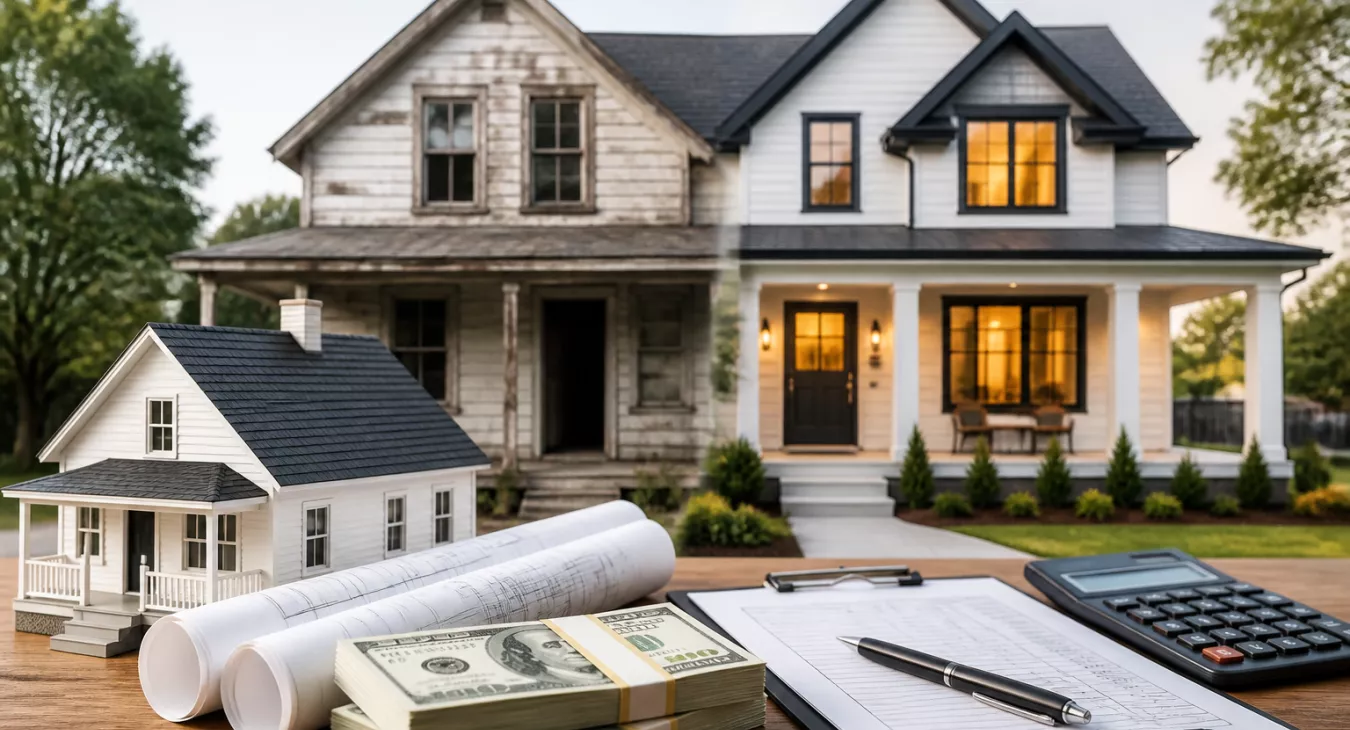
Explore house flipping loans and discover what types are available, requirements, and lenders. Get expert guidance to fund your next profitable investment.
Table of Contents
- what's a Fix and Flip Loan?
- Types of House Flipping Loans Available
- House Flipping Loan Types Comparison
- How Fix and Flip Loans Work
- Qualifying for House Flipping Loans
- How Much You Can Borrow
- Sample $300K House Flip Financing Costs
- Steps to Get a House Flipping Loan
- Finding Lenders for Fix and Flip Loans
- Important Considerations Before Financing a Flip
- Conclusion
- Frequently Asked Questions
Financing is what separates flippers who scale from those who stay stuck on one deal at a time. You're looking at your first distressed property—or maybe juggling three rehabs simultaneously. Either way, you need to know what house flipping loans actually exist, how lenders structure them, and what they're really looking for. Miss this, and you'll either overpay on terms or watch a deal slip away because you weren't pre-positioned. This guide walks you through every financing option that matters, with actual numbers, hard qualification thresholds, and the exact steps to move fast when opportunity knocks.
New to fix-and-flip? Start with our Fix-and-Flip Guide.

what's a Fix and Flip Loan?
You're buying a distressed property, putting in 6 to 18 months of work, and flipping it for profit. That's what a fix and flip loan finances. Unlike a traditional 30-year mortgage locked to someone's primary residence, these loans move at your pace — the investor's timeline, not the bank's.
Here's how it actually works. Most lenders will cover both your acquisition price and renovation budget, releasing cash in stages as the work gets done. And during construction? You're making interest-only payments, which keeps your cash available for the contractor bills stacking up on site. When you sell or refinance, that's when the principal gets paid back in one lump sum — so your exit strategy matters just as much as what you paid to get in.
Speed and flexibility. That's what separates this from what your bank offers.
Traditional lenders look at current market value or your W-2 income. Fix and flip lenders evaluate the after-repair value (ARV) instead. And that difference? It opens doors that conventional financing keeps bolted shut — letting you access capital based on what the property will be worth when it's done, not what the comps say today.
Back to topTypes of House Flipping Loans Available
The real estate financing market has way more options than most new investors think. Want to know what actually separates a 5-day close from a 45-day slog? It's picking the right loan structure. And that decision hinges on your timeline, your ARV, and how much equity you've got to work with. Here's what you're actually looking at:
Hard Money Loans
Speed is everything in this game. Hard money lenders don't care about your credit score or your W-2s—they care about the property's value and the ARV. You'll pay 9–15% in interest, plus 2–5 points in origination fees. But you'll close in 5–10 business days. That's the real advantage here.
Bridge Loans
Ever been stuck waiting for one sale to fund the next purchase? Bridge loans exist for exactly that scenario. You're sitting on equity in an existing property, but you need capital now to grab the next deal. These run 8–12% with terms from 6 to 24 months. If you're juggling multiple flips at once, this is worth serious consideration.
Home Equity Loans and HELOCs
Got a primary residence or investment property with real equity sitting in it? HELOCs are basically free money compared to hard money. You're looking at prime + 1–2%, which could be 7–9% depending on the market. The catch: you need solid credit (680+) and at least 20% equity remaining after you draw. But the flexibility is real—you only pay interest on what you actually borrow.
Cash-Out Refinance
Replace your old mortgage with a bigger one. Pull out the difference in cash. Use it to fund your flip. Simple enough. This works best when rates are actually favorable and you've got substantial equity. The downside? You're looking at 30–45 days to close, and you'll reset the amortization clock on your primary mortgage.
Personal Loans
No collateral needed. That's the only real advantage. You'll hit a hard ceiling at $50,000–$100,000, and rates range from 7–36% depending on your credit. These make sense for smaller rehabs or filling small gaps—not for funding a $400K acquisition.
Traditional Bank Loans and Portfolio Loans
Some community banks and credit unions keep loans in-house instead of selling them to Fannie Mae. Portfolio loans are underwriting gold—lower rates (6–9%), customizable terms, and the lender actually cares if you succeed. But they demand stronger credit, full income documentation, and patience. Budget 30–60 days for underwriting and close.
Seller Financing
Negotiate directly with the owner. This is where you win—flexible terms, lower down payments, sometimes no appraisal at all. Best case? A motivated seller who owns free and clear and just wants monthly income. Check out our deep dive on 15 types of motivated sellers and how to find them.
Other Options
401(k) loans let you borrow up to 50% of your vested balance (max $50,000) without tax penalties. Real estate crowdfunding platforms pool capital across multiple investors if you want to share risk. Business lines of credit give you revolving access for ongoing project funding. Each one has tradeoffs. Run the math against your overall financial picture before pulling the trigger.
Back to topHouse Flipping Loan Types Comparison
You've got options. A lot of them. But picking the right financing structure can literally make or break your flip—the difference between hitting your 20% IRR target and watching your margin evaporate to interest payments.
Here's how the major players stack up.
| Loan Type | Typical Interest Rate | Time to Fund | Credit Requirements | Down Payment | Best For |
|---|---|---|---|---|---|
| Hard Money | 9–15% | 5–10 days | 600+ (flexible) | 20–35% | Speed-sensitive deals, low credit |
| Bridge Loan | 8–12% | 7–14 days | 650+ | 20–30% | Bridging capital between projects |
| HELOC | Prime + 1–2% | 14–30 days | 680+ | N/A (equity-based) | Repeat investors with equity |
| Cash-Out Refinance | 6.5–9% | 30–45 days | 680+ | N/A (equity-based) | Lower-rate equity extraction |
| Personal Loan | 7–36% | 1–7 days | 660+ | None | Small projects, gap financing |
| Traditional/Portfolio | 6–9% | 30–60 days | 680+ | 20–30% | Lower-cost, longer timelines |
| Seller Financing | Negotiated | Varies | Flexible | Negotiated | Motivated sellers, creative deals |
| Crowdfunding | 8–14% | 14–30 days | Varies by platform | 10–30% | Investors without traditional access |
How Fix and Flip Loans Work
You'll avoid expensive mid-project surprises when you understand how these loans actually work. Let's walk through the mechanics from closing day to when you cash out.
Loan Structure and Draw Schedules
Your renovation budget doesn't land in your account as a check. The lender holds funds in escrow and releases them in draws tied to actual construction milestones. Before you get paid, an inspector shows up (or reviews photos) to verify work's actually done. And here's the catch: you need enough cash reserves to fund the work between draws. The lender's protecting their collateral, but that means your liquidity matters.
Interest Calculations
This is where fix and flip loans get investor-friendly. Interest accrues only on what you've actually drawn, not your full commitment. Say your loan is $400,000 but you've only pulled $250,000 so far? You're paying interest on $250,000, not $400,000. The downside: your carrying costs climb as the project progresses and you draw more capital.
ARV-Based Lending
Your ARV — after-repair value — is the single most important number in this entire deal. Lenders typically cap their loan at 65–75% of ARV, which means you need serious equity cushion to make the numbers work. Before you even apply, use specialized house flipping software to calculate your ARV accurately. Get this wrong and your whole deal falls apart.


Exit Strategies
Lenders fund the entry only when they understand your exit. You've got two primary plays: sell after renovation and pay off the loan, or refinance into a conventional mortgage if you're holding it as a rental. A documented exit strategy dramatically improves your odds at approval.
Back to topQualifying for House Flipping Loans
Different loan types have wildly different qualification standards. Your job is to figure out which lender will actually say yes to your deal — and that starts with knowing what they're looking for.
| Loan Type | Minimum Credit Score | Experience Required | Income Verification | Collateral Type |
|---|---|---|---|---|
| Hard Money | 580–620+ | Not always | Minimal | Subject property |
| Bridge Loan | 650+ | Preferred | Moderate | Subject + other assets |
| HELOC | 680+ | Not required | Full documentation | Primary/investment property |
| Cash-Out Refinance | 680+ | Not required | Full documentation | Existing property |
| Traditional/Portfolio | 680–720+ | Often required | Full documentation | Subject property |
| Seller Financing | Negotiable | Not required | Varies | Subject property |
First-timer? Don't sweat it. Hard money lenders will absolutely fund a newcomer if the deal is solid — and by solid, I mean strong ARV, realistic renovation numbers, and enough cash in reserves to handle overruns. Your credit score matters less than your deal does. And here's the secret: bring an experienced contractor or JV partner into the conversation. That one move changes how lenders see you. Before you pitch anyone, spend time learning how the full house flip process actually works. You'll sound like you know what you're doing.
Back to topHow Much You Can Borrow
Two ratios control your loan amount: loan-to-value (LTV) on the current purchase price, and loan-to-ARV on what the property's worth after you're done flipping it. Know these numbers cold—they're the gatekeepers to your deal.
- Hard money lenders: Typically lend 65–75% of ARV or up to 90% of purchase price
- Bridge lenders: 70–80% LTV on existing properties
- HELOCs: Up to 85–90% combined LTV (existing mortgage + HELOC)
- Portfolio lenders: 70–80% of purchase price, 65–70% of ARV
Your renovation budget needs to be itemized line by line. Don't show up with vague estimates like "kitchen update: $15,000"—lenders will tank your approval or string you along. They want specifics: flooring materials, labor costs, permits, contingencies. It matters.
And here's the thing: if you've already closed three successful flips, most lenders will bump your LTV ratios higher and give you better terms. Your track record earns you leverage. The markets you're targeting also move the needle—properties in hot markets command stronger ARVs, so lenders get more aggressive with their capital.
Back to topSample $300K House Flip Financing Costs
| Expense Category | Hard Money | Bridge Loan | HELOC | Traditional Mortgage |
|---|---|---|---|---|
| Interest Rate | 12% | 10% | 8.5% | 7.5% |
| Origination Fees (points) | $9,000 (3 pts) | $6,000 (2 pts) | $0–$1,500 | $3,000 (1 pt) |
| Interest (9 months) | $27,000 | $22,500 | $19,125 | $16,875 |
| Closing Costs | $4,500 | $4,000 | $2,000 | $6,000 |
| Total Financing Cost | $40,500 | $32,500 | $22,625 | $25,875 |
Here's the thing: lowest rate doesn't win. Hard money hits you with 12% interest plus $9,000 in origination fees, and by month nine you're looking at $40,500 in total financing costs on a $300K flip. Compare that to a HELOC at $22,625 total? You're bleeding $18,000 extra.
But that premium might actually be cheap insurance.
If hard money gets you funded in 7 days and closes a deal that a HELOC application would've killed, you just paid $18,000 to win the property. You know your market — is that deal-winning speed worth it on this project?
Back to topSteps to Get a House Flipping Loan

Get your financing locked down right, and you'll close faster with better terms. Here's how to make it happen:
- Calculate your total project cost: Add up the purchase price, renovation budget, carrying costs (taxes, insurance, utilities, interest), and selling costs (agent commissions, closing costs). Then pad it. You want a 15–20% contingency sitting there for the repairs nobody saw coming.
- Assess your qualifications: Pull your credit report. Calculate your liquid reserves. Document your investment experience. Show up to that lender conversation with your numbers already dialed in.
- Prepare documentation: Grab your tax returns (2 years back), bank statements (last 3 months), a detailed scope of work, contractor bids, comparable sales analysis, and an ARV estimate. Tools like FlipperForce let you organize all this professionally instead of hunting through spreadsheets.
- Research and compare lenders: Don't call one lender and stop. You need at least 3–5 options — hard money shops, local banks, mortgage brokers who focus on investor loans. The rates and terms vary wildly.
- Submit applications and review terms: Read the fine print. Prepayment penalties? Extension fees? Inspection fees per draw? Default clauses buried in paragraph seven? The headline rate doesn't tell you the whole story.
- Close and manage draws efficiently: When you're funded, get those draw requests in fast. Documentation complete. Delays kill your timeline and bleed carrying costs.
Finding Lenders for Fix and Flip Loans

Your lender relationship? That's a long-term asset. Build it right.
- Specialized hard money lenders: Kiavi (formerly LendingHome), RCN Capital, Lima One Capital, and Groundfloor live and breathe investment property financing. They'll fund you in weeks, not months — something your local bank can't touch.
- Community banks and credit unions: Don't sleep on these. They hold portfolio loans on their books, which means they're willing to bend on rates and terms if you've got skin in the game and a solid track record.
- Mortgage brokers: A broker who actually knows investor lending can shop your deal across 10+ lenders simultaneously. That's leverage. Better terms, faster closes, and you only fill out one application.
- Online lending platforms: Groundfloor and Fund That Flip handle applications like they're running an assembly line. Preliminary approvals land in your inbox in days.
- Real estate investor networks: Your local REIA and online investor communities are goldmines for private lender referrals. And joint venture partners. People who've already done what you're doing.
But here's what most flippers get wrong: they focus on the lender before they nail down the property. Find your off-market deals first. Pre-foreclosure lists get you there — deals that haven't hit the MLS yet. That's where you negotiate better purchase prices and better terms. Your lender follows the deal, not the other way around.
Back to topImportant Considerations Before Financing a Flip

Getting loan approval doesn't mean you've got a profitable flip. Before you sign anything, you need to stress-test your numbers — and I mean really test them:
- Market conditions: Markets shift. Your ARV projection might look great on paper, but in a softening market it's probably optimistic. Run the numbers three ways: best case, realistic case, and worst case. Then ask yourself: can I still make money if the worst case happens?
- Hidden renovation costs: This is where most flips go sideways. Structural issues, code violations, mold, outdated electrical systems — these aren't hypotheticals. They happen on almost every property. Skip the thorough pre-purchase inspection and you're gambling with your capital.
- Carrying costs: Time is money in flipping. Every month that property sits there — unsold, unrenovated, whatever — you're bleeding cash. Loan interest, property taxes, insurance, utilities. It adds up fast. On a $300,000 loan at 12%, you're looking at roughly $3,000 per month in interest alone. Multiply that by six months and you've lost $18,000 before the first rehab dollar is spent.
- Insurance requirements: And here's what kills most new flippers — standard homeowner's policies won't touch a vacant property under renovation. You need builder's risk or vacant property coverage. Those premiums? They're eating into your profit margin from day one.
- Tax implications: Sell within 12 months of purchase and you're paying short-term capital gains tax at ordinary income rates. That could be 37% depending on your bracket. Your 30% profit just became 19%. Talk to a CPA before you close on your first deal — not after.
- Exit strategy redundancy: What happens if your flip doesn't sell at target price? Can you rent it instead and still hit your numbers? A backup plan means you're not forced into a distressed sale.
Conclusion
Here's the reality: picking the right house flipping loan isn't just about rates and terms. It's about matching your financial situation, timeline, experience, and the specific deal in front of you. Hard money? Fast, but expensive. HELOC? Cheaper if you've got equity sitting around. Traditional financing? Best rates you'll find—if you can wait three months. And honestly, the "best" loan is whichever one closes the deal with enough cushion for surprises and still leaves you with a solid margin.
Start building lender relationships now, not when you're desperate. Have your financials locked down. Don't sleep on carrying costs—they'll kill your numbers faster than anything else.
Get the financing right, and you've got a machine. House flipping scales. It repeats. It works.
Back to topFrequently Asked Questions
Can I flip a house with bad credit?
Absolutely. Hard money loans don't care about your credit score the way banks do. They're looking at the property's value and ARV instead — which means investors with scores as low as 580 can get approved on the right deal. You'll pay for it, though. Expect rates in the 12–15% range and down payments of 30–35% to offset the lender's risk.
How quickly can I get funded for a house flip?
Speed matters when you're bidding against cash buyers. Hard money lenders fund fastest — typically 5–10 business days if your application is complete. Bridge loans run 7–14 days. Traditional banks? Plan on 30–60 days minimum. If you need to close in days, not weeks, hard money or a line of credit on your primary residence are your only real plays.
What are typical interest rates for house flipping loans?
It depends on the product and market. Hard money sits at 9–15% as of 2025. Bridge loans run 8–12%. HELOCs are prime plus 1–2%, so roughly 8.5–9.5% right now. Traditional and portfolio loans check in at 6.5–9%. Your credit score, experience, and LTV ratio all move the needle within those ranges.
Do I need experience to qualify for a fix and flip loan?
No — but it definitely helps. First-time flippers can absolutely get funded if you bring three things to the table: a strong deal, a down payment of 30% or more, and cash reserves in the bank. What really moves the needle? A detailed scope of work. Professional contractor bids. An ARV analysis that doesn't look like you pulled it out of thin air. And if you can partner with an experienced investor or bring a seasoned GC onboard, your application gets much stronger.
How long does the approval process take?
Same-day pre-approvals do exist with some hard money shops. But realistically, you're looking at a range. Hard money and bridge lenders typically spit out a term sheet in 24–72 hours after receiving everything they need. Full approval and funding follow within one to two weeks. Traditional bank products drag on — 30–60 days is standard. The real secret? Have your docs ready before you even apply. That single decision cuts weeks off your timeline.
Back to top