



In today's competitive real estate market, savvy investors are always looking for unique strategies to maximize profits.
Table of Contents
- What wholetailing is and what it is not
- Wholetail vs wholesale vs flip
- What makes a property a wholetail candidate
- The light-touch work: what to do and what to skip
- Running the numbers on a wholetail
- Financing a wholetail
- Finding and buying wholetail deals
- Selling the wholetail
- Taxes and legal points to check
- When wholetailing beats the other exits
- Common mistakes
- Where to go next
- All our wholetailing articles
- Frequently asked questions
Wholetailing means buying a house below retail value, doing only light work such as a clean-out, paint, flooring and small repairs, and then selling it on the open market to a regular homebuyer. You actually take title. Unlike a wholesaler, you never assign a contract. Unlike a flipper, you never gut a kitchen. The profit comes from the gap between a discounted as-is purchase and a retail sale to someone who wants a livable, financeable home.
This guide shows you how to spot a wholetail candidate, scope the light-touch work, run the numbers from the right starting point, finance the purchase, and sell. It also covers the tax and legal questions to raise with professionals and the situations where a flip, a wholesale assignment or a rental is the better exit.
Wholetailing fits investors who can fund or borrow for a purchase, who want lower construction risk than a full rehab, and who are comfortable with retail pricing and agent-led sales. It also suits agents who see off-market and estate properties, and contractors who can handle punch-list work quickly and price it accurately.
Back to topWhat wholetailing is and what it is not
A wholetail sits between two familiar strategies. You buy like a wholesaler, looking for motivated sellers and properties others overlook. You close and own like a flipper, with your own money or a loan, title insurance and holding costs. Then you sell like a homeowner, usually through an agent on the MLS, to an owner-occupant using a mortgage.
The defining feature is the scope of work. A wholetail gets enough attention to make the house clean, safe, functional and presentable. It is not renovated to the top of the neighborhood. A typical wholetail buyer accepts dated finishes in exchange for a lower price, and some actively want a house they can update over time.
Some things wholetailing is not:
- It is not selling as-is to investors. If your only buyers are cash investors, you are effectively wholesaling after closing, usually at a worse margin. The point of a wholetail is reaching retail buyers.
- It is not a light flip that grows. Once you start moving walls, replacing kitchens or pulling major permits, you are flipping. The timeline, budget and risk change with it.
- It is not a way to skip due diligence. Light work only pays when the expensive systems are sound. If you buy a house that needs a roof and a sewer line, the strategy no longer fits.
Wholetail vs wholesale vs flip
The three strategies often start from the same lead. What differs is who holds the risk, how much capital is tied up, and who the final buyer is. For a deeper side-by-side, see the dedicated comparison of wholesale and wholetail deals.
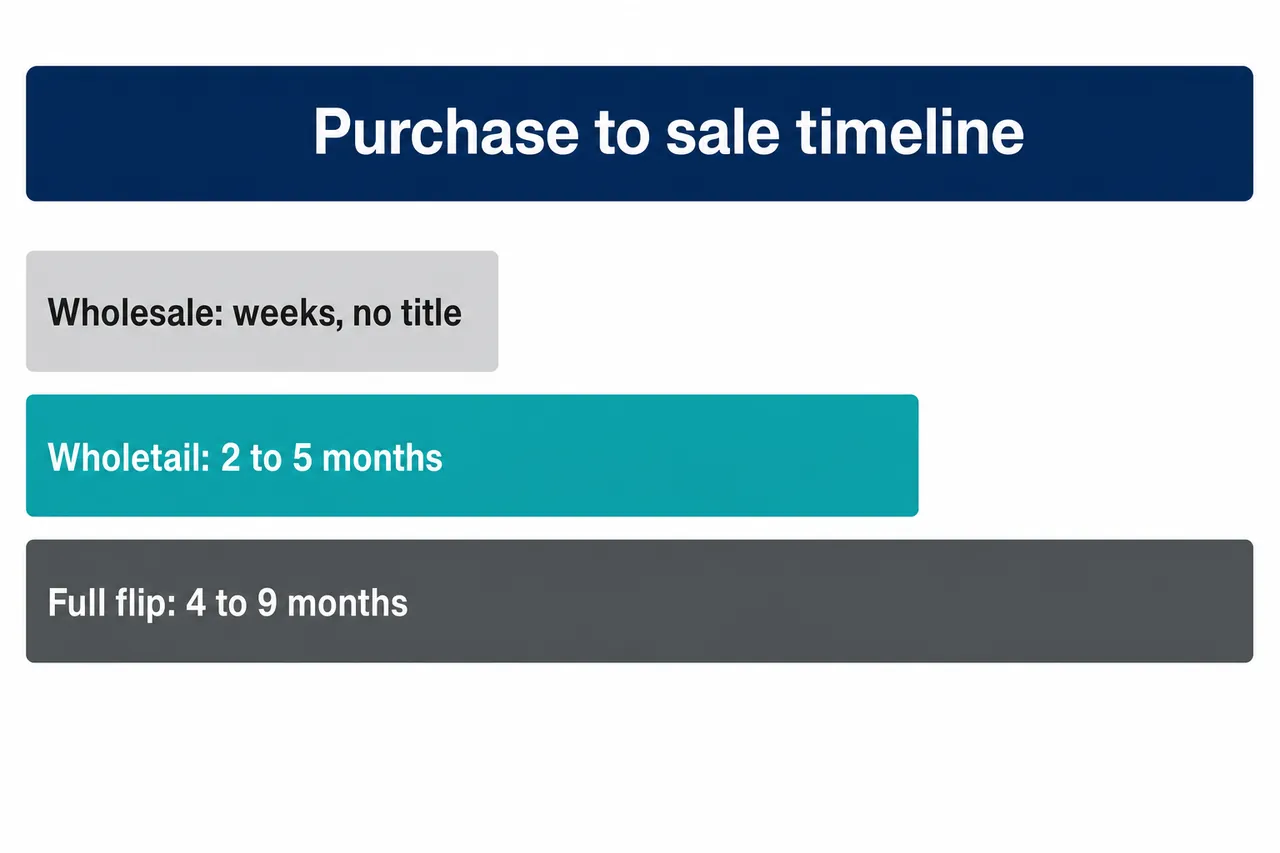
| Factor | Wholesale | Wholetail | Full flip |
|---|---|---|---|
| Do you take title? | Usually no (assignment), sometimes a double close | Yes | Yes |
| Work done | None | Clean-out, paint, flooring, small repairs, curb appeal | Full renovation, often kitchens, baths, systems, layout |
| Typical buyer | Cash investor | Owner-occupant using a mortgage, sometimes a landlord | Owner-occupant |
| Capital needed | Earnest money and marketing | Down payment, work budget, holding and selling costs | Down payment, large rehab budget, longer holding costs |
| Typical timeline | Weeks | Roughly 2 to 5 months, purchase to sale | Often 4 to 9 months or more |
| Main risks | Not finding a buyer, legal and licensing limits on assignments | Overpaying, hidden defects, slow retail market | Budget overruns, contractor delays, market shifts during long hold |
| Selling costs | Low | Retail: commissions, closing costs, concessions | Retail: commissions, closing costs, concessions |
The practical takeaway: wholetailing works on houses that are too nice or too expensive for flippers and wholesalers, but still discounted relative to what a retail buyer would pay once the house shows well and qualifies for a mortgage. If you want the full picture of the other two exits, the wholesaling guide and the fix-and-flip guide cover each in depth.
Back to topWhat makes a property a wholetail candidate
Most failed wholetails were never wholetails. The investor bought a project house and hoped light work would be enough. Screen hard before you make an offer.

The big systems are sound
Roof, foundation, electrical, plumbing, sewer line and HVAC drive both your budget and your buyer's ability to get a loan. A wholetail candidate has these items in serviceable condition, even if they are not new. If one needs replacement, price it in and ask whether the deal still works as a light-touch project. One roof is a line item. A roof plus an electrical panel plus a furnace is a flip.
The problems are cosmetic, cleanliness or neglect
Good candidates usually look worse than they are. Common examples:
- Estate homes full of belongings, with worn carpet and old paint
- Rentals after a long-term tenant moves out, with wear and deferred touch-ups
- Homes with smoke or pet odor, overgrown yards or dirty kitchens that photograph badly
- Listed homes that sat on the market because of poor photos, bad pricing or a seller who would not prepare the house
These issues scare off retail buyers and make the house unappealing in listing photos. Yet they cost relatively little to fix. That gap is the opportunity.
The house will qualify for buyer financing after light work
Your end buyer will most likely use a conventional, FHA, VA or USDA loan. Government-backed loans in particular have property condition standards that commonly cover peeling paint on older homes, missing handrails, nonworking utilities, and safety and roof issues. Requirements vary by loan program and are updated over time, so ask a loan officer which condition items commonly trip up appraisals in your area. If the house cannot pass after your planned work, your buyer pool shrinks to cash buyers and your price drops.
The neighborhood has retail demand at the as-is-plus price
Look for areas where owner-occupants actively buy homes with original or dated finishes, often first-time buyers or buyers who plan to renovate over time. Pull recent sales of comparable homes that sold in similar dated but clean condition, not just the fully renovated ones.
Red flags that push a deal out of wholetail territory
- Foundation movement, active water intrusion or significant mold
- Unpermitted additions, garage conversions or basement bedrooms you cannot legally market as such
- Knob-and-tube or other wiring that insurers or lenders may reject (rules vary, so check with an insurer and lender)
- Failing septic or sewer lines
- Title problems such as unresolved liens, missing heirs or boundary disputes
The light-touch work: what to do and what to skip
The goal is the highest sale price per dollar and per day spent. Every item should either remove a reason a buyer would walk away or a reason a lender would not lend.
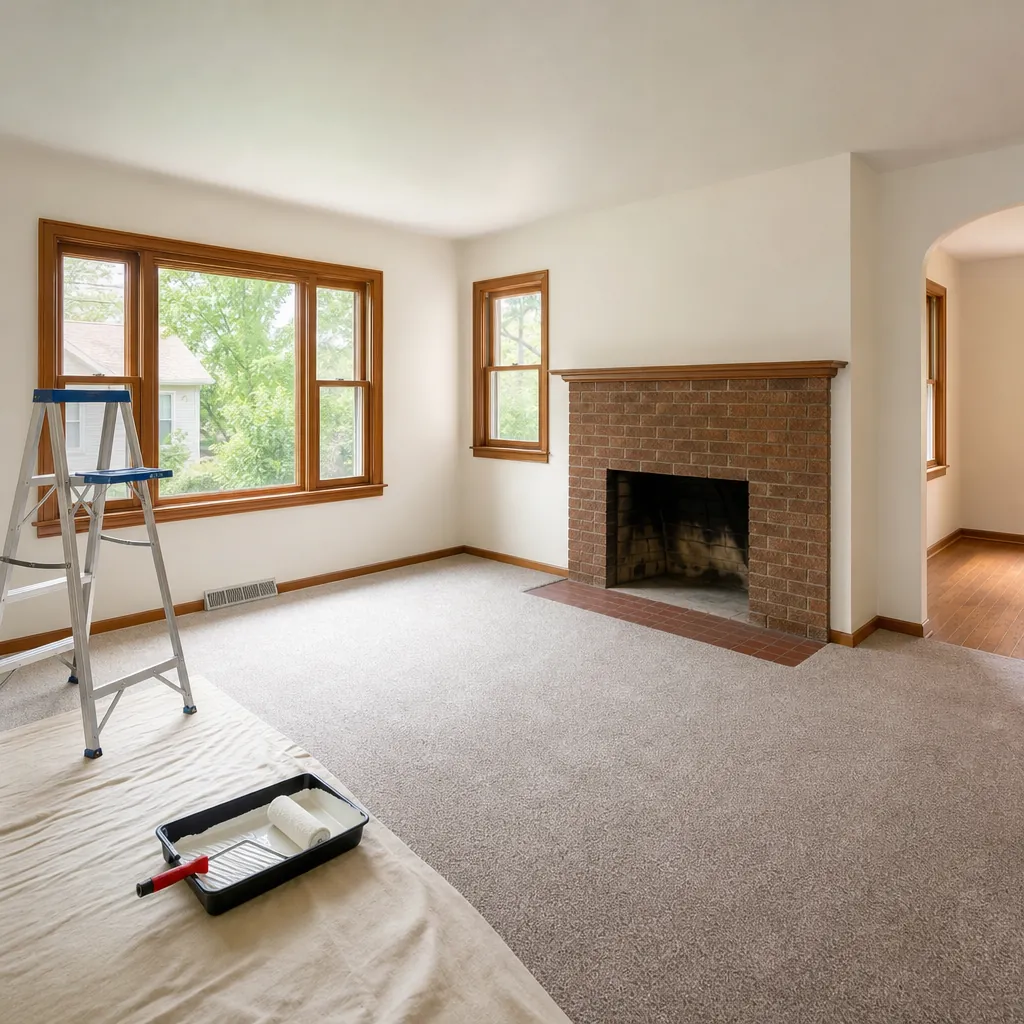
1. Clean-out and deep clean
Remove all belongings, debris and trash, including from the attic, garage and sheds. Then do a professional-level clean: kitchens, baths, windows, vents. Odor removal matters more than many investors expect, because smoke and pet odors drive away buyers at showings. Budget for a dumpster or junk removal crew. On estate properties, confirm in writing with the seller or estate representative what conveys with the house before anything is thrown out.
2. Paint and flooring
Neutral interior paint and replacement of stained or worn carpet are often the highest-return items in a wholetail. Durable, mid-grade flooring is enough. Refinishing existing hardwood is frequently cheaper than replacing anything. Skip feature walls, designer finishes and anything that turns the job into a remodel.
3. Safety and function items
- Working smoke and carbon monoxide detectors (local requirements vary)
- Handrails, broken steps, trip hazards
- Missing outlet covers, nonfunctioning GFCI outlets where expected
- Leaking faucets, running toilets, broken windows, doors that do not latch
- HVAC service and filter, water heater check
These items are inexpensive, show up on buyer inspections, and can cost you far more in renegotiation than they cost to fix up front.
4. Curb appeal and photo readiness
Mow, trim, mulch, clean gutters, pressure wash, replace a broken mailbox or porch light. Most buyers decide whether to visit based on listing photos, so make the front of the house and the main rooms look clean and bright. Light fixtures and cabinet hardware are cheap changes that photograph well.
What to skip
Kitchen and bath remodels, layout changes, additions, high-end appliances and anything requiring significant permits. If you find yourself pricing those, rerun the numbers as a flip and compare the two exits honestly. Also note that even minor work can require permits in some jurisdictions, for example water heater replacement or electrical changes. Check with your local building department before you start, and hire licensed trades where your state requires it.
Back to topRunning the numbers on a wholetail
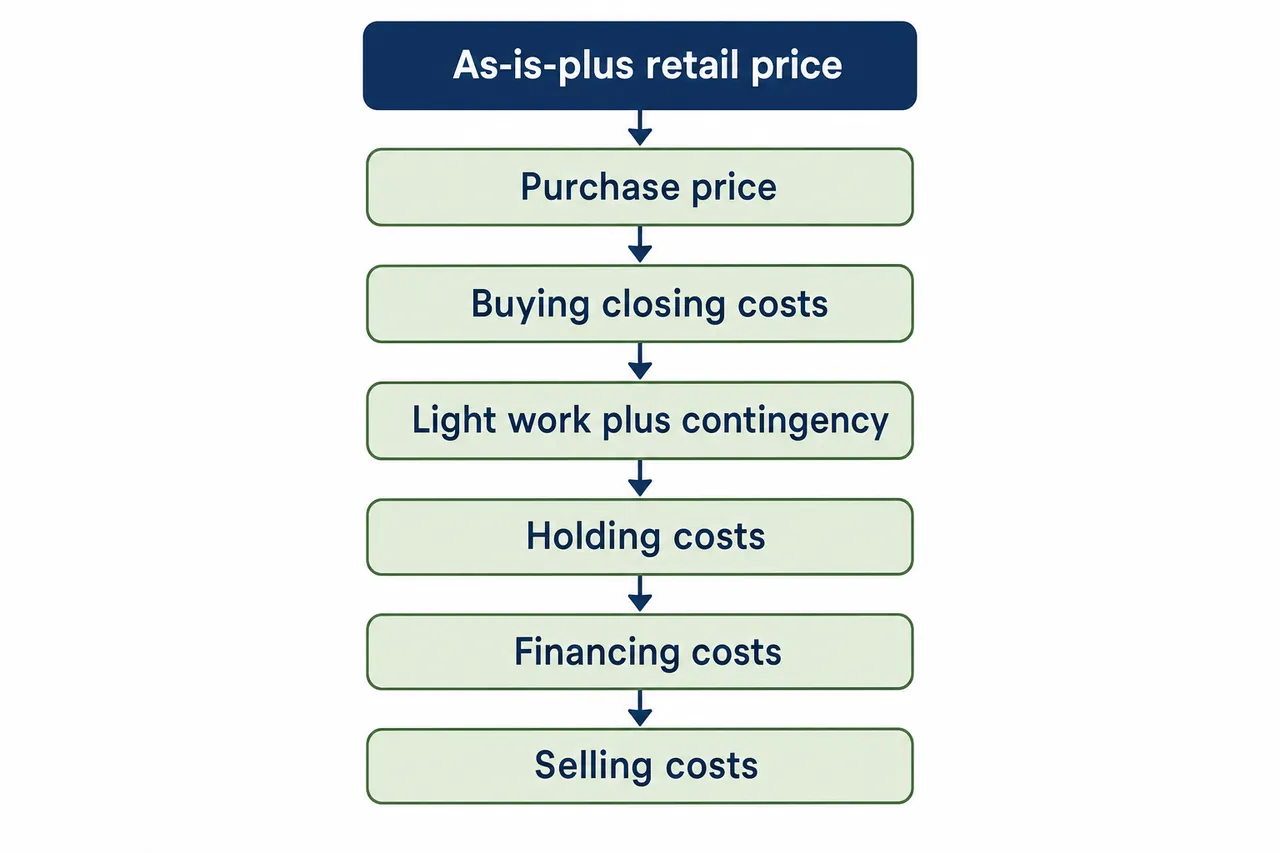
Start from the as-is-plus retail price, not the ARV
Flippers work backward from the after repair value (ARV), the price of a fully renovated house. Wholetailers work backward from a different number: what the house will sell for to a retail buyer after the light work, still with dated finishes. Pull comparable sales of clean, livable, unrenovated homes. Then adjust for size, condition and location. The best comps are homes that sold to financed buyers in that condition within the last several months.
Knowing the full ARV still helps, because it tells you what a flipper would pay. Run the property through the 70 percent rule calculator to see the maximum offer a typical flipper would make. Wholetail deals often exist at purchase prices above that number. That is why wholetailers can win houses that flippers and wholesalers pass on.
The cost stack
List every cost from contract to closing on the sale:
- Purchase price
- Buying closing costs: title, escrow, recording, any transfer taxes paid by the buyer in your area, inspection
- Light work budget plus a contingency, for example 10% to 20% of the work budget
- Holding costs: property taxes, insurance (vacant homes often need a vacant or builder's risk policy, so ask your agent), utilities, lawn care, HOA dues
- Financing costs: interest, points, lender fees
- Selling costs: listing and buyer-agent compensation (negotiable and handled differently since recent industry rule changes, so budget for both sides unless you know otherwise), seller closing costs, transfer taxes where the seller pays, and buyer concessions
The fix and flip calculator handles this cost structure well. Enter the light work budget as your rehab cost and the as-is-plus price as your sale price.
Example deal (illustrative numbers)
A three-bedroom ranch comes from an estate. It is full of furniture and has original carpet, smoke-stained walls and an overgrown yard. Inspection finds the roof, furnace and water heater serviceable and the sewer line clear. Fully renovated homes nearby sell for about $300,000. Clean, dated homes of similar size sell for about $265,000. The investor buys for $195,000 with a short-term loan covering 80% of the purchase price, at an illustrative 11% interest and 2 points. The work takes about four weeks. The total plan is three months from purchase to sale closing.
| Line item | Amount | How it is calculated |
|---|---|---|
| Purchase price | $195,000 | Negotiated with the estate |
| Buying closing costs | $3,000 | Title, recording, inspection, misc. |
| Light work | $14,000 | Clean-out $2,500, paint $4,500, carpet and flooring $4,000, repairs and safety items $1,800, landscaping $1,200 |
| Contingency | $2,500 | About 18% of the work budget |
| Holding costs | $2,700 | $900 per month for taxes, insurance, utilities x 3 months |
| Loan interest | $4,290 | $156,000 loan x 11% / 12 = $1,430 per month x 3 months |
| Loan points | $3,120 | 2% of $156,000 |
| Agent compensation | $13,250 | 5% of $265,000 (illustrative; negotiable) |
| Seller closing costs | $3,975 | About 1.5% of $265,000 |
| Total costs | $241,835 | Sum of the lines above |
| Sale price | $265,000 | As-is-plus retail comps |
| Profit before tax | $23,165 | $265,000 - $241,835 |
Cash invested: $39,000 down payment + $3,000 closing + $3,120 points + $14,000 work + $2,500 contingency + $2,700 holding + $4,290 interest = $68,610. The return is $23,165 / $68,610, about 34% on cash over roughly three months. That assumes the contingency is fully spent. If it is not, profit rises by the unspent amount.
Compare the other exits on the same house:
- Flipper's view: 70% of $300,000 is $210,000. Subtract an estimated $45,000 full renovation, and the maximum offer is $165,000. A flipper would not pay $195,000.
- Full flip at $195,000 anyway: $45,000 rehab plus $5,000 contingency, six months of holding ($5,400) and interest ($8,580), the same $3,120 points, and selling costs of about $19,500 on a $300,000 sale. Total costs come to about $284,600, for roughly $15,400 profit. That is less money, twice the time and far more construction risk.
- Wholesaler's view: to assign the contract to a flipper, a wholesaler would need it under contract around $155,000 to leave room for a fee. The estate would not accept that, so there is no wholesale deal at this price.
Stress test before you commit
Rerun the example with two things going wrong. Suppose the sale price comes in at $255,000 and the hold stretches to five months. Holding rises by $1,800 and interest by $2,860. Selling costs drop by about $650 on the lower price. Profit falls to roughly $8,600. The deal still works, but barely. If a modest price miss plus a slower sale wipes out your profit, you are paying too much. Also decide your fallback exit in advance. Could it rent for enough to cover a refinance? Could you sell as-is to an investor without a loss?
Back to topFinancing a wholetail
Because you take title, you need real purchase money. Common options:
- Cash. Cash buys quickly, wins competitive estate and as-is sales, and avoids loan costs. The trade-off is capital tied up in one house at a time.
- Hard money or short-term investor loans. These lenders fund quickly and size loans to purchase price and value. Terms such as rate, points, loan-to-cost and draw rules vary widely, so compare the total cost over your expected hold rather than the rate alone.
- Private money. Loans from individuals, usually secured by a recorded lien. Use a real estate attorney to document the loan. Securities and lending rules can apply when you raise money from others, and they vary by state.
- HELOC or other credit lines. These can cover a down payment or a whole purchase. You are putting other property at risk, so plan conservatively.
- Seller financing. Some estate and tired-landlord sellers prefer installments or a short-term note. Use the seller financing calculator to model payments and any balloon. Have an attorney review due-on-sale issues if the seller has an existing mortgage.
Resale timing and your buyer's loan
Your buyer's lender will look at how recently you bought the house. FHA rules restrict insuring loans on homes resold within 90 days of the seller's acquisition. Additional documentation, such as a second appraisal, can apply to some resales within the following months when the price rises sharply. Conventional lenders and appraisers may also ask for your purchase price and an explanation of the value increase. Rules change, so confirm current requirements with a loan officer before you set a listing date. Keep receipts and before-and-after photos to support the appraisal.
Back to topFinding and buying wholetail deals
Wholetail leads come from the same places as other investor deals. The difference is that you screen for condition rather than discount alone. The guide to finding motivated sellers covers lead generation in detail. The most common wholetail sources are:
- Estates and probate sales. Heirs who live elsewhere often value speed and not having to empty the house more than squeezing out the last dollar.
- Tired landlords. Owners selling after a tenant leaves, when the house needs a clean and touch-ups.
- Stale MLS listings. Homes with poor photos, cluttered rooms or overpricing that sat on the market. An agent can help you spot them and make clean offers.
- Wholesalers. A wholesaler's deal may be too thin for a flipper but fine for a wholetail. Verify every number yourself.
- Bank-owned and auction properties. These can work, but inspection access is often limited. Price that uncertainty into your offer, and confirm what title insurance will and will not cover.
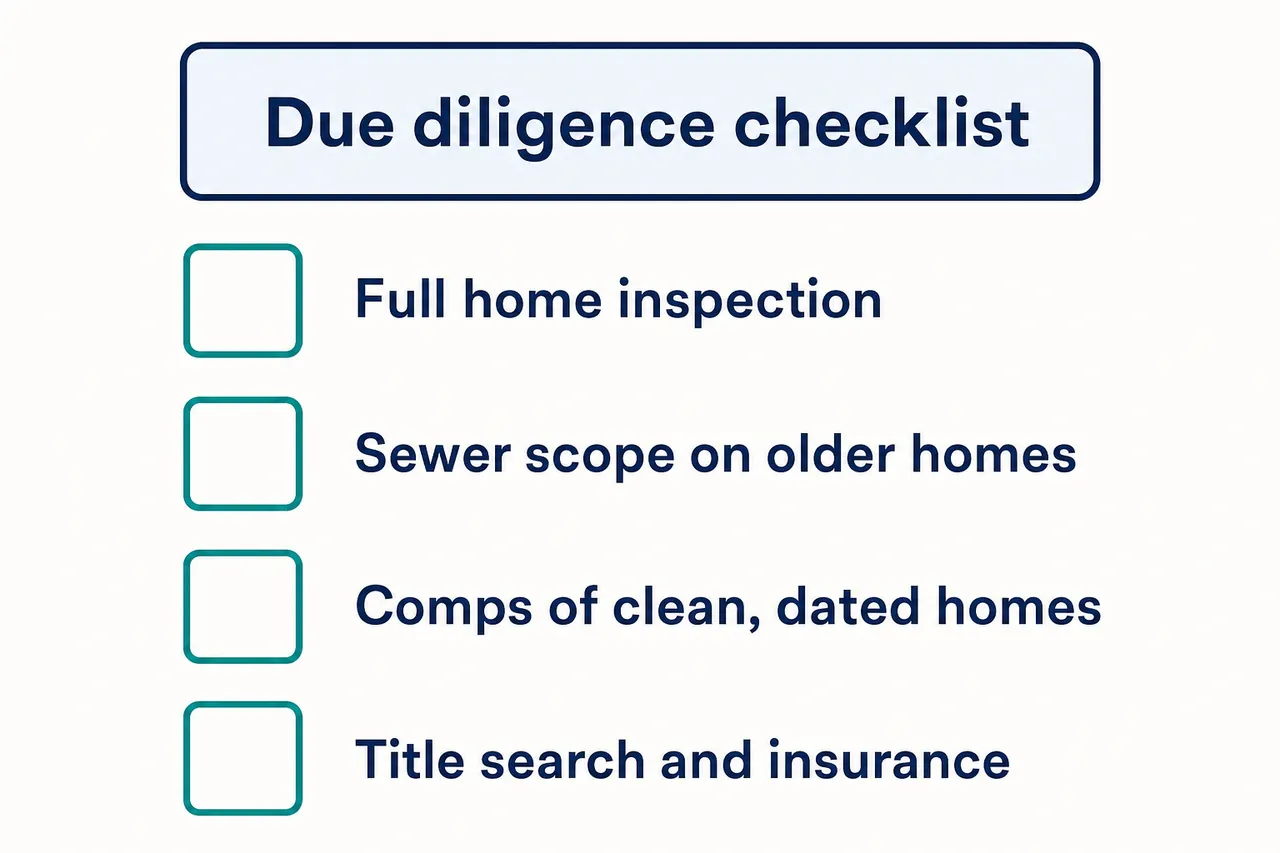
Due diligence checklist
- Full home inspection, plus a sewer scope on older homes and other specialist inspections as needed
- Comparable sales of clean, dated homes, not just renovated ones
- Title search and title insurance commitment; check for liens, code violations and open permits
- Insurance quote for a vacant property during your hold
- Local permit requirements for your planned work
- A lender conversation about condition items for your likely buyer's loan type
- Written scope and bids for the light work before you remove contingencies
Selling the wholetail
Pricing
Price from the as-is-plus comps, not from the renovated ones. Overpricing a dated house next to renovated listings is the fastest way to sit through weeks of holding costs. Pricing at or slightly below the comps often produces faster offers and fewer appraisal problems.

Listing and marketing
Most wholetails sell through an agent on the MLS, because that is where financed retail buyers search. Invest in professional photos and an accurate description. Do not hide the dated finishes; frame them, for example as an updated, clean home ready for the buyer's personal touches. Whether you need a license to sell your own property, and how you must disclose if you hold a license, varies by state. Check with your state's real estate commission or a real estate attorney.
Disclosures and inspections
Disclosure laws vary by state. Investor-sellers who never lived in the house are still typically expected to disclose known material defects, and anything your own inspection found counts as known. Ask a real estate attorney what your state requires. Many wholetailers order a pre-listing inspection or share their purchase inspection along with repair receipts. That reduces surprises during the buyer's inspection period.
Negotiating with buyers
Expect requests for repairs or credits, especially from buyers using government-backed loans. Decide in advance what you will fix, what you will credit and what you will decline. Seller-paid closing cost help can widen your buyer pool. Build it into your numbers rather than treating it as a surprise.
If it does not sell
Set checkpoints, for example after two and four weeks on market. If showings are low, the problem is usually price or photos. If showings are high but there are no offers, the problem is usually condition or price compared with what buyers saw elsewhere. Adjust early. Each extra month costs real money, as the stress test above showed.
Back to topTaxes and legal points to check
- Income tax treatment. Short holding periods usually mean any gain is short-term rather than long-term capital gain. Investors who buy and resell regularly may be treated as dealers, with profits taxed as ordinary income and possible self-employment tax. A CPA should review your situation. The capital gains tax calculator can help you see how holding period changes the estimate.
- 1031 exchanges. Property held primarily for resale generally does not qualify for a like-kind exchange. Confirm with a CPA or qualified intermediary before you plan around one.
- Entity and insurance. Many investors buy in an LLC. Lending, insurance and liability implications vary, so discuss them with an attorney and insurance agent.
- Contractor and permit rules. Licensing requirements for trades and permit thresholds vary by state and city.
- Older homes. Federal rules require lead-based paint disclosures when selling homes built before 1978. Renovation work that disturbs paint in those homes can trigger lead-safe work practice requirements. Confirm what applies with your contractor and local authorities.
When wholetailing beats the other exits
Wholetailing tends to be the strongest exit when:
- The house is mostly sound, so the gap between as-is and retail comes from mess, paint, flooring and presentation
- The purchase price is above what flippers would pay, which shuts out wholesale and flip exits
- Owner-occupant demand for dated but clean homes is steady in the area
- You want shorter holds and less construction risk than a full rehab
- Your capital is limited and you would rather do several smaller projects than one big one
Another exit is usually better when:
- The discount is deep and the house needs major work. A full flip or a wholesale assignment fits better. The house flipping guide covers scoping larger renovations.
- You found a deal but lack the cash to close. Wholesaling it may be the safer play.
- Rents are strong compared with the price. Keeping the house after the same light work can build long-term value. Model it with the rental property calculator. Check whether a rental loan would work using the DSCR calculator. If you plan to refinance out your capital, review the BRRRR approach.
- Retail demand is weak or falling. Long days on market erase the thin margins that wholetails depend on.
Common mistakes
- Using renovated comps to set the sale price. Your house will sell like a clean, dated house, not like a remodel.
- Skipping inspections because the work is light. The whole strategy depends on big systems being sound. One missed sewer line or roof can erase the profit.
- Scope creep. Adding a kitchen here and a bath there turns a three-month wholetail into a six-month flip with a wholetail budget.
- Underbudgeting selling costs. Agent compensation, seller closing costs, transfer taxes and buyer concessions together often make up the largest cost after the purchase price.
- Ignoring buyer financing rules. Listing too soon after purchase, or leaving condition items a lender will flag, can collapse a deal at appraisal.
- Insuring a vacant house on the wrong policy. Standard homeowner policies may limit or exclude coverage for vacant homes.
- No fallback exit. Decide before closing what you will do if the house does not sell: reduce price, rent it, or sell to an investor.
- Weak disclosures. Hiding known defects invites legal trouble. Disclose what your state requires and what you know.
Where to go next
- See how assignment and wholetail economics differ in wholesale vs wholetail.
- Compare single-family exits side by side in the single-family investing guide.
- If a wholetail candidate rents well, read the long-term rental investing guide before you list it.
- Run your purchase, work and sale numbers through the fix and flip and 70 percent rule calculators linked above before every offer.
Back to top
Back to top
All our wholetailing articles
Wholetailing articles on KDS Development, grouped so you can go deeper on any part of this guide. Newest first.
Comparisons
Frequently asked questions
What is wholetailing in real estate?
Wholetailing means buying a property at a discount, closing on it yourself, doing light work such as a clean-out, paint, flooring and small repairs, and selling it on the retail market, usually to an owner-occupant with a mortgage.
How is wholetailing different from wholesaling?
A wholesaler typically assigns a purchase contract to another investor without taking title or doing any work. A wholetailer buys the property, carries the holding costs and risk, improves it lightly, and sells to retail buyers, usually at a higher price than an investor would pay.
How much work is too much for a wholetail?
If the plan involves replacing kitchens or baths, changing the layout, or replacing several major systems, it has become a flip. A wholetail stays focused on cleaning, cosmetic updates, safety items and curb appeal, usually in a few weeks.
Do I need a real estate license to wholetail?
Selling property you own generally does not require a license, but rules vary by state. Licensed agents who sell their own investment properties usually have extra disclosure duties. Check with your state's real estate commission or a real estate attorney.
Can my buyer use an FHA loan on a wholetail?
Often, yes, but FHA restricts financing on homes resold within 90 days of the seller's purchase, and extra documentation can apply to some later resales. The house must also meet the program's condition standards. Confirm current rules with a loan officer before listing.
How are wholetail profits taxed?
Because holds are short, gains are usually short-term, and frequent buyers and resellers may be treated as dealers with ordinary income treatment. Tax treatment depends on your situation, so review it with a CPA before your first deal.
Back to top