

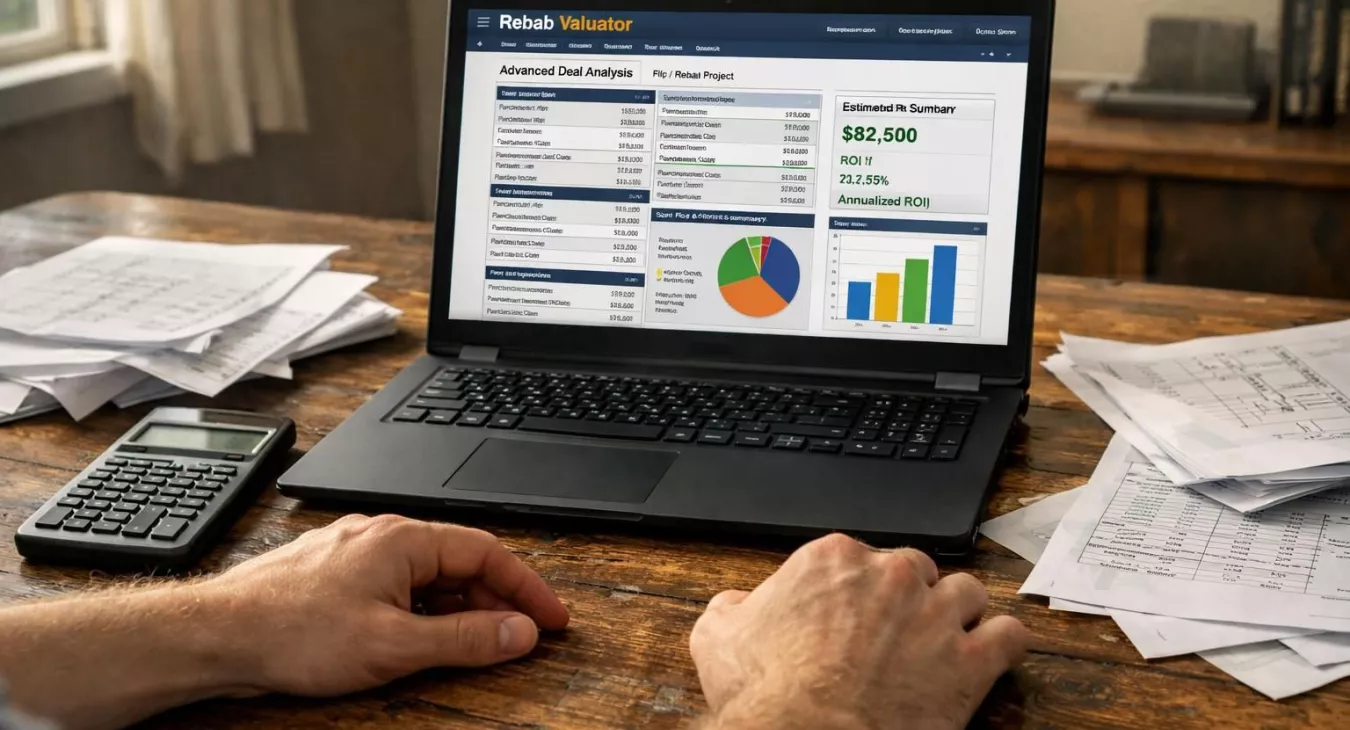
Master flip project management with our rehab valuator review. Learn essential tools and strategies to boost your real estate investing success.
Products and Tools Mentioned in this Post

Rehab Valuator
Rehab Valuator is fix and flip software that helps real estate investors analyze deals, manage rehab budgets, and create professional reports for lenders.
Rehab Valuator Review: Flip Project Management

New to fix-and-flip? Start with our Fix-and-Flip Guide.
Every real estate investor faces tough choices when flipping houses. Many new investors think they can manage flip projects without solid tools, but inaccurate cost estimating and poor cash flow planning often lead to trouble.
This rehab valuator review will show you how smart investors use modern deal analysis tools to avoid costly mistakes. You will see how accurate after repair value (ARV) calculations, reliable comps, and easy-to-use dashboards help streamline your house flipping process. 1
With over 20 monthly deals closed by leaders like Jackie Coffey of Four Point Investment Group, proven systems matter in real estate investing. Insights from experienced property managers are built into this guide to help you get ahead fast in project management for flips.
Keep reading if you want clear steps toward higher returns on your next investment property. 2
Key Takeaways
- Rehab Valuator helps real estate investors manage flip projects by offering tools for deal analysis, ARV and MAO calculations, accurate comps, and rehab cost estimates.
- Jackie Coffey of Four Point Investment Group used these features to close over 20 deals per month and reach $500,000 to $10 million in yearly net profit (Source: Article).
- Unlike Trello or Asana, Rehab Valuator streamlines project scheduling with drag-and-drop dashboards tailored for real estate. It supports clear budget tracking and stakeholder reports.
- The software makes it easy to track every dollar spent on labor, materials, permits, and contingency funds. Customizable templates help secure private money funding through professional proposals (Source: Section 4).
- Real-life stories show how strong cost controls and detailed data entry protect against theft or unreliable contractors—key risks that Jackie faced early in her career (Citation: Section 5).
Key Features of Rehab Valuator

Rehab Valuator gives you powerful tools to analyze real estate investments and manage flip projects. You get clear insights that help make smarter choices in house flipping and property investment.
Deal Analysis and Underwriting Tools
Deal analysis tools in this software give you a fast and detailed look at your real estate investments. You can run full investment projections using current comps, interest rates, property taxes, bank financing options, down payments, and title insurance costs.
This helps you see profit potential quickly. Use these tools to test lump sum cash deals or private money funding models side by side for each flip project.
You will find the underwriting system offers clear support for risk assessment and exit strategies. Quickly generate presentations to share with lenders or partners using built-in templates designed for funding proposals and marketing materials.
Many investors prefer this platform over PropStream since it targets only the most useful data relevant to house flipping projects. Other general task manager tools like Trello or Asana took more of your time without offering deal-specific insights that drive better decision-making for active real estate professionals.
From personal experience as a chief operating officer on actual flips, I found these features save hours every week managing multiple deals across different states. The ability to review key metrics such as debt coverage ratio, cap rate performance, and cash flow projections in one place significantly improved outcomes during tight deadlines.
The software’s focus on ease of use ensures even new entrepreneurs get up to speed quickly while seasoned house flippers gain an edge through precise data control throughout their property investment process.
After Repair Value (ARV) Calculations
Accurate ARV calculations drive smart real estate investing. Use the ARV formula to estimate a property’s market value after renovations: Property Purchase Price plus Renovation Cost. 1 For example, if you buy a house for $150,000 and plan repairs of $40,000, your preliminary ARV stands at $190,000. Professional investors like you rely on this figure to forecast cash flow, project cap rate returns, and structure private money funding offers.
Rehab Valuator streamlines ARV estimates by pulling comps from recent sales within any market area. Locate similar properties that sold in the last six months; compare their condition and size to your target house.
The software enables quick side-by-side reviews of these comps (comparables). This approach helps pinpoint fair after repair value with less guesswork.
Apply industry rules such as the 70% rule to determine pricing limits and risk thresholds. If your estimated ARV is $200,000 and expected repairs total $50,000, using the formula MAO equals ($200K x 70%) minus $50K yields a maximum allowable offer of $90K.
With Rehab Valuator’s tools on hand, create professional funding proposals or marketing materials backed by data-driven analysis trusted by experienced real estate investors nationwide.
Rehab Cost Estimation
Rehab Valuator gives you the power to estimate rehab costs and set a realistic project budget before making an offer. The software lets you input expenses for labor, materials, permits, and contingency funds in real time.
You can track each item and compare your estimates against market comps to avoid overpaying or underestimating repairs.
If you have ever lost money by hiring unreliable contractors or buying overpriced materials, this tool helps prevent those costly mistakes. Real-time reporting allows you to spot material theft or budget overruns early.
Rehab cost estimation links directly into your deal analysis, after repair value (ARV), and maximum allowable offer (MAO) calculations. With accurate numbers at every step, you lower risk and boost cash on cash returns in house flipping projects.
Maximum Allowable Offer (MAO) Generation
Maximum Allowable Offer (MAO) generation empowers you to make smart, competitive offers in real estate investing. The platform calculates MAO using the industry-standard formula: MAO equals after repair value (ARV) multiplied by 70 percent, then subtract the estimated renovation cost.
This approach helps you avoid overpaying for house flipping opportunities and reduces risk during deal negotiation.
You can instantly model different financing scenarios and see how private money funding affects your maximum offer. Automated calculations offer clear confidence when underwriting deals with tight profit margins or tough comps.
Every step fits into a structured workflow that supports transparent decision-making and effective project management for flips.
Back to topBenefits of Using Rehab Valuator

Rehab Valuator gives you smarter real estate investing by using comps, cash flow, cap rate, and after repair value to help you manage house flipping projects with confidence—read more to see how it can transform your approach.
Streamlined Project Management for Flips
You can manage your house flipping projects faster and with less stress using Rehab Valuator. The drag-and-drop project scheduler lets you plan each phase, move tasks around, and track progress in seconds.
This tool saved me hours compared to clunky spreadsheets and older apps like Basecamp or Monday.com. You will see all timelines, budgets, and milestones on a single dashboard. 2
Track every dollar with real-time budget updates as you upload receipts or adjust costs. Avoid cost overruns by catching issues early through automatic alerts built into the platform.
Keep deals moving by managing multiple rehab projects at once; I found this far more efficient than trying to juggle files across several tools.
The software supports clear communication between you and contractors using shareable templates for scopes of work. Generate reports for private money funding partners or stakeholders in two clicks thanks to the built-in reporting features.
Switch between different financing models quickly if your cash flow changes mid-project or your cap rate targets shift after reviewing comps data from recent sales nearby. 2
Accurate Profit Projections
Accurate profit projections drive smart decisions for real estate investing. Rehab Valuator uses real-time data to calculate ARV, MAO, rehab costs, and comps. These tools help model different scenarios and show clear cash flow expectations.
If project variables change, the system lets you update numbers quickly so your forecasts stay reliable.
Strong budgeting features in this software protect your house flipping profits by reducing surprise expenses. Users in private money funding have reported earning between $500,000 and $10 million in yearly net profit with disciplined projections like these.
Clear analysis tools also improve cap rate estimates for both short- and long-term deals. Using accurate profit forecasting supports steady business growth and makes it easier to attract investors with professional marketing materials or funding proposals.
Reduced Risk in Deal Analysis
The analytical tools in Rehab Valuator help you avoid overpaying for properties. Structured deal analysis flags red flags before a contract gets signed, allowing you to see potential pitfalls early.
Real-time budget tracking ensures that material theft or contractor problems do not derail your investment. After facing unreliable partners firsthand, I learned that tight contracts and data-driven decisions protect your business during real estate investing. 3
You can use precise cost and after repair value (ARV) calculations to steer clear of risky house flipping deals. Enhanced reporting features add another layer of transparency and accountability, making it easier to spot unexpected repair costs quickly.
The software’s support for comps lets investors compare deals with confidence while private money funding proposals provide clarity for lenders from the start. These protections reduce surprises and losses as you grow your entrepreneurial real estate portfolio.
Enhanced Decision-Making for Investors
Clear data leads to smart choices in real estate investing. Rehab Valuator gives you instant access to comps and after repair value (ARV) figures, so you can compare deals with confidence.
You no longer need to make guesses or rely on gut feelings. Instead, strategic thinking becomes your edge. With every flip project, you see risk and reward clearly before making a commitment.
You can generate customizable reports for private money funding proposals or share detailed profit projections with stakeholders. In my experience as an investor, having these tools has shifted decisions from emotional reactions to grounded analysis.
Real-time analysis helps you spot market changes fast and evaluate new opportunities without delay.
Educational resources like live webinars guide users through deal analysis and cash flow forecasting step by step. Greater accuracy in rehab cost calculations reduces surprises during renovations.
Over time, this approach builds financial independence by turning each house flipping opportunity into a well-informed decision backed by strong numbers and clear methods.
Back to topHow Rehab Valuator Assists in Flip Project Management

Rehab Valuator helps you keep your flip projects running on schedule and within budget. The platform supports real estate investors by improving control over project tasks using automated tracking features.
Tracking Expenses and Budgets
Tracking expenses and budgets is vital for profitable house flipping. You need the right tools to stay organized and make smart money decisions in real estate investing.
- Expense tracking software keeps your project’s finances clear and simple, helping you avoid surprise costs.
- Real-time budget monitoring lets you catch overspending early, which can stop theft or material overpayments.
- QuickBooks Online works well with rehab valuator, offering a clean way to keep your bookkeeping organized throughout a project.
- Budgeting tools in rehab valuator allow you to adjust spending as new challenges come up, giving you flexibility on flip projects.
- Every dollar spent gets tracked against your initial budget, making it easier to find gaps and protect cash flow.
- You can monitor costs down to labor or single materials, supporting strong cap rates and healthy profit margins.
- Financial reports are easy to generate; they help investors review operations with transparency and confidence.
- Accurate expense records simplify communication with private money lenders who want proof of responsible fund management and ARV projections.
- Tracking spending throughout the flip process shows where your team can maximize efficiency for future deals and business growth.
- Consistent budget updates ensure your house flipping stays sustainable in both good and challenging markets.
I use both QuickBooks Online for standard accounting and rehab valuator for detailed deal tracking. This system saves time during tax season, prevents headaches from missing receipts, and helps secure private money funding with strong financial reports every time you evaluate comps or send marketing materials.
Managing Timelines and Deadlines
Staying on schedule is vital for successful house flipping projects. 4 Effective timeline management with the right tools boosts both efficiency and profit in real estate investing.
- Use Rehab Valuator’s drag-and-drop scheduler to plan every phase of your flip project in detail. 5
- Benefit from real-time tracking of key deadlines and construction milestones across all stages.
- The software automatically alerts you before major deadlines, keeping private money funding partners and contractors accountable.
- Shifting from Trello or Asana to Rehab Valuator provides focused project scheduling tailored for real estate professionals and investors.
- Proactive updates on rehab costs, cash flow, and cap rate can reduce risks that are common in house flipping.
- Staying updated through the dashboard helps you spot potential delays early, improving overall project outcomes.
- Investors report that tighter tracking has led to better after repair value (ARV) results on their flips.
- Timely delivery of funding proposals and marketing materials to stakeholders gives you a professional edge in competitive markets.
Simplifying Communication with Contractors
Clear communication with contractors can make or break a real estate investing project. Rehab Valuator offers tools that support transparency and accountability throughout your house flipping journey.
- Share your project timelines, budgets, and deliverables directly with your contractors through customizable reports.
- Communicate expectations using centralized data management, which reduces errors and miscommunication.
- Track agreements within the platform for easy reference during disputes or change orders.
- Update stakeholders on rehab status in real time, helping you avoid project abandonment by unreliable contractors.
- Use built-in documentation features to keep contractors accountable for each task and milestone.
- Rely on transparent reporting to justify private money funding requests and clarify comps for everyone involved.
- Generate marketing materials and funding proposals that outline roles, costs, and timelines for all parties to see.
- Prevent common pitfalls that lead to lost cash flow or inflated cap rate projections through regular documented interaction.
- Apply these communication methods to ensure each contractor understands their responsibilities before work begins.
Customizable Reporting for Stakeholders
Rehab Valuator gives you powerful reporting tools that support your house flipping projects. You can share key project information with investors, lenders, and contractors using custom reports.
- Tailor the reporting suite to match the needs of different stakeholders such as private money lenders, real estate investing partners, or your contractor team.
- Use templates provided in the software to report financials, market comparables (comps), cash flow projections, cap rate calculations, and project milestones for each deal. 2
- Create funding proposals quickly by adjusting reports for after repair value (arv) estimates and budget breakdowns; this is a crucial step in securing private money funding for flips.
- Build marketing materials for investor presentations straight from Rehab Valuator based on real project data; these reports help build trust and credibility.
- Customize every report to match your audience so they get only the most relevant information without clutter or confusion.
- Track ongoing communication by sharing updated expense sheets and timeline progress; this keeps everyone informed about deadlines and performance on your flip projects.
- Support future fund-raising by documenting successful outcomes in detailed reports that showcase both profits earned and risks managed.
- Streamline workflow with regular status updates using customizable templates; these plug gaps between planning, execution, and stakeholder reporting.
- Boost transparency across all parties involved in real estate investing deals because comprehensive reporting reduces miscommunication over costs or timelines.
- Enhance investor confidence and open doors for new entrepreneurship opportunities with well-designed reports from Rehab Valuator; complement these with visual elements using Canva for an even stronger impact.
I have found that combining Rehab Valuator's detailed financial pages with graphics made in Canva leads to more effective presentations during funding meetings or partner calls. 2
Back to topUser Testimonials and Success Stories

Many successful real estate investors have used Rehab Valuator to manage their house flipping projects. Their stories show how you can boost cash flow, secure private money funding, and build winning marketing materials with this tool.
Real-Life Examples of Successful Flips
Jackie Coffey entered real estate investing after her family lost their home. She secured private money funding for her first house flip by making 202 calls. Material theft cost her $20,000 and unreliable contractors slowed progress.
Jackie stepped in to help renovate the property herself. Despite selling the first house without profit, she tracked expenses, used comps to estimate after repair value (ARV), and learned from mistakes.
With help from tools like Rehab Valuator, Jackie streamlined her project management and improved deal analysis skills over time. Her brother’s advice drove her to take ownership of both failures and wins.
Now she closes more than 20 deals per month with annual net profits ranging from $500,000 up to $10 million. You can use project management features such as cash flow tracking, marketing materials creation, MAO generation, and customizable reporting to mimic these successes on your own flips.
Insights from Experienced Real Estate Investors
Women like Jackie have broken ground in real estate investing, building their businesses with persistence and grit. You will face skepticism and self-doubt at times, especially if you are a woman or minority in this industry.
Early on, Jackie encountered dishonest contractors and bad partners who put her projects at risk. She strengthened her business by tightening contracts and learning to trust her gut instincts.
Education remains vital for long-term growth. Many investors study books, watch property investing content on YouTube, and join strong networks for mentorship. Strategic thinking beats emotional reactions when deals get tough or unexpected costs threaten cash flow projections.
Networking has proven more powerful than paid marketing; most of Jackie's best leads came from building genuine relationships rather than cold tactics.
Seasoned professionals stress the value of accurate comps and detailed rehab cost estimation within tools like Rehab Valuator. These steps help set realistic after repair value (ARV) targets while managing risk throughout house flipping projects.
Setting an example inspires others: Stories like Jackie’s motivate new investors—especially women—to pursue leadership roles in real estate investing for themselves and their families' futures.
Back to topRehab Valuator Review

You will notice serious upgrades in flip project management when you use Rehab Valuator. This platform helped me move beyond cluttered systems like Trello and Asana. You can analyze deals, estimate rehab costs, calculate after repair value (ARV), and generate maximum allowable offers (MAO) with fewer steps than on PropStream.
The software’s streamlined dashboards mean less information overload and more focus on profit projections, comps research, cash flow analysis, and cap rate calculations.
Customizable templates make your presentations stand out for private money funding or investor meetings. Rehab Valuator organizes every expense line and tracks budget changes clearly for each house flipping project.
Registering a free account gets you instant access to essential training resources; the $1 test drive removes risk from trying out the full suite of tools. I also run my educational content through Kajabi alongside this software for seamless backend automation; both platforms pair well together for real estate investing success.
Back to topComparing Rehab Valuator to Other Tools
Rehab Valuator stands out from platforms like Realeflow and PropertyFixer with its strong deal analysis features. You can also spot clearer differences in pricing and private money funding support compared to traditional property spreadsheets.
Key Differentiators in Features and Pricing
You get a unified platform that blends deal analysis, rehab cost estimation, ARV calculations, and MAO generation. Competing tools often make you juggle multiple apps or spreadsheets for these tasks.
This software offers real estate investors instant access to comps data, cap rate numbers, and cash flow analysis all in one place. You track expenses with a drag-and-drop scheduler while communicating directly with contractors—saving valuable time.
The pricing model suits both new flippers and experienced pros. You can test drive the paid version for only $1 or sign up for a free account packed with house flipping resources and training materials.
Competitors may charge extra for customizable templates or ongoing educational support; here you receive both included at no added cost. Ongoing webinars help you learn how to maximize private money funding or boost profit projections on every flip project.
Limitations of Alternative Software Solutions
Many project management tools, like Trello and Asana, fall short for house flipping. They often make you spend too much time setting up tasks instead of analyzing real estate deals or tracking rehab costs.
These platforms do not provide the focused, actionable data required for real estate investing success. Instead, they often create more work with complicated boards and checklists that do not tie into comps or private money funding calculations. 6
PropStream may seem powerful but can overwhelm you with too much information. Information overload slows decision-making and can cause missed opportunities in cash flow projections or ARV calculations.
Many alternative solutions also lack true integration options with other critical applications used in real estate investing, making it harder to streamline your workflow.
Existing intelligent software offers limited support for social rehabilitation activities as well as narrow personalization features helpful to investors’ needs. Most systems need professional collaboration just to set up basic decision-support functions; this makes daily use less practical for those wanting a fast turnaround on flip projects.
Personalized reporting or stakeholder updates become challenging if the tools do not focus on investor-specific requirements tied closely to actual deal analysis outcomes. 6
Back to topTips for Maximizing Rehab Valuator’s Potential
You can unlock deeper insights by exploring custom deal templates and using real comps for better property analysis. Smart use of Rehab Valuator’s project management tools helps you track every step of your house flipping projects with accuracy.
Best Practices for Inputting Data
Enter comparable sales data from the last six months to ensure accurate After Repair Value (ARV) calculations. Always check comps against recent neighborhood activity using trusted industry tools and resources, such as MLS or PropStream.
Avoid guessing numbers; use verified market rates and historical pricing for materials to prevent overpaying during house flipping projects.
Update expenses and project timelines in real time inside Rehab Valuator. Consistently track every cost related to labor, permits, private money funding fees, and unexpected expenses.
Log all rehab costs with detailed notes based on hands-on experience. Reliable data entry supports better profit projections for your real estate investing business and reduces risk of budget overruns or material theft.
Learn from any input errors by reviewing past deals, then adjust your process for stronger results moving forward.
Leveraging Custom Templates for Deals
Rehab Valuator provides customizable templates that real estate investors use to create professional reports and presentations. You can tailor these templates for specific audiences like private money lenders, buyers, or contractors.
Adjust them as project requirements change to keep your materials current. Using these tools helps you maintain consistency across multiple investment properties.
Templates in Rehab Valuator save you time by streamlining deal analysis and stakeholder communication. You quickly generate documents that support comps, accurate profit projections, and fundraising efforts without extra design work.
Many users combine Rehab Valuator with Canva for enhanced branding on marketing pieces or investor pitches; this creates a polished look every time. Customizable templates give your real estate investing business an edge by ensuring all your documentation looks credible and stays organized throughout each flip project management cycle.
Back to topConclusion
Choosing smart tools can shape your success in real estate investing. Rehab Valuator stands out as a robust platform for managing flip projects, tracking costs, and funding deals with private money.
You gain clearer insights, improve communication with contractors, and can make confident decisions faster. Learn from industry leaders like Jackie Coffey who scale their business using the right software solutions.
Start simplifying your next house flip today and see how strong project management adds up to bigger returns.
Back to topFAQs
1. What is Rehab Valuator and how does it help with flip project management?
Rehab Valuator is a software tool designed to streamline flip project management for real estate investors. It helps users estimate repair costs, analyze potential profits, and organize tasks in one place.
2. Can Rehab Valuator improve accuracy in estimating rehab costs?
Yes, Rehab Valuator provides detailed templates that guide users through cost estimation. This reduces errors and helps ensure more accurate budgets for each flip project.
3. Does using Rehab Valuator save time during the flipping process?
Rehab Valuator automates many steps of flip project management such as budget creation and deal analysis. These features cut down on manual work and speed up decision-making.
4. Is Rehab Valuator suitable for both new and experienced real estate investors?
The platform offers tools that benefit both beginners learning about flip projects and seasoned investors who want reliable data-driven insights to manage multiple deals efficiently.
References
- ^ https://www.wallstreetprep.com/knowledge/after-repair-value-arv/
- ^ https://rehabvaluator.com/
- ^ https://www.canada.ca/content/dam/esdc-edsc/documents/corporate/portfolio/labour/programs/employment-equity/reports/act-review-task-force/EEA-Review-Task-Force-Report-2023.pdf?v=1752710400022
- ^ https://www.flipperforce.com/how-to-flip-houses/managing-your-rehab-project/rehab-project-timeline
- ^ https://rehabvaluator.com/rehab-project-scheduler
- ^ https://pmc.ncbi.nlm.nih.gov/articles/PMC12565718/