

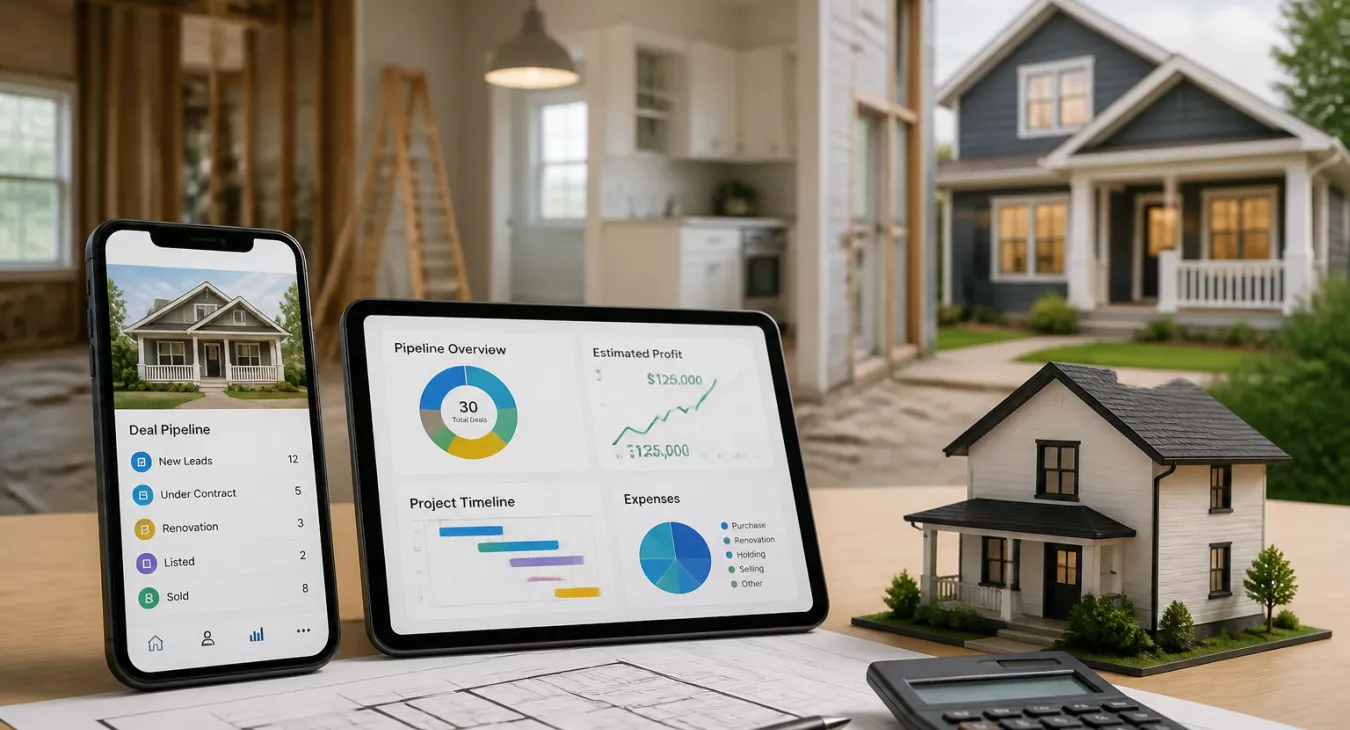
Discover the best house flipping apps to maximize profits, streamline renovations, and manage deals efficiently. Find your ideal tool today.
Products and Tools Mentioned in this Post

Propstream
Detailed information on Propstream. Get How-To's, reviews, Comparisons, and much more.



Matterport
Matterport creates immersive 3D virtual tours and digital twins for real estate. Capture properties with professional-grade technology and share interactive experiences.
Table of Contents
- what's a House Flipping App?
- Best House Flipping Apps by Category
- Top House Flipping Apps: Detailed Reviews
- Full App Comparison Table
- Deal Analysis Feature Matrix
- How to Choose the Right House Flipping App
- Using House Flipping Apps to Increase ROI
- Common Mistakes When Using House Flipping Apps
- House Flipping Apps for Home Design
- Future of House Flipping Technology
- Conclusion: Building Your House Flipping Tech Stack
- Frequently Asked Questions
The difference between a profitable flip and a money pit? Your decision-making process. And increasingly, that's powered by technology. Whether you're analyzing your first deal or juggling a portfolio of simultaneous rehabs, the right house flipping app can slash your timelines, tighten your numbers, and keep projects from hemorrhaging cash over budget. ATTOM Data Solutions reported that the average gross flipping profit in 2024 hit approximately $73,500 per transaction — but that margin disappears fast without disciplined systems. Here's what you need to know. This guide breaks down the top house flipping apps by category, gives you honest reviews, and shows you exactly how to pick the right tools for your investing strategy.
New to house flipping? Start with our House Flipping Guide.

what's a House Flipping App?

Definition and Purpose
A house flipping app is software. You'll find it on mobile devices, desktops, or both—built specifically to handle one or more phases of the flipping process. Finding deals, evaluating them, estimating rehab costs, managing your contractors, tracking timelines, pulling comps, marketing the finished property—it's all in there. But here's what separates these tools from your generic project management software: they're built with real estate math baked in. ARV calculations, the 70% rule, rehab cost databases that actually know your local market. That's the difference.
How House Flipping Apps Work
You punch in the numbers—purchase price, repair estimate, holding costs, financing details. The app runs those inputs through established investment formulas and spits out what matters: your MAO, projected profit margin, cash-on-cash return. And the stronger platforms? They don't stop there. MLS comp pulls, contractor task management, photo documentation, CRM for tracking leads—these platforms can handle the whole operation. The real test: does it integrate with how you already work, or does it just create more busywork?
Who Should Use These Apps?
There's actually two completely different groups hunting for "house flipping app." First, you've got casual users and gamers. They're looking for apps like House Flipper or Design Home—entertainment software that simulates renovation without any real money on the line. Then there's everyone else. Active real estate investors, wholesalers, agents, and contractors who actually need professional-grade software to run a business that makes money. Which group are you in? If you're flipping properties for real, you need tools that work with real numbers, real deadlines, and real team collaboration. Games don't cut it.
Back to topBest House Flipping Apps by Category
Here's the thing—most investors waste time chasing deals they shouldn't touch. That's where app selection matters. House flipping apps break down into four primary categories, and each one handles a different part of your investment cycle. Figure out which phase is killing your deals, then pick the right tool.
| Category | Primary Purpose | Target User | Key Features | Top App Example |
|---|---|---|---|---|
| Deal Analysis & Calculators | Evaluate investment viability | Investors, wholesalers | ARV, MAO, ROI, cash flow projections | DealCheck |
| Project Management | Manage rehab timelines and budgets | Investors, contractors | Task scheduling, cost tracking, photo docs | FlipperForce |
| Design & Visualization | Plan layouts and present renovations | Investors, designers, agents | Floor plans, AR visualization, mood boards | MagicPlan |
| Market Research & Comps | Identify markets and analyze sales data | Investors, agents | Comp analysis, market trends, neighborhood data | Realeflow |
Top House Flipping Apps: Detailed Reviews
We've tested these against what actually matters to fix-and-flip investors: feature depth, accuracy, ease of use, collaboration tools, mobile access, and ROI. Each review breaks down the specs, the real-world wins, and the gotchas. For a broader look at the software landscape, check out our guide to the Best House Flipping Software 2026.
DealCheck
Best for: Deal analysis and property screening
DealCheck is everywhere in the investor world for a reason. The platform handles fix-and-flip analysis, rental comps, BRRRR strategy modeling, and wholesale calcs all in one clean interface across iOS, Android, and web. Punch in your purchase price, financing, rehab costs, and holding expenses — it spits out ARV projections, cash-on-cash returns, and profit breakdowns instantly.
The comp pull feature is a game-changer. You're not bouncing between three tabs anymore. And the shareable deal reports? That's how you get money partners and lenders to move fast. The free tier covers three properties, which is plenty to kick the tires before upgrading.
- Pricing: Free (3 properties); Starter at $10/month; Pro at $20/month; Plus at $30/month
- Platform: iOS, Android, Web
- Pros: Full analysis formulas, shareable reports, comp pull integration, clean UI
- Cons: Limited project management features; comp data can lag in some markets
- Best for: Investors who analyze high volumes of deals and need fast, accurate screening
FlipperForce
Best for: End-to-end rehab project management
This is the only platform built specifically for house flippers. Not a construction tool shoehorned into flipping. Not a generic PM system. FlipperForce does the full pipeline: deal analysis, scope of work, Gantt charts, budget tracking, contractor collaboration. All under one roof.
The rehab estimating library is what separates it from everything else. Pre-priced line items tailored to your local market. That cuts weeks of busywork building scopes from scratch. The investor-ready reports also mean you're not manually putting together capital decks. Want the deep dive? Read our full FlipperForce Review 2026.
- Pricing: Starter at $49/month; Pro at $99/month; Team at $149/month
- Platform: Web, iOS, Android
- Pros: Full rehab estimating, Gantt scheduling, contractor portal, investor reports
- Cons: Higher price point; learning curve for new users; no native CRM
- Best for: Active flippers managing multiple projects with contractor teams
Realeflow
Best for: Lead generation, CRM, and market research
Realeflow's playing a different game entirely. It's not just a deal calculator — it's a full real estate investment operating system combining lead sourcing, CRM, deal analysis, and direct mail all in one subscription. Need a quick repair estimate? The Hammerpoint tool gets you there fast, though it's not as precise as line-item building.
Where Realeflow wins is deal sourcing. Their motivated seller database and built-in direct mail system mean you're not stuck waiting for MLS crumbs. They even throw in a website builder for your investor brand. But here's the catch: you'll want a dedicated CRM for maximum firepower. Check our Best CRM for Real Estate Investors 2026 guide for the heavy hitters.
- Pricing: Basic at $75/month; Pro at $125/month; Team at $175/month
- Platform: Web, iOS, Android
- Pros: All-in-one platform, lead generation, CRM integration, marketing tools
- Cons: Repair estimator is less granular; higher cost for full feature set
- Best for: Investors who need deal sourcing and pipeline management in one platform
MagicPlan
Best for: Floor plan creation and design visualization
Point your phone at a room. Wait three minutes. You've got a floor plan that used to require a surveyor and a $2K invoice. MagicPlan's AR scanning generates accurate layouts so fast you can scope properties in half the time. Better scopes mean better contractor bids. Better bids mean less cost creep.
The cost estimation layer is slick — assign rehab dollars directly to specific rooms and tasks right on the floor plan. If you're a visual thinker, this beats spreadsheets. Exports to PDF, JPG, and DXF, and plays nice with Houzz for design reference.
- Pricing: Free (basic floor plans); Starter at $9.99/month; Business at $49/month; Enterprise custom pricing
- Platform: iOS, Android
- Pros: Fast floor plan creation, AR scanning, cost estimation integration, multiple export formats
- Cons: Mobile-only limits some workflows; precision depends on scan quality
- Best for: Investors and contractors who need fast, accurate property documentation
House Flipper Home Design (Game)
Best for: Entertainment and conceptual design inspiration
It's a game. Not a business tool.
House Flipper Home Design is the most downloaded "house flipping app" in app stores. It's also why we need to be clear about what it is: a mobile simulation where you buy virtual properties, renovate them, and pocket fake profits. It's entertaining. You'll learn renovation sequences. But there's zero applicability to real deals. No financial modeling. No market data. No contractor management. Think of it as inspiration for design direction — nothing more.
- Pricing: Free with in-app purchases
- Platform: iOS, Android, PC (Steam)
- Best for: Entertainment only; not suitable for real estate investment decisions
Other Notable Apps
Property Evaluator does solid deal analysis on iOS with clean interface and multi-unit support. Buildium and AppFolio make sense if you're scaling into hold strategy — strong property management bones, though they're not built for flipping. See our Best Property Management Software 2026 roundup for full details. CoStar and PropStream go deep on market research and comp analysis if you're doing data-heavy analysis. Houzz Pro works if you're flipping high-end luxury — solid design visualization and client communication features that actually matter for that market segment.
Back to topFull App Comparison Table
Here's what you won't find anywhere else — a complete feature and pricing breakdown side-by-side. No need to bounce between ten different websites trying to piece together what each tool actually does or costs.
| App Name | Type | Primary Features | Starting Price | Platform | Best For |
|---|---|---|---|---|---|
| DealCheck | Deal Analysis | ARV, MAO, comp pulls, shareable reports | Free / $10/mo | iOS, Android, Web | High-volume deal screening |
| FlipperForce | Project Management | Estimating, Gantt charts, contractor portal | $49/mo | iOS, Android, Web | Active flippers, multi-project management |
| Realeflow | All-in-One Platform | Lead gen, CRM, repair estimator, marketing | $75/mo | iOS, Android, Web | Investors needing deal sourcing |
| MagicPlan | Design & Visualization | AR floor plans, room scanning, cost mapping | Free / $9.99/mo | iOS, Android | Floor plan creation, scope documentation |
| PropStream | Market Research | Comp analysis, skip tracing, market data | $99/mo | iOS, Android, Web | Market analysis, motivated seller lists |
| Property Evaluator | Deal Analysis | ROI, cash flow, multi-unit analysis | $9.99 one-time | iOS | iOS users needing quick deal analysis |
| Houzz Pro | Design & Client Mgmt | Mood boards, AR visualization, client portal | $65/mo | iOS, Android, Web | High-end flips and design-forward projects |
| CoStar | Market Research | Commercial data, analytics, comp reports | Custom pricing | Web, iOS, Android | Commercial/mixed-use investors |
| Matterport | 3D Visualization | 3D property tours, digital twins, AR | Free / $9.99/mo | iOS, Android, Web | Marketing finished flips to buyers |
| House Flipper Game | Entertainment | Simulation, renovation gameplay | Free (IAP) | iOS, Android, PC | Entertainment only |
Deal Analysis Feature Matrix
Here's what separates the serious platforms from the pretenders: a breakdown of which analytical features actually ship with each tool. This is where most investors get tripped up when comparing software.

| Feature | DealCheck | FlipperForce | Realeflow | Property Evaluator |
|---|---|---|---|---|
| ARV Calculation | ✓ | ✓ | ✓ | ✓ |
| 70% Rule / MAO | ✓ | ✓ | ✓ | ✓ |
| In-App Comp Pulls | ✓ | Limited | ✓ | ✗ |
| Repair Cost Estimating | Basic | ✓ (advanced) | ✓ (Hammerpoint) | ✗ |
| Holding Cost Modeling | ✓ | ✓ | ✓ | ✓ |
| Financing Scenarios | ✓ | ✓ | Limited | ✓ |
| Shareable Reports | ✓ | ✓ | ✓ | Limited |
| Multi-Property Portfolio View | ✓ | ✓ | ✓ | ✗ |
| BRRRR Strategy Support | ✓ | ✗ | ✗ | Limited |
How to Choose the Right House Flipping App

Assessing Your Needs
Forget the pricing page for now. First, you need an honest look at what's actually broken in your workflow. Where are deals falling through the cracks? Are your rehab estimates so far off they're killing your margin? Contractors running behind schedule and tanking your timeline? Or are you spending three hours analyzing deals when you should be looking at ten? That problem — your biggest constraint right now — that's what determines which app category to tackle first.
Here's the thing: most experienced flippers don't hunt for one perfect platform. They stack two or three complementary tools instead. DealCheck for quick deal screening, FlipperForce for on-site project management. It works.
Comparing Features and Pricing
The feature list on the marketing page means nothing. What matters is how those features actually perform when you're live on a deal. That rehab estimator claiming full functionality? If it requires 45 minutes of manual data entry per project, it's dead weight in a fast market. Look for apps with pre-populated databases, smart templates, and intelligent defaults you can tweak instead of building from scratch.
Free trials aren't optional here — they're standard. Use one with a real deal and run your market's numbers through it. How accurate is the output compared to your actual costs?
Now, the money side. Six flips a year at $99/month sounds expensive until one app prevents one costly mistake and pays for itself ten times over. But if you're doing one or two deals annually? Start with the free tier on DealCheck or MagicPlan. No subscription until you've proven ROI.
Integration and Automation
The right app is the one that actually fits your existing tech stack, not the one with the shiniest interface. Before you buy, verify integration with QuickBooks — especially critical for expense tracking — your CRM, and whatever communication tools you're already using. FlipperForce connects directly to QuickBooks, which saves hours on expense reporting.
And poor integrations? They'll kill your productivity faster than anything else. Duplicate data entry across systems is a silent profit drain in most real estate operations.
Need a broader look at contractor tools? Check our Best Contractor Software 2026 guide for the full comparison.
Mobile vs. Desktop Capabilities
You're not running this business from a desk. You're at properties, in the field, talking to contractors and suppliers. That's where your app actually needs to work.
Offline functionality isn't a nice-to-have — it's critical. Poor cell service on a job site shouldn't lock you out of photo capture, task updates, or contractor check-ins. Evaluate the mobile experience completely separate from the desktop version. Many platforms have solid web portals but weak mobile apps, and that imbalance will frustrate you.
Confirm the app supports offline data entry with automatic sync once you've got connectivity restored. That workflow matters more than you'd think in the field.
Back to topUsing House Flipping Apps to Increase ROI
Deal Analysis for Better Decisions
Here's the truth: improved deal screening is where house flipping apps actually move your ROI needle. Most investors who wing it—trusting their gut or scribbling rough numbers on a napkin—end up overpaying or drastically underestimating repair costs. Those are the two mistakes that kill flips. Apps like DealCheck force you to get disciplined. You input every variable, and it spits back a profit projection you can actually defend. Better yet, you've got a paper trail of your assumptions to review later and learn from. Want to know which markets are actually worth flipping in right now? Check out our Best Markets for House Flipping in 2026 guide for current data on top-performing metros.
Budget Management and Cost Estimation
Budget overruns kill more flips than bad bones do. A 2023 BiggerPockets survey found that over 62% of real estate investors blew their original budget by more than 15% on at least one project. That's not a coincidence—it's a pattern. Project management apps designed for flips solve this with line-item budget tracking that flags variances in real-time, not three months later when it's too late. A contractor submits an invoice that's over budget on drywall? The system flags it immediately. You investigate before the problem compounds into a hemorrhage.
Timeline Tracking and Project Management
Days matter. Every week your property sits unsold is money walking out the door—carrying costs, financing costs, opportunity costs, all of it. That's why tools like FlipperForce give you Gantt charts that visualize your entire project timeline in one place. You can see exactly how the plumber running three days late affects the drywall crew's schedule. Adjust accordingly. Proactive scheduling like this typically shaves one to two weeks off your average flip timeline. And those weeks go straight to your bottom line. Want deeper-dive tools? Our Best Construction Project Management Software 2026 comparison breaks down more sophisticated options.
Marketing Renovated Properties
Once the flip's done, it's showtime. Apps like Matterport let you create immersive 3D virtual tours—and the numbers speak for themselves. Properties with 3D tours get up to 87% more views than listings without them, according to Matterport's data. Pair that with solid digital marketing and you'll crush your days-on-market targets. Need the full post-flip marketing stack? See our Best Real Estate Marketing Tools 2026 guide.
Back to topCommon Mistakes When Using House Flipping Apps

Relying Too Heavily on Automated Estimates
No algorithm beats boots on the ground. Apps spit out repair estimates based on square footage and condition scores — fine for initial screening, but that's it. You need a licensed contractor walking the property before you make an offer. Here's the thing: use automated estimates to filter deals worth pursuing. Then use professional estimates to decide your actual bid. Most investors flip this backwards, and it costs them money.
Ignoring Local Market Data
Your app's national comp database can be wildly off. Markets with low transaction volume, fast-moving prices, or quirky properties won't show up accurately in a national dataset. Always cross-reference app-generated comps against your local MLS or talk to an agent who knows the area. Before you jump into a new market, check out our Best Markets for House Flipping in 2026 article. Current regional analysis matters, and it can save you from getting caught in a soft market.
Poor Data Entry and Maintenance
Your app is only as good as what you feed it. Investors who plug in optimistic repair numbers, skip holding costs, or ignore actual spend as work gets done? They're living in a fantasy. Start with accurate, complete data from day one. And here's the discipline part: after every flip, compare your estimates to what actually happened. That's how you get better at this.
Neglecting Mobile Field Features
Real estate investors who sit in their office using desktop only are missing half the value. Contractor check-ins. Photo documentation tied to specific line items. Real-time punch lists. These features only work when someone's actually on-site using the app. Make it mandatory — contractors and project managers need to be logging in at the property, not emailing updates days later. Want to know which tools work best in the field? Our Best Field Service Management Software for Contractors guide breaks down the purpose-built options.
Back to topHouse Flipping Apps for Home Design

Gaming vs. Professional Design Apps
You'll see House Flipper Home Design, Design Home, and their clones dominating the app store charts with millions of downloads. They're fun. But here's the thing — they're entertainment, not tools. These games let you flip homes in a consequence-free sandbox where budget doesn't exist and contractors never show up late. That's the opposite of reality.
Professional visualization tools? That's a different category entirely. MagicPlan, Houzz Pro, and RoomSketcher actually produce deliverables. We're talking outputs contractors can bid from, outputs that work in permit applications, outputs you can show serious buyers or lenders.
Professional Design Tools for Investors
Here's the workflow that actually works: Start with MagicPlan's AR scanning to nail down an accurate floor plan. Then move into RoomSketcher or Houzz Pro for renovation layouts. Finally, create your buyer-facing presentation using Matterport's 3D tours on the completed property.
Total cost? Under $100/month across all three platforms.
And that investment pays for itself the moment you eliminate scope creep with your contractor. Vague floor plans breed vague scope of work documents — and vague scope documents breed change orders, cost overruns, and disputes. A locked-down floor plan with clear dimensions? That's your armor against the single biggest source of contractor headaches on every flip project.
Back to topFuture of House Flipping Technology

AI and Predictive Analytics
AI's already reshaping how you analyze deals. Platforms now offer AI-driven ARV predictions, neighborhood trajectory scoring, and automated comparable selection that kills human bias in comp analysis. Early adopters are seeing faster screening times and better offer accuracy. And the data backs it up. Want to dig deeper? Check out our AI Tools for Real Estate Investors: Complete Guide 2026 for the full picture of where AI intersects with real estate investing.
Augmented Reality Tools
AR's moved way beyond floor plan scanning. You can now overlay finished renovation concepts onto raw property photos using apps like IKEA Place and investor-focused tools — giving buyers and lenders a crystal-clear picture of your post-renovation vision before a single nail gets driven. This changes everything when you're negotiating earnest money or pitching to private lenders. The clearer you can communicate vision, the less perceived risk they see.
Blockchain and Smart Contracts
Still early days for blockchain in residential real estate, but it's catching fire in high-volume markets. Smart contract automation could slash your title and closing costs while speeding up transaction timelines — a game-changer if you're juggling multiple simultaneous closings. Expect mainstream adoption in three to five years. If you're running a high-volume wholesale operation, keep your eye on this one.
Integration Trends
The next generation of house flipping software won't win on standalone features. Winners will be the platforms that plug seamlessly into MLS data feeds, contractor payroll systems, lender portals, and accounting software. They'll command premium pricing because the operational efficiency gains justify it. Consolidation's coming fast — watch for the bigger real estate tech companies snapping up specialized tools to build full platforms.
Back to topConclusion: Building Your House Flipping Tech Stack
Here's the truth: the best house flipping app isn't one tool. It's a strategic mix of solutions built around your actual pain points. Most active investors need three core pieces. DealCheck handles deal screening. FlipperForce keeps projects on track. MagicPlan documents properties and visualizes the scope. And once your volume hits 20+ deals annually, market research platforms and CRM integration stop being nice-to-haves.
Start with your biggest money leak. Are you overpaying on acquisitions? Then fix your deal analysis first. Rehabs bleeding cash and time? Project management software is your answer. Can't source deals fast enough? Invest in lead generation platforms instead. One tool, one problem, 90 days of real data before you layer on anything else.
But here's what separates the winners from everyone else.
Technology only multiplies what you're already doing. And if you're sloppy with data entry or skip steps in your deal analysis, fancy software won't save you. The investors crushing it in 2026 aren't running the most complex stacks. They're the ones executing discipline across every single deal with clean, accurate data. That's the difference between a 25% ROI and 12%.
Back to topFrequently Asked Questions
what's the best free house flipping app for beginners?
DealCheck wins if you're serious about analyzing deals. You get three full property analyses on the free tier—enough to kick the tires on actual opportunities. ARV calculations, MAO, cash flow projections. It's all there.
Want to visualize the space? MagicPlan handles basic floor plans without charging you a dime. Pair these two together and you've got a legit toolkit. No credit card required, no gimmicks.
Back to top