


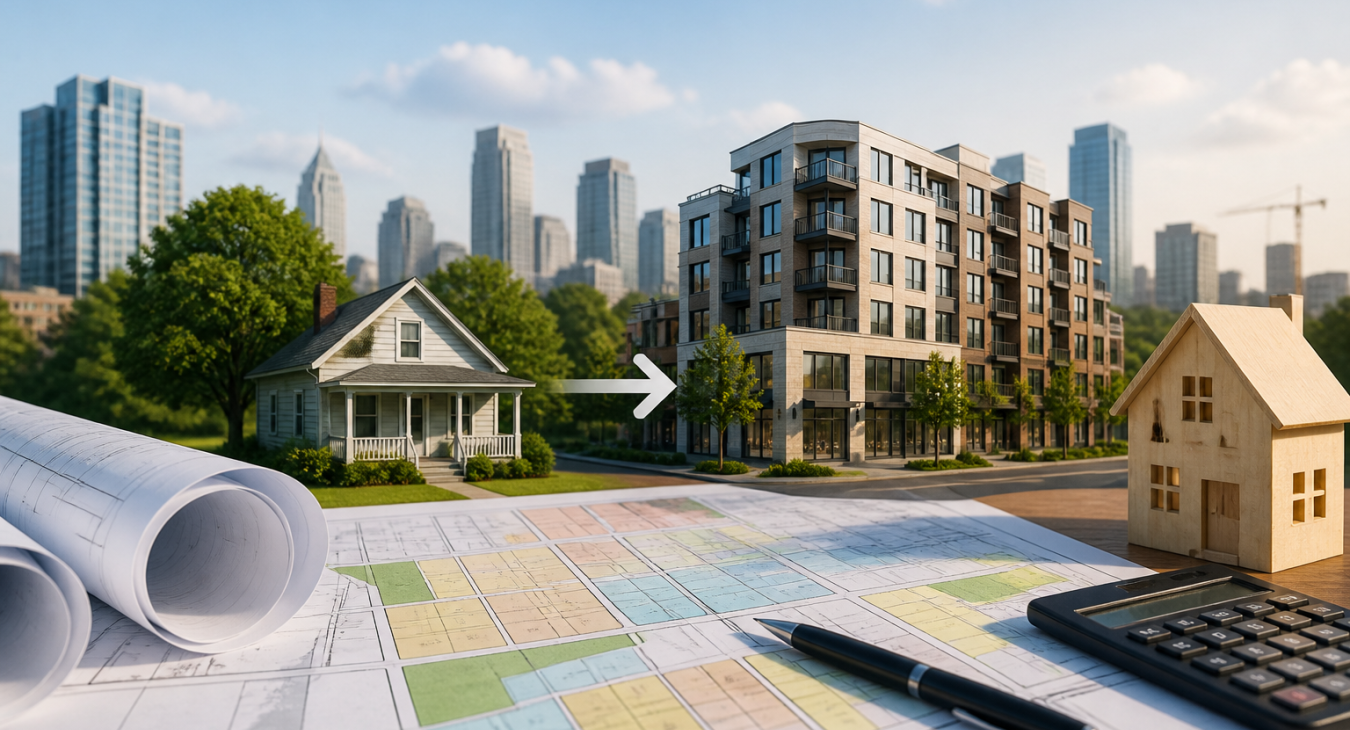
Learn how zoning variance real estate investing can unlock higher property values. Get expert strategies for variance approval, costs & profit potential.
Table of Contents
- What's a Zoning Variance?
- Types of Zoning Variances for Real Estate Investors
- How to Obtain a Zoning Variance
- Costs: What Investors Should Budget
- Criteria for Approving Zoning Variances
- Zoning Variance vs. Alternative Relief: Which Path to Take?
- Duration, Transferability, and Expiration
- Common Mistakes Investors Make
- Investor Strategies for Zoning Variance Success
- Conclusion
- Frequently Asked Questions
A zoning variance is one of the most powerful—and frankly, underutilized—tools in your playbook as a real estate investor. Most investors never even look at them. But here's the thing: when a property's stuck with outdated or overly restrictive zoning rules, a successfully obtained variance can unlock dramatically higher and better uses. You're turning a modest acquisition into a high-margin development opportunity. The process, though? It's highly localized, legally subtle, and far from guaranteed. This guide breaks down everything you need to know about zoning variance real estate investing: what variances actually are, how to get them approved, what they'll cost you, and how to build a real strategy around them.

What's a Zoning Variance?
Definition and Basic Concept
A zoning variance is permission from your local zoning board—usually called a Board of Zoning Appeals (BZA) or Board of Adjustment—to break the rules on one specific property. It doesn't rezone the land. Instead, it carves out a legal exception that acknowledges your particular situation makes strict compliance either impractical or unfair.
How Zoning Variances Differ from Other Zoning Exception
Here's where most investors stumble. You've got four different tools, and they're not interchangeable.
A conditional use permit (CUP) lets you do something the zoning code already allows—just under specific conditions attached to the approval. A special exception or special use permit works the same way: the use is already listed in the code as potentially acceptable, but the board has to review it first. A zoning amendment (or rezoning) actually changes the zoning map itself, which can affect your whole district or multiple properties. And a non-conforming use? That's a use or structure that was legal before someone changed the zoning, and grandfather clauses let it keep operating.
But a variance? That's a one-time exception for your specific parcel because enforcing the rules would create genuine hardship. And here's the critical part: if your code already permits the use conditionally, pursuing a CUP is faster and infinitely more defensible than fighting for a variance.
Back to topTypes of Zoning Variances for Real Estate Investors

| Variance Type | What It Covers | Common Investor Use | Relative Approval Difficulty |
|---|---|---|---|
| Area / Dimensional | Lot size, frontage, lot coverage percentage | Subdividing undersized lots; reducing minimum lot-size requirements | Moderate |
| Setback | Front, rear, or side yard setback distances | Maximizing buildable footprint; adding ADUs or additions | Moderate (commonly granted) |
| Height / Bulk | Building height, floor area ratio (FAR), density | Adding stories to multifamily or commercial buildings | High (neighborhood impact) |
| Use Variance | Allowing a land use the zone doesn't permit | Operating commercial use in residential zone; mixed-use conversion | Very High (most scrutinized) |
Use variances are brutal to get approved. Here's why: most jurisdictions view them as the functional equivalent of rezoning and require them to go through the legislative process instead. That means more scrutiny, more opposition, more time. Before you build your whole investment thesis around a use variance, talk to the municipality. Don't assume they even allow them—plenty don't.
One more thing that'll trip you up if you're not careful. Zoning code designations like "R-1" or "C-2" aren't standardized across the country. A 6,000-square-foot minimum lot in one county could mean a full acre in the next town over. You've got to pull the actual local ordinance and read it yourself. Making assumptions about what a variance would require is how investors end up walking away from deals that looked solid on paper.
Back to topHow to Obtain a Zoning Variance

The Variance Application Process
Every jurisdiction does this slightly differently. But the core steps? They're basically the same across the board.
- Pre-application meeting: Most municipalities want (or demand) a sit-down with planning staff before you formally submit anything. This is your chance to figure out if they'll actually greenlight your deal, spot red flags early, and get crystal clear on what paperwork you'll need to bring.
- Application submission: Time to file. You'll need the variance application itself, your fees, supporting documents, and usually site plans or surveys.
- Public notice: The jurisdiction mails notices to neighbors and publishes a legal notice. You're looking at 10–30 days of wait time here.
- Public hearing: The Board of Zoning Appeals holds a hearing. You present your case. Staff gives their recommendation. Neighbors either cheer you on or fight you tooth and nail.
- Board decision: They vote. You get approval, approval with conditions, or a flat denial.
- Appeal window: Lost? You can appeal—but there's a deadline, and it's strict. In New Jersey, you've got 45 days from the published Legal Notice of Decision per the 2025 Nelson v. Sirois ruling. Other states typically give you 15–30 days. Miss that window and you're done. No second chances.
Required Documentation and Evidence
A solid application package includes: current land survey, site plan showing what exists and what you're proposing, photos of your property and the neighborhood, a hardship narrative that actually explains why the zoning restriction creates real hardship, and impact assessments if relevant (traffic, environmental, stormwater). And here's the kicker—a traffic study alone can cost you $3,500–$10,000 as of 2025 on a commercial deal.
Timeline Expectations
Most places clear variance applications in 1–3 months from submission to decision, according to Shovels.ai data from July 2026. Texas moves faster—30–90 days is typical as of January 2026. But Minnesota? That's where you win. Under Minn. Stat. § 15.99, the municipality has 60 days to decide after you submit a complete application, plus one optional 60-day extension if they notify you in writing. Blow past that and it auto-approves. Check your state's rules—some have this deemed-approval backstop built in.
Want a full rezoning instead of a variance? Plan for a longer timeline. Typical rezoning for an investor flip takes 4–8 months as of 2026. And if they deny you? Most jurisdictions make you wait 12 months before you can re-file. That's capital sitting idle.
Back to topCosts: What Investors Should Budget
Application fees swing wildly depending on where you are and what you're zoning. The table below pulls actual government filing fees from multiple jurisdictions—treat these as real-world reference points, not hard rules everywhere.
| Jurisdiction | Application Type | Fee | As Of | Source |
|---|---|---|---|---|
| Winter Haven, FL | Residential variance (single-family) | $240.19 | FY 2025–2026 | City of Winter Haven |
| Winter Haven, FL | Residential variance (multi-family) | $480.36 | FY 2025–2026 | City of Winter Haven |
| Winter Haven, FL | Non-residential variance | $639.45 | FY 2025–2026 | City of Winter Haven |
| Cabarrus County, NC | Residential variance (first acre) | $1,000 + noticing costs | July 1, 2025 | Cabarrus County |
| Cabarrus County, NC | Non-residential variance (first acre) | $2,150 + noticing/engineering | July 1, 2025 | Cabarrus County |
| Prince William County, VA | Board of Zoning Appeals variance | $610.79 | FY2026 (eff. July 1, 2025) | Prince William County |
| Prince William County, VA | Appeal to Board of County Supervisors | $909.56 | FY2026 (eff. July 1, 2025) | Prince William County |
| Rockford, IL | Variance (base + tech fee) | $655.60 | 2026 | City of Rockford |
| New York City, NY | BSA variance (1–2 family dwelling) | $1,100 | April 2025 | NYC BSA |
| New York City, NY | BSA variance (commercial ≤10,000 sq ft) | $3,950 | April 2025 | NYC BSA |
But here's the reality: the government filing fee is just the tip. Professional services will eat your lunch. Land use attorneys bill $200–$600+ per hour as of 2026. A rezoning or contested variance? You're looking at $4,000–$20,000 in legal fees for a full engagement.
And that's just the attorney.
Land use consultants typically run $150–$300 per hour, totaling $2,250–$12,000 per project. A basic land survey costs $300–$1,200 (or north of $2,000 for complex parcels) in 2026. Need a commercial-grade ALTA/NSPS survey? Start budgeting $2,500 (as of 2025).
Add in environmental assessments, traffic studies, and planner fees—where does it all end? For a full rezoning, you're burning through $15,000 to $300,000 depending on complexity (as of 2026). If the variance gets denied and you push forward with an appeal, tack on $2,000–$10,000+ in additional legal costs (as of March 2026).
Back to topCriteria for Approving Zoning Variances

The Hardship Standard
Here's the first hurdle: you've got to prove undue hardship or practical difficulty from the zoning ordinance as written. But this isn't just complaining that a deal won't pencil. The board wants to see something concrete—an irregular lot shape, tricky topography, a substandard lot size—something that actually sets your property apart from the neighbors. And they want proof that strict compliance would essentially kill any reasonable use of the land.
No Substantial Detriment
You also need to show the variance won't hammer adjacent properties or the broader public interest. Traffic flow, noise levels, how it looks, whether it fits the neighborhood's character—boards scrutinize all of it.
The Self-Created Hardship Problem
Here's where investors trip up constantly.
Most jurisdictions won't grant a variance if you created the hardship yourself. Bought the property knowing the restriction was there? That's self-created. Made the situation worse through your own actions? Same problem. And the worst trap: you close on a non-conforming parcel, then file for a variance to fix what was already broken at acquisition. Many municipalities will deny that outright. Before you even make an offer, dig into title and zoning history. Identify these issues in due diligence, not at the hearing.


Variance Approval Rates
The numbers should scare you straight. Nationally, somewhere between 25–40% of rezoning applications are denied (as of 2026). And use variances? They face way harsher scrutiny than dimensional ones. Your local political climate matters too, as does how thoroughly you prepare your case. Don't ever walk into a deal assuming the variance gets rubber-stamped. Model your numbers assuming denial. If the deal only works with the variance approved, you don't have a deal.
Back to topZoning Variance vs. Alternative Relief: Which Path to Take?
| Relief Type | Changes Zoning Map? | Typical Timeline | Runs with Land? | Best For |
|---|---|---|---|---|
| Variance | No | 1–3 months | Generally yes | Property-specific physical constraints |
| Conditional Use Permit | No | 1–4 months | Conditional (may lapse) | Uses already contemplated by the code |
| Special Exception / Permit | No | 1–3 months | Varies by jurisdiction | Code-listed uses needing board approval |
| Rezoning (Map Amendment) | Yes | 4–8 months (typical investor timeline) | Yes (permanent) | Fundamental change in allowable use |
| Non-Conforming Use Continuation | No | Administrative | Limited; may not survive abandonment | Preserving grandfathered uses |
Duration, Transferability, and Expiration
Here's the good news: most variances are permanent. They run with the land, which means they transfer to the next owner when you sell. For investors, that's huge—a variance that unlocks higher-value use is essentially a durable improvement baked into your asset's ARV.
But there's a catch. Boards love conditions. Time limits on construction start, specific design standards, operational restrictions—they'll attach whatever they want. And many variances come with a "use it or lose it" clause that'll kill the whole thing if you don't exercise it within a set timeframe (usually one to three years, depending on your jurisdiction).
Let that sit for a second.
If you abandon the variance-permitted use for too long, local ordinance can force it to lapse. You could lose the variance entirely. So before you buy a property banking on a variance, pull the actual conditions and read them carefully. What does "exercised" actually mean in your municipality? How long is the clock? These details separate deals that work from deals that blow up.
Back to topCommon Mistakes Investors Make
- Failing to do pre-purchase zoning due diligence. You find out variance requirements exist—but after you've already closed. That's backwards. Use AI tools for real estate investors to run initial zoning research fast, then lock in verification with a local land use attorney before you move forward.
- Underestimating neighbor opposition. One organized group of angry neighbors can kill a solid application that otherwise works on paper. Start talking to them early. Address what they're actually worried about. And think about proposing conditions that genuinely reduce their concerns.
- Applying for a use variance when a conditional use permit is available. Don't do this. Use variances are brutally hard to get, and tons of jurisdictions restrict them or ban them outright. Research every relief mechanism available before you file anything.
- Assuming national standards apply locally. They don't. Setback distances, minimum lot sizes, variance legal standards, appeal windows—all of it gets set by local ordinance or state statute. There's no national template.
- Poor documentation. A weak application narrative gets denied. Period. Spend money on professional preparation. The cost of a solid application is pocket change compared to eating a denial and waiting 12 months to file again.
- Ignoring financing and insurance implications. Many lenders won't touch deals where the entire value depends on a variance coming through. Talk to your lender about deal structure before you're deep in the process. For the full breakdown on structuring, check out asset protection for real estate investors.
Investor Strategies for Zoning Variance Success
Pre-Purchase Feasibility Analysis
Don't buy a property betting on a variance without doing your homework first. Pull the zoning ordinance. Study what the local BZA actually approves and denies—their meeting minutes are public record, so use them. Then talk to a land use attorney who knows your market inside and out. If you're newer to complex deal evaluation, the Real Estate Investing for Beginners guide walks you through frameworks you can adapt to variance scenarios.
Build Your Professional Team Early
You'll need four people: a local land use attorney, a zoning consultant or land planner, a surveyor, and possibly a traffic engineer. Get them locked in before you file anything. Waiting until after your first denial? That's expensive and dumb. And here's the thing—the right LLC structure for real estate investors protects your capital while you're navigating the variance process.
Build Community Support Proactively
Show up to neighborhood association meetings. Present your deal yourself before the public hearing. Don't let neighbors hear about it from a legal notice in the mail—they'll hate that. Adjacent property owner support letters? They matter. A lot. Anticipate the objections you'll face: noise, traffic, how it looks, setting a precedent. Address all of it in your application materials before anyone raises it.
Model the Downside
Run the numbers like you would on any deal. What's the property actually worth if the variance gets denied and you're stuck with the existing zoning? If that number doesn't pencil, you're speculating on regulatory approval. That's fine—but only if the upside justifies it and you've honestly crunched the denial probability. The 70 percent rule works here as a stress test against worst-case scenarios.
Use Digital Research Tools
GIS portals, municipal permit databases, and real estate investing apps let you map zoning, pull permit histories, and find comparable variance cases in hours instead of days. And when you're sourcing deals that might have variance upside, the best CRM platforms in 2026 help you track complex pipeline deals without dropping the ball.
Back to topConclusion
Zoning variances can print money. But they'll destroy your deal if you're not disciplined about it. The difference between investors who crush it and those who blow capital? They treat the variance process like part of the acquisition itself—not some box to check after you've already closed. And honestly, most people get this backwards.
Here's what you need to do before you commit a single dollar: First, know your local zoning rules inside and out. Talk to a real estate attorney in that jurisdiction—nothing beats boots on the ground. Run the actual numbers on what happens if the variance gets denied. What's your exit? Can you live with the property at current zoning, or are you totally dependent on that variance approval? Assemble your team now: experienced variances consultants, local zoning attorneys, maybe a land surveyor if boundary issues are in play.
A variance done right transforms a dead parcel into real equity.
But a careless approach? That's how you end up burning six months and $15K in legal fees with nothing to show for it. Don't be that investor.
Back to topFrequently Asked Questions
How long does it take to get a zoning variance approved?
You're typically looking at 1–3 months from submission to decision (as of July 2026). The real delays? Public notice periods (10–30 days) and whenever the board schedules its next meeting. Some states cut through the noise with hard deadlines. Minnesota, for example, requires a decision within 60 days under Minn. Stat. § 15.99—and it's automatic approval if they blow the deadline. Texas cities usually land somewhere in the 30–90 day range (as of January 2026). But honestly, always verify your specific jurisdiction's rules. Every place operates differently.
How much does it cost to apply for a zoning variance?
Filing fees alone span wildly. A simple residential variance in a small Florida city might run you $240. New York City? The Board of Standards and Appeals will charge $3,950 for a commercial variance application (as of April 2025). And that's before you bring in the pros. An attorney, consultant, or surveyor typically adds $4,000–$20,000 or more for anything contested or complicated. Full rezoning projects? Those can blow past $15,000 to $300,000 depending on complexity (as of 2026). Call your local planning department and get the current fee schedule in writing. These things change every year.
Do zoning variances transfer to new owners when a property is sold?
Good news: in most places, an approved variance runs with the land. It transfers to the next owner automatically and actually boosts property value. But here's the catch—most variances come loaded with conditions. You might have a construction deadline or a specific use limitation baked in. Miss those and the variance evaporates. Before you buy a property banking on an existing variance, pull the approval resolution, review every condition attached to it, and call planning staff to confirm it's still active. Don't assume.
what's the most common reason zoning variances are denied?
Boards deny most applications because applicants can't prove genuine hardship. Financial hardship doesn't count—that's on you. Self-created hardship kills applications too. Bought the land knowing the zoning restriction existed? Expect rejection. The board wants to see a unique physical characteristic that sets your parcel apart from the neighbors. Beyond that, weak documentation, zero neighbor outreach, and sloppy narratives sink plenty of otherwise solid applications. Nationally, 25–40% of rezoning applications get denied (as of 2026). Variance-specific rates vary by type and location.
Should I hire an attorney to pursue a zoning variance?
Simple dimensional variances in friendly jurisdictions? You might handle that solo. Use variances, contested deals, large commercial projects, or anything where neighbors will likely push back? Get a local land use attorney. Period. They typically charge $200–$600+ per hour as of 2026. And here's the math: hiring counsel costs way less than getting denied and waiting through a mandatory re-filing period before you can try again. If you're building out your broader investor toolkit, the best real estate investing courses in 2026 and top real estate podcasts are solid supplements. But they're no substitute for real jurisdiction-specific legal advice.
Back to top