

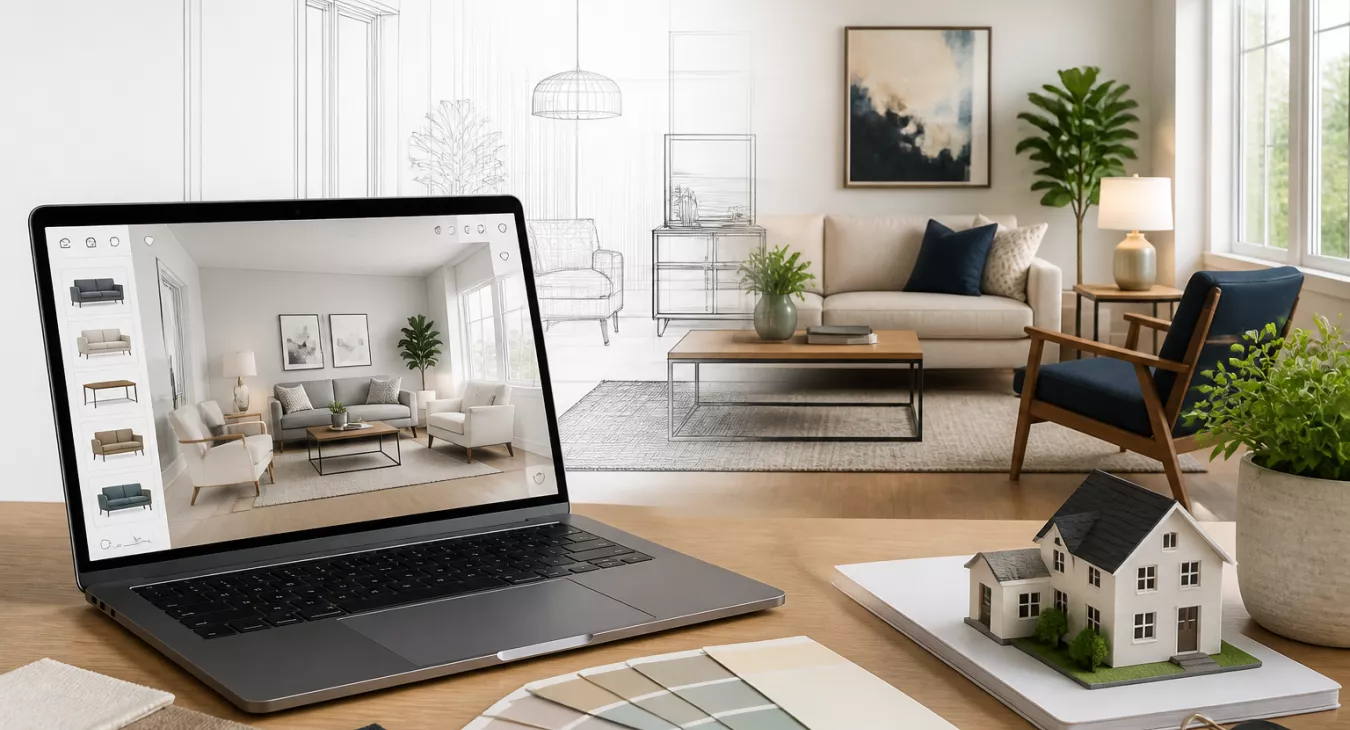
Modsy review: See if this affordable virtual interior design service delivers real value for real estate investors staging properties for sale or rent.
Products and Tools Mentioned in this Post


Matterport
Matterport creates immersive 3D virtual tours and digital twins for real estate. Capture properties with professional-grade technology and share interactive experiences.
Table of Contents
- What's Modsy?
- Modsy Design Process: Step-by-Step
- Modsy Pricing: Cost & Value Analysis
- Modsy Perks & Advantages
- Things to Consider: Limitations & Drawbacks
- Real-Life Modsy Reviews & Before/Afters
- Modsy vs Interior Design Alternatives
- Is Modsy Worth It? Final Verdict
- Conclusion
- Modsy Frequently Asked Questions
Quick sales at asking price? That's the dream. But shabby staging? That'll tank your exit timeline faster than a rising rate environment. Virtual interior design platforms like Modsy claim to deliver professional staging guidance without the $2,000–$5,000 traditional designer price tag — but does it actually work for flipping and rental prep? We're breaking down this Modsy review for interior design in real estate with real features, real pricing, and real limitations. You'll know exactly whether it belongs in your toolkit.

What's Modsy?
Modsy is an online interior design service that pairs homeowners, renters, and real estate professionals with virtual designers who create photorealistic 3D renderings of furnished spaces. The San Francisco-based company launched in 2015 with a clear mission: sit between expensive in-person designers (who charge $5K+ for consultation alone) and the chaos of DIY decorating. Their proprietary 3D modeling tech shows you exactly what a room will look like before you drop a dime on furniture.
Here's what matters for your bottom line: traditional staging companies want $1,500–$5,000 per property. Modsy undercuts that significantly while delivering professional renderings and furniture recommendations. Staging a flip for sale? Furnishing a short-term rental? Refreshing a tired unit in your long-term hold? Modsy claims to handle all three.
How Modsy Works
Everything happens online. You upload room photos, nail your measurements, answer a style quiz, and get matched with a designer. They build a 3D model of your space. Then comes the part investors actually care about—they populate it with real, shoppable furniture recommendations. One to two weeks. That's your timeline from signup to finished designs.
Who Should Use Modsy
This tool is built for specific scenarios. You're an investor staging one or two rooms? A real estate agent visualizing vacant listings? A house flipper nailing down finishes before closing? Modsy works. Don't expect it to scale if you're running dozens of units simultaneously or tackling massive commercial projects—you'll need something more systematized. And if you're already leveraging AI tools for real estate investment decisions, Modsy slots in naturally alongside your tech stack.
Back to topModsy Design Process: Step-by-Step

Want to know if Modsy actually fits your project timeline? Here's exactly how it works from start to finish.
| Step | Action | Time Required | What to Expect |
|---|---|---|---|
| 1 | Start Your Project | 15–30 minutes | Complete style quiz, upload room photos, enter measurements |
| 2 | Scan Your Room | 20–45 minutes | Use the Modsy app to capture 360-degree room scans |
| 3 | Designer Consultation | 30–60 minutes | Video or text chat with your assigned designer |
| 4 | Receive 3D Designs | 5–7 business days | Two photorealistic design concepts delivered to your dashboard |
| 5 | Refine the Vision | 3–5 business days per revision | Request changes; swap furniture items; finalize selections |
Step 1: Start Your Project
Pick your room type — living room, bedroom, dining room, whatever. Then you'll tackle a style preference quiz and set your furniture budget. Modsy uses all this to match you with a designer who gets your vision. And this quiz isn't a throwaway either. It digs into your aesthetic preferences, lifestyle priorities, and what you actually need functionally. For investors? That's gold. It helps you target the exact renter or buyer demographic you're going after.
Step 2: Scan Your Room with the Modsy App

This is what sets Modsy apart from basic staging tools. You use the mobile app to snap photos from multiple angles. The platform's algorithms then convert those photos into a 3D room model you can actually work with. The scanning works best in well-lit, empty rooms. And here's the thing — that's exactly what you've got on vacant flips and rental units. You're already in ideal conditions. No furniture clutter to photograph around.
Step 3: Meet Your Designer Online
Depending on your plan, you get either a live video call or text-based messaging with your designer. Use this time to lay out your hard constraints. Budget caps. Furniture already sitting in the space. What kind of buyer appeal you're chasing — young professional couple, family-friendly, luxury aesthetic.
Step 4: Receive Your 3D Designs
Five to seven business days later, you've got two photorealistic 3D renderings of your space. You can move around these virtually. Rotate the view. Zoom in. Click on any furniture piece to see the product details and exact pricing. This matters for investors because you can share these renderings with partners, lenders, or your real estate agent without scheduling someone to walk through the property in person. Compare this to tools like Matterport 3D virtual tours, which handle the photography side. Modsy handles the design and staging visualization side.
Step 5: Refining the Vision
Review the designs. Request changes. Your standard plan comes with a set number of revisions; premium plans give you unlimited. Each round of changes takes another three to five business days. If you're pushing toward a listing date, that's timeline math you need to factor in now, not later.
Back to topModsy Pricing: Cost & Value Analysis

Modsy's pricing has shifted over time. The platform even paused new sign-ups at certain points due to demand surges. When they're actively taking clients, the pricing structure breaks down by room count and designer access level.
| Plan Type | Price | Features Included | Best For |
|---|---|---|---|
| Essential | ~$89 per room | 2 design concepts, 1 revision, shoppable furniture list | Single-room staging on a budget |
| Premium | ~$149 per room | 2 design concepts, unlimited revisions, live designer consultation | Investors who need multiple rounds of refinement |
| Multi-Room Bundle | ~$299–$399 for 3 rooms | Premium features across multiple rooms, priority scheduling | Full-home staging for flips or Airbnb setups |
Here's what makes this relevant to your deal economics. Traditional staging companies? They'll charge you $300–$600 per room per month for physical furniture rental, then tack on setup fees. A freelance interior designer runs $100–$200 per hour, which adds up fast. Modsy's premium tier pencils out way better—especially if you only need virtual staging for your listing photos and MLS exposure instead of renting actual furniture.
And here's a pro tip: Modsy has run promotional discount codes up to 20% off through partner sites and email campaigns. Always search for active codes before you pull the trigger on a package.
Back to topModsy Perks & Advantages

If you're running deals on a budget, Modsy outperforms traditional design services in ways that actually matter to your bottom line.
Affordability Compared to Traditional Design
$89–$149 per room. That's what you're paying. Compare that to a local interior designer or staging company charging $500–$2,000 per room, and you see why this is the most compelling reason to use Modsy for flips with tight margins. That money you save? It goes back into renovations or marketing where it moves the needle.
Convenience and Speed
Everything's asynchronous. No scheduling headaches. No clearing your calendar for consultations that eat half your day. For investors juggling multiple properties, this flexibility matters—you can work through a Modsy project whenever you have 30 minutes, just like delegating tasks to a virtual assistant for real estate operations. And you're not dependent on anyone else's availability.
Virtual Room Visualization
This is where Modsy really stands out. The 3D renderings are photorealistic enough to use directly in your listing photos and social media. Before you spend a single dollar on furniture, you're showing buyers a fully furnished space. For new construction or gut-renovation flips? This is a game-changer for pre-sale marketing. You're selling the vision, not an empty box.
Expert Designer Access
A credentialed interior designer is behind every project—not an algorithm. That human touch catches the practical stuff AI misses: traffic flow, furniture scale, spatial relationships that feel off. You get the speed of technology paired with the judgment of someone who actually knows design. That combination is why Modsy justifies its price.
Real Estate Investment Benefits
Here's the data: the National Association of Realtors found that 82% of buyers' agents say staging makes it easier for buyers to picture themselves in a home. Staged homes move faster and sell for more money—that's not opinion, it's documented. But physical staging costs add up quickly. Modsy's virtual staging gets you the psychological benefits at a fraction of the cost. And here's the kicker: those shoppable furniture links mean you can actually buy and stage the property physically afterward if the numbers work out.
Back to topThings to Consider: Limitations & Drawbacks
Look, no service is perfect. If you're thinking about using Modsy, you need to see the real gaps first.
| Category | Advantages | Disadvantages |
|---|---|---|
| Cost | Much cheaper than traditional designers or staging | Adds up across multiple properties; not free |
| Speed | Faster than hiring and briefing a local designer | 5–14 days per project; not same-day turnaround |
| Quality | Photorealistic 3D renderings; human designer expertise | Designer matching can be inconsistent; style may not always fit |
| Scalability | Works well for 1–3 rooms at a time | Not built for large portfolios or commercial properties |
| Implementation | Shoppable links simplify purchasing | No implementation support; you buy and place furniture yourself |
Technology Limitations
The app needs good light to work. Empty rooms scan better than cluttered ones. And here's where it breaks down: unusual spaces don't play well with their tech. Very low ceilings, curved walls, quirky floor plans—the 3D model gets messy fast. If you're working with historic properties or anything non-standard, expect accuracy issues. The technology just isn't built for those edge cases.
Designer Customization Constraints
Modsy designers pull from their retail partner network—West Elm, Pottery Barn, CB2, that tier of furniture. You running a liquidation play? Using IKEA exclusively? Need commercial-grade pieces? Their recommendations won't match your actual buying channels. That's a real friction point if your sourcing strategy doesn't align with their partner ecosystem.
Service Availability Concerns
Here's the risky part: Modsy has shut down sign-ups before. They've had periods where they weren't taking new clients. Before you pencil a Modsy project into your renovation timeline, confirm they're actually accepting work right now. You don't want to hit go on a tight deadline only to find out they've paused operations.
Back to topReal-Life Modsy Reviews & Before/Afters

Check Trustpilot, Reddit, and design forums long enough and you'll spot the same story over and over: investors who set realistic expectations love Modsy. Those expecting magic? Not always.
What happy customers actually say: The 3D renderings blow people away. The shopping lists are genuinely useful — you know exactly what to buy and where. And the savings are real. One Airbnb investor we found applied Modsy to three separate units. They pocketed about $4,000 in savings versus local staging quotes while nailing the same visual impact in their listing photos. That's the kind of ROI you want to see.
Where things fall short: Turnaround times often run longer than promised. Design direction doesn't always match what you described in your preferences. Furniture goes out of stock before you can even order it — and good luck getting customer support to help you pivot. Some users flagged that too.
Living room redesigns dominate the before-and-after galleries online. And honestly? Most of them look fantastic. Empty, lifeless spaces transform into warm, furnished rooms that photograph like a magazine shoot. That's precisely what moves units faster.
Back to topModsy vs Interior Design Alternatives

Want to know which design tool actually makes sense for your deal? Let's break down how Modsy compares to what else is out there.
| Feature | Modsy | Decorilla | West Elm Room Planner | Traditional Designer |
|---|---|---|---|---|
| Price per room | $89–$149 | $299–$549 | Free | $1,000–$5,000+ |
| 3D Visualization | Yes (photorealistic) | Yes (photorealistic) | Basic 2D/3D | Varies by designer |
| Human Designer | Yes | Yes (multiple concepts) | No | Yes (dedicated) |
| Furniture Sources | Partner retailers only | Wide range of brands | West Elm only | Any source |
| Revisions Included | 1–unlimited (by plan) | Unlimited | Unlimited (self-serve) | Negotiated |
| Turnaround Time | 5–14 days | 7–14 days | Instant | Weeks to months |
| Best For | Mid-budget investors | Higher-end projects | Quick West Elm layouts | Luxury properties |
Modsy vs. Decorilla: Here's the trade-off. Decorilla gives you multiple designer concepts and taps into way more furniture brands. But you're paying 3–4x more per room. If you're flipping a $250,000 entry-level property? Modsy's $89–$149 price point crushes it. For your high-end luxury flip where design directly moves the needle on sale price? Decorilla's premium positioning might actually deliver better ROI.
Modsy vs. West Elm Room Planner: Free sounds good until you use it. West Elm's planner locks you into their catalog and there's zero human designer input. It's useful for sketching ideas fast. That's about it.
Modsy vs. Traditional Interior Designers: The math changes at the $800,000+ price point. That's when a traditional designer's hands-on implementation support and high-end expertise can justify $1,000–$5,000+ fees. Below $400,000? Modsy gets the job done without the markup.
And here's the reality: You wouldn't run acquisition analysis without a CRM or skip CRM systems and data analytics platforms. Design tools deserve the same logic. Match the solution to your property tier and investment thesis. That's how you optimize.
Back to topIs Modsy Worth It? Final Verdict
Here's the bottom line after looking at the features, pricing, user feedback, and real estate applications: Modsy is a genuinely useful tool for the right investor in the right situation — but it's not a universal solution.
Best For
- House flippers staging properties in the $150,000–$500,000 range
- Short-term rental investors setting up Airbnb or VRBO properties
- Real estate agents who need virtual staging for listing photos
- Investors renovating one to three properties at a time
- Anyone wanting professional design guidance without a $2,000+ designer retainer
Not Recommended For
- Luxury property investors where design quality directly impacts six-figure sales premiums
- Investors managing 10+ units simultaneously (the per-room pricing scales poorly)
- Properties with highly unusual architecture or commercial spaces
- Investors with tight timelines who can't absorb a two-week turnaround
Overall Value Assessment
On a typical mid-market flip or furnished rental, Modsy can save you $1,500–$4,000 compared to traditional staging. You're still getting 80–90% of the visual impact. That's a real ROI contribution on a property where net profit margins might be $20,000–$60,000. And here's what makes it fit: Modsy works naturally alongside other tech-forward investment tools — just as investors use services like fractional real estate platforms to diversify their approach, Modsy represents a smart, technology-enabled alternative to traditional staging overhead.
You're building a systematic investment operation? Then Modsy deserves consideration. Pair it with solid real estate photography services to turn those virtual designs into compelling listing images. That's when you've got a cost-effective staging pipeline that actually works.
Back to topConclusion
Modsy fills a gap most real estate investors actually care about: professional design work that won't torpedo your deal economics. You get photorealistic 3D renderings, real designers in your corner, and furniture you can actually buy—all without the $5K–$15K price tag of traditional staging services. That's genuinely useful.
But it's not perfect. Availability fluctuates. The furniture catalog is limited to partner brands. And their per-room pricing model breaks down fast if you're staging a ten-unit portfolio. For single properties or furnished rental setups? Those limitations barely matter.
Here's the real question: are you staging one to three rooms on a mid-market property with two weeks of runway? If yes, and if they're accepting new clients right now, pull the trigger. The margin improvement on your final sale or rental rate will justify the cost every time.
Back to topModsy Frequently Asked Questions
How accurate is the 3D design?
Here's the reality: Modsy's 3D designs are photorealistic and dimensionally accurate. But only if you nail the room scanning process. Lighting quality during the scan matters enormously, and your room measurements need to be precise. Most users report that furniture scales correctly in finished designs, though complex architectural features like bay windows or vaulted ceilings can occasionally reduce precision.
How long does the Modsy process take from start to finish?
Plan for 7–10 business days from sign-up to your first design concepts. Most users request revisions—that's another 3–5 business days per round. Budget two to three weeks for a complete, finalized design. Multiple revision rounds? You're looking at longer timelines, especially on the premium plan.
Can I request revisions to my Modsy design?
Absolutely. The Essential plan gives you one revision round. Premium plan? Unlimited revisions. You'll message your designer through the platform to communicate specific changes. And you can swap individual furniture items directly in the interactive 3D view without submitting a full revision request—that's a huge time-saver if you just want to test a different sofa.
What's Modsy's refund policy?
Modsy historically offered refunds within a specific window after purchase if design work hadn't started yet. Once a designer began your project, refunds were generally off the table. Here's the thing: terms have changed with different service iterations. Always review the current refund policy before purchasing, and contact customer support if you're unsure about the details.
Is Modsy available everywhere in the United States?
Modsy operated primarily in the U.S. market with service in most major metropolitan areas and many secondary markets. But the service has experienced periods of limited availability and paused new client intake. If you're in a rural area or smaller market, confirm availability before planning around Modsy's timeline. Have a backup plan ready—you don't want your project delayed if the platform's at capacity.
Back to top