


Are you struggling to find motivated sellers in today's competitive real estate market?
Products and Tools Mentioned in this Post

Carrot Websites
Investor Carrot provides top-notch investor and agent websites at affordable prices.


Propstream
Detailed information on Propstream. Get How-To's, reviews, Comparisons, and much more.
Table of Contents
- What makes a seller "motivated" (and what does not)
- Pick your target before you pick a method
- The main ways to find motivated sellers
- Free vs. paid methods: how they compare
- Turning a list into conversations
- How to qualify and talk to motivated sellers
- Example deal (illustrative numbers)
- What to do in your first 30 days
- Common mistakes
- Where to go next
- All our finding deals articles
- Frequently asked questions
Most properties that make good investment deals are never advertised as deals. They belong to owners whose situation has changed: an inherited house nobody wants, a rental with a bad tenant, a mortgage that fell behind, a move that can't wait. Finding those owners before they list with an agent, and having a useful conversation with them, is the core skill behind wholesaling, flipping and buying rentals below retail.
This guide shows you how to choose a target, build lists from public records and paid data, reach owners by mail, phone, text, online marketing and referrals, and qualify each lead so you spend time only on real opportunities. It also covers what each method costs, what it takes in time, and the legal limits you need to check before you start.
The approach fits investors who buy below market value: wholesalers, flippers, BRRRR investors and buy-and-hold landlords. It also fits agents who want listings from owners in difficult situations, and contractors who want to buy their own projects. It does not fit anyone who wants deals without steady, repeated outreach. Most sellers need several contacts before they are ready to talk.
Back to topWhat makes a seller "motivated" (and what does not)
A motivated seller is an owner whose reason for selling matters more to them than getting the highest possible price. Speed, certainty, convenience or relief from a problem outweighs squeezing out the last dollar. That is the only reason an owner would accept a discount from an investor instead of listing with an agent.
Motivation usually comes from one of a few situations:
- Financial pressure: missed mortgage payments, unpaid property taxes, liens, judgments, a job loss or medical bills.
- Life events: divorce, death in the family, a job relocation, a move into assisted living, a growing or shrinking household.
- Property problems: major repairs the owner cannot afford, code violations, fire or water damage, a house that has sat vacant.
- Landlord fatigue: problem tenants, repeated vacancies, an out-of-state owner tired of managing from a distance.
- Inheritance: heirs who live elsewhere, disagree with each other, or simply want the estate settled.
Distress is not the same as motivation
A tax-delinquent or run-down property is a signal, not a guarantee. Some owners of neglected houses are comfortable and have no plans to sell. Some owners of perfect houses urgently need to move. Lists and visual clues tell you where to look. Conversations tell you whether the owner actually wants to sell, and on what terms.
Equity matters too. An owner who owes more than the house is worth cannot sell at a discount without the lender agreeing to a short sale. That is why many investors filter for owners with substantial equity, such as long-time owners or properties with no recorded mortgage.
Back to topPick your target before you pick a method
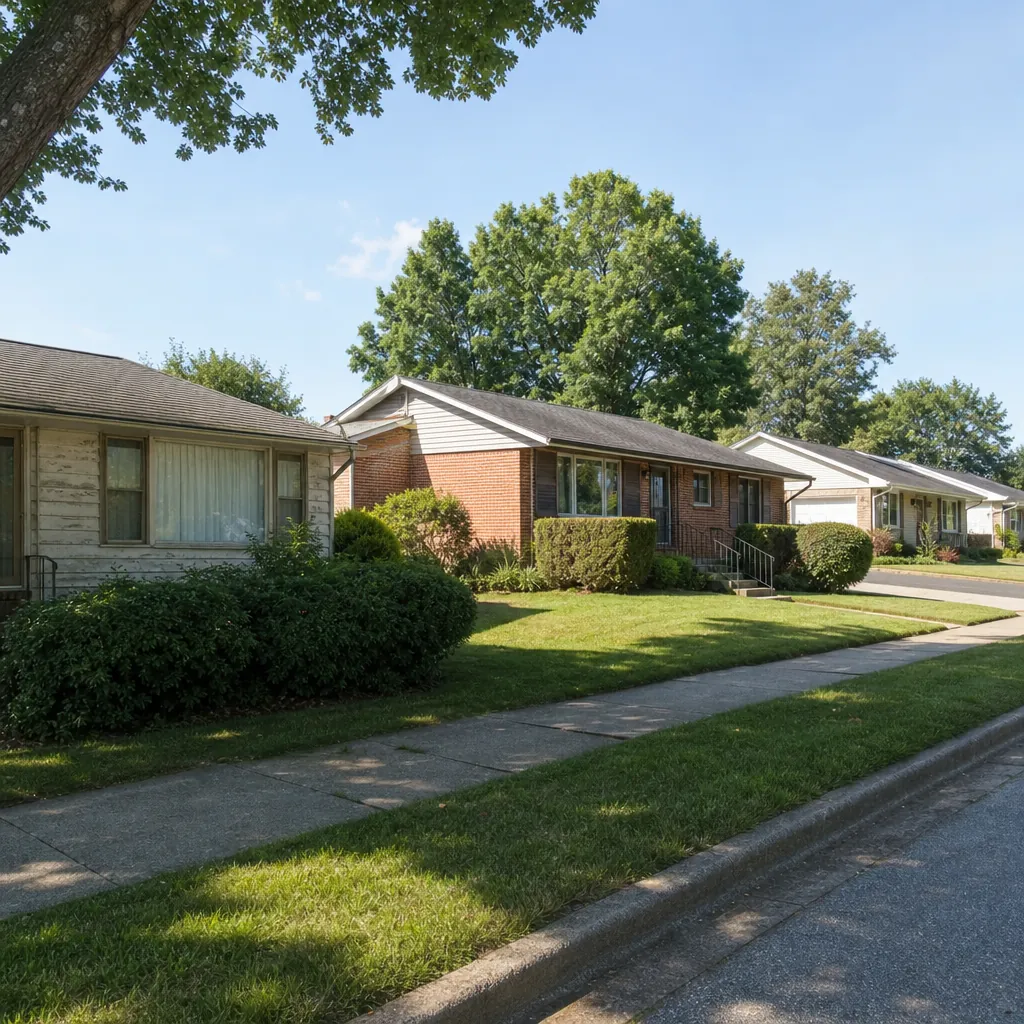
New investors often start by buying a big list or mailing an entire zip code. A narrower target almost always works better, because your message, your offer math and your follow-up all depend on who you are talking to.
Define a buy box
Write down, in one or two lines, what you will buy:
- Area: a handful of zip codes or neighborhoods you can value with confidence.
- Property type: for example, single-family homes, 1960s to 1990s construction, 3 bedrooms.
- Price range: where retail buyers or your rental numbers support the purchase.
- Condition: light cosmetic work only, or full renovations you can manage.
Match the exit strategy
Your exit decides how much discount you need. A wholesaler needs room for an assignment fee plus the end buyer's profit. A fix-and-flip investor needs room for repairs, holding costs and selling costs. A buy-and-hold investor using the BRRRR method needs a price that lets a refinance pull most of the cash back out. The same seller can be a good lead for one strategy and a poor one for another.
Choose one or two seller situations
Pick a seller situation that suits your skills and temperament. Probate requires patience and comfort talking with grieving families. Pre-foreclosure moves fast and carries extra legal rules. Absentee landlords tend to be practical and numbers-focused. Specializing lets you learn the timelines, paperwork and common objections for one group instead of being average at everything.
Back to topThe main ways to find motivated sellers
Every method below is either a way to identify likely sellers (driving, public records, lists) or a way to reach them (mail, calls, texts, ads, referrals). Most working systems combine one source with one or two outreach channels, then follow up consistently.
Driving for dollars
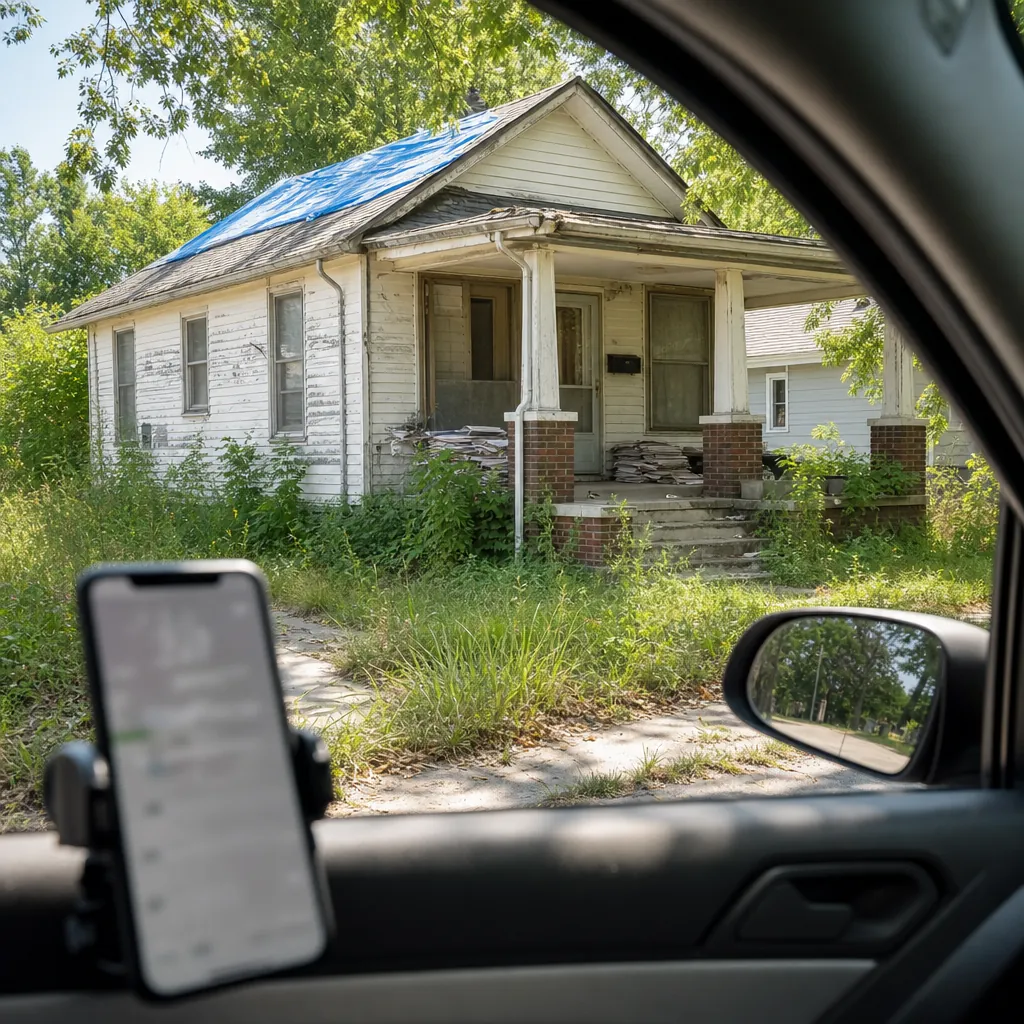
Driving for dollars means driving or walking target neighborhoods and recording properties that show signs of neglect or vacancy:
- Overgrown yards, piled-up mail or newspapers, notices taped to doors
- Boarded or broken windows, tarps on roofs, peeling paint, sagging gutters
- Utility shutoff tags, no cars over several visits, curtains never moving
- Code enforcement notices or a "for sale by owner" sign that has been up for months
Record the address, a short note and a photo. Many investors use a phone app that drops a pin and logs the property automatically. Then look up the owner in county records and reach out by mail, phone or text.
Trade-offs: the cost is mostly time and fuel. You find properties that may not appear on any list yet, and you learn the neighborhood street by street. The downside is low volume. A few hours might produce a few dozen addresses. Driving works best as a steady weekly habit in a small area. For more detail on vacant houses specifically, see this guide to finding and flipping vacant and abandoned homes.
Public records and courthouse data
County and court records are the raw material behind nearly every paid list. You can often access them yourself, for free or for small copy fees, through the county assessor, recorder, treasurer or tax collector, clerk of court, and code enforcement office. What is online, and how it is searched, varies widely by county.
The most useful record types:
- Tax delinquency: owners behind on property taxes. Many counties publish delinquent lists or tax sale notices. See how to access property tax lien lists.
- Pre-foreclosure filings: notices of default in non-judicial states, or lis pendens and foreclosure complaints in judicial states. This guide to notice of default lists covers sourcing and timing.
- Probate filings: estates opened after an owner dies, listing the personal representative or executor. The probate real estate investing guide explains how to work with executors and heirs respectfully.
- Code violations: open violations, condemnation orders, repeat citations. See code violations as investment opportunities.
- Absentee ownership: the owner's mailing address differs from the property address, which often means a landlord or heir. You can build these lists yourself using free methods for finding absentee owners.
- Divorce, eviction and judgment filings: available in many court systems. Access rules and privacy restrictions vary by state.
Stacking is where records become powerful. An absentee-owned house that is also tax-delinquent and has an open code violation is a much stronger lead than any one of those signals alone. Spreadsheets or list software let you cross-reference records and sort by the number of signals each property has.
Paid data and list providers
Paid platforms pull county data into one searchable database. You filter by equity, ownership length, absentee status, vacancy, liens and pre-foreclosure status, then export a list. They save a lot of time, but the data can lag behind county records, and you are competing with every other subscriber pulling similar lists in your area.
Before paying, compare cost per usable record, not cost per record. Duplicates, bad addresses and owners already contacted by many investors all reduce the real value. This breakdown of lead list costs and ROI walks through how to compare providers.
Expired listings and FSBOs
Owners whose listing expired without a sale, or who are trying to sell on their own, have already shown they want to sell. Some priced too high or chose a poor agent. Others have a property problem that scared buyers away. Expired data usually comes through an agent with MLS access. FSBO listings appear on public listing sites and yard signs.
Expect competition. Agents contact these owners too, often within hours. Your angle is different from an agent's: a fast, certain sale without repairs or showings. Be clear about that difference, and accept that many of these owners will relist instead.
Direct mail
Mail remains a common outreach channel because it reaches everyone with a mailing address, needs no phone number, and carries fewer consent rules than calls or texts. Formats include postcards, typed letters, handwritten or handwritten-style letters, and yellow letters.
What makes mail work is mostly not the design:
- A well-targeted list. A small, stacked list beats a large generic one.
- Repetition. Owners decide to sell on their own schedule. Mailing the same list every four to six weeks puts your name in front of them when the timing changes.
- A specific message. Mention the property address. Speak to the likely situation, such as a rental, an inherited house or needed repairs, without guessing at private details.
- Tracking. Use a separate phone number or code for each campaign so you know which list and piece produced each call.
Mail costs vary by format and volume. As a rough example, postcards might run well under a dollar each including postage, while handwritten-style letters cost more. Mail is also slow. Responses trickle in over weeks.
Cold calling and texting
Phone and text outreach are faster than mail and let you qualify a lead in the first conversation. Both require phone numbers, which usually means skip tracing your list. Skip tracing matches owner names and addresses to phone numbers and emails. See how skip tracers work for what the results include and where they fall short.
Calling and texting are the most regulated channels. Federal rules cover the Do Not Call registry, calling hours, caller ID, the use of autodialers and prerecorded messages, and consent for marketing texts. Many states add their own rules, and some states are stricter than federal law. Penalties can be counted per call or per message. Before you dial or send a single text:
- Scrub numbers against the national and any state Do Not Call lists, and keep your own internal do-not-contact list.
- Understand which dialing and texting tools may require prior consent.
- Honor opt-outs immediately.
- Have a local real estate attorney review your process, especially for texting.
The guide to dialer compliance and calling rules covers this in more detail, and legal compliance when buying seller lists covers the list side.
On the call itself, keep it short and human. Say who you are, why you are calling about that specific property, and ask whether they have thought about selling. Most people will say no. Thank them, note the answer, and ask whether you can check back in a few months if that is appropriate.
Online ads, SEO and a website
Online marketing reverses the direction: sellers who are already searching for a fast sale find you. The pieces:
- A simple website that explains what you do, how a sale works, and what the seller can expect, with a short form and a phone number.
- Search engine optimization: pages that answer the questions sellers search for, such as selling an inherited house, selling a house that needs major repairs, or selling a rental with tenants, focused on your city or county. SEO is cheap in cash but slow, and it often takes many months to produce leads.
- Pay-per-click and social ads: faster, but you pay for every click. Costs per lead vary widely by market and competition. Set a fixed test budget and track cost per lead and cost per contract, not just clicks.
- Free listings and posts: a business profile in map listings, posts in local community groups where rules allow, and marketplace ads.
Inbound leads tend to be more ready to talk because they reached out first. They are also often comparing several buyers at once, so answer quickly and follow up reliably. Ad platforms limit targeting for housing-related ads, and fair housing law applies to all your marketing. Do not target or exclude people based on protected characteristics.
Networking and referrals
Many good deals come from people who meet motivated sellers in the course of their work:
- Estate, probate, divorce and bankruptcy attorneys
- Property managers and landlords who know owners ready to exit
- Contractors, roofers, plumbers and restoration companies who see houses owners cannot afford to fix
- Agents with listings that don't fit retail buyers
- Other investors and wholesalers with deals outside their own buy box
- Friends, family and past sellers who know you buy houses
Referrals cost little in cash and produce warm, trusting leads, but they build slowly and depend on your follow-through. Tell people exactly what you buy, keep in touch, and treat every referred seller well, because the referrer's reputation is on the line too. Paying referral fees is restricted in some situations. Paying an unlicensed person for referring a buyer or seller can violate state licensing law, so check with a local attorney before offering money. See real estate investor networking for deal flow for practical ways to build these relationships.
Door hangers and bandit signs
Door hangers on targeted streets and small roadside "we buy houses" signs are inexpensive. However, many cities and counties prohibit roadside signs or require permits, and fines can add up per sign. Some neighborhoods restrict door-to-door solicitation. Check local ordinances before using either one.
Back to topFree vs. paid methods: how they compare
"Free" methods cost time instead of money. Paid methods buy speed and volume. Most investors start with free sources while learning and add paid channels once they know their numbers.

| Method | Cash cost | Time required | Speed to first leads | Main risk or limit |
|---|---|---|---|---|
| Driving for dollars | Low (fuel, optional app) | High | Weeks | Low volume; needs owner lookup |
| DIY public records | Low to none | High | Weeks | Varies by county; manual work |
| Paid lists and data | Moderate, ongoing | Low | Days | Shared with competitors; data lag |
| Direct mail | Moderate to high per round | Low to moderate | Weeks | Slow; needs repeated rounds |
| Cold calling | Low to moderate (skip tracing, dialer) | High | Days | Heavy regulation; rejection |
| Texting | Low to moderate | Moderate | Days | Strict consent rules; carrier filtering |
| Paid online ads | Moderate to high | Moderate | Days to weeks | Cost per lead can climb quickly |
| SEO and website | Low to moderate | High at first | Months | Slow to build |
| Networking and referrals | Low | Moderate, ongoing | Months | Irregular volume |
A sensible starting mix for a beginner with limited cash: drive one or two neighborhoods weekly, pull one stacked list from county records, mail it consistently, call the numbers you can reach legally, and tell every contractor, agent and landlord you meet what you buy.
Back to topTurning a list into conversations
The list is the cheap part. Turning it into conversations takes process.
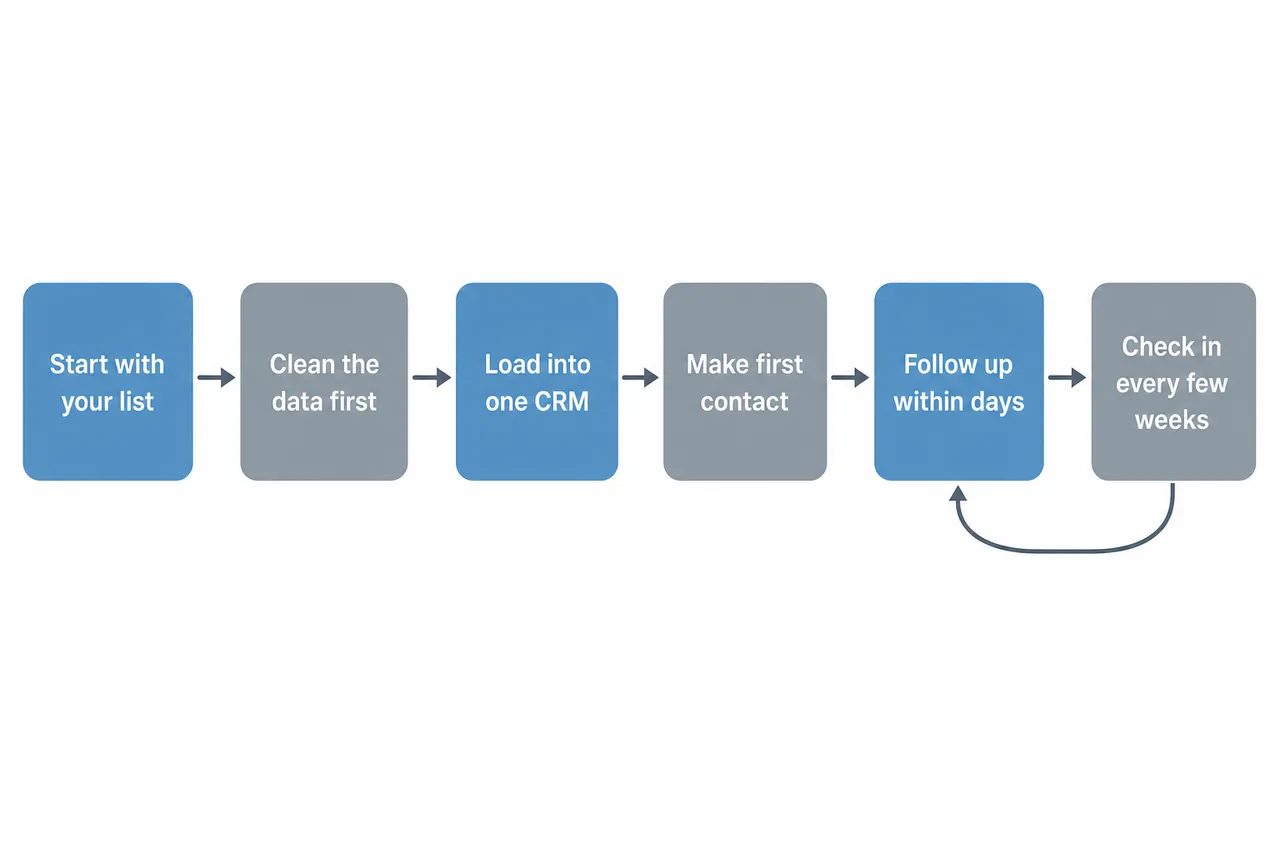
Clean the data first
Remove duplicates, owners you already contacted, properties outside your buy box, and entity-owned properties if you only want individuals. Run mailing addresses through address standardization. Check that the owner name is current, since recent sales can lag in the data. This guide to validating and cleaning investor databases covers the steps.
Load everything into one system
A CRM, or even a disciplined spreadsheet at first, should hold every owner, property, contact attempt, note and next follow-up date. Without it, leads get lost and you will contact the same people twice by accident. See how to load and manage seller lists in a CRM.
Build a follow-up schedule
Most owners are not ready the first time you reach them. A workable pattern is to make first contact, follow up within a few days if they showed any interest, then check in every few weeks for active leads and every few months for "not now" leads. Many deals come from the third, fifth or tenth touch, after a tenant moves out or a sibling finally agrees.
Back to topHow to qualify and talk to motivated sellers
Qualifying separates people who will sell at a price that works from people who are curious, testing the market or not ready. Most experienced investors gather the same four pieces of information on every call.
The four things to learn
- Condition: age of the roof, HVAC, plumbing and electrical; known problems; whether it is occupied, and by whom.
- Motivation: why they are selling and why now. This is the most important answer.
- Timeline: when they need or want to be done.
- Price: what they hope to get and what they owe, including liens or back taxes.
Questions that work
- "What has you thinking about selling?"
- "If we agreed on a price, when would you want to close?"
- "What would you need to fix before listing it with an agent?"
- "Is anyone else on the title or involved in the decision?"
- "Do you have a number in mind that would work for you?"
- "What happens if it doesn't sell?"
Then listen. Let the seller explain their situation without interrupting. Repeat back what you heard so they know you understood. Do not argue about price on the first call. Your job is to understand the problem, not to win.
Run the numbers before you offer
Estimate the after-repair value (ARV) from recent sales of similar, renovated homes nearby, then estimate repairs. A common screen is the 70 percent rule: maximum offer equals 70 percent of ARV minus repairs. It is a rough filter, not a guarantee. Run it with the 70 percent rule calculator, then check the full flip budget with the fix and flip calculator, including closing, holding and selling costs.
Offer solutions, not just a number
A cash offer at a discount is only one option. Depending on the situation, the seller may value a flexible move-out date, buying the house as-is with belongings left behind, taking over a rental with tenants in place, or seller financing that gives them monthly income instead of a lump sum. If you discuss terms, use the seller financing calculator to show payments and any balloon clearly.
Be honest when you are not the best option. If the house needs little work and the owner has time, listing with an agent will probably net them more. Saying so builds trust, earns referrals and protects your reputation.
Know the extra rules for vulnerable sellers
Buying from owners in foreclosure is regulated in many states. Some states require specific contract language, rescission periods or disclosures, and restrict certain "equity purchase" arrangements. Wholesaling is also regulated differently from state to state. Some states require a license or specific disclosures to market a contract you do not yet own. Probate sales may require court approval. Before you sign your first contract, have a local real estate attorney review your purchase agreement and process for your state.
Back to topExample deal (illustrative numbers)
The figures below are invented for illustration. They are not benchmarks. Your costs, response and results will differ by market, list and execution.
The campaign. An investor pulls a list of 600 absentee-owned single-family homes in three zip codes, filtered for owners with long ownership and no recorded mortgage. They mail the list four times over about four months and call owners whose numbers are reachable under the rules.
| Item | Calculation | Amount |
|---|---|---|
| Mail, 4 rounds | 600 × 4 = 2,400 pieces × $0.65 | $1,560 |
| Skip tracing | 600 records × $0.12 | $72 |
| CRM software | 4 months × $75 | $300 |
| Total marketing | $1,932 |
Assume this produces a handful of serious conversations and one signed contract: an inherited, dated three-bedroom whose owner lives out of state.
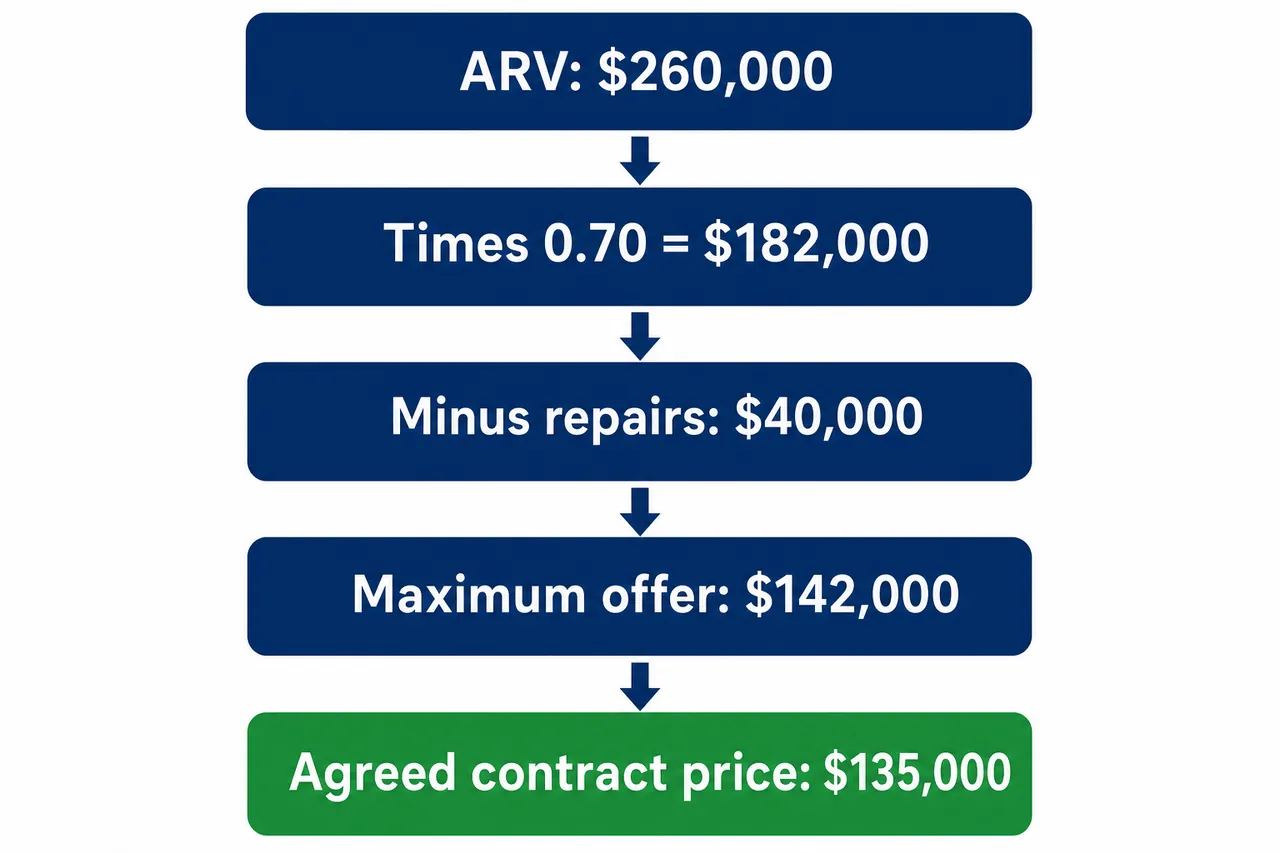
The numbers.
- ARV from renovated comparable sales: $260,000
- Estimated repairs: $40,000
- 70 percent rule maximum offer: ($260,000 × 0.70) − $40,000 = $182,000 − $40,000 = $142,000
- Agreed contract price: $135,000
Exit A: flip it.
- Purchase price: $135,000
- Repairs: $40,000
- Purchase closing costs: $3,000
- Holding costs, about 5 months of loan interest, taxes, insurance and utilities: $7,500
- Selling costs, about 8 percent of $260,000 for commissions and closing: $20,800
- Total project cost: $135,000 + $40,000 + $3,000 + $7,500 + $20,800 = $206,300
- Profit before marketing and taxes: $260,000 − $206,300 = $53,700
- Profit after marketing: $53,700 − $1,932 = $51,768, before income taxes
Exit B: wholesale it. The investor assigns the contract to a flipper buying at the $142,000 maximum offer. Assignment fee: $142,000 − $135,000 = $7,000. After marketing: $7,000 − $1,932 = $5,068, with no repair or holding risk.
The example shows a few things. The deal only works because the purchase price was set from the numbers, not from what the seller first asked. Marketing cost is small next to a flip profit, but it matters for a wholesale fee. And a repair overrun of $15,000 or a longer hold would cut the flip profit sharply. Check the scenarios before you commit.
Back to topWhat to do in your first 30 days
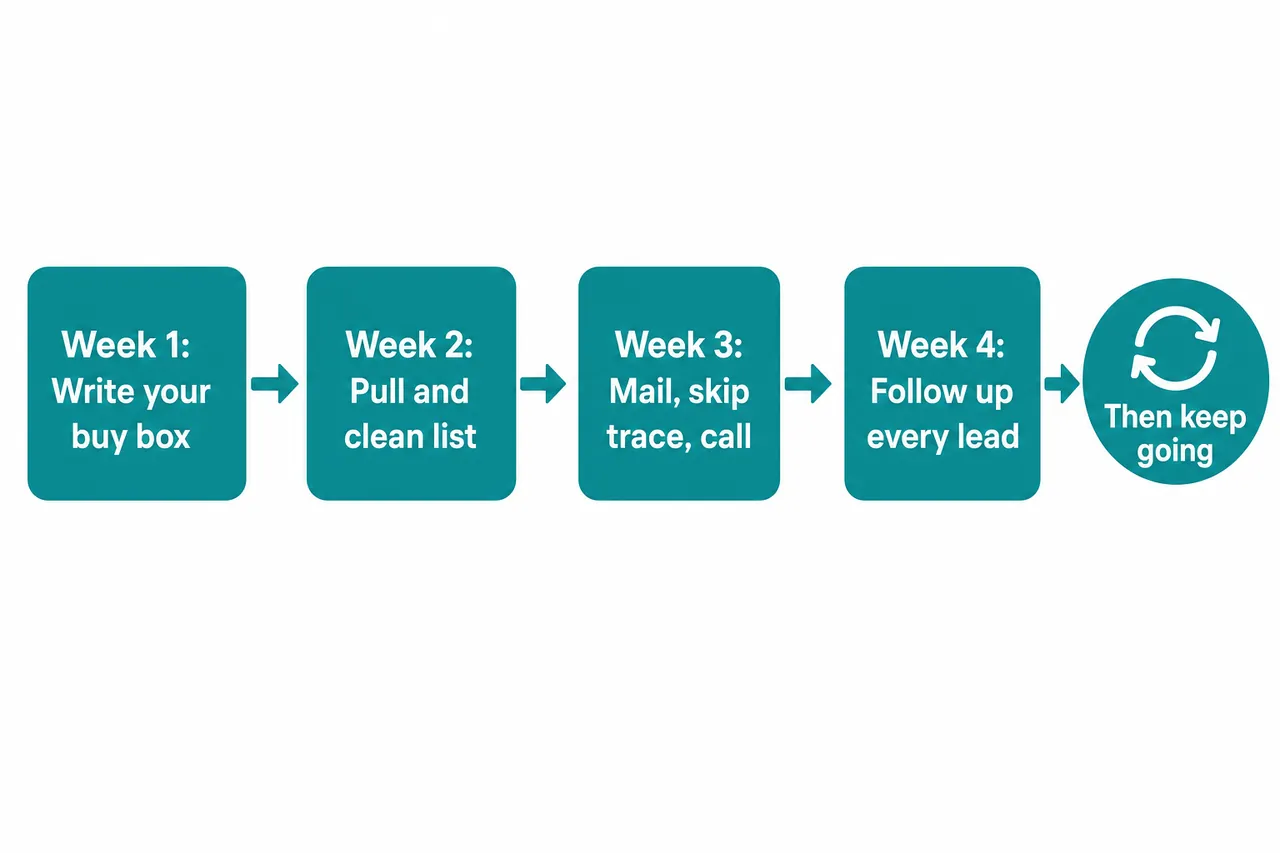
- Week 1: Write your buy box. Learn values in your target zip codes by studying recent sales. Have an attorney review your purchase contract and any state rules on wholesaling, foreclosure purchases and outreach.
- Week 2: Pull one stacked list from county records or a data provider, such as absentee owners combined with tax delinquency. Clean it and load it into a CRM. Start driving one neighborhood once a week.
- Week 3: Send your first round of mail. Skip trace the list, scrub the numbers against Do Not Call lists, and start calling. Write and practice a short call outline.
- Week 4: Follow up with every lead. Tell ten local contractors, property managers or attorneys what you buy. Track each lead's source, status and next step. Schedule your second mail round.
Then keep going. The investors who get deals are usually the ones still mailing, calling and following up in month six.
Common mistakes
- Marketing too broadly. Mailing a whole city wastes money and gives you leads you can't value confidently.
- Stopping after one round. A single mailing or call attempt rarely reaches owners at the right moment.
- No follow-up system. "Call me in three months" leads are often the best ones, and they vanish without a CRM.
- Ignoring calling and texting laws. Fines can be calculated per call or text, and they add up quickly.
- Guessing ARV and repairs. Overestimating value or underestimating repairs turns a good-looking deal into a loss.
- Pressuring people in hardship. It is wrong, it can be illegal, and it damages your reputation in a market that runs on referrals.
- Buying every list and tool at once. Learn one source and one channel well before adding more.
- Not tracking cost per deal. Without lead-source tracking, you cannot tell which spending works.
- Skipping title checks. Heirs, liens and judgments can block a closing. Use a title company or attorney early.
Where to go next
- Learn how to turn contracts into assignment fees with the wholesaling guide.
- Plan renovations and resale with the fix-and-flip guide.
- Go deeper on probate leads in the probate investing strategy guide.
- Build free absentee owner lists using these data sources and methods.
- Get your calling process right with the dialer compliance guide.
Back to top
Back to top
All our finding deals articles
Finding deals articles on KDS Development, grouped so you can go deeper on any part of this guide. Newest first.
Motivated sellers
- Best CRM for Probate Real Estate: Heir & Executor Management
- How to Sell a House With Water Damage: Options for Distressed Properties
- How to Sell an Abandoned House Fast: Options and Strategies for Investors
- How to Build a Pre-Qualified Seller List for Real Estate Investment Deals
- Real Estate CRM Data Import: How to Load & Manage Seller Lists
- Judgment Lien Lists: Finding Distressed Property Leads
- Legal Compliance When Buying Seller Lists: GDPR, TCPA, and Fair Housing
- Probate Land Deals: How to Source & Close with Heirs & Executors
- Heir Property Investing: Buying from Multiple Owners Without Clear Title
- Probate Listing Real Estate Investing: Finding Heirs & Executors
- Empty Property Lists: Sourcing Vacant Properties for Investment
- High Equity Absentee Owners: Sourcing Strategy for Motivated Deals
Inbound marketing
- Best Real Estate Investor Blogs Worth Following in 2026
- Real Estate CRM Blog Guide: Best Resources for Investor Software
- How to Get Better Seller Leads Using Facebook Ads: Step-by-Step
- How to Build a Real Estate Blog: Faster than 10 Minutes Setup
- Real Estate PPC Landing Pages: 5 Elements That Convert Leads
- Real Estate SEO Rankings Dropped: Troubleshooting & Recovery Strategies
- How to Identify & Fix Keyword Cannibalization: Real Estate SEO Guide
- How to Choose a Domain Name for Your Real Estate Business: Strategy Guide
- Real Estate Website Design: Credibility Sites vs. Targeted Lead Sites
- Best Real Estate Blogs Today: Top Resources for Investor Education
- Real Estate SEO Keywords: 100+ High-Intent Terms Investors Search
- How to Build a Real Estate Investor Website: Tools & Best Practices
Outbound marketing
- SMS vs Email in Real Estate CRM: Which Channel Converts Better
- Real Estate Dialer Compliance: FTC Rules & Calling Best Practices
- Predictive Dialer for Real Estate Investors: Does It Work?
- Bulk SMS for Real Estate: Send Campaigns & Track Results
- Best Dialer App for Real Estate Agents: Call Tracking & Analytics
- Automatic Dialer for Real Estate: Best Tools & Setup Guide
- Batch Dialer for Real Estate: Power Calling Tools & Best Practices
- Real Estate CRM with Built-In Dialer: Top Platforms Compared
- BatchDialer Introduces Reduced, Simplified Pricing Plans to Support Scalable Outbound Growth - Business Wire
- Cold Calling Scripts for Wholesaling: Word-for-Word Templates
- Direct Mail Campaigns for Wholesaling: What Works in 2026
- SMS Marketing for Real Estate: Compliance and Conversion
Networking
- How to Use CRM for Real Estate Networking: Build & Maintain Relationships
- Real Estate Investor Networking: Build Deal Flow & Partnerships
- Real Estate Business Cards for Investors: Design & Networking Tips
- Land Investor Networking Strategies: Building Deal Sourcing Relationships
- Real Estate Investment Clubs: How to Start or Join One
- Best Real Estate Investor Networking Groups & Communities
- Best Real Estate Forums & Communities for Investors in 2026
- Real Estate Investing Mastermind Groups: How to Find & Benefit
More on finding deals
- Surplus Government Land Auctions: How to Buy Public Property
- Real Estate Investor Lead List Quality Metrics: Benchmarks & How to Evaluate
- Real Estate Investor Lead List Costs: Pricing & ROI Comparison Guide
- Lead List Accuracy: How to Validate & Clean Your Investor Databases
- Automated Lead List Campaigns: Running Continuous Outreach for Deals
- Lis Pendens Lists: Early Foreclosure Leads for Wholesalers
- Land Auction Bidding Strategy: How to Win & Avoid Overpaying
- How Skip Tracers Work: The Complete Guide for Real Estate Investors
- How Tax Auctions Work: Complete Guide for Land Investors & Bidders
- How to Acquire Bank-Owned Land: REO Property Strategies
- Mining Courthouse Records for Land Deals: Deeds, Liens, and Auctions
- How to Access Property Tax Liens Lists: Complete Research Guide
Frequently asked questions
What is the cheapest way to find motivated sellers?
Driving for dollars, searching county records yourself, and networking with contractors, landlords and attorneys cost very little in cash. They do take a lot of time. Combine them with low-cost outreach such as phone calls, made in line with Do Not Call rules, or a small mail campaign.
How long does it take to get a first deal?
It varies with your market, budget and consistency. Mail and SEO are slow and often take weeks to months to produce serious leads. Calling and inbound ads can produce conversations sooner. Plan for several months of steady follow-up rather than expecting quick results.
Is it legal to text motivated sellers?
Marketing texts are heavily regulated at the federal level, and some states add stricter rules on consent, timing and tools. Whether your texting is lawful depends on how numbers were obtained, what platform you use and where the recipient lives. Review your process with a real estate or telecommunications attorney before sending.
Do I need a license to buy from motivated sellers?
Buying property for yourself generally does not require a license. Some states, however, regulate wholesaling, marketing contracts you don't own, or buying from homeowners in foreclosure. Check your state's rules with a local real estate attorney.
Which list is best to start with?
Many beginners start with absentee owners who have high equity, then stack in a distress signal such as tax delinquency or code violations. Smaller stacked lists are easier to market to repeatedly and usually produce more relevant conversations than large generic lists.
How much should I offer a motivated seller?
Base the offer on your numbers, not on the seller's asking price. Estimate the after-repair value and repairs, then subtract holding, selling and financing costs and your required profit. The 70 percent rule is a quick first screen. A full deal analysis should confirm it before you sign.
Back to top