


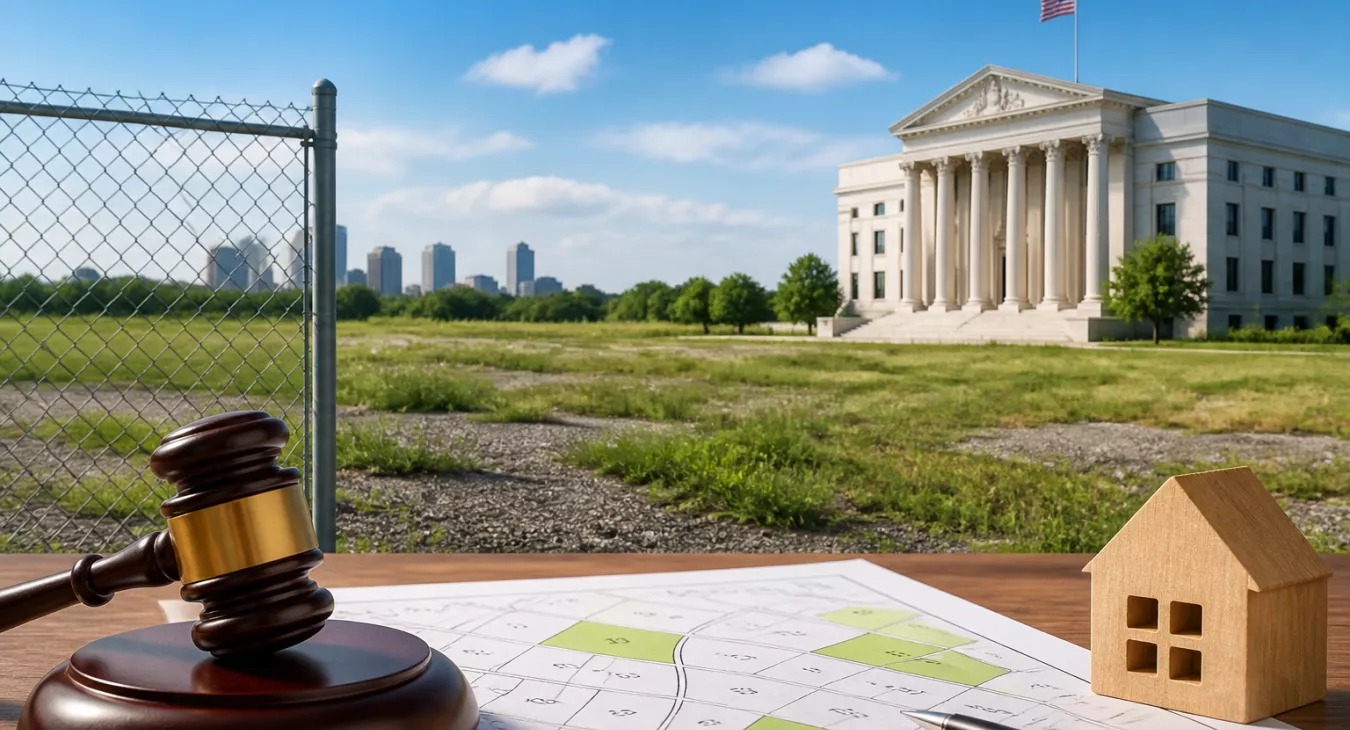
Learn how to buy federal buildings, land, and seized property through surplus government land auctions. Complete guide for investors.
Table of Contents
- What Are Surplus Government Land Auctions?
- Major Government Agencies That Auction Land
- Types of Auction Methods Used
- How to Find and Bid on Surplus Land
- Key Terms and Conditions of Government Auctions
- Advantages and Disadvantages of Government Land Auctions
- Tips for Success in Government Auctions
- Conclusion
- Frequently Asked Questions
Surplus government land auctions give you access to properties that almost never hit the MLS — federal buildings, raw undeveloped land, seized real estate, municipal overstock. You might find raw acreage from the Bureau of Land Management or a decommissioned federal building through the General Services Administration. The process itself? Transparent, legally structured, and open to qualified buyers. But here's the catch: you're navigating a system built for government efficiency, not your convenience. We'll walk through every stage, from spotting available properties to closing the deal, so you can actually compete effectively.
New to finding deals? Start with our Guide to Finding Motivated Sellers.

What Are Surplus Government Land Auctions?
Definition and Overview
A federal, state, or local agency declares real estate surplus when they don't need it anymore. Once that happens, the property hits a disposal process locked down by statute. At the federal level, you're looking at the Federal Property and Administrative Services Act—and for public lands, the Federal Land Policy and Management Act (FLPMA). The endpoint? Usually an auction or competitive sale open to the public.
Types of Government Properties Sold
The range is massive. Federal surplus includes office buildings, warehouses, military installations, vacant lots, agricultural land, mineral-rich acreage, lighthouses, and specialized infrastructure. State and local governments? They're constantly auctioning tax-foreclosed residential lots, school buildings, and utility corridors. And then there's seized property from criminal forfeiture—handled by the U.S. Marshals Service and the Treasury—which brings residential homes and commercial real estate into the mix.
Why Governments Auction Surplus Land
Cut maintenance costs. Eliminate liability exposure. Get land back into productive private use. That's the mandate. Revenue from these sales funds specific programs, too. Take Nevada. The Bureau of Land Management (BLM) runs land sales under the Southern Nevada Public Land Management Act (SNPLMA), and the breakdown is strict: 85% goes to Nevada state parks, trails, and conservation projects; 5% to Nevada education; and 10% to the Southern Nevada Water Authority. That's real money flowing back into the state's infrastructure and reserves.
Back to topMajor Government Agencies That Auction Land
| Agency | Platform | Property Types | Geographic Coverage | Auction Frequency |
|---|---|---|---|---|
| General Services Administration (GSA) | realestatesales.gov | Federal buildings, offices, warehouses, vacant land | 50 states and territories | Rolling — listings added as declared surplus |
| Bureau of Land Management (BLM) | BLM state office websites; competitive sealed-bid sales | Undeveloped public land, grazing land, mineral parcels | Primarily western states | Periodic — announced via Federal Register |
| HUD | HUDHomeStore.com | FHA-foreclosed single-family homes | Nationwide | Continuous listing cycle |
| U.S. Marshals Service / Treasury | usmarshals.gov; treasury.gov/auctions | Seized and forfeited residential and commercial property | Nationwide, case-driven | Irregular — tied to forfeiture proceedings |
| State and Local Governments | GovDeals.com; county tax offices | Tax-foreclosed lots, municipal buildings, school sites | All 50 states | Frequent — often monthly or quarterly cycles |
Want consistent deal flow? The GSA is your biggest federal source for improved property. In 2025 alone, the agency dumped 90 buildings—that's roughly 3 million square feet cleared from their books and $182 million in proceeds generated. And that's just one year. You're looking at reliable inventory if you're monitoring realestatesales.gov, the GSA's official auction hub for surplus real property.
Back to topTypes of Auction Methods Used

| Method | How It Works | Typical Use Cases | Buyer Advantages | Buyer Disadvantages |
|---|---|---|---|---|
| English (Ascending-Bid) | Bids go up in real time; whoever's willing to pay the most gets it | GSA online auctions, GovDeals listings | You see what everyone else is bidding. Bid only what you can actually afford. | Other bidders pushing the price up creates pressure—fast. Your deal math gets blown apart. |
| Sealed-Bid | You submit one bid, sealed. All bids opened at once; highest wins. | BLM competitive land sales, some HUD listings | No adrenaline. Pure strategy. You're not reacting to what someone else just bid. | You get one shot. Underbid and you lose. Overbid and you just crushed your margins. No second chances. |
| Highest and Best Offer | Government asks for offers and reserves the right to accept, reject, or counter | HUD homes, Marshals Service properties | Price isn't everything—you can offer terms that matter. Flexibility wins here. | Government walks away if they don't like any offer. You wasted due diligence for nothing. |
| Online vs. Live | Online means a longer window to bid; live auctions compress everything into minutes or hours | GSA, GovDeals (online); county tax sales (often live) | Online gives you breathing room. You've got time to run your numbers and verify the property condition. | Live auctions? You're on the spot, deciding fast, no room to breathe. You need capital standing by. |
How to Find and Bid on Surplus Land

Finding Available Properties
Three federal portals dominate the game: realestatesales.gov handles GSA and other agency surplus real estate, HUDHomeStore.comis where you'll find FHA-foreclosed homes, and individual BLM state office websites list public land sales announced in the Federal Register. But don't stop there. GovDeals.com aggregates thousands of municipal listings across state and local inventory. Layer in abandoned property lists and distressed property data sources to cross-reference off-market opportunities that might overlap with government holdings — this is where you find the real diamonds.
Registration and Pre-Qualification Requirements
GSA registration is free. Seriously — zero cost. But BLM sales? They've got teeth. You must be a U.S. citizen 18 or older, a state or state instrumentality, or a corporation authorized to hold real estate in the target state. Foreign nationals and non-resident entities? They're locked out of direct BLM purchases. That's a hard constraint if you're working with international capital.
Placing Bids Online
The interface on realestatesales.gov is straightforward once you're in. Here's the wrinkle: GSA caps credit card payments at $24,999. Anything above that demands wire transfer, certified check, or equivalent. Don't treat financing like an afterthought — lock it down before you bid, not after you've won.
Inspection and Due Diligence
As-is sales. Non-negotiable. That's the government's standard, and it's not changing for you. Inspection windows get announced in the listing, and you work around those dates. Environmental screening isn't optional, especially on undeveloped federal land. Wetland designations, easements, mineral reservation clauses — these survive the sale and will wreck your exit strategy if you miss them. Check our environmental guide on identifying wetlands before you touch raw parcels. And run a full lien search. Research any property liens before purchase — forfeited properties sometimes carry surviving encumbrances that'll surprise you at closing.
Back to topKey Terms and Conditions of Government Auctions
Reserve vs. Non-Reserve Auctions
You won't find deep discounts on federal real estate. The government sets reserves at or near appraised value — that's the law. GSA must obtain Fair Market Value for surplus real property under 40 U.S.C., and BLM land sales are required to generate no less than Fair Market Value. Significant below-market bargains on improved federal property? Rare by design.
Earnest Money and Deposit Requirements
BLM competitive sales hit you with a deposit requirement right away. You'll need to put down not less than 10% and not more than 30% of your bid amount via certified check, postal money order, bank draft, or cashier's check. Here's a real example: the April 2026 BLM Las Vegas Valley auction. Thirteen parcels totaling 108 acres went for $68,654,000. Winners had to pay 20% the same day the hammer dropped. The rest was due within 180 days.


Large-Parcel Congressional Notification
Going after massive tracts? Know this: BLM parcels larger than 2,500 acres need Congressional approval before BLM can sell them, and Congress can block the deal under FLPMA §203. That adds real timeline risk for very large acquisitions.
As-Is Conditions and Title Considerations
Government sellers offer zero warranties. Environmental contamination, deferred maintenance, code violations, and access problems all transfer to you with the deed. And if you're eyeing a parcel without road frontage, don't skip this step. Review the implications of landlocked property ownership and understand your legal options for establishing access rights.
Back to topAdvantages and Disadvantages of Government Land Auctions

Benefits for Buyers
- Legitimacy and transparency: Every federal sale hits the public record, gets competitively bid, and is legally documented. No backroom deals.
- Volume and variety: You'll find everything. Single residential lots. Multi-hundred-acre tracts. The full spectrum.
- Motivated seller: Agencies have no choice here — federal law requires them to dispose of surplus property. They can't just sit on it indefinitely like a private owner might.
- Tax considerations: Depending on how you structure your acquisition and entity, investment land property taxes could be deductible. Want the details? Check out our guide on vacant land tax deductibility.
Risks and Challenges
- Fair Market Value floor: Federal law won't let you steal improved federal property below market. Your profit comes from market knowledge and operational upside, not buying at 30 cents on the dollar.
- As-is condition: What you see is what you get. No representations. No recourse if something's hidden.
- Financing complexity: Here's the real pain point. Most government auctions demand cash or near-cash deposits within days. Conventional mortgages? They don't play nicely with government closing timelines.
- Access and utility issues: This kills deals faster than anything else. Undeveloped parcels — especially BLM land out west — often sit with no utilities, no road access, and permitting that'll take months or years. Before you bid, ask yourself: is this thing actually developable?
Tips for Success in Government Auctions

Research and Preparation Strategies
Here's what most investors miss: courthouse records reveal deed restrictions, prior liens, and easement history that the auction listing conveniently leaves out. Pull these records on every parcel you're serious about. The Federal Register is your other goldmine — BLM sales drop there weeks or even months before the actual bid date. That advance notice? It's your window to inspect the property and run a real appraisal before you're standing in that auction room.
Bidding Tactics
- Set your maximum bid before the auction opens. Don't break that number when the adrenaline kicks in and competitors are driving the price up.
- For sealed-bid deals, pull comps and bid slightly above Fair Market Value — government appraisals are your floor, not your ceiling. Beat them on execution.
- Build in every post-acquisition cost you can think of: environmental remediation, infrastructure buildout, holding costs, management overhead. The rental property expense estimation guide walks through the framework. Use it to model your true cost of ownership before you bid.
Post-Auction Considerations
You've won the bid. Now what? Closing timelines range from 30 to 180 days depending on the agency and how messy the parcel is. Federal title transfers move slower than private deals — don't wait until after the auction to get your entity documents, financing, and environmental clearances in order. Do it now. And if you're converting this into a rental or managed investment property, start vetting property management tools before the hammer drops.
Back to topConclusion
Surplus government land auctions work. They're legitimate, they're regulated, and most investors completely ignore them. Federal law isn't some gray area—it spells out fair market value floors, competitive bidding, public notice requirements, and payment deadlines. The real edge isn't gaming the system or stealing deals at taxpayer expense. It's spotting what others miss: undervalued parcels hiding in plain sight, doing the environmental and title work that separates winners from bag holders, and actually pulling the trigger when the bid window's open.
Here's what you need to do. Start your search on realestatesales.gov and GovDeals. Build a pre-auction checklist and don't skip it—environmental red flags, title issues, and access problems kill more deals than bad markets ever will. That as-is condition clause? Don't treat it like a risk you're forced to accept. Treat it as your mandate to dig deeper than the next bidder.
Back to topFrequently Asked Questions
Can anyone bid on government surplus land auctions?
Most GSA and state/local auctions? Yes. Any adult with a registered account can jump in. BLM land sales are different — they've got stricter rules. You'll need to be a U.S. citizen age 18 or older, a qualifying state entity, or a corporation authorized to own real estate in the relevant state. Non-U.S. citizens and foreign corporations can't bid directly on BLM property.
Are government land auctions really below market value?
Here's the thing — they're not supposed to be. The GSA and BLM are legally required to get Fair Market Value on every sale. Sometimes you'll see below-market deals, but that's usually because market conditions shifted between appraisal and auction day, or the property's got characteristics that scare off most buyers. Don't count on a discount. Underwrite to FMV instead.
How much deposit is required to bid on BLM land?
BLM wants not less than 10% and not more than 30% of your bid amount. Certified check, postal money order, bank draft, or cashier's check only. The exact percentage they're asking for is spelled out in each sale notice.
How do I find upcoming government land auctions?
You've got multiple channels to work. Check realestatesales.gov for GSA surplus property, HUDHomeStore.com for FHA foreclosures, your state BLM office website for public land sales, and GovDeals.com for state and local deals. BLM announces sales in the Federal Register weeks or months before auction. But here's what really moves the needle: combine these with professional distressed property data sources. That's how you build a real deal pipeline.
What happens if I win a bid but can't close?
You lose your deposit. Period. The property gets re-offered to the next highest bidder or relisted, and government agencies don't play around with buyer contingencies. Finish your financing and due diligence before you hit submit — not after you win.
Back to top