

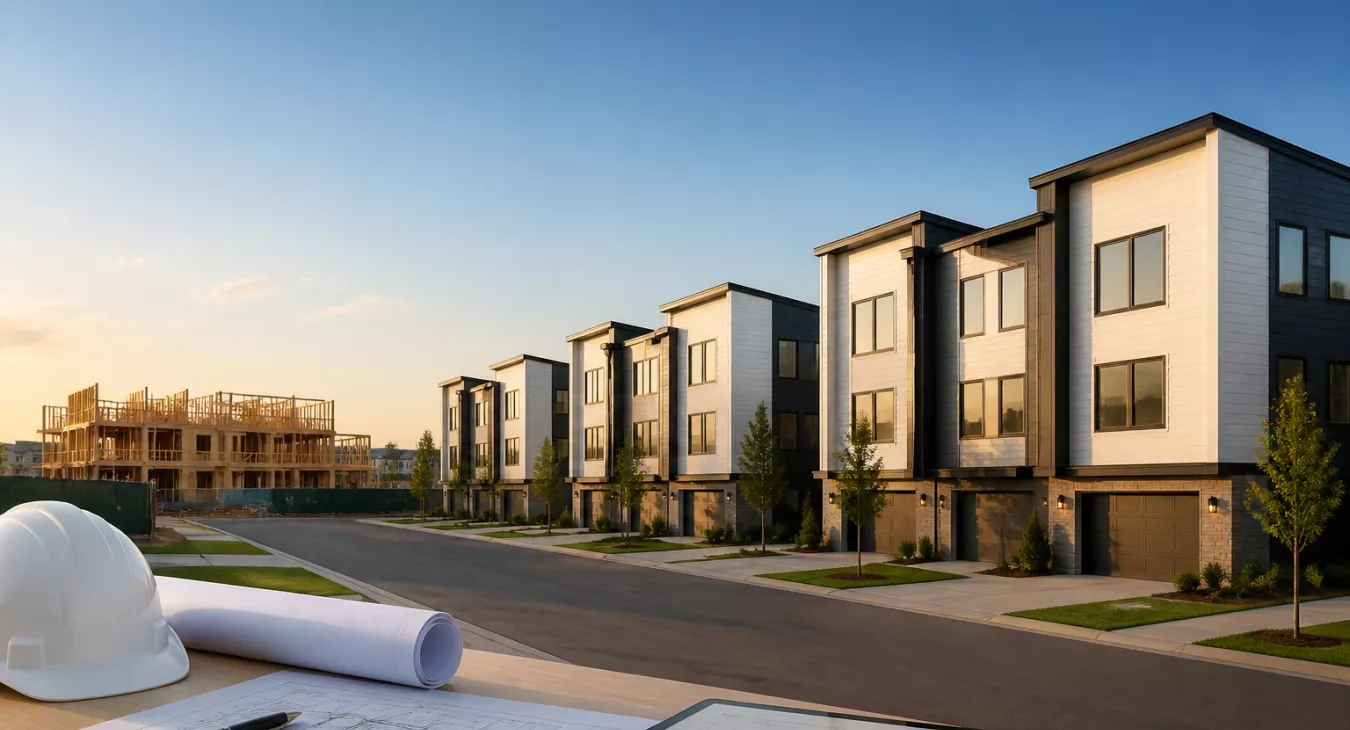
Learn how build-to-rent development strategy can generate long-term rental income. Explore BTR mechanics, market trends, and investor opportunities.
Products and Tools Mentioned in this Post
Buildertrend
Buildertrend is construction management software for home builders and remodelers. Manage projects, schedules, budgets, and client communication in one platform.

Table of Contents
- what's Build-to-Rent Development?
- Strategic Benefits of Build-to-Rent Development
- Tenant Demographics and Market Appeal
- Financing Build-to-Rent Projects
- Build-to-Rent vs. Alternative Development Models
- Regulatory Framework and Geographic Considerations
- Real-World Case Studies
- Building a BTR Development Strategy: Step-by-Step
- Conclusion
- Frequently Asked Questions
Build-to-rent used to be an institutional play on the fringe. Not anymore. The BTR model is now mainstream — and the capital flowing into these deals proves it. The global BTR market hit USD $210.4 billion in 2025. By 2026, that number jumps to USD $236.9 billion. And the 10.3% CAGR forecast through 2034 tells you this isn't a blip. If you're a developer or institutional investor looking at where to deploy capital next, you can't ignore BTR strategy anymore. It's not optional. It's the foundation.

what's Build-to-Rent Development?
Definition and Core Concept
Build-to-rent flips the traditional real estate playbook. Instead of building units to sell them off individually, a developer constructs a residential property — or entire portfolio — and keeps it. The goal? Hold it long-term and collect rental income. That's the whole strategy. You're not chasing a quick exit through unit sales. The asset itself is the product, and cash flow beats a one-time capital event every time.
Institutional investors, REITs, and large consortiums typically own BTR developments. And the model covers everything from single-family built-for-rent communities to multifamily apartment buildings designed from the ground up for renters.
How BTR Differs from Buy-to-Let and Traditional Development
Buy-to-let is what individual landlords do — they buy existing or newly built units and rent them out. BTR operates at a completely different scale. A single entity develops and manages an entire community as one cohesive operation. This creates fundamentally different cost structures, operational dynamics, and return profiles than anything a solo landlord handles. Need a granular breakdown of individual rental strategies? Check our guide on building a rental portfolio from 1 to 10 doors.
Historical Context and Market Growth
The U.S. and UK pioneered the BTR model after 2008, when institutional capital finally recognized that large-scale residential rentals could be a legitimate asset class. It's since spread to Australia and parts of continental Europe. But here's what matters for your analysis: single-family BTR starts hit 68,000 units in 2025 — a 19% drop from 84,000 in 2024. Higher financing costs are the culprit. As of early May 2026, approximately 61,700 BTR units remain under construction nationally, per RealPage data.
Back to topStrategic Benefits of Build-to-Rent Development

Financial Advantages and Long-Term Cash Flow
Here's what makes BTR really attractive: predictable revenue. You're not gambling on a sales pipeline or waiting for buyer financing to close. Instead, you're collecting rent checks month after month from a stabilized portfolio that actually performs. The NAA data backs this up—national average BTR rent hit $2,207 per month as of Q1 2026, with occupancy holding steady at 91.9%. And stabilized communities? John Burns Research shows roughly 93% occupancy as of Q1 2025. Even as new BTR supply floods the market, demand's proving resilient.
Compare that to traditional for-sale development. Pre-sale requirements, buyer financing contingencies, market timing risk—any of these can tank your project economics. Want a deeper dive into why long-term rental income makes sense? Check out our piece on long-term rental investing.
Economies of Scale in Operations
Single ownership structure. That's your competitive edge here. BTR operators can negotiate serious bulk contracts on maintenance, landscaping, insurance, and property management software that scattered-site buy-to-let investors can't touch. Marketing costs per unit drop significantly once reputation and referrals take over. And vacancy risk? It's spread across dozens or hundreds of units instead of concentrated in one struggling property. This operational advantage simply doesn't exist for traditional landlords.
Sustainable and Efficient Building Practices
BTR developers think differently about construction because they're holding these assets for the long haul. They're not flipping or selling—they're living with operational costs for decades. Energy efficiency, durable materials, low-maintenance systems. These aren't nice-to-haves anymore; they're financial necessities. You'll find better-built communities in BTR because the developer's skin is in the game. For-sale builders face constant pressure to cut corners and minimize upfront costs, which just gets passed to individual owners later on.
Back to topTenant Demographics and Market Appeal

Primary Target Markets
Young professionals and family-stage renters dominate the BTR space. What do they actually want? Flexibility—no 30-year mortgage hanging over their heads—plus professionally managed maintenance and access to quality locations. They're not obsessing over square footage the way homebuyers do. Position your community near job centers and transit hubs, and you'll crush scattered-site SFR portfolios on both occupancy rates and rent growth. It's that straightforward.
Amenities and Services
Here's where BTR really separates from your average buy-to-let operation. Scale matters. You can offer amenity packages that'd be financially impossible for a single-property landlord to justify.
| Amenity Type | Common Examples | Tenant Appeal |
|---|---|---|
| Fitness & Wellness | On-site gym, yoga studio, pool | Replaces separate gym membership; convenience factor |
| Concierge & Services | Package management, maintenance hotline, pet services | Reduces friction of daily living; premium positioning |
| Communal Spaces | Co-working lounges, BBQ areas, rooftop terraces | Community building; attracts remote workers |
| Smart Home Technology | Keyless entry, smart thermostats, EV charging | Sustainability-conscious tenants; operational efficiency |
| Family-Friendly Features | Playgrounds, dog parks, extra storage | Appeals to family renters seeking permanence without purchase |
Financing Build-to-Rent Projects

Funding Mechanisms and Capital Sources
BTR requires patient capital. The long-term hold strategy means you're not flipping these—you're banking on sustained rent growth and operational efficiency over years. Your primary financing toolbox includes construction loans, institutional equity, forward-purchase agreements with REITs, and government-backed programs if you qualify. Construction loan interest rates for solid sponsors are running 6.5% to 8.0% in 2026. That's a far cry from the pre-pandemic era, which means every dollar of cost control matters now—margins don't have the same padding they used to. Institutional money has already poured more than $50 billion into BTR and single-family rental since 2020. What does that tell you? The big players see staying power in this asset class.
Key Financial Metrics for BTR Development
| Metric | Description | 2026 Benchmark |
|---|---|---|
| Yield-on-Cost | Stabilized NOI divided by total development cost | 7–8% target |
| Development Spread | Yield-on-cost minus prevailing cap rate | 150–250 bps; 250+ bps = strong margin of safety |
| Stabilized Occupancy | Percentage of units leased at stabilization | 91.9% (Q1 2026, NAA) |
| Average Asking Rent (3-bed SFH) | National median rental rate | $2,100/month (flat H1 2026) |
| Construction Contingency | Budget buffer for cost overruns | 15–20% of hard costs (industry standard) |
Here's what really matters: understanding how rental yield moves with development cost. That's where your deal either works or dies. Our deep dive on rental yield calculation and why it moves the needle for investors breaks down the math you actually need.
Risk Management and Due Diligence
Construction cost volatility will kill a deal faster than anything else. National averages hover around $323,000 per unit in 2026, but that's meaningless without context—the real range is brutal: $139,000 on the low end, $531,000 on the high end. Geography and specs matter enormously. Multifamily and horizontal BTR communities sit somewhere between $220 to $700 per square foot, with mid-rise per-unit costs landing at $200,000 to $400,000 in 2026. And here's the kicker: labor scarcity is compounding the pain. The Associated Builders and Contractors is projecting the construction workforce will be short 349,000 workers in 2026, climbing to 456,000 by 2027. Build labor availability into your pro forma. Really think about it. Your contingency reserve should reflect those staffing realities—not just the line-item materials cost.
Back to topBuild-to-Rent vs. Alternative Development Models

| Factor | Build-to-Rent | Buy-to-Let | Traditional For-Sale Development |
|---|---|---|---|
| Ownership Structure | Single institutional owner retains all units | Individual private landlords own scattered units | Developer sells to individual buyers at completion |
| Revenue Model | Long-term rental income | Rental income per individual unit | One-time capital gain from sales |
| Management | Professional, centralized at scale | Often self-managed or small agency | Sales and marketing during construction cycle |
| Economies of Scale | High — bulk procurement, shared amenities | Low — per-property basis | Moderate — construction phase only |
| Cash Flow Predictability | High — diversified across many units | Moderate — concentrated in few units | Low — dependent on sales pipeline and market |
| Capital Intensity | Very high — full development cost retained | Moderate — purchase price per unit | High — but capital recycled through sales proceeds |
So where does BTR actually sit in your overall investment playbook? Check out our comparison of wholesaling, flipping, and rental investing for the bigger strategic picture. And if you're torn between active and passive approaches, our breakdown of passive investing versus DIY rentals shows which path actually builds more wealth.
Back to topRegulatory Framework and Geographic Considerations
Planning, Zoning, and Government Incentives
BTR regulatory rules aren't one-size-fits-all. They shift dramatically depending on where you're building. The UK's got it figured out — they've explicitly recognized BTR in planning policy, which means developers can actually get planning permission under a dedicated BTR use class. And here's the kicker: you're required to include affordable rental units in the same development. Not across town. Same asset.
The U.S. playbook is messier. BTR communities go through the standard zoning and permitting processes that conventional residential projects do. But some Sun Belt municipalities? They've realized housing supply is tight enough that they're fast-tracking approvals. Smart move on their part.

Here's what matters for your underwriting: approximately 82% of the BTR pipeline in the U.S. sits in Sun Belt markets as of 2026. Why? Land costs are lower. Population growth is real. But there's a tradeoff — you're concentrated in the same regional cycles as everyone else, and supply gluts are starting to emerge in pockets.
Australia and Europe present different headwinds. Tax treatment for institutional landlords varies wildly by country. Some jurisdictions tax BTR portfolios differently than they do retail or corporate real estate, which kills institutional capital flow until you get favorable treatment. You need advocates in those markets pushing for parity.
Affordable Housing Integration
This is where BTR has a genuine structural edge over fragmented buy-to-let portfolios. Single ownership means cross-subsidization between market-rate and affordable units is simple. One entity. One P&L. One accounting ledger.
Government incentive programs recognize this. Many actively reward BTR developers for mixing income levels within a single development as part of planning approval. It's a win-win if you structure the unit mix correctly.
Back to topReal-World Case Studies
Queen Elizabeth Olympic Park, London
Queen Elizabeth Olympic Park in East London is the gold standard for BTR at scale. More than 10,000 homes completed. By 2031, they're projecting 55,000 residents on-site. Get Living London operates nearly 2,000 units, while Triathlon Homes manages close to 1,400 with mixed affordable tenures baked in. And here's what makes it work: anchor the BTR model to real infrastructure investment and genuine long-term community planning. You get scale, quality amenities, and measurable social value all at once.
U.S. Sun Belt Communities
Horizontal BTR communities—single-family rental neighborhoods purpose-built for renters—have exploded across Texas, Arizona, Georgia, and the Carolinas. Most of these developments run 100–400 detached or semi-detached homes under one operator's management. Professional landscaping, community amenities, lease flexibility. Things a scattered portfolio of SFR landlords just can't deliver. Want to see how these stack up against traditional multifamily? Check our guide on multifamily rental investing—it's the right comparison point.
Back to topBuilding a BTR Development Strategy: Step-by-Step

Step 1 — Market Analysis and Site Selection
Start here. You need rigorous demand analysis—population growth trends, employment base diversification, household formation rates, and existing rental vacancy. The numbers tell the story: the national rental vacancy rate across all rental types hit 7.3% as of Q2 2026 (Census Bureau), but single-family rentals are way tighter at 6.1% in Q1 2026. Markets with SFR vacancy below 5% and limited new supply? That's where you want to be. Look for transit access, proximity to employment centers, and solid infrastructure capacity to support development.
Step 2 — Financial Modeling and Budgeting
Build a detailed pro forma. And I mean detailed—hard construction costs, soft costs (architecture, engineering, permits), financing costs, lease-up assumptions, stabilized operating expenses, cap rates on exit. You're targeting a yield-on-cost of 7–8% with a development spread of at least 150 basis points above prevailing cap rates. But here's what matters: underwrite conservatively and pad your budget with the industry-standard 15–20% contingency for construction overruns. The rent environment is brutal right now—SFR rents declined 1.6% year-over-year in H1 2026, the first sustained national decline since the post-pandemic boom. Stress-test your revenue assumptions at flat and declining scenarios. Don't skip this step.
Step 3 — Construction and Project Management
BTR projects at scale demand serious construction management systems. Platforms reviewed in our Buildertrend 2026 review and our Buildertrend vs. Procore comparison handle multi-unit residential workflows, subcontractor scheduling, and budget tracking across complex projects. They're purpose-built for this.
Step 4 — Operational Infrastructure and Tenant Relations
Before your first tenant signs a lease, you need property management infrastructure in place. Leasing software, maintenance workflows, tenant communication systems, rent collection platforms—get it done. BTR communities that invest in professional management achieve faster lease-up, lower turnover, and stronger tenant satisfaction than scattered-site SFR portfolios. And that matters more than most investors realize. Because of BTR's emphasis on long lease terms and community identity, tenant retention becomes a core operating metric—not an afterthought.
Step 5 — Portfolio Growth and Exit Planning
Here's the truth: BTR isn't automatically a forever hold. Institutional investors refinance into long-term debt at stabilization, aggregate communities into a REIT structure for a public market exit, or sell portfolios to larger operators. You need to know your exit options before you close on the land—not after you're stabilized. If you're exploring alternative structures with built-in optionality, check out our article on lease options and rent-to-own strategies for hybrid approaches worth considering.
Back to topConclusion
Build-to-rent done right delivers the holy trinity: predictable cash flow, scale, and long-term appreciation. You're looking at a market growing 10%+ annually with demand that's structurally sound and rental housing getting more professional by the quarter.
But here's the catch. Construction costs are crushing margins. Labor shortage of 349,000 workers. Rents moderating. Financing costs elevated. This isn't 2021 anymore.
The developers winning right now? They're stress-testing everything. Building operational infrastructure that actually works. Picking markets with real supply-demand imbalance, not just hype. That's how you capture the decade-long BTR opportunity that's still in front of us.
Back to topFrequently Asked Questions
What's the minimum scale required for a BTR development to achieve meaningful economies of scale?
Most industry practitioners land on 100 units as the practical minimum. That's where BTR-specific operational efficiencies kick in — centralized management, bulk maintenance contracts, shared amenity costs. Below that threshold, you're probably better off looking at small multifamily rental strategies. They use similar principles but at a more accessible entry point.
How does BTR perform during rental market downturns?
BTR communities with professional management and strong amenities have historically held occupancy better than scattered-site SFR when markets soften. Quality matters more when tenants have options. But don't mistake that for immunity. National SFR rents dropped 1.6% year-over-year in H1 2026 — a reminder to always model conservative revenue assumptions in your pro forma.
What share of new housing starts does BTR currently represent in the United States?
Single-family built-for-rent starts hit 7.2% of all single-family housing starts as of 2025, according to Arbor/Chandan Economics. That's well above historical norms. It reflects a real structural shift toward institutional rental housing, even as absolute start volumes have moderated from 2024 peaks.
Can BTR projects include affordable housing?
Absolutely. Many jurisdictions — particularly the UK — actually encourage or require it as part of planning approval. And here's the smart part: mixed-income BTR developments let a single operator cross-subsidize affordable units with market-rate revenue. You'll often qualify for government incentive programs that improve overall project economics. Try doing that with fragmented buy-to-let portfolios. You can't practically administer affordable housing obligations across multiple individual owners.
What technology systems are essential for managing a BTR portfolio?
You need integrated property management software at minimum. That covers leasing, maintenance, accounting, and tenant communications in one system. Add construction management tools during development phase. And don't skip data analytics platforms for occupancy and rent trend monitoring. Our comparison of leading construction management platforms is a practical starting point for finding what fits your project scale.
Back to top