

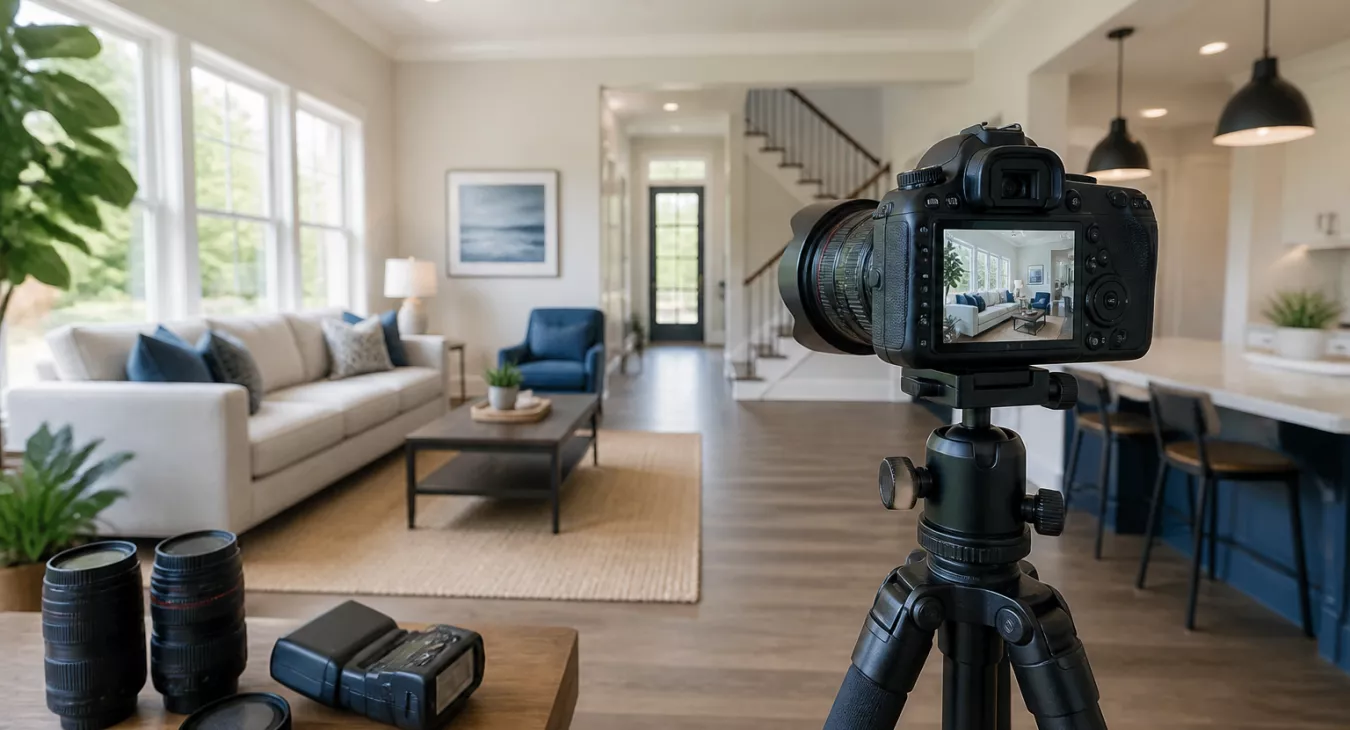
Discover the best real estate photography equipment guide for agents and investors. Learn which cameras, lenses, and gear deliver professional results at e
Products and Tools Mentioned in this Post

BoxBrownie
BoxBrownie offers professional virtual staging, photo editing, and image enhancement services for real estate. Fast turnaround, affordable pricing, 24/7 service.

Matterport
Matterport creates immersive 3D virtual tours and digital twins for real estate. Capture properties with professional-grade technology and share interactive experiences.
Table of Contents
- Why Quality Equipment Matters for Real Estate Professionals
- Choosing the Right Camera
- Essential Lenses for Real Estate Photography
- Tripods, Heads, and Stabilization Equipment
- Lighting Equipment for Real Estate
- Drone Photography and Videography
- Advanced Equipment: 360-Degree Cameras and Virtual Tours
- Post-Processing Software and AI-Assisted Editing
- Accessories and Supporting Gear
- Budget Planning: Equipment Tiers
- Equipment for Specialized Property Types
- Building Your Complete Gear Kit
- Equipment Maintenance and Longevity
Your listings live or die online. Pro-quality photos get more clicks, more showings, better offers—smartphone shots just don't cut it. And that gap compounds fast if you're moving multiple properties a year.
Whether you're an agent building your personal brand or an investor documenting deals at scale, gear matters. The right equipment is what separates a listing that languishes from one that moves. But here's the thing—you don't need to drop $10K to get serious results.
This real estate photography equipment guide covers everything: cameras, lenses, tripods, lighting, drones, accessories. You'll get honest recommendations at every price point. Skip the guesswork.

Why Quality Equipment Matters for Real Estate Professionals
Your listing photos aren't just pretty pictures—they're a statement about how you do business. Bright, sharp, wide-angle shots tell buyers the property's been cared for and presented seriously. Blurry, dark, or distorted images? They scream the opposite, no matter how solid the actual condition or price point. Photography quality directly impacts days-on-market and agent brand perception. For investors, it affects both how fast you can move a deal and your ability to track a property's condition over months or years.
And here's what most agents don't think about: the tax angle. Equipment you buy for your real estate business is deductible. IRS Section 179 lets you deduct up to $2,560,000 in equipment costs for tax year 2026 — basically the full purchase price in year one. Better yet? Bonus depreciation hit 100% for qualifying property acquired after January 19, 2025 thanks to the One Big Beautiful Bill Act (signed July 4, 2025). This is permanent. That $3,000 lens or $5,000 camera body? You're writing it off immediately. Factor that into your ROI.
Beginner vs. Professional Grade Gear
Don't drop $10,000 on a camera setup just to feel professional. But your smartphone photos aren't going to cut it either. An entry-level mirrorless camera paired with a solid wide-angle lens will produce sharp, bright interior shots that actually move units. Professional-grade gear buys you speed, range, performance in low light, and equipment that lasts a decade. Here's the real talk: a mid-tier camera with premium lenses will crush an expensive body with cheap glass every single time. Invest in your lenses first.
Back to topChoosing the Right Camera

Your camera choice ripples through everything else. Sensor size, autofocus speed, and video chops—pick these today and you're locked into which lenses work, how well your images hold up in dim interiors, and whether you'll regret this investment in three years. Real estate photography demands wide dynamic range, bulletproof autofocus, and the ability to handle whatever lighting situation you walk into. Canon, Sony, and Nikon's modern mirrorless bodies check all these boxes.
DSLR vs. Mirrorless Cameras
The shift is done. No major manufacturer is developing DSLRs anymore. Sure, older DSLR bodies still work, but they're missing the electronic viewfinder accuracy, silent shooting modes, and compact size that mirrorless systems bring to occupied homes. And in 2026? Buy mirrorless. Full stop.
Full-Frame vs. APS-C Sensors
Full-frame sensors collect more light and deliver better dynamic range. That's huge when you're staring down blown-out windows while the living room falls into shadow—it's the real estate photography nightmare. APS-C (crop) sensors weigh less and cost significantly less. The trade-off: you'll need to think differently about lenses because the crop factor narrows your effective field of view. Most agents and investors shooting standard residential deals? An APS-C kit is your sweet spot. But if you're handling luxury listings, commercial spaces, or you just want maximum image quality, full-frame delivers.
Want to go full-frame? A mirrorless body like the Canon EOS R8 or Sony a7 IV paired with a wide-angle lens runs $2,000–$2,800 in 2026. Step down to a crop-sensor mirrorless kit—think Nikon Z50 II or Canon EOS R10—and you're looking at $1,000–$1,400. That's a real difference when you're building out your kit from scratch.
Top Camera Models for Real Estate
Here's what's actually available across sensor sizes and brands. Keep in mind prices move around—use this as a relative guide, not gospel.
| Camera Model | Sensor Type | Kit Price Range (2026) | Best For | Video Capability |
|---|---|---|---|---|
| Canon EOS R8 | Full-Frame | $2,000–$2,800 (with wide lens) | Entry full-frame; quality without the weight | 4K 60fps (cropped) |
| Sony a7 IV | Full-Frame | $2,000–$2,800 (with wide lens) | Photo and video hybrid; autofocus is genuinely best-in-class | 4K 60fps uncropped |
| Canon EOS R10 | APS-C | $1,000–$1,400 (with wide lens) | Cost-conscious agents; fast and doesn't kill your back | 4K 30fps (cropped) |
| Nikon Z50 II | APS-C | $1,000–$1,400 (with wide lens) | Beginners and investors who want a straightforward workflow | 4K 30fps |
Why Smartphones Aren't Enough
Flagship smartphones kill it in outdoor daylight. Computational photography has closed the gap with dedicated cameras—we get that. But step inside a residential interior? That's where smartphones fall apart. Tiny sensors blow out your windows, shadow areas turn into grainy disasters, and the HDR processing makes everything look artificial instead of real. Ultra-wide smartphone lenses distort rooms to look bigger than they actually are. Buyers show up disappointed. For properties that need professional presentation, a dedicated camera isn't optional. Smartphones have their place—use them for behind-the-scenes content or quick social media hits—but for the core listing shots, you need the real thing. Want to layer mobile tools into your workflow? Check our 20 Best Mobile Apps for Real Estate Investors for secondary productivity boosts.
Back to topEssential Lenses for Real Estate Photography

The lens is everything. Your camera body? It's just the body — the lens is the soul that determines field of view, sharpness, low-light performance, and whether rooms actually look like rooms or circus mirrors. Wide-angle dominates real estate photography for a reason, but knowing which wide-angle will save you hundreds on gear you'll never use.
Wide-Angle Lens Selection
You want wide-angle lenses — typically 10mm to 24mm on full-frame — because they let you shoot an entire room in one frame without the architectural distortion that ultra-wide glass creates. The real money zone for interior work on full-frame? 16–24mm. Shooting crop sensor? Take those numbers and multiply by 1.5 (Nikon and Sony APS-C) or 1.6 (Canon APS-C). That's your focal length target.
Starting out? The Canon RF 16mm f/2.8 STM runs about $300 and it's genuinely solid for Canon R-system shooters. Compact. Sharp in the middle. Affordable enough that you won't lose sleep if you scratch it. Sony folks who need zoom range should look at the Sony FE 16-35mm f/4 G PZ, which costs around $1,300 as of April 2026. You get both tight interior shots and exterior angles without lens swaps. And then there's the top tier — professional-grade wide-angle with image stabilization and weather sealing typically run $1,200 to $2,500.
Prime vs. Zoom Lenses
Primes win on sharpness and speed at any given price point. Fixed focal length means less glass, less compromise. Zooms trade some of that optical purity for flexibility. Here's the thing with real estate though: you're moving fast. Every property has different dimensions, different furniture layouts, different natural light. You can't always step back and "zoom with your feet" in a packed master bedroom. A 16–35mm zoom covers basically every scenario residential real estate throws at you.
Recommended Lens Options by System
| Lens Model | Focal Length | Max Aperture | System | Price Range (2026) | Best For |
|---|---|---|---|---|---|
| Canon RF 16mm f/2.8 STM | 16mm (full-frame) | f/2.8 | Canon RF | ~$300 | Budget entry; compact Canon kit |
| Sony FE 16-35mm f/4 G PZ | 16–35mm (full-frame) | f/4 | Sony E-mount | ~$1,300 | Versatile mid-range Sony zoom |
| Professional wide-angle with IS/WS | Varies (typically 14–35mm) | f/2.8–f/4 | All major systems | $1,200–$2,500 | Luxury listings; adverse weather shoots |
Tripods, Heads, and Stabilization Equipment

Skip the tripod and you're shooting blind. A quality tripod isn't nice-to-have — it's the foundation that separates pro listings from amateur snapshots. You get consistent framing, level horizons, and sharp images even when light's terrible. Plus, you'll save hours in post-processing fixing tilted verticals and wonky compositions.
Tripod Selection Criteria
What should you actually look for? Here are the non-negotiables:
- Stability at low heights: You're shooting at 4–5 feet most of the time — eye level feels natural to buyers. A tripod that locks solid at mid-range heights beats one that only works fully extended or collapsed down.
- Built-in or attachable spirit level: Crooked images kill your credibility. Most heads come with a bubble level built in. Don't have one? Grab an inexpensive hot-shoe level for thirty bucks.
- Weight-to-load ratio: Carbon fibre tripods weigh less and dampen vibration better than aluminium. They cost more, though. But if you're bouncing between five properties a day, that weight saving adds up fast.
- Quick-release plate system: Arca-Swiss compatibility is your friend here. Mount and dismount the camera in seconds. Works with ball heads, L-brackets, and gimbals too — essential when you're moving fast.
Ball Heads vs. Pan-Tilt Heads
Ball heads are faster. One lock and you're repositioning for the next angle — exactly what real estate demands with all its varied shots. Pan-tilt heads? They give you precise control over each axis separately, which matters when you're panning smoothly for video. Here's what most pros actually do: ball head for stills during the day, then swap in a fluid head or gimbal when that video walkthrough starts rolling. If you're doing hybrid photo-and-video content, get a tripod that lets you swap heads without fussing around.
Stabilization for Video Content
Three-axis gimbals are now standard equipment for listing videos. They smooth out every jitter on every plane at once, giving buyers that cinematic feel they expect from high-end properties. And stabilized lenses — Canon IS, Sony OSS, Nikon VR — add another layer of smoothness when you're shooting handheld stills in tight spaces where a tripod won't fit.
Back to topLighting Equipment for Real Estate

Light matters most. Yet most beginners skimp on it. Here's the reality: you're balancing a bright window, overhead fixtures, and shadowed corners into one exposure that doesn't look artificially lit or blown out. Get this right, and your property pops. Get it wrong, and you're losing 20-30% off the perceived ARV before anyone even tours the space.
Ambient Light Optimization
Start with what's already in the room — it costs you nothing. Turn on every light. Open the blinds completely. Timing matters too. A south-facing living room? Shoot mid-morning or early afternoon when the sun angles in from the side. North-facing rooms thrive on overcast days because you eliminate the harsh shadows that make spaces feel cramped. You're not being creative here. You're being strategic about sun position and its impact on perceived square footage.
Flash and Fill Light Options
One off-camera speedlight bounced off a ceiling or wall transforms a dark room instantly. Suddenly it's bright and inviting instead of dim and depressing. Off-camera flash setups—where you position the flash away from the camera with a wireless trigger—let you paint light exactly where you need it. On-camera flash? That's the enemy. Flat, unflattering, looks cheap. For the price of a wireless trigger kit (roughly $150-250), you're looking at the highest-ROI lighting investment an agent or investor can make. Hands down.
Continuous Lighting Solutions
LED panels aren't what they were five years ago. Modern options deliver excellent colour accuracy. They're mandatory for video work because flash doesn't work for motion. But here's why they matter for stills too: you see exactly what you're getting before you click. Look for panels rated CRI 95 or higher—anything below that and colours shift in post, costing you time and credibility. Bi-colour panels (warm to cool) let you match whatever ambient light the room already has, which means less post-processing headaches and faster turnarounds on listings.
Exposure Bracketing and HDR
Large windows destroy single exposures. The sky blows out or the interior goes dark. Exposure bracketing solves this. You fire three, five, or nine frames at different exposures—then blend them in post to hold detail everywhere simultaneously. This is HDR done right. Most mirrorless cameras have automated bracketing built in. It fires rapid-succession exposures without you touching anything. For rooms with tough light ratios, this technique pays for your gear investment on the first 10 listings alone.
Back to topDrone Photography and Videography
Aerial shots used to be a luxury. Now? They're basically expected — especially if you're marketing land, waterfront, or a distinctive roofline. But here's the thing: you can't just launch a drone and start filming. The regulatory side matters, and so does picking the right equipment.
FAA Regulations for Commercial Drone Use
Let's be clear. Any drone photography you use commercially — including real estate listings — requires a FAA Part 107 Remote Pilot Certificate. There's no workaround. Fly commercially without it and you're looking at civil penalties exceeding $11,000 per violation. That's not a typo.
Here's what the certification process actually involves: a $175 knowledge test with 60 multiple-choice questions, taken in-person at an FAA Knowledge Testing Center, and you need 70% to pass. And you're not done after that. Every 24 months you'll need to complete free online recurrent training to keep your certificate active.

Now for the operational limits. You're capped at 400 feet AGL (Above Ground Level), and any drone over 0.55 lbs (250 grams) needs to be registered with the FAA. Registration is cheap — $5 and good for three years — but it's mandatory.
Recommended Drone: DJI Mini 4 Pro
The DJI Mini 4 Pro is the most widely used sub-250g real estate drone in 2026. You'll find it priced around $599 for the standard kit, or $699–$959 for the Fly More Combo with different controller and battery options.
Why this one? It weighs under 250 grams, which means you skip the FAA registration entirely — a real operational advantage in many Class G airspace situations. And the specs don't suffer because of the light weight: 4K HDR video, 48-megapixel still images. For residential real estate work, this is your best bet. It fits in a small backpack. It produces professional results. Done.
Back to topAdvanced Equipment: 360-Degree Cameras and Virtual Tours
The pandemic made virtual tours non-negotiable. Now? They're table stakes for serious listings — especially when you're marketing out-of-area deals, relocation clients, or anything in the luxury bracket. But here's the catch: you can't shoot these with your standard mirrorless body. You need dedicated 360-degree hardware.
360-Degree Camera Options
Want to start lean? Entry-level rigs like the Insta360 X4 or Ricoh Theta Z1 run $300–$900 and produce tours that work fine for standard residential comps. Step up to professional gear — Matterport Pro3, Leica BLK360 — and you're spending real money. The tradeoff? Spatial data capture, automated floor plan generation, and native integration with every major MLS platform.
Most agents doing this themselves land somewhere in the middle: entry-level or mid-range 360 camera paired with Matterport or Kuula. It's the sweet spot between cost and output quality.
Virtual tours don't exist in a vacuum. They're part of your broader digital marketing play. Building out your online presence at the same time? Check our guide to the Best Real Estate Website Builders for Investors & Agents 2026 — we break down which platforms actually embed tours cleanly without slowing load times to a crawl.
Back to topPost-Processing Software and AI-Assisted Editing
Your camera captures raw files. The real magic happens in post-processing. Think of editing as part of your gear investment — it's non-negotiable if you want professional results that actually sell properties.
Core Editing Tools
Adobe Lightroom is still the workhorse for most real estate photographers. Here's why: batch processing. You're applying consistent color and exposure corrections across a full property shoot in minutes, not hours. That efficiency matters when you're shooting 10+ properties a week.
Adobe Photoshop handles the heavier lifting — sky replacements, removing construction debris from exterior shots, virtual staging. And if you're cost-conscious? Luminar Neo delivers strong AI-assisted features without the premium price tag that comes with Adobe's subscription model.
AI-Assisted Editing Platforms
AI tools have fundamentally changed how real estate photos get edited. BoxBrownie, PhotoUp, and Styldod charge per image and handle professional editing, virtual staging, and sky replacement automatically. You're looking at outsourcing the work entirely — no learning curve, no software to master, just upload and download polished files.
Want professional results without investing time in editing software? This is the path for agents who'd rather focus on listings than Lightroom tutorials.
Photography is the foundation, but it's not the whole system. Your edited photos need distribution, and that's where the real conversion happens. Check out our Best Real Estate Marketing Tools 2026 to see how agents and investors turn great photography into actual leads and closed deals.
For a deeper dive into how AI is reshaping your toolkit across the board, read our AI Tools for Real Estate Investors: Complete Guide 2026.
Back to topAccessories and Supporting Gear
Most photographers cheap out on accessories early, then blow money later when they finally figure out what they actually need. Get this right from day one and you'll save both cash and headaches.
Memory Cards and Storage
Fast UHS-II SD cards or CFexpress cards — matched to your camera's slot — are non-negotiable. Slow cards? They'll bottleneck your write buffer and leave you staring at your camera between shots waiting for it to clear. Here's the thing: speed beats capacity every single time. A fast 64GB card outperforms a slow 256GB card. Bring at least two cards to every shoot. Back everything up to an external SSD the same day you're done.
Remote Releases and Wireless Triggers
Pressing the shutter button by hand introduces shake, especially on a tripod at slow speeds. A remote shutter release kills that problem instantly.
Wireless triggers for off-camera flash? They're game-changers. Position your speedlights anywhere in the room without running cables across the floor. Both tools are dirt cheap and they'll noticeably sharpen your images while giving you way more control over your lighting.
Carrying and Protection
Real estate photographers shoot multiple properties in one day, often in brutal weather. Your gear needs protection during transport — a padded backpack-style camera bag isn't optional, it's required. Drones demand hard-shell cases. And if you're shooting in humid climates, silica gel packs are your best friend. Lens hoods? Use them year-round to cut flare from strobes and sunlight alike.
Back to topBudget Planning: Equipment Tiers
Every agent and investor starting out asks the same thing: "What's this actually going to cost me?" Here's the real answer — it depends on your property type, how much you're shooting, and whether you're doing this full-time or just supplementing a hired photographer. The table below breaks down three realistic budget levels using verified 2026 pricing.
| Tier | Target Buyer | Camera + Lens | Tripod | Lighting | Accessories | Approximate Total |
|---|---|---|---|---|---|---|
| Entry | Investors; occasional agent use | APS-C mirrorless kit (e.g., Canon EOS R10) + Canon RF 16mm f/2.8 (~$300 lens): $1,000–$1,700 | Aluminium tripod + ball head: ~$80–$150 | 1× speedlight: ~$150–$250 | Cards, bag, remote: ~$100–$150 | ~$1,330–$2,250 |
| Mid-Range | Active agents; small-scale photography business | Full-frame mirrorless kit (e.g., Canon EOS R8 or Sony a7 IV + wide zoom): $2,000–$2,800 | Carbon fibre tripod + ball head: ~$200–$400 | 2× speedlights + triggers: ~$400–$600 | Cards, SSD, bag, remote, 360 camera: ~$500–$700 | ~$3,100–$4,500 |
| Premium | Professional photographers; luxury listings | Full-frame mirrorless + professional wide-angle with IS/WS ($1,200–$2,500 lens only): ~$3,200–$5,300 | Premium carbon fibre + fluid video head: ~$400–$800 | LED panels + speedlights: ~$800–$1,500 | Gimbal, DJI Mini 4 Pro ($599–$959), editing software, hard cases: ~$1,500–$2,500 | ~$5,900–$10,100 |
And here's the tax play you shouldn't miss — the full cost of qualifying photography equipment is eligible for the Section 179 deduction up to $2,560,000 in tax year 2026. Plus, 100% bonus depreciation applies to qualifying property acquired after January 19, 2025. Talk to your CPA before you buy anything to confirm you're positioned to take advantage of this.
Used Equipment and Rental Strategy
The used camera market is a goldmine. Platforms like MPB, KEH, and B&H Used offer professionally graded bodies and lenses at 20–40% below retail. Mirrorless cameras hold up well — low actuations, reliable build. You can get a full-frame system on an APS-C budget if you go this route.
But here's what most investors miss: renting before buying saves you from expensive mistakes. A weekend lens rental costs next to nothing compared to buying the wrong glass. LensRentals and BorrowLenses let you test equipment on actual jobs before committing. Make this your rule — rent anything over $500 before you own it.
Back to topEquipment for Specialized Property Types
Your standard residential kit won't cut it everywhere. Different property types have different demands, and buying gear that doesn't match your market is money wasted.
Luxury Properties
Full-frame cameras. Premium wide-angle lenses with weather sealing. Professional-grade continuous lighting. And usually a licensed drone pilot for aerial work. That's the minimum. Buyers at $2M+ can spot the difference between a pro shoot and a competent amateur one — it's that stark. Treat your equipment as client-facing infrastructure. Don't cheap out here.
Commercial and Industrial Properties
Now you're dealing with massive open floor plans, soaring ceilings, and mixed lighting that'll drive you crazy. This is a completely different discipline than residential. You'll want a tilt-shift lens to kill perspective distortion in tall spaces. Multiple continuous light sources to actually fill those cavernous areas. Consider a wide rectilinear lens designed specifically to minimize barrel distortion — it matters at this scale.
Drone coverage pays for itself on exterior shots of large commercial sites.
Regional and Seasonal Considerations
Cold climates? Your batteries die fast. Lithium batteries lose serious capacity below freezing, and that includes your drone. Keep spares in your jacket pocket between shots. Coastal markets and humid climates are worse — mould grows on lenses faster than you'd expect. Store your gear with desiccant packs, and weather-sealed bodies and lenses stop being a luxury upgrade and become a necessity.
In northern winters with brutal daylight limitations, continuous LED lighting isn't optional. You can't rely on natural window light when you've got maybe four hours of usable daylight.
Back to topBuilding Your Complete Gear Kit

Here's what actually works: start with the essentials, get genuinely good at them, then add gear only when you've identified a real gap in your operation. Most investors drop serious cash on a full kit right out of the gate—and then watch half of it collect dust. You don't know what you'll actually use until you're shooting properties week after week.
Essential vs. Nice-to-Have
- Essential from day one: Camera body + wide-angle lens, tripod, 1× speedlight, fast memory cards, editing software
- Add within 6 months: Second speedlight, wireless triggers, external SSD backup, gimbal if producing video
- Add when justified by revenue: Drone (after Part 107 certification), 360 camera, premium lens upgrade, LED panels
Brand Market Compatibility
Lock in a camera brand now. You can't mix lenses and flashes across Canon RF, Sony E-mount, and Nikon Z—the ecosystem just doesn't work that way. This matters more than anything else because it'll shape every single purchase you make going forward.
Sony E-mount? You're looking at the broadest third-party lens ecosystem. Canon RF gives you the most native glass options directly from Canon. Already own older Nikon lenses? The Z system lets you adapt them with minimal headaches. Bottom line: pick the system that either leverages gear you've already got or delivers the best third-party lens selection at your actual budget.
And here's the bigger picture—your camera kit doesn't live in a vacuum. The software layer, your CRM, how you deliver these photos to clients: that's where the real competitive edge lives. Check out our breakdown of the Best Real Estate Software: Tools for Investors & Agents to see the full tech stack. Then look at Best Real Estate CRM with IDX Integration options—these platforms let you showcase your photography directly in your listing pipeline, which converts faster than scattered photos ever will. If you're thinking about where photography fits into a broader portfolio, our guide to passive real estate investment strategies walks through the ROI calculation.
Back to topEquipment Maintenance and Longevity
Your camera gear is capital. Treat it like one. Proper maintenance doesn't just extend lifespan—it directly impacts your ROI on that investment. A sensor with dust spots? That's money leaving the table every shoot.
Clean your sensors regularly. Use a sensor cleaning kit or spring for professional service. Those dust spots show up everywhere—sky shots, white walls, bright interiors. And fixing them in post? That's billable hours you didn't budget for. Don't let preventable sensor issues tank your turnaround time on listings.
Same logic applies to lenses. Keep them clean. Protect them from dust, moisture, and impact damage.
Back to top