

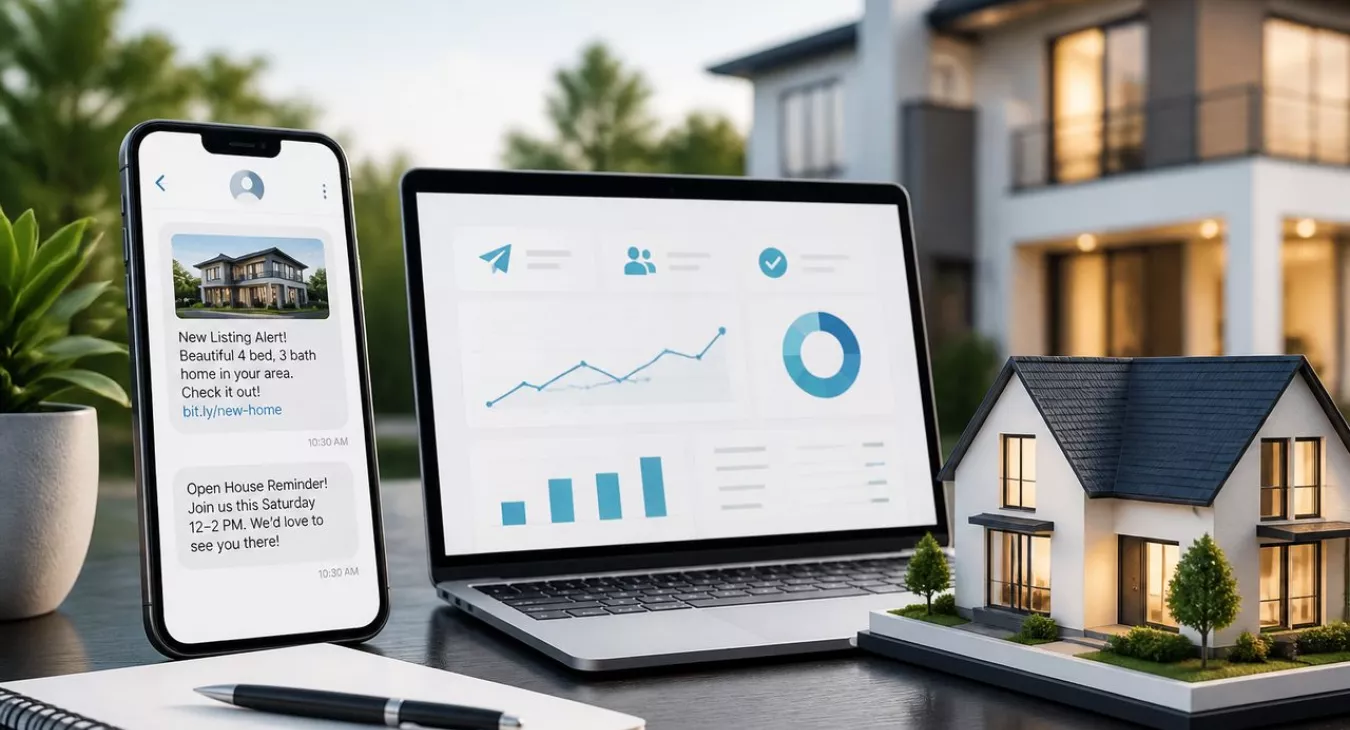
Reach more buyers and sellers instantly. Learn how bulk SMS for real estate boosts response rates, closes deals faster, and scales your campaigns with prov
Products and Tools Mentioned in this Post

Contactually
Contactually is a real-estate-ready CRM with list building, skip tracing, calling, texting, automated follow-up, project management and websites under one login.
Table of Contents
- what's Bulk SMS for Real Estate?
- Why Bulk SMS Marketing Works for Real Estate
- Top Bulk SMS Use Cases for Real Estate Agents and Investors
- Key Features to Look for in Bulk SMS Platforms
- Bulk SMS Platform Comparison
- Building Effective Bulk SMS Campaigns: Step-by-Step
- TCPA Compliance and Legal Requirements
- Common Mistakes to Avoid
- SMS vs. Email: Marketing Channel Comparison
- ROI and Cost Analysis for Real Estate Bulk SMS
- Conclusion: Getting Started with Bulk SMS for Real Estate
Real estate moves fast. The agent or investor who reaches a motivated seller or eager buyer first? They win. Bulk SMS for real estate compresses that response window dramatically — you can broadcast hundreds or thousands of targeted messages simultaneously while keeping that personal, one-on-one text feel intact. And if you're still leaning on email blasts or cold calls as your primary outreach, you're hemorrhaging response rates, appointments, and closed deals. This guide covers everything: platform selection, building compliant campaigns, tracking your actual results, and scaling what's working.
New to finding deals? Start with our Guide to Finding Motivated Sellers.

what's Bulk SMS for Real Estate?
Definition and Scope
Bulk SMS — mass texting, SMS marketing, whatever you want to call it — means sending thousands of text messages at once to a segmented list through a platform, not hunching over your phone texting one person at a time. In real estate, that list is your motivated sellers, active buyers, past clients, or investors hunting for deals.
But here's where it gets interesting. Modern platforms don't just blast out generic messages. They automate the workflow: a listing status changes, a prospect fills out your web form, an appointment's coming up — and boom, the right message hits at the right time. Two-way conversations happen right there in the platform too. When someone replies, you're not juggling texts across five different apps.
How Bulk SMS Differs from Traditional Texting
One-at-a-time texting from your personal cell? That's not scalable, not trackable, and not legal for commercial campaigns. Dedicated platforms use registered 10-digit long codes (10DLC) or short codes, log every message, and give you delivery receipts. Your personal number can't do any of that.
Why Real Estate Professionals Need Dedicated SMS Platforms
Scale matters, but compliance matters more. The TCPA and carrier A2P registration rules exist for a reason — they force businesses to use registered pathways for commercial SMS. Run a bulk campaign from your personal number or an unregistered line, and you're looking at carrier filtering, suspended accounts, and real legal exposure. It's not worth the risk.
Back to topWhy Bulk SMS Marketing Works for Real Estate

Engagement Rates That Dwarf Email
There's no contest here. SMS open rates hit 90–98% — and in real estate, you're looking at 97–97.8%. Email? You're lucky to crack 20%. But here's what really matters: SMS gets a ~45% response rate while email limps along at ~6%. That's a 7.5x advantage on the metric that actually builds your pipeline.
Now factor in speed. Most SMS messages get opened within 3 minutes. Responses come back in roughly 90 seconds. Email? You're waiting about 90 minutes. And here's the brutal reality: a motivated seller texts five investors the same morning. Those 88 minutes between your SMS and an email response? That's when someone else locks in the contract.
Speed-to-Lead Competitive Advantage
Speed-to-lead is everything in this business. 94% of Realtors already use text messaging according to AMRA & Elma data — so your competition's texting too. The real edge? Systematic, automated follow-up that hits the moment a lead lands in your CRM instead of waiting hours until you remember to call.
Want to understand how speed-to-lead connects with your other conversion levers? Check out our breakdown on Real Estate KPIs: Metrics Every Investor Should Track.
Buyer and Seller Preferences Favor Text
58% of buyers prefer texting their agent. Think about that for a second. Your prospects are telling you exactly which channel works best. When you listen and use it, conversions climb. It's that simple.
Back to topTop Bulk SMS Use Cases for Real Estate Agents and Investors

Bulk SMS works at practically every touchpoint in a real estate deal. Whether you're on the buy side or listing properties, the tactics below will move the needle.
- New listing announcements: The second a property hits your MLS or database, an automated SMS goes out. Include a short link to the listing page or drop in an MMS photo.
- Price drop alerts: Buyers who flagged interest in a specific neighborhood or price range get notified instantly when something moves. Real estate SMS response rates hit 40–50% on property alerts—way better than email.
- Showing and appointment reminders: No-shows tank your pipeline. Send automated reminders at 24 hours and 1 hour before a showing. Two-way SMS lets prospects confirm or reschedule on the spot, no phone call needed.
- Open house invitations: Segment buyers by location and price point. Then hit them with targeted invites 48–72 hours out and a same-day reminder. This works.
- Lead follow-up sequences: Want to keep deals alive? Set up multi-step campaigns that text prospects over days or weeks. Your name stays top-of-mind until they're ready to move.
- Transaction milestone updates: Inspection scheduled. Appraisal ordered. Clear to close. These updates keep buyers and sellers in the loop, cut down anxiety, and stop the phone from ringing off the hook.
- Post-closing check-ins: Message them at 30, 90, and 365 days post-close. Zero manual work required, and you're nurturing that referral goldmine.
- Investor wholesale outreach: Reach your motivated seller lists with personalized messages at scale. Opens doors for real conversations—phone calls, in-person meetings, deals.
Key Features to Look for in Bulk SMS Platforms
Automation and Workflow Capabilities
Workflow automation is where you actually save time. You want trigger-based message sequences that run on their own — no babysitting required. Look for platforms that let you set up if/then branching logic, stagger messages with time delays, and pull contacts directly from your lead sources so they automatically flow into nurture sequences without lifting a finger.
CRM Integration
Standalone SMS tools are worthless. They create data silos that mess up your pipeline and confuse your team. You need a platform that integrates natively with your CRM — or better yet, is built into it — so every message and response gets logged against the contact record automatically. Want to dig deeper into CRM strategy? Check out our articles on the Best CRM for Real Estate Property Managers and Best CRM for Commercial Real Estate Investors — both break down the market in detail.
Compliance Infrastructure
A2P 10DLC registration. Automatic opt-out processing. Quiet-hour restrictions. These aren't nice-to-haves. If a platform doesn't handle compliance, don't waste your time — move on immediately.
Analytics and Reporting
You're flying blind without data. Delivery rates, open rates, click-through rates, response rates — you need all of it broken down by campaign, segment, and individual message. Without granular reporting, you're just guessing. And if you want to actually connect SMS performance back to closed deals, our guide on Real Estate CRM Reporting & Analytics: Track Metrics That Matter shows you how.
Two-Way Messaging and MMS Support
One-way blast tools are for bulk marketing, not deal-making. Real estate requires actual conversation. You need inbound message handling, conversation threading, and MMS capability so you can send property photos directly — it's one of the biggest engagement drivers for listing campaigns.
Back to topBulk SMS Platform Comparison
You've got three main buckets here: enterprise platforms, mid-market SaaS, and tools built specifically for investors. Fair warning—pricing shifts constantly. What you see below is what was publicly available in mid-2026. Before you pull the trigger, reach out to vendors directly and confirm current rates.


| Platform | Starting Price (approx.) | Best For | Key Strengths | CRM Integration | TCPA / 10DLC |
|---|---|---|---|---|---|
| Launch Control | Mid-market; contact vendor | Wholesale investors | Investor-focused workflows, skip-tracing integration | Investor CRMs | Built-in compliance tools |
| SimpleTexting | ~$39/month for 500 credits | Agents & small brokerages | Easy UI, strong template library, MMS support | Zapier / API | 10DLC registration supported |
| EZ Texting | ~$25/month for 500 msgs | Mid-market brokerages | 230,000+ customers, enterprise-grade reliability | HubSpot, Salesforce, Zapier | Managed compliance features |
| Textedly | Contact vendor | Agent-level automation | Agent drip campaigns, keyword auto-responses | Limited native; API available | 10DLC registration supported |
| Twilio (API) | ~$0.0083/msg + carrier surcharge | Tech-forward teams / custom builds | Maximum flexibility, programmable workflows | Any (custom) | 10DLC registration required; developer-managed |
| Contactually | See contactually.net for current pricing | Agents & investors wanting an all-in-one platform | SMS + calling + email + pipelines + websites + workflows in one system; usage billed on top of plan | Native (built-in CRM) | A2P 10DLC registration required through platform |
Full transparency here: Contactually is the real-estate CRM that KDS—the team behind this site—partnered to build. It's not the older Contactually that Compass picked up. We're including it because it actually fits what you're trying to do. But you should absolutely stack it against the other options and pick what works best for your business. Just remember: calls, minutes, and texts get billed separately on top of your subscription. Head over to contactually.net and check their current rates.
Contactually wins if you want everything under one roof—SMS, calling, email, pipeline work, and hosting your own funnels. You're not juggling four different logins. But if you're deep into wholesale and need niche features like list stacking, investor-specific CRMs like REsimpli or REISift might give you more firepower. The choice comes down to what your operation actually needs.
Back to topBuilding Effective Bulk SMS Campaigns: Step-by-Step

Step 1: Audit and Segment Your Contact Database
Here's the truth: before you send anything, clean your list. Duplicates kill your ROI. Verify numbers where you can. Then segment by role—buyer, seller, investor, past client—plus geography, price range, and lead status. Sending a $450K listing alert to a seller prospect? That's wasted credit and a potential unsubscribe waiting to happen. And proper segmentation becomes the backbone for the goal-setting frameworks you'll lean on to measure what actually works.
Step 2: Register Your 10DLC Number
Every US commercial SMS campaign runs through A2P 10DLC-registered numbers—no way around it. The process breaks into two parts. Brand registration costs a one-time $4.50 for standard businesses with an EIN (August 2025), then campaign registration adds another $15.00 per campaign. Optional standard brand vetting runs $41.50 one-time and can bump your throughput limits higher.
Timeline? Plan for 1–4 weeks end-to-end. Brand approval usually takes 1–3 business days; campaign review averages 10–15 business days in 2026. Real estate campaigns specifically have hit a 95.4% approval rate with roughly 34 hours average approval time (2025 data), but carriers move at different speeds.
Step 3: Build Your Templates and Workflows
Create message templates for every scenario you'll encounter—before launch day. Use dynamic merge fields: first name, property address, neighborhood. This scales personalization without extra work. Keep it under 160 characters when possible. Longer messages split into multiple segments and get billed that way. Every marketing message needs an opt-out instruction too—"Reply STOP to unsubscribe" is non-negotiable.
Here's what templates actually look like:
- New listing: "Hi [FirstName], just listed: 3BR/2BA in [Neighborhood] at $[Price]. Photos + details: [Link]. Reply STOP to unsubscribe."
- Price drop: "Hi [FirstName], price reduced on [Address] — now $[NewPrice]. Still interested? Reply YES and I'll set up a showing. Reply STOP to opt out."
- Showing reminder: "Reminder: Your showing at [Address] is tomorrow at [Time]. Reply CONFIRM to hold your spot or CANCEL to reschedule. – [AgentName]"
- Investor outreach: "Hi [FirstName], I buy homes in [City] as-is, any condition. Cash offer in 24 hrs. Interested? Reply YES or call [Number]. Reply STOP to unsubscribe."
Step 4: Test Before You Blast
Send every campaign to an internal test group first. Really. Check that merge fields populate, links work, MMS images display properly, and opt-out handling functions as designed. One bad merge field hitting 5,000 contacts—"Hi [FirstName]" sitting in their inbox—torches your credibility instantly and won't come back.
Step 5: Send at Optimal Times
TCPA regulations lock you into 8 a.m. to 9 p.m. in the recipient's local time zone. Within that window, real estate pros typically see best response during mid-morning (10–11 a.m.) and early evening (6–7 p.m.). But your specific audience might behave differently. A/B test your send times and follow the data, not the conventional wisdom.
Step 6: Track, Analyze, and Optimize
Watch delivery rate, open rate, click-through rate (real estate SMS typically runs 16–22.1%), response rate, and unsubscribe rate at campaign level. But don't stop there. Connect the downstream metrics—appointments booked, offers submitted, deals closed—to identify which sequences actually drive business. Our guide on measuring real estate marketing success covers attribution methodology that works for SMS too.
Back to topTCPA Compliance and Legal Requirements

The Telephone Consumer Protection Act isn't something to wing. Class-action TCPA lawsuits in real estate have landed companies multimillion-dollar settlements — all from bulk texting without proper consent. Non-compliance here is genuinely one of the highest-risk plays you can make in marketing. Talk to a qualified attorney before you launch any cold outreach SMS campaigns. Here's the thing: A2P 10DLC registration looks like permission, but it's not. It's just a carrier requirement. You still need actual consent from real people.
| Requirement | Details | Penalty for Violation | How to Comply |
|---|---|---|---|
| Prior Express Written Consent (PEWC) | Required for all marketing SMS; must be affirmative, in writing (electronic counts), name the specific sender, and can't be a condition of purchase. Source | $500/message | Use web forms, paper sign-ins, or keyword opt-ins; store records with timestamps |
| One-to-One Consent Rule | Consent applies only to the single named sender; can't be shared with affiliates or co-registrants. Effective January 2025. Source | $500–$1,500/message | don't purchase shared consent lists; collect consent on your own properties |
| Opt-Out Processing | Must honor opt-outs within 10 business days; real-time processing is best practice; must recognize STOP, informal language, and other reasonable opt-out methods. Effective April 2025. | Up to $1,500/message (willful) | Use platforms with automatic opt-out handling; audit suppression lists regularly |
| Quiet Hours | 8 a.m.–9 p.m. recipient's local time for marketing SMS | $500/message | Enable time-zone-aware send scheduling in your platform |
| DNC Registry | don't Call Registry violations apply to commercial texts | Up to $43,792 per text | Scrub lists against DNC registry before sending; use a compliant list management provider |
| Willful Violations | Knowing or willful violations carry treble damages | Up to $1,500/message; no aggregate cap | Document all consent, suppression, and compliance procedures in writing |
State regulations make this even messier. Take Florida's FTSA — it slaps you with $500 per violation (tripled for willful violations), enforces quiet hours from 8 a.m.–8 p.m., and caps you at just 3 messages per 24 hours per recipient (amended 2024, kicks in 2026). And if you're touching multiple states? Get your compliance attorney involved. Don't guess on this stuff.
Back to topCommon Mistakes to Avoid
Even experienced marketers blow this. Here's what trips people up when they launch bulk SMS programs:
- Skipping 10DLC registration: Your unregistered business messages get filtered or blocked by the major carriers now. Register before you send anything.
- Texting purchased lists without verifying consent: The 2025 one-to-one consent rule changed the game — consent from a third party doesn't transfer to you. Talk to an attorney before you text any purchased list.
- Oversending to the same contacts: People unsubscribe when you spam them. Start conservative with your cadence. Then measure engagement and scale up only if the data supports it.
- Ignoring time zones: A 7 a.m. EST message hits your West Coast list at 4 a.m. That's not just a compliance violation. It tanks your relationship with that contact.
- No A/B testing: You're leaving conversion gains on the table if you send one message version and call it done. Test one variable at a time. CTA phrasing. Send time. Message length. Let the numbers tell you what works.
- Failing to connect SMS to deal outcomes: Delivery rate doesn't matter if you can't tie it to appointments booked and revenue closed. That's a vanity metric. Build your tracking stack before campaigns go live — not after. Check out our framework for real estate investment performance tracking to nail your reporting structure.
SMS vs. Email: Marketing Channel Comparison
| Metric | SMS | Advantage | |
|---|---|---|---|
| Open Rate | 90–98% (97–97.8% real estate) | ~20% industry average | SMS |
| Response Rate | ~45% | ~6% | SMS |
| Average Response Time | ~90 seconds | ~90 minutes | SMS |
| Read Within 3 Minutes | 90% | Minority of recipients | SMS |
| Click-Through Rate | 19–36% (16–22.1% real estate) | 2–5% typical | SMS |
| Property Alert Response Rate | 40–50% | Low single digits | SMS |
| Rich Content Support | MMS (images, GIFs) at additional cost | Full HTML, images, video embeds | |
| Detailed Analytics | Delivery, open, click, response | Open, click, bounce, conversion | Roughly equal |
| Cost per Message | $0.005–$0.05/segment | Fractions of a cent at scale | Email (volume) |
| Compliance Complexity | TCPA, 10DLC, state laws | CAN-SPAM (less restrictive) |
SMS crushes email on every engagement metric that matters. We're talking 97.8% open rates in real estate versus 20% for email, 45% response rates versus 6%, and people reading texts within 90 seconds instead of 90 minutes. But there's a catch — email still wins on cost at scale and gives you way more creative flexibility with rich content.
Want the real-world advantage? Use both.
The smartest investors coordinate SMS and email in sequence. Hit leads with SMS for immediate, attention-grabbing property alerts or time-sensitive off-market deals. Then follow up with longer-form email content — market reports, neighborhood deep-dives, investment guides. This two-channel approach captures urgency and intent where it counts most. For a deeper breakdown on channel strategy across your whole marketing stack, check out Real Estate Marketing: Pain vs. Pleasure.
Back to topROI and Cost Analysis for Real Estate Bulk SMS
Cost per message? That's just half the picture. At $0.005–$0.05 per SMS segment, you're looking at $25–$250 in pure message costs for a 5,000-contact blast — before platform fees kick in. But here's what matters: one closed deal on a median-priced home generates thousands in gross commission income. The math works, even at conversion rates most investors would consider conservative.
Build your ROI model around this funnel: messages sent → responses → appointments → offers → contracts → closings. Calculate cost per deal by dividing total campaign spend by actual closings. Now compare that against your other channels — PPC, direct mail, boots on the ground. Which one's pulling its weight? For a solid benchmarking framework, check out our deep dive on Real Estate KPIs. Running paid search too? Our guide on measuring real estate PPC campaign success helps you compare cost-per-lead apples to apples across every channel.
Pricing isn't one-size-fits-all — it shifts based on platform, volume, and message length (160-character segments matter). Calculate your actual monthly volume first. A brokerage sending 10,000 messages per month at $0.01 per segment spends $100 on messages alone. Add platform subscription and integration fees to that number. Then you can actually compare vendors without leaving money on the table.
Back to topConclusion: Getting Started with Bulk SMS for Real Estate
Bulk SMS isn't a silver bullet. But here's what the numbers actually show: it crushes nearly every other outreach channel on the metrics that matter most in real estate—speed, open rate, response rate. 94% of Realtors already use text messaging, and that's not because they're chasing trends. They're chasing deals.
You're competing against other investors who've already figured this out. When you can reach a motivated seller with a 98% open rate and get a response in minutes instead of days, your ARV calculations move faster. Your BRRRR timeline tightens. Your cash flow improves.
The setup? Straightforward. The ROI? Proven at scale across thousands of real estate operations. And unlike paid ads or cold calling, your cost per contact stays low no matter how aggressive you get with volume.
Start with a solid SMS platform, build your contact list, test your messaging, then scale what works. Don't overthink it. The investors making the most noise in your market right now probably aren't—they're just doing it.
Back to top