

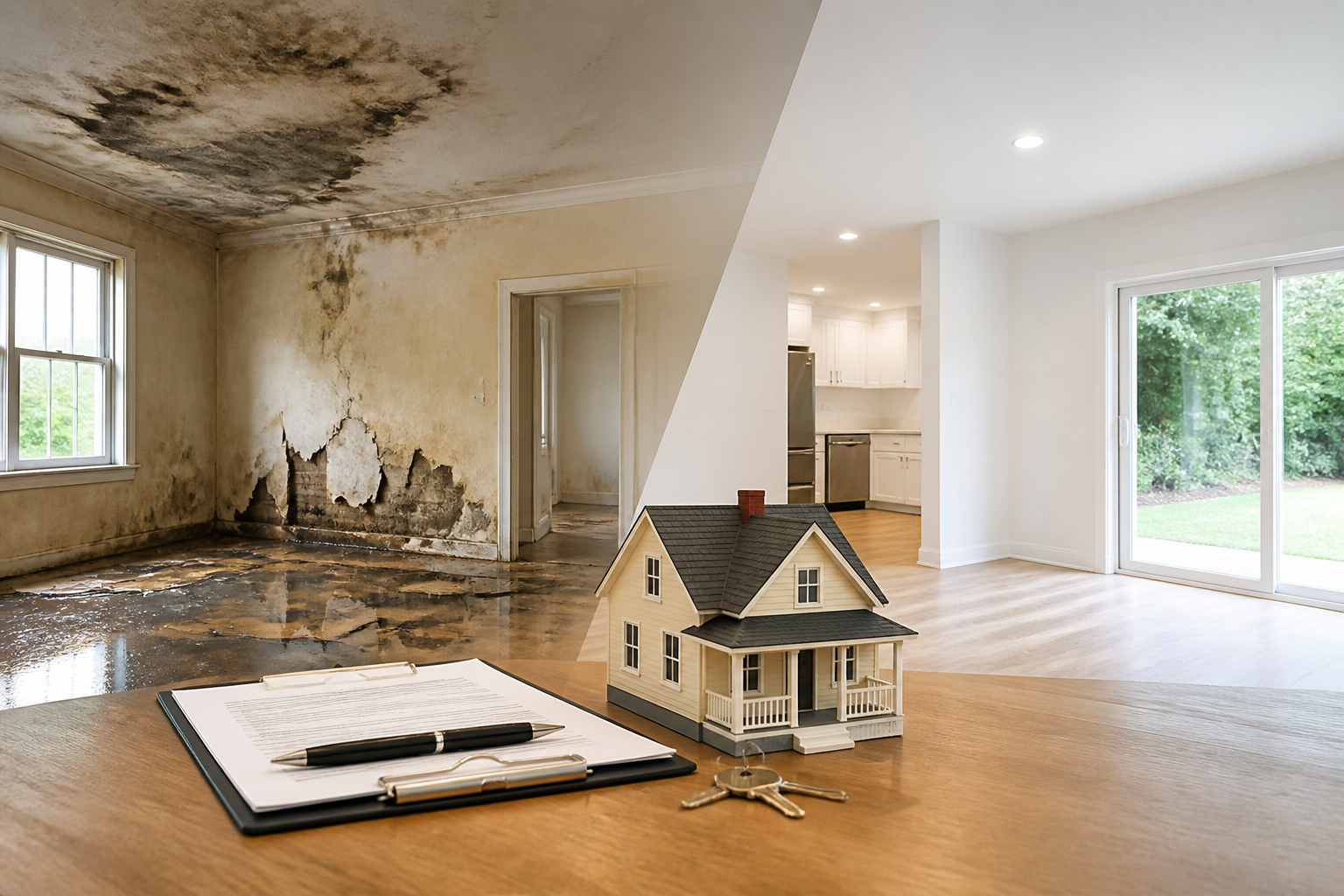
Learn how to sell a house with water damage legally and profitably. Explore your options, disclosure requirements, and buyer strategies today.
Table of Contents
- Can You Sell a House with Water Damage?
- Understanding Water Damage and Its Impact on Property Value
- Your Legal Obligations and Disclosure Requirements
- Getting a Professional Assessment Before Selling
- Repair vs. Sell As-Is: Making the Right Financial Decision
- Pricing a Water-Damaged Property Correctly
- Your Selling Options and Which Buyers to Target
- Managing Buyer Concerns and Mortgage Challenges
- Marketing a Water-Damaged House Effectively
- A Step-by-Step Process to Sell Your Water-Damaged House
- Insurance Claims and Their Impact on Selling
- Avoiding Lowball Offers and Protecting Yourself
- Timeline Expectations for Selling a Water-Damaged House
- Conclusion
- Frequently Asked Questions
Finding water damage in a property you're trying to move is stressful. But here's the thing — it's not a deal-killer. A leaky roof, flooded basement, or structural saturation doesn't mean you're stuck. There are real, legally compliant ways to close this sale and get paid. You just need to know your playbook: understand what you're actually dealing with, price it right, and be straight with buyers about the damage. This guide breaks down how to sell a house with water damage — everything from damage assessment and disclosure requirements to finding the right cash buyer and protecting yourself from lowball offers.
New to finding deals? Start with our Guide to Finding Motivated Sellers.

Can You Sell a House with Water Damage?
Yes. You can sell a house with water damage. Active leaks, old flooding, mold, structural issues — there's a buyer for every one of these scenarios. The real variables? Your buyer pool shrinks. Your price takes a hit. And you'll need to disclose what happened, because the law requires it.
Let's kill three myths right now. First: you don't have to fix everything before you list. Second: lenders absolutely will finance water-damaged properties — just not at conventional rates. Third (and this one matters legally): you can't pretend the damage doesn't exist. That's not just bad ethics; it's illegal in most jurisdictions.
Here's what actually happens. Multiple paths exist to move this property. But you need to walk in with clear eyes about one thing: price adjustments are non-negotiable. According to 2026 market data, water-damaged homes move at a 15–30% discount compared to clean comps. That gap reflects real risk and real remediation costs. Accept it upfront, and you'll negotiate faster without the frustration.
Back to topUnderstanding Water Damage and Its Impact on Property Value

Types and Severity Levels
Water damage isn't all the same. The industry breaks it down into three water source types and four damage classes — and knowing which category you're dealing with changes your entire investment thesis. Category 1? That's clean water from a burst pipe. Least hazardous of the bunch. Category 2 comes from appliances or overflow situations, and it carries real contamination risk. Then there's Category 3 — black water from sewage or floodwaters. This one's a nightmare to remediate and costs accordingly.
Here's where it gets critical: the split between cosmetic and systemic damage. Surface staining, minor drywall issues, old watermarks from a leak you've already fixed — those are cosmetic. You can live with those. Rotted framing, foundation problems, persistent mold colonies, saturated subfloor systems? That's structural damage. And it directly hits your safety profile, insurability, and appraised value. You can't hide it.
How Damage Type Affects Resale Value
Even after professional remediation, water-damaged properties carry a stigma. Appraisers routinely apply up to a 20% stigma deduction on homes with documented water damage history, even when repairs are done. Flood-prone areas? The hit's even worse. Research on Harvey-flooded homes in Harris County, Texas (2013–2022 data) found an approximately 10.8% additional discount for properties in 100-year Special Flood Hazard Areas, jumping to as much as 37% for the highest-risk zones.
In extreme cases — extensive Category 3 contamination combined with structural damage — cash offers tank hard. You're looking at 50–70% of ARV, sometimes less. Want to know what you're actually dealing with? Get ahead of it now. A realistic assessment early saves you from listing mistakes later.
Back to topYour Legal Obligations and Disclosure Requirements
Don't skip this part. In most U.S. jurisdictions, you're legally required to disclose known water damage, flooding history, mold, and related defects to prospective buyers. The consequences for hiding these issues? Lawsuits, rescinded contracts, and serious financial liability — sometimes years after closing.
What Must Be Disclosed
You need to come clean on past or present water intrusion, flooding events (even ones that happened before you owned the property, if you know about them), insurance claims tied to water damage, mold remediation history, and the status of repairs. And here's the thing: even water damage that's been fully repaired still has to be disclosed. Buyers deserve to know what this property has been through.
But disclosure requirements aren't one-size-fits-all. California sellers complete a Transfer Disclosure Statement under Civil Code Section 1102, which demands full condition reporting. Washington State? You're using Form 17, and it has to be delivered within 5 business days of mutual acceptance of a purchase and sale agreement. Your state's rules are different. Get a real estate attorney to walk you through your specific obligations and deadlines.
Documentation to Gather
- Insurance claim records (including payout amounts and dates)
- Contractor invoices for any remediation or repair work
- Before-and-after photos of damage and repairs
- Inspection reports from professional assessors
- Mold testing results and clearance certificates
- FEMA flood map documentation if in a designated flood zone
Good documentation does two things. It protects you legally. It also builds buyer confidence and keeps deals from falling apart at inspection.
Back to topGetting a Professional Assessment Before Selling

Don't price your exit strategy on guesses. Before you lock in a number or start pitching buyers, get a certified water damage restoration specialist or structural inspector on site. You'll find stuff that nobody else catches — saturated insulation hiding behind walls, floor joists that've actually lost structural integrity, moisture readings that spike under the flooring, early mold colonies tucked into spaces you can't see. A general home inspector? They'll miss half of it.
Why does third-party validation matter so much? It hands you real numbers for repair estimates. You've got legal protection against claims you hid defects. Buyers stop throwing lowball offers based on worst-case scenarios. And you get documentation — actual proof — to share with every serious offer that comes in.
That upfront assessment cost pays for itself. You'll close faster. Your pricing will actually hold water.
Back to topRepair vs. Sell As-Is: Making the Right Financial Decision

Here's where most sellers in your position get stuck. You're looking at one of the biggest financial decisions you'll make on this deal. The answer hinges on damage severity, your cash position, how fast you need to move, and what the market's actually doing right now.
Repair Cost Benchmarks (2026)
Let's talk real numbers. Here's what water damage restoration is running in 2026:
- Minor damage (drying, stain removal, basic mold, repainting): $1,200–$5,000
- National average restoration cost: approximately $3,860–$3,868, with a typical range of $1,383–$6,384
- Mitigation only (extraction and drying): $3.00–$7.50 per square foot
- Repair and rebuild (drywall, flooring, trim): $20–$37 per square foot
- Major repairs (foundation, extensive mold, structural): $15,000–$70,000
- Severe flooding with structural damage (Class 4): up to $100,000+
- Mold removal add-on: $1,200–$3,800, averaging $2,225
When to Repair Before Selling
Pull the trigger on repairs if the damage is minor to moderate and your repair costs sit well below what you'll actually recover in sale price. You've also got to have the timeline. If carrying costs aren't crushing you while work gets done, that's a green light. And here's the thing—if your market rewards move-in-ready homes and your buyers are using conventional financing, lenders might force repairs anyway. You're better off controlling the process yourself.
When to Sell As-Is
Don't waste time repairing if repair costs are eating up most or all of your expected recovery. Severe damage? Buyers will want to handle remediation on their own terms anyway. Your timeline tight? As-is closes faster. And if you're marketing to investors hunting distressed deals, they expect to specialize in distressed property acquisition.
But here's what you need to know about the money side. As-is sales generally yield 5–30% below market value. Most sellers in non-severe cases are looking at 75–95% of what an updated comparable pulls in. Run those numbers before you decide.
Back to topPricing a Water-Damaged Property Correctly
This is where most distressed deals live or die. You price too high? You're bleeding carrying costs while the listing gathers dust. Go too low and you're screaming "desperate seller"—and the vultures circle fast. The market's already brutal: the U.S. median home sale price sits at $398,596 as of August 2026, and standard homes spend a median of 50 days on market. Water damage? That's fighting uphill.
Pull a solid CMA first. Look at recent comps in your area, then discount for damage severity—and don't forget to factor in the remediation tab the buyer's going to own. Multiple appraisals help if you can swing them. And here's the thing: have your inspection docs ready to back up your number. Investors evaluating your deal? They work backward from ARV. They're looking for a 30–50% profit margin on ARV when they make an offer. Know that going in.

Your Selling Options and Which Buyers to Target

Speed, price, repair requirements. Pick two—you can't have all three. Your decision hinges on three things: how fast you need to move, how bad the water damage is, and whether you've got cash reserves to handle repairs or carrying costs.
| Selling Method | Typical Price Recovery | Estimated Timeline to Close | Best For | Key Consideration |
|---|---|---|---|---|
| Traditional Agent / MLS | Highest (minus 5–6% commission) | 3–6 months | Minor/repaired damage; conventional buyer pool | Lender may require repairs before financing |
| Cash Buyers / iBuyers | 60–80% of market value | 7–21 days | Urgent timelines; moderate to severe damage | Speed is the primary advantage; price is lower |
| Real Estate Investors | 50–70% of ARV (severe cases) | 2–4 weeks typically | Severe or structural damage; as-is sales | Investors build in significant profit margins |
| Property Auction | Varies widely; often below market | 30–60 days from listing to auction | Unique or hard-to-value properties | Competitive bidding can surprise upward or downward |
You want to move fast without leaving money on the table? FSBO approaches and investor-oriented sales strategies let you bypass the agent commission entirely. And you can market directly without middlemen getting a cut.
But don't sleep on direct buyer channels.
Facebook Marketplace and Craigslist connect you straight to cash buyers and local investors. That's where the people who actually close in days are hunting deals.
Back to topManaging Buyer Concerns and Mortgage Challenges

Financing kills deals on water-damaged properties. That's the hard truth. Conventional lenders and FHA programs won't touch a property that doesn't meet minimum habitability standards, and appraisers will absolutely flag active water intrusion, mold, or structural problems. The result? Loan denial or a repair contingency that tanks your closing timeline.
Then there's flood insurance — another buyer headache you need to know about. Properties in flood zones require it by law, and the costs add up fast. A typical NFIP policy runs $250–$1,500 annually in 2026, though high-risk coastal properties can hit $2,800 or more per year. The national average NFIP premium sits around $926 yearly as of July 2025—the latest FEMA data we have. Here's another thing: there's a standard 30-day waiting period before coverage kicks in. That delays closing. And you're capped at $250,000 for structure and $100,000 for contents on a single-family home.
Cash buyers don't deal with any of this. They skip appraisals, financing contingencies, flood insurance requirements—everything. That's why they're your best move on severely damaged properties. If you're looking at financed strategies instead, check out subject-to real estate strategies or run the numbers on cash vs. mortgage scenarios. Either way, you'll make a sharper decision when you understand how the property's condition impacts your financing options.
Back to topMarketing a Water-Damaged House Effectively
Your most powerful tool? Honest, well-organized marketing. Here's why it matters: buyers who feel deceived will walk — or worse, sue you after closing. But buyers who see you've been thorough and transparent? They'll move forward confidently, even knowing about the damage.
Practical Marketing Principles
- Be upfront in listings: Describe the damage accurately. Don't hedge with vague language. Write "kitchen subfloor requires replacement following 2024 flood event" — not "needs minor work."
- Emphasize what's working: Your location, lot size, and structural integrity all support your price. Neighborhood comparables matter too, damage or not.
- Show documentation: Attach inspection reports, remediation certificates, and contractor invoices to your listing package. This signals competence and good faith at a glance.
- Target the right buyers: If the damage is significant, phrase your listing for investors and flippers. Use language like "investor special," "priced for condition," or "as-is sale." You're not being misleading — you're signaling correctly.
- Use professional photography: Quality photos matter even more on distressed properties. Photograph repaired areas and sound structural elements. Shoot the full exterior. Don't hide damage in photos. And don't let poor photography make sound areas look worse than they actually are.
Understanding negotiation dynamics from the buyer's perspective helps you anticipate how investors will approach your property. You'll prepare counterarguments grounded in documentation rather than emotion.
Back to topA Step-by-Step Process to Sell Your Water-Damaged House
- Get a professional inspection. Before you touch anything, hire a certified water damage specialist and/or structural engineer. This is your baseline — without it, you're flying blind.
- Determine your repair vs. as-is strategy. Pull those inspection numbers and run both scenarios. What's your actual repair cost? How long will it take? Now factor in carrying costs — mortgage, taxes, insurance — for every month that timeline stretches. The math gets real fast.
- Gather all documentation. Insurance claims, repair invoices, inspection reports, mold clearance letters, FEMA flood maps. All of it. Build a clean disclosure package that shows you've got nothing to hide.
- Complete required disclosure forms. Don't guess on this one. Work with a real estate attorney to nail your state's legal requirements and deadlines. You'll want that buffer.
- Price the property competitively. Pull a CMA, get at least one formal appraisal, and use your documentation to back up your asking price. Leave some room for negotiation — but don't lowball yourself out of money.
- Choose your selling method. Speed or price? That's the trade-off. If you need cash fast and the damage is severe, cash buyers are your answer. But if damage is moderate and you've got time, a traditional listing might net you 15–25% more. Match your timeline to your buyer pool.
- Market transparently and target the right buyers. Be the person with answers, not excuses. Expect detailed questions. Expect inspection contingencies. Expect negotiation on remediation credits. And own that — transparency builds confidence faster than anything else.
Insurance Claims and Their Impact on Selling
Here's what most investors miss: your claims history is discoverable. Period. The CLUE report—that's the Comprehensive Loss Underwriting Exchange—pulls 7 years of insurance claims on any property. Buyers and their insurers will access it. And if you've got multiple water-related claims flagged there, you're signaling recurring problems that'll make the next owner's insurance more expensive (or harder to get at all).
Think about this from a buyer's perspective. They see two claims in five years? They're already worried. Most water damage claims run $11,098 on average (2026 NAIC data)—that's real money. But here's the counter-intuitive part: if you settled a claim, you've actually got leverage. That settlement proves the damage was legit and that you funded professional remediation.
Don't bury it. Lead with it.
Got an open or pending claim when you're selling? Disclose it immediately and loop in your insurer about the sale timeline. They need to know. Closing a claim before you list almost always means fewer complications and faster closing timelines.
Back to topAvoiding Lowball Offers and Protecting Yourself
Water-damaged properties are hunting grounds for predatory buyers. They know sellers are desperate, and they'll exploit that. Preparation is your only real defense.
- Get a professional valuation first. Before you even look at an offer, you need an independent benchmark. No benchmark? You're flying blind.
- Understand the math. When investors offer 30–50% profit margins on ARV, that's not greed—it's their business model. Once you know those numbers, you can tell the difference between a fair offer and one designed to rob you.
- Don't accept the first offer without review. Even when you're under pressure, spending 24–48 hours to compare multiple offers almost always pays off. And it costs you nothing.
- Work with reputable buyers. Check their reviews. Ask for references. Verify proof of funds. Document everything in writing—emails, texts, contracts, all of it.
- Understand negotiation use. Your documentation, clear pricing rationale, and demonstrated transparency are your strongest tools. Sellers who can show their work command more credibility than those who can't. For advanced tactics, check out how to eliminate competition through negotiation.
Timeline Expectations for Selling a Water-Damaged House
Before you list, get real about timing. Standard undamaged homes were sitting at a national median of 50 days on market as of August 2026. Water damage changes everything. You're looking at 3–6 months typically for a traditional listing with damage disclosed. That's the reality. But here's the kicker: cash buyers and investors can close in as little as 7–21 days. And if you're doing repairs first, add variable time on top of whatever path you pick.
This is where carrying costs kill deals. Mortgage payments, insurance, property taxes, utilities — they're bleeding you every single month the property sits. Do the math. Sometimes that lower cash offer closing in 10 days actually nets you more than waiting 5–6 months for a higher traditional sale price. Run both scenarios before you decide.
Back to topConclusion
Selling a house with water damage? It's harder than a standard sale. But it's absolutely doable. The winners here—the ones who actually close—start with a real inspection. Professional, documented, thorough. Then they disclose everything. Price it right based on actual comps and damage assessment. And they pick a buyer that fits their situation, whether that's a 90-day timeline or a quick cash close.
You've got options. Repair and list traditionally. Sell as-is to an investor. Close fast with a cash buyer. They all work when you do the legwork upfront.
But here's what kills deals: sellers who overprice because they're in denial about the damage, or worse, hide known defects and hope nobody notices. Both blow up in your face eventually. Document everything. Disclose everything. Do that, and you'll find your buyer.
Back to topFrequently Asked Questions
Do I have to disclose old water damage if it's been fully repaired?
Yes, in most U.S. states you do. Here's the thing: disclosure requirements cover the history of water intrusion or damage — not just what's actively leaking right now. Even fully remediated damage needs to be disclosed. And if a buyer finds evidence of prior damage after closing? That's post-sale litigation waiting to happen. Document your repairs thoroughly and disclose proactively. It protects you legally and builds buyer trust.
How much will water damage reduce my home's value?
That depends. Severity matters. Type matters too. The numbers are stark: water-damaged homes sell for 15–30% less than comparable undamaged properties in 2026. But here's what catches most investors off guard — even after you've repaired everything, appraisers still apply up to a 20% stigma discount. The buyer knows there was damage, and that history sticks. In high-risk flood zones, the hit is even steeper. Get a professional appraisal on your specific property and market. That's the only number that matters for your deal.
What if I can't afford to make repairs before selling?
You've got options. Selling as-is to a cash buyer or investor — that's a real path forward that sidesteps upfront repair costs entirely. Yes, you'll take a hit on price. Expect 60–80% of market value from cash buyers. But think about what you're avoiding: repair expenses, carrying costs during renovation, contractor headaches, and timeline risk. If you're the investor side of this equation and want to fund acquisitions of distressed properties yourself, creative no-money-down strategies and flipping funding options are worth exploring.
Will my homeowner's insurance cover water damage repairs before I sell?
It depends on two things: what caused the damage and what your policy actually says. Sudden, accidental damage? Burst pipe, failed appliance — that's typically covered. Gradual deterioration or flooding from external sources? Standard homeowner's policies won't touch it. Now, if you've got NFIP flood insurance, that covers flood-related damage up to $250,000 for the structure. Here's the reality check: the average water damage claim pays out around $11,098. That covers minor to moderate repairs. Severe structural damage? You're probably short. Review your policy, file legitimate claims fast, and get estimates before you assume insurance will save you.
Should I use a real estate agent to sell a water-damaged house?
It depends on your priorities. A traditional agent makes sense when the damage is moderate or already fixed, your timeline isn't tight, and you want maximum buyer exposure. Agents cost 5–6% commission on damaged home sales. But if damage is severe, you're under time pressure, or you'd rather deal directly with an investor? Skip the listing process. You'll close faster — though the check will be smaller. The right answer comes down to one question: are you optimizing for speed or price?
Back to top