


The vacation rental market is booming, presenting a golden opportunity for savvy investors to capitalize on this rapidly growing asset class.
Table of Contents
- How the short-term rental business actually works
- Check the rules before anything else
- Choosing a market
- Choosing the property
- Running the numbers
- Furnishing and setting up the property
- Managing it yourself vs hiring help
- Financing a short-term rental
- Taxes in plain terms
- Risks and how to limit them
- Common mistakes
- Where to go next
- All our short-term rental articles
- Frequently asked questions
Short-term rental investing means buying or controlling a furnished home and renting it by the night or week to travelers, usually through platforms such as Airbnb and Vrbo. When it works, a well-placed property can earn more than the same house rented on a yearly lease. It also costs more to set up, takes more work to run, and carries more regulatory risk than almost any other rental strategy.
This guide shows how to check whether short-term renting is legal where you want to buy, choose a market and a property, build a realistic revenue and expense estimate, and work through a complete example deal. It also covers furnishing, management options, financing, taxes, and the risks that sink new hosts.
The strategy fits investors who are comfortable running something closer to a small hospitality business than a passive rental. It suits people with solid cash reserves, an eye for detail, and either the time to manage guests or the margin to pay someone else. If you want steady, low-touch income, a traditional lease is usually the better fit.
Back to topHow the short-term rental business actually works
A short-term rental (STR) is typically defined as a stay of fewer than 30 nights. Many cities use 30 days as the line between "transient" lodging and a residential tenancy. The exact definition varies by city and state, so confirm it locally.
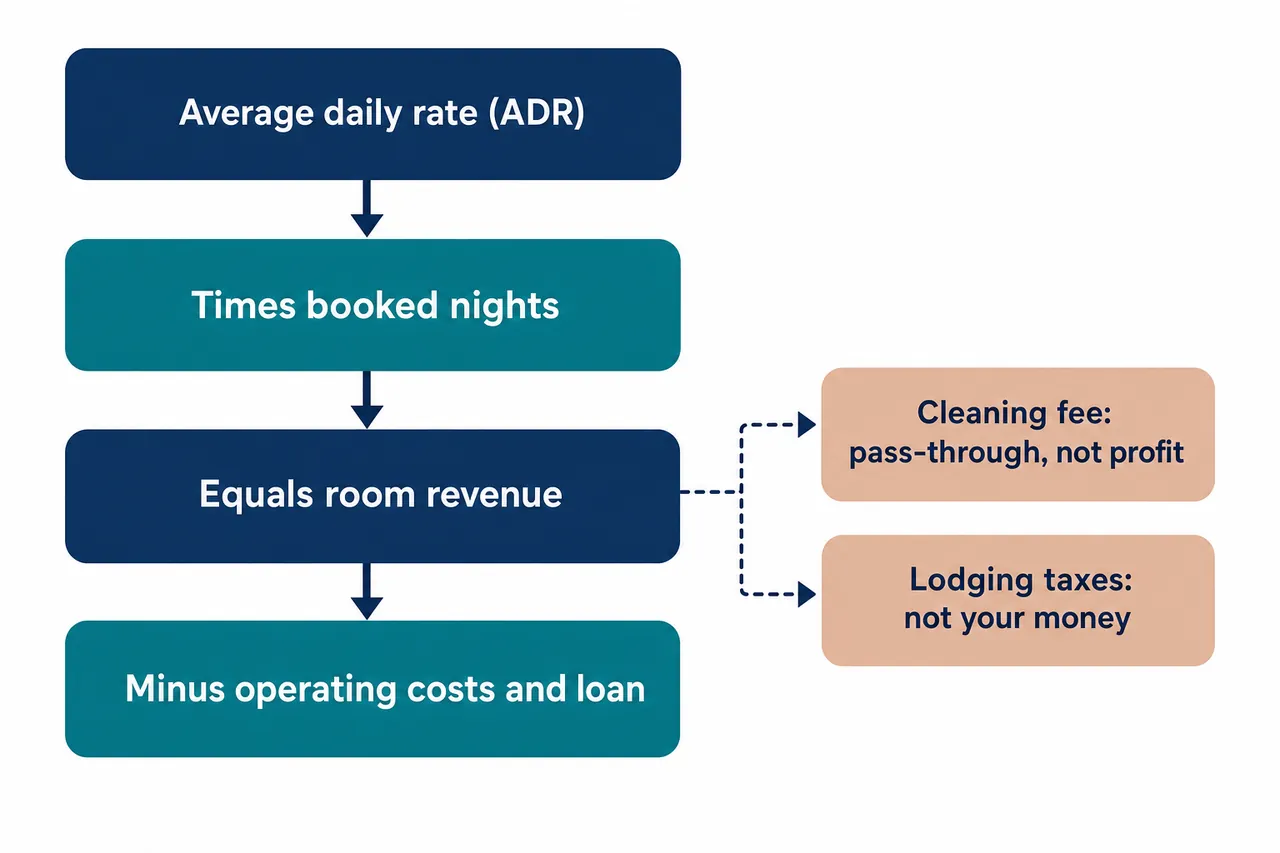
Revenue comes from two numbers multiplied together:
- Average daily rate (ADR): the average nightly price you actually collect, after discounts.
- Occupancy: the share of available nights that are booked.
ADR times booked nights gives you room revenue. Most hosts also charge a cleaning fee per stay. That fee usually just covers the cleaner, so treat it as a pass-through rather than profit.
From that revenue you pay platform fees, cleaning, utilities, supplies, insurance, property taxes, repairs and your loan. Guests also pay lodging or occupancy taxes. Those taxes are not your money. Depending on the jurisdiction, the platform may collect and remit some of them, and you are responsible for the rest.
Three features set STRs apart from long-term rentals:
- Prices change daily. Weekends, holidays, local events and seasons all move what guests will pay. Good pricing is a large part of the job.
- Turnover is constant. Every checkout means cleaning, laundry, restocking and an inspection.
- Reviews drive bookings. Ratings affect search placement and what guests are willing to pay. One bad stay costs more than one night's revenue.
If the day-to-day guest work sounds unappealing, compare this with long-term rental investing. Also consider mid-term rentals of one to several months, which sit between the two strategies.
Back to topCheck the rules before anything else
Regulation is the first filter, not the last. A property that pencils out beautifully is worthless as an STR if the city will not issue a permit. Rules also change. Cities add caps, restrict non-owner-occupied rentals, or create new zones, sometimes with little notice.
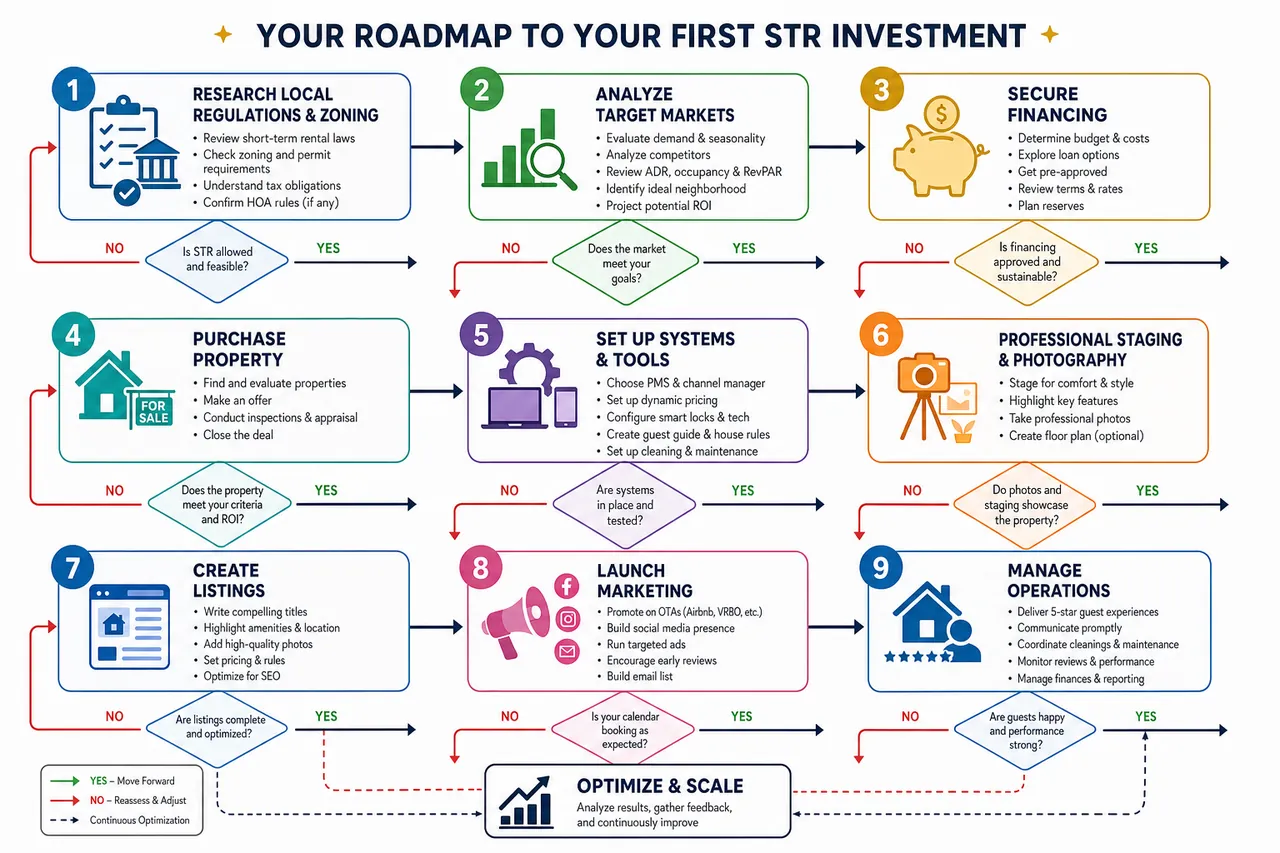
Questions to answer for any address
- Is short-term renting allowed in this zone? Some cities allow STRs only in certain districts. Others allow them only in a home the owner lives in.
- Is a permit or license required, and are permits available? Ask whether there is a cap, a waiting list, or a lottery. Ask whether an existing permit transfers to a buyer. In many places it does not.
- What are the operating rules? Common examples include occupancy limits, minimum-night requirements, annual night caps, parking requirements, quiet hours, a local contact who must respond within a set time, and posted safety information.
- What inspections and safety requirements apply? These often cover smoke and carbon monoxide detectors, fire extinguishers, egress windows in bedrooms, and sometimes a fire or building inspection.
- What taxes must be collected? State, county and city lodging or sales taxes may all apply. Each one may need its own registration.
- Does an HOA or condo association allow it? Association rules can ban or limit rentals even where the city allows them. Read the governing documents, not just the listing.
- Is anything pending? Read recent city council and planning commission agendas. Call the planning or permitting office and ask directly whether changes are under discussion.
Get answers in writing where possible. For a purchase, have a local real estate attorney review the zoning, the permit rules and any HOA restrictions before your inspection or contingency period ends. For a starting overview, see short-term rental regulations by state. Always treat the city and county as the final word.
Back to topChoosing a market
The right market has steady demand, rules you can live with, and purchase prices that leave room for profit after realistic costs. Popular destinations often fail the last test because prices already reflect the demand.

Demand drivers to look for
- Leisure draws: beaches, lakes, mountains, national and state parks, ski areas.
- Year-round anchors: hospitals, universities, large employers, military bases and convention centers. These bring visiting families, traveling professionals and business travelers.
- Drive-to access: markets within a few hours' drive of large population centers tend to get weekend bookings across more of the year than fly-to destinations.
- Events: sports, festivals and graduations create peak nights, but they rarely carry a property on their own.
Seasonality and supply
Look at how bookings spread across the year. A beach town may fill every summer night and sit mostly empty for four months. Your annual budget has to survive the slow months.
Look at supply too. Count how many comparable listings exist and whether many new ones have appeared recently. Fast supply growth can push down both rates and occupancy, even when demand is healthy.
Practical fit
Make sure you can get cleaners, handymen and a backup contact in the area. Cleaning capacity is a real constraint in some small resort towns. If you will self-manage remotely, you need people on the ground before your first guest arrives.
For candidate areas to research, see the best markets for Airbnb investing. Then verify every market yourself with local data and local rules.
Back to topChoosing the property
Short-term rental guests choose a property for how it sleeps, what it offers and where it sits. Square footage matters less. When you evaluate a house, think like the guest who will book it.
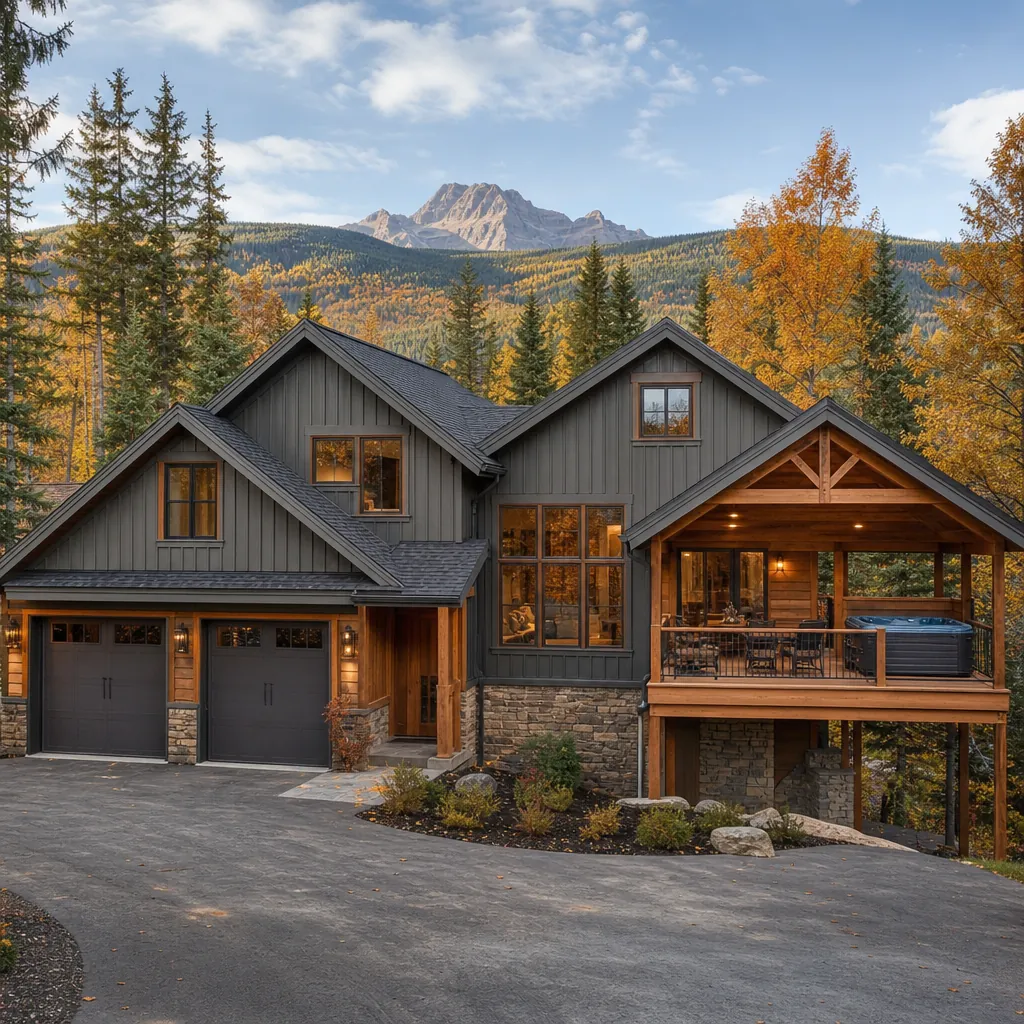
- Sleeping capacity and layout: separate bedrooms, enough bathrooms for the group size, and a common area where everyone can gather. A home that sleeps a family or two couples comfortably often reaches a wider group of guests than a studio.
- Parking: guests arriving with two cars need space for both, and many cities require off-street parking for permitted STRs.
- Amenities that match the market: a hot tub in a mountain market, outdoor space near a lake, a dedicated workspace near a hospital or business district. An amenity that does not fit the guest type rarely pays back its cost.
- Location within the market: walking distance to the main attraction often matters more than an extra bedroom.
- Condition and durability: heavy use wears out carpet, cheap flooring and older systems quickly. Hard flooring, simple finishes and newer mechanicals reduce repair calls.
- Neighbors: dense neighborhoods with close neighbors bring more noise complaints. A single complaint pattern can threaten a permit in some cities.
For a closer look at how cabins, condos, beach homes and urban units compare, read the best types of short-term rentals by property type.
If you want to test a market before buying, Airbnb arbitrage means leasing a unit with the landlord's written permission and subletting it short-term. It needs less capital. It also brings its own legal and landlord risks.
Back to topRunning the numbers
Most failed STR purchases fail on paper first. The buyer overestimated revenue, left out costs, or never tested a slower year. Build your estimate from the ground up, then try to break it.
Estimating revenue
Start by finding comparable listings. These are properties in the same area with the same bedroom count and similar amenities, ideally with a long review history. Paid market data tools can show estimated past revenue and occupancy for listings. Treat those figures as estimates, not facts.
Cross-check them in a few ways:
- Browse comparable listings' calendars and prices at several points across the year, including off-season weeks.
- Ask local property managers for a revenue projection. Their numbers can run optimistic because they want the contract, so use them as one input.
- Ask the seller for actual booking history if the property is already operating. Request platform payout reports, not a summary spreadsheet.
- Use the middle or lower part of the comparable range, not the top performers. Top listings often have years of reviews and experienced hosts behind them.
The guide to STR revenue projections walks through this process step by step.
Listing every expense
STR expense lists are longer than long-term rental lists, because you pay for everything a tenant would normally cover. Include:
- Cleaning and laundry for every turnover
- Platform service fees. These vary by platform and fee model, so check the current terms.
- Electricity, gas, water, trash, internet and any streaming services
- Property taxes and any HOA dues
- Insurance written for short-term rental use
- Consumables: toiletries, paper goods, coffee, cleaning supplies
- Repairs and maintenance, including lawn care, snow removal, pest control, and pool or hot tub service if applicable
- A replacement reserve for linens, furniture, small appliances and décor
- Software (pricing tool, messaging or channel manager), permit and license fees, smart lock subscriptions
- Management fees if you hire out
Then add debt service, meaning your mortgage principal and interest.
Example deal (illustrative numbers)
The following numbers are illustrative, not a forecast for any real market. The property is a three-bedroom, two-bath house in a drive-to lake and mountain area. The purchase price is $350,000. The buyer puts 25% down, pays about 3% in closing costs, and spends $25,000 to furnish and set up the house.
The loan is $262,500 over 30 years at an example rate of 7.25%. That works out to about $1,791 a month, or $21,492 a year. Your actual rate will depend on your lender, your loan type and the market when you buy.
Revenue assumptions:
- ADR of $240 and 58% occupancy, which gives 212 booked nights (365 × 0.58).
- Room revenue: 212 × $240 = $50,880.
- Average stay of about 3 nights, which gives roughly 70 stays.
- A $150 cleaning fee per stay brings in $10,500, and the cleaner is paid the same amount.
| Line item | Calculation | Annual amount |
|---|---|---|
| Room revenue | 212 nights × $240 | $50,880 |
| Cleaning fees collected | 70 stays × $150 | $10,500 |
| Gross revenue | $61,380 | |
| Cleaning and laundry | 70 × $150 | $10,500 |
| Platform fees | Example 3% × $61,380 | $1,841 |
| Utilities, internet, streaming | $450 × 12 | $5,400 |
| Property taxes | Example | $4,200 |
| STR insurance | Example | $3,000 |
| Supplies and consumables | $150 × 12 | $1,800 |
| Repairs and maintenance | About 5% of gross | $3,100 |
| Furnishing replacement reserve | Example | $1,500 |
| Software, permits, licenses | Example | $1,200 |
| Lawn, pest, snow | Example | $1,200 |
| Total operating expenses | About 55% of gross | $33,741 |
| Net operating income (NOI) | $61,380 − $33,741 | $27,639 |
| Debt service | $1,791 × 12 | $21,492 |
| Annual cash flow (self-managed) | $27,639 − $21,492 | $6,147 |
Next, work out the cash invested in the deal:
- Down payment: $87,500
- Closing costs: $10,500
- Furnishing and setup: $25,000
- Total: $123,000
From there, the key ratios are:
- Cash-on-cash return: $6,147 ÷ $123,000 = about 5.0%.
- Cap rate: $27,639 ÷ $350,000 = about 7.9%.
- Debt coverage ratio: $27,639 ÷ $21,492 = about 1.29. Lenders calculate this in different ways, so ask how yours does it.
You can run your own version with the rental property calculator, the cash-on-cash return calculator and the cap rate calculator.
Two more items are not in the table. Set aside separate cash reserves of several months of expenses and loan payments. And remember that lodging taxes collected from guests pass through to the taxing authorities, so they are not revenue.
Stress-testing the example
Now test what happens when things go worse than planned.
- Hire a full-service manager. At an example fee of 20% of room revenue, the manager costs about $10,176 a year. Cash flow falls to about −$4,029. The deal only works if the owner self-manages or finds lower-cost help.
- Occupancy drops to 50%. That gives 183 nights and $43,920 of room revenue. With about 61 stays, cleaning fees and cleaning costs each fall to $9,150. Gross revenue is about $53,070, operating expenses about $32,142, and NOI about $20,928. Cash flow is about −$564, roughly break-even.
- A slow first year. New listings often start with fewer bookings until reviews build up. Budget for that.
The lesson is that a deal with thin margins at your base-case occupancy has little room for a weak season, a rate cut by competitors, or a new expense.
Also check the fallback. Find out what the property would rent for on a standard lease, and whether it would cover the mortgage if STR rules changed.
Back to topFurnishing and setting up the property
Setup is where your listing's first impression is created. Plan it like a project with a budget and a checklist.
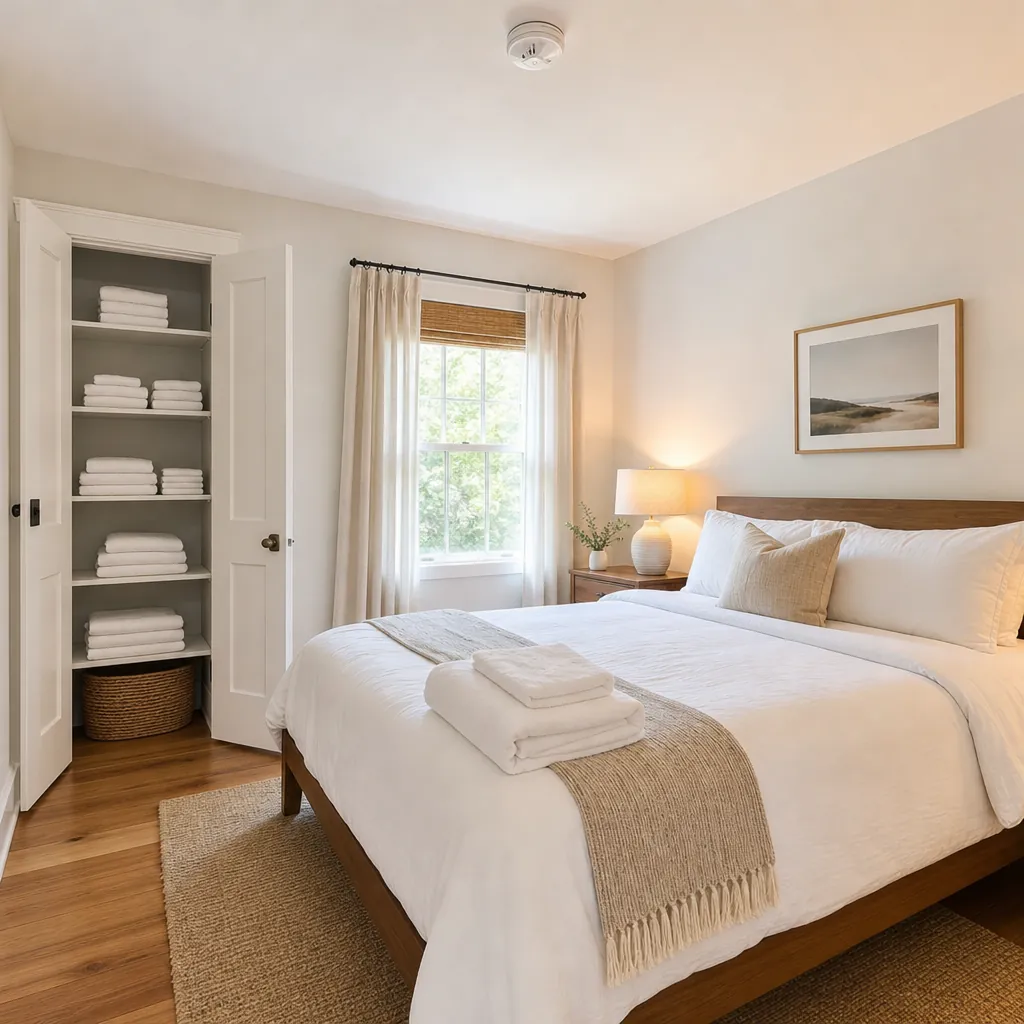
Furnish for durability and photos
- Choose comfortable, durable mattresses and furniture over trendy pieces that wear out quickly. Washable slipcovers and performance fabrics save money.
- Buy at least two to three full sets of linens and towels per bed so turnovers never wait on laundry.
- Stock the kitchen fully: matching dishes for the maximum guest count, decent cookware, a coffee maker, and basic spices and oil.
- Create one or two features guests will remember and photograph, such as a firepit area, a reading nook or a game room. Keep the rest simple.
For ways to control the setup budget, see furnishing a short-term rental on a budget.
Safety and access
- Install smoke and carbon monoxide detectors, fire extinguishers and a first-aid kit, and post emergency information. Check local requirements, which may go further.
- Use a keyless smart lock with unique codes for each stay.
- Exterior cameras and noise or occupancy monitors can deter parties. Platform rules and local laws restrict where cameras may be placed and require disclosure. Never place cameras inside living or sleeping areas.
The listing and launch
- Get professional photos taken after the house is fully staged.
- Write an accurate description that names the guest type you serve and sets clear house rules.
- Prepare a digital or printed guidebook covering Wi-Fi, appliances, trash days, parking and local recommendations.
- Do a test night yourself, or with a friend, before taking real bookings. You will find the missing items.
Managing it yourself vs hiring help
Management is a daily job: messaging guests, adjusting prices, scheduling cleaners, handling problems, restocking and reviewing every stay. You have three basic choices.
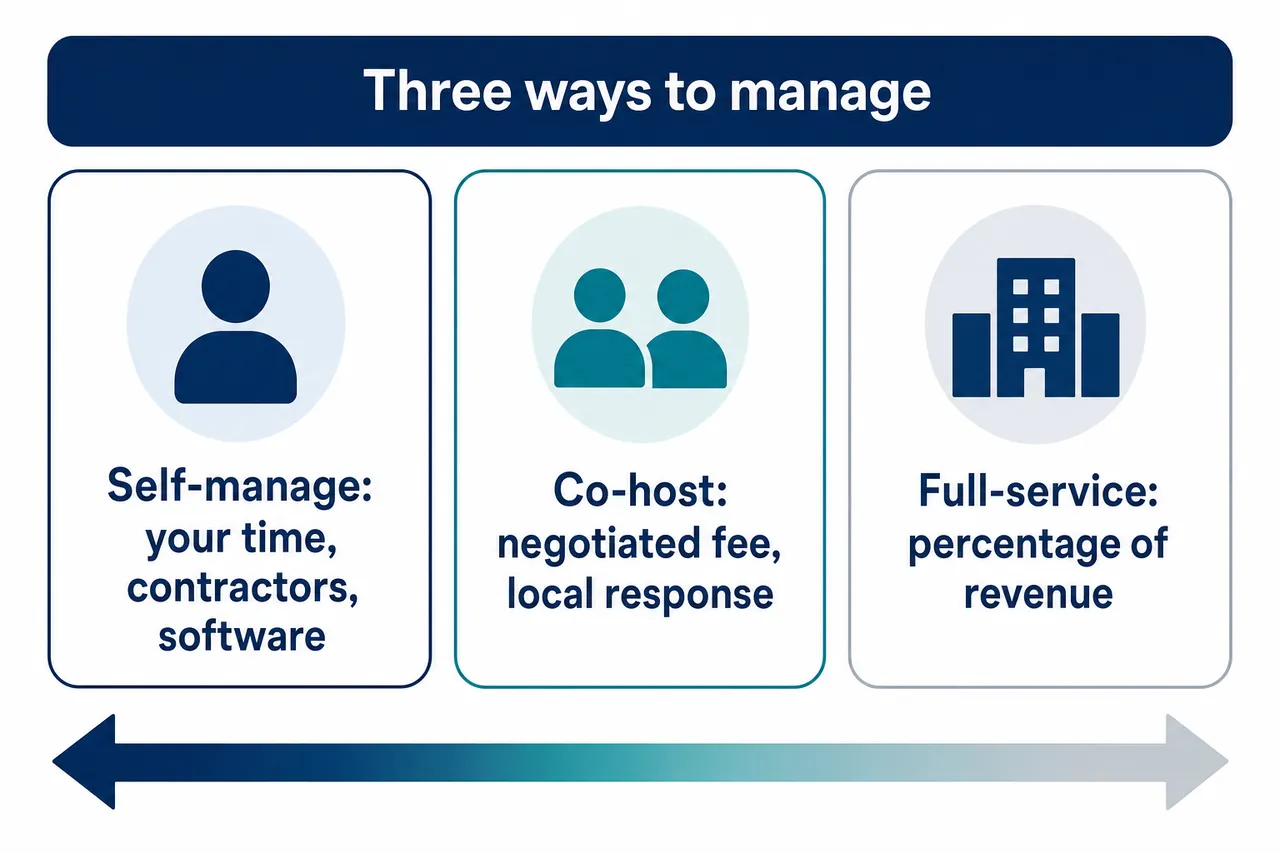
| Option | What it involves | Cost | Best fit |
|---|---|---|---|
| Self-manage | You handle pricing, messaging, reviews and scheduling. Local cleaners and handymen do the physical work. | Your time, plus software and contractor costs | Owners with time, a reliable local team and an interest in the operations |
| Co-host | A local person or small company handles some tasks, often guest communication and on-site issues, while you keep pricing and strategy. | A negotiated fee, often lower than full service | Remote owners who want control but need local response |
| Full-service manager | The company runs nearly everything: listing, pricing, guests, cleaning and maintenance. | A percentage of revenue that varies widely, plus pass-through costs | Owners who want hands-off ownership and whose numbers still work after the fee |
Before hiring a manager, ask these questions:
- Is the fee charged on room revenue or on gross revenue including cleaning fees?
- Who keeps the cleaning fee?
- Are there markups on repairs or supplies?
- Who owns the listing and its reviews if you part ways?
- What notice is required to end the contract?
Read self-managing vs hiring out for a fuller breakdown.
Whoever manages, a few systems matter most. Use dynamic pricing instead of a fixed nightly rate; see STR dynamic pricing tools and strategies. Fast, friendly communication and a spotless turnover drive reviews, covered in building a five-star guest experience. And when a review is unfair or harsh, reply calmly and factually, as explained in how to respond to negative Airbnb reviews.
Back to topFinancing a short-term rental
How you finance the purchase affects both your cash needs and your risk. Lender guidelines change often and differ between lenders, so treat the options below as categories to discuss with a lender, not fixed terms.
- Conventional investment property loan: typically requires a larger down payment than a primary home and qualifies you mostly on personal income and debts. Lenders vary in whether and how they count projected or actual STR income.
- Second home loan: may offer better terms, but comes with occupancy and personal-use requirements and limits on how the property can be rented. Read the loan terms carefully. Never misrepresent how you plan to use a property on a loan application.
- DSCR loan: qualifies the property mainly on its income compared with the loan payment, rather than on your personal income. Lenders differ on whether they accept STR revenue projections or actual history. Pricing is often higher than conventional loans. Check your ratio with the DSCR calculator.
- Home equity loan or HELOC: uses equity in a property you already own. This puts that property at risk if the rental struggles.
- Cash: removes debt risk and simplifies the purchase, but ties up capital.
Some investors buy a property that needs work, renovate it and refinance, following the BRRRR method. This can work for STRs, but refinance appraisals and lender appetite for STR income both vary.
Whatever the loan, include furnishing, setup and reserves in your cash plan. Lenders may also require proof of reserves.
Back to topTaxes in plain terms
STR taxes have more moving parts than long-term rental taxes. Rules depend on your situation and change over time. Work with a CPA who handles short-term rentals regularly, ideally before you buy, so you can structure records correctly from day one.
Lodging and occupancy taxes
Most jurisdictions charge guests lodging, occupancy or sales taxes on short stays. Platforms collect and remit some of these in some places, but not all of them everywhere. Register with each taxing authority that requires it. Confirm what the platform covers, and file the rest on time, including for direct bookings.
Income tax basics
Rental income is generally taxable. Ordinary operating expenses, mortgage interest, property taxes and depreciation are generally deductible against it.
Two special rules come up often:
- Very short rental periods: if a home you also use personally is rented for 14 days or fewer in a year, federal rules generally do not require reporting that rental income. The flip side is that the related rental expenses are not deductible.
- Personal use: if you also use the property personally beyond certain thresholds, deductions are limited and must be split between rental and personal use.
The "STR loophole" in brief
Under federal passive activity rules, a rental with a short average guest stay may not be treated as a "rental activity." If the owner also materially participates in running it, losses, often created by depreciation, may be able to offset other income rather than being limited as passive losses.
The tests are specific and documentation matters. Keep a contemporaneous log of hours and tasks. Tools such as cost segregation studies and accelerated depreciation interact with these rules and with later taxes when you sell.
Read short-term rental tax strategies and the STR loophole for detail, then confirm your plan with a CPA.
Your state may treat STRs differently, and some local property tax rules classify STRs as commercial. Ask your CPA and the local assessor.
Back to topRisks and how to limit them
- Regulatory change: a new cap, ban or owner-occupancy rule can end a business plan. To limit this risk, buy where rules are stable, watch city agendas, join local host associations, and only buy deals that also work as mid-term or long-term rentals.
- Market saturation: new listings can pull down rates and occupancy. To compete, offer something specific (sleeping layout, amenity, location) and keep standards high.
- Seasonality: slow months are predictable, so budget for them. Consider mid-term stays during the off-season where rules allow.
- Insurance gaps: a standard homeowner policy may not cover business use. Get a policy written for short-term rentals with adequate liability coverage. Do not rely on platform host protection programs as your main coverage. Ask your attorney whether an LLC makes sense for you, and confirm it does not conflict with your loan terms.
- Guest damage and parties: screen bookings, set clear rules, require minimum ages where allowed, use noise monitoring, and collect deposits or damage protection where the platform permits.
- Neighbor relations: share your contact number with neighbors and respond quickly. Complaints can affect permits.
- Liquidity: resale buyers in an STR market may value the property on its income history and current rules. Keep clean financial records so the property is easier to sell.
Common mistakes
- Buying before confirming the permit. "Other houses on the street are on Airbnb" is not confirmation. Some may be operating illegally or under rules that have since changed.
- Using top-performer revenue. Projecting the best comparable listing's results for a brand-new listing with no reviews.
- Leaving out costs. Forgetting utilities, replacements, software, snow removal or lodging tax filings, and calling the result profit.
- Counting cleaning fees as profit. In most cases they only cover cleaning.
- Ignoring the management fee. Planning to self-manage, then hiring a manager after six months on a deal that cannot carry the fee.
- Thin reserves. One slow season or a failed HVAC system should not require new outside money.
- Overspending on finishes. Expensive décor that does not raise the nightly rate or occupancy.
- No local team. Owning remotely without a backup cleaner and a handyman who can respond the same day.
- Poor tax records. Not logging hours or separating personal and rental use, then losing deductions you expected.
Where to go next
- Once your first property is stable, plan growth with how to buy five short-term rentals in five years.
- Re-run the worked example with your own market numbers in the calculators linked above before making an offer.
- Review the regulations and revenue projection guides first if you are still choosing a market. They are the two steps that eliminate the most bad deals.
Back to top
Back to top
All our short-term rental articles
Short-term rental articles on KDS Development, grouped so you can go deeper on any part of this guide. Newest first.
Guides and how-tos
- How to Invest in Short-Term Rentals: Complete Strategy & Tax Guide
- How to Buy Five Short-Term Rentals in Five Years: Scaling Strategy
- STR Revenue Projections: How to Estimate Before You Buy
Explainers
- Best CRM for Short-Term Rental Investors: Guest & Booking Management
- Best Types of Short-Term Rentals: Maximize Returns by Property Type
- Best Short-Term Rental Books: Top Reads for Airbnb & VRBO Hosts
- Furnishing a Short-Term Rental on a Budget
- Mid-Term Rentals: The Overlooked Strategy Between STR and LTR
- Short-Term Rental Tax Strategies: STR Loophole Explained
- Airbnb Investing: Buy, Furnish, and Profit
- Airbnb Arbitrage: Short-Term Rentals Without Owning Property
Comparisons
Tool reviews
- How to Delete Unfair Airbnb Reviews: Rights & Procedures for Hosts
- 5 Ways to Earn Rave Reviews on Airbnb: Maximize Bookings and Income
- How to Respond to Negative Airbnb Reviews: Protect Your Rental Rating
- STR Guest Experience: 5-Star Reviews Every Time
- STR Dynamic Pricing: Tools and Strategies for Max Revenue
News and courses
Frequently asked questions
How much cash do I need to buy a short-term rental?
Plan for the down payment your lender requires, closing costs, the full furnishing and setup budget, and separate reserves covering several months of expenses and loan payments. In the illustrative example, cash into the deal was about $123,000 before reserves, on a $350,000 purchase.
Is short-term renting more profitable than long-term renting?
It can produce more gross revenue, but costs, management work and risk are all higher. Compare both strategies for the same property using conservative numbers, including a management fee and a slower year, before deciding.
What occupancy should I assume?
Use the middle to lower part of what comparable listings with similar size and amenities actually achieve. Also test a lower figure. If the deal only works at strong occupancy, it is fragile.
Can I manage a short-term rental from another state?
Yes, if you have a dependable local cleaner, a handyman, and a backup contact who can respond quickly. Some cities require a local responsible party. Confirm the rule before you buy.
Do I have to collect lodging taxes if Airbnb already does?
Possibly. Platforms collect some taxes in some jurisdictions, but not every tax everywhere, and not on direct bookings. Check with each state, county and city tax office, and ask your CPA to confirm your filing obligations.
What happens if my city bans short-term rentals after I buy?
You may need to switch to mid-term or long-term renting, or sell. That is why it helps to check before buying that the property's numbers still cover the mortgage on a standard lease.
Back to top