

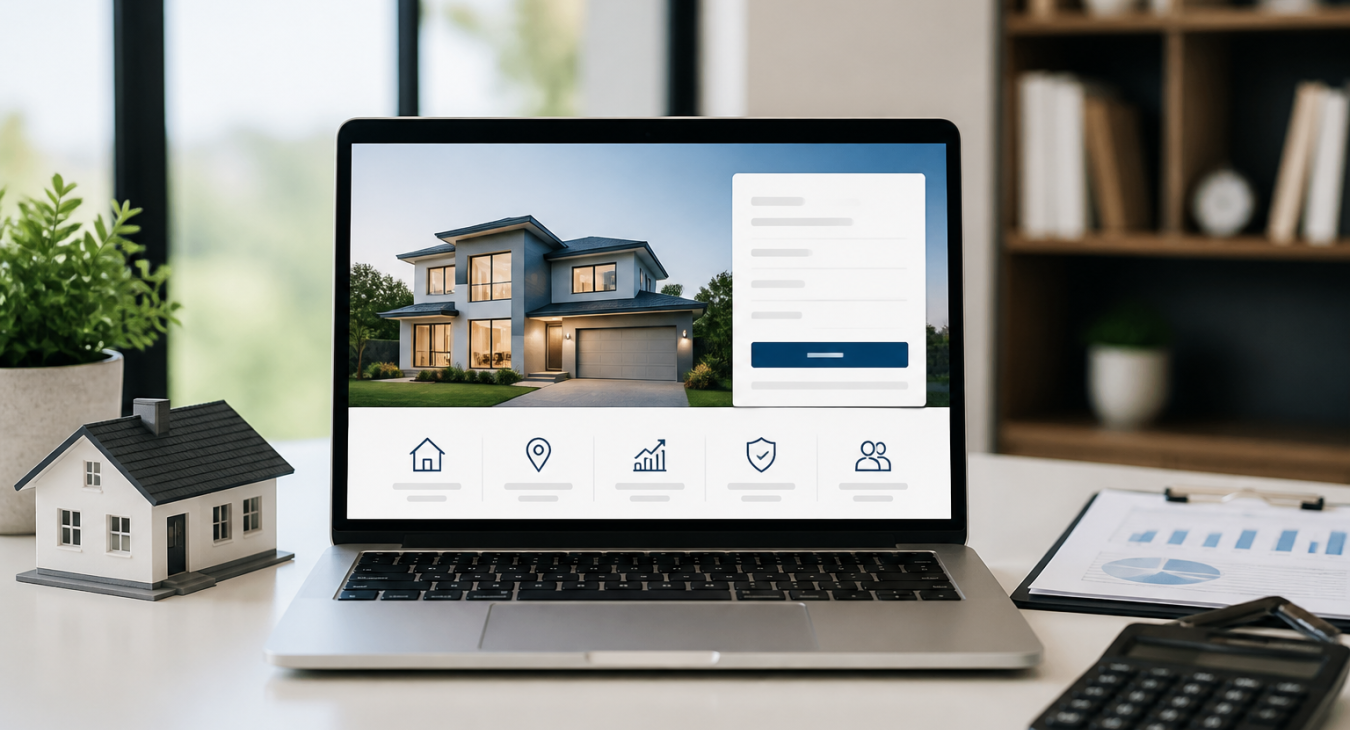
Discover 5 essential elements that convert leads with real estate PPC landing pages. Optimize your campaigns and stop wasting budget today.
Products and Tools Mentioned in this Post

Table of Contents
- what's a Real Estate PPC Landing Page?
- Why Real Estate PPC Landing Pages Matter for Business Performance
- 5 Essential Elements of High-Converting Real Estate PPC Landing Pages
- Types of Real Estate PPC Landing Pages and When to Use Them
- Driving Traffic to Your Real Estate PPC Landing Pages
- Conversion Rate Optimization for Real Estate Landing Pages
- Landing Page Builders: Choosing the Right Tool for Real Estate
Your ad copy is sharp. Keywords are locked in. Bid strategy? Dialed. But here's what actually kills most real estate PPC campaigns: the landing page. Generic, unfocused, buried CTAs — that's how you torch budget without a single qualified lead. The math is brutal. A mediocre landing page can cut your conversion rate in half compared to a purpose-built one. And that's the difference between a 3% cost per lead and a 9% one.
Real estate PPC landing pages aren't fancy marketing theory. They're conversion machines. Build them right, and you'll see immediate ROI. Miss the fundamentals, and you're hemorrhaging cash on every visitor who bounces.
So what makes them work? This guide breaks it down: the five core elements that actually drive conversions, tool comparisons for your tech stack, legal compliance you can't ignore, CRM integration that doesn't break your workflow, and A/B testing frameworks built specifically for the real estate vertical. You'll get actionable specifics — not generic advice.

what's a Real Estate PPC Landing Page?
Definition and Purpose
A PPC landing page is a standalone web page built to capture paid traffic and drive one thing: a single, defined conversion action. Your homepage? Your property listings page? Those serve everybody. They're designed for multiple audiences chasing multiple goals. But a PPC landing page is different — it's laser-focused. Every element exists for one reason: moving one type of visitor toward one specific outcome. That might be submitting contact info, requesting a home valuation, scheduling a call, or downloading a market report.
Why does this matter so much in real estate? Consider this: a homeowner typing "what's my home worth in Austin" has completely different intent than a buyer searching "3-bedroom condos for sale in downtown Chicago." Send both to your homepage and watch your conversion rates tank. A dedicated landing page tailored to each intent performs dramatically better because it actually speaks to what that visitor came to find.
How PPC Landing Pages Differ from Regular Website Pages
Your regular website pages? They do heavy lifting. Brand awareness. SEO juice. Agent bios. Blog content. Property searches. Navigation menus everywhere. Footers packed with dozens of links. Multiple calls to action fighting for attention.
PPC landing pages strip all that away. No main navigation. Minimal footer. Single CTA, repeated strategically. Every additional link is a click that takes someone away from converting. WordStream's research shows it clearly: landing pages with a single CTA hit conversion rates 300% higher than pages with multiple competing links. And in real estate? That hits your bottom line hard.
Buyer keywords can run $2 to $15+ per click. Seller keywords in competitive markets? $5 to $25+. When you're paying that much per visitor, maximizing conversion rate isn't optional — it's how you stay profitable. Before you dump money into PPC, take time to understand what pages your real estate investor website needs and why.
Why Real Estate Agents and Investors Need Dedicated Landing Pages
Dedicated landing pages do something else that matters: they close the attribution gap. A lead coming through a landing page tied to a specific campaign, ad group, and keyword? You know exactly where it came from. You know what spend generated that lead. That's how you make real decisions — increasing budget on what works, cutting budget on what doesn't. Generic website pages can't tell you any of that.
Back to topWhy Real Estate PPC Landing Pages Matter for Business Performance

Impact on Conversion Rates
Here's what the data shows: dedicated PPC landing pages crush generic website pages. We're talking 2-3x better performance across the board. While your standard real estate website converts PPC traffic at just 1-2%, a well-built landing page targeting the same traffic pulls in 4-8%. And the best operators? They're hitting 10-15% on niche offers like home valuations. That gap matters. A lot. On identical ad spend, you're looking at 10 leads a month versus 50-75. This isn't splitting hairs — it's the difference between a struggling campaign and one that actually works.
Cost Per Lead Reduction
Math doesn't lie. You're paying $10 per click, your page converts at 2%, so your cost per lead sits at $500. Now bump that conversion rate to 6% with better page design. Suddenly that same click costs you only $167 per lead. That's a $333 difference on every single lead you generate.
Run the numbers on 500 monthly clicks. Same $5,000 budget. At 2%, you get 10 leads. At 6%, you're walking away with 30. Landing page optimization is arguably the cheapest ROI lever you've got in your PPC toolbox.
Ad Relevance and Google Quality Score
Google doesn't just show ads randomly — they reward relevance through Quality Score, a 1-10 ranking that factors in click-through rate, ad copy alignment, and landing page experience. A page that actually matches what you promised in your ad gets rewarded. And the payoff? Scores of 8-10 can cut your cost per click by 50% compared to mediocre scores of 4-5.
But here's the thing: landing page relevance drives that Quality Score higher. A fast-loading page with clear messaging and a logical user flow beats a generic homepage every single time. Better score means lower CPCs. Better positioning. More visibility. This is how you stay competitive in a crowded market.
Back to top5 Essential Elements of High-Converting Real Estate PPC Landing Pages

Element 1: A Headline That Matches Your Ad Copy
Your headline is everything. Seriously. It's the single most impactful element on any landing page, and in real estate PPC, it has to achieve "message match" with the ad that got the visitor there in the first place. Think about it from your visitor's perspective: they clicked an ad that says "Find Out What Your Austin Home Is Worth — Free Estimate in 60 Seconds," but your landing page headline says "Welcome to [Agency Name] — Austin's Premier Real Estate Team." That disconnect causes an instant bounce.
The best real estate headlines are specific. They mention a location. They hit on a benefit. And they push action. Examples that actually convert: "Get Your Free Austin Home Valuation in 60 Seconds," "See Every Home For Sale in [Neighborhood] — Updated Daily," and "We Buy Austin Houses Fast — Any Condition, Any Price." Notice the pattern? Fast, specific location, clear benefit. A time element doesn't hurt either — 60 seconds, instant, today. Before you test anything else on your landing page, test your headline. It typically delivers the highest conversion rate impact of any single change you'll make.
Element 2: Optimized Lead Capture Forms
Most real estate landing pages leave conversion volume sitting on the table because of one thing: form bloat. The temptation to ask for everything upfront is real — name, email, phone, property address, price range, timeline, preferred contact method. But here's what actually happens: every field beyond field three reduces your conversion rate by 10-25% per additional field. That math adds up fast.
The optimal form length depends on your offer. Home valuation pages? You can justify four fields — property address, name, email, phone — because visitors expect to give their address to get an accurate estimate. Buyer lead captures should cap at three fields maximum: name, email, phone. Gated content like market reports or neighborhood guides? Just email.
And here's a tactic that works: the two-step form. Ask one easy question first ("Are you looking to buy or sell?") before showing the full form. It's called the Zeigarnik effect — people want to finish what they start — and it'll bump your form completions by 10-30%. Get that form above the fold on desktop. On mobile, test sticky form placement to see if it beats the standard layout.
Element 3: High-Quality Visuals and Property Photography
Real estate lives and dies by visuals. Your hero image — that big banner at the top — needs to be aspirational, locally relevant, and sharp. For buyer pages, show properties that match your target buyer's actual price point. Luxury campaigns? Invest in pro photography or drone footage. Seller pages? Run those before-and-after renovation shots. Or capture the emotional moment of keys changing hands.
Video is where the real edge is right now. Landing pages with video can lift conversions by 30-80%, per EyeView Digital's research. For real estate, that means a quick agent intro (30-60 seconds max), a neighborhood walkthrough, or a property tour clip. Keep autoplay videos muted with captions — most people browse on mobile in noisy environments anyway. Want to dig into the best tools for virtual tours? Check out the best 3D tour software for real estate in 2026 to see what integrates cleanly with your landing pages.
Element 4: Social Proof and Trust Signals
Real estate deals are high-stakes. Visitors aren't going to hand over their contact info until they believe you're legit and that you actually deliver. Social proof fixes that, and it's got to be strategically placed throughout your page — not buried at the bottom where nobody scrolls.
The heavy hitters for real estate landing pages: client testimonials with full names and actual photos (not just "J.M. from Austin"), Google review star ratings with the graphic, transaction volume spelled out ("147 Homes Sold in 2024"), agent credentials and licenses, and market expertise signals ("15 Years in Austin Market" or "Neighborhood Specialist Since 2018"). For investor-focused pages, pull real numbers into your case studies: "Helped investors acquire $4.2M in off-market deals in 2024." Third-party review widgets pulled straight from Google My Business or Zillow hit different than testimonials you wrote yourself — authenticity matters.
Element 5: Clear, Repeated Calls to Action
Your CTA is where the conversion actually happens. Don't waste it with "Submit" or "Contact Us." Those are weak. Action-oriented CTAs that spell out the benefit convert way better. Compare these for a home valuation page: "Submit" versus "Get My Free Home Value Report." The second one tells visitors exactly what they're getting.
If your page goes longer than one screen, hit them with your primary CTA at least three times: once above the fold (no scrolling needed), once after your social proof, and once at the bottom. Make that button high-contrast against your background so it actually pops. Orange, green, and red buttons outperform blue and gray in multiple studies, though your specific winner depends on your design — this is prime A/B testing material. Skip the language that screams "sales trap." "Get a Quote" beats "Speak to an Agent" on cold traffic because it feels less committal.


Mobile Optimization: The Non-Negotiable Sixth Element
Here's the thing about that five-element framework: it only works if mobile doesn't suck. Over 60% of real estate PPC traffic comes from phones, and Google's using mobile-first indexing. Your desktop masterpiece will tank if it's a nightmare to navigate on a phone. Mobile best practices: click-to-call buttons that auto-dial, forms with native mobile keyboard inputs, compressed images that load fast on cellular, and CTAs big enough to tap without zoom. Before you launch any campaign, test your page on both iOS and Android devices. Don't skip this.
| Element | Importance | Best Practice | Common Mistake | Testing Recommendation |
|---|---|---|---|---|
| Headline | Critical | Match ad copy exactly; include location and benefit | Generic welcome message with agency name only | Test 2 headlines with different benefit framing; run 2 weeks minimum |
| Lead Capture Form | Critical | 3-4 fields maximum; use two-step for higher intent offers | 7+ fields including unnecessary qualifying questions | Test 3-field vs. 4-field form; test field order |
| Hero Image/Video | High | Locally relevant, aspirational; video increases conversions | Stock photography or irrelevant property images | Test static image vs. video background; measure bounce rate |
| Social Proof | High | Include testimonials with names, photos, and specific results | Placing all testimonials below the fold only | Test testimonial placement above vs. below fold |
| Call to Action | Critical | Benefit-focused language; high contrast button color; multiple placements | "Submit" or "Contact Us" as button text | Test button color and CTA copy variations separately |
| Mobile Optimization | Critical | Click-to-call, large tap targets, compressed images | Desktop-first design with poor mobile experience | Compare mobile vs. desktop conversion rates by device segment |
| Page Speed | High | Under 3 seconds load time; compress all images; minimize scripts | Uncompressed hero images; excessive third-party scripts | Use Google PageSpeed Insights; test CDN implementation |
| Trust Signals | High | License number, years in business, review ratings, certifications | Missing agent photo or credentials | Test adding/removing trust badges and measure conversion change |
Types of Real Estate PPC Landing Pages and When to Use Them
Your landing page type needs to match your campaign objective. Full stop. The disconnect between offer and audience kills conversion rates faster than anything else. Here's what actually works—broken down by page type and audience.
Home Valuation Pages
These convert like crazy. We're talking 5-12% when you get them right. They work because homeowners in the awareness and consideration stages have one simple question: what's my house worth? The offer's obvious. The mechanics are friction-free—HomeBot, CloudCMA, or a basic address-collection form that triggers a CMA request. And here's the thing: make it feel instant even if there's a follow-up call involved. "Enter your address for an instant estimate, followed by a detailed report from your local agent" sets expectations without deflating conversions.
Seller Lead Pages ("We Buy Houses" / "Sell Your Home Fast")
Speed, convenience, certainty. Those are the pain points you're solving for homeowners facing divorce, foreclosure, inherited properties, or relocation. Don't talk about market value. Talk about "No repairs, no open houses, close in 14 days." For investors running wholesale and fix-and-flip campaigns, this page type is non-negotiable. The targeting matters too—if you're serious about finding motivated sellers, understanding how to find divorce real estate leads ethically integrates directly into your PPC strategy and improves your lead quality.
Luxury Property Landing Pages
Throw your standard template away. High-net-worth buyers live in a different world. Full-screen photography, minimal copy, elegant typography, and a soft CTA like "Request a Private Showing"—not a form that screams mass-market. Your social proof shifts too. Show sale prices and portfolio wins, not call volume. Traffic channels matter: Facebook and Instagram with tight demographic targeting (household income, zip code, interests) will outperform broad search every time.
Buyer Search and IDX Pages
Registration is your only real goal here. Get them to create an account, and you've got contact info plus search behavior data. That's gold. "Save your searches and get new listings before they hit Zillow"—that's the hook. Bundle your IDX search with a simple login form and you're capturing leads while they're actively researching. Can't ask for better timing.
Neighborhood and Community Pages
Geographic PPC campaigns live or die by relevance. Buyers researching a specific neighborhood need stats, school ratings, lifestyle details, recent comps, and market trends. Your CTA options: guide download ("Download Our Complete [Neighborhood] Home Buyer's Guide") or direct search link. These pages build local authority fast and they age well for organic SEO too.
| Page Type | Target Audience | Primary Goal | Typical Conversion Rate | Best Traffic Source | Optimal Form Fields |
|---|---|---|---|---|---|
| Home Valuation | Homeowners considering selling | Collect address + contact info | 5-12% | Google Search | Address, Name, Email, Phone |
| Seller / We Buy Houses | Motivated sellers | Phone call or form submission | 4-8% | Google Search + Facebook | Address, Name, Phone |
| Luxury Property | High-net-worth buyers | Private showing request | 2-5% | Facebook/Instagram, Display | Name, Email, Phone |
| Buyer Search / IDX | Active home buyers | Account registration | 3-7% | Google Search, Facebook | Name, Email (+ optional phone) |
| Neighborhood Guide | Buyers researching areas | Content download / email capture | 6-14% | Google Display, Facebook | Name, Email |
| Open House | Local buyers ready to tour | RSVP / appointment booking | 8-18% | Facebook, Google Local | Name, Email, Phone |
| Pre-Construction | Early-stage buyers and investors | VIP list registration | 5-10% | Facebook, Google Search | Name, Email, Phone, Budget |
Driving Traffic to Your Real Estate PPC Landing Pages
Google Search Campaigns
Google Search is where the money is. Users actively searching for what you offer represent the highest-intent traffic you'll find for real estate landing pages. Here's what separates winners from everyone else: structure campaigns with tightly themed ad groups. One ad group per keyword theme. Each one points to its own landing page.
A seller lead campaign? You'd build separate ad groups for "sell my home fast," "home value estimate," and "cash offer for my house" — each with its own landing page variant. This granular approach does three things at once: it maxes out message match, boosts Quality Scores, and gives you clean performance data to work with.
Most real estate campaigns should lean on phrase match and broad match modifier keywords instead of broad match. You'll capture query variation while keeping intent tight. Then layer in negative keywords (think "jobs," "school," "rent," "zillow login") to stop irrelevant clicks from torching your budget.
Facebook and Instagram Advertising
Facebook and Instagram hit different. Their demographic and behavioral targeting capabilities are exactly what real estate needs — zip code precision, age ranges, household income estimates, life events (recently moved, newly engaged), interest categories (real estate investment, home improvement, mortgage).
For cold traffic? Use Facebook's lead ads format. Forms load natively within Facebook. No page visit required. You'll generate leads at lower cost. Then retarget with website landing pages where your audience already knows who you are.
Display and Remarketing Campaigns
Display advertising reaches people browsing other websites. Use it for brand awareness and remarketing, not cold traffic acquisition.
Remarketing is where display really shines in real estate. Your buyer has a long consideration cycle. A visitor who checked your home valuation page without converting? Follow them across the Google Display Network with reinforcing ads until they're ready to move. Segment your remarketing lists by page visited — valuation page visitors get different messaging than neighborhood guide readers. This relevance matters.
Conversion Tracking Setup
Skip conversion tracking and you're flying blind. It's not optional.
For real estate landing pages, track three conversion actions: form submissions (your primary win), phone calls (use CallRail or Google forwarding numbers), and appointment bookings. Get this data into Google Ads so the algorithm can optimize bids toward actions that actually matter. Without it, you're making budget decisions on clicks and impressions instead of real leads — a costly mistake you can avoid.
Want to benchmark your PPC approach? The 6 best places to buy real estate leads in 2025 shows how PPC-generated leads stack up against other sources.
Back to topConversion Rate Optimization for Real Estate Landing Pages
A/B Testing Framework for Real Estate
Want to know which version of your landing page actually converts better? A/B testing gives you the answer. It's the systematic process of comparing two versions of a page element to see which one drives more conversions. Here's the golden rule: test one variable at a time. Change your headline, button color, and form fields all at once? You'll have no idea what actually moved the needle.
For real estate landing pages, here's the priority order based on expected impact. Start with headline copy. Then move to CTA button text and color, hero image (agent photo versus property photo versus lifestyle image), form length (3 fields versus 4 fields), and secondary elements like testimonial placement and page layout. But here's the catch—most real estate PPC campaigns need 100-200 conversions per variation before you can declare a winner. That means you need sufficient traffic volume and patience to get statistically valid results.
| Element | Variation A (Control) | Variation B (Test) | Expected Conversion Impact | Recommended Test Duration |
|---|---|---|---|---|
| Headline | "Get a Free Home Valuation Today" | "Find Out What Your [City] Home Is Worth in 60 Seconds" | High (10-30% lift possible) | 2-4 weeks or 100+ conversions |
| CTA Button Text | "Get Started" | "Get My Free Home Value Report" | Medium (5-20% lift) | 2-3 weeks |
| CTA Button Color | Blue | Orange | Low-Medium (5-15% lift) | 2-3 weeks |
| Hero Image | Property exterior photo | Agent headshot with social proof | Medium (8-25% lift) | 2-4 weeks |
| Form Length | 4 fields (Name, Email, Phone, Address) | 3 fields (Name, Email, Phone) | Medium (10-30% lift for 3-field) | 2-3 weeks |
| Social Proof Placement | Below the fold only | Above the fold + below the fold | Medium (8-20% lift) | 2-3 weeks |
| Video vs. Static Image | Static hero image | 60-second agent intro video | High (15-40% lift with video) | 3-4 weeks |
Page Speed Optimization
53% of mobile users bail out if your page takes longer than 3 seconds to load. Google's got the data to prove it. Real estate landing pages with all those massive property photos? Page speed isn't optional—it's essential.
Compress images to WebP format (that's 25-34% smaller than JPEG with the same quality). Enable browser caching. Deploy a CDN to serve assets from servers near your visitors. Defer non-critical JavaScript. Cut down third-party scripts. Run your page through Google PageSpeed Insights and target a score above 80 on mobile. Aberdeen Group research shows that shaving just one second off load time bumps conversions up 7%. That's free money you're leaving on the table if you're not optimizing.
Heat Mapping and User Behavior Analysis
Hotjar, Microsoft Clarity (free), or Lucky Orange show you exactly where visitors click. You'll see scroll depth data revealing how far down your page people actually read. Session recordings let you watch real visitor sessions play out in front of you.
Real estate landing pages reveal predictable patterns in the heat maps. Most visitors never scroll below the fold on mobile—which means your CTA needs to live above the fold. Visitors constantly click on non-clickable agent photos because they want more info before converting. Form abandonment spikes at the phone number field—a sign that making phone optional for initial capture could lift your lead volume.
Live Chat and Chatbot Integration
A visitor won't fill out a form but will ask a quick question via chat. That's where live chat and chatbots win.
Tools like Drift, Intercom, or Structurely (AI-powered lead qualification built for real estate) engage visitors in real time, ask qualifying questions, and book appointments. They work like a 24/7 virtual assistant. Chatbots that appear proactively—say, after 30 seconds on page with a message like "Looking for homes under $400K in [city]? I can help narrow that down"—recover a meaningful chunk of visitors who'd otherwise bounce. Integrating AI tools effectively isn't a nice-to-have anymore—the complete guide to AI tools for real estate investors shows how these technologies are reshaping lead generation across the board.
Back to topLanding Page Builders: Choosing the Right Tool for Real Estate
Your choice of platform matters. It affects speed, flexibility, integrations, and—most importantly—your cost per lead. Let's look at what the top options actually deliver for real estate investors and agents.
| Platform | Best For | Starting Price/Month | Lead Capture | CRM Integration | Real Estate Templates |
|---|---|---|---|---|---|
| Unbounce | Agencies and teams running multiple campaigns | $99 | Native forms + webhooks | HubSpot, Salesforce, Zapier | Limited; customizable |
| Leadpages | Individual agents and small teams | $49 | Native forms + integrations | 200+ via Zapier; direct Mailchimp | Several real estate templates |
| Instapage | High-volume PPC campaigns with A/B testing | $299 | Native + advanced form logic | Marketo, HubSpot, Salesforce | Minimal; highly customizable |
| ClickFunnels | Full funnel campaigns with nurture sequences | $147 | Native forms + upsell flows | Active Campaign, Zapier | Some real estate funnels |
| Carrd | Budget-conscious agents; simple single pages | $19/year | Basic form embed | Limited (via Zapier) | None (build from scratch) |
| Custom Development | Large teams needing IDX integration | $1,500-$5,000+ (one-time) | Fully customizable | Any CRM via custom API | Fully custom |
| WordPress + Elementor | Agents with existing WordPress sites | $59/year (Elementor Pro) | Native + WP plugins | Extensive via plugins | Many via theme marketplaces |