

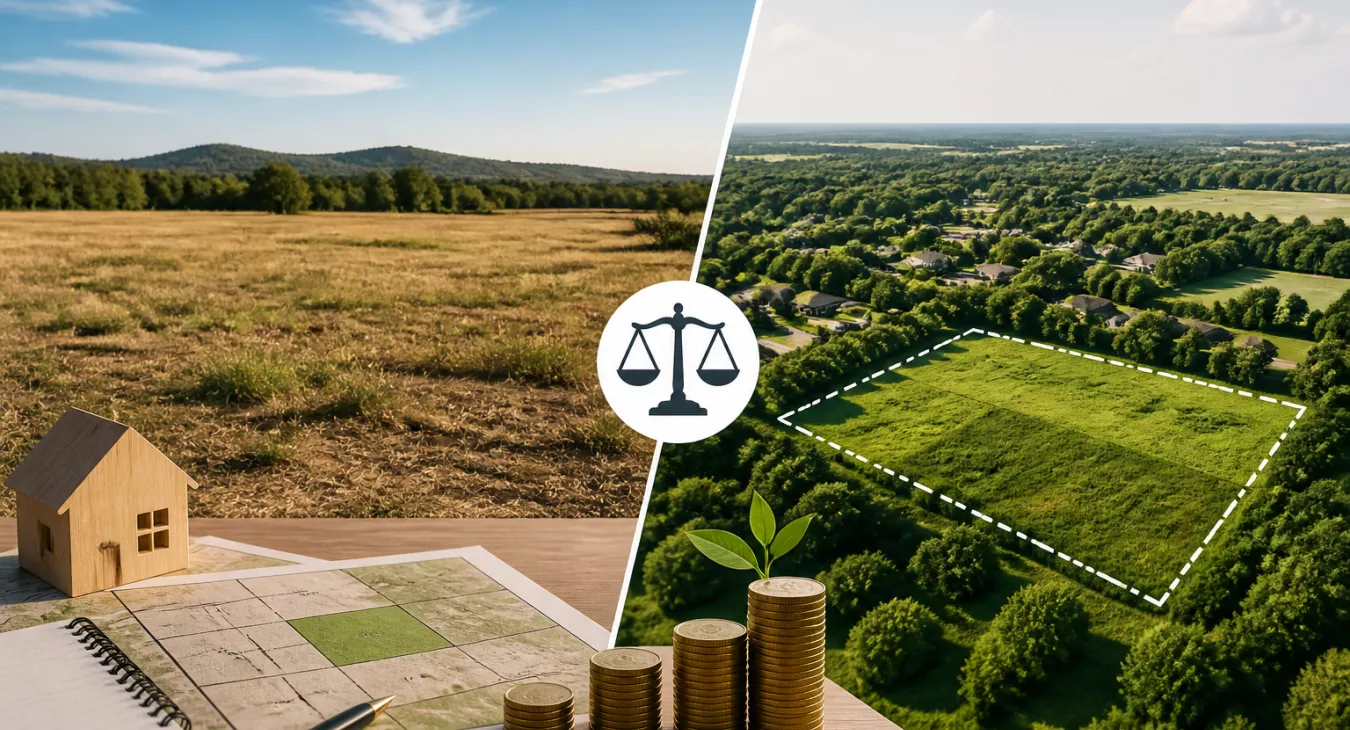
Discover the key differences between land wholesaling vs land investing. Compare capital needs, timelines, and profit potential to choose the right strateg
Products and Tools Mentioned in this Post

FortuneBuilders
FortuneBuilders provides real estate investing education, training programs, and coaching led by Than Merrill. Learn fix and flip, wholesaling, and rental strategies.
Table of Contents
- Quick Comparison: Land Wholesaling vs Land Investing
- what's Land Wholesaling?
- What's Land Investing?
- Key Differences: A Feature-by-Feature Breakdown
- Profit Potential Comparison
- Finding and Sourcing Land Deals
- Common Mistakes and How to Avoid Them
- Which Strategy Is Right for You?
- Wholesale Deal Walkthrough: Concrete Example
- Land Investment Walkthrough: Concrete Example
- Getting Started in 2026
- Conclusion: Making Your Decision
Choosing between land wholesaling and land investing is one of the most consequential decisions a new real estate entrepreneur will make — and one of the most misunderstood. Both strategies operate in the same raw-land niche, yet they differ fundamentally in how capital is deployed, how long money is tied up, and how profits are earned. If you've been researching land wholesaling vs land investing and feeling like the two are being described interchangeably, you're not alone. This guide cuts through the noise with a structured, numbers-grounded comparison so you can align your strategy with your actual goals, capital position, and risk appetite in 2026.
New to wholesaling? Start with our Wholesaling Guide.

Quick Comparison: Land Wholesaling vs Land Investing
Here's the snapshot. Before you decide which path fits your business model, look at how these two strategies stack up against what actually matters in real estate.
| Feature | Land Wholesaling | Land Investing |
|---|---|---|
| Capital Required | Low (earnest money only, often $500–$5,000) | Moderate to high (purchase price + holding costs) |
| Ownership of Property | No — contracts are assigned, not land | Yes — buyer takes title at closing |
| Timeline to Profit | Typically ~30 days per deal | Months to years depending on strategy |
| Profit Margins (per deal) | Assignment fees averaging $13,000 nationwide | Higher per deal; varies by hold period and exit |
| Risk Level | Lower (limited capital at risk) | Higher (capital tied up; market exposure) |
| Skills Required | Marketing, negotiation, buyer network building | Valuation, due diligence, finance, land development |
| Licensing Requirements | Actively changing by state — never assume none needed | No special license for personal investing |
| Scalability | High (volume-based model) | Moderate (capital-constrained; portfolio growth) |
| Passive Income Potential | None — requires active deal flow | Yes — through seller financing or lease income |
| Tax Treatment of Gains | Ordinary income rates (10%–37% in 2026) | Long-term capital gains rates if held >1 year (0%, 15%, or 20%) |
Now let's dig into each one. The real differences show up when you're actually on the ground executing.
Back to topwhat's Land Wholesaling?

Core Definition and Mechanics
You find a motivated seller. They'll accept way below market—we're talking 40% to 60% of true value. You lock them into a contract, then flip that contract to a builder, developer, or investor for a fee. That's land wholesaling in a nutshell.
The magic? You never actually own the land. You're not carrying inventory, paying taxes on a property, or dealing with mortgage debt. You're a deal finder—someone who monetizes information and relationships instead of capital and holding periods. It's fundamentally different from traditional real estate investing because your core asset is your pipeline and buyer list, not a portfolio of properties.
Want to get deeper into the terminology? Check out our guide to learning the language of land investing: terms, deals, and strategy.
The Contract Assignment Process
Here's how it actually works on the ground. You negotiate a purchase and sale agreement with that motivated seller—typically at 40%–60% of market value. That contract has an assignability clause built in, which lets you transfer your rights to someone else. Find your buyer, assign the contract, collect your fee at closing. Done. The seller and buyer close on their own; your name never hits the deed.
And here's the thing: some investors use a double-close instead of an assignment. Want the pros and cons of each? Read our breakdown on double closing vs assignment and which strategy to use.
How Wholesalers Make Money
Everything rides on the assignment fee. That's the spread between what the seller takes and what your end buyer pays. Pure arbitrage.
Current data through June 2026 shows the national average is $13,000—but that's the mean. You'll typically see deals land between $5,000 and $22,000. The experienced guys? They're consistently pulling in $15,000–$20,000 per deal. In hot markets like St. Louis, MO—one of the best wholesale markets right now—the average bumps to $25,000 as of June 2026. That matters if you're scaling.
But there's a tax reality you need to know. The IRS classifies wholesaler gains as ordinary income, not capital gains. You're looking at federal rates from 10% to 37% in 2026. No long-term capital gains benefit. No favorable holding-period rules. Speed is your business model, and the tax code reflects that.
Back to topWhat's Land Investing?

Core Definition and Strategy
You buy raw land. You hold title. You wait for it to appreciate, develop it, flip it, or collect monthly payments from buyers who can't qualify for bank financing. That's land investing — and it's nothing like wholesaling. You're taking on holding costs and market risk, but you're also building real equity over time.
Here's what the market's actually doing. According to the NAR/RLI Land Market Report (January 2026 survey), U.S. land stabilized at roughly $7,200 per acre by the end of 2025. Year-over-year? Only +1.5% — modest growth. But step back further. Raw land prices jumped +77% from 2019 through early 2026. That's the real story. Now we're seeing a stabilization phase with a light –0.5% correction — which honestly means the market's cooling after a hot run.
Types of Land Investing Approaches
- Buy and hold for appreciation: You snag raw or rural land in the development path and wait for demand to drive values north.
- Flip and resell: Grab undervalued parcels and turn them around to retail buyers — maybe after clearing, surveying, or adding road access. Check out our full breakdown on how to flip vacant land for profit.
- Seller financing: Sell land on installment terms to folks who can't get traditional loans. You collect monthly payments. It's closer to passive income than most land plays.
- Development-ready positioning: Land gets locked in. You secure entitlements, run utility lines, or pull subdivision approvals. Then the value explodes before you resell.
Long-Term vs Short-Term Land Investment
Hold your land under 12 months? You're taxed at ordinary income rates — same treatment as wholesaling. Not great. But hold it longer than one year and everything changes. Federal long-term capital gains rates kick in at 0%, 15%, or 20% depending on your income bracket, as of tax year 2026. Single filers under $49,450 in taxable income pay zero federally. Married couples filing jointly under $98,900? Same 0% rate. The 15% bracket stretches up to $545,500 for single filers in 2026. And here's the kicker — high earners get hit with an extra 3.8% Net Investment Income Tax (NIIT) surtax once modified adjusted gross income crosses the threshold. Your CPA needs to run your specific numbers because state income tax on land varies wildly and we're not touching that here.
Back to topKey Differences: A Feature-by-Feature Breakdown
Capital Requirements
Here's where wholesaling pulls ahead for someone just getting started. You need maybe $500 to a few grand in earnest money to lock up a contract. That's it. If the deal blows up, you're out the deposit and whatever time you spent marketing — but nothing catastrophic.
Land investing? That requires actual cash to close. Undeveloped rural land runs $1,500 to $2,500 per acre nationally in 2026, and the USDA NASS pegged average farm real estate at $4,350 per acre in 2025. Add taxes, holding costs, and whatever improvements you're planning, and you're looking at serious capital deployment.
And good luck financing it. Traditional lenders won't touch raw land. Supervisory loan-to-value guidance is set at the institution and regulator level — there's no universal consumer standard. Your rates and down payment will vary wildly depending on the lender, loan type, and what the parcel looks like. Hit up local community banks, credit unions, or USDA programs to see what your market actually offers right now.
Risk and Ownership Exposure
You don't own the land as a wholesaler, so you're not on the hook for market crashes, environmental liability, or title problems. Take title though? You own all of it — the good and the ugly.
That deed type matters more than most investors realize. Our breakdown of quit claim vs warranty deeds and which protects land investors better shows you exactly what protection each one actually gives you.
Then there's zoning. Zoning regulations vary dramatically by jurisdiction — and here's the thing most people miss. That "A-1" or "R-1" designation doesn't mean the same thing in the next county over. Ever. Don't assume it.
Timeline to Profit
Wholesaling moves fast. Really fast.
A solid deal closes in roughly 30 days from start to finish. That velocity is the whole point — knock out enough deals per quarter and you're building real annual income without locking up massive capital.
Land investing timelines are completely different animals. A straightforward flip might take 60–180 days to close. But a buy-and-hold parcel sitting in the path of suburban sprawl? 3–7 years before you hit your exit price. Development deals with entitlements can drag on even longer. You need patience and reserves — plural.
Skills and Expertise Needed
Wholesaling is fundamentally a marketing and sales business. Your core skills: finding motivated sellers off-market (direct mail, cold calling, online leads), negotiating contracts, building a solid buyer's list, and closing fast. Valuation? Sure, enough to spot the spread. But you don't need to know how to actually develop the property.
Land investing demands different chops entirely — accurate valuation, environmental due diligence, soil analysis, access evaluation, title research, zoning deep-dives, and financial modeling for development scenarios. It's not harder. Just different. And if you're weighing this against other real estate strategies, check our real estate investing strategies comparison for the full picture.
Legal Considerations and Licensing
This is the area where things are moving fastest — and where people get burned. Wholesaling legality isn't uniform. Not even close. States are rewriting the rules right now.
In 2025 alone, six new wholesaling laws hit five states — Connecticut, Maryland, North Dakota, Oklahoma, and Tennessee. Here's what actually changed:
- Connecticut (effective July 1, 2026): Public Act 25-168 requires you to register and drop $285 for a nonrefundable biennial registration fee. Sellers get a 3-business-day rescission window.
- Oklahoma (SB 1072, 2024–2026): You need a real estate license just to market properties you don't own.
- Illinois: Unlicensed wholesalers are limited to one deal per 12 months; anything beyond that requires a broker's license.
- ~25+ states including TX, AZ, CO, AK, and AL: As of June 2025, these have minimal wholesaling-specific requirements — but disclosure obligations exist everywhere regardless.
Don't bet your business on "no license needed." Pull your state's current statutes and get a licensed real estate attorney to review before you wholesale anything, anywhere.
Land investors buying for their own portfolio typically don't need a license. But start selling frequently enough and regulators might tag you as a "dealer" — and that changes everything. Have your CPA and attorney weigh in.
Back to topProfit Potential Comparison

Profit Margins in Land Wholesaling
The nationwide average assignment fee hits $13,000 — though experienced operators typically land $15,000–$20,000 per deal (with the range spanning $5,000–$22,000). Here's what makes wholesaling attractive: volume. A disciplined operator closing 2–4 deals monthly can bank $300,000–$500,000+ annually without ever holding title. But let's be real — those numbers only happen with a locked-in marketing system, consistent lead generation, and a solid buyer network in place.
Profit Margins in Land Investing
Land appreciation? It's all over the map depending on parcel size, location, improvements, and how long you hold. But here's what the data shows: stable markets deliver 3%–6% annual appreciation. And high-growth corridors? You're looking at 4%–6% yearly, with some markets breaking 10%. Even more telling — the cumulative +77% run from 2019 to 2026 shows what patient money can generate, despite recent headwinds.
Want to find those markets before they spike? Check our data-driven breakdown of the best land markets heading into 2026.
The Tax Advantage Gap
Here's where most wholesalers leave money on the table. A wholesaler pocketing a $15,000 assignment fee in the 22% bracket takes home roughly $11,700 after taxes. A land investor who's held that same parcel over one year and qualifies for the 15% LTCG rate? That's $12,750 on an identical $15,000 gain. And that's before appreciation kicks in. At higher income levels the math gets brutal — ordinary rates hit 37% while LTCG maxes at 20% (plus the 3.8% NIIT). Long-term land investing wins the tax efficiency game at every income bracket above the 0% LTCG threshold.
Back to topFinding and Sourcing Land Deals
Wholesaling: Finding Motivated Sellers
Your deal flow is only as strong as your marketing. Direct mail works—hit delinquent tax lists, out-of-state owners, and probate records. Cold calling still closes deals. Pay-per-click advertising and driving for dollars round out the arsenal. The real play? Finding motivated sellers before they list with an agent. That's where you lock in below-market contracts and build the rapport that keeps deals flowing. And now you've got AI-assisted outreach tools making this easier—check out how wholesaling with AI helps automation find better deals.
But here's the move most wholesalers miss: the "builder-first" approach. Instead of hunting deals blind and praying you'll find a buyer, flip it. Identify what builders and developers in your market actually need. Then reverse-engineer your acquisition criteria to match their specs. You're not hoping anymore—you're sourcing exact inventory they'll pay premium for. Shorter buyer timelines. Lower deal risk. This is how you eliminate that unsold inventory nightmare.
Land Investing: Identifying Opportunity Properties
Think like an analyst. Population growth trends matter. Infrastructure investment paths matter. Study zoning change histories. Map utility expansion plans in your target counties. County GIS systems? Free. USDA soil surveys? Free. State transportation department plans? Also free. Most retail investors never touch this stuff—and that's your edge. The best land deals come from knowing where demand hits in 3–7 years. Not where it is today.
Back to topCommon Mistakes and How to Avoid Them
Wholesaling Mistakes
- Overpricing the assignment fee: You're leaving too little margin for your end buyer if you're not careful here. The deal becomes unworkable. Before you even write a contract, know what your buyer's required return actually is.
- Ignoring state licensing changes: Six new laws hit in 2025 alone. Operating on outdated compliance assumptions? That's how you void contracts or catch fines. Verify current requirements before your next deal closes.
- Building a thin buyer list: And here's the reality: relying on one or two buyers for everything is a massive bottleneck. The wholesalers who dominate their markets have 50–100+ active buyers lined up. That competitive tension is what protects your margins.
- Skipping due diligence because "you won't own it": Wrong move. A fatal environmental or title flaw doesn't disappear just because you're wholesaling. Your buyer will kill the contract or renegotiate hard — either way, your reputation takes the hit.
Land Investing Mistakes
- Overpaying at acquisition: This is the killer. It's the most common mistake in land deals and the most expensive one. Land doesn't generate cash flow to absorb overpayment. Every dollar you overpay comes directly out of your eventual return.
- Underestimating holding costs: Property taxes, liability insurance, access maintenance, HOA fees — they pile up fast on long hold periods. Model these costs before you close or you'll be underwater.
- Ignoring environmental and access issues: Wetlands determinations, flood zone status, landlocked parcels, contamination history — any of these can kill a deal entirely. Here's the complication: WOTUS/wetlands jurisdiction remains unsettled nationally following Sackett v. EPA (2023), and many states (including California, Washington, Minnesota, and New Jersey) regulate wetlands independently. Federal clarity doesn't equal state clearance. Always conduct parcel-specific environmental due diligence.
- Assuming zoning is fixed: It's not. What's approved today gets restricted tomorrow — or opens up the other way around. Monitor your local planning commission agendas if you're evaluating or holding properties. Zoning changes quietly.
Which Strategy Is Right for You?

The Capital Test
Under $10,000 to start? Wholesaling's your lane. You'll build deal flow, a solid buyer network, and real market knowledge without risking much capital. Land investing, on the other hand, requires you to actually have cash in the bank—plus reserves for deals that sit on the market longer than you'd like.
The Time Horizon Test
Need cash in the next 90 days? Wholesaling delivers. But if you're playing the long game—parking capital for 1 to 5 years—land investing's appreciation and tax benefits start looking a lot better. And here's what most people don't realize: you don't have to pick one. Many sharp operators wholesale on the side to generate active income, then use that cash to fund their land portfolio. For a broader view of how this fits into a full real estate strategy, see our comparison of wholesaling vs flipping vs rental — which strategy to pursue first.
The Risk Tolerance Test
Wholesaling? The risk is mostly on you—marketing, negotiation, pipeline management. That's execution risk. Land investing adds layers: market risk, liquidity risk, capital concentration risk. Neither is bulletproof. A wholesaling business dries up fast when deal flow stops. A land parcel can sit unsold for years in a down market. They fail differently, but they do fail.
The Hybrid Approach
Here's the move most competitors won't tell you about: use wholesaling as your built-in deal filter. You're already out there finding deeply discounted land deals anyway. When you find one, run it through your investment criteria first. Meets your numbers? Buy it. Doesn't fit? Wholesale it and pocket the spread. You're leveraging the same lead generation machine for both active income and long-term asset growth. It's also natural insurance—wholesale income carries you through slow periods in the land market, and those held parcels keep appreciating in the background.
Back to topWholesale Deal Walkthrough: Concrete Example
Want to see how this actually plays out? Here's a real-world deal using numbers you'll recognize across the Sun Belt:
- Target parcel: 10-acre rural lot in a growing Sun Belt county, comps suggest $60,000 market value
- Negotiated purchase contract: $32,000 (motivated out-of-state seller, delinquent taxes)
- Earnest money deposited: $1,000
- Marketing to buyer list: 3 weeks of outreach
- Buyer found: Local builder agrees to pay $47,000
- Assignment fee collected at closing: $15,000
- Total time elapsed: ~30 days
- Capital at risk at any point: $1,000
The wholesaler pockets $15,000 before taxes and marketing. But here's where it gets interesting—after ordinary income tax at roughly 22%, you're looking at $11,700 net. Do that four times in a quarter and you've banked nearly $47,000 in after-tax income. And you never owned a single acre.
Back to topLand Investment Walkthrough: Concrete Example
A land investor playing the long game? Here's how they'd tackle the same market differently:
- Target parcel: 20-acre tract sitting just outside a growing metro area, picked up for $70,000 ($3,500/acre — that's above the 2026 national range of $1,500–$2,500/acre for undeveloped rural land, but you're paying for location closer to development action)
- Annual holding costs (taxes, liability coverage): ~$1,500/year
- Hold period: 4 years while the parcel appreciates at 5% annually (pretty solid — that's within the 3%–6% stable-market range)
- Value at sale: approximately $85,100
- Gross gain: ~$15,100, but subtract ~$6,000 in cumulative holding costs = ~$9,100 net gain
- Tax rate (LTCG, 15% bracket): ~$1,365 in federal tax (15% of $9,100)
- After-tax return: ~$7,735
The net dollars here are smaller than the wholesale deal. But here's the kicker — you're doing absolutely nothing during those four years. You could've been crushing wholesale deals on the side. And if your parcel happens to sit in a high-growth corridor where values run toward the top end of that range? Your returns jump significantly.
Back to topGetting Started in 2026

First Steps for Wholesalers
- Check your state's wholesaling rules right now. Six new state laws hit in 2025, and Connecticut's registration requirement kicks in July 1, 2026 — you can't skip compliance and expect to stay in business long-term.
- Find your buyers before you find your first deal. That means hitting REIA meetings, networking with builders and land developers in your target area, and jumping into online communities where serious land investors hang out.
- Pick one county or region. Learn it cold — what comps are actually selling for, who's buying, what land types move, and where motivated sellers hide.
- Start small with direct mail to out-of-state owners on the delinquent tax list. Track every single response in a CRM. You'll learn what actually works in your market.
- Get a real estate attorney to review your purchase and assignment agreement language before you use them on your first deal.
First Steps for Land Investors
- Define what you're actually looking for: parcel size, geography, capital available, how long you'll hold, and what your exit looks like (flip, seller financing, development).
- Dig into the county where you want to buy. Pull GIS maps, review recent sales, check zoning overlays, and track infrastructure plans that could impact value.
- Do the math before you make any offer. Include holding costs, selling costs, realistic appreciation (not wishful thinking), and your tax liability based on your bracket.
- Local lenders are your friend here. Community banks, credit unions, and USDA programs beat the national chains when it comes to land financing.
- Want structured education and community? BiggerPockets delivers learning paths that actually work. Our breakdown of BiggerPockets vs FortuneBuilders helps you pick the platform that fits how you learn best.
Conclusion: Making Your Decision
Here's the truth: there's no universally "better" strategy between land wholesaling and land investing. It depends entirely on your situation. Land wholesaling is your move if you're working with limited capital, need cash flowing in quickly, want minimal risk per transaction, and you're ready to build a serious marketing machine. Land investing wins if you've got patient capital, you're playing the long game, and you care about tax efficiency. It's particularly strong for investors who can handle holding costs in markets with solid fundamentals.
And here's what the best operators actually do? They don't pick a lane and stay there. They use wholesaling cash flow to fund land acquisitions. They flip deals fast to build reserves. Then they buy and hold the best assets they find. You get the quick wins from wholesaling plus the wealth-building power of long-term holds — all in one portfolio.
Back to topMore on wholesaling: explainers
- CRM for Wholesaling Operations: Lead to Contract Pipeline Tools
- Lis Pendens Lists: Early Foreclosure Leads for Wholesalers
- Wholesaling Real Estate in Australia: How It Works Down Under
- Wholesaling Real Estate: Meaning, Process, and Profit Potential
- Real Estate Wholesaling Salary: How Much Wholesalers Actually Make
- Real Estate Wholesaling: Common Questions Answered (Reddit Edition)
See our guide: “Wholesale Real Estate: Step-by-Step Guide for Beginners” →