


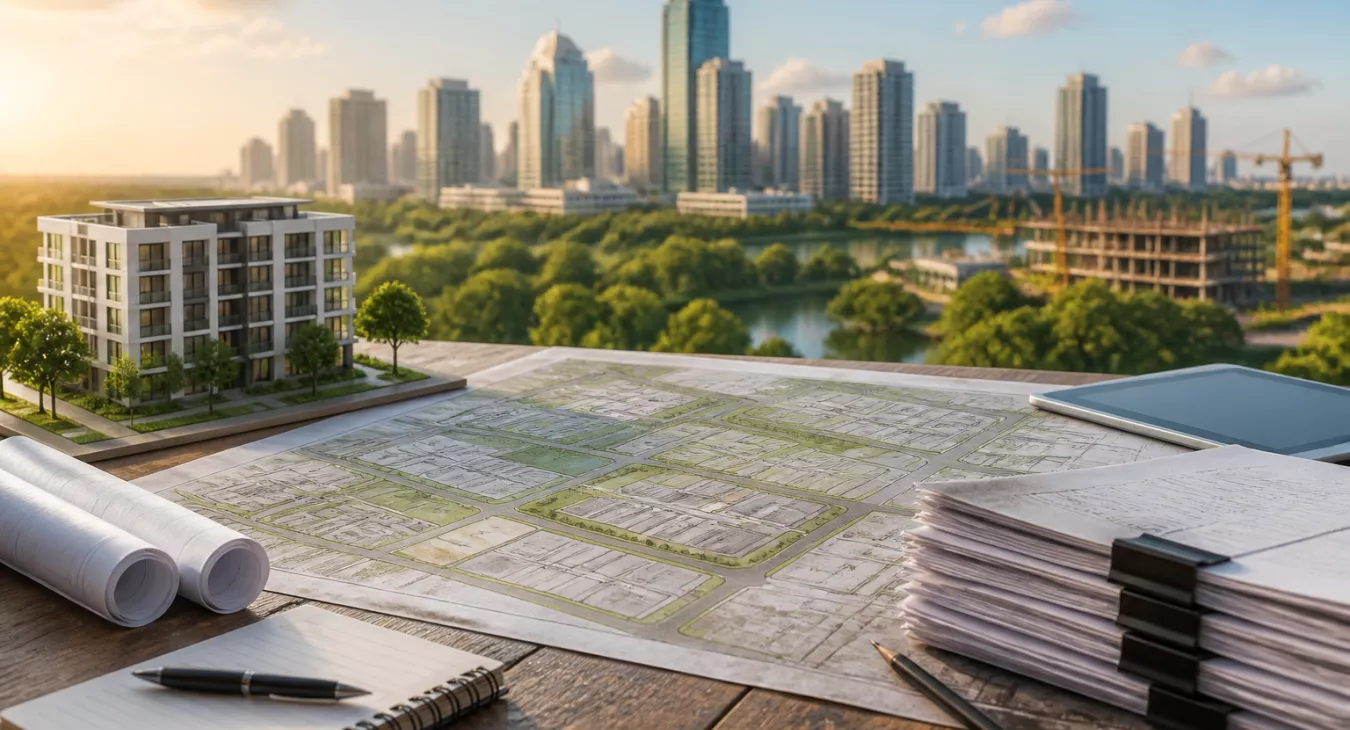
Learn the land use entitlement process steps, timelines, and investor strategies to secure approvals and maximize real estate development returns.
Table of Contents
- What's Land Entitlement?
- Who Needs Land Entitlements?
- Types of Land Use Entitlements
- The Land Entitlement Process: Step-by-Step
- Timeline and Duration
- Fees and Costs Associated with Entitlements
- Managing Entitlement Risk
- Land Entitlements and Property Value
- Regional Considerations and Variations
- Conclusion
- Frequently Asked Questions
The land use entitlement process is one of the most consequential — and least understood — phases of real estate development. You probably know this already: before a single foundation gets poured, developers and investors have to navigate a layered approval system that determines what can be built, how dense it can be, and whether the project is legally permitted at all.
And here's the truth. Mastering this process can mean the difference between a high-return investment and a sunk-cost failure. It's not optional. Whether you're buying raw land for resale, planning a residential subdivision, or developing a commercial property, you need to understand every critical stage — because the entitlements determine your actual ARV and feasibility.
This guide walks you through it all.

What's Land Entitlement?
Definition and Core Concept
Land entitlement is the legal process of getting government approvals for specific development on a parcel. These approvals — called "entitlements" — spell out what you can build, how dense it can be, and what conditions apply. Without them? Your project doesn't legally exist, no matter how well it's financed.
Why Land Entitlement Matters in Real Estate Development
Here's the real value: entitlements kill regulatory uncertainty. That raw parcel might theoretically fit 50 apartments, sure. But speculation isn't a development strategy. Once the municipality formally approves it, you've converted potential into actual development rights — and that shift has real dollar impact. According to SDRP Capital (2025 data), unentitled raw land sits at about 60% of its total economic value. Partially entitled land? That jumps to roughly 80%.
Entitled vs. Unentitled Land

The gap isn't small. Land Partner Group shows that entitled land typically pulls in 2× to 3× the price of unentitled raw land. Want a real example? A 30-unit multifamily parcel in Orange County traded for roughly $800,000 unentitled. After entitlements closed, it sold for over $3,000,000 — that's more than $2 million in pure value creation, as of April 2026. To see how this fits into your broader development strategy, check out our guide on the real estate development process from acquisition to exit strategy.
Back to topWho Needs Land Entitlements?
Here's the reality: entitlements matter for almost everyone in the development space.
- Developers and builders need them to construct new residential, commercial, or industrial projects
- Real estate investors running a buy-entitle-sell play to pocket that value uplift without ever breaking ground
- Business owners wanting to expand operations or build owner-occupied facilities on their own land
- Property owners sitting on underutilized land and ready to unlock its highest and best use
Before you write that check on a land deal, you need to understand what you're actually buying. Check out our guide on how to get land purchase agreements reviewed—it'll save you headaches and capital.
Back to topTypes of Land Use Entitlements

Here's what most investors don't realize: entitlements aren't one monolithic approval. They're a whole toolkit of permits and authorizations—each one tackling a different regulatory hurdle. What you actually need depends entirely on where your land sits and what you're trying to build.
| Entitlement Type | Purpose | Typical Timeline (National) | Complexity | Approval Authority |
|---|---|---|---|---|
| Zone Change / Rezoning | Changes the parcel's land use designation | 1–2 years (as of June 2026) | High | Planning Commission + City/County Council |
| Conditional Use Permit (CUP) | Allows a specific use not automatically permitted by current zoning | 6–12 months (as of June 2026) | Moderate–High | Planning Commission or Zoning Board |
| Variance | Permits deviation from dimensional or use standards | 6–12 months (as of June 2026) | Moderate | Zoning Board of Appeals |
| Site Plan Review | Ensures project design meets development standards | 3–6 months (as of June 2026) | Low–Moderate | Planning Staff / Planning Commission |
| Subdivision / Lot Split | Divides one parcel into multiple lots | Varies widely by jurisdiction | Moderate–High | Planning Commission + Recorder |
| Design Review Permit | Architectural and aesthetic compliance | 3–6 months (as of June 2026) | Low–Moderate | Design Review Board / Planning Staff |
Want to understand the most common entitlement path? Check out our dedicated guide on can you rezone land? Investor's guide to rezoning strategy. And if you're splitting a parcel, don't skip our breakdown of how to subdivide land—it covers the legal process and what investors actually need to know.
Back to topThe Land Entitlement Process: Step-by-Step

Step 1: Pre-Application Planning and Consultation
Here's what most investors skip — the pre-application meeting with your local planning department. Most jurisdictions will sit down with you before you submit anything. You'll identify what entitlements you actually need, spot potential deal-killers early, and get a realistic timeline. It costs almost nothing and saves months of back-and-forth. Bring a preliminary site plan and know your intended use inside out.
Step 2: Prepare Plans and Submittals
Now you assemble your full package: scaled site plans, civil engineering drawings, project narrative, traffic studies, environmental reports, and fee schedules. Incomplete submittals are the #1 reason projects stall. Don't cheap out here. You'll need real consultants doing this work.
Step 3: Submit Application and Pay Fees
Time to file. Application and processing fees on a mid-sized project typically run $10,000 to $75,000 (April 2026 data). California and other high-cost states? Expect the top end. But here's the thing — fee schedules vary wildly by jurisdiction, so request the current one in writing before you budget anything.
Step 4: Planning Staff Review
Staff planners now pick through your application. They're checking for completeness and compliance with zoning, general plan, and development standards. Comment letters come back. You revise. More cycles mean more time. This is why that thorough initial submission matters so much.
Step 5: Environmental Review
Environmental analysis isn't always required, but location and scope determine that. California? You're dealing with CEQA — that's California Environmental Quality Act, and it's a beast that doesn't apply outside the state. A full EIR in California can add 36 to 48 months to your timeline (April 2026). And if your site's in an environmentally sensitive area, investigate wetland and biological constraints now. Check out our guide on how to identify wetlands on property — it's a solid reference.
Step 6: Public Hearings and Planning Commission Review
Most discretionary entitlements trigger a public hearing. Neighbors show up. Community groups show up. They comment. The planning commission evaluates against policy and either approves, approves with conditions, or kills it. Community opposition? That extends timelines real quick. Do your outreach before the hearing, not after.
Step 7: City Council Approval (When Required)
Major entitlements — general plan amendments, zone changes — go to city or county council for final vote after the planning commission recommends. Add another hearing cycle.
Step 8: Final Entitlement Issuance
Approval drops and the entitlements attach to the land itself, not to you as the applicant. That's the beauty of it — they transfer automatically when you sell, which is why the buy-entitle-sell play works. But watch the expiration clock. Most entitlements expire if you haven't broken ground within the validity period — typically 6 months to 1 year depending on where you are (2026). Extensions are usually available if you apply, but don't count on it.
Back to topTimeline and Duration

Most investors get blindsided by timeline. And they shouldn't. Here's what you're actually looking at based on current market data:
| Entitlement Path | Typical National Timeline | California EIR Projects | Key Variable |
|---|---|---|---|
| By-right / Site Plan Only | 3–6 months (June 2026) | N/A | Staff workload, submittal completeness |
| Conditional Use Permit / Variance | 6–12 months (June 2026) | Longer with CEQA review | Hearing schedule, community input |
| Rezoning / General Plan Amendment | 1–2 years (June 2026) | Longer with full EIR | Political climate, environmental review |
| Full EIR (California) | N/A (CA-specific) | 36–48 months (April 2026) | Scope of impacts, comment volume |
| California Coastal Commission Review | N/A (CA-specific) | +12–24 months on top of base (April 2026) | Coastal resource sensitivity |
| Seattle Mid-Rise Multifamily (SEPA + Design Review + Permit) | N/A (city-specific) | N/A | 24–36 months total (April 2026) |
California-specific note: AB 130 dropped on June 30, 2025 and it changes the game for qualifying infill housing projects. Processing now maxes out at 164 days after your application is deemed complete. But here's the real win — agency decisions on qualifying housing come within 90 days (or 30–60 days for smaller and affordable projects) after CEQA compliance. None of this applies outside California though. These are state-only provisions.
Back to topFees and Costs Associated with Entitlements
Here's what most investors miss: entitlement costs blow past application fees fast. You're looking at 15% to 30% of your total project budget when you add it all up—application fees, professional services, environmental studies, impact fees, carrying costs. The math gets real ugly. Third-party soft costs alone (engineering, legal, environmental, planning consultants) run $25,000 to $100,000+ in 2025. And that's just the consultants. Here's what you'll actually spend:
- Phase I Environmental Site Assessment: $2,200–$4,000 (as of June 2026)
- Phase II ESA (if contamination suspected): $5,000–$50,000+ (as of April 2026)
- Biological survey: $3,000–$20,000 (as of April 2026)
- Traffic study: $5,000–$30,000 (as of April 2026)
- Legal fees (complex projects): $15,000–$50,000+ (as of April 2026)
Then development impact fees hit your deal. For LIHTC family housing projects, we're talking $24,000 per unit nationally in 2026—and most projects see fees above $30,000 per unit. That's a significant line item. If you don't budget this before you lock in your acquisition price, your underwriting falls apart. Want to build better models? Check out our guide to free budgeting apps for real estate investors.
Back to topManaging Entitlement Risk

Entitlement risk kills deals. You need a system to manage it.
- Conduct zoning code analysis before closing. Run the numbers on whether your intended use is permitted by right — or if you've got a realistic shot at getting it approved. Here's the thing: zoning labels don't mean the same thing across jurisdictions. What's allowed under "Mixed-Use" in one city might be totally locked down in another.
- Commission environmental due diligence early. A Phase I ESA catches contamination or sensitive habitat issues before they torpedo your entitlements. This costs maybe $3,000–$5,000. Waiting until later costs millions.
- Assess community sentiment proactively. Don't wait for the public hearing to learn there's opposition. Attend local planning commission meetings. Pull past decisions on similar projects. Talk to neighbors. Opposition you find in advance? You can manage it. Opposition that blindsides you at a hearing? That's a nightmare.
- Build contingency timelines. Well-prepared projects still hit delays. Add a minimum 25% buffer to your projected timeline when you're underwriting holding costs. Better to be conservative.
- Use experienced local consultants. Land use attorneys, planning consultants, and civil engineers who actually know the jurisdiction and have relationships with decision-makers are worth every penny. They'll save you time and money on the back end.
Thinking about owner financing or lease options to manage upfront capital while you're grinding through approvals? Check out our guides on owner financing land and lease options and rent-to-own strategies. Both preserve cash during the entitlement process.
Back to topLand Entitlements and Property Value

Here's what separates real money moves from amateur hour: buying raw land, grinding through approvals, and flipping it to a builder. No construction risk. No tenant headaches. Just pure entitlement arbitrage. The approval process itself creates the value—and here's the kicker: fully entitled land typically commands 2× to 3× the price of raw land. That's not speculation. That's market math. When entitlements attach to the parcel itself, whoever buys it after closing inherits those approved development rights. You're selling a product that's dramatically more valuable than what you bought.
Want to understand how the money actually flows in land deals? Dig into our complete guide to land investing language, deal structures, and strategy. It'll sharpen your edge in any active market.
Back to topRegional Considerations and Variations
Land use entitlements are local. Period. The steps we've covered work in most U.S. jurisdictions, but here's the thing — codes, timelines, fees, hearing procedures, and political winds shift from one city to the next. What works in one county might tank in another. Let's break down what actually matters:
- California stacks CEQA environmental review on top of everything else, and those timelines add real months to your schedule. AB 130 reforms in 2025 do streamline qualifying infill housing projects, but anything outside that box? You're still looking at lengthy reviews and delays.
- High-growth metros like Austin and Seattle play by their own rules. Austin's building department grinds through complex commercial and multifamily reviews in 6–12 months (April 2026 data). Seattle? Their full entitlement process for mid-rise multifamily hits 24–36 months (April 2026 data). That's two to three years you need to factor into your underwriting.
- Some cities have actually streamlined infill development to fix housing shortages. Others? They're still stuck in the weeds with prescriptive requirements. Before you assume a jurisdiction is friendly, pull their recent approval history. The data doesn't lie.
Call your local planning department and get current fee schedules, hearing calendars, and code requirements. Don't rely on outdated information. These details shift constantly, and nothing's standardized nationally.
Back to topConclusion
Raw land is just potential. The entitlement process transforms it into confirmed development rights—and that's where real value gets created. But here's the thing: you need to understand every step, from pre-application consultation straight through to final approval. Skip that homework, and your deal falls apart.
The investors who win are the ones who underwrite risk accurately, build timelines that aren't fantasy, and make acquisition decisions backed by data. You'll see substantial value creation when entitlements come through. And when they don't? The costs and delays can sink a project fast.
This is where most developers fail.
Approach every project with thorough due diligence. Get local expertise on your team. Run conservative financial modeling on the backend. When you do this right, entitlements become a powerful lever for creating real estate value—not a speed bump that kills your returns.
Back to topFrequently Asked Questions
What's the difference between a zoning variance and a conditional use permit?
A variance lets your project break the dimensional or use rules baked into existing zoning. Think reduced setback, height limit exception—anything that deviates from the code's dimensional standards. You typically get one when strict compliance creates undue hardship. A conditional use permit is different. It authorizes a use that isn't automatically allowed in your zoning district, but the jurisdiction will permit it if you meet defined conditions. The legal framework for each one? It changes by jurisdiction. Always confirm the specifics with local planning staff before you sink time and money into applications.
Do entitlements expire?
They do. Most carry a validity window—often 6 months to 1 year (as of 2026)—and if you haven't broken ground or requested an extension by then, you lose it. But here's the thing: extensions usually exist. You just have to request one before the original approval lapses. The exact timeline varies wildly depending on jurisdiction and entitlement type, so don't assume your timeline matches your neighbor's deal.
Can I sell land with entitlements already in place?
Absolutely. This is literally the entire entitlement play. Entitlements run with the land, not the person who applied for them. When you sell, they transfer to the new owner automatically. Buyers will pay serious money for entitled land because you've already bulldozed through the regulatory uncertainty. The typical value bump runs 2× to 3× against unentitled raw land in the same area.
How do I find out what entitlements my property needs?
Start at the local planning department. Schedule a pre-application meeting, bring your site map and project description, and walk through it with staff. Have them spell out your zoning designation, what uses are permitted outright, and every discretionary approval you'd actually need. The municipality's general plan and zoning code are usually online if you want to dig before that meeting. If land investing terminology feels foreign, our piece on learning the language of land investing covers the fundamentals fast.
What happens if my entitlement application is denied?
Don't assume it's over. Most jurisdictions have appeals processes that let you challenge the planning commission before a zoning board or city council—typically within 15 to 30 days of the decision, though timelines shift by location. You can also revise and resubmit, addressing whatever objections they raised. In California, projects with a Notice of Determination get a 30-day window for legal challenges under CEQA. And if an appeal looks likely? Get a land use attorney involved early. They'll sharpen your position significantly and catch procedural mistakes that could tank your case.
Back to top