

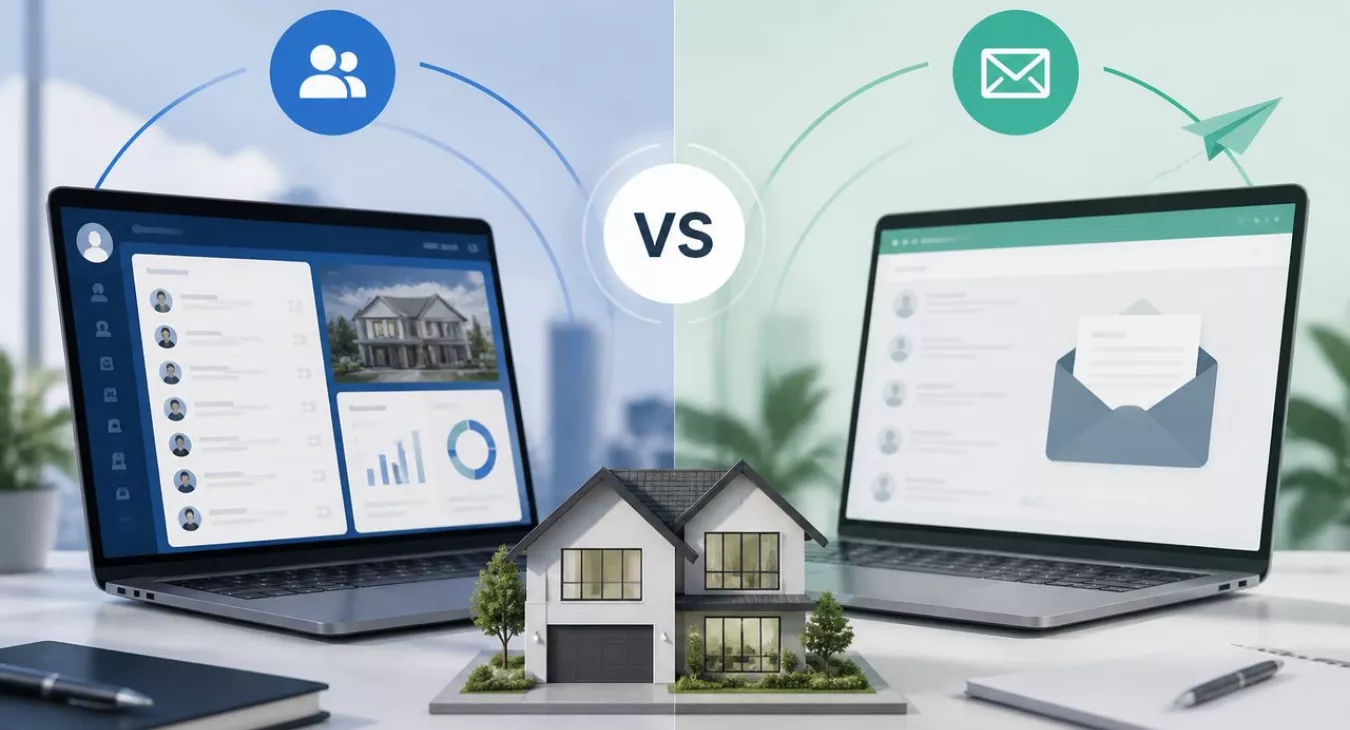
Compare real estate CRM vs email marketing platform to find the right tool for your business. Learn which you need first to convert more leads.
Products and Tools Mentioned in this Post
Follow Up Boss
Follow Up Boss is a real estate CRM that helps agents manage leads, automate follow-up, and increase conversions. Streamline your sales process today.

Real Geeks
Real Geeks offers real estate agents an all-in-one platform with lead generation, IDX websites, and CRM tools. Grow your business with proven technology.

Sierra Interactive
Sierra Interactive provides real estate agents with cutting-edge IDX websites, CRM, and lead generation tools. Discover how this platform can transform your business.

Wise Agent
Wise Agent is a comprehensive real estate CRM offering contact management, transaction tracking, email marketing, and automation tools for agents and brokers.

Contactually
Contactually is a real-estate-ready CRM with list building, skip tracing, calling, texting, automated follow-up, project management and websites under one login.
Table of Contents
- Understanding CRM vs Email Marketing Platform
- CRM vs Email Marketing Platform: What Actually Matters
- The Role of Email Marketing in Real Estate
- When to Use a CRM for Real Estate
- When to Use an Email Marketing Platform
- Real Estate Email Marketing Benchmarks
- Compliance: What Agents Must Know
- Top Real Estate CRM Solutions
- Top Email Marketing Platforms for Real Estate
- CRM and Email Integration: Which System Owns What?
- Cost Analysis: CRM vs Email Platform Pricing
- Decision Framework: Choosing the Right Tool
- Automation Workflows Every Agent Should Build
Most real estate agents don't have a marketing problem — they've a tool confusion problem. The debate around real estate CRM vs email marketing platform isn't academic; it directly affects how many leads fall through the cracks, how much money you waste on software that doesn't fit your workflow, and whether your database is actually working for you. With approximately 1,439,163 NAR Realtors as of June 2026 competing for transactions in a market running at 3.98 million existing-home sales annually as of August 2026, the agents who build systems that consistently convert contacts into closings win. Here's the straight answer: what each tool actually does, which one you need first, when you need both, and which specific platforms to consider.

Understanding CRM vs Email Marketing Platform
what's a CRM?
A Customer Relationship Management platform is a database with action attached. It's the backbone of your pipeline. In real estate, a CRM tracks individual contacts from initial lead capture through active client status, contract, close, and post-sale follow-up. Call logs, task reminders, deal stages, conversation history — it all lives here. The whole point? Make sure no contact goes unworked and no opportunity ages without attention.
Real estate-specific CRMs layer on features that actually matter: MLS integration, saved search alerts, lead routing from Zillow or Realtor.com, speed-to-lead automation. These aren't nice-to-haves. They're why you'd pick a purpose-built real estate CRM over some generic platform.
what's an Email Marketing Platform?
An email marketing platform does one thing really well — it broadcasts at scale. Send emails to hundreds or thousands of contacts. Manage deliverability. Segment audiences. Track who opens what and clicks where. A CRM handles one-to-one follow-up; an email platform handles one-to-many communication. Think newsletters, market updates, drip campaigns, nurture sequences sent to your entire sphere.
These platforms obsess over inbox placement, template design, A/B testing, and list hygiene. They're engineered to make mass communication feel personal and keep your domain out of spam filters.
Key Differences Explained

Here's the simplest way to separate them: a CRM owns your pipeline; an email platform owns your database. Your CRM answers "what's my next move with this person?" Your email platform answers "how do I stay in front of 3,000 contacts without losing my mind?" Both matter. Different tools required.
And this is where real estate workflows fall apart. Your CRM crushes it at routing Zillow leads and tracking offers. But send a beautifully designed neighborhood newsletter to your entire sphere? That's not what it's built for. Flip it around — your email platform nails that newsletter, but it has zero concept of pipeline stages or saved MLS searches. You see the problem.
Back to topCRM vs Email Marketing Platform: What Actually Matters
Here's the thing: these tools do different jobs. A CRM manages your deals. An email platform blasts campaigns. But which one do you actually need? Check the breakdown below and see where your workflow fits.
| Feature | CRM | Email Platform | Best For |
|---|---|---|---|
| Lead routing | ✓ Core function | ✗ Not designed for this | CRM |
| Pipeline management | ✓ Core function | ✗ Not designed for this | CRM |
| Segmentation | Basic (tags/stages) | ✓ Advanced (behavior, lists) | Email Platform |
| Automation workflows | ✓ Pipeline-based | ✓ Broadcast-based | Both (different use cases) |
| MLS integration | ✓ Real estate CRMs | ✗ Rarely supported | CRM |
| Saved search alerts | ✓ Real estate CRMs | ✗ Not applicable | CRM |
| Email design tools | Basic templates | ✓ Advanced drag-and-drop | Email Platform |
| Deliverability management | Limited | ✓ Core function | Email Platform |
| Contact volume pricing | Per user/seat | Per contact/email volume | Depends on team size |
| Multi-user access | ✓ Built for teams | Limited | CRM |
Bottom line: if you're running a team and need to track deals from lead to close, get a CRM. Want to send killer campaigns to your buyer and seller lists? Email platform wins. Most successful investors use both—they're not competing, they're complementary.
Back to topThe Role of Email Marketing in Real Estate
The Real Estate Sales Cycle and Email
Weeks. Sometimes months. That's how long the median real estate transaction stretches from first contact to close—and here's the thing: the relationship shouldn't stop at closing. Email is what actually keeps it alive across that entire journey. The numbers back this up. Industry-wide email ROI hits $36–$42 per dollar spent in 2026, making it one of the most cost-effective channels available to agents, regardless of budget.
But that ROI doesn't happen by accident. You need deliberate sequencing, proper segmentation, and a clear read on where each contact sits in their journey. A first-time buyer who's 18 months away from purchasing? They're getting a completely different email than a seller who just requested a CMA last week. Context matters.
Buyer and Seller Nurture Sequences

Effective nurture sequences aren't one-off emails. They're structured campaigns running over weeks or months. Picture this: a buyer nurture sequence opens with a welcome email, moves into a neighborhood guide, then a mortgage pre-approval explainer, a market conditions update, and finally a "what to expect at your showing" guide—all spaced perfectly and triggered by actual behavior. Seller sequences take a different angle: home valuation education, staging tips, market timing content. And they work because they're relevant at each step.
Here's where dedicated email platforms leave most CRM email modules in the dust. Segmentation logic, conditional send rules, deliverability infrastructure—a purpose-built email platform handles all of this better than what most CRMs offer out of the box. Want to dig deeper into how messaging strategy actually moves conversions? Check out our breakdown on Real Estate Marketing: Pain vs. Pleasure—Which Approach Gets Results?
Post-Purchase Communication
Most agents drop their clients cold at closing. It's a mistake that costs money when you consider what's sitting right there: referrals, repeat business, lifetime relationship value. Post-sale automation—anniversary emails, homeowner tip sequences, local market updates, referral request campaigns—lives almost entirely in email platforms, not CRMs. CRMs typically don't prioritize closed contacts. They're built for pipeline management, not client relationships.
Building a post-sale email sequence ranks among the highest-ROI activities an agent can tackle.
Back to topWhen to Use a CRM for Real Estate
Lead Routing and Pipeline Management
Running paid ads? Pulling leads from Zillow or Realtor.com? Working with a team where everyone's getting inbound? You need a CRM. Period. Lead routing—getting that incoming lead to the right agent in seconds, every single time—is what a CRM does. Your email platform can't touch this.
Speed-to-lead isn't just a nice-to-have in real estate. It's everything. A system that auto-assigns, shoots a text, and fires off an email within 90 seconds of registration is the difference between closing a deal and watching it walk to your competitor. Wait two hours and you've already lost.
MLS Integration and Saved Search Alerts
Any solid CRM built for buyer-side agents connects straight into your MLS. New listing hits that matches a buyer's saved search? Automatic alert. Price drop on a property they've looked at three times? You're notifying them before they refresh Zillow. Your buyers stay warm without you lifting a finger, and you look like the agent with their finger on the pulse.
Email won't do this. MLS integration is purely a CRM function. Want to dig deeper into actually finding and converting buyers? Check out our breakdown of Best Real Estate Lead Generation Platforms 2026.
Speed-to-Lead Workflows
Those first 48 hours after someone fills out a form? That's where a CRM earns its keep. Automated text acknowledgments. Email introductions. Task assignments. Call reminders. All of it triggers based on where the lead came from and what stage they're at. This isn't broadcast email marketing. It's transactional. It's urgent. It's personal—one lead at a time, not 500 at once.
Back to topWhen to Use an Email Marketing Platform
Sphere and Database Growth Management
Your sphere doesn't live in your pipeline. Past clients, friends, family, referral partners — they're not active buyers or sellers right now. But they're long-term relationship contacts who might refer business or convert down the road. Here's the problem: managing 500 to 5,000 contacts through your CRM's email tools? It's clunky. An email platform was built for this. Scheduled newsletters, event invitations, holiday campaigns, market updates — you send them all at scale with actual deliverability that works.
Segmentation and Personalization
Dedicated email platforms crush CRM email modules on segmentation. You can segment by behavior — who opened your last 3 emails, who clicked on multifamily deals. Tag-based segments work too: investors, first-time buyers, past sellers. Geographic splits are built in. And this is crucial: a market update for downtown condo buyers is just noise to suburban families. Send irrelevant emails and you've trained your contacts to ignore you. You don't want that.
Scalable Pricing Models
The median entry-tier price across 35 email platforms in 2026 is approximately $15/month for up to roughly 1,000 contacts. Pricing scales with contact volume, not user count — which matters if you're building your database over time. Your list grows to 5,000 contacts? Constant Contact runs approximately $80/month. For most active agents, that's pocket change compared to the ROI email actually delivers.
Back to topReal Estate Email Marketing Benchmarks

Before you panic about your email performance — or start bragging — you need to understand what these benchmarks actually mean. Here's the catch: Apple's Mail Privacy Protection (MPP) has completely warped open rate data since it rolled out. Your inbox shows reported open rates of 35–45% in 2026, but MPP is inflating those numbers — the real engagement-adjusted rate sits closer to 20–25%. This is why smart investors watch click-through rates instead. You're looking at 1.5–2.5% CTR as the 2026 real estate benchmark.
| Email Type | Reported Open Rate (MPP-affected) | Engagement-Adjusted Open Rate | Benchmark CTR |
|---|---|---|---|
| Just Listed Alert | 35–45% | ~20–25% | 1.5–2.5% |
| Price Drop Alert | 35–45% | ~20–25% | 1.5–2.5% |
| Market Update Newsletter | 35–45% | ~20–25% | 1.5–2.5% |
| Open House Invitation | 35–45% | ~20–25% | 1.5–2.5% |
| Past Client Newsletter | 35–45% | ~20–25% | 1.5–2.5% |
| Buyer Nurture Sequence | 35–45% | ~20–25% | 1.5–2.5% |
| Seller Lead Follow-up | 35–45% | ~20–25% | 1.5–2.5% |
Note: These 2026 numbers represent the overall real estate category range — individual campaign performance will vary by type. But here's the rule: track CTR, not open rate, because MPP makes opens unreliable. Source: Email Awesome 2026 Benchmarks.
Back to topCompliance: What Agents Must Know
Real estate email marketing isn't just about getting into inboxes. It's got legal teeth. Every violating email carries a maximum civil penalty of $53,088 — that's the frozen rate as of September 15, 2026. And here's the kicker: that's per email, not per campaign. You need a physical mailing address on every commercial message you send, a real unsubscribe option, and honest subject lines. Got contacts in the European Economic Area? GDPR applies to you.
Check out the CAN-SPAM Act penalty details — it's worth knowing exactly what you're risking.
SMS compliance is where agents trip up most. The TCPA classifies a text as a call, and cold texting without proper consent? That's serious liability. A2P 10DLC registration is a carrier requirement — not legal permission to blast your list. Before you launch any cold outreach sequence, talk to an attorney.
Want specifics on SMS best practices? SMS Marketing for Real Estate: Compliance and Conversion breaks down the compliance piece and conversion angles.


Top Real Estate CRM Solutions
Don't pick a CRM lightly. Migration is painful, and switching costs will hurt your bottom line. Base your decision on what you actually do today — not features you think you'll use someday.
Follow Up Boss
Speed-to-lead automation. Lead routing. Team management. That's what Follow Up Boss does best, and it integrates with virtually every major lead source out there. As of August–September 2026, you're looking at roughly $69/user/month. Running a team that's throwing serious volume at paid lead portals? This is your tool. But if you're mostly working your sphere and don't need complex routing rules, you're probably overspending.
Sierra Interactive
Approximately $299.95/month as of September 2026 — and here's what you get: website, IDX/MLS integration, and CRM all bundled together. Your MLS feeds directly into your pipeline. Teams love this model. Solo agents on a shoestring budget? Or you've already got a website that converts like crazy? Skip it.
Real Geeks
Same ballpark pricing — around $299/month as of September 2026 — but Real Geeks has earned serious respect for IDX website quality and built-in lead gen. It's the all-in-one play: website, MLS search, CRM. Perfect for solo agents and small teams who want one vendor. Large brokerages needing sophisticated routing? Look elsewhere.
Wise Agent
The budget option. Approximately $49/month as of August–September 2026. You get the core essentials: contact management, transaction tracking, basic email automation. Nothing fancy. Nothing wasted. Solo agents and newer agents managing a modest database will find this does what it needs to do. Teams or anyone needing deep MLS integration should look up.
Contactually (by KDS Development)
This isn't the old Contactually that Compass bought. This is a separate product, purpose-built for real estate, and it's built on automation from the ground up. One system. List building, skip tracing, project management, texting, calling, email, funnels, websites, pipelines, workflows, social posting — it's all there. Calls, minutes, and texts cost extra beyond your base plan. And there's no free tier. Want one system handling your outreach, follow-up, and pipeline without duct-taping tools together? This is for you. But if you need native MLS saved-search alerts from a dedicated IDX platform, or you're looking for a free entry point, this won't work. Visit contactually.net for current pricing — it shifts based on what you actually use.
Want to understand how these fit into your broader marketing playbook? Check out our guide on Best Real Estate Marketing Tools 2026.
Back to topTop Email Marketing Platforms for Real Estate
Constant Contact
New to email marketing? Constant Contact's probably your move. It's one of the easiest platforms to learn, and agents pick it up fast without any painful onboarding. At 5,000 contacts, you're looking at roughly $80/month in 2026. The deliverability is solid, and you won't spend weeks buried in documentation. But here's the catch—if you need advanced automation or behavior-based segmentation, you'll outgrow it. Best for agents who value simplicity and want their emails landing in inboxes consistently. Skip it if you're planning to build complex automation workflows down the road.
MailerLite
MailerLite won't break the bank, and that's before you even look at what you get. The automation builder actually works. You also get landing pages and pop-up forms baked in, which means you can capture leads without wiring up three different tools. And the pricing? Genuinely competitive. This is your sweet spot if you want real automation firepower without dropping five figures a month. The downside: if you've got a large team needing complex workflows or CRM functionality, you'll hit the platform's limits. Best for budget-conscious agents serious about automation. Not the move for multi-user operations needing enterprise collaboration.
HubSpot Marketing Hub
Want an all-in-one system? HubSpot's the heavyweight option here. It talks natively to HubSpot CRM, which means your contacts, deals, and email campaigns live in one place—no more data syncing nightmares. The free CRM tier works fine for solo operators, but real email automation demands a paid Marketing Hub subscription. You're investing both time and money, but if you're already in the HubSpot ecosystem, the payoff is worth it. Best for agents or brokerages already committed to HubSpot who want unified data. Avoid this if you're bootstrapping a new business or hate vendor lock-in.
Sequenzy
Unlimited contacts. That's the whole pitch, and it actually matters. If you've got a 10,000-person sphere that you've built over fifteen years, watching your bill spike every time you add names gets old fast. Sequenzy kills that pain point. You're not paying per contact—you're paying a flat rate and adding lists without penalty. Best for agents with massive databases who've been beaten down by volume-based pricing. Not the fit if you need tight CRM integration or you're still in list-building mode.
Back to topCRM and Email Integration: Which System Owns What?
The Division of Labor
Clear rules matter. Your CRM handles hot leads, active clients, pipeline stages, and speed-to-lead workflows. Meanwhile, your email platform owns the sphere, past clients, cold nurture sequences, and newsletter campaigns. Here's the thing: when both systems fire emails at the same contact without talking to each other, you're creating duplicate messages. That's one of the most common — and most damaging — stack mistakes you can make.
Data Ownership and Syncing
Make your CRM the system of record. Period. Your email platform syncs from the CRM, never the other way around. When a cold sphere contact converts into an active buyer, they move up in the CRM and drop out of the email platform's nurture sequences. Automatically. Not manually.
Most integrations run through native connections or middleware like Zapier. But here's what separates solid stacks from broken ones: you need to plan this architecture before you spend a dime on either system. Integration logic is where most setups fall apart.
Avoiding Duplicate Campaigns
One system. One contact. One time. That's your rule. If your CRM is running a 7-day new lead sequence on someone, they should be suppressed from your email platform's broadcasts. Nearly every platform supports suppression lists or tag-based exclusions — use them. Want to see how this fits into a complete investor marketing operation? Check out Real Estate Investor Marketing: Complete Multi-Channel Guide.
Back to topCost Analysis: CRM vs Email Platform Pricing
Here's the fundamental difference: CRMs charge per user. Your cost stays flat whether you've got 100 leads or 10,000 sitting in the database. Email platforms? They scale with your list size — the bigger your contact database, the more you pay.
| Platform | Type | Starting Price (2026) | At ~5,000 Contacts | CRM Included | Email Included |
|---|---|---|---|---|---|
| Follow Up Boss | Real Estate CRM | ~$69/user/mo | Per seat, not contact | ✓ | Basic |
| Wise Agent | Real Estate CRM | ~$49/mo | Per seat, not contact | ✓ | Basic |
| Sierra Interactive | All-in-One (site + CRM) | ~$299.95/mo | Per seat, not contact | ✓ | Basic |
| Real Geeks | All-in-One (site + CRM) | ~$299/mo | Per seat, not contact | ✓ | Basic |
| Constant Contact | Email Platform | ~$15/mo entry tier | ~$80/mo | ✗ | ✓ |
| Mailchimp | Email Platform | ~$15/mo entry tier | ~$75/mo | ✗ | ✓ |
| Contactually (KDS) | All-in-One CRM + Outreach | See contactually.net | Usage-based add-ons | ✓ | ✓ |
These numbers come from published data collected August–September 2026 and shift constantly. Don't rely on this table alone — hit up each vendor's pricing page and confirm what you'll actually pay before you commit.
Back to topDecision Framework: Choosing the Right Tool

Solo Agent Scenario
You're closing around 9 transaction sides at a median $2.7 million sales volume annually (based on 2025 NAR data)? Your tech stack shouldn't be complicated. Start with a solid CRM for your active leads. Once your sphere hits 500 contacts, layer in email marketing. That's it. Most solo agents I know are running Wise Agent at ~$49/month paired with MailerLite or Constant Contact for their sphere emails. Total spend? Under $150/month, and they're fine.
Team Scenario
Teams operate differently. You need CRM-first architecture — no way around it. Lead routing, agent assignment, accountability dashboards, speed-to-lead automation. These aren't nice-to-haves. They're the problems killing your team's production. Email marketing? Secondary. Usually it's handled by an admin managing a shared account. Follow Up Boss or Sierra Interactive beat budget solo-agent tools here.
Brokerage Scenario
Managing a large agent population means all-in-one platforms start making financial sense. kvCORE/BoldTrail at approximately $499/month as of September 2026 gives you CRM, lead generation, and marketing in one place. But here's the catch: you sacrifice depth for breadth. All-in-one doesn't mean best-in-class at anything.
The "Buy for the Job" Philosophy
Stop buying tools because your office uses them. Stop buying because a demo looked slick. Buy based on your most expensive problem right now — not your second or third problem.
Losing new leads within 48 hours? Buy CRM speed-to-lead automation. Your sphere went cold because you haven't emailed in six months? Buy an email platform. The most expensive problem gets solved first. For a deeper look at allocating your overall marketing budget, check out Real Estate Marketing Budget: How to Allocate by Strategy.
Back to topAutomation Workflows Every Agent Should Build
Buyer Nurture Sequence (Email Platform)
Here's the deal: you need a 6–10 email sequence running on autopilot over 4–8 weeks. Each email educates active buyer leads on mortgage pre-approval, neighborhood deep-dives, the actual buyer process, and a soft ask to book a consultation. Set it up once and forget it. Your email platform handles everything — this is pure sphere and cold lead work.
Seller Lead Follow-up (CRM)
Seller leads hit your CRM and things move fast. An automated text fires immediately, followed by an email intro, and a task pops up for your agent to call within 5 minutes. You're tracking everything through the pipeline: CMA delivery, listing appointment scheduled, contract signed. This is hot, urgent territory. Your CRM owns this layer completely.
Just Listed and Price Drop Alerts (CRM)
Active buyers watching saved searches get instant property alerts through your CRM's MLS integration. And here's the key difference: these aren't marketing emails. They're transactional notifications fired by MLS data changes. The CRM is the only tool that handles this. It has to be.
Past Client and Referral Campaigns (Email Platform)
Your past clients deserve to hear from you. Annual check-ins, home anniversary messages, market update newsletters, occasional referral asks — all automated through your email platform.
Back to top