

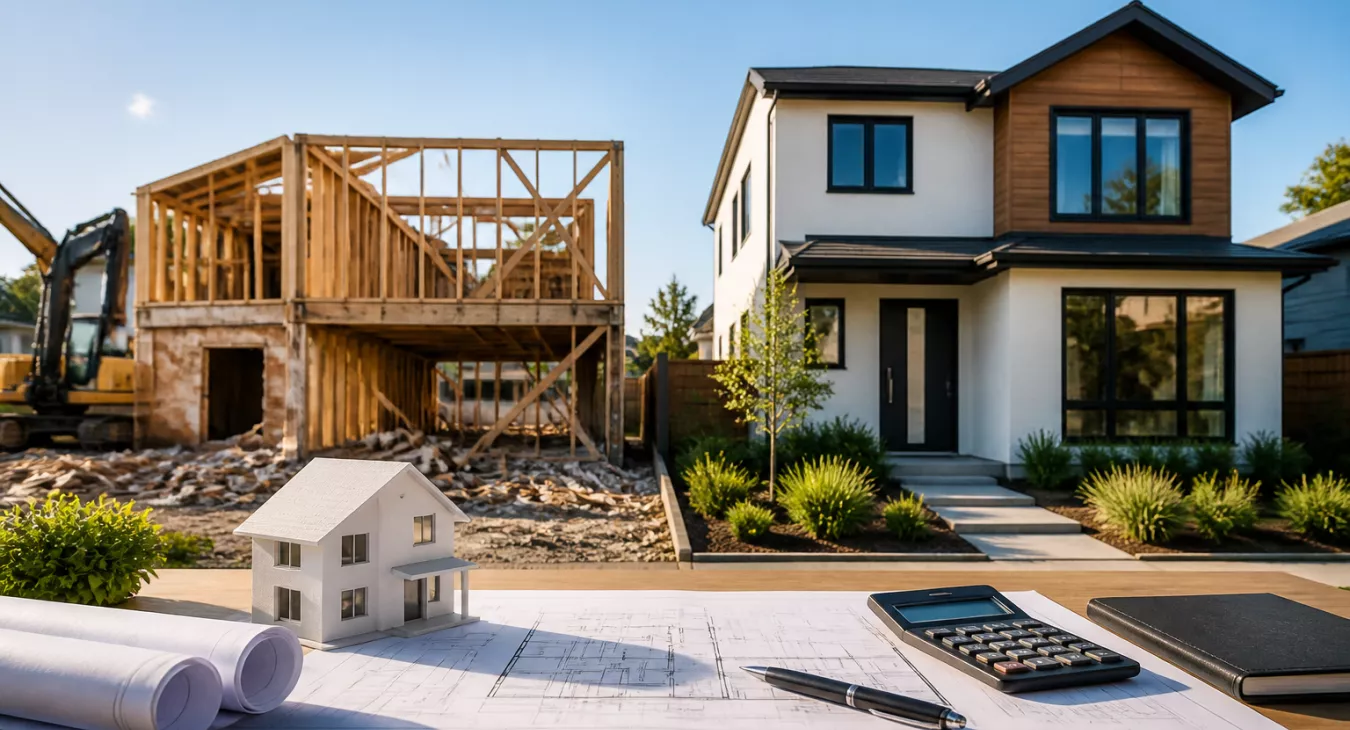
Learn residential redevelopment investing fundamentals—from ROI benchmarks to financing and team building. Transform properties into profitable assets.
Products and Tools Mentioned in this Post

Table of Contents
- What's Residential Redevelopment?
- Why Invest in Residential Redevelopment?
- How Residential Redevelopment Impacts Property Values
- Redevelopment vs. Value-Add vs. Ground-Up Development: A Comparison
- Key Risks and Challenges in Residential Redevelopment
- The Residential Redevelopment Investment Process
- Location and Market Factors Driving Success
- Multifamily Redevelopment Strategies
- Getting Started as a Residential Redevelopment Investor
- Maximizing Returns on Residential Redevelopment
- Conclusion
- Frequently Asked Questions
Residential redevelopment investing sits at the intersection of opportunity and complexity. You're chasing outsized returns, but it demands more skill, capital, and market insight than traditional rentals or fix-and-flips. Real investors know this isn't entry-level work.
And that's exactly why it works. A distressed multifamily building or a blighted single-family block in the right market? Those properties can transform into seriously profitable, long-term assets. But only if you understand the fundamentals.
Get this wrong, and your first redevelopment project becomes an expensive lesson. Get it right, and you've got a case study in success.
This guide covers what you actually need to know: definitions and ROI benchmarks, financing strategies, building your team, and how to mitigate risk. Everything.

What's Residential Redevelopment?
Definition and Core Concept
You're buying existing residential properties — often distressed, underperforming, or just plain obsolete — and making serious improvements or completely repositioning them for higher value. We're not talking paint and carpet here. Redevelopment means structural changes, rezoning fights, demolition, or a total asset repositioning that transforms both use and income potential.
Residential Redevelopment vs. New Construction
New construction? You start with raw land. Full design control, yes — but you're also taking on maximum entitlement risk, longer timelines, and way higher upfront capital. Redevelopment's different. You're working with existing structures and infrastructure that's already there. That usually means faster permitting, lower land costs, and less market guessing.
But here's the catch: hidden structural problems and legacy code compliance can absolutely torpedo your numbers if you skip proper due diligence. And if you're just getting started as an investor, take a look at the Real Estate Investing for Beginners: 2026 Complete Guide — it'll show you how redevelopment fits into your overall strategy.
Types of Redevelopment Projects
- Adaptive reuse: Converting an old warehouse or commercial building into residential units
- Multifamily repositioning: Upgrading a Class C apartment complex to Class B or A
- Infill development: Demolishing dilapidated housing and building new units on established urban lots
- Historic renovation: Restoring heritage properties with tax credit incentives
- Single-family assemblage: Buying multiple adjacent lots to develop a larger residential project
Why Invest in Residential Redevelopment?
Strong Return Potential
You're looking at 15% to 35% ROI on most residential redevelopment projects. The spread depends on market, project size, and how well you execute. Value-add multifamily deals sit in that 12–18% sweet spot. But if you've got entitlement upside and you're doing a full-scale redevelopment? You can easily push past 25%. These returns crush what you'd get from passive vehicles — just know you're putting in active work and committing to a longer hold.
Risk Mitigation Compared to Ground-Up Development
Here's what makes redevelopment smarter than ground-up. The infrastructure's already there. Utilities. Roads. Neighborhood context. You don't have to solve for soil conditions or figure out utility hookups from zero. Ground-up construction forces you to deal with all that uncertainty.
And lenders know this. Municipalities know it too. They'd rather see you redevelop an existing neighborhood than sprawl outward. You get better financing terms and faster approvals because you're improving, not expanding.
Market Demand and Growth Opportunities
The U.S. is short 3.8 million housing units. That's not changing anytime soon. Demand stays concentrated in established neighborhoods where people actually want to live and work. Redevelopment fills that gap directly — you're either adding density or improving existing stock in the exact locations where demand is hitting hardest.
Back to topHow Residential Redevelopment Impacts Property Values

Here's what the data actually shows: well-executed redevelopment projects lift neighboring home values by 5% to 15% within a one-mile radius. That's not theoretical. It's a ripple effect that compounds across your entire portfolio if you're buying early in transitioning neighborhoods. This is one of the most compelling arguments for redevelopment investing.
Redevelopment doesn't stop at individual parcels. It triggers infrastructure investment, attracts retail and services, and pumps more money into school funding through higher tax bases. And that's where timing becomes everything. Investors who position themselves at the inflection point — that sweet spot between decline and revival — capture appreciation that passive buy-and-hold investors won't see for years. You've got to identify those neighborhoods before the market does. Market selection is therefore as important as project execution. The Indianapolis Investing: Zip-by-Zip Market Guide dives deep into how micro-market analysis drives redevelopment success.
Back to topRedevelopment vs. Value-Add vs. Ground-Up Development: A Comparison
| Strategy | Timeline | Capital Required | Risk Level | Expected ROI | Best For |
|---|---|---|---|---|---|
| Value-Add | 6–18 months | Low–Moderate ($50K–$500K) | Low | 8–15% | Beginners, cashflow focus |
| Residential Redevelopment | 12–36 months | Moderate–High ($500K–$5M+) | Moderate | 15–35% | Intermediate investors, equity builders |
| Ground-Up Development | 24–60 months | Very High ($1M–$50M+) | High | 20–40%+ | Experienced developers, institutional capital |
Key Risks and Challenges in Residential Redevelopment


Gentrification and Community Displacement
You're redeveloping in a low-income neighborhood — rents climb, property values spike, and long-time residents get priced out. It happens fast. Beyond the ethical angle, this creates real business problems: regulatory pushback, organized community opposition, and permitting delays that tank your timeline. The smart move? Engage the community before you break ground. Consider affordable housing set-asides. Explore public-private partnerships. Balance your cap rate with actual community benefit — it's not just good PR, it's a risk mitigation strategy.
Overdevelopment and Market Oversupply
Even hot markets saturate. Five developers converge on the same corridor, absorption rates tank, rents soften, and suddenly your exit timeline stretches from two years to four. This kills returns.
Do your homework on supply. Track permit activity, pipeline projects, vacancy trends — the full picture. Before you deploy capital, you need to know if demand will actually support all that new inventory. Market timing errors derail beginners constantly, and we've documented the full list in Real Estate Investing Mistakes: 20 Costly Errors Beginners Make.
Regulatory and Permitting Obstacles
Zoning changes, environmental reviews, historic preservation requirements, community input processes — they stack up. You're looking at 6 to 18 months added to your timeline and tens of thousands in legal and consulting fees. Don't guess on zoning. Hire a local land use attorney during due diligence and get written confirmation that your intended use is actually permitted.
Construction and Timeline Risks
Cost overruns hit 10–20% on most projects, even the well-managed ones. Material price swings, labor shortages, subcontractor delays — it all compounds. Build a 15% contingency reserve into your budget as a bare minimum, and lock in contractual milestones with your GC. You need accountability built into the contract, not just a handshake agreement.
Back to topThe Residential Redevelopment Investment Process

| Stage | Phase | Duration | Key Activities | Cost Implications |
|---|---|---|---|---|
| Stage 1 | Site Selection & Acquisition | 1–3 months | Market analysis, due diligence, LOI, contract negotiation | Earnest money, inspection fees, legal costs |
| Stage 2 | Underwriting, Planning & Design | 2–6 months | Financial modeling, architect engagement, entitlement strategy | Soft costs: 5–15% of total project budget |
| Stage 3 | Permitting, Construction & Execution | 6–24 months | Permit filing, GC management, construction draws, inspections | Hard costs: 60–75% of total project budget |
Stage 1: Site Selection and Acquisition
Disciplined site selection is where redevelopment success starts. Population growth trends, employment diversification, infrastructure signals (new transit lines, highway expansions)—these matter. And you're looking for rent-to-price ratios that actually work in your favor. Distressed properties trading at steep discounts to replacement cost? Those are your targets.
Don't skip the environmental due diligence. Phase I assessments are mandatory. For older properties, Phase II isn't optional either—it's insurance against buried liabilities that'll blow your underwriting apart.
Stage 2: Underwriting, Planning, and Design
Your underwriting model needs to account for acquisition cost, soft costs running 5–15% of budget (design, legal, permits), hard construction costs, carrying costs while you're building, and a stabilization runway before you exit or refinance. Sound comprehensive? It should be.
Find an architect who actually knows your local municipal approval process. You want someone who's gotten deals through planning and zoning, not just someone who draws pretty pictures. Build stress-test scenarios into your financial model. What happens if rents underperform by 10–15%? What if hard costs jump 20%? You need those numbers before you commit capital.
Stage 3: Permitting, Construction, and Execution
Active management separates wins from disasters. Weekly site visits. Regular draw reviews. Clear communication with your general contractor—minimum standards, not best practices.
But here's the thing: tie your draw schedule to completion milestones, not calendar dates. Otherwise you're funding incomplete work, and that's how projects balloon.
Back to topLocation and Market Factors Driving Success
Location is everything in redevelopment investing. Full stop. The neighborhood you pick will make or break your returns — not the contractor, not your financing, not your business plan. So what does a neighborhood ready for a comeback actually look like? New coffee shops opening. Restaurants taking chances on side streets. A surge in permits from owner-occupants who've already decided to bet on the area. Vacancy rates dropping. Median incomes climbing. Those are your signals.
But here's what'll kill your deal: population nosediving faster than 1% per year, industrial contamination in the soil or groundwater, or a single employer dominating the entire employment base. When Ford or GM closes their plant, that town's done. Diversification matters. You want 20 employers, not one.
| Criteria | Ideal Characteristics | Red Flags | Data Sources | Importance Level |
|---|---|---|---|---|
| Population Trends | Growing 1–3% annually | Declining >1% per year | U.S. Census, CoStar | Critical |
| Employment Base | Diversified, low unemployment | Single employer dominance | BLS, local EDC reports | Critical |
| Rent Growth | 3–7% annual growth | Flat or declining rents | Yardi, RealPage, Zillow | High |
| Permit Activity | Moderate owner-occupant improvements | Zero permits or oversupply pipeline | Local municipality records | High |
| Infrastructure Investment | Transit, road, school improvements | Deferred maintenance, closures | City capital improvement plans | Moderate |
Multifamily Redevelopment Strategies

Multifamily assets dominate the redevelopment space for good reason — you get scale efficiency and lenders actually want to fund these deals. Need the full picture on multifamily investing? The Ultimate Guide to Making Money With Multifamily Rentals covers income structures and how to actually run these properties day-to-day.
Value-Add vs. Redevelopment vs. Development
Value-add is your lighter touch. New appliances, fresh paint, landscaping upgrades, better management systems — cosmetic and operational plays without touching the structure. Redevelopment? That's where the real money moves happen. You're talking gut renovations, adding units through ADUs or conversions, sometimes flipping the entire property class. Development is building from zero dirt.
Which strategy wins depends on three things: your available capital, how much risk you can stomach, and what the asset actually looks like right now.
Multifamily Repositioning Approaches
Taking a Class C multifamily asset up to Class B typically runs $15,000–$40,000 per unit. But here's what matters — if the market actually supports it, you can push rents up 20–40%. And that's the key question: do comparable Class B properties in your market really command those higher rents, or are you guessing?
Run your rent comps first. Calculate the gap between what you're collecting now and what Class B units fetch. That delta should justify your renovation spend, or you're throwing money at the problem.
Don't sleep on tax incentives either. Low-Income Housing Tax Credits (LIHTC) and Opportunity Zone benefits can meaningfully improve your return profile on the right projects. These aren't theoretical — they move the needle on deal economics.
Back to topGetting Started as a Residential Redevelopment Investor

Essential Mindset and Dedication
Here's the hard truth: redevelopment isn't passive. You're looking at active problem-solving, a high tolerance for ambiguity, and the patience to push through a 24-month timeline without chasing quick wins. Start small. A duplex conversion or a four-unit gut renovation teaches you what you need to know before you scale to bigger developments. Many investors cut their teeth with strategies like house flipping to build both capital and construction management experience. Then they move into full redevelopment projects.
Building Your Development Team
You need a core crew. This means a local real estate attorney who knows land use inside and out, a licensed architect, a general contractor with actual redevelopment experience (not just residential construction), a CPA who specializes in real estate tax strategy, and a lender relationship manager you can trust. Bigger projects? Add a project manager and a leasing specialist to the mix.
Don't wait until you're under the gun to build these relationships. Network now. Get referrals. Join local real estate investment groups. Having your team locked in before you need them cuts execution risk dramatically.
Financing Options and Capital Requirements
Redevelopment deals almost always stack multiple funding sources. Construction loans typically cover 65–75% of total project cost. Equity—from your own pocket, private investors, or syndication—covers the rest. But there's more flexibility here than you might think.
Bridge loans, mezzanine debt, and preferred equity can plug the gaps. They cost more, but they work. If you've got affordable housing in the deal, you've got access to tax credit equity, grants, and CDFI financing—money that doesn't exist in straight commercial deals. That's real competitive advantage.
And don't sleep on Self-Directed IRA Real Estate investing. It's a smart way to deploy retirement capital into redevelopment deals with serious tax advantages built in. If you're building an entire business around redevelopment, the How to Start a Real Estate Investing Business: 2026 Guide covers the entity structure, banking setup, and operational foundations you'll need to actually scale.
Back to topMaximizing Returns on Residential Redevelopment
Exit Strategies and Timing
You've got two plays here: build-to-sell or build-to-hold. The first one—disposition at stabilization—maxes out your immediate profit but triggers capital gains taxes right away. Build-to-hold is different. You refinance, keep the asset, and let the cashflow roll in for years. But it demands solid property management systems to actually work.
Build-to-sell hits hard on taxes. That's the trade-off. And if you're looking to defer those gains? A 1031 exchange lets you reinvest your proceeds into a qualifying replacement property within IRS deadlines and skip the tax hit entirely.
Portfolio Diversification and Scaling
Smart redevelopment investors don't put all their chips on one deal type. They spread across multifamily, single-family, mixed-use projects—different geographies too. You'll also diversify across the capital stack itself. Running multiple projects simultaneously? That's not a weekend hobby. You need systematized processes, a solid team, and working capital reserves you can actually count on.
Start with one deal.
Document everything. Once you've proven consistent execution, then expand. And if you're thinking about scaling beyond residential redevelopment, check out rental property investing and commercial real estate investing to see how redevelopment fits into the bigger picture of a diversified portfolio.
Back to topConclusion
Residential redevelopment delivers returns that'll make traditional rentals look boring. But you can't just show up with a checkbook and expect success. You need market intelligence, a solid crew, bulletproof risk controls, and the patience to see multi-year projects through to completion.
Here's the thing: beginners who start small and scale methodically can blow past what fix-and-flip or buy-and-hold investors are pulling in annually. The numbers don't lie. But it all hinges on preparation. Before you even think about breaking ground, you've got to know your market inside out, assemble your team, stress-test every assumption in your underwriting, and know exactly how you're exiting.
The winners in this space? They're running a business. Not chasing a transaction.
Back to topFrequently Asked Questions
What returns should I realistically expect from residential redevelopment investing?
You're looking at 15–35% ROI on well-executed residential redevelopment projects. Multifamily repositioning sits on the lower end; full-scale redevelopment with entitlement upside pushes toward the higher numbers. But here's the thing—market selection, your acquisition price, construction cost control, and when you exit matter enormously. Every investor needs to model a downside scenario before writing any checks.
How much capital do I need to start a residential redevelopment project?
Most lenders want to see 25–35% of total project cost as equity. That's non-negotiable. On a $1 million deal, you're talking $250,000–$350,000 in your own capital. Don't have that sitting around? Partner with experienced investors, tap private lenders, or syndicate the equity. As your track record grows, your personal capital requirements shrink.
What are the biggest risks in residential redevelopment and how do I mitigate them?
Four risks will keep you up at night: cost overruns, timeline delays, regulatory obstacles, and market softening when you're ready to exit. Build a 15–20% contingency reserve into every budget. Work only with contractors who have skin in the game—performance-based contracts separate the pros from the amateurs. Bring a land use attorney into due diligence early. And stress-test your exit assumptions hard. What happens if rents are 10–15% below your base case? That's the scenario you need to survive.
How do I evaluate whether a market is right for a redevelopment project?
Look for positive population and employment trends. Rent growth of 3–7% annually is your sweet spot. You want a housing supply deficit and visible neighborhood transition—new permits getting pulled, retail activity picking up, infrastructure investment happening. Avoid markets showing population decline, heavy single-employer dependence, or a pipeline packed with competing projects that'll flood the market right when you're trying to exit.
Should I start with single-family or multifamily redevelopment as a beginner?
Single-family and small multifamily (2–4 units) are your entry point. Lower capital needs. Simpler permitting. Better financing availability. You'll learn construction management and project coordination without betting your net worth on complexity. Complete two or three smaller projects successfully, and then you're ready for larger multifamily redevelopment. That track record also unlocks better financing terms.
Back to top