

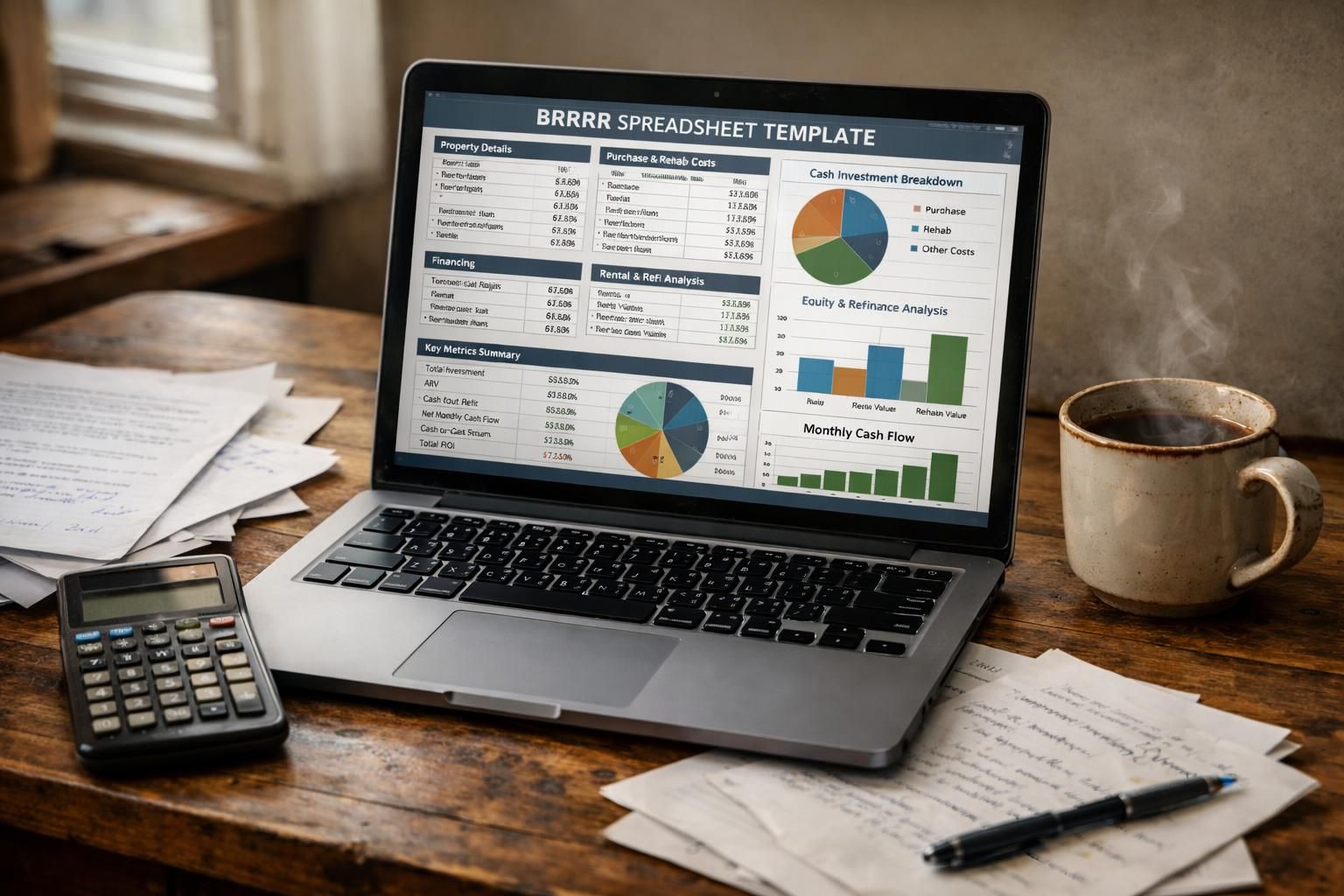

Maximize your property investments with our free BRRRR Spreadsheet template. Track every deal effortlessly and boost your rental income today!
BRRRR Spreadsheet: Free Template to Track Every Deal
New to BRRRR? Start with our BRRRR Investing Guide.
Tracking property investment deals often feels overwhelming, especially when you manage multiple transactions at once. Many real estate investors lose profits from missed details and poor record-keeping.
Recent data from the National Association of Realtors shows that over 60% of new investors struggle to analyze all their costs for each deal. A BRRRR Spreadsheet helps you solve this problem by organizing every step of your real estate investing plan in one place, making it easier to maximize rental income and monitor cash flow.
With years spent advising clients on building a strong real estate portfolio using tools like Google Sheets, I have seen firsthand how structured deal tracking improves returns. As someone who has worked closely with both flippers and landlords, I know which categories matter most for growing your investments.
Keep reading to find out how a free BRRRR Spreadsheet template can help you achieve better results on every transaction.
Key Takeaways
- Over 60% of new real estate investors struggle with deal analysis due to poor record-keeping, according to the National Association of Realtors.
- A BRRRR Spreadsheet tracks every phase: Buy, Rehab, Rent, Refinance, and Repeat—helping organize numbers like purchase price, rehab costs, ARV (after-repair value), and cash flow for each property.
- Using Google Sheets or Microsoft Excel ensures real-time updates; experts such as J Scott and Jane Meeks recommend these tools for accuracy in data entry and teamwork.
- Accurate spreadsheets speed up mortgage approvals by tracking loans, maintenance costs, rental income, ROI calculations, DCR metrics (like 1.20 minimum advised), and risk factors like location score or environmental issues.
- Comparing deals side by side helps you spot underperformers quickly; Dr. Nancy Wallace from UC Berkeley stresses that direct comparison uncovers hidden risks or value gaps in your portfolio.
Understanding the BRRRR Method
The BRRRR method offers you a strategic framework to grow your real estate portfolio using repeatable steps. Mastering these concepts lets investors optimize cash flow, leverage after-repair value (ARV), and increase passive income through careful market analysis and practical deal structuring.
What is the BRRRR method?
BRRRR stands for Buy, Rehab, Rent, Refinance, and Repeat. You acquire a property below market value using cash or a hard money loan. Next, you renovate it to improve its market value and appeal to renters.
Once renovations are complete, lease the home to generate steady rental income.
After renting the property, refinance with a traditional mortgage based on the new after-repair value (ARV). This allows you to pull out your invested capital while reducing monthly debt costs.
Use this recovered capital as a down payment on another investment property and repeat the process to build your real estate portfolio efficiently. Using this strategy helps maximize return rates by recycling funds through each deal rather than letting them sit in one asset.
How does it work?
You start the BRRRR method by buying an undervalued property, often below market value. You then renovate it to boost its after-repair value, using detailed spreadsheets to track every step.
This includes logging purchase price, renovation costs, and estimated operating expenses in your real estate investment tracker. After repairs, you rent out the home for steady rental income; this move lets you analyze cash flow and calculate your real rate of return.
Once a tenant occupies the unit, refinance with a lender based on the new appraised value. Many investors use private lenders or hard money lenders during acquisition and shift to banks or savings and loans during refinancing.
The spreadsheet helps document loan origination fees, appraisal costs, escrow funds, title insurance premiums, property taxes owed at closing, mortgage insurance (PMI), interest rates offered, and expected tax burden from rental properties.
Efficient record-keeping in your spreadsheet streamlines deal analysis; agents report that clear records hasten approvals with both lenders and inspectors according to 2023 reports by larger brokerages like Marcus & Millichap.
Accurate tracking positions you to scale your portfolio faster since it supports easier comparison of deals across markets or public transportation corridors near leased units.
Back to topThe Importance of Tracking Deals
Tracking your real estate deals in a spreadsheet allows you to spot patterns in rental income, cash flow, and operating expenses with clarity. Use clear categories in your investment property tracker to avoid errors that can impact your loan agreement or inventory records.
Benefits of tracking deals
Recording each property investment in a structured spreadsheet gives you clarity and control over your real estate portfolio. Effective deal tracking lets you see patterns, pinpoint risks, and boost rental income over time.
- You can measure cash flow for each investment property, which helps you spot underperformers early.
- Comparing renovation costs across projects enables smarter budgeting on future house flipping or buy-and-hold deals.
- Monitoring operating expenses side by side with incomes shows the true financial health of your rental properties.
- Real-time access to after-repair value (ARV) estimates supports accurate refinancing decisions and loan-to-value ratio checks.
- Spotting trends in leasing activity or vacancy rates gives you data to pivot marketing strategies fast.
- Evaluating returns on investment (ROI) using formulas ensures that every acquired asset meets stringent sales or appraisal goals.
- Regular deal analysis reveals hidden fees like private mortgage insurance (PMI), escrow account shortfalls, or increases in hazard insurance premiums.
- Accurate records speed up mortgage loan applications since lenders need clear inventories of existing debts and assets.
- Having detailed data supports better negotiations with real estate brokerages, inspectors, appraisers, or title search professionals during sales or acquisition phases.
- Systematic review uncovers discrepancies in rents collected versus market options so adjustments can be made swiftly to keep yields competitive.
A well-organized BRRRR spreadsheet forms the backbone of professional real estate investing, enabling actionable insights that grow your holdings while minimizing costly surprises.
Common mistakes to avoid in tracking deals
Tracking each real estate deal in your property investment journey demands accuracy and attention. Small errors in a BRRRR spreadsheet can lead to flawed analysis, affecting your cash flow and investment strategy.
- Failing to update data in real-time creates discrepancies that distort your rental income forecasts and operating expenses.
- Overlooking small transaction costs, such as home inspector fees or homeowner’s insurance premiums, causes underreported renovation costs and ROI miscalculations.
- Using inconsistent formats for after-repair value (ARV), appraisals, or mortgage rates makes it hard to compare multiple investment properties objectively.
- Ignoring credit history requirements and debt-to-income ratio in deal input misses risks that appraisers or lenders might flag during a refinance process.
- Entering estimates instead of documented values for acquisition price, closing costs, or discounts can introduce bias into the spreadsheet and skew your decision-making framework.
- Neglecting to track different stages—purchase, rehab, rent, refinance—results in incomplete real estate deal analysis and hinders portfolio growth assessments.
- Skipping regular reviews of your investment property data may cause you to miss trends or warning signs that impact overall real estate investments.
- Assuming market rents without verifying with property appraisers or current comparable listings can overstate expected rental property performance.
- Focusing on one metric like cash flow without assessing total returns hides potential weaknesses in your investment strategy.
- Incomplete documentation of mortgages, credit checks, FHA requirements, or stakeholder equity stakes leaves gaps that complicate future audits.
Use an organized system like Google Sheets or Excel with structured columns for each data point. Always fact-check inputs before finalizing any calculation. This approach fosters accurate analysis for every BRRRR method deal you pursue.
Back to topCreating a BRRRR Spreadsheet
Use a spreadsheet application like Microsoft Excel or Google Sheets to create your own BRRRR template. Structure the page to show key numbers, letting you track property investment metrics and spot ways to grow your real estate portfolio.
Choosing the right spreadsheet program
Opt for a spreadsheet program that balances robust calculations with user-friendly navigation. Microsoft Excel remains popular in real estate investing because of its advanced functions, pivot tables, and compatibility with market analysis tools.
Google Sheets offers cloud storage, allowing you to update your BRRRR spreadsheet from any device and collaborate with partners or property managers easily.
Prioritize programs that support complex formulas for tracking cash flow, rental income, operating expenses, renovation costs, and after-repair value (ARV). Real estate professionals like Jane Meeks at Urban Investments state, “A responsive platform lets teams analyze each investment property’s details quickly.” Programs integrating real-time data sharing enhance deal analysis accuracy across your portfolio.
Select a tool that aligns with your workflow so you can make fast investment strategy decisions and compare multiple deals efficiently.
Organizing categories and columns
Organizing categories and columns in your BRRRR spreadsheet improves clarity and accuracy. Clear structure allows you to evaluate every real estate investment with confidence and efficiency.
- Start with the property address column. It helps you identify each investment property quickly for cross-referencing and deeper analysis.
- Add a purchase price column to record acquisition costs. Real estate professionals can track entry values across your portfolio for improved deal comparison.
- Include a renovation costs section. Detail expenses for repairs, upgrades, and improvements, as these numbers influence your after-repair value (ARV).
- Insert an after-repair value (ARV) column. This figure serves as the cornerstone of real estate deal analysis and allows quick calculation of equity.
- Document loan details such as amount, interest rate, term, and lender name. Access to this information supports ongoing analysis of financing terms.
- Incorporate operating expenses like property taxes, insurance premiums, utility charges, management fees, and ongoing maintenance. Accurate tracking ensures reliable cash flow projections.
- Allocate a category for rental income per month or year. You can monitor gross revenue streams from each property investment over time.
- Add a cash flow column by inputting rental income minus operating expenses; this measures profitability at a glance.
- Create a refinance section that covers loan payoff amounts, new loan proceeds once refinanced, closing costs, and net cash-out figures. Refinancing data guides future investment strategy decisions.
- Implement formulas to calculate key metrics including return on investment (ROI), cap rate percentages, cash-on-cash returns, and payback periods. These calculations help you compare deals based on tangible financial data.
- Enable columns for notes about market trends or neighborhood characteristics that impact long-term return potential or support community-conscious real estate investing.
A well-organized sheet empowers you to spot strengths or risks before committing capital to any real estate deal.
Adding formulas and functions
Insert formulas to calculate your rental income, operating expenses, and after-repair value (ARV) directly into your BRRRR spreadsheet. Use built-in tools in Excel or Google Sheets to automate these calculations, making data analysis fast and accurate.
For example, apply the SUM function to total renovation costs across categories like materials and labor. Add a formula for cash flow by subtracting monthly operating expenses from projected rent.
Apply conditional formatting to highlight negative cash flow or excessive budget overruns on investment properties. Leverage IF statements for quick scenario analysis, such as flagging if mortgage payments exceed 40 percent of rental income.
This streamlining empowers you to evaluate each real estate deal efficiently while maintaining clarity across your real estate portfolio.
Back to topInputting Data and Calculating ROI
Input your numbers into the BRRRR spreadsheet template using Google Sheets or Microsoft Excel to ensure accuracy. Calculate the cash-on-cash return and after-repair value (ARV) for each property investment to sharpen your decision-making.
Gathering and inputting property data
Accurate data collection forms the backbone of successful BRRRR deal analysis. Each detail you enter enhances your ability to forecast cash flow and grow your real estate portfolio.
- Collect property addresses using reliable public records, tax assessor data, or Multiple Listing Service (MLS) feeds. This ensures transparency and easy reference in all future communications.
- Record purchase prices from executed sales contracts for clarity in calculating acquisition costs and after-repair value (ARV). This also helps gauge market trends against your own investment strategy.
- Enter detailed renovation costs using contractor estimates, supply invoices, or project management apps. Regularly update these figures as work progresses to reflect true capital investment.
- List annual operating expenses such as taxes, insurance, utilities, repairs, and property management fees. Draw these numbers from historical statements if available; otherwise use credible industry benchmarks.
- Track rental income based on signed leases, rent rolls, or local market comparables. Accurate rental figures drive meaningful cash flow and ROI projections for each investment property.
- Note financing terms including loan amounts, interest rates, monthly payments, origination fees, and lender details. These specifics affect net returns and help you refine future loan negotiations.
- Register occupancy rates by reviewing past tenant histories or researching area demand among nearby listings. Strong occupancy supports stable long-term income in any real estate investing venture.
- Input photos or digital scans of key documents into cloud storage linked within the spreadsheet; this simplifies audits while supporting due diligence efforts during real estate deal analysis.
Industry experts such as J Scott emphasize meticulous recordkeeping: “A single missing detail can turn a promising BRRRR project into a loss,” he notes in his guide for real estate entrepreneurs. Employing tools like Google Sheets or Microsoft Excel lets you streamline collaboration with partners and track every change in real time.
This thorough approach to data entry empowers you to spot errors early, avoid common mistakes in property investment forecasts, and make sound operational decisions that support both financial growth and community impact.
Calculating ROI using the BRRRR method
Start by listing your total investment, including the purchase price, renovation costs, and any closing fees. Calculate the after-repair value (ARV) to estimate how much you can refinance after renovations.
Subtract your loan balance from the ARV to find out how much equity remains in the property.
Next, account for expected rental income by subtracting monthly operating expenses such as taxes, insurance, and maintenance from gross rents. Divide your annual cash flow by your total cash invested to determine ROI for each real estate deal.
Industry experts like Brandon Turner recommend using a BRRRR spreadsheet or a dedicated tool for precise tracking of every cost and revenue source. This ensures you make evidence-based decisions that strengthen your real estate portfolio over time.
Back to topAnalyzing and Evaluating Deals
Use your BRRRR spreadsheet platform—such as Microsoft Excel or Google Sheets—to spot trends in rental property performance and cash flow projections. Rely on clear data to make timely adjustments that strengthen your overall investment strategy.
Utilizing data to make informed decisions
Pull clear numbers from your BRRRR spreadsheet to weigh the strengths and risks of each investment property. Compare rental income, operating expenses, after-repair value (ARV), and cash flow across deals.
This helps you spot trends in real estate investing performance and quickly identify top opportunities for your portfolio.
Analyze data points such as acquisition price, rehab costs, loan terms, and projected appreciation side by side. “Data reveals patterns that intuition might miss,” says analyst Lisa Tran of Realty Metrics Group.
Accurate records support fact-based decisions on which properties to buy or hold within an investment strategy. Stay alert for red flags like high vacancy rates or poor return on investment so you can address issues early and refine future strategies with confidence.
Identifying potential issues and adjustments
Spotting challenges early in your real estate deal analysis saves you time and reduces risk. Addressing issues at the data stage helps protect your rental income and long-term returns.
- Overestimate costs for repairs and renovations by comparing your budget with several contractor bids and recent local project averages.
- Verify projected rental income by checking market rents through multiple property management companies to ensure you do not base decisions on outdated figures.
- Confirm the after-repair value (ARV) using comparable sales from the past 90 days in the same neighborhood; outdated comps can inflate your numbers and mislead your return calculations.
- Double-check operating expenses like insurance, taxes, maintenance, and utilities against historical records for similar properties in your area to avoid underestimating future costs.
- Reassess loan terms at each stage, especially if interest rates shift or lenders change requirements; rising rates can erode cash flow fast.
- Track vacancy rates by consulting both local census reports and interviews with real estate agents who specialize in investment property leasing.
- Adjust cash flow projections if unexpected costs appear during the rehab phase or if tenant demand softens due to new housing supply nearby.
- Evaluate property management options by interviewing firms about their fees, leasing strategies, and track record of keeping units filled at market rent.
- Monitor shifts in local zoning laws or city ordinances that may increase operating expenses or cap rental rates; connect with municipal planning offices regularly for updates.
- Compare actual post-renovation occupancy levels to pre-purchase estimates using a simple spreadsheet formula so you can tweak your investment strategy before expanding your real estate portfolio further.
Each actionable step ensures you spot risks quickly, protect profits, and make smart adjustments as property trends evolve in your target markets.
Comparing multiple deals
Evaluating several property investments side by side enables you to maximize returns and minimize risks. A robust template, such as a BRRRR Spreadsheet, allows for data-driven decisions and keeps every project transparent. The following table demonstrates a clear comparative analysis you can implement in your workflow as a real estate investor or agent.
| Property Name | Purchase Price | Rehab Cost | After Repair Value (ARV) | Rent | Total Investment | Loan Amount | Cash Out | Monthly Cash Flow | Cash-on-Cash Return (%) | Debt Coverage Ratio (DCR) | Location Score | Environmental Risks |
|---|---|---|---|---|---|---|---|---|---|---|---|---|
| Maple Ave Duplex | $210,000 | $45,000 | $320,000 | $2,000 | $255,000 | $224,000 | $36,000 | $320 | 12.5% | 1.35 | 8.2 | Flood Zone C |
| Pine Street Fourplex | $375,000 | $90,000 | $565,000 | $3,800 | $465,000 | $452,000 | $13,000 | $620 | 6.1% | 1.28 | 9.0 | Clean |
| Oak Lane Single | $162,000 | $32,000 | $235,000 | $1,410 | $194,000 | $176,000 | $42,000 | $285 | 14.7% | 1.46 | 7.5 | Medium Lead Risk |
- Use cash-on-cash return and DCR to compare profitability and risk exposure.
- Incorporate environmental risks and location score for holistic assessment.
- Consider rent-to-rehab cost ratio for operational efficiency.
- Leverage spreadsheet formulas for automatic performance metrics.
- Review each field monthly to adapt to changing market conditions.
Dr. Nancy Wallace, a finance professor at UC Berkeley, underscores this approach: “Direct side-by-side comparison is vital for recognizing not only value, but also hidden operational or environmental costs.”
Access to structured data, advanced analysis, and actionable takeaways enhances your portfolio resilience while advancing responsible property investment.
Back to topHow to Analyze a BRRRR Deal
Precise deal analysis stands as the cornerstone of a successful BRRRR method. Strong financial judgment lets you grow your real estate portfolio with lower risk.
- Assess the property’s purchase price against recent comparable sales in the area to avoid overpaying and confirm market value.
- Estimate rehab costs using detailed contractor quotes, material receipts, and past project data so you keep surprises at bay.
- Project after-repair value by reviewing neighborhood trends, recent renovations, and guidance from skilled appraisers or Realtors.
- Calculate potential rental income using local rent rolls, listings on Zillow or Rentometer, and verify demand for unit type in that submarket.
- Examine operating expenses such as taxes, insurance, repairs, vacancy, and property management to ensure sustainable cash flow.
- Determine your loan terms; include interest rates, length of loan period, points charged by lenders like Fannie Mae or Freddie Mac.
- Analyze debt service coverage ratio (DSCR) to safeguard strong cash flow; lenders often require a DSCR of 1.2 or greater before refinancing.
- Input all data into a BRRRR spreadsheet for clear real estate deal analysis—this step makes it easier to compare across multiple assets in your investment strategy.
- Calculate ROI by factoring in initial outlay, holding costs during renovation, expected equity after refinance, projected rent less expenses, and future appreciation potential.
- Use clear benchmarks based on your investment goals; for example some professionals aim for 20% cash-on-cash return before proceeding with any acquisition.
Direct input from NAR economist Dr. Lawrence Yun notes: “Detailed tracking prevents errors that wipe out profits.” Making decisions based on verified numbers supports long-term rental income growth while reducing avoidable losses in your real estate investing journey.
Back to topConclusion
Tracking each property with a BRRRR spreadsheet gives you clear insight into your real estate portfolio. This free template helps you stay organized and catch mistakes before they hurt your rental income or cash flow.
You can compare deals side by side and spot which investment strategy works best for your goals. Use these tools to refine every real estate deal analysis and build a smarter, stronger investing plan.
Start using the spreadsheet now to take full control of each deal’s future.
Run the numbers. See how much cash stays in the deal after the refinance, and the cash flow on the new loan. Free, no sign-up.
FAQs
1. What is the BRRRR spreadsheet and how does it help real estate investors?
The BRRRR spreadsheet is a free template designed to track every deal using the buy, rehab, rent, refinance, and repeat method. Investors use this tool to record rental income and cash flow for each property in their real estate portfolio.
2. How does tracking cash flow with a BRRRR spreadsheet improve real estate investing decisions?
Tracking cash flow helps investors evaluate if a property produces enough rental income to cover expenses. This data guides future investment choices within their real estate portfolio.
3. Can new investors use the BRRRR spreadsheet for small portfolios?
Yes, new investors can apply the BRRRR method even with just one or two properties. The template supports both large and small-scale real estate investing by organizing key financial details.
4. Why do experts recommend monitoring rental income through such templates?
Experts state that clear records of rental income allow owners to spot trends in returns over time. As one analyst explains, “Consistent tracking ensures you understand your portfolio’s strengths and weaknesses.” Clear documentation also aids compliance with tax regulations while supporting sustainable growth strategies in real estate investing.
Back to top