

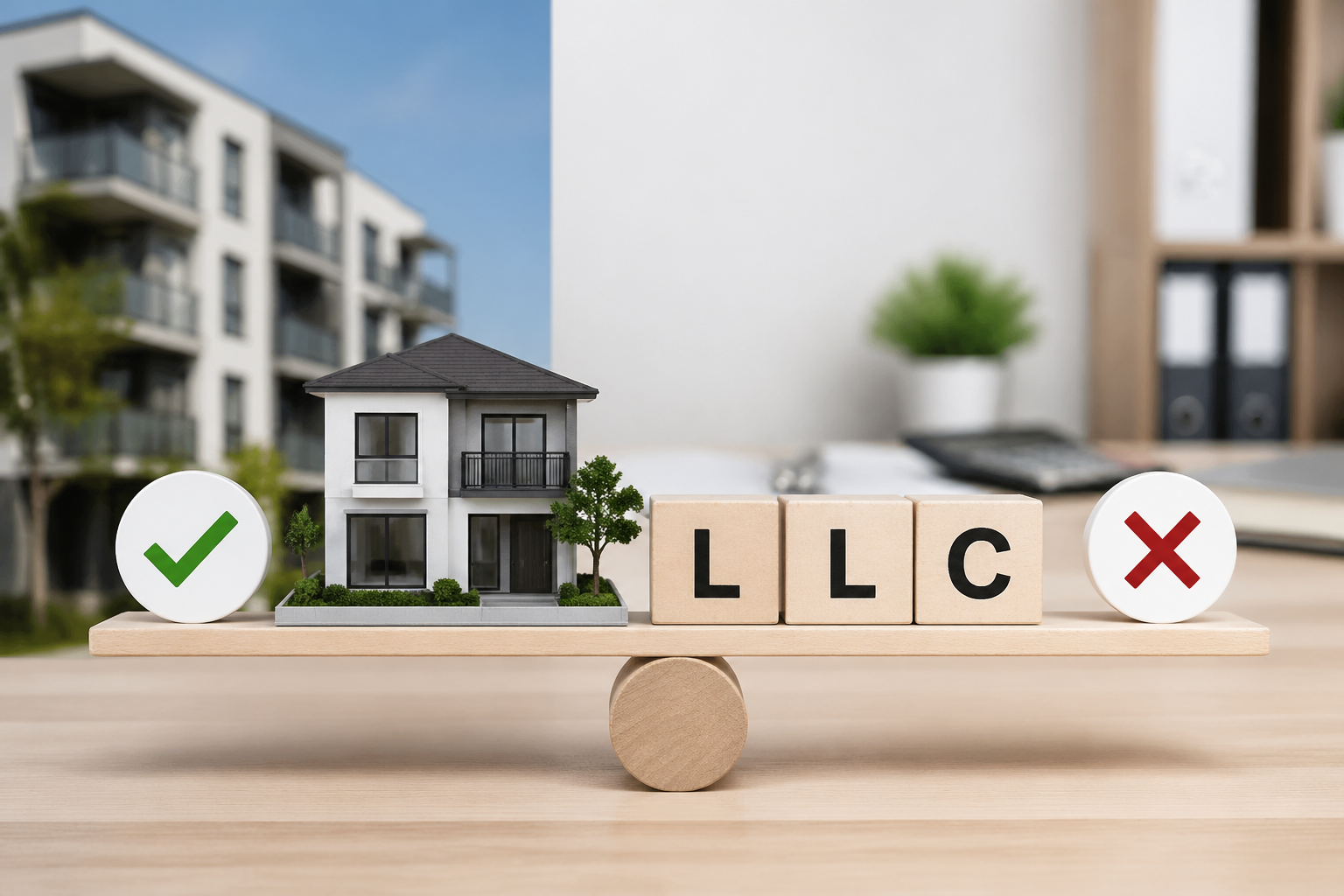

Weigh the benefits and drawbacks of using an LLC for rental property ownership. Learn liability protection, tax implications, and financing considerations.
Table of Contents
- What's an LLC for Rental Property?
- Key Benefits of Creating an LLC for Rental Properties
- Drawbacks and Challenges of Rental Property LLCs
- How to Form an LLC for Your Rental Property
- Tax Implications for Rental Property LLCs
- Transferring Existing Rental Property Into an LLC
- LLC Financing: What Lenders Need to Know
- LLC vs. Umbrella Insurance for Rental Property Protection
- Who Should Create an LLC for Rental Properties?
- Best Practices for Managing Your Rental Property LLC
- Conclusion
- Frequently Asked Questions
An LLC for rental property ownership? It's one of the biggest legal and financial calls you'll make as an investor. Get it right, and you've got personal asset protection from tenant lawsuits, a cleaner tax structure, and genuine credibility in your portfolio. But mess it up—or worse, ignore the trade-offs—and you're looking at triggered due-on-sale clauses, financing nightmares, and thousands in annual compliance fees that don't deliver squat in terms of actual protection.
New to long-term rental? Start with our Long-Term Rental Investing Guide.
This guide walks through every major consideration. You'll know exactly how to decide based on your portfolio size, risk tolerance, and specific situation.

What's an LLC for Rental Property?
Definition and Basic Structure
An LLC is your legal shield. It's a business entity that sits between you and your rental activity, protecting your personal assets from lawsuits tied to the property. Here's the critical part: the LLC owns the property, not you. So when a tenant sues over a slip-and-fall, mold damage, or habitability issues, they're coming after the LLC's assets — not your personal bank accounts, vehicles, retirement funds, or primary residence.
And here's where state law matters. Every state has different rules for forming an LLC, different filing fees, and different annual requirements. Most single-investor LLCs get treated as "disregarded entities" by the IRS. Translation? Your tax situation flows straight to your personal return with no separate corporate tax burden.
LLC vs. Sole Proprietorship for Rentals
Plenty of landlords never formally structure their business. That's operating as a sole proprietor by default — and it's risky. There's no legal barrier between you and your rental activity. Your personal assets are fully exposed in court.
Here's how they actually stack up:
| Factor | LLC | Sole Proprietorship | Winner for Most Investors |
|---|---|---|---|
| Liability Protection | Strong — personal assets shielded | None — full personal exposure | LLC |
| Taxation | Pass-through (default) or S-corp election | Pass-through on Schedule E | Tie (similar outcome) |
| Complexity | Moderate — requires formalities | Very simple | Sole Proprietorship |
| Cost to Form | $50–$500+ in state fees | $0 | Sole Proprietorship |
| Annual Costs | $50–$800+ per year | Minimal | Sole Proprietorship |
| Financing Options | More restrictive with lenders | Standard residential loans available | Sole Proprietorship |
| Professional Credibility | Higher — formal business entity | Lower — personal name on leases | LLC |
But don't assume an LLC is always the move. Holding one property with minimal equity and a light personal balance sheet? The math might not work — you're paying $100–$500 annually for protection you may not need. Own five rentals or sit on serious personal wealth? That calculus flips hard in favor of an LLC.
Back to topKey Benefits of Creating an LLC for Rental Properties

Liability Protection and Asset Separation

Your rental properties are lawsuit magnets. The Insurance Information Institute reports that slip-and-fall claims alone can generate jury awards over $50,000, and catastrophic incidents? You're looking at six or seven figures. An LLC puts a legal wall between your rental business and everything you own personally. Here's the catch: you've got to actually maintain it. Separate bank accounts, documented decisions, no mixing personal and business funds. Do it right, and courts won't pierce that corporate veil to come after your house.
Multiple properties? That's where a Series LLC becomes brilliant. Available in Delaware, Texas, Nevada, and a few other states, it lets you create separate "cells" under one umbrella — one cell per property. A tenant sues Property A. They can't touch the assets sitting in Property B's cell.
Tax Advantages and Pass-Through Taxation
This is what makes LLCs so attractive for rental investors. Pass-through taxation. By default, your single-member LLC flows rental income and expenses straight to your Schedule E—no second tax hit like you'd get with a C-corp. Running multiple members? It defaults to partnership taxation, with each member reporting their pro-rata share on their personal return. Double taxation? Gone.
And here's the thing—you need to know your numbers before you structure. Your tax exposure hinges directly on your net income position. Understanding your rental property cash flow and real returns isn't optional.
Professional Credibility and Business Separation
An LLC name on your lease carries weight. Tenants see it as a real business. Lenders respect it. Contractors treat you differently when you're operating with a business bank account and clean bookkeeping. That separation matters even more if you're buying long-distance rental properties—professional structure builds trust with remote property managers and vendors who've never met you in person.
Flexibility in Tax Treatment Options
Here's where it gets interesting for high-income operators. Elect S-corporation taxation on your LLC and suddenly you're paying yourself a reasonable salary, then taking the rest as distributions. Those distributions dodge self-employment tax. If you're clearing $50,000 or more in net rental income annually, you're looking at thousands in annual savings. But talk to your CPA first. S-corp elections come with real administrative overhead, and the math has to work for your specific situation.
Back to topDrawbacks and Challenges of Rental Property LLCs
Formation and Ongoing Costs
LLCs aren't free. Costs swing wildly depending on where you set up shop. Check out what you're actually looking at in the major markets:
| State | Filing Fee | Annual Report Fee | Total First Year | Annual Ongoing |
|---|---|---|---|---|
| Delaware | $90 | $300 (franchise tax) | $390+ | $300+ |
| Nevada | $75 | $350 | $425+ | $350+ |
| Wyoming | $100 | $52 minimum | $152+ | $52+ |
| Florida | $125 | $138.75 | $263.75+ | $138.75+ |
| California | $70 | $800 minimum franchise tax | $870+ | $800+ |
| New York | $200 | $9 biennial + publication ~$1,000–$2,000 | $1,200–$2,200+ | $9 biennial |
Then add registered agent fees ($50–$300/year), accounting and tax prep ($300–$1,500/year), and the occasional legal check-in. California's brutal $800 annual minimum franchise tax? That alone kills the deal on a single property with thin margins. You're bleeding money before you collect a dime in rent.
Financing and Due-on-Sale Clause Concerns
Here's what most investors miss. Your residential mortgage almost certainly has a due-on-sale clause — language that lets the lender demand the full balance if you transfer title without asking permission first. And transferring a property from your personal name into an LLC? That technically flips the trigger, even if you own the LLC 100%.
Lenders rarely pull the plug immediately in real life. But the risk sits there, waiting — especially if you refinance or if some portfolio manager's automated system flags the transfer. If you're buying the rental with financing from day one, buy it directly in the LLC's name instead. This sidesteps the whole clause issue. The catch? Most banks won't touch LLC borrowers for conventional Fannie Mae or Freddie Mac loans, so your lending options narrow.
Complexity and Administrative Burden
Annual filings. Separate bank accounts. Documented operating decisions. Consistent accounting practices. None of this is optional.
Skip these formalities, and your liability protection evaporates. A plaintiff's attorney will shred the corporate veil and come after your personal assets. That's why solid rental property bookkeeping isn't a nice-to-have — it's the foundation of your legal defense. Get it wrong, and your LLC becomes window dressing.
Back to topHow to Form an LLC for Your Rental Property

Step-by-Step Formation Process
- Choose your state of formation. Here's the trap most investors fall into: you own a property in California but form your LLC in Delaware thinking you'll save money on taxes or get better privacy. Reality check—you'll still need to register as a foreign LLC in California anyway, which means you're paying double filing fees and getting zero benefit.
- Select a registered agent. Your LLC needs someone to receive legal notices on your behalf. That's what a registered agent does. Professional services typically cost $50–$300 per year, which is cheap insurance.
- File Articles of Organization. This is your formation document. Submit it to your state's Secretary of State office with the filing fee. Straightforward step.
- Draft an Operating Agreement. Your state might not require one, but you should create this anyway—especially if you've got multiple members. This document locks down ownership percentages, who handles day-to-day management, how profits get distributed, and what happens when someone wants in or out. It's the difference between a bulletproof structure and a messy dispute down the road.
- Obtain an EIN (Employer Identification Number). Head to irs.gov and apply. It's free. You'll need this number to open your business bank account, file taxes, and sign leases in the LLC's name.
- Open a dedicated business bank account. Every dollar of rental income goes here. Every property expense comes out of here. Don't mix it with your personal checking account—commingling funds is one of the fastest ways to blow up your liability protection and lose the whole reason you formed the LLC in the first place.
- Transfer title to the property (if applicable) using a properly recorded deed. Bring in a real estate attorney for this step. They'll make sure the transfer is documented correctly and that your lender gets notified if they need to be.
Tax Implications for Rental Property LLCs
Default Tax Treatment and Pass-Through Taxation
Single-member LLCs get disregarded entity status by default. That means you're reporting rental income and expenses on Schedule E, just like you would without the LLC wrapper. No separate business return needed. Multi-member LLCs? They file Form 1065 and issue K-1s to each member. And here's the real win: neither structure hits your rental income with self-employment tax under the default setup — try getting that advantage with active business income.
Deductions and Depreciation Benefits
The LLC itself doesn't magically create new deductions. You could claim the same write-offs as a sole proprietor. But here's what actually happens: the structured accounting an LLC forces you to maintain usually surfaces deductions you'd otherwise miss. Mortgage interest, property taxes, insurance, repairs, management fees, professional services — these all come off your taxable income. Depreciation too.
Before you can maximize what you're claiming, though, you need to analyze a rental property and understand the numbers that matter. Depreciation on residential property runs 27.5 years. When you eventually sell? Depreciation recapture tax hits at up to 25% on everything you've claimed — and that happens whether you held it in an LLC or not.
Reporting Requirements and BOI Compliance
Starting January 1, 2024, most LLCs have to file a Beneficial Ownership Information (BOI) report with FinCEN under the Corporate Transparency Act. You're disclosing anyone who owns 25% or more or exercises real control over the entity. Miss the deadline? That's $500 per day in penalties.
Timing depends on when you formed. Pre-January 2024 LLCs had until January 1, 2025. Those created in 2024 got 90 days from formation. New LLCs in 2025 and beyond get 30 days. Most advisors gloss over this or skip it entirely — don't be that investor.
Back to topTransferring Existing Rental Property Into an LLC

Title Transfer Process and Tax Consequences
You'll need a new deed — typically a quitclaim or warranty deed — signed from you to your LLC. Then it gets recorded at your county recorder's office. Here's the good news: moving property into a single-member LLC you control usually isn't a taxable event for federal purposes. But that "usually" matters. Some states will reassess your property taxes, and you might owe transfer taxes locally.
Depreciation recapture is the real headache here. If you've been depreciating the property and later sell the LLC interest itself instead of the underlying property, the math changes. And not in your favor. The recapture liability doesn't disappear — you're just reporting it differently. Before you move anything, talk to your CPA or a tax-focused real estate attorney.
Mortgage and Lender Notification
This is where most investors get nervous. Your mortgage docs might have a due-on-sale clause lurking in there.
You've got options. Some investors get permission from their lender upfront — transparent, but slow. Others transfer title quietly and bet the lender won't notice or care, which is riskier than it sounds. A third play involves a real estate attorney structuring the deal through a land trust or similar vehicle that technically avoids triggering the clause. Different risk, different complexity, different cost. Don't wing this part — get professional advice first.
Back to topLLC Financing: What Lenders Need to Know
Challenges Obtaining Mortgages for LLC Properties
Here's the hard truth: Fannie Mae and Freddie Mac won't touch LLC-titled properties. Those cheap, standardized conventional mortgages? Not available. You want to buy directly in the LLC's name? Then you're working with a smaller menu of options.
- Portfolio loans: Local banks and credit unions hold these on their own balance sheets instead of selling them off. You'll pay 0.5%–1.5% more in rates, and terms vary significantly between lenders.
- Commercial loans: Scaling your portfolio? Commercial lenders step in with their own playbook — expect 20–30% down, 5–20 year terms, and 20–25 year amortization schedules.
- DSCR loans: Non-QM lenders use Debt Service Coverage Ratio to qualify you based on what the property actually makes, not your W-2 income. Most DSCR products explicitly allow LLC ownership.
And if you're running fix-and-flip projects alongside buy-and-hold rentals, understanding fix and flip financing options helps you see how lenders think about real estate investment entities across different deal types. The same bridge lenders who fund your flips often have rental portfolio products built for LLC borrowers.
Personal Guarantees and Their Implications
Most lenders will fund your LLC. But almost every single one requires you to personally guarantee the debt. That changes everything. If you default, they come after your personal assets — house, bank accounts, retirement accounts. The liability shield you created by forming that LLC? It evaporates the moment you sign the guarantee on this specific loan. True non-recourse financing exists, but it's reserved for institutional-scale deals and isn't realistic for most investors building a rental portfolio.
Back to topLLC vs. Umbrella Insurance for Rental Property Protection

| Situation | LLC | Umbrella Insurance | S-Corp | Recommendation |
|---|---|---|---|---|
| Single property owner | Moderate benefit | Strong, cost-effective | Overkill | Umbrella Insurance |
| Multiple properties (3+) | Strong benefit | Helpful supplement | Consider for high income | LLC + Umbrella |
| High-liability property | Strong benefit | Strong benefit | Not applicable | Both |
| High income earner ($150k+ net) | Strong benefit | Helpful supplement | Strong benefit | LLC + S-Corp Election |
| Business partner involved | Essential | Insufficient alone | Consider | Multi-member LLC |
Here's the math: a $1–2 million personal umbrella policy runs you about $150–$400 per year. That's nothing compared to setting up and maintaining an LLC. If you're holding a single property and your personal net worth isn't substantial, umbrella coverage alone makes sense as your first layer of defense. But here's the catch—umbrella policies have blind spots. They won't cover every liability scenario, they cap out at their limits, and they don't create the legal separation or tax advantages an LLC provides.
And that's why the smartest move? Stack both protections. Most serious investors should.
Back to topWho Should Create an LLC for Rental Properties?
Pros and Cons at a Glance
| Aspect | Pros | Cons | Impact Level |
|---|---|---|---|
| Liability | Shields personal assets from lawsuits | Veil can be pierced if formalities ignored | High |
| Taxes | Pass-through, S-corp election option | BOI reporting, added complexity | Medium |
| Costs | Deductible as business expense | $500–$2,000+/year ongoing | Medium–High |
| Financing | Some DSCR/portfolio loan options | No conventional loans, higher rates | High |
| Complexity | Enforces good business habits | Annual filings, accounting required | Medium |
| Flexibility | Multiple tax elections, Series LLC option | State-specific rules vary widely | Medium |
Here's the real talk: an LLC makes sense if you're holding multiple doors, you've got real assets to defend, or you're in high-risk territory—think multifamily complexes, commercial buildings, or short-term rentals where guest injuries are a genuine concern. Bringing partners into a deal? Then you definitely want the structure in place.
But here's where it gets tricky. If you're running short-term rental strategies or executing a BRRRR method play, that financing headache becomes a real problem. Lenders hate LLCs on conventional mortgages—you'll be stuck with DSCR loans or portfolio products at 1–2 points higher. That's expensive.
Back to topBest Practices for Managing Your Rental Property LLC
Maintaining the Corporate Veil
After you form an LLC, maintaining the legal separation between you and your entity is non-negotiable. Courts will look at whether you commingled personal and business funds, ran personal expenses through the LLC bank account, kept proper records, and capitalized the LLC adequately. Mess up even one of these, and your liability protection disappears fast.
Annual Compliance and Ongoing Requirements
- File annual or biennial reports with your state on time
- Renew your registered agent service annually
- Keep your EIN active and linked to the correct entity
- Maintain your BOI filing with FinCEN and update it within 30 days of any ownership changes
- Hold documented meetings or written consent actions for major decisions
- Retain all financial records for a minimum of 7 years
- File the appropriate tax returns (Form 1040 Schedule E or Form 1065) by deadlines
And here's the thing: consistent bookkeeping isn't optional if you want to keep that liability shield intact. Every deductible expense matters. Clear financial records matter to lenders. But they also matter to a judge if someone tries to pierce your veil. Proper rental property bookkeeping practices demonstrate genuine business separation—and that's what actually protects you.
Back to topConclusion
An LLC for rental property is a powerful tool. But it's not a universal solution. The core benefit is real: genuine personal asset protection from the liabilities that come with being a landlord. The core drawback? Added cost, complexity, and financing restrictions that can meaningfully tank your investment returns. For investors with multiple properties, significant personal wealth, or high-liability rental assets, the LLC structure almost always makes sense. But if you're a single-property investor just starting out, you might be better off pairing a solid landlord insurance policy with a personal umbrella policy as your starting point while you build your portfolio.
Whatever structure you choose, treat it seriously. An LLC that isn't properly maintained gives you nothing but a false sense of security. Work with a licensed real estate attorney and CPA in your state before making formation, transfer, or tax election decisions. These details matter enormously. The costs of getting it wrong far exceed what you'll pay for professional advice.
Back to topFrequently Asked Questions
Does forming an LLC eliminate all personal liability for my rental property?
No. It reduces your exposure, but doesn't wipe it out completely. Here's the catch: if you don't maintain proper corporate formalities, mix personal and business funds, or personally guarantee a loan, your protection evaporates. And if you're personally negligent — say you fail to maintain the property and someone gets hurt — the LLC won't shield you.
Can I transfer my rental property into an LLC if it already has a mortgage?
Yes, but there's real risk here. Most residential mortgages have a due-on-sale clause. Technically, that gives your lender the right to demand full repayment the moment you transfer the deed. Lenders don't always exercise this immediately, but they can — especially when you refinance. Before you move any mortgaged property into an LLC, talk to a real estate attorney.
How many LLCs should I have if I own multiple rental properties?
There's no universal answer. Some investors create one LLC per property for complete liability isolation between assets. Others throw everything into a single LLC to keep costs down, knowing a lawsuit against one property could theoretically reach the others. A Series LLC — available in certain states — splits the difference by giving you separate liability cells under one entity. Let your portfolio size and your attorney guide the call.
What's a BOI report and does my rental property LLC need to file one?
The Beneficial Ownership Information (BOI) report is a federal requirement under the Corporate Transparency Act. You file it with FinCEN (Financial Crimes Enforcement Network). Most LLCs holding rental properties have to submit one. You're disclosing anyone who owns 25% or more of the entity or exercises substantial control. Miss the deadline? You're looking at $500 per day in penalties. File at fincen.gov and loop in your attorney if your ownership structure is complex.
Is an LLC or umbrella insurance better for a first-time landlord?
For your first single property, skip the LLC setup costs. A solid landlord policy paired with a $1–2 million umbrella policy gives you real protection for way less money. Once your portfolio grows, adding an LLC makes financial sense. The best strategy for serious investors? Get both. Use the LLC for legal separation and layer in umbrella coverage as your financial backstop.
Back to top