

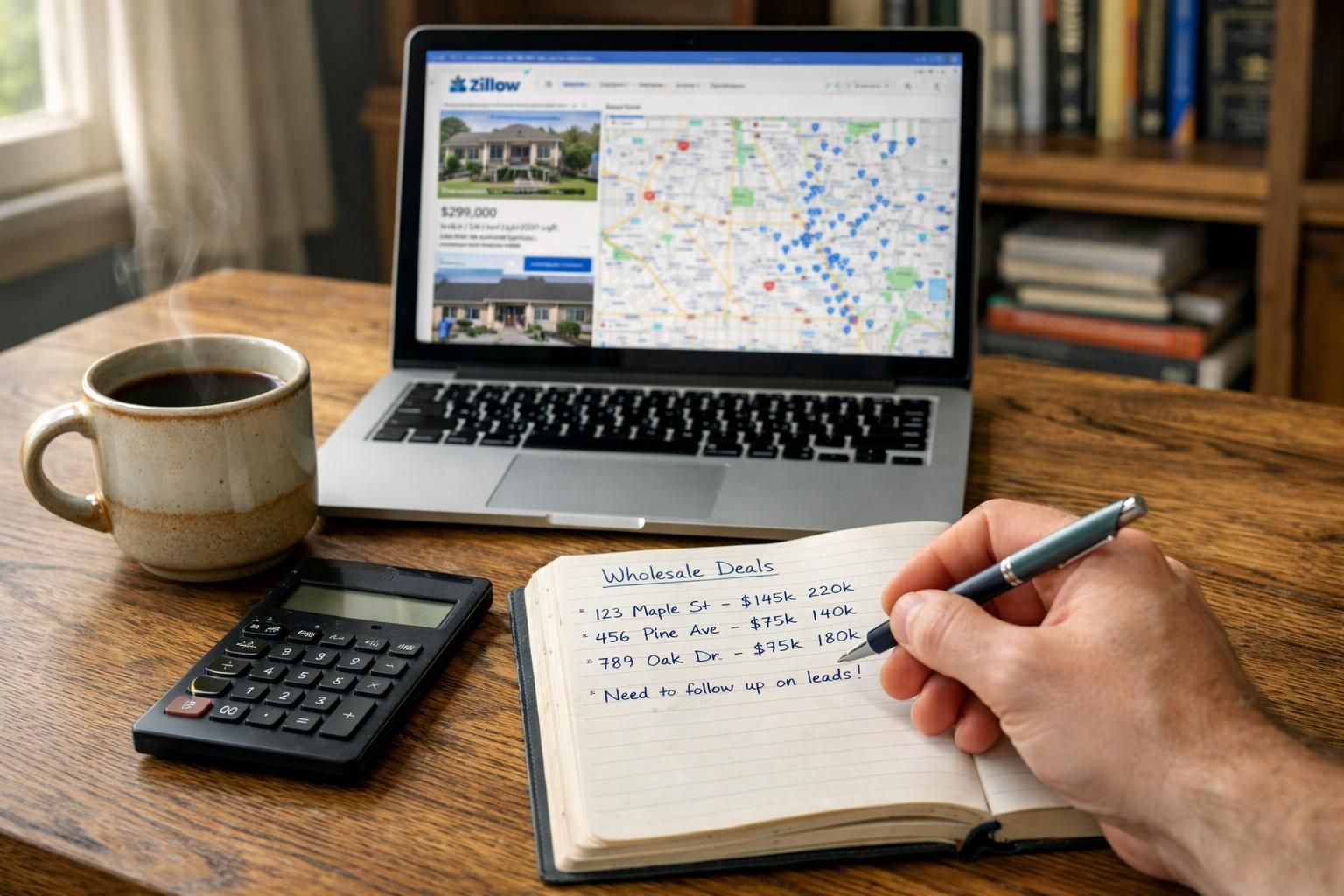

Master wholesale deal analysis in just five minutes with quick tips on ARV, repair costs, and fees. Start making smarter investment decisions today!
Wholesale Deal Analysis: How to Run Numbers in 5 Minutes
Running numbers on a wholesale deal analysis often feels like a high-stakes guessing game. Many real estate investors miss out on profit margins because they overestimate the after repair value or underestimate repair costs. 1 Yet, with the right property analysis tools and a systematic approach, you can break down any investment property's key metrics in under five minutes. This article will show how to analyze comparable sales, closing costs, and your wholesale fee using trusted resources like Zillow and DealCheck.
With years of hands-on experience in real estate investing and access to leading real estate software, I have studied techniques that set top house flippers apart from beginners. 2 You will learn practical steps for smart decision-making with each wholesale deal analysis.
Master time-saving methods today—keep reading for insights that work.
Key Takeaways
- Speed is critical in wholesale deal analysis. Use tools like DealCheck or PropStream to estimate ARV, repair costs, and holding expenses in under five minutes (ATTOM Data Solutions, 2023).
- Always use accurate local comps from the last 36 months when calculating After Repair Value (ARV). Overestimating ARV with outdated or wrong-area sales can ruin your profit margins.
- Classify renovation needs as light ($10-$20/sq ft), medium ($25-$40/sq ft), or full gut ($50-$80/sq ft). Mistakes in repair estimates can cost you thousands of dollars per deal.
- Apply the 70% Rule: MAO = (ARV x 70%) – estimated repairs. This formula keeps your offers competitive and helps protect your wholesale fee.
- Software like DealCheck provides BRRRR calculators and long-term projections up to 35 years. PropStream offers nationwide data for comps and rehab costs—choose based on your business focus (Real Estate Skills; Ryan Pineda).
Understanding Wholesale Deal Analysis
Wholesale deal analysis helps real estate investors make smart choices about property value and profit. Use property analysis tools like DealCheck or PropStream to ensure your numbers reflect true market conditions and protect your investment interests.
Definition and Importance
Real estate wholesaling involves finding deeply discounted properties, often in need of repairs, and assigning purchase contracts to cash buyers for a wholesale fee. You act as a connector between motivated sellers and real estate investors who want investment properties without spending time sourcing deals.
Speed is critical; the ability to run numbers on property value, assignment fees, ARV (after repair value), repair costs, and closing costs separates successful wholesalers from average ones. 1
Deal analysis hinges on four key metrics: ARV, purchase price, estimated repair cost, and maximum allowable offer (MAO). These figures help you quickly assess whether a deal has enough equity for profits after factoring in holding costs and other operating expenses.
Using simple calculations with tools like DealCheck or PropStream lets you complete thorough investment analysis within five minutes. This efficiency streamlines your decisions while protecting your bottom line in today’s competitive market. 2
Key Metrics to Consider (ARV, Purchase Price, Repair Costs, etc.)
Understanding the key metrics in wholesale deal analysis helps you make fast and accurate decisions. These figures shape your potential profits, risks, and next steps in real estate wholesaling.
- After Repair Value (ARV):
Estimate the ARV by using comparable sales of similar properties in the same neighborhood sold within the past 36 months. Tools such as DealCheck or PropStream provide current data for analysis. The ARV predicts what a property could fetch after repairs, guiding your entire strategy. 3 - Purchase Price:
Identify the lowest possible purchase price through negotiation and market research. This number sets the baseline for your investment and maximizes your wholesale fee. - Repair Costs:
Calculate renovation expenses by ranking needed work as light ($15-$25 per square foot), medium ($25-$40 per square foot), or full gut ($40-$60 per square foot). Factor inspection reports or contractor bids into this estimate for better accuracy. - Maximum Allowable Offer (MAO):
Apply the 70% Rule to determine MAO using this formula: (ARV x 70%) minus repair costs. This ensures a margin that appeals to both you and cash buyers, supporting fast decision-making on offers. - Comparable Sales Analysis:
Use real estate software like PropStream or Deal Machine to find recent comps with similar size, age, and condition in nearby locations. Strong comps validate your ARV assumptions and aid negotiations with buyers. - Closing Costs:
Add closing costs including title fees, attorney charges, and transfer taxes into your calculations from the start. Ignoring these expenses can erode your expected profit margins quickly. - Holding Costs:
Account for expenses such as utilities, insurance, taxes, and loan interest during ownership before resale or assignment to a buyer. Longer hold times increase risk; plan exit strategies accordingly. - Loan-to-Cost Ratio (LTC):
Estimate LTC by dividing total loan amount by project cost, then express as a percentage. Lenders use this metric to decide funding limits for investments involving major renovations. - Loan-to-Value Ratio (LTV):
Calculate LTV by dividing loan amount by property value post-rehab; lenders use it to set terms and assess risk for both fix-and-flip deals and BRRRR strategies. - Scope of Work:
Document every repair item clearly before making offers; detailed scopes protect you from surprise costs later in the process. - Wholesale Fee:
Set an appropriate assignment fee based on market standards; fees usually range from $5,000 to $15,000 per deal depending on complexity, location, and investor demand. - Zoning Regulations and Location Research:
Review local zoning codes as well as flood zone maps before finalizing offers; check school rankings using public sources since strong schools can boost resale values significantly.
Step-by-Step Guide to Running Numbers in 5 Minutes
Speed is crucial for real estate investors who must assess deals quickly in a competitive market. Use property analysis tools such as DealCheck or PropStream to streamline calculations and gain an actionable edge.
Step 1: Determine the After Repair Value (ARV)
Estimate the After Repair Value (ARV) by adding the property purchase price to your expected renovation costs. This crucial step allows you to predict how much the property will be worth after upgrades, which guides both your offer and exit strategy.
For example, if you acquire a building for $2 million and plan $520,000 in renovations, set the ARV at $2.52 million. 4
Use tools like DealCheck or PropStream to compare similar sales and confirm your calculation matches real market data. Focus on value-add strategies that boost rental income post-renovation; higher stabilized rents mean better investment returns for real estate investors who use flip or BRRRR strategies.
Always base your numbers on solid comparable sales rather than inflated projections; this discipline supports sound analysis in every wholesale deal.
Step 2: Estimate Repair Costs
Accurately assess repair costs by first categorizing the level of renovation required for the property. Light renovations often fall in the range of $10 to $20 per square foot, while medium rehab can reach $25 to $40 per square foot.
Full gut renovations may climb as high as $50 to $80 per square foot. Use recent comparable sales and inspect property conditions closely to validate your estimates.
Underestimating repair costs is a frequent error that quickly erodes profits for real estate investors in wholesale deals. Rely on property analysis tools such as PropStream or DealCheck for user-friendly checklists and cost templates.
Leverage input from licensed contractors whenever possible. Accurately factoring in these numbers ensures you set a realistic purchase price and protects your wholesale fee against surprises.
Step 3: Calculate Your Maximum Allowable Offer (MAO)
Apply the 70% rule to determine your maximum allowable offer (MAO) on a wholesale deal. The formula is simple: take seventy percent of the after repair value (ARV), then subtract estimated renovation costs.
For example, if a building’s ARV stands at $5 million and you estimate repairs at $400,000, multiply $5 million by 0.7 to get $3.5 million. Subtract $400,000 in renovation costs, leaving an MAO of $3.1 million.
Include your wholesale fee in this calculation to secure profitability for yourself as a real estate wholesaler or investor. Tools like DealCheck or PropStream can help you run these numbers quickly and avoid costly mistakes in property analysis.
Use this approach across flip strategy deals or brrrr strategy investments; it keeps your offers competitive while ensuring room for profit after closing costs and operating expenses are covered.
This method helps attract motivated cash buyers who expect transparent calculations based on clear comparable sales data every time you present a contract.
Step 4: Analyze Comparable Sales
Review recent comparable sales in the same neighborhood to estimate a realistic after repair value (ARV). Rely on comps from within the last 36 months, and match features like square footage, lot size, and bedroom count.
Focus on precise local data by checking flood zones and school rankings. These details affect value as much as number of beds or baths.
Use property analysis tools such as PropStream or DealCheck for efficient comparison. Always check zoning regulations since they can impact future use and buyer demand. Careful comp selection ensures your ARV supports a strong offer price, critical for successful real estate wholesaling deals.
Step 5: Factor in Holding and Closing Costs
Holding costs can erode your profit margins fast. You must include expenses like property taxes, insurance, utilities, and loan interest in your wholesale deal analysis. For instance, if a house sits unsold for three months, you might pay $1,200 or more in holding costs depending on location and market conditions.
Real estate investing software such as PropStream lets you input these variables directly into your property analysis tools.
Closing costs add another layer to total acquisition cost. These often include title fees, escrow charges, recording fees, and sometimes transfer taxes. On average across the United States in 2023, closing costs reach two to five percent of the purchase price according to industry analysts at ATTOM Data Solutions.
If you want to keep your wholesale fee attractive to cash buyers and meet investor standards for net operating income (NOI) or cap rate requirements, factor all holding and closing line items before finalizing offers using real estate software like DealCheck or Deal Machine.
Back to topOverview of Tools for Wholesale Deal Analysis
Many real estate investors use software like DealCheck and PropStream to speed up property analysis. Select a tool that lets you compare recent home sales quickly, so you can make confident decisions in minutes.
DealCheck vs. PropStream
For a clear evaluation of DealCheck vs. PropStream, review the distinctions in features, usability, and practical value for wholesale deal analysis in the table below.
| Criteria | DealCheck | PropStream |
|---|---|---|
| Core Functionality | Offers comprehensive real estate calculators, including a BRRRR calculator for analyzing the full investment cycle. | Provides property data aggregation, location research, comps, and renovation estimates tailored for wholesalers. |
| Key Metrics | Input essential details: property name, type, address, purchase price, ARV, financing, and rehab costs. Long-term cash flow projections up to 35 years. | Supplies robust data for location research and comparable sales. Presents renovation estimates using nationwide data. |
| Speed of Analysis | Enables you to run quick deal analysis, often in under five minutes, by streamlining data entry and reporting. | Delivers high-speed access to property records and comps, supporting rapid estimation and feasibility review. |
| BRRRR Analysis | Specialized BRRRR calculator guides you from purchase and rehab through refinance, helping evaluate each phase. | Lacks an integrated BRRRR analysis tool; relies on data aggregation and manual calculation. |
| Comparables (Comps) | Presents a comp database, though usually less expansive than PropStream, for after repair value estimation. | Superior nationwide comps database. Filters, maps, and sorts recent transactions for precise ARV calculation. |
| Long-Term Projections | Projects cash flow, equity, and ROI up to 35 years; ideal for holding strategies and BRRRR deals. | Focuses on immediate data for acquisitions and flips. Lacks detailed projections beyond purchase and rehab phase. |
| Environmental & Societal Impact | Tracks projected costs and returns, supporting more sustainable and informed investment decisions. | Provides insight into neighborhood trends which can impact community development and local markets. |
| Actionable Takeaway | Use DealCheck for complete BRRRR, long-term rental, and rehab analysis. Streamline workflows with preset calculators for faster offer calculations. | Leverage PropStream for market research, comp pulls, and renovation cost estimates. Ideal for rapid wholesaling and location vetting. |
PropStream vs. Deal Machine
PropStream and Deal Machine each offer critical solutions for real estate professionals pursuing wholesale deals. Their features address both data analysis and lead generation demands. The table below provides a detailed comparison tailored for your investment analysis.
| Feature | PropStream | Deal Machine |
|---|---|---|
| Primary Strength | Comprehensive data analytics and property market insights | Lead generation and direct mail campaign execution |
| Comp Analysis | Robust comparable sales with historical transaction records | Basic comps, focused on quick snapshot of property values |
| Repair Cost Estimation | Integrated estimator for rehab costs, includes regional price data | Simplified repair calculator with custom input options |
| Lead Sourcing | Data filters for absentee owners, pre-foreclosures, and vacancies | Driving for dollars, instant homeowner contact via direct mail or text |
| Market Coverage | Nationwide property records, over 153 million properties tracked as of 2023 | Coverage in most U.S. markets, strong mobile integration |
| User Interface | Web-based dashboard, advanced filters, exportable reports | Mobile-first design, real-time updates, user-friendly mapping tools |
| Actionable Takeaway | Best suited for detailed due diligence and bulk prospecting | Optimal for first contact, speedy outreach, and team-based fieldwork |
| Environmental/Societal Impact | Supports data-driven investment, reducing speculative flips and contributing to market stability | Enables targeted outreach, potentially revitalizing neglected neighborhoods |
| Industry Quote | "PropStream’s analytics set the benchmark for accurate deal analysis," comments Alex Martinez, founder of Real Estate Skills. | "Deal Machine streamlines prospecting, allowing teams to build relationships at scale," says David Lecko, CEO of Deal Machine. |
Real estate professionals use PropStream for granular market research, multi-metric analysis, and exporting lead lists. Agents and investors seeking immediate property opportunities often prefer Deal Machine's intuitive field tools and rapid communication features. Both excel in wholesale deal evaluation, but their unique strengths cater to specific phases of your business. Consider your primary need: if you rely on deep analytics for strategic acquisitions, opt for PropStream. If quick action and local lead capture drive your process, Deal Machine provides a competitive edge.
Back to topWholesale vs. Wholetail: Understanding the Differences
Wholesale deals in real estate involve selling property contracts to cash buyers for a wholesale fee, with no need to own the property. You focus on fast transactions and collect assignment fees, often relying on strong market knowledge and quick deal analysis tools like DealCheck or Deal Machine.
Wholetailing takes a different approach; you purchase the property, make minimal repairs, and then resell it—usually retailing to traditional homebuyers rather than investors.
This distinction leads to differing risk profiles. Wholesale offers lower financial risk but limits your profit potential. Wholetail provides higher possible returns but demands more capital upfront and exposes you to holding costs such as taxes, insurance, and closing costs.
Both strategies require accurate ARV estimates, understanding of comparable sales data, and careful use of real estate analysis software. Investors should analyze local market conditions before deciding which approach fits their goals for net operating income or flip strategy success.
Back to topHow to Analyze a BRRRR Deal
Analyzing a BRRRR deal can drive your real estate investing success. You need clear numbers and the right real estate software to make confident decisions.
- Define each BRRRR step using the buy, rehab, rent, refinance, and repeat framework. 5
- Input the purchase price of the potential property into a tool like DealCheck to initiate your property analysis.
- Estimate rehab costs precisely by considering materials, labor, and timeframes, since underestimating repairs can decrease profits.
- Evaluate rental income by researching similar properties in the area with reliable comparable sales data to predict cash flow accurately.
- Factor in operating expenses such as taxes, insurance, property management fees, maintenance reserves, and utilities for a realistic net operating income (NOI).
- Use a BRRRR calculator, such as our free BRRRR calculator or DealCheck’s, to input ARV (after repair value), loan details, and recurring costs; customize these variables for accuracy.
- Review long-term projections for up to 35 years through tools like BUY & HOLD PROJECTIONS; this helps visualize returns and debt payoff over decades.
- Analyze your maximum allowable offer (MAO) considering closing costs and wholesale fees so you do not overpay. 3
- Assess key metrics including cap rate and cash-on-cash return using outputs from real estate software; ensure projected performance meets or exceeds your investment standards.
- Compare total investment with estimated refinancing proceeds; verify that you can recoup most or all initial capital after completing the rental strategy cycle.
This methodical approach lets you quickly gauge if a BRRRR opportunity stands up to scrutiny before committing funds or presenting offers to cash buyers or partners.
Back to topCommon Mistakes in Wholesale Deal Analysis
Rely on precise data from platforms like DealCheck and PropStream to avoid costly errors in your wholesale deal analysis; refine your process now to secure stronger investment outcomes.
Overestimating ARV
Overestimating After Repair Value, or ARV, can undermine your entire wholesale deal. Using inaccurate comparable sales data from outside the immediate neighborhood skews your property analysis.
You may end up offering too much for a house and watch your profit margins shrink. For example, if you base ARV on comps that closed six months ago in another zip code instead of focusing on recent sales nearby, you risk selling to cash buyers at a loss.
DealCheck and PropStream provide fast access to updated comparable sales within the correct area. Use these tools to gather real-time market info before running your numbers. Experts like John Martinez warn that even experienced investors lose credibility by inflating ARV figures in their analysis.
Stick with facts from local comps sold within three months and avoid chasing unrealistic values during periods of high market volatility. This approach helps protect both your wholesale fees and long-term business reputation as a real estate wholesaler or investor focused on rental or flip strategy deals.
Underestimating Repair Costs
Investors in real estate wholesaling often face shrinking profits after failing to budget for the true scope of repairs. Neglecting to classify renovations as light, medium, or full gut can turn projected margins into losses.
You must break down every needed update and apply current price-per-square-foot estimates for each category. Estimating repair costs on a 1,200 square foot home at $15 per square foot when it actually needs medium renovation at $35 per square foot leads to a shortfall of $24,000.
Experts like Ryan Pineda argue that automation tools such as DealCheck or PropStream help you avoid these mistakes by offering detailed checklists and up-to-date labor costs.
Overlooking critical repairs not only cuts your wholesale fee but may endanger closing with your cash buyer. Costs left unaccounted for—such as HVAC updates or outdated electrical systems—regularly surface during property analysis using software platforms like Deal Machine or PropStream.
A structured approach saves both money and time; always inspect the property thoroughly instead of relying on assumptions from online photos or comparable sales data alone. Assign specific line items for every repair rather than rounding figures, then use trusted property analysis tools before locking in your purchase price offer.
Back to topConclusion
Mastering wholesale deal analysis can sharpen your edge in real estate investing. Powerful property analysis tools like DealCheck and PropStream help you run numbers fast and with confidence.
Use clear steps to estimate ARV, repair costs, and holding expenses before making an offer. Quick number crunching means fewer mistakes and better deals for your portfolio or clients.
Take five minutes to analyze each opportunity; you set yourself up for smarter decisions every time.
Back to topFAQs
1. What is wholesale deal analysis in real estate investing?
Wholesale deal analysis helps investors assess if a property is worth pursuing. The process uses property analysis tools to review the purchase price, closing costs, and comparable sales. This method supports decisions for various strategies like rental, flip, or BRRR.
2. How do you calculate the after repair value (ARV) during wholesale deal analysis?
To find ARV, compare recent sales of similar homes in the area. These comparable sales show what buyers paid for updated properties nearby. Accurate ARV estimates help set your offer price and project potential profits.
3. Why are closing costs and operating expenses important in running numbers on a wholesale deal?
Closing costs impact your total investment amount at purchase and sale stages. Operating expenses affect net operating income (NOI). Both must be included when analyzing deals using cap rate or calculating final profit margins.
4. What role does the wholesale fee play in structuring a real estate wholesaling transaction?
The wholesale fee compensates for connecting sellers with end buyers. It gets added to the purchase price when assigning contracts or double-closing transactions; understanding this fee ensures that both investor returns and fair market values align within each strategy.
5. Can property analysis tools speed up number crunching for wholesalers?
Property analysis tools automate calculations like NOI, cap rate, ARV, and projected cash flow from rental or flip strategies; these digital solutions reduce errors while helping investors run accurate numbers within minutes instead of hours.
References
- ^ https://flipmantis.com/blog/how-to-analyze-a-wholesale-deal-in-5-minutes (2026-01-12)
- ^ https://www.emerald.com/ijpdlm/article/24/10/4/163050/WHOLESALER-A-Decision-Support-System-for-Wholesale
- ^ https://slgpropertydeals.ca/blog/how-to-analyze-a-wholesale-deal-in-10-minutes-or-less/ (2025-05-15)
- ^ https://www.wallstreetprep.com/knowledge/after-repair-value-arv/
- ^ https://help.dealcheck.io/en/articles/3546945-how-to-analyze-brrrr-deals