


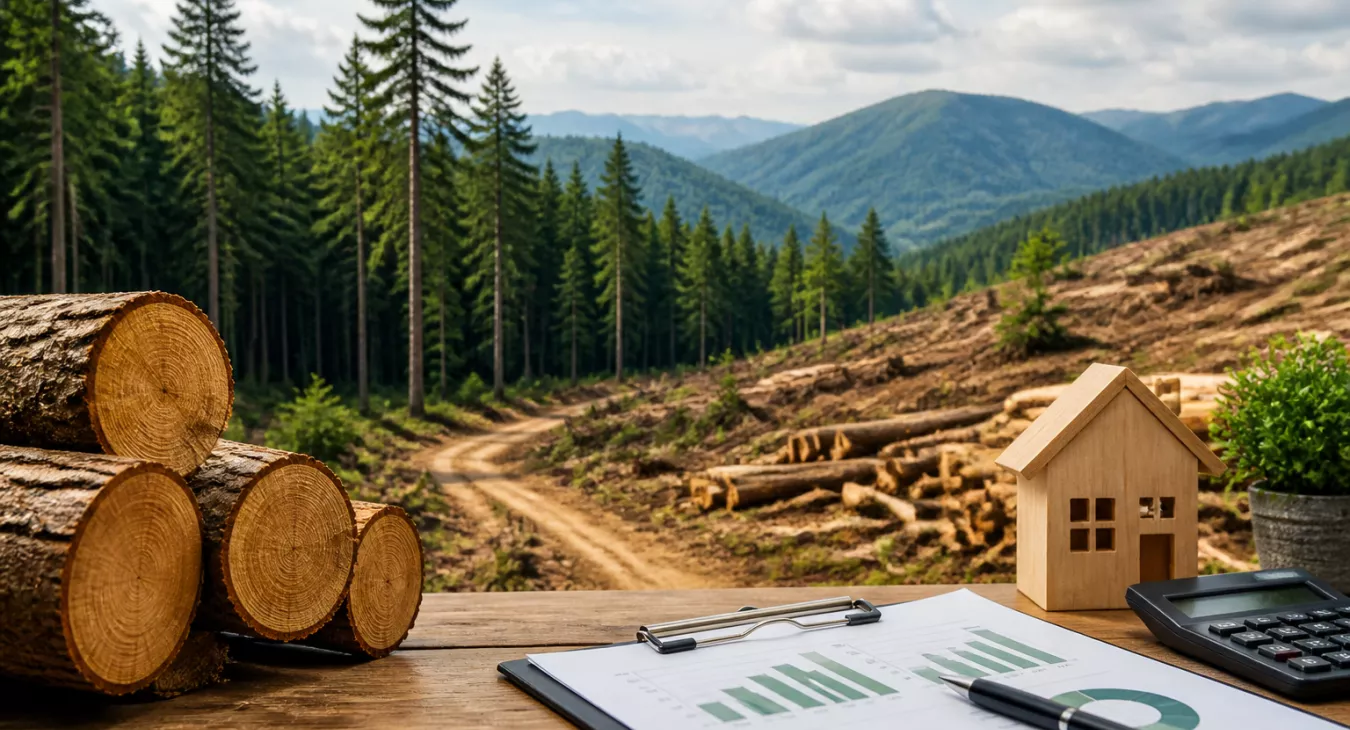
Learn how to invest in timber harvesting for 6-8% annual returns. Explore timberland investment strategies, income streams, and key considerations in this
Table of Contents
- What's Timber Harvesting Investment?
- Understanding Timberland Investment Basics
- Evaluating Your Timber Property
- Timber Measurement and Pricing
- Timber Products and Harvesting Methods
- Developing a Timber Management Plan
- Timber Sales Process and Marketing
- Payment Structures and Financing
- Tax Considerations for Timber Sales
- Regional Timber Market Overview
- Post-Harvest Management
- Emerging Revenue Streams: Beyond Timber
- Risk Management and Mitigation
- Getting Started: Action Steps for New Investors
- Conclusion
- Frequently Asked Questions
Timber harvesting is one of those asset classes most real estate investors overlook — but it shouldn't be. You get biological growth, land appreciation, and multiple income streams all baked into one tangible asset. Unlike conventional real estate, timberland actually outperforms inflation over time. The numbers back this up: timberland has averaged 6–8% annual returns over the past 30 years, according to NCREIF data. Some well-managed properties push well beyond that. And here's the thing — whether you've already got rural land sitting idle or you're hunting for new investment angles, timber can be a serious play. This guide breaks down everything you need to know to actually execute on a timber investment and lock in real returns.

What's Timber Harvesting Investment?
You buy forestland. You wait for trees to mature. Then you sell the timber and pocket the proceeds. That's timber harvesting investment at its core — acquiring and managing forestland to generate income through periodic harvests and timber sales. But here's what makes it different from a rental property: your cash flow doesn't start immediately. Trees operate on biological timelines, not market cycles. Once trees mature and get harvested, the land appreciates while you're waiting for the next crop. And that's just the beginning — modern timberland generates revenue streams most investors don't even think about: carbon credits, hunting leases, conservation easements, recreational access agreements.
Why are investors suddenly interested in timberland? It's simple. Timber is a renewable resource — properly managed forests produce multiple harvests over decades, not just one. Your portfolio needs diversification, and timberland values move independently of stock market swings, making it a legitimate hedge. Then there's Section 1231 treatment under federal tax law. What could be ordinary income gets taxed as capital gains instead. If you're already comfortable holding land long-term and thinking in 10-20 year cycles, timber investing feels like a natural next step.
Back to topUnderstanding Timberland Investment Basics

Types of Timberland Investments
You've got options here, and they're not all created equal. Direct land ownership is where most serious investors land. You get maximum control, the best tax treatment, and the highest potential returns — but you're also doing the work and writing the big checks. We're talking $1,000–$3,000 per acre depending on region and timber stocking. Then there's Timber REITs like Weyerhaeuser or PotlatchDeltic. They're liquid, easy to buy, lower barriers to entry. And you sacrifice the tax advantages and direct control in exchange. Timber Investment Management Organizations (TIMOs) cater to institutions and high-net-worth players, pooling capital to manage large timber tracts professionally. For most real estate investors building wealth through land, direct ownership is the move. It fits with land stewardship strategies you already understand.
Investment Timeline Expectations
Patience isn't optional here. Softwood species like loblolly pine in the South hit harvestable size in 25–35 years. Hardwoods? Oak or walnut can take 60–80 years for premium sawtimber quality. But here's the good news: thinning operations and pulpwood harvests can generate cash as early as years 10–15. That smooths out your cash flow over the rotation cycle. Buy already-stocked land with mature or near-mature timber, and you compress the timeline dramatically. Three to seven years to realize returns. That changes the math completely.
Risk and Reward Analysis
Timber's got lower volatility than equities. Trees keep growing whether the market's up or down. That's the real edge here. But don't sleep on the risks. Commodity price swings can hurt. Natural disasters — fire, wind, ice — happen. Pest and disease outbreaks. Regulatory changes. They all affect your bottom line. The solution? Diversify across multiple tracts, species, and age classes. You reduce exposure to any single risk factor substantially when you spread your capital this way.
Back to topEvaluating Your Timber Property

Timber Basis and Property Inventory
You need a clear picture of what's actually standing on the land before you write a check. A timber cruise — basically a statistical sampling of your standing timber volume — tells you what you've got: species, sizes, quality, and estimated volumes. That's your baseline. And here's the critical part: this data drives your timber basis calculation, which matters hugely for tax planning. Your timber basis is the allocated cost of just the timber component of your land purchase price, and it's what reduces your taxable gain when you eventually harvest and sell.
Site Productivity and Location Factors
Not every acre performs the same. Foresters measure something called site index — the height a dominant tree species reaches at age 25 or 50 — to predict how productive a site really is. Higher site indexes mean faster growth and bigger timber values. But timber quality alone won't make you money. Accessibility changes everything. Properties with existing roads, proximity to active mills, and solid drainage for logging equipment? They command real premiums and deliver substantially more efficient harvests. Take two identical timber stands. Put one 20 miles from the nearest mill on a barely-maintained road, and the other sits adjacent to active mill infrastructure. The second one will net you significantly more per acre.
Back to topTimber Measurement and Pricing
How Timber Is Measured
You'll run into several different measurement units when you're pricing timber, depending on what product you're selling. Board feet (MBF — thousand board feet) tell you how much lumber a log will theoretically produce, and that's what sawtimber deals use. Cords are the standard for pulpwood and firewood — 128 cubic feet per cord. And then there's tons, which have become the go-to metric in the Southeast for pine pulpwood. Here's the thing: timber buyers quote in these terms, and if you don't normalize the units when comparing bids, you'll leave serious money on the table. It's a mistake new investors make constantly.
Stumpage Prices and Market Trends
Stumpage price is straightforward — it's what buyers pay for standing timber before a single tree hits the ground. Think of it as the raw value sitting in your woods right now. But here's where it gets complicated. Species, region, quality grade, and market conditions all swing the numbers dramatically. Southern yellow pine sawtimber has traded anywhere from $20–$60 per ton over the last few years. Meanwhile, premium hardwood sawtimber in the Northeast? You're looking at $200–$600 per MBF for high-grade veneer logs — completely different animal. Don't ignore seasonal patterns either. Mills pay premiums when housing demand spikes and construction is hot. When the market cools, so do their offers.
Back to topTimber Products and Harvesting Methods
| Product Type | Description | Typical Price Range | Market Demand | Processing Requirements |
|---|---|---|---|---|
| Sawtimber | Large-diameter logs for structural lumber | $150–$600/MBF | High (tied to housing starts) | Sawmill processing required |
| Pulpwood | Small-diameter wood for paper/fiber products | $8–$22/ton | Moderate (paper demand declining) | Chipping or grinding at pulp mill |
| Chip-n-Saw | Mid-size logs yielding both chips and lumber | $14–$35/ton | Moderate-High | Specialized mill equipment |
| Veneer Logs | High-grade hardwood for decorative veneers | $300–$1,200/MBF | High for premium grades | Rotary or sliced veneer mill |
| Specialty/Niche | Poles, pilings, fence posts, biomass | Varies widely | Niche but stable | Varies by product specification |
Sustainable Harvesting Practices
You've got three main harvesting methods to choose from, and each one fits a different management strategy. Clear-cutting removes all the merchantable timber in one operation—it's the most economically efficient play for even-aged species like loblolly pine. But here's the catch: you need solid regeneration planning in place before you cut. Selective cutting takes out only specific trees based on size, species, or quality. This approach works best for hardwood operations where you're also concerned about maintaining forest aesthetics. Then there's shelterwood harvesting, which phases the timber removal over time. Seed trees stay put initially, regenerating the stand naturally, and you harvest them in a final cut once the new growth is established. Want to unlock premium markets and boost your land's value? Pursue sustainable certification through SFI or FSC. It's a tangible way to differentiate your timber income stream.
Back to topDeveloping a Timber Management Plan
You need a written timber management plan. It's the foundation of any serious timberland investment. This document lays out your property's current timber inventory, what you want to achieve, when you'll harvest, how you'll replant, and what environmental regulations you need to follow. Here's the upside: most state forestry agencies will actually subsidize your plan development and reforestation costs through cost-share programs. And in some states, that enrollment can knock down your property taxes significantly under current-use taxation rules.
Working With Consulting Foresters
| Aspect | Hiring Forester | Self-Management | Hybrid Approach | Typical Cost Comparison |
|---|---|---|---|---|
| Timber Inventory | Professional cruise with error <10% | High error risk without training | Forester-led with owner participation | $5–$15/acre vs. $0 (but risk-adjusted) |
| Sale Management | Competitive bidding, legal oversight | Limited buyer network access | Forester manages sale, owner supervises | 7–15% commission vs. 0% |
| Compliance | Full regulatory knowledge | Significant compliance risk | Periodic consulting for compliance review | Included vs. potential fines |
| Market Access | Established buyer relationships | Cold-calling mills | Forester contacts + owner negotiation | Higher prices often offset fees |
| Long-Term Planning | Full multi-rotation strategy | Reactive rather than strategic | Annual check-ins with forester | $500–$2,000/year retainer |
Look for a Certified Forester (CF) with credentials from the Society of American Foresters or an SAF-accredited state license. These aren't just nice-to-haves. You're paying for the professional network, legal knowledge, and mill relationships that actually move the needle on your stumpage prices. The data's clear: professionally managed timber sales bring in 15–30% more revenue than owner-managed ones. That premium almost always eats the forester's 7–15% commission and leaves money on the table. Got more than 100 acres? Hiring a consulting forester isn't optional—it's the math.
Back to topTimber Sales Process and Marketing

Steps to Marketing Timber
You need a pre-sale inventory. Then mark your boundaries, develop a solid prospectus, and get bids from multiple buyers. After that? Evaluate, execute, and supervise the harvest. Skip any of these steps and you're leaving money on the table — usually because you didn't create enough buyer competition. Sealed-bid auctions beat informal negotiations every single time. Why? Because they force real competition for your resource, and that drives prices up.
Methods of Selling Timber
Three main routes exist: sealed competitive bids, direct negotiation, or timber brokers. Sealed bids win for transparency and top-dollar returns. Direct negotiation makes sense only for small volumes or specialty products where you're already limited on buyer options anyway. And timber brokers? They'll take a 5–10% commission, but that's money well spent if you don't already have deep industry relationships. They've got the network to move your timber faster and find buyers you'd never reach on your own.
Back to topPayment Structures and Financing
| Aspect | Lump Sum Payment | Pay-as-Cut | Timber Lease | Best For |
|---|---|---|---|---|
| Cash Flow Timing | Immediate, full payment upfront | Payments as timber is harvested | Periodic lease payments over time | Varies by liquidity need |
| Price Risk | Seller bears no market risk post-sale | Shared between buyer and seller | Seller retains most market exposure | Risk-averse sellers prefer lump sum |
| Volume Risk | Buyer assumes all volume risk | Seller bears volume risk | Buyer typically assumes volume risk | Large tracts with volume uncertainty |
| Tax Implications | Single-year income event | Income spread across multiple years | Ordinary lease income treatment | Consult tax advisor based on bracket |
| Administrative Burden | Low — one transaction | High — requires ongoing measurement | Moderate — periodic monitoring needed | New investors often prefer lump sum |
Here's the reality for most first-time timber investors: the lump sum payment structure is your cleanest exit. You know exactly what hits your account, the buyer takes on all volume and market risk, and you don't deal with ongoing measurement headaches. Want to chase bigger returns? Pay-as-cut arrangements can absolutely deliver higher total revenue if timber prices tick up during harvest. But you're trading convenience for complexity — you'll need meticulous load ticket tracking, and disputes over volumes happen more often than you'd think. And then there's timber leases. They're rare in the fee-timber world, but they dominate niche products like pine straw or Christmas trees.
Back to topTax Considerations for Timber Sales
Section 1231 Treatment and Capital Gains
Here's the reality: timber gets taxed like few other real estate assets. When you hold timber as an investment or use it in business operations, it qualifies as Section 1231 property. That means your net gains hit long-term capital gains rates (0%, 15%, or 20% based on your bracket) instead of ordinary income rates. Hold it for over a year and file the proper election under IRC Section 631(b)? You're golden.


And there's more. You can claim a timber depletion deduction — think of it as depreciation for your standing timber — that directly reduces your taxable gain when you harvest. The catch? Documentation matters. From day one of acquisition, you need clean records: purchase price, basis allocation between land and timber and improvements, and updated timber basis after each cut. Don't skip this step.
State tax treatment isn't uniform either. Southern states especially often throw in property tax relief for managed timberland that qualifies. But here's my advice: don't try to navigate IRC Sections 631 and 1231 with a generalist CPA. You need someone who lives and breathes natural resource taxation. The nuances'll cost you money if you get them wrong.
Back to topRegional Timber Market Overview
| Region | Primary Species | Average Stumpage Price | Primary Products | Key Markets |
|---|---|---|---|---|
| Southeast US | Loblolly Pine, Longleaf Pine | $18–$55/ton (pine sawtimber) | Lumber, pulpwood, pellets | Home construction, export to Europe/Asia |
| Northeast US | Northern Hardwoods, Sugar Maple | $80–$400/MBF (species dependent) | Furniture, flooring, veneer | Cabinet, furniture, specialty products |
| Pacific Northwest | Douglas Fir, Western Red Cedar | $250–$700/MBF | Structural lumber, plywood | US construction, Pacific Rim export |
| Lake States | Aspen, Jack Pine, Northern Hardwoods | $10–$35/cord | Pulpwood, OSB, pallet wood | Paper mills, engineered wood |
| Appalachian | Black Walnut, White Oak, Cherry | $150–$1,000+/MBF (veneer) | High-grade veneer, flooring | Premium furniture, export markets |
Where you invest matters. The Southeast US is your most liquid play — abundant pine plantations, a dense network of sawmills and pulp mills, and relentless domestic plus export demand make this the country's most active timber market. You'll move timber here. But the Pacific Northwest? Different animal entirely. Douglas Fir and Western Red Cedar command $250–$700/MBF, the highest per-unit values in the country. The catch: significant regulatory constraints from environmental protections on federal and state lands will limit your harvest windows and cap your upside.
And then there's Appalachia.
Black walnut veneer logs hit $1,000+/MBF. But here's the reality check: growing premium veneer-quality timber takes 70+ years of careful management. That's a multi-generational wealth play. You need patience, a long holding horizon, and deep pockets to weather market cycles. If you're looking for faster returns, this isn't your region.
Back to topPost-Harvest Management

Most timber investors miss it. The 6–18 months right after harvest—that's where your next rotation gets made or broken. You nail site prep and regeneration now, your productivity numbers climb. You don't? You're leaving money on the table for decades.
Pine plantations need the full playbook: bedding, herbicide, mechanical treatment, then certified seedlings from reputable nurseries. Hardwoods? They're cheaper if you plan ahead—but you've got to keep enough seed source trees standing during harvest to make natural regeneration actually work. Don't just assume it'll happen.
Soil Health and Future Rotation Planning
Here's what harvest does to your land: compaction. Rutted skid trails. Drainage goes sideways. And that's not just an environmental headache—most states will fine you for it under Best Management Practices guidelines. It's non-negotiable.
Fix the compaction. Install water bars on logging roads. Seed exposed soil fast. You're protecting water quality, staying legal, and something else that matters to your bottom line: establishing cost basis for tax planning. Every dollar you spend on post-harvest work becomes ammunition for your next rotation's tax strategy.
That first year after harvest? It sets your productivity for the next 25–35 years. Act like it.
Back to topEmerging Revenue Streams: Beyond Timber
Carbon credits are exploding right now. Smart timberland investors are already capturing value from sources way beyond conventional timber harvesting. Here's what's happening: landowners who commit to extended timber rotations or improved forest management under voluntary carbon market protocols can generate carbon offset credits worth $10–$50+ per ton of CO₂ sequestered. That's real money sitting on your balance sheet. Carbon credits get certified by organizations like the American Carbon Registry and the Verified Carbon Standard (Verra).
But there's more to stack on top of your timber harvest. Hunting and recreational leases pull in $3–$15 per acre annually across most regions. Conservation easements work differently—you get upfront payments or tax deductions in exchange for development restrictions. And if you own longleaf or loblolly in the Southeast? Pine straw harvesting can be a serious annual income stream on well-stocked properties.
These alternatives won't replace your timber income, but they meaningfully improve cash flow during those long growth periods between harvests. You're essentially monetizing idle capital. Want to dig deeper into rural land opportunities across different asset types? KDS Development's rural land investment resources can point you in the right direction.
Back to topRisk Management and Mitigation
Timberland isn't passive. You're exposed to biological risk, market swings, and regulatory headwinds all at once. Timber insurance covers fire, wind, and ice storm losses — and it's worth every penny if you've got more than $100,000 in timber value on a single tract. The math is simple: premiums run $0.10–$0.30 per dollar of insured value annually. That's cheap insurance against losing everything to one bad fire season.
Then there's the pest problem. Southern Pine Beetle in the Southeast. Emerald Ash Borer in hardwood country. These aren't minor annoyances — they'll crater your timber values fast. Your defense? Monitor actively, harvest infected or at-risk timber before it spreads, and keep your stands properly spaced and healthy.
But regulatory risk has become the real wild card over the past few decades. Water quality standards. Wetlands protection. Endangered species rules. They keep getting tighter. Stay on top of your state's BMP requirements and actually talk to your state forestry agency. This approach cuts compliance risk significantly — and often opens doors to cost-share funding for management work you'd be doing anyway.
Back to topGetting Started: Action Steps for New Investors
| Phase | Timeline | Key Activities | Estimated Investment | Expected Outcomes |
|---|---|---|---|---|
| Acquisition & Assessment | Months 1–6 | Property search, timber cruise, due diligence, purchase | $1,000–$3,000/acre + closing costs | Clear picture of timber stocking and land value |
| Planning & Team Building | Months 6–12 | Hire consulting forester, develop management plan, establish timber basis | $2,000–$8,000 for plan development | Written management plan, tax basis established |
| Early Management | Years 1–5 | Thinning, prescribed burning, road maintenance, monitoring | $30–$80/acre for treatments | Improved stand health, growth rates accelerate |
| First Commercial Harvest | Years 5–15 (existing timber) | Timber sale planning, competitive bidding, harvest supervision | Forester commission 7–15% of sale | First significant timber revenue event |
| Post-Harvest & Regeneration | Year 1 post-harvest | Site prep, planting, road reclamation, carbon program enrollment | $100–$250/acre for pine replanting | Next rotation established, basis updated |
| Long-Term Optimization | Ongoing | Annual monitoring, mid-rotation thinning, revenue diversification | $500–$2,000/year management oversight | Maximized rotation value, multiple income streams |
Your first-year playbook comes down to three non-negotiables. Establish your timber basis accurately—and I mean right now. You can't reconstruct this retroactively without losing precision and money on the back end. Hire a consulting forester before you touch a single tree. Not after. And enroll in your state's current-use property tax program if it's available. Want to know why these three moves matter? They protect your capital, optimize your tax position, and set you up with pro-grade management from day one instead of scrambling to fix it later.
But here's where most investors slip up: they treat timber like it's a passive asset. It isn't. You've got to track this stuff. Annual growth measurements, market price monitoring, periodic updated appraisals—these aren't busy work. They're the data points that keep you from guessing.
Back to topConclusion
Timber harvesting isn't for impatient money. You need patience, professional management, and a real strategy to win in this space. What makes it work? Genuine diversification away from stock market swings, biologically compounding growth that actually compounds, federal tax advantages that matter, and multiple revenue streams — carbon credits, recreational leases, and more — stacked on top of your timber income.
The downsides exist. Commodity price volatility, natural disasters, pest pressure, regulatory headaches. But here's the thing: they're manageable. Insurance, diversification, and solid professional guidance handle most of it.
Starting your first timber tract or already managing forest acreage? The framework in this guide applies either way. It works because it treats timberland as both a financial asset and a managed natural resource. And that's the real insight — the forest's health and your investment returns are locked together. Neglect one, and you'll damage the other.
Back to topFrequently Asked Questions
How much money do I need to start investing in timberland?
You're looking at $50,000–$150,000 minimum for direct ownership of a meaningful tract (50–100 acres) in most US regions. But location and timber stocking matter hugely—some rural markets let you grab smaller parcels cheaper. Want to enter with less capital? Timber REITs only need a few hundred dollars. The trade-off stings though: you lose the tax advantages and hands-on control that make direct ownership actually worth it. And here's the good news if you don't have that full down payment ready—Farm Credit institutions and specialized agricultural lenders will do timber land loans with 20–25% down, making leveraged acquisition doable for qualified investors.
How does Section 1231 treatment benefit timber investors?
Standing timber held for investment or business use for over one year gets taxed as Section 1231 gains under IRC Section 631(b). That means long-term capital gains rates, not ordinary income rates. The math is powerful: if you're in the 32–37% bracket, you're saving 12–17 percentage points in federal taxes on those timber sale proceeds. And that's just the beginning. Combine that with the timber depletion deduction—which slices your taxable gain by the cost basis of harvested timber—and your effective tax rate drops far below what you'd pay on almost any other income source.
What's a consulting forester and do I really need one?
A consulting forester is a licensed forestry professional. They give independent advice on timber management, harvest planning, and sales—unlike a company forester who works for a mill and answers to their employer's interests, not yours. Any timber sale over $20,000? Hire one. Research is clear: professionally marketed timber sales pull 15–30% higher stumpage prices than owner-negotiated deals, and that premium almost always crushes the forester's 7–15% commission. Look for the Certified Forester (CF) designation from the Society of American Foresters. That's your quality credential.
How do carbon credits work for timberland investors?
Extended rotations, improved forest management, or avoided conversion—these generate carbon credits you can actually sell. Verra and the American Carbon Registry certify them. Corporations buy credits to offset emissions, and voluntary market prices typically land between $10 to $50+ per ton of CO₂, sometimes higher in premium markets. The catch? Third-party verification, project registration, long-term commitments (usually 40–100 years). But the upside is real. A 500-acre pine plantation might generate $15,000–$50,000+ annually in carbon revenue. Just make sure those harvesting restrictions don't choke out your timber income potential.
What are the biggest mistakes new timber investors make?
Five mistakes will wreck your returns if you let them. First: failing to establish proper timber basis at acquisition—that locks in a permanently higher taxable gain at harvest. Second: selling timber to the first buyer who knocks instead of running a competitive bid process. Third: skipping reforestation or waiting too long after harvest, blowing the planting window. Fourth: buying timberland without a pre-purchase timber cruise, which leads to overpayment and blown return expectations. And fifth—this one's insidious—managing without a written plan. You'll lose productivity, disqualify yourself from cost-share programs, and kiss those current-use tax assessments goodbye. That's money you actually need.
Back to top