

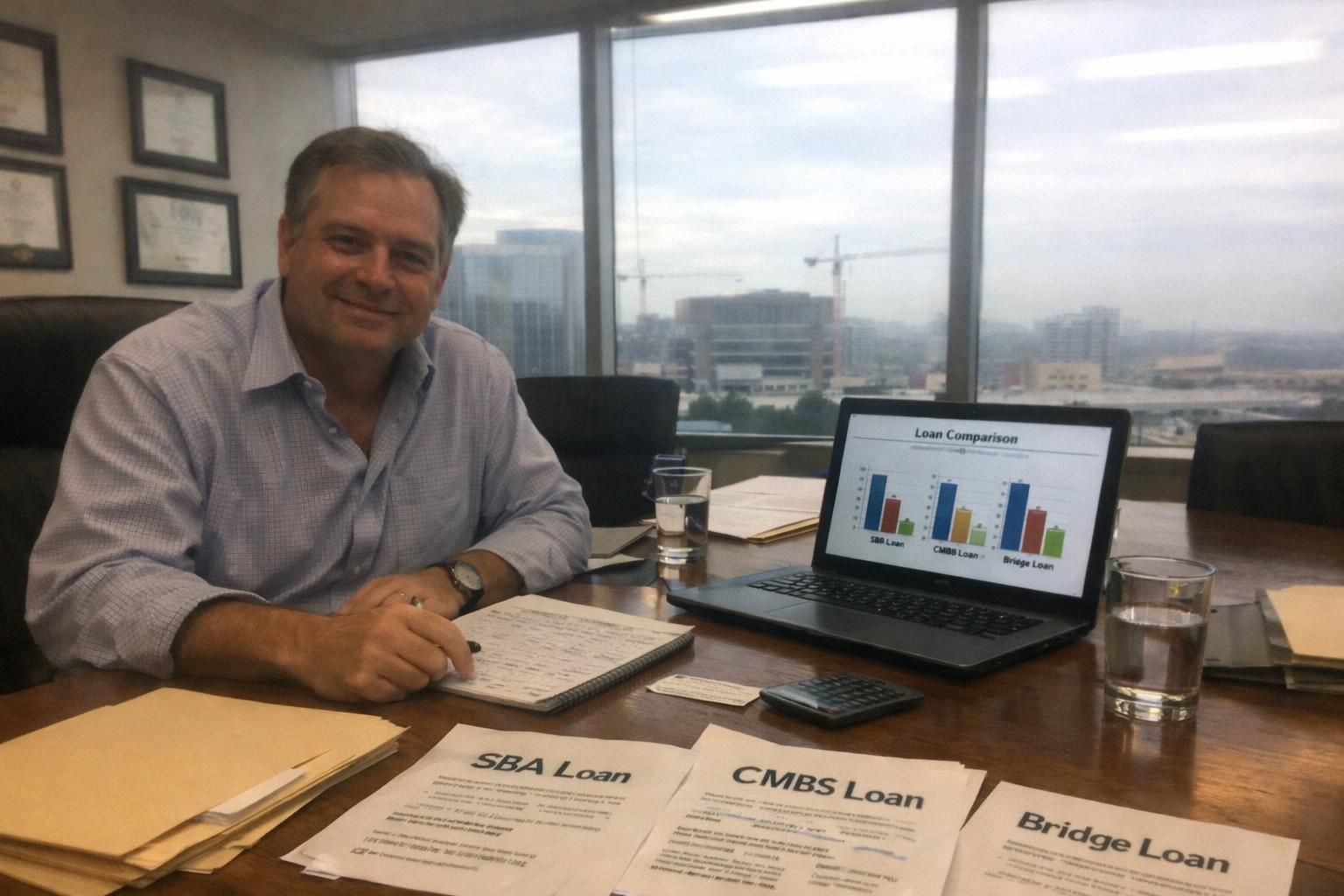
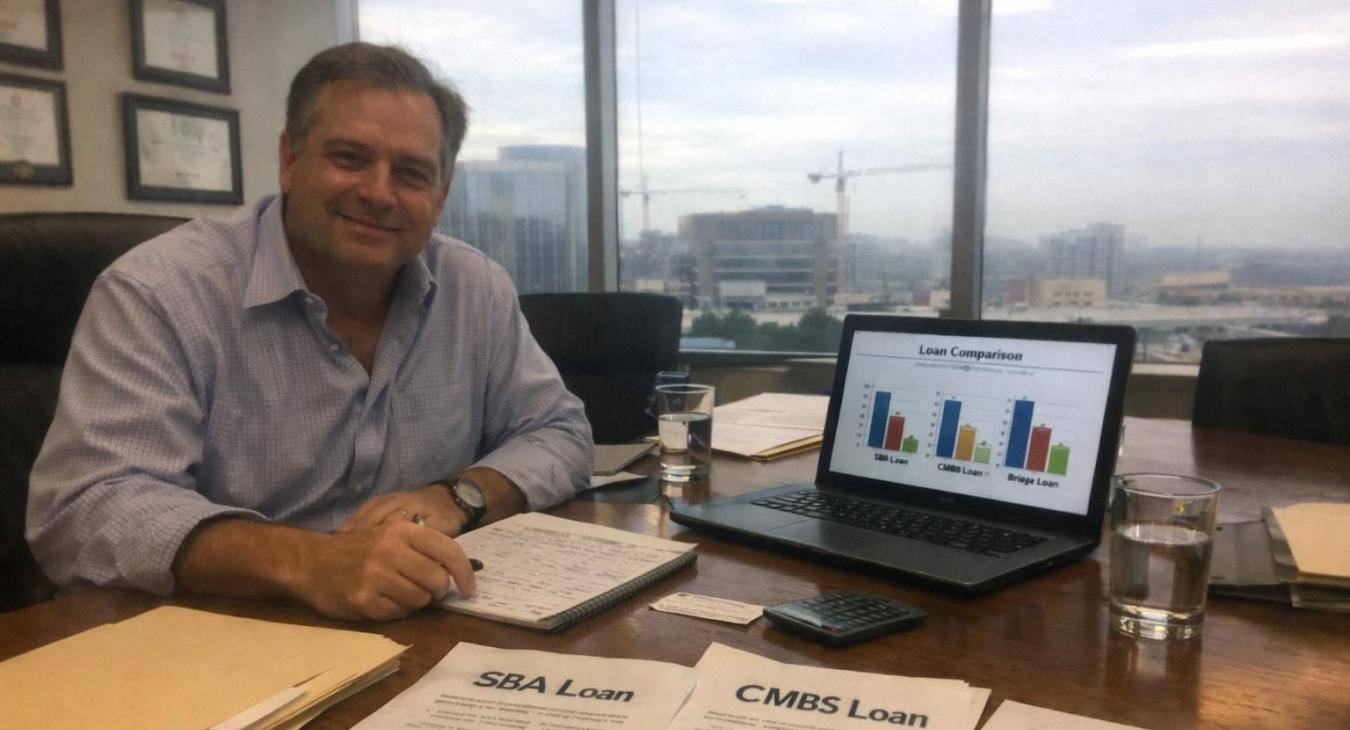
Explore the world of commercial real estate financing, including SBA loans, CMBS options, and bridge loans to find the right fit for your investment needs.
Commercial Real Estate Financing: SBA, CMBS, and Bridge Loans
Many real estate professionals face confusion when selecting the right commercial real estate financing for new projects or property acquisitions. You often see terms like SBA loans, CMBS loans, and bridge loans used interchangeably, yet each option serves a specific purpose. 1 For example, SBA loans are backed by the U.S. Small Business Administration but do not allow you to purchase multifamily properties. Knowing which loan fits your business goals can help you avoid costly mistakes.
With years of hands-on experience in business banking and property financing, I have helped countless investors choose the best commercial real estate loan for their needs. My knowledge covers term loans, construction loans, owner-occupied commercial loans from lenders such as JPMorgan Chase and U.S. Bank National Association.
In this blog post about commercial real estate financing options—SBA loans (7(a) and 504), CMBS financing structures, and bridge lending—you will gain practical insights on how to secure funding that matches your investment plan. 3 Find out what works best for your next deal.
Key Takeaways
- SBA loans, like the 7(a) and 504 programs, are backed by the U.S. Small Business Administration. They help you finance or refinance owner-occupied properties but do not cover multifamily investments. You can get up to 25-year terms and loan-to-value (LTV) ratios as high as 80%. At least 51% of the property must be used for your business.
- CMBS loans use property income—not your credit score—as their main qualifier. Lenders bundle these mortgages into securities sold on Wall Street to investors, lowering risk for lenders while providing larger loan sizes—often starting at $1 million—with fixed rates over five to ten years. These have non-recourse structures but include large prepayment penalties.
- Bridge loans provide quick, short-term financing—usually one year or less—for urgent needs like purchasing undervalued buildings or handling major renovations before securing long-term funding such as SBA or CMBS loans. Downside: higher interest rates and stricter repayment timelines.
- For all commercial real estate loans, banks require strong financial statements, detailed business plans with executive summaries capped at two pages, and proof of a minimum debt service coverage ratio (DSCR) of 1.25x.
- Each financing option fits different needs: use SBA for owner-users seeking low down payments; choose CMBS for big projects in strong markets; select bridge loans when speed is vital and you have a clear exit strategy through future refinancing.
Overview of Commercial Real Estate Financing Options
You can access a variety of commercial real estate loans to meet your investment needs, including long-term and short-term solutions from institutions such as JPMorgan Chase and First Citizens Bank.
Understanding which property financing method fits your project can position you for better terms, lower construction costs, and stronger cash management.
SBA Loans (7(a) and 504)
SBA loans, including 7(a) and 504 options, offer powerful tools for commercial real estate financing. These small business loans are backed by the U.S. Small Business Administration and typically feature adjustable interest rates tied to the WSJ Prime Rate.
You may access repayment terms up to 25 years with loan-to-value ratios from 65% to 80%. SBA products allow you to acquire or refinance owner-occupied properties like office buildings, warehouses, and retail property but exclude multifamily rental units.
For the SBA 504 program, at least 51% of the building must be used for your own operations; this structure splits funding between a private lender (50%), a Certified Development Company (40%), and your down payment as low as ten percent.
A detailed business plan is essential for approval in practice financing or other agency-backed deals with First Citizens Bank or JPMorganChase. Lenders require an executive summary capped at two pages, thorough market analysis data such as construction costs or community demographic trends, legal documents highlighting ownership structure, resumes of key team members like Michelle Herrick or John Hofmann if applicable, financial projections with DSCR minimums of 1.25x, and a clear request outlining your required loan amount.
SBA financing does not support multifamily properties but supports most other owner-occupied spaces regardless of trade policy shifts or changing tariffs impacting capital markets.
Prepare accurate statements on cash flow and net income before seeking these competitive interest rates through approved institutions engaged in commercial property lending programs overseen by experts such as Ed Ely or Karen Purcell.
CMBS Loans
CMBS loans let you secure funding for commercial investment property using the property’s cash flow as the main qualifier. Lenders pool these mortgages and sell them to CMBS investors as securities, reducing their risk exposure while expanding access to capital for property financing.
You will find fixed interest rates, often between 5 and 10 years in term length, with up to 30-year amortization schedules. CMBS loans are common for office buildings, apartment buildings, industrial properties, and hospitality properties in major metropolitan markets.
Small business owners may face challenges finding these loans in smaller cities or with non-traditional asset types.
You can benefit from a non-recourse structure; only the asset itself acts as collateral against default rather than your personal assets. Prepayment of CMBS loans typically triggers significant penalties due to securitization terms set at closing.
Credit score takes a back seat since underwriters focus on building income performance and maintaining a debt service coverage ratio (DSCR) above 1.25x for approval. This financing model suits commercial real estate investors seeking larger loan amounts or refinancing options without intensive scrutiny of personal credit backgrounds or business line of credit history.
Industry experts such as Kurt Stuart highlight that competitive DSCR levels help maintain investor confidence within agency & institutional capital markets tied to this product class.
Bridge Loans
Bridge loans offer a fast, short-term solution for urgent commercial real estate needs. You use them to secure properties quickly or fund major renovations before moving to agency financing or permanent options.
Most bridge loans last one year or less and come with higher interest rates than traditional commercial property loans. Lenders often approve these based on total project costs including purchase price, construction expenses, tenant improvements, and even an interest reserve if your asset doesn't yet generate enough cash flow.
This type of commercial real estate loan lets you unlock equity in your investment property while waiting for stabilization or long-term refinancing options. Bridge financing works well for time-sensitive projects like acquiring undervalued buildings, handling balloon payments on maturing mortgages, or repositioning multi-family rental units and industrial property assets.
If you expect to refinance after stabilizing the asset without penalty, bridge term lending allows a smooth transition into standard mortgage products such as SBA Loans (7(a) or 504).
Non-recourse bridge loans are available but tend to cost more than recourse versions; consider this as you evaluate business lending risk and return. As Burke Davis from Real Estate Banking says: “Speed is key in competitive markets where small businesses seek quick access to capital.”.
Back to topUnderstanding Commercial Real Estate Investing
Commercial real estate investing centers on properties that generate income, such as office buildings, apartment complexes with five or more units, and retail centers. You seek property financing to acquire or develop new spaces for business operations, facility expansion, or rental income streams.
Commercial real estate loans differ from consumer mortgages in several ways. 1 Lenders expect stricter credit standards and detailed business financials during your application process.
Approval periods are longer than residential lending. Most commercial investment property deals also involve lower loan-to-value (LTV) ratios—often at 75% to 80% of the purchase price—compared to up to 100% for owner-occupied home loans.
Your lender closely examines the projected cash flow of your target building using the debt service coverage ratio (DSCR). This metric helps ensure you can make regular mortgage payments from operating profits.
Loan terms generally range from five to twenty years; many agreements end with a balloon payment requirement instead of full amortization like a traditional mortgage loan. As an investor or agent, you should prepare complete financial statements and robust business plans before seeking acquisition loans or term loans for commercial properties.
"You must present credible data on future rental income," advises Jen D'Ambrosie, a senior advisor in treasury management services; this strengthens your case when negotiating small business loans through programs like SBA 504 or CMBS structures backed by asset-based lending strategies.
To maximize long-term yields while minimizing risk exposure in volatile sectors such as office-to-residential conversions under cybersecurity threats and shifting tenant demand patterns, maintain strong compliance with all underwriting criteria set by institutional lenders in community development banking initiatives.
Back to topWhen to Use Specific Financing Options
Selecting among SBA loans, CMBS financing, or bridge funding can help you match your property needs with the right terms and maximize tax advantages—explore which option aligns with your investment strategy.
Scenarios for SBA Loans
SBA 504 loans suit owner-occupied real estate projects where your business will use at least 51% of the space. You can secure financing for commercial investment property such as office buildings, medical clinics, or warehouses under this program.
The typical loan structure splits funding between a private lender at 50%, a Certified Development Company (CDC) at 40%, and requires only a 10% down payment from you. SBA 504 loans target fixed assets like land, existing structures, or construction.
You might use an SBA 7(a) loan if your small company needs to purchase or refinance real estate while also covering equipment financing or working capital. Qualifying involves presenting strong financial statements, tax returns, and a comprehensive business plan that proves management experience.
These programs do not support multifamily properties but excel in supporting owner-occupied locations with long-term growth potential for businesses looking to expand their presence using government-backed commercial real estate loans.
Grounded preparation increases approval rates; thorough documentation remains crucial throughout the process for securing these types of term loans through the Small Business Administration’s diverse lending initiatives.
Situations for CMBS Loans
CMBS loans suit large commercial real estate assets with strong property-level incomes and loan amounts starting at $1 million. 3 Investors often select CMBS financing for stabilized retail centers, multi-family complexes, or office buildings in primary or secondary markets.
Your credit score takes a back seat to the asset's financial strength. Structures like non-recourse protections and fixed interest rates appeal to those seeking lower risk exposure. 2
You will benefit from long amortization periods up to 30 years and terms between five and ten years. Property owners pursuing refinancing options or acquisition of investment property may favor these business term loans due to their transferable nature on secondary markets.
"Prepayment penalties are part of the structure," notes JLL Managing Director Tom Fish. You should review balloon payment schedules carefully; they commonly appear in this type of commercial real estate loan package.
Ideal Use Cases for Bridge Loans
Investors often use bridge loans for time-sensitive property financing. You can secure a bridge loan if your funds remain tied up in another commercial investment property or alternative assets. 4 Many real estate professionals find these loans critical when traditional term loans, such as SBA 7(a) and 504 programs, have strict requirements you cannot meet quickly enough.
Experienced investors rely on bridge loans to buy undervalued properties fast or to begin urgent rehabilitation projects before securing long-term refinancing options.
You may also use a bridge loan for multifamily lease-up, office asset improvements, or capital expenditures where cash flow covers neither the interest nor the carrying costs during stabilization.
Built-in interest reserves allow repayment flexibility until rental income increases. Bridge lenders sometimes permit you to pay off early without penalty after value-add improvements or upon asset sale or refinancing with a standard commercial real estate loan product like CMBS securities.
Always ensure your exit strategy is clear and achievable before taking this short-term debt solution; avoid using it for high-risk investments that lack defined repayment plans.
Back to topImplementation Steps for Securing Financing
Prepare accurate financial documents and a thorough business plan to support your property financing application. Meet standard benchmarks for loan-to-value ratios or debt service coverage to qualify for diverse commercial real estate loans like SBA, CMBS, or bridge funding.
Preparing Financial Statements and Business Plans
Clear financial statements and a detailed business plan are vital for your commercial real estate loan application. 5 Lenders rely on these documents to evaluate your creditworthiness and the viability of your property financing project.
- Create income statements that reflect both current and projected revenues and expenses for the investment property loans you seek.
- Generate cash flow statements, which show liquidity trends and assure lenders of the property's capacity to meet regular commercial real estate payments.
- Include a break-even analysis in your projections to demonstrate precisely when your commercial investment property will start generating profit.
- Craft an executive summary not exceeding two pages, highlighting key points of the proposed commercial real estate financing, overall strategy, and market outlook.
- Conduct thorough market analysis using recent data on rental rates or comparable sales; this supports realistic forecasting for property financing success.
- Build realistic financial projections aligned with lender expectations; SBA 7(a) and 504 programs, for example, require substantiated numbers matched with local economic conditions.
- Attach supporting documents such as legal agreements, key team member resumes, detailed market research findings, and ownership structures in your appendix.
- Tailor your business plan to each specific loan program's requirements; an SBA small business loan application might need more detail than an application for term loans or CMBS financing.
- Ensure documentation meets standards set by banks issuing revolving credit or treasury solutions; incomplete submissions can slow approval of construction loans or refinancing options.
- Use templates available from lenders or industry groups like the business diversity lending program to streamline preparation without sacrificing quality.
- Demonstrate both personal and business credit strength; high scores increase approval odds for adjustable-rate loans and lower rates on ink® business credit cards such as ink business preferred® or ink business unlimited®.
- Highlight diverse revenue streams including any linked to a separate business money market account, showing risk reduction strategies that support long-term debt service coverage ratio (DSCR) compliance in commercial term lending decisions.
A well-organized financial package helps you secure competitive loan amounts while reducing delays in processing your commercial real estate loan application.
Meeting Loan-to-Value (LTV) and Debt Service Coverage Ratio (DSCR) Requirements
Lenders require you to meet strict loan-to-value (LTV) and debt service coverage ratio (DSCR) thresholds for commercial real estate loans. The LTV is calculated by dividing your loan amount by the appraised property value, often capped at 65% to 80%.
For example, if you apply for a $1 million loan on an asset valued at $1.4 million, the maximum eligible financing with a typical 70% LTV is $980,000. Some structures such as mezzanine or preferred equity can raise this ceiling up to 85%.
DSCR measures how well cash flow covers your debt payments; most lenders demand a minimum DSCR of 1.25x for favorable terms in commercial property financing. Calculate this ratio by dividing net operating income (NOI) by annual loan obligations.
A higher DSCR signals less risk and can lead to larger loan amounts or improved rates. In construction deals involving term loans or bridge loans, consider the loan-to-cost metric instead of just LTV since it examines total project expenses against financing requested.
Meeting these standards strengthens your application before refinancing options or seeking new small business loans through programs like SBA 504 and CMBS platforms such as Ink Business Cash®.
Back to topConclusion
Choosing the right commercial real estate financing option shapes your investment success. You can use SBA loans to secure long-term, stable capital for owner-occupied spaces if you meet strict requirements.
CMBS loans back larger deals and focus on the property’s income rather than your credit alone, making them perfect for big investment properties. Bridge loans allow you to act fast, upgrade assets, or refinance with fewer penalties after improving a building's value or stability.
Evaluate each term loan based on project needs and risk profile; strong preparation of statements and business plans puts you ahead in securing funds quickly and competitively.
Back to topFAQs
1. What are the main types of commercial real estate financing?
Commercial real estate financing includes small business loans, property financing, and commercial real estate loans. These options serve different needs such as construction loans, refinancing options, or term loans.
2. How do SBA loans differ from CMBS and bridge loans in property financing?
SBA loans often have lower interest rates and longer terms for small business owners seeking property financing. CMBS offers large loan amounts by pooling many mortgages into securities sold to investors; these usually come with a balloon payment at the end of the term. Bridge loans provide short-term funding during transitions like refinancing or new construction.
3. What should borrowers consider when choosing between term loans and construction loans for commercial properties?
Borrowers should assess their project scope and timeline before selecting a loan type. Term loans offer fixed payments over several years which suit stabilized properties needing predictable costs. Construction loans support building projects but require detailed plans since funds release as work progresses.
4. How can refinancing options benefit holders of existing commercial real estate debt?
Refinancing allows property owners to replace current obligations with better terms such as lower interest rates or extended repayment periods on their commercial real estate loan or small business loan; this may free up cash flow or fund improvements without facing an immediate balloon payment at maturity.
References
- ^ https://tafpc.com/types-of-commercial-real-estate-loans-understanding-your-financing-options/
- ^ https://www.hklaw.com/files/Uploads/Documents/Articles/Booth_CMBSLoans.pdf
- ^ https://www.jpmorgan.com/insights/real-estate/commercial-real-estate/commercial-mortgage-backed-securities-cmbs-loans
- ^ https://rcncapital.com/blog/ideal-use-cases-for-a-bridge-loan-and-when-not-to-use-one (2022-02-21)
- ^ https://firstbusiness.bank/resource-center/how-to-make-business-plan-for-sba-loans/