


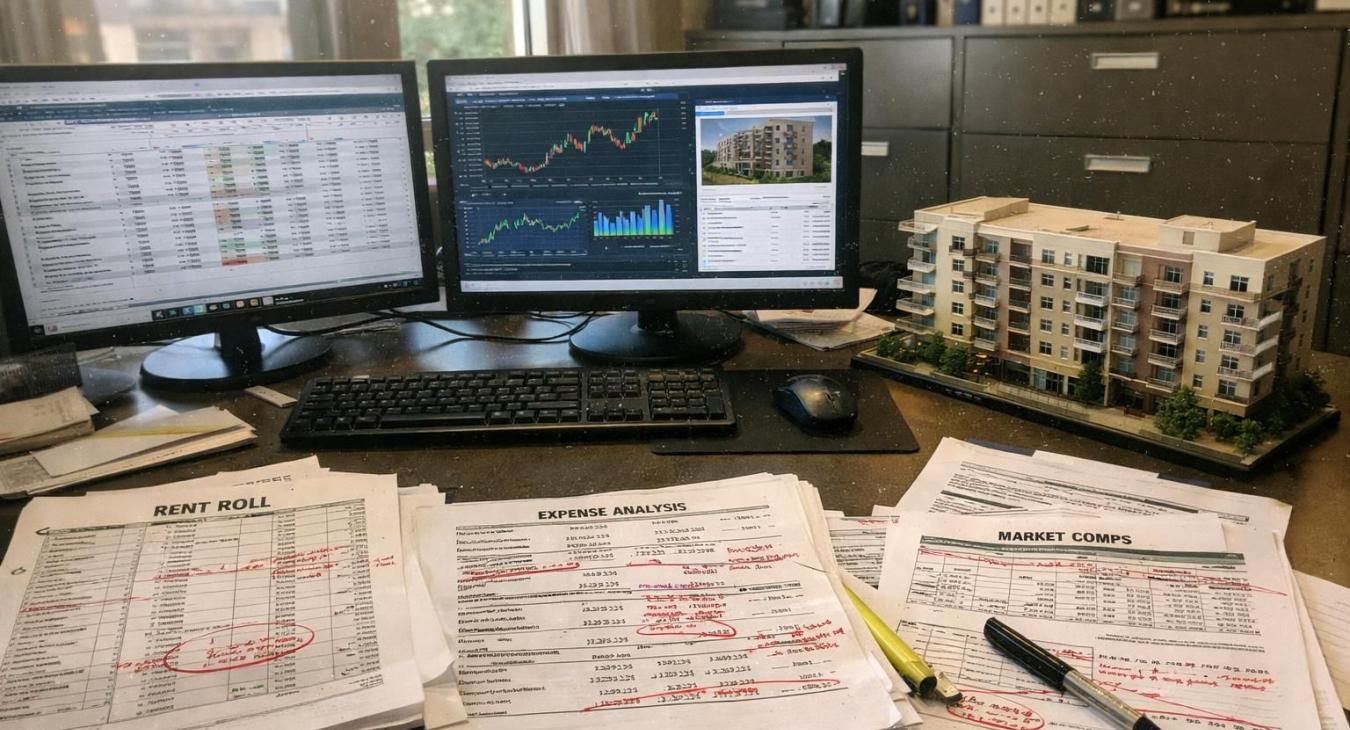
Learn how to underwrite multifamily deals effectively with step-by-step guidance, ensuring accurate valuations and maximizing your investment potential.
Table of Contents
How to Underwrite a Multifamily Deal: Step-by-Step
Uncovering the real value behind a multifamily property is often more complex than it looks—misjudging operating expenses or overlooking market comps can turn a promising investment into an expensive lesson. 1 Every investor faces the challenge of ensuring their numbers are right, and even seasoned professionals sometimes underestimate factors like net operating income or forget to stress-test their pro forma models for vacancy loss. This article breaks down how to underwrite multifamily deals in clear steps, using concepts such as expense ratios, loan-to-value calculations, rent roll analysis, and submarket research—all essential tools for anyone seeking risk-adjusted returns in today's competitive real estate landscape. 2
Having worked on detailed acquisitions like Neighborhood Ventures' purchase of Venture on 16th—an 86-unit community bought through direct negotiation and strategic underwriting—I know what separates successful deals from costly mistakes. You will find here practical guidance that helps you avoid common pitfalls while protecting your capital and maximizing cash flow potential. Master the fundamentals of underwriting a multifamily deal with every step ahead. 3
Key Takeaways
- Always collect and verify documents like the T-12 income statement, rent roll, leases, utility bills, and expense records before underwriting. Cross-check numbers with property management reports or software like Zillow Rental Manager to avoid costly mistakes.
- Use key metrics such as Net Operating Income (NOI), Debt Service Coverage Ratio (DSCR), and Loan-to-Value (LTV) ratios when modeling deals. For example, lenders often require DSCR above 1.25x and LTV below 75% for multifamily loans in 2024.
- Study local market comps within a one-mile radius for current rent rates, occupancy trends, job growth data from sources like CoStar or Yardi Matrix, and population changes. Match your assumptions to real submarket analysis instead of relying on citywide averages to spot risks.
- Run stress tests using Excel or software tools on pro formas for changes in vacancy loss (+3%), rent drops (-5%), or rising expenses such as insurance costs after recent storms. This helps protect projected cash flow and keeps risk-adjusted returns realistic.
- Update all financial models quarterly to reflect current interest rates, new cap rates, shifts from economic events since January 2024 (like tighter lending rules), maintenance needs found during inspection checks, and changing property taxes—this prevents overpaying based on outdated info.
Brief overview of underwriting in multifamily real estate
Underwriting in multifamily real estate requires you to analyze property financials and compare them with your investment criteria. 1 You must review documents such as the trailing 12-month income statement, rent roll, seller's pro forma, and a detailed list of operating expenses.
Key metrics like Net Operating Income (NOI), Debt Service Coverage Ratio (DSCR), and cash-on-cash return help you measure performance.
You calculate vacancy loss, credit loss, property taxes, insurance costs, and maintenance costs to determine actual cash flow. Stress testing using sensitivity analysis prepares you for shifts in market trends or expense ratios.
Using tools like MRI Software or Rod's Free Multifamily Deal Analyzer brings precision to projections. Solid underwriting protects your capital by helping you avoid reliance on a seller's estimates or underestimating expenses.
Conducting thorough due diligence ensures that risk-adjusted returns align with your multifamily investing goals.
Why solid underwriting is crucial for investors
Solid multifamily underwriting protects your capital by grounding each decision in data. 2 You analyze net operating income (NOI), market comps, property taxes, and insurance costs to assess the true value of apartment buildings.
This process uses historical financials like trailing 12-month income statements and rent rolls for precise projections. Rigorous analysis helps you avoid overpaying while revealing hidden risks such as vacancy loss or underreported maintenance costs.
You rely on thorough submarket analysis to understand job growth, rent trends, and local occupancy rates that impact rental properties. Stress tests using sensitivity analysis forecast how shifts in rent growth or expense ratios affect cash flow and internal rate of return (IRR).
Adopting best practices from experts such as Rod Khleif or firms like Dominion Financial ensures your real estate underwriting supports risk-adjusted returns instead of speculative estimates.
Always build assumptions with transparency; use tools like property management software for sharper expense tracking, making your investment resilient against future market changes.
Back to topStep 1: Gather and Verify Property Information
First, collect recent financial records and audit the rent roll using tools like Zillow Rental Manager or Rod’s Free Multifamily Deal Analyzer to confirm rental income and spot errors before you model returns; this step protects your future cash flow projections—review the next section for vital market analysis techniques.
Collecting financial statements, rent rolls, leases, and maintenance records
Gather the trailing 12-month (T-12) income statement, rent roll, and detailed records of operating expenses to start your multifamily underwriting process. Review utility bills and property management reports to verify cash flow, gross potential rent (GPR), effective gross income (EGI), and expense ratios.
Examine current leases for rental income terms, expiration dates, loss to lease amounts, vacancy rates, and market rental rate alignment. Compare these figures with market comps using platforms such as Zillow Rental Manager or a proprietary tool like Rod’s Free Multifamily Deal Analyzer.
Inspect maintenance logs for patterns in repair costs or frequent issues that may impact future capital expenditures (CapEx). Use information from offering memorandums and seller’s pro forma statements alongside material data provided by owners or agents.
This approach uncovers hidden risks tied to occupancy rate history or maintenance costs while providing real evidence of net operating income (NOI) performance. Always collect complete documentation before advancing to deeper financial modeling or submarket analysis; this step keeps your numbers reliable for value-add strategies and prepares you for lender due diligence on loan-to-value (LTV) and debt service coverage ratio (DSCR) requirements.
Assessing property condition and unit mix
Assess the property's condition first by reviewing maintenance records, inspection reports, and recent capital expenditures (CapEx). 2 For a multifamily asset like Venture on 16th in Phoenix, focus on structural integrity and amenity quality.
Inspect common spaces such as landscaped courtyards or resort-style pools with glass fencing. Calculate CapEx needs at $200 to $500 per unit per year based on observed wear or deferred repairs.
Accurate evaluation of these factors affects your operating expenses and long-term net operating income (NOI).
Study the unit mix next for its impact on rental income and occupancy rates. Properties featuring two-, three-, and four-bedroom units attract larger households but remain rare in urban markets like Phoenix.
Review rent rolls to confirm the distribution aligns with local demand trends identified during submarket analysis. Check for features such as private patios or dual access points that may justify higher market rents or support value-add strategies.
This information helps you predict gross potential rent (GPR) more reliably while guiding decisions about repositioning the property to match tenant preferences.
Verifying data accuracy
Scrutinize the T-12 and rent roll line by line. 3 Cross-check lease expiration dates, gross potential rent (GPR), and occupancy rates against source documents, including signed leases or property management software exports.
Inaccurate expense ratios can distort your net operating income (NOI) projections and mislead multifamily underwriting decisions. For example, an error of just 5% in reported insurance costs or maintenance expenses may result in thousands lost annually.
Normalize all expenses using market comps to identify discrepancies in repair and renovation outlays compared to similar multifamily properties. Speak directly with property managers or review bank statements for evidence of real cash flow.
Drew Breneman highlights that underestimating utility costs on C- and D-class assets often leads investors to overvalue a deal's risk-adjusted returns. Apply this rigor as you verify rental income from short-term leases or value-add strategies, ensuring every figure stands up before proceeding with deeper analysis.
Back to topStep 2: Analyze Market and Location Factors
Use market rent analysis and submarket research to identify key trends affecting your multifamily property. Study local job growth, population shifts, and competing properties to inform your underwriting process and strengthen your investment model.
Researching neighborhood trends, supply/demand, and local comps
Evaluate the market by tracking neighborhood trends, supply and demand shifts, and recent sales of similar properties. 2 In Phoenix's Biltmore District, for example, high walkability and access to employment centers drive rental growth.
Review local occupancy rates; strong submarkets often post 95% or higher occupancy year-round. Compare your subject asset with market comps to see if rents align or present opportunity for value-add strategies.
Monitor job growth and population changes in the area to estimate future demand pressure on multifamily assets. Rely on data from tools like CoStar or Yardi Matrix for accurate submarket analysis and current rent growth projections.
"Strong supply-demand fundamentals protect cash flow," notes industry analyst Lisa Harris of REIS, Inc., citing Phoenix's steady rent increases since 2021 as evidence. Tracking these elements directly impacts property valuation, net operating income (NOI), and risk-adjusted returns during underwriting.
Always check comps within one mile radius using gross potential rent (GPR) per unit as a baseline for your assumptions before finalizing any deal terms.
Evaluating job growth, population trends, and rent growth
Job growth in a market often sparks higher housing demand and rising rental rates. 4 Look for cities or neighborhoods with growing employment hubs, as employers like Amazon or Tesla can shift entire submarkets almost overnight.
Strong job markets lead to lower vacancy loss and make multifamily deals more attractive for investors seeking risk-adjusted returns.
Population trends also drive your underwriting process. An influx of residents signals strong long-term rental demand, pushing up gross potential rent and effective gross income. Areas with top schools and low crime usually sustain better rent growth year-over-year, which boosts property value over time.
Target locations where income levels are rising faster than the national average; these spots show the most resilience during economic downturns. Always compare local data with broader submarket analysis tools before finalizing projected rent increases in your investment model.
Assessing risks unique to the submarket
Local market risks can quickly lower occupancy rates and cut into rental income. 1 Shifts in job centers or big employers leaving could push vacancy loss above 12 percent, crippling your cash flow projections.
For example, a sudden drop in local employment may shrink demand, hurting your effective gross income (EGI).
You should study property taxes, crime trends, and new construction projects since these factors often impact operating expenses and capital expenditures (CapEx). Use sensitivity analysis to test exit cap rate scenarios shaped by submarket volatility.
Major swings in rent growth tied to C- and D-class multifamily assets can erode risk-adjusted returns fast. 5 A practical takeaway: Always adjust your underwriting models for unique risks using current market comps as benchmarks rather than relying on citywide averages.
[Related resource: Multifamily Deal Evaluation Guide](https://www.kdsdevelopment.net/articles/re101-deal-evaluation)
The Multifamily Deal Evaluation Guide offers clear steps for aligning your underwriting assumptions with real market data. 2 Use this resource to review documents like the Offering Memorandum, T-12 Financial Statement, rent roll, and market comps.
This helps you confirm figures on operating expenses, property taxes, and insurance costs before finalizing any real estate investment decision. The guide highlights the importance of stress testing your models using strategies such as sensitivity analysis for changing occupancy rates or effective gross income.
Follow its breakdown of local supply-and-demand trends to spot risks unique to your submarket. 1 By leveraging these best practices in multifamily underwriting, you can avoid overpaying or missing key risk factors that impact net operating income (NOI) and value-add opportunities.
Action one takeaway by applying stress tests to assess how shifts in rent growth or expense ratios affect risk-adjusted returns and property valuation before moving forward with a deal.
Back to topStep 3: Conduct Detailed Financial Analysis
You must review your net operating income and expense ratios with precision, using pro forma tools to forecast cash flow and strengthen your multifamily underwriting—read more to learn how detailed analysis drives smarter investment decisions.
Calculating Net Operating Income (NOI)
Start by gathering the gross potential rent (GPR) from your rent roll, then subtract vacancy loss using a conservative rate, such as 5% to 7% for strong markets or up to 15% in weaker areas.
Factor in other sources of income like laundry fees and parking charges before totaling these figures into effective gross income (EGI).
Deduct all operating expenses from EGI to arrive at net operating income (NOI). Typical line items include property taxes, insurance costs, utilities, repairs and maintenance costs, property management fees, and regular upkeep.
Avoid including debt service or capital expenditures here; NOI serves as a pure measure of asset performance. This figure directly impacts property valuation through tools like the capitalization rate (cap rate) analysis used across multifamily underwriting and real estate investment scenarios.
Proper calculation helps you compare deals objectively and stress test future cash flows with accuracy.
Estimating operating expenses and capital expenditures
Estimating operating expenses (OpEx) and capital expenditures (CapEx) demands both precision and realism in multifamily underwriting. 3 Include ongoing costs such as property management fees, insurance costs, utilities, maintenance costs, property taxes, and repair budgets in your annual OpEx calculation.
"Overestimating income or underestimating expenses is one of the fastest ways investors get into trouble," warns Julie Smith of Green Street Advisors. Aim for expense ratios between 35% and 50% of effective gross income (EGI), but always adjust for changing market trends or building age.
Assign CapEx to significant upgrades like roof replacements, HVAC systems, or value-add strategies that impact long-term property valuation. A comprehensive rent roll combined with financial statements helps you project expected cash flow while factoring in vacancy loss and short-term rental revenue swings.
Incorporate insights from submarket analysis tools such as Yardi Matrix to benchmark against local comps before finalizing projections. Set aside reserves specifically for future improvements to protect risk-adjusted returns over your investment period.
Projecting rent increases and occupancy rates
Projecting rent increases requires you to study historical data and emerging trends within the local multifamily real estate market. Review the current rent roll, compare with market rental rates from recent comps, and analyze reports on supply-demand shifts.
For example, if annual rent growth in your submarket averaged 3 percent over five years but slowed to 2 percent last year, use a conservative future estimate between those figures to reduce risk-adjusted returns uncertainty.
"You want assumptions grounded in reality," says Marcus & Millichap’s John Chang, stressing that optimistic projections may inflate net operating income (NOI) but increase exposure to loss.
Occupancy rate forecasts depend on several key factors such as local employment levels, job creation statistics from sources like the Bureau of Labor Statistics or city economic reports, and population growth cited in census studies.
Analyze vacancy loss seen at comparable properties using expense ratios found in financial statements. Multifamily underwriting best practices call for stress-testing these projected occupancy rates against possible downturns or spikes in apartment supply.
Combine this information with submarket analysis tools like CoStar or Yardi Matrix for more accurate effective gross income (EGI) targets. Conservative projections help protect cash flow stability while providing investors clearer insights into likely debt service coverage ratio (DSCR) performance under various scenarios.
Always anchor assumptions to verified data rather than speculation when conducting multifamily deal analysis for stable property valuation outcomes and favorable equity multiples.
Example calculations
To calculate Net Operating Income (NOI), first determine the Effective Gross Income (EGI) by subtracting a conservative vacancy loss from the Gross Potential Rent (GPR). 1 For example, with a GPR of $500,000 and a 7% vacancy rate in a strong submarket, deduct $35,000 for vacancies to get an EGI of $465,000.
Next, total all operating expenses—including property management fees, insurance costs, maintenance costs, and property taxes. If yearly operating expenses total $180,000 plus capital expenditures of $250 per unit on a 40-unit multifamily real estate asset ($10,000 annually), sum these for an expense line item of $190,000. 2
Subtract all operating expenses from your EGI to arrive at NOI; here that results in an NOI of $275,000. To estimate property value using the capitalization rate method—a critical step in multifamily underwriting—divide NOI by your market's exit cap rate.
For instance if local cap rates are 6%, then $275,000 divided by 0.06 yields an estimated value near $4.58 million. Use this process to reveal cash flow potential and assess whether risk-adjusted returns align with your investment goals or those set out in common industry standards like DSCR or LTV ratios.
Back to topStep 4: Assess Financing Options and Capital Stack
Explore options like rental loans, multifamily bridge financing, and ground-up construction debt to match your investment strategy. Use tools such as debt service coverage ratio (DSCR) calculators and loan-to-value (LTV) analysis to safeguard cash flow and protect investor equity.
Reviewing available loan types and terms
Evaluate loan types like conventional, agency, bridge, and rental loans with a focus on interest rates and amortization terms. 2 A property like Venture on 16th secured long-term financing to stabilize operations and improve cash flow.
Agency loans such as Freddie Mac or Fannie Mae programs often provide lower interest rates but require higher net operating income (NOI) ratios.
Pay close attention to loan-to-value (LTV) and debt service coverage ratio (DSCR). 1 Lenders may set thresholds above 1.25x DSCR or limit LTV at 75 percent for multifamily underwriting in today's market conditions.
Finance structures can shift risk-adjusted returns; shorter-term or floating-rate debt increases exposure if interest rates rise. Compare product features side by side using a deal analysis spreadsheet so you can select the optimal fit for your investment strategy and projected exit cap rate targets.
Calculating debt service coverage ratio (DSCR) and loan-to-value (LTV)
Lenders, insurance companies, and investors all scrutinize the debt service coverage ratio (DSCR) before approving a loan for multifamily properties. To compute DSCR, divide net operating income (NOI) by annual debt service.
For example, if your property’s NOI is $150,000 and your total yearly debt payments are $100,000, the DSCR would stand at 1.5. Most lenders require a minimum DSCR of 1.20 to 1.30 to ensure that cash flow covers both mortgage commitments and unexpected expenses like higher property taxes or vacancy loss.
You will also need to determine the loan-to-value (LTV) ratio to assess leverage risk in real estate underwriting. Calculate LTV by dividing the proposed loan amount by current property value; for instance, a $2 million mortgage on a building valued at $2.5 million results in an LTV of 80 percent.
Many lenders set maximums between 70 and 80 percent to protect against sharp market corrections or drastic drops in occupancy rates due to adverse submarket trends or broader economic shifts such as rising interest rates or tightening lending standards under regulatory changes effective since January 2024.
Ensuring you meet these key ratios can help attract institutional partners seeking risk-adjusted returns while positioning your project favorably with banks during the underwriting process.*.
Structuring equity and preferred returns
You must structure the equity stack to balance risk-adjusted returns for all stakeholders. Place preferred returns at the top to reward limited partners before you, as a sponsor or general partner, share in profits.
For example, set a preferred return of 7 percent on investor capital contributions from net operating income (NOI) before profit splits occur.
Use models like an 80/20 or 70/30 split after reaching the preferred hurdle rate. This approach attracts investors who seek predictable cash flow and aligns interests across the partnership.
Adjust terms based on loan-to-value (LTV) ratios and debt service coverage ratios (DSCR), ensuring enough cash flow covers both debt obligations and distributions to passive equity holders.
In multifamily real estate deals, clarify these structures within your offering documents to avoid confusion and build trust with your capital sources.
Example debt scenarios
Consider the $19.5 million purchase of Venture on 16th, closed through a short sale at a price nearly 30% below the previous owner's basis. This multifamily deal used direct talks with both seller and lender over six months to secure favorable loan terms.
Suppose you finance such an acquisition with a senior loan covering 70% loan-to-value (LTV) at a 6% fixed interest rate over thirty years.
Your annual debt service would total about $819,000. With projected net operating income (NOI) reaching $1.2 million after stabilizing operations and executing your value-add strategy, the property achieves a debt service coverage ratio (DSCR) of roughly 1.46x—well above most lender minimums near 1.25x for multifamily underwriting in today’s market cycle.
Always factor in property taxes, insurance costs, management fees, and repair expenses when modeling scenarios to ensure risk-adjusted returns under various rent and occupancy assumptions.
Back to topStep 5: Create Investment Models and Run Stress Tests
Use tools like Excel or RealPage to build clear investment models that show future cash flow and returns. Test changes in rent, vacancy loss, or maintenance costs to spot risks and protect your capital before closing a multifamily deal.
Building pro forma projections for 5-10 years
Build your pro forma projections in Excel or with software like RealPage, ARGUS, or Stessa to ensure accuracy over a 5-to-10-year period. Include detailed revenue streams like gross potential rent (GPR), vacancy loss, and other income sources.
Forecast operating expenses, property management fees, insurance costs, capital expenditures (CapEx), debt service payments, and property taxes for each year. Model rent escalations using local market trends while accounting for possible changes in occupancy rates based on reliable submarket analysis.
Include assumptions about expense ratios to avoid underestimating repair and renovation expenses across the projection period. Run sensitivity analyses to stress-test key variables such as rental income growth or vacancy spikes by at least 1% annually as recommended by leading multifamily underwriting experts.
“A well-built model prevents costly surprises,” says industry veteran Marcus Lemonis of The Lemonis Group in his recent interview with CRE News (May 2023). Conduct regular reviews of your investment models and update them with fresh data from your latest market survey to improve risk-adjusted returns and sharpen internal rate of return (IRR) estimates before acquisition decisions.
Sensitivity analysis for rent, vacancy, and expense changes
Perform sensitivity analysis to see how shifts in rent, vacancy loss, or operating expenses impact your projected returns. For example, if rental income drops by 5 percent or if vacancy rates grow by 3 percent above your base case projections, use pro forma models in tools like Excel or Argus to measure effects on net operating income (NOI), debt service coverage ratio (DSCR), and internal rate of return (IRR).
These tests show you the risk level and help prevent overestimating cash flow. 6
Run these scenarios regularly as market trends shift. A small increase in maintenance costs or property taxes can shrink effective gross income (EGI) and lower your projected equity multiple.
Multifamily deal analysis should stress test both downside and upside cases. Investors rely on this process to ensure their underwriting accounts for changing expense ratios, occupancy rates, and economic pressures before approving a real estate investment decision.
Stress testing for worst-case scenarios
Stress testing in multifamily underwriting uncovers potential risks that may impact your investment, especially during economic downturns. 7 Use tools like the Multifamily Investment Stress Test Spreadsheet, which provides seven detailed sheets to model adverse outcomes for rental income, vacancy loss, expense ratios, and exit cap rate changes.
Examine how a sharp rise in insurance costs or operating expenses can push net operating income (NOI) down and tighten your debt service coverage ratio (DSCR).
Adjust rent growth assumptions and increase economic vacancy rates to identify points where cash flow may turn negative. Input cap rate expansion into your projections to see its effect on property value at sale.
Rely on the Results Sheet from your stress test model to evaluate limited partner returns as well as overall deal-level performance under these tough scenarios. Always run multiple stress scenarios so you can pursue risk-adjusted returns instead of relying on best-case models alone.
Top investors follow this discipline before closing any multifamily real estate transaction because it exposes hidden weaknesses you might otherwise miss with standard pro forma analysis.
Using software/tools
Excel and specialized investment modeling platforms like Real Estate Financial Modeling (REFM) or Argus Enterprise can accelerate your underwriting process. 8 You can automate calculations for Net Operating Income (NOI), Gross Potential Rent (GPR), debt service coverage ratio (DSCR), and loan-to-value ratios using these tools.
Automated software streamlines analysis of T-12 income statements, rent rolls, property taxes, insurance costs, and expense ratios with greater accuracy than manual methods.
You can input data points such as occupancy rate, rental income, market comps, capital expenditures (capex), vacancy loss, maintenance costs, exit cap rate projections, and operating expenses into pre-built templates.
Professional-grade systems also enable you to run sensitivity analyses on variables like interest rates or value-add strategies. Use technology to create multifamily deal analysis models that improve risk-adjusted returns forecasts while saving time on recurring tasks.
Back to topCommon Mistakes and How to Avoid Them
Misjudging operating expenses or overlooking local market trends can put your cash flow at risk—review your underwriting process with real estate tools like rent roll software and sensitivity analysis to safeguard returns; discover expert tips for smarter multifamily investing.
Overestimating rent growth or underestimating expenses
Relying on aggressive rent growth projections or underestimating operating expenses can disrupt your multifamily underwriting process. For example, assuming a 5 percent annual rent increase when current market trends only support 2 to 3 percent can inflate projected cash flow and net operating income (NOI).
Use actual local comps and conservative rent growth rates to create accurate pro forma statements.
Failing to properly estimate property management fees, insurance costs, maintenance costs, or property taxes often leads directly to shortfalls in cash flow. Experts like John Wilhoit Jr.
advise investors to verify expense ratios with recent financials rather than the seller’s pro forma alone. You should build in buffers for capital expenditures (capex) and vacancy loss using tools such as sensitivity analysis and stress testing.
This practice safeguards your debt service coverage ratio (DSCR) and risk-adjusted returns while supporting reliable property valuation over time.
Ignoring local market risks
Ignoring local market risks can lead you to overestimate property value and misjudge rental income. 1 For example, failing to account for recent changes in the job market or a spike in vacancy rates may inflate both net operating income (NOI) projections and gross potential rent (GPR).
Local economic trends shape effective gross income (EGI), expense ratios, and occupancy rate assumptions.
Underestimating the effect of new supply or population shifts often results in higher vacancy loss than projected. Always conduct sensitivity analysis that accounts for submarket analysis, property management challenges, and possible increases in maintenance costs.
Review current comps, monitor changes in property taxes and insurance costs by zip code, then adjust your underwriting process accordingly. Use data-driven models like Yardi Matrix or CoStar to support your real estate underwriting decisions with accurate risk-adjusted returns.
Failing to inspect property thoroughly
Skipping a thorough inspection can lead you to underestimate capital expenditures and overlook hidden issues. Missed problems with roofing, plumbing, or structural components often translate into unexpected maintenance costs that disrupt your cash flow projections and lower net operating income (NOI).
For example, failing to check the condition of all HVAC units may result in major outlays during your first year of ownership.
Physical inspections help you verify repair needs so you can create accurate models for multifamily underwriting. Experts such as property managers and licensed contractors should assess each unit and common area before closing.
“A proactive walkthrough protects returns by validating assumptions about repairs,” explains Marcus & Millichap senior broker John Vogel. Use findings from these inspections to update expense ratios, operating expenses estimates, and capital expenditure forecasts within your pro forma analysis.
Always review rent rolls alongside inspection notes to understand potential vacancy loss due to needed repairs before estimating your effective gross income (EGI).
Skipping regular review and updating of underwriting assumptions
Failing to review and update your underwriting assumptions puts your entire multifamily investing strategy at risk. 2 Market trends shift quickly, especially in areas like submarket analysis, rent growth projections, or vacancy loss rates.
For example, if you use outdated financing terms from six months ago, sudden changes in interest rates can erase cash flow and distort your net operating income (NOI). Outdated expense ratios may ignore new property taxes or increased insurance costs driven by recent storm activity.
Professional investors use tools such as RealPage and Yardi Matrix to track effective gross income (EGI) shifts and compare property management expenses using current market comps.
Updating assumptions quarterly ensures that you reflect both rising capital expenditures (capex) and any drop in occupancy rates due to economic changes. Incorporate sensitivity analysis into every underwriting process so you catch risks before they impact returns.
Reviewing data lets you avoid overpaying for properties based on old cap rate expectations or unrealistic gross potential rent (GPR) forecasts. Make sure each pro forma matches the latest real estate investment environment for more reliable cash flow predictions and improved risk-adjusted returns.
Back to topConclusion
Solid multifamily underwriting forms the backbone of successful real estate investment. Apply a rigorous underwriting process using tools like pro forma models and market comps to sharpen your risk-adjusted returns.
Key takeaways and actionable next steps for underwriting multifamily deals
Successful multifamily underwriting starts with accurate data collection. 2 Use key documents such as the trailing 12-month income statement, rent roll, utility bills, and a detailed list of operating expenses to build your own conservative financial models. 1 Assess net operating income (NOI), verify property taxes and insurance costs, check expense ratios, and confirm that your debt service coverage ratio (DSCR) meets lender requirements.
Analyze current market comps in the submarket for trends in gross potential rent (GPR), occupancy rate, vacancy loss, and effective gross income (EGI).
Test risk scenarios by running sensitivity analysis on high-impact variables like rent growth or changes in maintenance costs using spreadsheet tools or dedicated real estate modeling software.
Update assumptions often to reflect current market trends and new information from sources like industry reports or local databases. Participate in virtual boot camps or workshops to improve your underwriting skills and stay competitive in multifamily investing.
Always inspect each property thoroughly; do not rely only on seller-provided numbers when projecting value-add strategies or internal rate of return (IRR).
Back to topFAQs
1. What is the first step in multifamily underwriting?
The process starts with a careful review of the rent roll and gross potential rent. Analysts compare these figures to market comps to gauge rental income accuracy for the submarket.
2. How do you calculate net operating income (NOI) in multifamily deal analysis?
Subtract total operating expenses, including property management fees, insurance costs, maintenance costs, and property taxes, from effective gross income. The result is your net operating income.
3. Why are expense ratios important in real estate underwriting?
Expense ratios help investors measure how much of the effective gross income goes toward covering operating expenses such as capital expenditures and vacancy loss. This ratio reveals efficiency and signals risk levels compared to similar properties.
4. What role does debt service coverage ratio (DSCR) play in evaluating cash flow?
Debt service coverage ratio shows if a property's net operating income can cover its debt service obligations like mortgage payments at current interest rates. Lenders use DSCR to assess loan eligibility and risk-adjusted returns.
5. How do exit cap rate and property valuation affect investment decisions?
Investors use an exit cap rate based on prevailing market trends or submarket analysis to estimate future property value at sale or refinance; this directly impacts projected internal rate of return (IRR), equity multiple, and overall risk profile.
6. Which factors influence sensitivity analysis during multifamily investing?
Sensitivity analysis tests changes in occupancy rates, loan-to-value ratios, capitalization rates, rental income projections, or market conditions against expected cash flow outcomes; this helps identify vulnerabilities before finalizing value-add strategies or fix & flip loans within multifamily real estate portfolios.
References
- ^ https://rodkhleif.com/how-to-underwrite-a-multifamily-deal-step-by-step-the-complete-guide/ (2026-02-27)
- ^ https://www.momentummultifamily.com/resources/a-step-by-step-guide-to-underwriting-a-multifamily-deal-and-deciding-whether-to-submit-an-offer (2025-11-20)
- ^ https://tiltanalytics.com/how-to-underwrite-a-multifamily-acquisition-a-step-by-step-guide/
- ^ https://www.mrisoftware.com/blog/how-to-analyze-multifamily-deals/
- ^ https://www.mrisoftware.com/blog/how-analize-underwrite-multifamily-property-deal/
- ^ https://www.tacticares.com/blog-feed/multifamily-development-4-critical-stress-tests
- ^ https://www.credaily.com/briefs/multifamily-investment-stress-testing-a-must-have-tool-for-passive-investors/
- ^ https://www.facebook.com/groups/2277408836/posts/10162287445863837/