


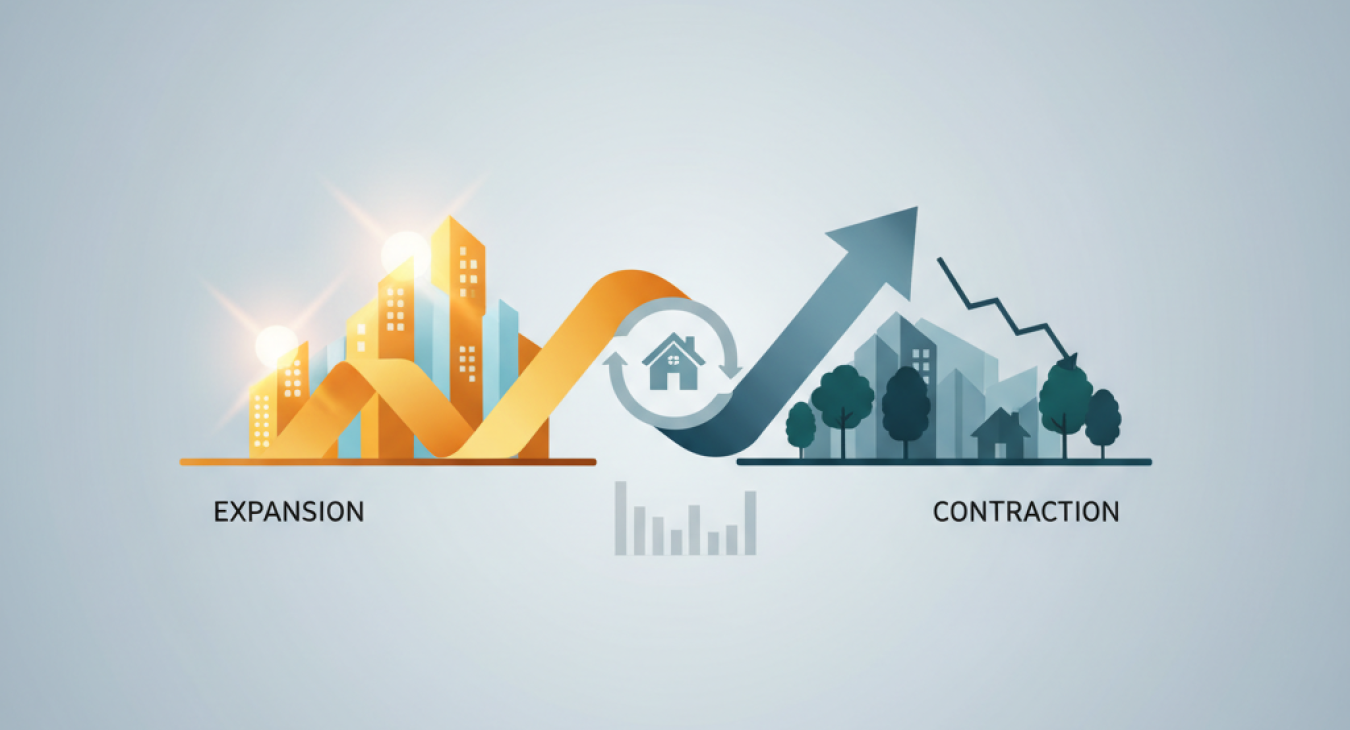
Learn the real estate cycle investing strategies to maximize profits across housing market phases and avoid costly timing mistakes.
Table of Contents
- what's the Real Estate Cycle?
- The Four Phases of the Real Estate Cycle
- Investment Strategies for Each Phase
- Macroeconomic Factors Influencing Real Estate Cycles
- Cycle Timing and Predictability
- Real Estate Cycles vs. Economic Cycles
- Risk Management and Long-Term Wealth Building
- Conclusion
- Frequently Asked Questions
Here's the thing: knowing where the housing market sits in its cycle can make or break your portfolio. Whether you're flipping houses or buying commercial property, your entry timing, financing strategy, and exit approach need to shift with the market phase. Investors who ignore cycle dynamics? They overpay at peaks. They miss generational buying opportunities during downturns. Both mistakes are expensive.
This guide walks you through every phase of the real estate cycle, the macroeconomic forces that drive it, and the specific strategies that separate profitable investors from those caught on the wrong side of the market.
Back to topwhat's the Real Estate Cycle?
Definition and Overview
Supply, demand, financing conditions, and economic fundamentals drive the real estate cycle—a recurring pattern of market expansion and contraction that plays out very differently than stock markets. Real estate doesn't reprice in seconds. It's slow. That slowness works both ways: prices take longer to fall, sure, but they also take longer to recover. And because property is physical, supply imbalances can hang around for years.
Real estate cycle investing means timing your acquisitions, management moves, and exits to match where the market actually is—and where it's headed. We'll use the framework most institutional investors rely on: four distinct phases. Recovery. Expansion. Hypersupply. Recession. That's it.
Why Real Estate Cycles Matter for Investors
Cycle timing directly impacts your total return. Period. Buy in Recovery, hold through Expansion, and you historically get the strongest risk-adjusted gains. Buy in late Expansion or Hypersupply? You'll compress future returns and spike your risk of negative equity.
CBRE and other institutional research backs this up hard: properties acquired near market troughs have outperformed peak acquisitions by 30–50% over ten years in most major metros. That's the difference between a solid deal and a value trap.
But it's not just about buying low. Cycle awareness keeps you from drowning in debt during downturns. Carrying high leverage into a Recession phase is how investors get forced to dump assets at a loss. If you're newer to this, start with the Real Estate Investing for Beginners: 2026 Complete Guide before you layer in cycle strategy.
Historical Context of Real Estate Cycles
U.S. real estate cycles have run 10–18 years from trough to trough over the past several decades, though individual phases move at their own pace. Here's what the biggest cycles looked like since the 1970s.
| Cycle Period | Duration | Key Events | Market Peak | Market Trough |
|---|---|---|---|---|
| 1975–1982 | ~7 years | Oil crisis, stagflation, rising rates | 1979–1980 | 1982 |
| 1982–1992 | ~10 years | S&L crisis, overbuilding in commercial | 1988–1989 | 1991–1992 |
| 1993–2006 | ~13 years | Loose credit, subprime lending, securitization | 2005–2006 | 2009–2012 |
| 2012–2022 | ~10 years | Post-GFC recovery, low rates, pandemic demand surge | 2021–2022 | Ongoing adjustment |
Every cycle ends. But they don't all end the same way, and they don't follow some universal playbook on timing. Local market dynamics can diverge wildly from national numbers—that's where your real edge comes from as an investor.
Back to topThe Four Phases of the Real Estate Cycle
Want to know when to buy, hold, or get out? The four-phase model cuts through the noise. It's how you read a market before your competitors do.
| Phase | Market Conditions | Typical Duration | Investment Strategy | Key Indicators | Risk Level |
|---|---|---|---|---|---|
| Recovery | High vacancy, flat or rising rents, minimal new construction | 1–3 years | Aggressive acquisition, value-add | Vacancy rates declining, absorption turning positive | Moderate (timing risk) |
| Expansion | Declining vacancy, rising rents, increasing construction | 3–7 years | Buy and hold, stabilize assets | Permits up, employment growth, cap rate compression | Low to Moderate |
| Hypersupply | Rising vacancy, rent growth slowing, excess construction | 1–3 years | Selective buying, reduce use | New supply exceeds demand, longer days on market | Moderate to High |
| Recession | High vacancy, declining rents, distressed sellers | 1–3 years | Capital preservation, opportunistic buying | Job losses, rising foreclosures, credit tightening | High (but opportunity-rich) |
Phase 1: Recovery
Vacancy rates stop climbing. Absorption turns positive. This is when Recovery starts—at the cycle trough. Rents are flat or just beginning to creep up, new construction's nearly dead (lenders and developers got torched in the downturn), and investor sentiment is cautious at best. But that pessimism? That's your edge. Prices haven't caught up to the fundamentals that are already improving. If you've got access to capital, you can buy assets at discounts to replacement cost before everyone else figures it out.
Phase 2: Expansion
This is the phase where everything works. Vacancy drops below historical averages, rents climb month after month, and lenders start throwing money at deals again. New construction kicks in, sure—but there's an 18–36 month lag before those units actually lease up. Demand crushes supply. Buy-and-hold investors see their rent growth and appreciation spike. Value-add deals you picked up during Recovery? You're selling those at real profits now.
Phase 3: Hypersupply
The market overheats. All those construction projects that broke ground in late Expansion start delivering simultaneously. Vacancy creeps back up. Rent growth flatlines. And here's the thing—the market isn't even distressed yet, but if you know what to look for, you see it coming. Sellers are still holding out for premium prices. Cap rates haven't expanded. But rental income growth is gone. This is when over-leveraged investors get crushed.
Phase 4: Recession
Real estate recessions don't always match the economy. What matters is this: vacancy spikes, rents fall, and forced sellers flood the market. Over-leveraged developers. Owners who can't service debt anymore. Cap rates expand—meaning prices crater relative to the income they generate. It hurts if you're stuck holding over-leveraged positions. But for investors with cash on hand? Recessions are the biggest buying opportunities you'll ever see.
Back to topInvestment Strategies for Each Phase
Knowing which phase you're in? That's only half the battle. The real skill is acting on it. And here's the thing — your strategy has to match your investor type. Buy-and-hold operators, fix-and-flip investors, wholesalers — they each have totally different sweet spots in the cycle.
| Phase | Buy Properties? | Hold Strategy | Sell/Exit? | Focus Areas | Capital Deployment |
|---|---|---|---|---|---|
| Recovery | Yes — aggressively | Long-term hold, stabilize | No — too early | Distressed, undervalued assets | Deploy reserves strategically |
| Expansion | Yes — selectively | Optimize rents, refinance | Late expansion exits ideal | Value-add, stabilized cash flow | Use moderately |
| Hypersupply | Cautiously, if below replacement cost | Defensive — lock in leases | Yes — exit overvalued assets | Discount acquisitions only | Reduce use, build reserves |
| Recession | Yes — opportunistically | Capital preservation first | Only distressed if necessary | Foreclosures, short sales, off-market | Cash and low use only |
Recovery Phase Strategy
While everyone else is paralyzed by fear, the smart money moves. That's Recovery in a nutshell. Fix-and-flip investors are drowning in discounted inventory right now, though don't expect fast exits like you'd see in Expansion. Buy-and-hold operators using the BRRRR strategy absolutely crush it here. Buy distressed, renovate, refinance, repeat — rinse and repeat until you've built a portfolio.
But here's where it gets tight: financing. Lenders are still gun-shy. If you've got cash, private money connections, or established credit lines? You've got a serious structural edge over your competition. Run deals through the 70% rule for acquisitions. Future appreciation's still a question mark in Recovery, so don't get cute with your math.
Expansion Phase Strategy
Expansion isn't about buying anymore. You've already bought. Now you optimize. Push rents to market rate. Refinance at those favorable terms you've been waiting for. Take a hard look at your best performers — have they appreciated enough to justify a 1031 exchange into larger multi-unit deals? Properties you picked up during Recovery often hit their repositioning sweet spot in mid-to-late Expansion. Small multifamily units are your prime candidates here.
Hypersupply Phase Strategy
Hypersupply demands discipline. Period. Cut your variable-rate exposure. Lock in long-term leases. And please — don't touch properties where the rent projections are based on wishful thinking.
You've got assets with real gains built in? Late Hypersupply gives you a reasonable window to exit before things get ugly. Short-term rental investors especially need to watch this phase closely. These properties get hammered first when occupancy drops.
Recession Phase Strategy
Preserve capital. That's your north star in a recession. But if your balance sheet's solid, Recession hands you opportunities you won't see anywhere else in the cycle. Wholesale deals. Probate acquisitions. Foreclosure auctions. Entry points that simply don't exist in normal times.
Keep leverage conservative though. A 50–60% LTV ceiling is the move here. You don't know where the bottom actually is — nobody does. Not until you're looking in the rearview mirror.
Back to topMacroeconomic Factors Influencing Real Estate Cycles
Interest Rates and Financing
Interest rates move everything. When the Fed raises them, financing gets expensive. Buyer purchasing power drops. Cap rates expand — which means your asset prices fall. You saw this in 2022–2023 when the Fed hiked rates more aggressively than any cycle since the early 1980s. Commercial transaction volume tanked by more than 50% in some segments because buyers and sellers couldn't find middle ground on pricing. Now flip the script: the low-rate free-for-all from 2009 to 2021 basically created the longest Expansion phase we've seen in modern history. That's not a coincidence.
Economic Growth and Employment
Job numbers don't lie. They're a leading indicator for residential demand and dead-center for commercial absorption. Here's how it works: job growth creates household formation, which drives apartment demand. Corporate hiring fuels office and industrial demand.
Want real forward-looking intel? Track non-farm payrolls, unemployment claims, and local job diversification. Single-employer markets carry higher cycle risk than diversified ones — that matters when you're underwriting a 5-year hold.
Supply and Demand Dynamics
Building permit data, housing starts, and construction pipeline reports — these should be on your desk every month. They tell you when Hypersupply is knocking on the door. If permits significantly exceed historical absorption rates, you're likely approaching a phase transition.
And geography changes everything. San Francisco, Manhattan, Miami Beach? Zoning restrictions and terrain limitations mean oversupply is structurally unlikely. Sun Belt markets with abundant buildable land? That's where you get burned by construction cycles running too long.
Regulatory and Policy Changes
Rent control legislation hits different. So do zoning reforms, tax policy shifts, and environmental regulations — especially at the local level where they actually matter for your deals. The post-pandemic rent control wave in Minnesota and California threw serious uncertainty into multifamily valuations that no national cycle model would've predicted.
Then there's the 2026 insurance crisis. That's reshaping operating cost assumptions across multiple markets completely independent of the classic cycle framework. It's a disruption you can't ignore.
Back to topCycle Timing and Predictability
Average Cycle Length
Here's the reality: full real estate cycles run 10–18 years in the U.S., measured trough to trough. But the phases? They vary wildly. Residential moves faster than commercial — interest rate changes hit homebuyers instantly, and consumer confidence swings shift prices quick. Commercial's different. Office and retail cycles drag because long lease terms buffer income from short-term demand shocks. Valuations stay insulated longer.
Leading Indicators to Watch
| Indicator | Recovery | Expansion | Hypersupply | Recession |
|---|---|---|---|---|
| Vacancy Rate | High, declining | Low, stable | Rising | Peak high |
| Rent Growth | Near zero or slight | Strong positive | Slowing | Negative |
| Construction Permits | Very low | Rising sharply | Peak levels | Falling rapidly |
| Cap Rates | High, compressing | Compressed (low) | Expanding slightly | Expanding sharply |
| Lending Standards | Tight | Loosening | Liberal | Tightening rapidly |
| Days on Market | Long, improving | Short | Lengthening | Very long |
Predicting Market Transitions
Anyone who promises to nail the exact cycle turn is lying to you. It doesn't work that way. What actually works? Track multiple leading indicators at once and watch for convergence. When vacancy, permits, lending standards, and days-on-market all move the same direction simultaneously, you're watching a phase shift happen in real time. And here's the kicker: local markets don't follow the national playbook. They lead or lag by 12–24 months. Geographic granularity isn't optional in cycle investing — it's essential.
Current Market Position
Most major U.S. markets in 2025 sit somewhere between Hypersupply and early Recovery. Multifamily got hit hardest — that 2021–2023 construction boom is now dumping units into a higher-rate, lower-demand world. Industrial's holding in late Expansion across many regions. Office? That's a different animal entirely. Remote work created a structural problem, not a temporary cyclical one. You can't treat all asset classes the same or rely on one national story. Analyze each market and each sector independently.
Back to topReal Estate Cycles vs. Economic Cycles

Key Differences
Here's the thing: economic cycles and real estate cycles aren't the same beast. Yes, they're connected, but they don't move in lockstep. Economic cycles track GDP growth and contraction—that's top-line stuff that shifts with aggregate demand, which can swing hard and fast. Real estate cycles? They're driven by supply, which moves like molasses. Supply takes years to adjust because you can't instantly build or demolish a commercial portfolio. That's why you'll see real estate still expanding during a mild economic slowdown, or why a real estate recession can drag on for years after GDP's already bounced back.
Lead and Lag Relationships
Residential real estate is a leading indicator—housing starts and permits typically drop 6–12 months before a recession officially hits. You want to watch those numbers closely. Commercial real estate tells a different story. Office and retail lag the broader economy by 12–24 months because long-term leases mask underlying demand issues. Tenants stay put even when occupancy's slipping and rents should be falling. But industrial? That's become more coincident with e-commerce and supply chain velocity. It's got its own rhythm now, decoupled from traditional commercial movements.
Impact on Different Asset Classes
Single-family, multifamily, office, retail, industrial, hospitality—they're not all hit the same way when cycles turn. Multifamily's your defensive play. People need somewhere to live regardless of what GDP's doing. Hotel properties? They're the most economically sensitive asset class out there. Occupancy swings can be brutal—20+ percentage points in a single quarter isn't rare. That's why you can't apply a one-size-fits-all framework. Commercial real estate investors need asset-class-specific models. If you're getting started in this space, the beginner's guide to commercial real estate breaks down how these classes actually perform differently through cycle phases.
Back to topRisk Management and Long-Term Wealth Building

Understanding Cycle-Related Risks
Leverage plus illiquidity. That's the combination that kills investors in cycle downturns. You can't dump 10% of a commercial building when a capital call comes due — but you can sell 10% of your stock portfolio in minutes. Look at 2007 and 2021. Investors who maxed out at 80%+ LTV on peak valuations got crushed when property values tanked and lenders stopped lending. They couldn't refinance. They couldn't service debt. And they couldn't sell without taking massive losses. That's why experienced cycle investors cap leverage at 65% LTV or lower on anything they're holding long-term. It's not conservative thinking — it's survival math.
Portfolio Diversification Across Cycles
Not every market cycles at the same time. Sun Belt multifamily doesn't peak when Midwest industrial does. Coastal commercial has its own timeline entirely. This timing difference is your edge. A portfolio spread across geographies and asset classes means you're not exposed to synchronized stress across all holdings when one market turns. And platforms like fractional real estate investing have opened this diversification strategy to investors without eight-figure net worths. You don't need to own five full properties anymore — you can own pieces of five different ones. But here's what most investors miss: diversification only works if you've got the right people executing it. Check out our guide on building a real estate investing team to nail your hiring sequence.
Why Real Estate Isn't a Get-Rich-Quick Strategy
Cycle investing demands patience. Long-term patience. The wealth builders — the ones actually getting rich — they're not chasing peaks. They maintain cash reserves. They keep leverage reasonable. They don't panic-sell in downturns. And they don't need to run this full-time to make it work. Part-time investors crush it all the time. What matters? A solid plan. Our guide to part-time real estate investing shows you exactly how to build a cycle-aware portfolio while keeping your day job. When you're ready to lock in your strategy, get a formal real estate investing business plan down on paper. It's not flashy. It works.
Back to topConclusion
Real estate cycle investing isn't about timing the market perfectly. It's about making smarter decisions based on where you actually are in the cycle instead of pretending the cycle doesn't exist. The four-phase framework — Recovery, Expansion, Hypersupply, and Recession — gives you a structured playbook to evaluate risk, deploy capital strategically, and know when to exit.
Macroeconomic factors like interest rates, employment, and supply dynamics are your leading indicators. They tip you off to phase transitions before the crowd sees them coming. And that's where the real edge lives.
Want to manage a multi-asset portfolio without getting caught flat-footed? Aligning your strategy with the cycle is one of the highest-ROI skills you can develop as an operator. The market will always cycle — no getting around that. The real question is whether you're positioned to profit from it or just survive it.
Back to topFrequently Asked Questions
How long do real estate cycles typically last?
Complete real estate cycles in the U.S. average 10–18 years from trough to trough. But the individual phases? They're all over the map. Recovery and Recession typically run 1–3 years each, while Expansion can stretch 5–7 years or longer when rates cooperate. And here's the kicker—local markets often lag or lead the national average by 12–24 months, so don't assume your market moves in lockstep with what you're reading about nationally.
Can you time the real estate market perfectly?
No. Full stop. Investors chasing the perfect entry kill their own returns by sitting on the sidelines while the market moves without them. The real play is simpler: buy during Recovery and early Expansion, optimize during mid-Expansion, pull back or hold defensively during Hypersupply, and move cautiously into Recession when opportunity shows up. Track multiple signals—vacancy rates, permits, lending standards, days on market. Relying on one metric will get you caught.
How do interest rates affect real estate cycles?
They hit both sides of the equation. On the demand side, rates control buyer purchasing power and financing costs. On the supply side, they determine whether development pencils out for developers. When rates rise, Expansion phases stall or end because buyers pull back and new construction becomes underwater. Falling rates? They're the trigger for Recovery—affordability improves, buyers return, and investor capital flows back in. The magnitude and speed of rate movement matter just as much as direction.
What property types perform best in each phase of the cycle?
Multifamily's the workhorse. It outperforms most cycles because housing demand doesn't evaporate, and it really sings during Expansion. Industrial—especially logistics and last-mile—has become the leader because it's hitched to e-commerce growth and shows genuine resilience through downturns. Office and retail are your danger zones in Recession, and frankly, office has structural headwinds now that go beyond the normal cycle. Hospitality's the most sensitive to economic swings, so if you're buying it, grab it in Recovery for a hold or deep into Recession for a value play.
How far in advance can you predict a real estate cycle shift?
Smart operators using multiple leading indicators can spot phase shifts 6–18 months before consensus catches on. Permit data and absorption trends are your most reliable early warnings. But exogenous shocks—COVID, credit market freezes, unexpected policy shifts—can wipe out your playbook entirely. That's precisely why you need cash reserves and liquidity discipline no matter how confident you feel about your cycle forecast.
Back to top