

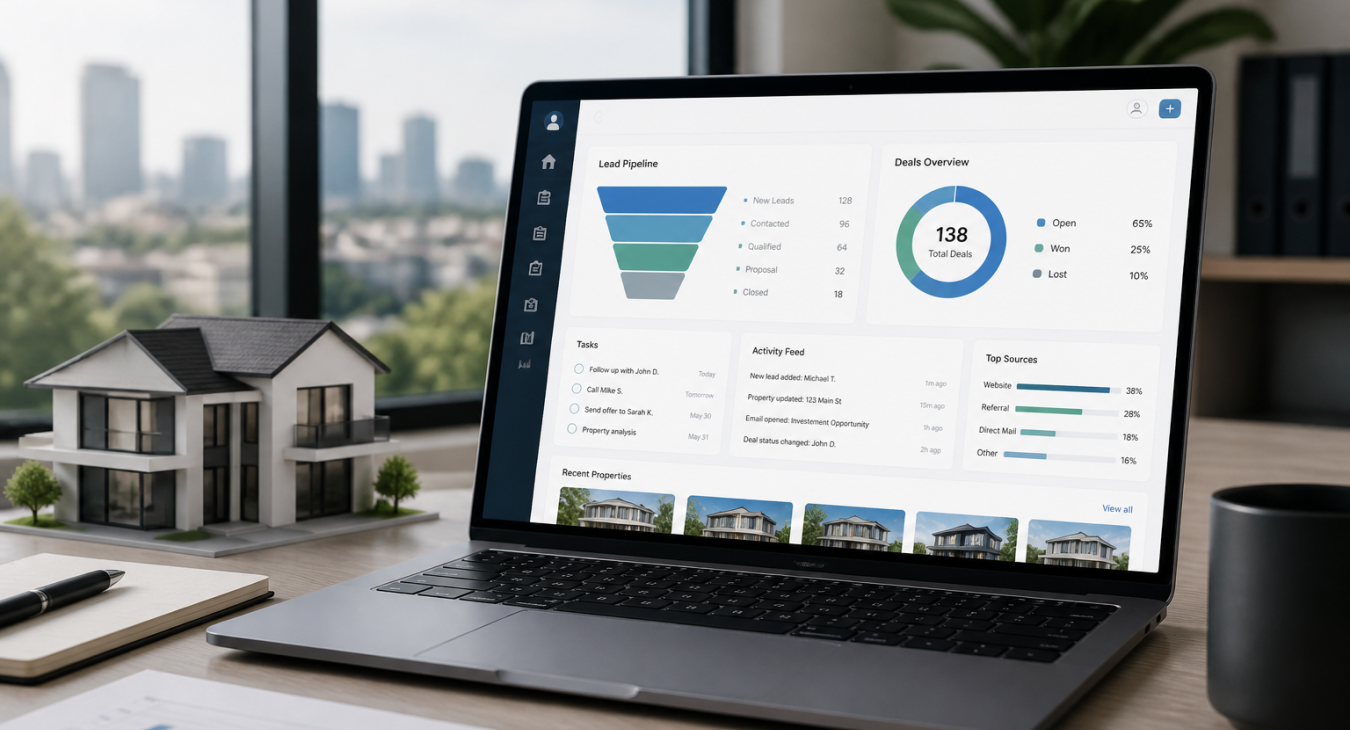
Compare top real estate investor CRM systems for 2026. Find features, pricing & expert reviews to close more deals and scale your business faster.
Products and Tools Mentioned in this Post


Follow Up Boss
Follow Up Boss is a real estate CRM that helps agents manage leads, automate follow-up, and increase conversions. Streamline your sales process today.


REI BlackBook
REI BlackBook is a comprehensive real estate investment platform offering deal tracking, CRM, marketing automation, and property management tools for investors.


InvestorFuse
InvestorFuse is a Podio-powered investor CRM designed for real estate professionals. Manage leads, deals, and workflows with automation built for investors.
Table of Contents
- What's a Real Estate Investor CRM System?
- Core Benefits of Real Estate Investor CRM Systems
- Essential Features to Look For in Real Estate Investor CRM Systems
- AI-Powered Real Estate CRM Systems
- Top Real Estate Investor CRM Systems Compared
- Spreadsheets vs. CRM Systems: A Comparison
- How to Choose the Right CRM for Your Investing Business
- Real Estate CRM Integration and Workflow Setup
- Real Estate CRM for Different Investor Types
- Measuring CRM ROI and Success Metrics
- Implementation and Onboarding Best Practices
Close 3 deals a month or 15? The difference usually comes down to one thing: pipeline management. How effectively are you tracking leads? How fast are you following up?
In 2026, real estate investor CRM systems aren't just contact databases anymore. They're AI-powered deal engines. They automate follow-ups, qualify sellers, and scale your operation without hiring five new team members. And if you're running a team-based fix-and-flip operation trying to standardize workflows, the right CRM might be the single highest-ROI software investment you'll ever make.
This guide covers what actually matters.
What these systems do. Which platforms are winning the market. How to compare them on price and features without getting lost in the noise. And—this is critical—how to implement one without killing your deal flow in the process.

What's a Real Estate Investor CRM System?
A real estate investor CRM (Customer Relationship Management) system does one thing: it manages your entire deal pipeline. From that first cold call with a motivated seller to closing and everything after. Unlike Salesforce or HubSpot, investor-specific platforms are built for wholesaling, fix-and-flip, rentals, and dispositions. They speak your language.
Definition and Core Purpose
Here's what actually happens: a real estate investor CRM pulls all your fragmented data together. Marketing channels. Lead sources. Team members. It all lives in one place now. You're tracking motivated sellers, managing your buyer and lender relationships, automating your follow-up sequences, and always knowing which deals are hot and which ones are stalling. Pipeline visibility isn't optional — it's survival.
How CRMs Differ for Investors vs. Agents
Agent CRMs like Follow Up Boss or kvCORE? They're optimized for representation, open houses, and listings. Not what you do. Investor CRMs are built around deal acquisition, off-market sourcing, and disposition to cash buyers. And the features prove it. You get motivated seller tracking. ARV calculators. Rehab cost estimation. Cash buyer list management. Agents don't touch any of this. You use it every single day.
Key Distinctions from General Business CRMs
Try forcing a general business CRM into your investor workflow and you'll waste weeks customizing it. Investor-specific platforms come pre-built for your deal stages: Lead → Contacted → Appointment Set → Offer Made → Under Contract → Closed. Property-specific data fields. Skip tracer integrations. Dialer connections. Direct mail platforms. Everything's already wired up. You're operational in days, not months.
Back to topCore Benefits of Real Estate Investor CRM Systems

Here's what separates winners from the pack: investors with CRM systems consistently outperform those without them. The data's compelling, and the operational advantages compound fast.
Lead Management and Qualification
You're probably juggling leads from 5–8 different channels right now — cold calling, direct mail, driving for dollars, PPC, SEO, referrals. And if you're tracking them across sticky notes, email inboxes, and spreadsheets, you're leaving money on the table. A CRM pulls everything into one system. Automated lead scoring tells you exactly which sellers to hit first based on motivation level, equity position, and engagement history. No guessing.
Deal Pipeline Tracking
Investors using visual pipeline management close 27% more deals than those still running spreadsheets, according to industry data. Think about that number. Pipeline tracking gives you real-time visibility into every opportunity — which deals are stalled, which ones need follow-up, where your revenue comes from next month. You're no longer chasing deals reactively. You're managing your business proactively.
Automated Follow-Ups and Nurturing
Most investors quit after 1–2 contact attempts. But here's the reality: 50% of deals close after the 5th touch. CRM automation closes that gap with drip campaigns — scheduled texts, emails, and voicemail drops that keep you in front of prospects for weeks or months without you lifting a finger. One investor triggered a follow-up campaign on a 14-month-old cold lead and walked away with a $47,000 wholesale assignment fee.
Team Collaboration and Visibility
When you scale from solo to a team operation, your CRM becomes the nervous system of your business. Acquisition managers, dispositions specialists, transaction coordinators — everyone's working from the same data source. That kills the endless "what's happening with that deal?" conversations that drain 5–10 hours a week.
ROI Quantification for Investors
Most CRM implementations pay for themselves in 90 days. Do the math: a $300/month platform that helps you close one extra deal per quarter at $15,000 assignment fee generates a 12.5x return. Add the 10–15 hours per week most investors recover from administrative work, and the value compounds even faster. This isn't theoretical — it's real money in your pocket.
Back to topEssential Features to Look For in Real Estate Investor CRM Systems
Not all CRMs are created equal. And frankly, not every feature matters equally for every investor type. Here's what separates great investor CRMs from the mediocre ones.
Lead Capture and Scoring
You need platforms that capture leads from multiple sources — web forms, inbound calls, SMS keywords, and API connections. But here's the kicker: they have to automatically score them based on configurable criteria like equity percentage, time owned, and engagement behavior. Automated scoring means your team's always working the hottest leads first, not wasting time on tire-kickers.
Deal Tracking and Pipeline Management
Custom deal stages, drag-and-drop kanban boards, and deal value tracking are non-negotiable. The best platforms also include property-specific fields: purchase price, ARV, repair estimates, MAO calculator, and projected profit — integrated directly into the deal record. You shouldn't have to toggle between tabs to see your numbers.
Automated Workflows and Drip Campaigns
Multi-channel drip campaigns covering SMS, email, and voicemail drops are table stakes. But what really matters? Event-based triggers instead of just time-based ones. Lead added, appointment missed, contract expired — that's what should fire your sequences. The ability to build complex conditional logic ("if seller opens email AND doesn't reply within 48 hours, send SMS") separates top-tier platforms from basic ones.
Integration Capabilities
Your CRM is only as powerful as the tools it connects to. Critical integrations include: skip tracing services (for finding seller contact info), real estate dialers for cold calling, direct mail platforms, and real estate accounting software. And if the CRM lacks native integrations with your favorite tools? Zapier connectivity provides a fallback.
AI and Machine Learning Features
AI-powered lead scoring, predictive analytics, conversation intelligence, and automated seller qualification aren't luxuries in 2026. They're competitive necessities. We'll cover this in depth in the AI section below.
Mobile Accessibility
Deal opportunities don't wait for desk time. A strong mobile app with full functionality matters here. Not a stripped-down viewer — actual full functionality. Your acquisition managers need to update deals from the field, respond to hot leads instantly, and run appointments end-to-end from their phone.
Reporting and Analytics
Can your CRM tell you which marketing channel produces your most profitable deals? If not, you're flying blind. Custom dashboards showing KPIs like cost per lead by channel, conversion rate by lead source, average days to close, and marketing ROI are essential for data-driven scaling decisions.
Back to topAI-Powered Real Estate CRM Systems

Since 2024, the biggest shift in real estate investor CRM systems has been generative AI and machine learning baked directly into deal management. If you know how to leverage it, you're getting a serious edge over competitors who don't.
Automated Seller Qualification
Platforms like REsimpli now use Gen 2 AI to handle initial seller conversations through SMS or chat. The system asks about property condition, timeline, and motivation — then scores the lead before your team ever touches it. Your acquisition guys focus only on deals that hit your minimum thresholds. Early adopters? They're cutting time spent on tire-kickers by 40%.
AI-Driven Follow-Up and Nurturing
This isn't your grandmother's drip campaign. Modern AI systems personalize every message based on conversation history, seller behavior, and deal specifics. A seller mentioned divorce proceedings two months back? The AI references it in the re-engagement email, making it feel human at scale. Documented case studies show this bumps lead-to-appointment conversion by 22–35%.
Appointment Booking Automation
Calendar blocking. Time proposals. Confirmations. Reminders. All handled by AI without a human in the loop.
For high-volume acquisition teams, this kills administrative drag and guarantees warm leads don't slip through scheduling gaps.
Pushback Handling and Objection Management
"I need to think about it." "I'm working with an agent." "Your offer's too low." And then what? Advanced AI systems handle these exact objections in real-time while keeping conversation natural and flowing. They follow your configured response trees until a human takes the handoff. Want deeper intel on AI across the investment space? Check our complete guide to AI tools for real estate investors.
Predictive Deal Scoring
Machine learning models trained on thousands of closed deals can predict which pipeline leads are actually going to convert. The system analyzes behavioral signals, demographics, and property comps. Investors using predictive scoring close 18% more deals from the same lead count by spending time on highest-probability opportunities.
Back to topTop Real Estate Investor CRM Systems Compared
The market's matured fast, and a few platforms have clearly separated themselves from the pack. Each one dominates a different investor type or operational scale. Let's dig into the real strengths and weaknesses of each.
| Platform | Starting Price/Month | AI Features | Best For | Ease of Use | Integrations | Mobile App | G2/Capterra Rating |
|---|---|---|---|---|---|---|---|
| REsimpli | $99 | Advanced (AI caller, drip AI) | Wholesalers, fix-and-flip | 4.5/5 | Native + Zapier | Yes (full) | 4.8/5 |
| Podio + GlobiFlow | $24 (base) | Limited | Custom workflows, advanced teams | 3/5 | API + Zapier | Yes (limited) | 4.1/5 |
| InvestorFuse | $197 | Moderate (AI follow-up) | Wholesalers, mid-volume teams | 4.3/5 | Native integrations | Yes | 4.5/5 |
| Follow Up Boss | $69/user | Moderate (AI assist) | Agent-investor hybrids | 4.4/5 | Extensive native | Yes (excellent) | 4.6/5 |
| HubSpot CRM | Free / $45+ | Advanced (AI tools) | Marketing-heavy investors | 4.2/5 | Extensive (500+) | Yes | 4.4/5 |
| Salesforce | $25/user | Advanced (Einstein AI) | Large commercial operations | 2.5/5 | Extensive | Yes | 4.2/5 |
| FreedomSoft | $97 | Moderate | Solo investors, beginners | 4.6/5 | Limited native | Yes | 4.3/5 |
| REI BlackBook | $97 | Moderate (AI follow-up) | Wholesalers, marketing automation | 4.2/5 | Native + Zapier | Yes | 4.4/5 |
Need verified user reviews and 2026 pricing details? Check out our full breakdown of the best CRM for real estate investors in 2026.
REsimpli: Best Overall for Investor-Specific Workflows
REsimpli wins here because it was actually built for real estate investors — not shoehorned into a generic CRM and called a day. You get a dialer, skip tracing, driving for dollars, direct mail, and accounting all in one platform. That means your entire operation runs from a single system instead of juggling five different tools. The AI caller feature can pick up qualifying calls and conduct conversations with inbound leads, and it's honestly one of the best implementations you'll find anywhere in this space. You're looking at $99/month to start (Basic tier), then $199/month for Professional and $399/month for Elite when your team scales.
InvestorFuse: Best for Systematic Follow-Up
This platform does one thing obsessively well: it makes sure follow-ups don't die. Instead of hoping your deal managers remember the next step, InvestorFuse pushes them through action-based workflows automatically. You hit a bottleneck? The system forces a decision. That discipline is gold when you're growing from a 2–3 person operation to 10+ acquisition agents because consistency gets harder, not easier, as you scale. At $197/month for unlimited users, the math works.
FreedomSoft: Best for Beginners
Intuitive navigation. Pre-built campaigns. A deal flow that doesn't bury new investors in options.
FreedomSoft's earned its beginner reputation honestly. It includes a property analyzer, skip tracing credits, and a cash buyer database — everything a new wholesaler needs on day one. But here's the trade-off: once you're doing high volume, you'll bump against its constraints. REsimpli and InvestorFuse will feel less cramped.
HubSpot: Best for Content and Inbound Marketing
If you're winning deals through SEO, content, and inbound leads rather than cold calling and direct mail, HubSpot's your move. Its marketing automation plays well with your content machine, and the free CRM tier actually works. And its integration with real estate investor websites and your entire marketing stack is genuinely extensive. The catch? You'll spend weeks customizing it to think like an investor platform, and you might need developer help to make it sing.
Back to topSpreadsheets vs. CRM Systems: A Comparison

Most investors start with spreadsheets. And honestly? A lot of them stay there way too long. But here's what matters: once you see exactly where spreadsheets fall apart, you'll understand what you're really gaining—and what risks you're actually cutting—when you make the jump to a CRM.
| Capability | Spreadsheets | Real Estate Investor CRM |
|---|---|---|
| Lead Organization | Manual, error-prone | Automated, structured |
| Follow-Up Automation | None — fully manual | Multi-channel automated sequences |
| Team Collaboration | Version control issues, conflicts | Real-time, role-based access |
| Pipeline Visibility | Custom-built, fragile | Built-in visual pipeline views |
| Reporting and Analytics | Manual calculations, formulas | Automated dashboards and KPIs |
| Lead Scoring | Manual/none | Automated, AI-enhanced |
| Integration with Other Tools | Manual export/import | Native and API integrations |
| Scalability | Breaks down above ~500 leads | Handles 50,000+ contacts |
| Data Security | Vulnerable to accidental deletion | Cloud backup, role permissions |
| Mobile Access | Limited, clunky | Full-featured mobile apps |
| Monthly Cost | Free (but hidden time costs) | $97–$400/month |
Here's what kills most spreadsheet operations: the hidden cost. You're spending 15–20 hours every single week on manual data entry, sending follow-ups one at a time, and patching broken formulas that torpedoed your pipeline view. Do the math. At $100/hour opportunity cost, that's $6,000–$8,000 per month of your productive capacity getting swallowed by busywork.
A CRM gives you that time back.
Back to topHow to Choose the Right CRM for Your Investing Business

Your team won't use a CRM they hate. Period. So before you swipe your credit card, work through this framework — it'll save you months of wasted subscriptions and broken workflows.
Step 1: Define Your Specific Business Needs
Map out your actual workflow first. How many monthly leads are you pulling in? What channels are they coming from? And critically — how many people on your team need access to this thing? Dig into your operational bottlenecks. Is it follow-up speed? Pipeline visibility? Team accountability? Reporting that doesn't require you to export three spreadsheets? Your answers separate the must-haves from the fluff.
One more thing: check whether your shortlisted CRMs play nice with your lead generation platforms. Native integration beats duct tape every time.
Step 2: Assess Integration Requirements
Write down every tool you're currently using. Dialer, skip tracer, direct mail platform, marketing software, accounting system — all of it. A CRM that doesn't connect to your existing stack creates friction, not efficiency. Native integrations are preferable to Zapier workarounds. Those workarounds introduce latency and drain your budget with extra monthly fees you don't need.
And if you're running skip tracing services, confirm right now whether your CRM includes this natively or how it plugs in.
Step 3: Evaluate Ease of Use
Get a demo. Get a trial. Demand both before you sign anything. A feature-rich CRM that your team abandons after two weeks is just an expensive line item on your P&L.
Time how many clicks it takes to do the tasks you actually do daily: logging a call, moving a deal stage, sending a follow-up message. That friction? It's the #1 reason CRM adoption fails in real estate investing.
Step 4: Analyze Pricing Relative to Your Volume
Per-user pricing ($69/user/month for Follow Up Boss, for example) gets brutal as your team scales. Flat-rate unlimited-user models like InvestorFuse at $197/month often win at scale. Don't just look at the base subscription price. Factor in add-ons, overage fees, and integration costs. That's your actual cost of ownership.
Step 5: Test Support and Onboarding Quality
Open a support ticket before you buy. Response time tells you everything.
Do they have live chat or phone support, or are you stuck with email? Are they going to hand-hold your team through onboarding, or are you reading through a knowledge base at 9 PM trying to figure out why your integration broke? Poor support kills CRM implementations, especially for investors running lean and needing problems solved yesterday.
Back to topReal Estate CRM Integration and Workflow Setup
Your CRM is the operational hub. But here's the thing—its real power comes from smart integrations that multiply your effectiveness. We're talking about building a workflow that runs on autopilot while you're closing deals.
Critical Integration Points for Investors
Most successful investors plug these core systems into their CRM:
- Marketing channels: Direct mail platforms, Google Ads, Facebook Ads for lead capture
- Communication tools: Dialer software, SMS platforms, voicemail drop services
- Data enrichment: Skip tracing services for contact information
- Accounting: QuickBooks, FreshBooks, or dedicated real estate accounting platforms
- Document management: DocuSign or similar for contract execution
- Marketing automation: Email platforms for nurturing campaigns
Building Automated Workflows
Map out your lead journey once the integrations are live. From first touch to closed deal. Here's what a motivated seller workflow actually looks like in practice:
Lead captured from web form → Automatically skip-traced for additional contact info → SMS confirmation sent → Lead scored based on property data → If score above threshold, acquisition manager notified → If no response within 24 hours, automated follow-up sequence begins → Appointment set → CRM deal record created with property analysis populated automatically.
And this is the killer part: you've just eliminated the need for a full-time coordinator. The system engages leads around the clock—24/7—while your team stays laser-focused on appointments and negotiations where you actually make money. Want a bigger picture? Check out our breakdown of the best real estate marketing tools for 2026.
Back to topReal Estate CRM for Different Investor Types

What works for a wholesaler won't cut it for a landlord building a rental portfolio. Your CRM setup needs to match your actual business model — not what some vendor thinks you need.
| Investor Type | Primary CRM Needs | Recommended Platform | Key Features to Prioritize |
|---|---|---|---|
| High-volume wholesaler | Lead volume management, automated follow-up, fast disposition | REsimpli, InvestorFuse | AI follow-up, bulk SMS, cash buyer management |
| Fix-and-flip investor | Deal analysis, rehab tracking, contractor management | REsimpli, FreedomSoft | Rehab calculator, deal stage customization, document storage |
| Rental portfolio investor | Long-term relationship management, portfolio tracking | HubSpot, Podio | Long-term nurture sequences, property records, accounting integration |
| Commercial real estate investor | Broker relationships, complex deal timelines, large teams | Salesforce, HubSpot | Custom deal stages, team hierarchy, advanced reporting |
| Solo operator | Simplicity, automation, affordability | FreedomSoft, REI BlackBook | Easy setup, built-in campaigns, mobile access |
| Scaling team (5–20 people) | Team accountability, role-based access, KPI tracking | InvestorFuse, REsimpli | User permissions, manager dashboards, activity tracking |
Wholesalers and Fix-and-Flip Investors
Speed wins deals. Leads go cold fast, and the investor who submits a credible offer first usually takes the deal home. That's why wholesalers need instant lead notifications, one-click follow-ups, and automated sequences that enroll prospects immediately. You can't afford delays here.
Fix-and-flip investors juggle more moving parts. You're managing acquisition, renovation timelines, contractor relationships, and the exit strategy all at once. Your CRM has to track deals through every phase without slowing you down.
Rental Portfolio Investors
The landlord who says "no thanks" in 2024 might be ready to sell in 2026 — especially after two years of tenant headaches. Long-term nurture sequences spanning 12–24 months aren't optional; they're your money-maker.
And here's what separates rental investors from everyone else: integration matters. You need your CRM talking to your property management system and real estate accounting software. Wholesalers? They don't care. You do.
Scaling from Solo to Team-Based Operations
This is where everything breaks.
You go from managing your own deals to managing people managing deals. Now accountability isn't nice to have — it's survival. You need to see who's working which leads, how many calls went out today, and why that hot prospect hasn't moved in seven days. Those manager dashboards and activity tracking features you skipped as a solo operator become non-negotiable.
Get this right before you hire your first acquisition agent. Getting it wrong after you've got five people pulling data from a broken system costs you way more than upgrading the CRM would've cost upfront.
Back to topMeasuring CRM ROI and Success Metrics

You can't run a marketing campaign without tracking conversions. Same deal with CRM — implement one and then ignore the metrics? That's just burning money. You need baselines. You need KPIs. Without them, you're flying blind on whether this thing is actually delivering value or just eating up your budget.
Key Performance Indicators to Track
- Lead-to-appointment rate: What percentage of new leads actually show up to a seller appointment? Industry benchmark sits at 8–15% for outbound campaigns. That's your starting line.
- Appointment-to-offer rate: Once you're sitting across from them, how many turn into submitted offers? You're looking at 60–80% if your process is solid.
- Offer-to-contract rate: Now how many offers actually get accepted? This one varies hard by market, but 25–40% is typical.
- Cost per acquisition: Total marketing spend divided by deals closed. Break this down by channel too — you need to know which marketing dollar is actually working.
- Average days to close: From initial lead capture to closing? Every day matters when you're managing cash flow. Shorten this and your velocity improves.
- Follow-up sequence engagement rate: Track opens, clicks, and replies on your automated campaigns. These numbers tell you if your message resonates or if it's getting ignored.
- Pipeline velocity: What's the total dollar value of deals moving through your pipeline each month? This is your true momentum metric.
Expected Efficiency Improvements Post-CRM
Real investors who've ditched manual tracking systems see real gains. We're talking documented before-and-after metrics, not consultant projections. Within six months, here's what shows up:
- 25–40% jump in lead-to-appointment conversion (consistent follow-up is the game-changer)
- 10–15 hours per week back in your pocket from administrative grunt work
- 35% drop in lead abandonment — that's deals that used to die because nobody followed up
- 20–30% higher deal closure rate from the same lead volume you already had
- 50%+ reduction in cost per acquisition as your systems tighten
And here's the thing — these aren't made-up numbers. Investors have published these metrics. They're real outcomes from people in the field. But don't just slap a CRM on your operation and hope. Make sure it aligns with where you're actually buying. Check out the best real estate markets for cash flow in 2026 and ensure your CRM strategy targets the right geographic pockets for your portfolio.
Back to topImplementation and Onboarding Best Practices
A CRM only works if you actually use it. Most investors dump their CRM within 60–90 days, and it's almost always because the implementation was sloppy. Don't be that person.
Phase 1: Data Preparation (Week 1–2)
Start by cleaning up what you've got. Duplicate contacts, inconsistent address formats, and jumbled lead statuses will kill your workflow before it starts. Migrate garbage data into a shiny new system, and you've just created an expensive, organized mess.
Back to top