

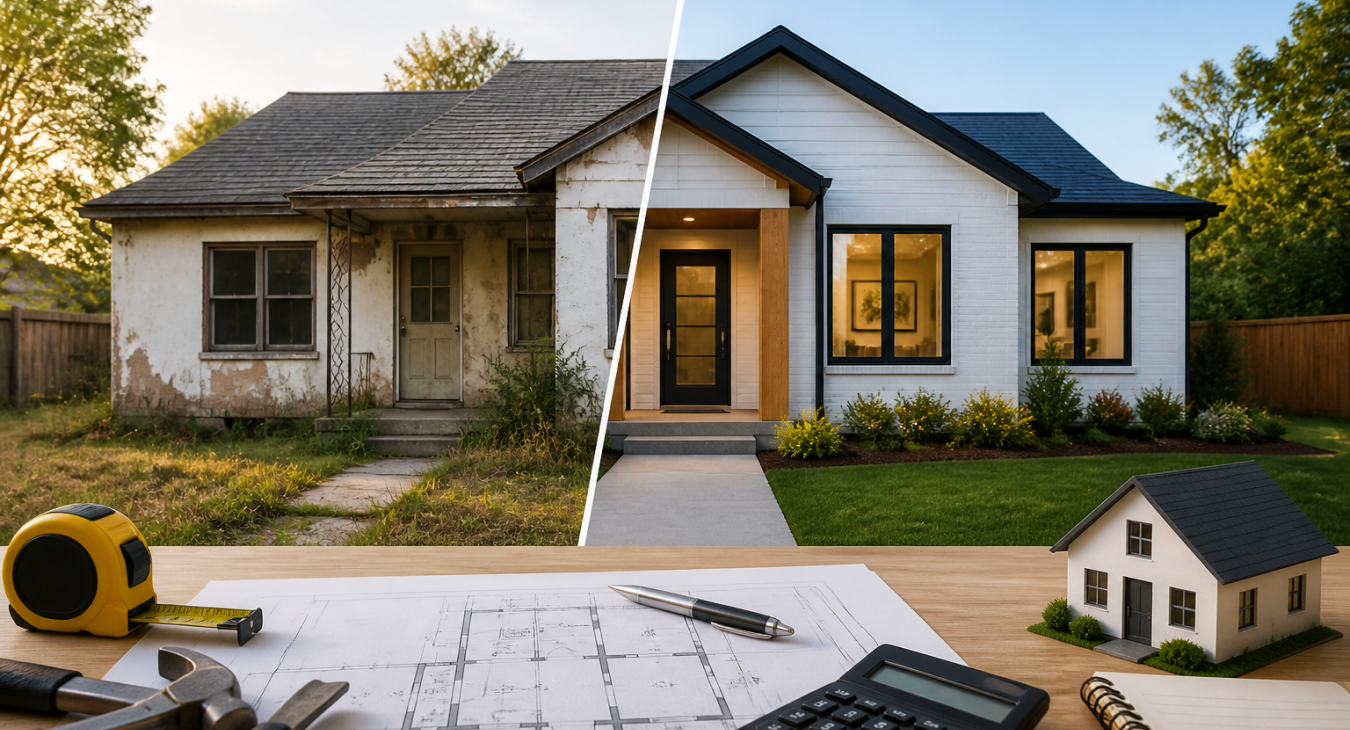
Learn house flipping how to start with our complete step-by-step guide. Discover proven strategies to find deals, renovate, and profit like a pro.
Products and Tools Mentioned in this Post


Table of Contents
- what's House Flipping?
- How House Flipping Works
- Is House Flipping Right for You?
- Getting Started: 7 Steps to Your First Flip
- Finding the Right Property to Flip
- Financing Your House Flip
- Planning Your Renovation
- How Much Money Can You Make Flipping Houses?
- Pros and Cons of House Flipping
- Do You Need a Real Estate License?
- Your House Flipping Checklist
- Conclusion
- Frequently Asked Questions
House flipping has captured the imagination of real estate investors for decades — and for good reason. A single flip done right? That's $30,000 to $70,000 in profit within six to twelve months. But here's the thing: the gap between a profitable flip and a costly mistake often comes down to preparation, education, and execution. This full guide will walk you through every phase of the process, from setting your budget to handing over the keys to a buyer. Whether you're brand new to investing or a real estate agent looking to expand into active deals, you'll find everything you need to know about house flipping how to start.

what's House Flipping?
You buy a property below market value. Renovate it. Sell it for profit. That's house flipping in a nutshell. Unlike long-term rental investing, which generates passive income over years, flipping is active work focused on short-term capital gains. And it's not the same as wholesaling — wholesalers contract properties and flip those contracts to other buyers without ever owning or improving anything.
The model is simple. Find a distressed or undervalued property, execute strategic improvements, and sell it within months for a profit. According to ATTOM Data Solutions, the average gross profit on a flipped home in the U.S. exceeds $66,000. But here's the reality check: your net profit after all costs typically ranges from $20,000 to $40,000, depending on your market and how well you execute.
Back to topHow House Flipping Works
There are four distinct phases: acquisition, renovation, marketing, and sale. You need to understand the timeline and what actually happens in each one before you write that first check.
- Acquisition (Weeks 1–4): You're identifying deals, running the numbers, making offers, digging into due diligence, and closing on the property.
- Renovation (Months 2–5): This is where the real work happens—executing your scope, managing contractors, dealing with surprises, and passing inspections.
- Marketing (Month 5–6): Getting it listed, staging it right, hosting open houses, and negotiating offers with buyers.
- Sale (Month 6–12): You've got an accepted offer. Now you're navigating the buyer's due diligence period and closing out.
Six to twelve months. That's your target window from purchase to closing. But here's what kills deals: projects that drag past twelve months. Your holding costs—mortgage interest, property taxes, insurance, utilities—start eating into profit like crazy. Speed wins in this business. Efficiency isn't optional.
Back to topIs House Flipping Right for You?
Successful flippers share a profile. They're analytical, decisive, organized. They manage people and projects under pressure without breaking a sweat. But here's the real question: do you have what it takes? Before you commit capital, you need to honestly assess whether flipping aligns with your skills, your bankroll, and your risk tolerance.
Capital Requirements
Most deals need 20–30% down if you're financing, or the full purchase price for cash. That's just the start. You've got renovation costs to cover, holding costs eating away at your timeline, and you need a 10–20% contingency reserve sitting there for when things go sideways—and they will. A realistic baseline for most markets is $50,000–$100,000 in liquid capital you can actually access.
Common Mistakes to Avoid
- Overestimating the after-repair value (ARV)
- Underestimating renovation costs
- Failing to account for holding and selling costs
- Skipping the home inspection
- Over-improving for the neighborhood
- Going it alone without a reliable team
Want the full picture before you write that first check? Dig into this complete beginner's guide to flipping houses in 2026. It'll give you current market data and context so you're not guessing.
Back to topGetting Started: 7 Steps to Your First Flip

Step 1: Set Your Budget and Secure Financing
Here's what kills most first-time flips: fuzzy math on the backend. You need to know your total spend before you even look at properties. That means purchase price, closing costs (2–5%), your renovation budget, holding costs, and selling costs (6–10% — yes, that's real). Most beginners underestimate by 15–20%, so pad your numbers accordingly. Want a deeper dive into funding? Check out our breakdown on how to get money to flip a house.
Step 2: Educate Yourself
Read The Book on Flipping Houses by J Scott. Take courses. Join your local REIA. But here's the real education: get your hands dirty. Shadow flippers who've actually closed deals, walk properties with contractors, and study your market until you dream about comps and PPSF. And don't skip the newer stuff either — AI tools built for real estate investors can cut your market research time in half.
Step 3: Build Your Team
You're only as good as your team. You'll need a real estate agent who actually works with investors (not just homebuyers), a general contractor with verifiable references, a real estate attorney who knows investor deals, a CPA comfortable with flipping taxation, a title company, and hard money lender relationships. Vet contractors like you're hiring a CFO. Check licenses, insurance, references, and past project portfolios. One bad contractor doesn't just cost you money — it tanks your entire flip economics.
Step 4: Find the Right Property
Distressed properties are your sweet spot. Look on the MLS (expired listings, true fixer-uppers). Check foreclosure auctions. Talk to wholesalers. Scan probate sales. And then do something most investors skip: drive for dollars. Get out and physically scout neighborhoods for neglected properties. It's old school. It works.
Step 5: Analyze the Deal and Make an Offer
The 70% Rule keeps you disciplined. Don't pay more than 70% of ARV minus your renovation costs. Real example: ARV is $300,000, renovations run $40,000. Your max offer? ($300,000 × 0.70) – $40,000 = $170,000. This formula locks in profit margin and gives you buffer room for the surprises every renovation has.
Step 6: Plan and Execute Renovations
Get a detailed scope of work locked before you close. Pull three bids per trade — don't settle for one. Kitchen, bathroom, curb appeal, flooring: those are your ROI-killers if they're done wrong. Skip structural work unless the full cost still pencils out on your numbers. Use house flipping software to track budget, timeline, and contractor invoices daily.
Step 7: Sell the Property
Price off comps. Not off your profit target. Overpricing kills days on market, which bleeds holding costs and signals red flags to buyers. Stage it properly. Get professional photos. List in spring or early summer if you can. And here's the thing most flippers miss: what's your backup plan if the market softens? Could this work as a rental? Have an exit strategy before you buy — it's how you sleep at night.
Back to topFinding the Right Property to Flip

Deals get made or broken at the property selection stage. That's where you either print money or hemorrhage it. The markets that work best for flipping have three things in common: strong buyer demand, a steady stream of distressed properties you can actually buy, and ARVs you can predict with confidence. Check out the best markets for house flipping in 2026 — these numbers shift every year, so you need current data.
Start by evaluating the neighborhood. You can gut a house and rebuild it from the studs. But you can't change the zip code. Hunt for properties in areas where renovated comps move fast and command serious money. And steer clear of neighborhoods with shrinking populations, rising crime numbers, or warehouses and commercial development creeping into residential zones.
Some red flags kill deals instantly. Foundation problems that go beyond surface cracks? Walk. Active mold or water intrusion without a clear fix? Don't touch it. Unpermitted additions, environmental contamination, and HOA restrictions that strangle resale potential—these are deal-killers, period.
Back to topFinancing Your House Flip

Pick the wrong financing structure and you'll kill your margins before you ever swing a hammer. Your choice directly impacts your cost basis, how fast you can close, and how much risk you're actually carrying.
| Financing Type | Typical Interest Rate | Approval Time | Pros | Cons | Best For |
|---|---|---|---|---|---|
| Cash | N/A | Immediate | No interest, fastest close, strong negotiating position | Ties up capital, limits deal volume | Experienced investors with reserves |
| Hard Money Loan | 10–15% | 3–7 days | Fast funding, asset-based approval, flexible terms | High interest rates, short terms (6–18 months) | Most first-time and active flippers |
| Conventional Mortgage | 6–8% | 30–45 days | Lower rates | Slow, strict requirements, doesn't fund distressed properties | Move-in ready properties only |
| HELOC | 7–10% | 2–4 weeks | Flexible draw schedule, lower rates than hard money | Requires existing home equity, variable rate risk | Homeowners with significant equity |
| Partnership/JV | Profit split (typically 50/50) | Varies | No debt, shared risk | Shared profits, potential disagreements | First-timers without sufficient capital |
Hard money loans are the real workhorse for most beginners. They're built for investors, fund in 3–7 days (not 30), and don't care if your credit score isn't pristine—they care about the deal's ARV and your exit strategy. And don't sleep on assumable mortgages either. In the right market, you can take over a seller's low-rate loan. That's a meaningful advantage on your cost of capital.
Back to topPlanning Your Renovation

Start planning before closing. Seriously — walk the property with your contractor during due diligence, nail down a detailed scope of work, and lock in firm bids before you commit any capital. Hidden water damage, outdated electrical panels, failing HVAC systems? These aren't surprises on distressed properties. They're the norm. That's why you need a contingency buffer of 10–20% above your initial estimate.
Renovation ROI by Improvement Type
| Improvement | Average Cost | Estimated ROI | Priority Level |
|---|---|---|---|
| Minor Kitchen Remodel | $15,000–$25,000 | 75–85% | High |
| Bathroom Update | $8,000–$15,000 | 70–80% | High |
| New Flooring | $5,000–$12,000 | 70–80% | High |
| Exterior Paint / Curb Appeal | $3,000–$8,000 | 80–100% | High |
| Interior Paint | $3,000–$6,000 | 100%+ | Essential |
| HVAC Replacement | $6,000–$12,000 | 50–60% | Medium (required if failing) |
| Roof Replacement | $8,000–$20,000 | 55–65% | Medium (required if failing) |
| Luxury Addition/Expansion | $30,000+ | 40–60% | Low (avoid over-improving) |
Notice the ROI spread. Interior paint returns 100%+ on a $3K–$6K spend — that's your quick win. Kitchen and bathroom work land in the 75–85% range at $15K–$25K and $8K–$15K respectively. Both are high-priority hits. But luxury expansions? They're cap-rate killers. You'll dump $30K+ for a 40–60% return, and that math doesn't work on most deals.
And here's the reality: major systems like roofs and HVAC won't wow your buyer, but they will tank a deal if they're failing. You're not getting your money back on these — you're buying optionality.
Juggling multiple trades across timelines and budgets? FlipperForce lets you track scopes, contractor schedules, and spend all in one dashboard.
Back to topHow Much Money Can You Make Flipping Houses?

Your profit margin depends on the market you're in, what type of property you buy, how extensive the renovation gets, and how well you execute the deal. Let's walk through a realistic scenario: a $250,000 ARV property in a solid mid-tier market.
| Cost Category | Example Amount | % of ARV |
|---|---|---|
| Purchase Price | $160,000 | 64% |
| Acquisition Closing Costs | $4,000 | 1.6% |
| Renovation Costs | $35,000 | 14% |
| Holding Costs (6 months) | $8,000 | 3.2% |
| Selling Costs (agent commissions, concessions) | $17,500 | 7% |
| Total Costs | $224,500 | 89.8% |
| Gross Profit | $25,500 | 10.2% |
That's $25,500 in gross profit. But here's the thing—taxes will eat into that number. Properties you flip in under a year get taxed as short-term capital gains, which means they're treated like ordinary income. You're looking at 22–37% depending on your bracket. And that's where a good CPA comes in. One who specializes in real estate can structure your entity, implement cost segregation, and track expenses properly so you're not leaving money on the table.
Back to topPros and Cons of House Flipping

Advantages
- You can pocket significant short-term profits if you execute right
- You're steering the ship — not passive, not at the mercy of tenants or market cycles
- You'll learn construction, negotiation, and real market analysis faster than any course could teach you
- Scale it into full-time income once you've nailed your process
- You're actually improving neighborhoods while you make money
Disadvantages
- Short-term capital gains hit hard at tax time — way worse than long-term hold returns
- Market timing kills flips. A cooling market can wipe your margins in months.
- Contractors? They'll drain your time and test your sanity.
- Your cash gets locked up the entire project — zero liquidity
- One surprise foundation issue or asbestos discovery tanks your profit
Flipping isn't for everyone. If the hands-on grind doesn't suit you but you want real estate exposure, look at house hacking instead. Or explore how to build a real estate investing business that mixes multiple strategies together.
Back to topDo You Need a Real Estate License?
You don't need a license to flip houses. But here's the thing — having one gives you real, measurable advantages. Licensed investors get direct MLS access, which means you're not paying buyer's agent commissions just to see listings. You'll save on the buyer's side commission in some transactions too. And you get access to way more detailed market data, which makes your ARV analysis actually accurate instead of guesswork. The setup cost runs $1,000–$3,000 for pre-licensing education, exam fees, and your initial license — and most investors recover that on their first deal alone.
Time's the tradeoff here. You're looking at 40–200 hours of coursework depending on where you operate, plus ongoing continuing education requirements. If you're planning multiple flips per year? Get the license. It pays for itself. One flip to test the waters? Skip it for now.
Back to topYour House Flipping Checklist
Pre-Purchase Due Diligence
- Pull 3–5 comparable sales within 1 mile from the past 6 months to lock in your ARV. This is non-negotiable.
- Get a contractor on-site for a walkthrough and preliminary cost estimate before you even think about making an offer
- Order the title search and dig into it yourself—you need to know if there are liens or encumbrances lurking
- Don't skimp on the full home inspection. Structural, electrical, plumbing, HVAC, roof. All of it.
- Verify permits for all prior additions or improvements—unpermitted work kills deals fast
- Check zoning and HOA restrictions. Some neighborhoods will tank your exit strategy.
- Secure financing commitment before making an offer—this shows you're serious and protects you from rate lock surprises
- Calculate holding costs for your expected timeline. Most flippers underestimate this by 20–30%.
Renovation Management
- Get signed contracts with every contractor spelling out scope, timeline, and payment schedule
- Submit permit applications before work begins. No exceptions.
- Show up on-site weekly and document everything with photos and notes
- Track budget against actuals in real time—if you wait until the end, you're already underwater
- Schedule final inspections and get the certificate of occupancy if your municipality requires it
Pre-Sale
- Professional staging and photography aren't luxuries. They move properties faster and at higher prices.
- Run a comparative market analysis to nail your list price—overpricing costs you money on holding costs
- Get seller's disclosure prepared early
- List during peak season if your timeline allows it. Spring and early summer are your friends.
- Review your exit strategy: are you selling or refinancing to hold? Decide this before you close.
Conclusion
House flipping comes down to three things: education, preparation, and taking calculated action. The winners in this game? They're not the ones with the deepest pockets or the most construction crews on speed dial. They're the ones who underwrite deals like their money depends on it—because it does—build bulletproof teams, manage projects tight, and never let the emotions override the math.
Your first flip will cost you in ways no course ever could. But here's the thing: going in with a solid framework cuts that education bill in half, maybe more.
Start with your market. Define your budget. Build your team. Then get obsessed with finding that first deal using everything you've learned here. The path from deal one to a scalable flipping business is proven—plenty of investors have walked it. You just need to take the first step. For a full resource on current strategies, return to our complete house flipping guide as your ongoing reference.
Back to topFrequently Asked Questions
How much money do I need to start flipping houses?
You're looking at $30,000–$50,000 minimum as a first-timer. That covers your down payment on a hard money loan, closing costs, and those initial renovation expenses. Going all-cash? Budget the full purchase price plus another 15–20% for renovation and holding costs — and that number swings wildly depending on your market. A $200K property in Cleveland plays a lot different than one in Austin.
How long does a typical house flip take?
Six to twelve months. That's your standard timeline from acquisition to closing. A cosmetic flip in a solid neighborhood? You might close in 3–4 months and move on to the next deal. But if you're gutting systems, replacing structural elements, or dealing with foundation issues, expect the full year or more. And here's the reality: every extra month bleeds your profit margin. Holding costs don't care about your timeline.
Is house flipping profitable in 2025?
Absolutely. But don't expect 2021 margins anymore. Interest rates are higher, acquisition prices are stubbornly high, and you've got to be ruthless with your underwriting. The investors winning right now are targeting markets with real buyer demand, tight inventory, and actual distressed deals to work with. Want to find them? Check the best markets for house flipping and see where the numbers actually work today.
Do I need a contractor license to flip houses?
No. You hire licensed contractors — that's how it works. What you *do* need to do is verify every single person touching your property has the right licenses and insurance. Some investors pick up their own contractor licenses over time. It cuts renovation costs and tightens quality control. But you don't need one to get started and close your first flip.
what's the 70% rule in house flipping?
The 70% rule keeps you from overpaying and killing your profit. Pay no more than 70% of the property's ARV minus your estimated renovation budget. Real example: ARV of $300,000, renovation costs of $50,000. Your max offer should be $160,000 ($300,000 × 0.70 – $50,000). This leaves enough breathing room to cover all costs and actually pocket money when you sell.
Back to top