

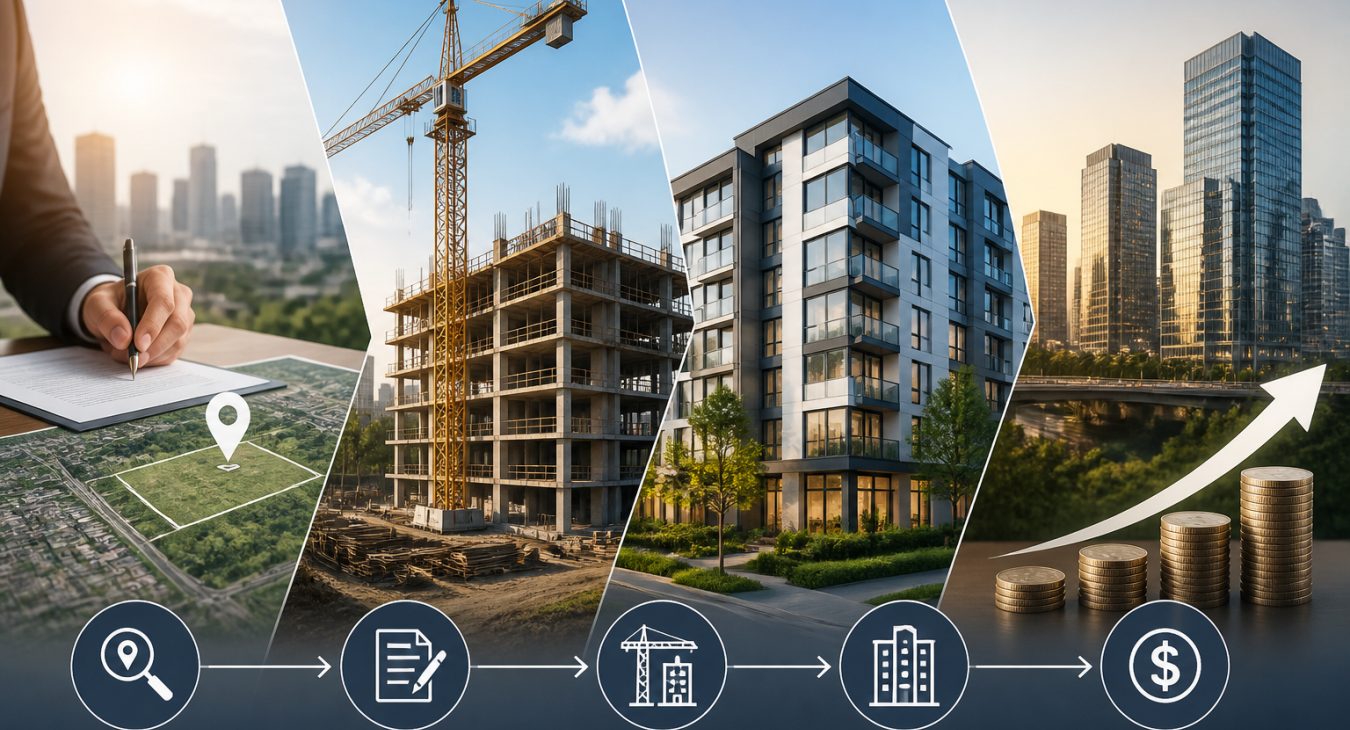
Learn the essential real estate development process steps from land acquisition to profitable exit. Master value creation strategies today.
Products and Tools Mentioned in this Post

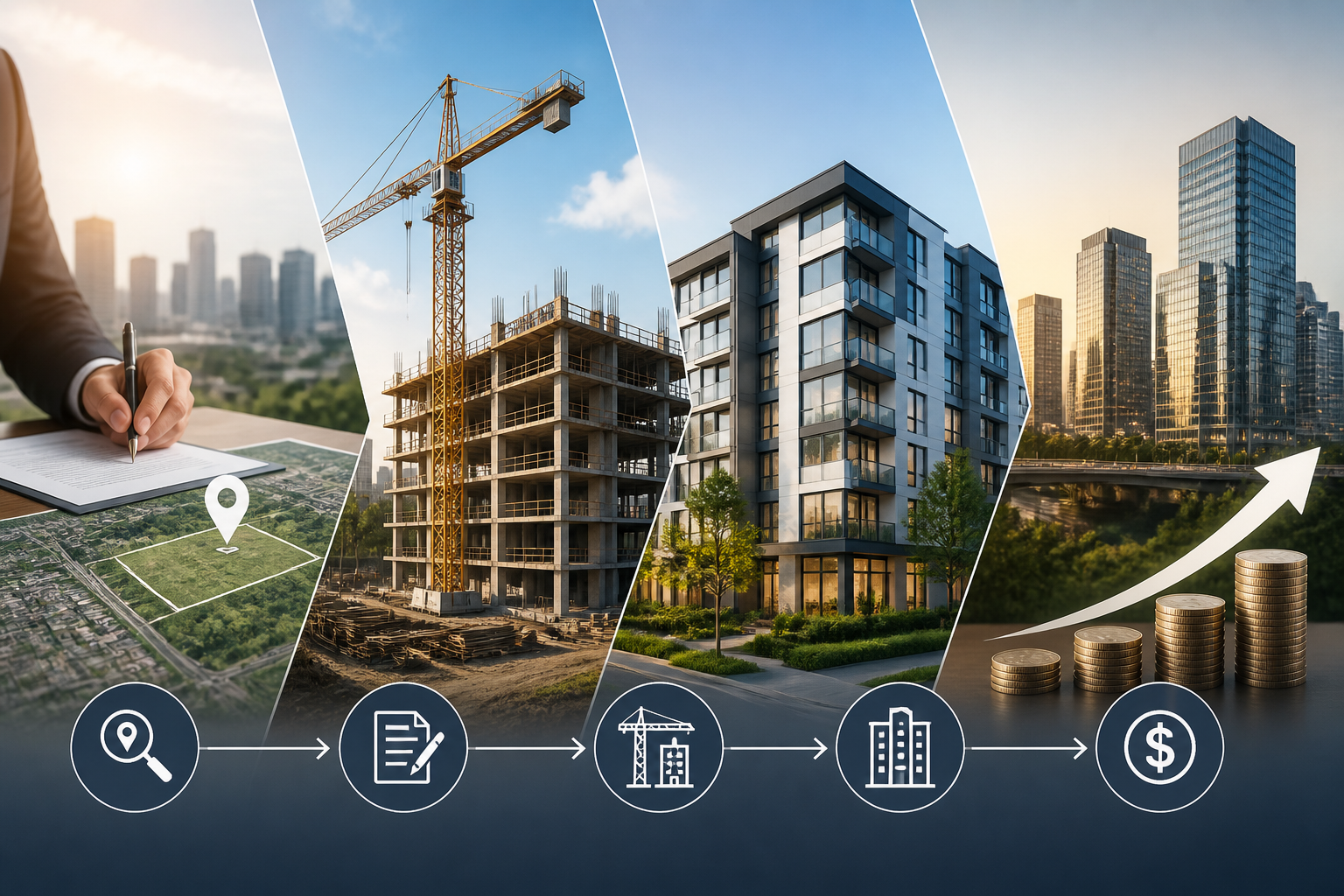
Table of Contents
- Introduction to Real Estate Development
- Phase 1: Pre-Development and Site Selection
- Phase 2: Development and Entitlements
- Phase 3: Construction and Development
- Phase 4: Post-Construction and Operations
- Risk Management Across All Stages
- Technology and Process Optimization in Development
- Sustainability and Alternative Development Models
Real estate development is one of the most capital-intensive, complex, and rewarding endeavors in the investment world. Unlike buying a stabilized rental property or flipping a house, ground-up development transforms raw land or underutilized assets into income-producing properties. You're creating value at every stage. But that value creation doesn't happen by accident—it follows a structured, repeatable sequence of real estate development process steps that experienced developers, investors, and their teams execute with precision. Whether you're evaluating your first development deal or managing a multi-site portfolio, understanding the full lifecycle from initial acquisition through final exit gives you a decisive edge. You'll underwrite risk better, manage timelines tighter, and maximize returns harder.

Introduction to Real Estate Development
What's Real Estate Development?
Real estate development converts land, capital, and ideas into functional, income-producing built environments. That's the short version. On the longer end, it spans everything from buying raw land and building from scratch to repositioning existing assets through adaptive reuse or major renovation. The developer? They're the orchestrator—pulling together architects, engineers, contractors, lenders, municipal authorities, and end users to move a project from napkin sketch to ribbon cutting.
This is fundamentally different from traditional real estate investing. An investor buys a stabilized asset and collects cash flow. A developer creates the asset itself—and shoulders all the risk and reward that comes with it. You're targeting profit-on-cost margins of 15–25%+ on total project cost, or IRR in the 18–30% range for ground-up deals depending on market conditions and use type. That's where the real money is.
Why Understanding the Process Matters
One mistake in any single phase cascades fast. Cost overruns. Timeline blowouts. Regulatory landmines. Project failure. The Urban Land Institute data backs this up: cost overruns of 10–20% are the norm, not the exception. Timeline extensions run 6–18 months as standard. And if you don't know where these risks hide, you'll pay for that ignorance in capital and opportunity cost.
Working with the BRRRR real estate method or active house flipping? You'll recognize the structural similarities to development. But development operates at bigger scale, longer timelines, and way more regulatory friction. Learning how seasoned developers navigate this complexity directly translates to how you'll handle value-add or ground-up projects.
Overview of Key Stages
Development breaks into four primary phases: Pre-Development, Entitlements and Design, Construction, and Post-Construction Operations. Each has its own activities, players, cost buckets, and risk profile. The table below gives you the lay of the land before we dig into each one.
| Phase | Typical Duration | Key Activities | Primary Stakeholders | Budget Allocation |
|---|---|---|---|---|
| Phase 1: Pre-Development | 3–12 months | Site selection, feasibility, financing, land acquisition | Developer, broker, attorney, lender, consultant | 1–5% of total project cost |
| Phase 2: Entitlements & Design | 6–24 months | Team assembly, architecture, engineering, zoning, permits | Architect, engineer, municipality, legal, planner | 5–12% of total project cost |
| Phase 3: Construction | 12–36 months | Site prep, vertical construction, inspections, tenant fit-out | GC, subcontractors, lender, inspector, PM | 60–80% of total project cost |
| Phase 4: Post-Construction & Operations | Ongoing (12–36 months to stabilization) | Lease-up, property management, asset optimization, exit | Property manager, tenants, asset manager, broker | 5–10% annually (OpEx) |
Phase 1: Pre-Development and Site Selection
Pre-development is where projects get won or lost. You're making the critical decisions before any dirt moves—and that's where the real money gets made or lost. Experienced developers will tell you the same thing: the most important choices happen in the first 10% of the timeline. This phase isn't for the faint of heart. It demands rigorous analysis, creative problem-solving, and the discipline to walk away from deals that don't pencil.
Project Scope and Goals Definition
What are you building, for whom, and why will the market actually support it? That's your thesis. Your project scope needs to spell out the property type—multifamily, office, industrial, mixed-use, retail—along with your target user base and your development strategy. Are you doing ground-up construction? Adaptive reuse? Value-add renovation?
And here's the part most developers undersell: your exit strategy. Are you developing to hold and generate NOI, or developing to flip upon stabilization? This decision cascades through everything—your financing structure, your success metrics, your investor return profile.
That's why understanding the difference between hold and flip strategies matters so much. It's foundational.
Site Selection and Evaluation
Site selection is both art and science. You need a framework that doesn't miss the obvious plays or overlook hidden gems. Here's what strong site evaluation covers:
- Location fundamentals: Population growth, employment base, income levels, and demographic trends
- Market demand: Absorption rates, vacancy levels, comparable rents or sale prices
- Infrastructure: Utilities availability (water, sewer, gas, electric), road access, and transportation proximity
- Zoning and land use: Current designation and likelihood of favorable rezoning if required
- Physical attributes: Topography, soil conditions, flood zone status, environmental contamination history
- Competitive market: Existing supply pipeline and competing projects in the submarket
Strong development sites usually look like problems. They're the properties other investors passed on. If you know how to identify undervalued real estate opportunities, you're already halfway there—skilled developers see solutions where others see obstacles.
Preliminary Due Diligence
Before you even sign a purchase contract, run preliminary due diligence. Some call it "light" due diligence—and that's exactly what it is. You're screening for deal-killers without blowing capital.
Title search for encumbrances or easements. Preliminary zoning review. Phase I ESA at minimum. A survey of existing utilities. The goal? Spend minimal money while gathering enough information to make an informed go/no-go decision on full due diligence costs.
Feasibility Studies and Analysis
This is the backbone. A full feasibility study typically includes three components: a market study, a financial feasibility analysis, and a preliminary project pro forma.
The market study validates your assumptions—rental rates, absorption pace, competitive positioning. All of it. The financial feasibility analysis answers the question that actually matters: given all projected costs and revenues, does this project generate an acceptable return?
Your development pro forma needs to account for:
- Land acquisition cost
- Hard costs (construction, site work, tenant improvements)
- Soft costs (architecture, engineering, permits, legal, financing)
- Carrying costs during construction and lease-up
- Projected revenue (stabilized NOI or gross sale proceeds)
- Profit-on-cost margin and IRR calculation
Financial Planning and Capital Acquisition
Development financing works differently than conventional investment property loans. Most projects combine a construction loan (typically 60–75% loan-to-cost) with equity capital from you and/or your equity partners. The structure you choose determines everything about your returns and your risk exposure.
Here's how the most common financing options stack up:
| Financing Type | Typical LTC/LTV | Interest Rate Range | Term | Best For | Key Considerations |
|---|---|---|---|---|---|
| Construction Loan | 60–75% LTC | Prime + 1–3% (floating) | 12–36 months | Ground-up development | Requires completion guarantee; draws tied to milestones |
| Permanent/Takeout Loan | 65–80% LTV (stabilized) | 5–7% fixed (market-dependent) | 5–30 years | Refinancing upon stabilization | Requires minimum occupancy (typically 90%+) |
| Mezzanine Debt | Up to 85–90% total stack | 10–15% | 12–36 months | Filling gap between senior debt and equity | Higher cost; subordinate to senior lender |
| Joint Venture Equity | N/A (equity position) | 18–25%+ preferred return | Project duration | Reducing developer capital requirement | Profit sharing; loss of full control |
| EB-5 / Tax Credits | Varies | Below-market | Project-specific | Affordable housing, urban renewal projects | Complex regulatory requirements; long lead times |
Many developers use a construction-to-permanent refinance as their primary capital recycling mechanism. It's the development equivalent of the BRRRR refinance step. Understanding how a cash-out refinance fits into a hold strategy gives you the playbook.
Purchase Negotiations
Feasibility is confirmed. Financing is structured conceptually. Now you negotiate the purchase and sale agreement. But development deals aren't like conventional acquisitions.
Push for an extended due diligence period—60 to 180 days on larger projects. Build in contingencies tied to entitlement milestones. Consider seller carry or earnest money structures that preserve your capital during the approval process. Options contracts are especially valuable on entitlement-heavy deals. They lock in your purchase price without obligating you to close until you've gotten your approvals.
Back to topPhase 2: Development and Entitlements
The entitlements phase is the wild card. Unlike construction—which follows a predictable timeline—entitlements depend on municipal politics, community sentiment, and regulatory complexity. Experienced developers don't wait and see. They manage this proactively.
Assembling the Development Team
You can't build a deal alone. Your development team is a cross-disciplinary group of professionals whose coordinated effort determines whether your project runs on time, on budget, or spirals into cost overruns and delays. Here's who you need:
| Team Member | Primary Responsibilities | Phase of Greatest Involvement | Fee Structure |
|---|---|---|---|
| Architect | Schematic design, construction documents, permit drawings | Entitlements & Construction | 6–10% of hard costs |
| Civil Engineer | Site grading, utilities, drainage, site plan | Entitlements & Pre-Construction | 1–3% of hard costs |
| General Contractor | Construction management, subcontractor coordination | Construction | GMP or fixed-price contract; 5–10% fee |
| Real Estate Attorney | Contract negotiation, entitlement strategy, entity structure | All phases | Hourly ($300–$600/hr) or flat fee |
| Land Use Attorney/Planner | Zoning approvals, variance applications, hearings | Entitlements | Hourly or retainer |
| Environmental Consultant | Phase I/II ESA, remediation oversight | Pre-Development | Project-based ($3,000–$50,000+) |
| Lender/Loan Officer | Construction loan origination and draw management | Pre-Development & Construction | 1–2% origination fee |
| Property Manager | Lease-up planning, operations transition, tenant relations | Post-Construction | 4–10% of gross revenue |
Site Plans, Engineering, and Architectural Design
The design process hits three distinct stages: schematic (big picture), design development (the details), and construction documents (ready for permits). Each stage locks in more certainty and costs. And here's the key insight: value engineering early—finding cost cuts without killing the project—costs a fraction of what you'll spend redesigning after permits drop.
Expect to pay your architect 6–10% of total hard construction costs. Cutting corners on design is penny-wise, pound-foolish. Bad drawings spawn RFIs, change orders, and angry tenants. Those mistakes cost you multiples of whatever you saved.
Land Entitlements and Zoning
Entitlements are the legal green light that lets you build a specific project on a specific lot. Zoning approvals, conditional use permits, variances, subdivision approvals, special exceptions—you need them. But here's the catch: timelines are all over the place.
A pro-development suburb? 90 days. A dense urban market with organized opposition? Three years or more. The difference comes down to strategy: engage neighbors early, hire a land use attorney who knows the local players, and build relationships with planning staff before you even file. Entitlement risk—the chance your approvals get denied or buried in review—is the biggest early-stage risk you'll face. And it's almost entirely avoidable with smart prep work.
Municipal Submissions, Reviews, and Permit Approvals
Once entitlements are locked, you move to building permits. That means submitting your construction documents to the local building department for plan review. Commercial projects typically take 4–16 weeks, and you'll probably go through multiple review cycles.
Fire department, health department (if you've got food service or medical uses), utilities—they all review in parallel. But here's what separates smart developers from the rest: pre-application meetings with plan reviewers before you formally submit. You identify red flags early, avoid weeks of revision loops, and sometimes buy expedited review for a fee premium. When you're carrying a construction loan at tens of thousands per month, that premium pays for itself in a heartbeat.
Back to topPhase 3: Construction and Development
This is where it gets real. Construction is when you're deploying the biggest chunk of capital, and it's also where most deals go sideways if you're not disciplined. You need rigorous scheduling, aggressive cost control, quality oversight, and clear communication across every party on site. Budget and timeline discipline? They're tested hard during this phase.


Pre-Construction Coordination
You've got 60–90 days before breaking ground, and it's packed. This is arguably the most operationally intensive stretch of the entire project. You're finalizing the construction contract—GMP, lump sum, or cost-plus—completing subcontractor buyout, locking in the construction schedule, establishing draw procedures with your lender, and setting up site logistics. Get this wrong and surprises will haunt you for months. A detailed pre-construction checklist cuts mid-construction headaches in half.
Budget Finalization and Cost Control
Your construction budget comes from detailed contractor bids. Make sure it covers:
- Hard costs (foundations, framing, MEP systems, finishes)
- Site work (grading, utilities, paving, landscaping)
- Owner-furnished items and tenant improvements
- Contingency reserves (typically 5–10% on hard costs)
- Owner's soft costs during construction (insurance, taxes, loan interest)
Here's where most developers blow it: under-reserving contingency. You set aside 5% on a $10 million budget? That's only $500,000. Ground-up work with real complexity? Experienced operators reserve 10–15% for unforeseen conditions, design changes, and scope creep. And that's not overcautious—it's smart math. The disciplined use of cost thresholds in real estate investment applies directly here: never let construction costs erode past the point where your deal still pencils. Period.
Construction Management and Quality Control
Daily site oversight. Weekly owner-architect-contractor meetings. Monthly draw reviews. Continuous quality control inspections. You or your owner's rep needs to be sharp enough to read the GC's progress reports and spot schedule slippage, cost trends, and quality problems before they snowball. Don't be a passive observer on your own project.
Track these metrics religiously:
- Schedule adherence: Percent of milestones completed on time
- Budget-to-actual variance: Committed costs vs. original budget
- Change order volume: Number and dollar value of approved change orders
- RFI response time: Speed of design team response to contractor questions
- Safety incident rate: OSHA recordable incidents per 200,000 work hours
Tenant Coordination and Turnover
On income-producing commercial or multifamily deals, lease-up doesn't wait until you're done building. Most construction lenders want prelease commitments—especially on retail and office—before they'll fund. And coordinating tenant finish work (tenant improvements, or TI) inside the construction schedule? That demands constant communication between the GC, tenants, and their own contractors. For multifamily, you're typically leasing 60–90 days before the first units deliver, targeting stabilized occupancy at 90–95% within 12–18 months of certificate of occupancy. Hit those numbers and your business plan works.
Back to topPhase 4: Post-Construction and Operations
Most developers celebrate the certificate of occupancy like they've won. But here's what separates experienced operators from the rest: they know the real work is just beginning. This is where you either maximize your asset's income potential or watch it underperform.
Project Closeout
Your punch list won't complete itself. You need to nail every contractor item, get that certificate of occupancy in hand, collect warranties and as-built drawings, and pull your final lender draw. Do this right, and you protect your rights under the construction contract. You also ensure the building transfers in the exact condition your lender and investors expect. Skip a step here? You'll regret it.
Property Management Setup and Operations
Moving from construction site to income-producing asset means setting up management systems, staffing the office (if you're doing a larger deal), signing leases, and getting utilities live. And here's what matters most: picking the right property manager. Third-party or in-house—either way, this call directly impacts your NOI. A manager who knows the local market intimately can be worth 80 basis points at disposition. That's the difference between trading at a 5.0 cap and a 5.8 cap.
Before you flip the switch to operations mode, get your asset protection structures locked in. Proper insurance, tight entity structuring, liability waivers—whatever your asset type demands.
Operations and Monetization Strategy
The operating phase validates everything. Your thesis gets tested in real time. Different asset classes run different playbooks: multifamily chases occupancy and rent growth, retail and office focus on lease-up and tenant credit, industrial targets lease rates and clear height premiums. But the metrics that matter? They're universal. NOI, occupancy, DSCR. Those three numbers tell you if the project works.
And here's a hard truth: knowing when to exit matters as much as building the asset. Define your exit strategy before you break ground—not after you've stabilized. You've got three main plays: sell at stabilization and pocket the development spread, refinance and hold for long-term cash flow, or bring in an institutional equity partner for a recap.
Back to topRisk Management Across All Stages
You can't treat risk management as a one-time box to check. It's embedded in every call you make—from the moment you're evaluating a site through the final exit. What does your actual risk profile look like at each phase? Here's the breakdown developers rely on:
| Project Stage | Key Risk | Probability | Impact | Mitigation Strategy |
|---|---|---|---|---|
| Pre-Development | Entitlement denial | Medium | High | Early community engagement; contingent contracts; phased earnest money |
| Pre-Development | Environmental contamination | Low–Medium | Very High | Phase I and II ESA; remediation cost reserve; seller indemnification |
| Pre-Development | Market demand shift | Medium | High | Conservative underwriting; flexible program design; prelease commitments |
| Construction | Cost overruns | High | High | 10–15% contingency reserve; GMP contract; experienced GC selection |
| Construction | Schedule delays | High | Medium–High | Liquidated damages clauses; float in schedule; lender extension provisions |
| Construction | Contractor default | Low | Very High | Payment and performance bonds; prequalification; retainage |
| Operations | Lease-up underperformance | Medium | High | Conservative absorption assumptions; lease-up reserve; strong PM selection |
| Operations | Interest rate risk | Medium | High | Rate caps on floating debt; early permanent loan locking; shorter holds |
| Operations | Tenant default | Low–Medium | Medium | Thorough tenant underwriting; lease guarantees; diversified tenant mix |
Early-Stage Risk Mitigation
Pre-development is where you get the biggest bang for your risk dollar. Spend $50,000–$150,000 on solid feasibility work, environmental studies, and legal review now. You'll avoid the multi-million-dollar disasters later. And here's the thing—the cost of information is dirt cheap at this stage compared to fixing problems after you've already broken ground.
Structure your purchase contracts with real teeth. Use contingencies and phased earnest money deposits. If the project tanks before you hit your go/no-go milestones, you walk away with most of your capital intact.
Construction-Phase Risk Management
Once you're building, your toolkit shifts. Contracts matter—GMP agreements, bonds, insurance, retainage. So does cash—solid contingency reserves and tight lender draw controls. But the real work is operational: pick a GC you trust, then don't trust them anyway. Site visits. Independent inspections. That's the discipline.
Payment and performance bonds? Non-negotiable on anything north of $5 million. Doesn't matter if you've worked with the contractor for fifteen years.
Operational Risk Strategies
Operational risks snowball. You need to catch them early. Rate caps on floating construction debt became table stakes in 2022–2023. If you didn't lock that in, you learned the hard way.
Build a lease-up reserve equal to 6–12 months of projected operating expenses. That buffer keeps you alive when absorption runs slower than you modeled, which it will on new submarkets or unproven product types.
Back to topTechnology and Process Optimization in Development

Real estate development's been behind the tech curve for years. But that's changing fast. Developers who've actually invested in purpose-built technology tools? They're seeing real gains in efficiency, cost control, and how their teams communicate.
Development Process Checklists and Standardization
Here's what separates solid operators from the rest: standardized checklists. They're among the highest-ROI tools you can implement. A comprehensive pre-development checklist means nothing gets missed—not on your first deal, not on your fiftieth. Same goes for permitting checklists, construction draw reviews, and project closeout procedures. They'll catch errors and build the kind of institutional knowledge that sticks around even when people leave.
Project Management and Task Tracking Systems
Dealpath, Procore, Yardi Voyager—these platforms let you track milestones, manage documents, and watch your budget in real time. Most development shops are still juggling spreadsheets, email threads, and shared drives. It's inefficient. Purpose-built project management software consolidates all that noise into one place. AI-powered tools for real estate investors are getting smarter too. They're automating deal screening, document review, and portfolio reporting—capabilities that translate directly to development workflows.
Stakeholder Collaboration and Communication Platforms
A typical development deal involves dozens of stakeholders. Legal, design, construction, finance, government relations—all of them need to stay aligned. Procore, Slack, Fieldwire—platforms like these centralize communication and kill the information silos that tank projects and blow budgets. And here's something to pay attention to: lenders now demand access to your project management platform before they'll fund construction financing. They understand what should be obvious—better-informed lenders are better-protected lenders.
Reporting, Analytics, and Data-Driven Decision-Making
Forget the basic monthly variance report. Real developers are running business intelligence dashboards that track metrics across an entire portfolio simultaneously. You can spot systemic cost trends, measure your GC's performance against benchmarks, and run return scenarios in real time. When you integrate data from construction management systems, accounting platforms, and market data providers, you've got a single source of truth.
That matters. It means you make faster, smarter decisions at every stage. And if you're managing multiple projects or dealing with investor relationships? Strong reporting systems are non-negotiable for keeping stakeholders confident and staying compliant. Learning how top real estate operators allocate their marketing and operating budgets gives you solid benchmarks for the operational phase of your development project.
Back to topSustainability and Alternative Development Models
Ground-up construction on vacant land? It's just one option. Two models are reshaping how serious investors think about modern deals: adaptive reuse and sustainability-focused development. You should understand both.
Adaptive Reuse vs. Ground-Up Construction
Urban infill land keeps getting scarcer and pricier. That's why adaptive reuse—turning old factories, retail centers, and office buildings into something completely new—has exploded. You get reduced entitlement risk because the structure's already there. Demo and site work costs drop dramatically. And you've got tax incentives like historic tax credits (20% federal credit on qualified rehabilitation expenditures) and new markets tax credits sitting on the table.
But there's a catch. Existing structures hide surprises. You'll pay more per square foot in soft costs, and renovation work in older buildings is inherently unpredictable. Unknown conditions within those walls can kill your timeline and budget.
Sustainability and ESG Considerations
ESG used to be nice-to-have. Not anymore. Environmental, social, and governance considerations are now market expectations across most asset classes and capital markets.
Green building certifications—LEED, WELL, Energy Star—aren't just marketing anymore. They command rent premiums of 3–10% in competitive markets. Institutional equity investors demand them. Certain lenders require them. Incorporating sustainability features—high-performance building envelopes, EV charging infrastructure, solar-ready roofs, and water efficiency systems
Back to top