


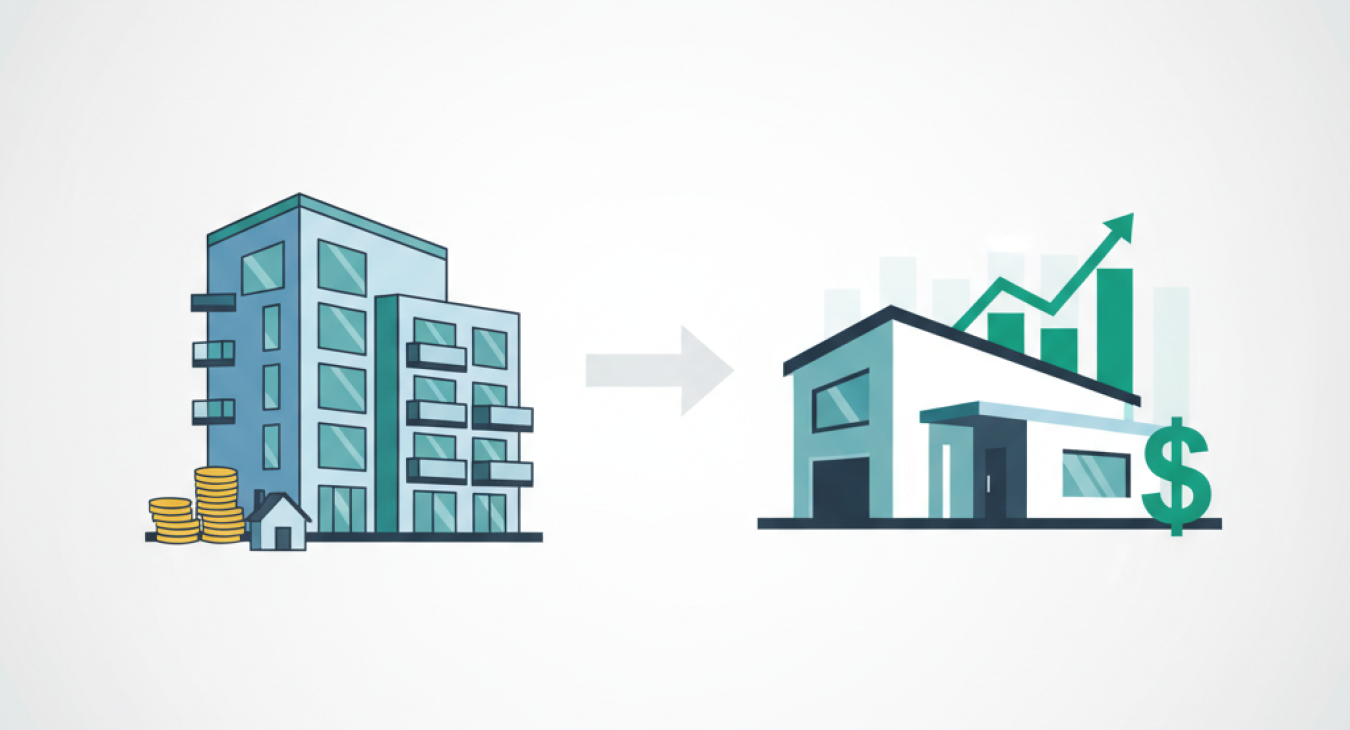
Learn the key differences between whole-tailing vs wholesaling real estate and which strategy maximizes your profits based on capital, skills, and market.
Table of Contents
- What's Wholesaling in Real Estate?
- What's Whole-Tailing in Real Estate?
- Wholesaling vs. Whole-Tailing: A Detailed Comparison
- Advantages of Wholesaling
- Disadvantages of Wholesaling
- Advantages of Whole-Tailing
- Disadvantages of Whole-Tailing
- Financing Your Strategy
- Case Studies: Wholesaling vs. Whole-Tailing
- Common Mistakes and How to Avoid Them
- Which Strategy Should You Choose?
- Conclusion: Choosing Your Real Estate Investment Path
- Frequently Asked Questions
You'll hear wholesaling and whole-tailing used interchangeably in real estate circles — but that confusion could cost you serious money. They're not the same strategy. One requires almost no capital and closes in days. The other? It demands cash reserves, project management chops, and a much longer runway to profitability. Both can print money — but only if you match the strategy to your capital, your market, and the actual deal in front of you. This article breaks down whole-tailing vs wholesaling from every angle so you can decide which path actually fits your situation.

What's Wholesaling in Real Estate?

How Wholesaling Works
You find a deeply discounted off-market property. Lock it up under contract. Then flip that contract to a cash buyer and pocket the difference — without ever owning the thing. That's wholesaling. The wholesaler sits in the middle, capturing spread between what the seller accepts and what the end buyer pays.
The Wholesaler's Role
What's your real job here? Deal-finding and buyer network management. Not property management, not tenant relations. You're hunting motivated sellers through direct mail, cold calling, driving for dollars, and digital marketing. Once you've got a deal under contract, you market it to your cash investor list. Want the full breakdown of how this actually works? Check out The Complete Guide to Wholesaling Real Estate in 2026.
Capital Requirements
Here's what makes wholesaling so attractive to investors starting out: the capital barrier is almost nonexistent. Earnest money runs $500–$5,000 to secure the contract. Add your marketing costs and maybe a small transaction coordination fee. That's it. Most investors launch for under $5,000 total. And the upside? Assignment fees typically range from $5,000 to $50,000 per deal — with high-equity plays going significantly higher. For specifics on what you actually need to get rolling, see how much money you need to start wholesaling.
Back to topWhat's Whole-Tailing in Real Estate?

How Whole-Tailing Differs
You take title. That's the biggest difference. Unlike wholesalers who assign contracts and never own the deal, whole-tailers actually purchase the property, throw in some light cosmetic work—cleaning, paint, flooring, minor repairs—and then flip it on the MLS to retail buyers or move-in-ready investors. It's the sweet spot between the thin margins of wholesaling and the heavy lift of a full fix-and-flip. And here's why it matters: you capture way more of the value spread without burning 12 months and six figures on a gut renovation. Want the step-by-step breakdown? Learn how to wholetail real estate before you commit any capital.
The Whole-Tailer's Approach
Take title. Stabilize cosmetically. Sell near retail.
That's the whole play. Instead of assigning a contract like a wholesaler, you own the property. You limit improvements intentionally—typically $5,000 to $25,000 total—to avoid the complexity and bleeding costs of a full rehab. This strategy crushes on structurally sound properties that look tired but don't need major work.
Required Capital and Timeline
Here's where whole-tailing demands real money. You'll need a down payment (or the full purchase price if you're buying all cash), renovation funds, and carrying costs stretching 60–180 days depending on market conditions and how quickly you can find your buyer. Hard money financing typically runs 10–14% interest, and every month you're holding costs you money. But the margins? $20,000 to $100,000+ per deal isn't uncommon. That's why investors with access to capital and patience prefer whole-tailing over wholesaling.
Back to topWholesaling vs. Whole-Tailing: A Detailed Comparison

Let's lay out the core numbers side-by-side. This matrix covers every decision factor that actually matters:
| Factor | Wholesaling | Whole-Tailing |
|---|---|---|
| Capital Required | $500–$5,000 (earnest money + marketing) | $20,000–$100,000+ (purchase + rehab + carrying costs) |
| Typical Profit Per Deal | $5,000–$50,000 | $20,000–$100,000+ |
| Timeline to Profit | 7–30 days | 60–180 days |
| Property Condition | Any condition (heavily distressed OK) | Cosmetically distressed, structurally sound |
| Holding Period | None (no title transfer) | 1–6 months |
| Risk Level | Low | Moderate |
| Financing Needed | Rarely | Almost always |
| Skill Set Required | Negotiation, marketing, contract management | Project management, market analysis, financing |
| Scalability | High (multiple simultaneous deals) | Moderate (limited by capital and bandwidth) |
| Passive Income Potential | None (transactional) | Low–Moderate (if held as rental) |
Advantages of Wholesaling

Speed to Profit
Want cash in your account fast? Wholesaling's your answer. You can take a deal from first contact with a motivated seller straight to an assignment fee deposited in your bank in as little as 7–14 days. That's the kind of speed that matters when you need active income right now, not some theoretical wealth-building play ten years from now.
Minimal Capital Required
No down payment. No renovation budget. No carrying costs eating away at your returns month after month. Get your earnest money structure right—and seriously, understand how to protect your earnest money—and your financial exposure stays minimal. This is why wholesaling's the most accessible entry point in real estate investing. Anyone with hustle and a phone can get started.
Lower Risk Profile
You never take title. That's the whole game right there. Market crashes? Not your problem. Contractors go sideways? Doesn't touch you. Holding costs spiral? You're already gone. If your buyer bails, you find another one or extend the contract. Your worst-case scenario is losing your earnest money and whatever you spent on marketing.
Scalability
And here's where wholesaling flexes. A dialed-in wholesaler runs 5–10+ deals at the same time with solid systems and a real buyer network. Whole-tailing? You're capped by capital and how much work you can physically manage. But wholesaling scales with your marketing and networking muscle. Check our wholesaling vs flipping vs rental breakdown to see how this stacks up against other strategies.
Back to topDisadvantages of Wholesaling
Market Dependency and Assignment Challenges
You need buyers. Lots of them. Without an active, deep buyer pool, your wholesale operation stalls fast. In slow markets or niche property types, finding an end buyer becomes the bottleneck that kills your deal. And here's the kicker: some states have enacted restrictions on contract assignments, which means you're stuck doing double-closes that add complexity and erode your already-thin margins.
Reputation Sensitivity and Margin Limits
One bad contract performance, and your reputation takes a hit in local investor circles—a market that's surprisingly small and interconnected. You can't afford that kind of fallout. But here's what really stings: even on your best wholesale deals, you're leaving serious equity on the table. Take a $80,000 ARV spread. As a wholesaler, you might pocket a $15,000 assignment fee while a whole-tailer captures $60,000 of that same upside. That gap widens on every single deal. Understanding how assignment contracts work keeps you out of legal trouble, at least.
Back to topAdvantages of Whole-Tailing

Higher Profit Potential
Here's the core advantage: you're selling to traditional homebuyers with conventional mortgages, not scrapping it out with other cash investors for the same deal. That's a much bigger buyer pool. The retail premium? You're looking at $20,000 to $50,000 in additional profit compared to what you'd pocket on a wholesale assignment. Same property, different exit strategy, dramatically different bottom line.
Greater Control and Tax Benefits
Own the property, own the decisions. You set the renovation timeline, you choose the contractor, you determine when and how to list it, and you negotiate the terms. And that's just the operational side.
Ownership unlocks tax advantages you don't get wholesale — depreciation benefits if you hold it longer, for one. But it gets better. Your exit strategy isn't carved in stone. Market shifts? Pivot to a rental. Want to leverage the equity? Try a BRRRR strategy instead. You're not locked into anything.
Back to topDisadvantages of Whole-Tailing
Capital, Complexity, and Market Risk
Higher profit ceilings don't come free. You're looking at serious capital requirements upfront, pre-arranged financing, and the operational chops to execute a light renovation without blowing your timeline. Every single week the property sits empty bleeds money — interest, taxes, insurance, utilities. The numbers add up fast.
Here's where it gets risky. Market softens during your hold period? Or the rehab uncovers surprises in the walls? Your projected profit disappears. Just like that.
Most whole-tailers lean on hard money loans, and they're not cheap. You're looking at 10–14% interest rates, 1–3 points in origination fees, and terms of 6–12 months. That's real money eating into your deal economics. And you need to account for it in every single analysis you run.
Want the full picture on hard money? Check our complete guide to hard money loans — it breaks down terms, lender expectations, and what actually matters when you're shopping rates.
Back to topFinancing Your Strategy
| Financing Type | Wholesaling Applicability | Whole-Tailing Applicability | Typical Terms | Key Advantage |
|---|---|---|---|---|
| Contract Assignment | Primary method | Not applicable | No financing required | Zero capital exposure |
| Hard Money Loans | Rarely needed | Very common | 10–14% rate, 1–3 pts, 6–12 months | Fast approval, ARV-based lending |
| Private Money | Occasionally for double-close | Common alternative to hard money | 6–10% rate, negotiable terms | Lower cost, flexible structure |
| Bank/Conventional Financing | Not applicable | Rarely (too slow for distressed deals) | 5–8% rate, 20–25% down | Lowest cost long-term |
| Bridge Loans | Not applicable | Moderate use | 8–12% rate, 6–24 months | Bridges to longer-term financing |
Case Studies: Wholesaling vs. Whole-Tailing
Wholesaling Example Deal
| Metric | Amount |
|---|---|
| Purchase Price (Contracted) | $115,000 |
| After Repair Value (ARV) | $210,000 |
| Assignment Fee | $18,000 |
| Time to Close | 14 days |
| Capital Required | $2,500 (earnest money) |
Whole-Tailing Example Deal
| Metric | Amount |
|---|---|
| Purchase Price | $115,000 |
| Renovation Costs | $18,000 |
| After Repair Value (ARV) | $210,000 |
| Retail Selling Price | $198,000 |
| Gross Profit (before carrying costs) | $65,000 |
| Holding Period | 90 days |
| Carrying Costs (financing + taxes + insurance) | $8,500 |
| Net Profit | ~$56,500 |
Here's where it gets interesting. The same deal hits you with $18,000 as a wholesale assignment or roughly $56,500 through whole-tailing — that's $38,000 more sitting in your pocket. But here's the catch: whole-tailing demands $133,000+ of your actual capital locked up for 90 days. Wholesaling? Just $2,500 for 14 days. Your call comes down to one thing: do you have the dry powder, and can you stomach the longer hold?
Back to topCommon Mistakes and How to Avoid Them
Wholesaling Pitfalls
- Overpaying for deals: Emotional buying kills wholesale profit. That's why you need a hard rule: 65–70% of ARV minus repairs, every single time. Don't break it.
- Weak buyer lists: You can't build your cash buyer network after you've already locked up a deal. Do it now, before you need it. A deal with no buyer waiting? That's a liability, not an asset.
- Legal compliance: Here's the thing—some states restrict assignment of contracts or require a real estate license to wholesale. Your state might be one of them. Verify your regulations before you sign anything. And when you're sourcing deals, stick with proven lead sources that actually generate quality assignments worth your time.
Whole-Tailing Pitfalls
- Underestimating renovation scope: You think it's cosmetic. Then your contractor finds rotten joists or a shot HVAC system. Cosmetic projects regularly hide structural and mechanical problems, which is why you should always budget a 15–20% contingency on top of your estimate.
- Misjudging the market: Listing a retail-priced property in a market with limited conventional buyer activity is how you bleed money. Your hold extends. Your margins evaporate.
- Poor exit flexibility: Know your backup plan before you close on the property. If the retail market stalls, can you actually pivot to a rental or BRRRR strategy? Figure that out upfront.
Which Strategy Should You Choose?

Start with what you've actually got in the bank. Less than $20,000 and need cash in 30 days? Wholesaling's your move. You can flip contracts without ever closing. But if you're sitting on $50,000+ in liquid capital, have solid financing lined up, and can handle construction management, whole-tailing crushes wholesaling on per-deal economics. The ARV spread is just wider.
Your market's playing a huge role here too. Hot seller's markets with hungry retail buyers? Whole-tailing wins because properties vanish fast and you're capturing real retail premiums. Flip the script—slower markets dominated by investors—and deal velocity from wholesaling might actually outperform your annualized returns versus sitting on a retail listing for months. Need the full breakdown? Our real estate investing strategies comparison walks through every major play. And if capital constraints are killing your ability to move forward, check out real estate investing with no money strategies.
Here's what most pros actually do: both, at the same time. They wholesale the absolute dogs—properties so distressed or discounted they'll never work as a retail flip. Then they whole-tail the cosmetic rehabs with obvious retail demand. This hybrid approach keeps money flowing every month, maximizes your profit per deal, and honestly, it's just a smarter business model.
Back to topConclusion: Choosing Your Real Estate Investment Path
Here's the truth: there's no universal winner in the wholesaling vs. whole-tailing debate. What works depends entirely on your situation, the deal in front of you, and market conditions right now. Wholesaling dominates on speed, scalability, and capital efficiency. You need minimal cash to get started, and it's honestly the best entry point for new investors. If you've got a solid buyer network? You've got a reliable cash flow machine. Whole-tailing wins on profit per deal and direct retail market access. But it demands capital, serious project management chops, and the patience to see a rehab through to completion.
Your best bet? Learn both inside and out. Understand what each specific deal actually requires, then pick the strategy that maximizes your ROI on time and capital. Start with what you've got—whether that's cash, connections, or hustle—build your skills and network from there, and add new tools to your toolkit as your business scales.
Back to topFrequently Asked Questions
Can you do whole-tailing without a real estate license?
Yes. Most states won't require a license just to buy and flip a property for profit—even if you're listing it on the MLS with an agent. But here's the catch: if you're actually representing buyers or sellers in the transaction, licensing laws kick in. Get a local real estate attorney to review your state's specific rules. Don't guess on this one.
Is wholesaling or whole-tailing better for beginners?
Wholesaling wins for most new investors. You need less capital, you're taking on less risk, and you'll get deal feedback fast—which teaches you more about market analysis than anything else. Whole-tailing? That's a move for later, once you've stacked some capital, built your lender relationships, and know exactly who your retail buyers are in your market.
what's a novation agreement and how does it relate to these strategies?
A novation agreement lets you step out of the deal entirely without assigning your contract rights. Instead of assigning your interest to an end buyer, a novation replaces you as the purchaser on the original contract. The end buyer becomes the new buyer—you're gone. It's especially valuable in states with tight assignment restrictions and gives you flexibility between wholesale and whole-tail plays.
How do I evaluate whether a property is better for wholesaling or whole-tailing?
Run both scenarios on every deal. Is the spread between your contract price and ARV fat enough that an investor buyer at 65–70% ARV still clears strong profit—and you pocket a solid assignment fee? That's wholesaling territory. Now flip it: does the property only need cosmetics, sit in a market with real retail demand, and do you have the capital and patience to hold? Whole-tailing almost always wins on return for the same deal.
What happens if I can't sell my whole-tail property at retail pricing?
You've got options. Cut the price and flip it to a cash investor buyer (it's a late-stage wholesale at that point). Or convert it to a rental and pull cash back out through a cash-out refinance BRRRR approach. You could also lease it while you wait for the market to move in your favor. The real move? Underwrite every deal with at least two or three exit strategies baked in before you even close.
Back to top