


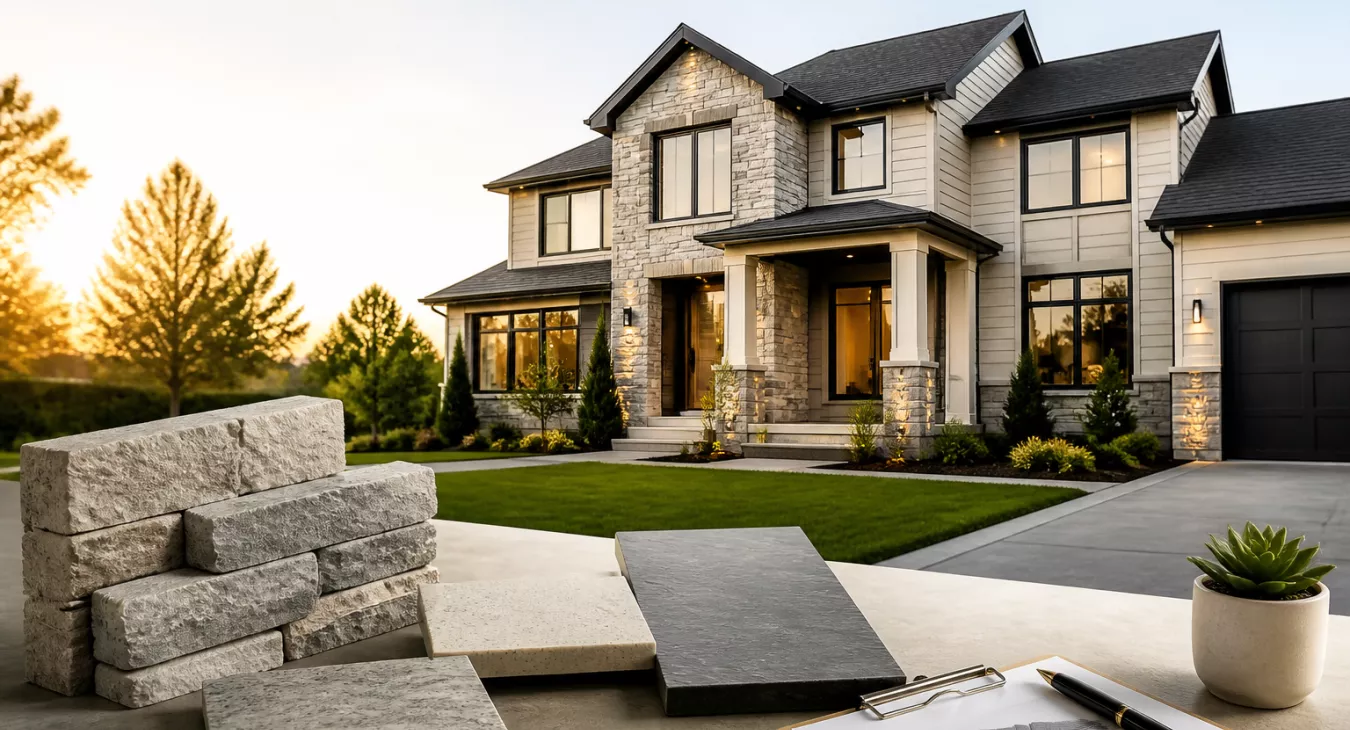
Maximize your real estate exit value with strategic stone improvements. Learn how veneer, hardscaping & stonework boost property multiples and buyer percep
Table of Contents
- Understanding Stone Improvements and Their Impact on Real Estate Exit Value
- What Stone Improvements Actually Return
- Stone Improvements and Exit Cap Rate Analysis
- Value-Add Strategy Through Stone Improvements
- Hidden Value Revealed Through Stone Improvements
- Real Estate Exit Strategies Using Stone Improvements
- Underwriting Stone Improvements in Real Estate Analysis
- Key Performance Metrics for Stone Improvement Investments
- Conclusion
- Frequently Asked Questions About Stone Improvements and Exit Value
Most commercial real estate investors focus on rent growth, occupancy rates, and cap rate compression when planning an exit. But here's what they're missing: stone improvements have a measurable, direct impact on your exit multiple. Install stone veneer on a multifamily façade. Add hardscape to a retail center. Upgrade structural stonework on a commercial building. Each one changes how buyers perceive the property—and crucially, what they'll actually pay for it. This guide walks you through the mechanics of stone improvements and exit value creation. You'll get the underwriting framework, timing strategies, and specific data points you need to decide if stone is worth the capital deployment on your deal.

Understanding Stone Improvements and Their Impact on Real Estate Exit Value

What Are Stone Improvements in Real Estate?
Stone improvements are capital expenditures that bring natural or manufactured stone materials into a property. Think of them as tactical moves in your renovation playbook. They break down into three distinct buckets:
- Stone veneer: Thin-cut or manufactured stone applied to building exteriors, lobby walls, or accent features. Mostly cosmetic, but it hits hard on curb appeal and perceived quality.
- Hardscaping: Stone-based outdoor work — retaining walls, paved walkways, courtyards, landscaping details. You'll see this in multifamily, retail, and mixed-use plays all the time.
- Structural stone work: Load-bearing or foundational stone, column cladding, staircase renovation, entry features. These pull double duty: functional and beautiful.
Each comes with its own cost structure, installation timeline, and return profile. Pick the wrong one for your exit strategy and you're leaving money on the table.
How Stone Improvements Create Hidden Value
Stone creates value two ways: direct aesthetic uplift and indirect market repositioning. Buyers and tenants see stone and think premium. Quality construction. Lower maintenance headaches. Longer asset life. That's real perception, and perception drives price.
But here's where it gets interesting. Stone improvements can shift an entire property class — take a Class B to Class B+ and suddenly you're pulling higher rents and attracting different buyer pools at exit. That gap between where your property sits now and where it could sit after improvements? That's the hidden value sophisticated investors hunt for. And stone delivers it fast because the visual impact is both immediate and durable.
The Connection Between Physical Improvements and Exit Multiples
Your equity multiple and IRR live or die by the gap between entry basis and exit price. Stone improvements move both levers. Higher NOI from rent premiums and lower vacancy. Better cap rate compression because buyers pay more per dollar of income for quality assets. Want specifics? A mid-size commercial property spending $150,000–$400,000 on strategic stone work can see exit value jump $500,000–$1.5M when you time it right and execute properly. Understanding the 70 Percent Rule for Real Estate Investing keeps your acquisition math tight and protects those returns.
Back to topWhat Stone Improvements Actually Return

Cost-Benefit Analysis Framework
Four variables drive your stone improvement ROI: what you spend, how long it takes, the incremental NOI you pull, and where exit cap rates compress. Here's the math:
Value Created = (Post-Improvement NOI – Pre-Improvement NOI) / Exit Cap Rate + Cap Rate Compression Benefit – Improvement Cost
Let's run real numbers. You upgrade a 60-unit multifamily property with stone work. Tenants pay an extra $75/month—that's $54,000 in new annual NOI once you've stabilized occupancy (12 months). At a 5.5% exit cap rate, that NOI stream is worth $981,818 in additional exit value. Subtract your $300,000 improvement cost and you're sitting on roughly $681,818 in net value creation. That's before cap rate compression kicks in.
Measuring Property Value Uplift
You need comps, broker opinions, and appraisal adjustments. Pull recent sales from properties in your market that completed similar work. Then compare. Exterior stone veneer on multifamily? Expect 3–8% value uplift. Full hardscape renovations on retail or mixed-use? That pushes to 5–12% depending on your submarket and tenant demand.
Case Study: Stone Improvement Investment Returns
48-unit multifamily, $4.2M acquisition price, $252K NOI at a 6.0% cap rate going in. You commit $280K to stone veneer and hardscape courtyard work. Market rents climb $85/unit/month. Occupancy jumps from 91% to 96%. Your Class B property becomes Class B+. Stabilized NOI now sits at $312K. Exit at 5.25% (compressed from market-rate 5.75% because the asset's objectively better) and you're looking at $5.94M in value. Total invested: $4.48M. That's a 1.57x equity multiple and a 16.4% IRR on a three-year hold. Not bad for some stone and landscaping work.
| Stone Improvement Type | Typical Cost Range | Installation Timeline | Average Value Uplift | Best Asset Class |
|---|---|---|---|---|
| Exterior Stone Veneer | $15–$35/sq ft | 4–10 weeks | 3–8% | Multifamily, Retail |
| Hardscape (Walkways, Courtyards) | $8–$22/sq ft | 2–6 weeks | 2–6% | Multifamily, Mixed-Use |
| Structural Stone Work | $45–$120/sq ft | 8–20 weeks | 5–12% | Commercial, Retail, Hotel |
| Lobby/Interior Stone Accents | $20–$60/sq ft | 3–8 weeks | 2–5% | Office, Multifamily |
| Retaining Walls & Site Features | $25–$70/linear ft | 3–8 weeks | 1–4% | All Asset Classes |
Stone Improvements and Exit Cap Rate Analysis

How Improvements Affect Exit Cap Rates
Cap rate compression. It's one of the biggest levers you've got for boosting returns, and stone improvements are exceptional at pulling it. Here's why: buyers will pay more per dollar of income for properties that look solid, feel modern, and don't come with a maintenance nightmare waiting to happen. Stone work checks all three boxes at once.
The math gets real in tight markets. That gap between a Class B and Class B+ exit cap rate? It's typically 25–75 basis points. Take a $5M property and knock 50 bps off the cap rate. You're looking at $454,545 in additional exit value. In many cases, that exceeds what you spent on the improvements in the first place.
Projecting Cap Rates After Stone Improvements
You need three things to project post-improvement cap rates: what the market's currently pricing similar-quality assets at, how long you're holding, and where cap rates might move. And here's the key—stay conservative with your assumptions. For stone-only work, apply a 10–25 bps compression bump. Save the aggressive projections for full value-add programs where you're doing real operational work too. AI tools for real estate investors can run stress tests across multiple scenarios so you're not just guessing.
Comparing Entry vs. Exit Valuations
| Scenario | Entry NOI | Entry Cap Rate | Entry Value | Post-Improvement NOI | Exit Cap Rate | Exit Value | Value Gain |
|---|---|---|---|---|---|---|---|
| No Improvements | $300,000 | 6.00% | $5,000,000 | $318,000 | 5.90% | $5,389,830 | +$389,830 |
| Stone Veneer Only | $300,000 | 6.00% | $5,000,000 | $336,000 | 5.65% | $5,946,018 | +$946,018 |
| Full Stone Program | $300,000 | 6.00% | $5,000,000 | $354,000 | 5.40% | $6,555,556 | +$1,555,556 |
Value-Add Strategy Through Stone Improvements

Stone Improvements as a Value-Add Play
Here's what makes stone improvements different: they're visible, they're marketable, and they won't blow your budget. For the right investor, they're the sweet spot between core-plus and full value-add plays. You get transformation without the mechanical complexity or structural headaches.
The scope tells the story. A core-plus investor drops $150K–$300K on targeted stone veneer and hardscape work—enough to shift market perception and justify a better exit cap rate. A full value-add operator? They're looking at $500K+ in stone improvements as part of a complete repositioning. The goal's the same: move the asset up a quality grade and expand the buyer pool when you sell.
Forced Appreciation Mechanics
Forced appreciation is the core thesis of value-add investing. You're not waiting for the market to move. You're actively creating value through capital improvements.
And stone improvements? They're one of your most reliable tools. Why? Because the impact is immediately obvious. Tenants see it. Appraisers see it. Buyers see it. Unlike mechanical systems—which are basically expected—stone upgrades feel premium. They justify higher rents and lower exit cap rates.
The mechanism works through two channels: income growth (higher rents, better occupancy) and multiple expansion (lower exit cap rate). Stack those two together and your total value impact exceeds what either channel produces alone.
Market Perception and Property Grade Uplift
Market perception shifts don't always show up in a spreadsheet, but they absolutely show up in your bank account. Move a property from Class B to Class B+ and you're suddenly in a different comp set. Different comps mean higher per-unit values and per-square-foot pricing.
Stone improvements alone can trigger that grade uplift when they transform how the property looks. The key is knowing how to position the improved asset at exit. That's where strategic planning matters. For a deep dive on timing and positioning, check out resources on real estate exit strategies and optimal timing.
Back to topHidden Value Revealed Through Stone Improvements
Identifying Undervalued Properties for Stone Improvement Plays
You're looking for a specific profile: fundamentally sound assets with strong location and demand metrics that just look tired. Visually dated. Aesthetically misaligned with their market. These deals are priced at Class C or lower-B cap rates, but they've got B-level income characteristics. That's your opportunity. The visual deficiency is creating a valuation discount, and stone improvements can directly close that gap.
Your screening criteria should be tight. Properties with occupancy above 85%? That's demand signaling—tenants want to be there, they're just not paying market rents yet. Look for assets with no recent exterior capital investment in 10+ years. And find buildings in markets where Class B and B+ cap rate spreads exceed 40 basis points. Those markets reward cosmetic improvements.
DCF Modeling with Stone Improvement Variables
A rigorous DCF model for stone improvement investments needs four specific variables baked in: (1) improvement cost and timing, (2) rent premium achievable post-improvement, (3) stabilization period assumption, and (4) exit cap rate adjustment. Don't just run one scenario. Run three.
Conservative case: 10 bps cap rate compression, 3% rent premium. Base case: 25 bps compression, 5% premium. Aggressive case: 50 bps compression, 8% premium. This gives you an IRR range that actually informs go/no-go decisions instead of pretending there's only one outcome.
The Reflexive Nature of Improvement-Driven Value Creation
Here's where stone improvements get interesting. Better aesthetics attract better tenants. Better tenants support higher rents. Higher rents improve NOI. Improved NOI at a lower cap rate drives higher exit value. Each step reinforces the next.
And this is the key insight: the total value creation often exceeds what a linear analysis would suggest. Experienced operators target cosmetic improvements first because they unlock the value creation loop that makes all subsequent improvements more productive. You're not just painting walls. You're starting a cascade.
| Strategy Type | Stone Improvement Scope | Typical Improvement Cost | Expected Value Uplift | Target IRR | Hold Period |
|---|---|---|---|---|---|
| Core-Plus | Targeted veneer + hardscape | $100K–$300K | 3–6% | 10–13% | 5–7 years |
| Value-Add (Light) | Full exterior + courtyard | $300K–$600K | 6–10% | 14–18% | 3–5 years |
| Value-Add (Heavy) | Full stone program | $600K–$1.5M | 10–18% | 18–25% | 2–4 years |
Real Estate Exit Strategies Using Stone Improvements
Timing Stone Improvements Before Exit
Timing matters here. Install stone improvements too close to your exit date, and appraisers won't give you full credit for the income uplift—rents haven't stabilized yet, so the premium doesn't stick. The sweet spot? 12–24 months before you plan to exit. That's enough runway for rents to climb, leases to renew at the new rates, and occupancy to hold steady at the improved level. That stabilization period is what actually converts your improvement spend into credible, underwritable NOI. And that's what buyers will pay for.
Positioning Improved Properties for Market Sale
When you're ready to sell, the story matters as much as the stones themselves. Buyers need to see the transformation—before/after photos, comps that prove the new quality tier, a detailed capital improvement schedule. You're giving their investment committees the evidence they need to justify a lower exit cap rate and a higher price. Want to reach out-of-market investors? 3D tour software lets you showcase your stone work virtually. That expands your buyer pool dramatically, especially investors who can't fly in for a walkthrough before submitting an offer.
Exit Strategy Selection: Stabilized vs. Value-Add
Stone improvements buy you optionality. You can sell fully stabilized to core and core-plus buyers who want turnkey assets with minimal execution risk—they'll accept lower returns, which means lower cap rates and higher prices for you. Or you can sell partially repositioned to a value-add buyer who'll squeeze out the remaining upside. The hybrid play accelerates your exit timeline while you still pocket meaningful improvement-driven value. And don't sleep on a 1031 exchange after a successful stone improvement exit—the deferred tax benefit compounds your IRR even further.
Back to topUnderwriting Stone Improvements in Real Estate Analysis

Improvement Cost Estimation and Budget Planning
Get stone contractor bids locked in before you close — not after. Accurate cost estimation requires licensed stone contractors at the pre-acquisition phase. You'll typically see budget variance between initial estimates and final costs ranging from 15–25% on stone projects. Why? Substrate conditions, material lead times, and labor availability all shift post-bid.
Build a 20% contingency into every stone improvement budget as your baseline. That's not padding—it's reality on projects with this much complexity. Since 2020, natural stone costs have been all over the map, but manufactured stone veneer delivers price stability and runs 30–40% cheaper than natural cut stone while delivering comparable visual impact.
Sensitivity Analysis: Cost Overruns and Timeline Delays
| Scenario | Improvement Budget | Actual Cost | Timeline Delay | Exit Value | Project IRR |
|---|---|---|---|---|---|
| Base Case | $350,000 | $350,000 | None | $6,200,000 | 17.2% |
| 10% Cost Overrun | $350,000 | $385,000 | None | $6,200,000 | 16.4% |
| 20% Overrun + 3-Month Delay | $350,000 | $420,000 | 3 months | $6,100,000 | 14.8% |
| 30% Overrun + 6-Month Delay | $350,000 | $455,000 | 6 months | $5,950,000 | 12.6% |
| Market Cap Rate Expansion +50 bps | $350,000 | $350,000 | None | $5,720,000 | 11.9% |
Look at that spread. A 30% cost overrun plus a 6-month delay tanks your IRR from 17.2% down to 12.6%. That's the difference between a solid deal and one you should've passed on.
Contingency Planning for Improvement Projects
Budget contingency is only half the battle. You've also got to plan for operational disruption when crews show up. Exterior stone work on occupied multifamily properties can kill occupancy fast if you don't sequence it properly.
Phase improvements by building section. Finish one wing before you touch the next. This approach minimizes tenant displacement and keeps income flowing instead of hemorrhaging rent during construction. And don't skimp on contractor selection, scope documentation, and lien waiver management—these three things protect your asset when crews are on-site.
Run all improvement expenses through dedicated accounts. It simplifies tax reporting, supports your depreciation strategy, and gives you clean audit trails. Real estate accounting software can automate most of this legwork effectively.
Back to topKey Performance Metrics for Stone Improvement Investments

Return Metrics That Matter
You need three metrics to properly evaluate a stone improvement deal: IRR (time-weighted return that accounts for your improvement costs and hold timeline), equity multiple (total capital returned per dollar you put in), and cash-on-cash return (what you're pulling annually after the work's done). But here's the one that really matters for stone improvements — yield-on-cost. It's stabilized NOI divided by your total project cost. This tells you if your improvement program actually created enough spread above market cap rates to justify the risk you're taking.
Let's say you hit a 6.5% yield-on-cost in a 5.5% cap rate market. That's a 100 bps spread. Most experienced investors won't touch a value-add program that doesn't clear at least that hurdle.
Tracking Value Creation from Improvements
The only way to know if your stone improvements actually moved the needle is to measure before and after. Start with a baseline — calculate what the property's worth using income approach math, running the pre-improvement NOI through the current market cap rate. Once you've stabilized things post-improvement, run the new NOI through your adjusted exit cap. Subtract your improvement costs from the difference between those two values. That's your net value creation from the stone work.
Don't do this once and forget it.
You should be updating these numbers quarterly while the work's happening and the property's stabilizing. It keeps you honest about whether you're tracking to your underwriting.
Benchmarking Against Market Standards
Here's what the market expects from stone improvement programs that actually work: a minimum 2:1 return on your improvement cost. Every dollar spent should create $2 or more in exit value on multifamily assets. Retail and mixed-use? You can push higher — 2.5:1 to 3.5:1 is realistic when the improvements drive meaningful lease-up or rent growth. But if you're looking at a project that's only hitting 1.5:1 or lower, walk away. The execution risk won't be worth it.
And if you're managing a portfolio with multiple improvement plays, CRM tools for real estate investors aren't just nice to have — they're how you track these metrics across deals without losing your mind.
Back to topConclusion
Stone improvements are one of the most capital-efficient tools you'll find in real estate investing. Done right, they hit your exit value hard through two channels: NOI growth and cap rate compression. And those work together.
What separates winners from everyone else? Disciplined execution. You need accurate cost estimation with real contingency buffers, installation timed 12–24 months before your exit, and documentation tight enough that buyers see the story immediately. Don't wing this part.
Whether you're running a light core-plus play with targeted veneer upgrades or a full value-add repositioning with comprehensive stone work, the financial mechanics don't change. The best investors find properties where aesthetic quality lags behind the actual demand in that market — then close that gap with precision. That's where your IRR expansion lives.
Back to topFrequently Asked Questions About Stone Improvements and Exit Value
What stone improvements have the highest ROI?
Exterior stone veneer and hardscape courtyard improvements are your best bet for consistent returns. You're looking at 3–8% value uplift with 2:1 to 3:1 return ratios relative to cost. Structural stone work? It'll add more absolute value, but you're paying more and waiting longer. That makes it ideal only if you're targeting premium repositioning plays where you can compress exit cap rates by 40+ basis points.
How much value do stone improvements add to exit price?
A solid stone improvement program typically adds 5–15% to your exit price on multifamily or retail properties. It depends on scope, market conditions, and whether the improvements actually drive NOI growth. Take a $5M property. You're looking at $250,000–$750,000 in additional exit value — and that's usually 2–3x what you spent on the work itself.
Should all value-add properties include stone improvements?
No. Not every deal needs stone work. Stone improvements work best when the property's main problem is how it looks, not how it operates. If mechanical systems, unit interiors, or management are dragging down your value-add thesis, fix those first. And here's the thing: stone improvements deliver their best returns when they're part of a coordinated exterior transformation, not random line items in your scope.
How do stone improvements affect refinance exit options?
They open doors. Stone improvements bump up appraised value, which improves your LTV and lets you pull more cash in a refi. An 8% appraisal bump translates to significantly higher cash-out proceeds — capital you can redeploy into your next deal. This is why BRRRR strategy operators love stone work. It's the quickest way to recycle your capital efficiently.
What's the typical payback period for stone improvement investments?
You're typically looking at 18 to 36 months before incremental NOI and value uplift exceed what you spent. Hot markets with strong rent growth? You could hit payback in 12–18 months. Conservative markets might take 36–48 months. If you're on a 2–3 year hold, prioritize fast-stabilizing improvements like exterior veneer over longer structural programs. That way your payback aligns with when you're actually exiting.
Back to top