

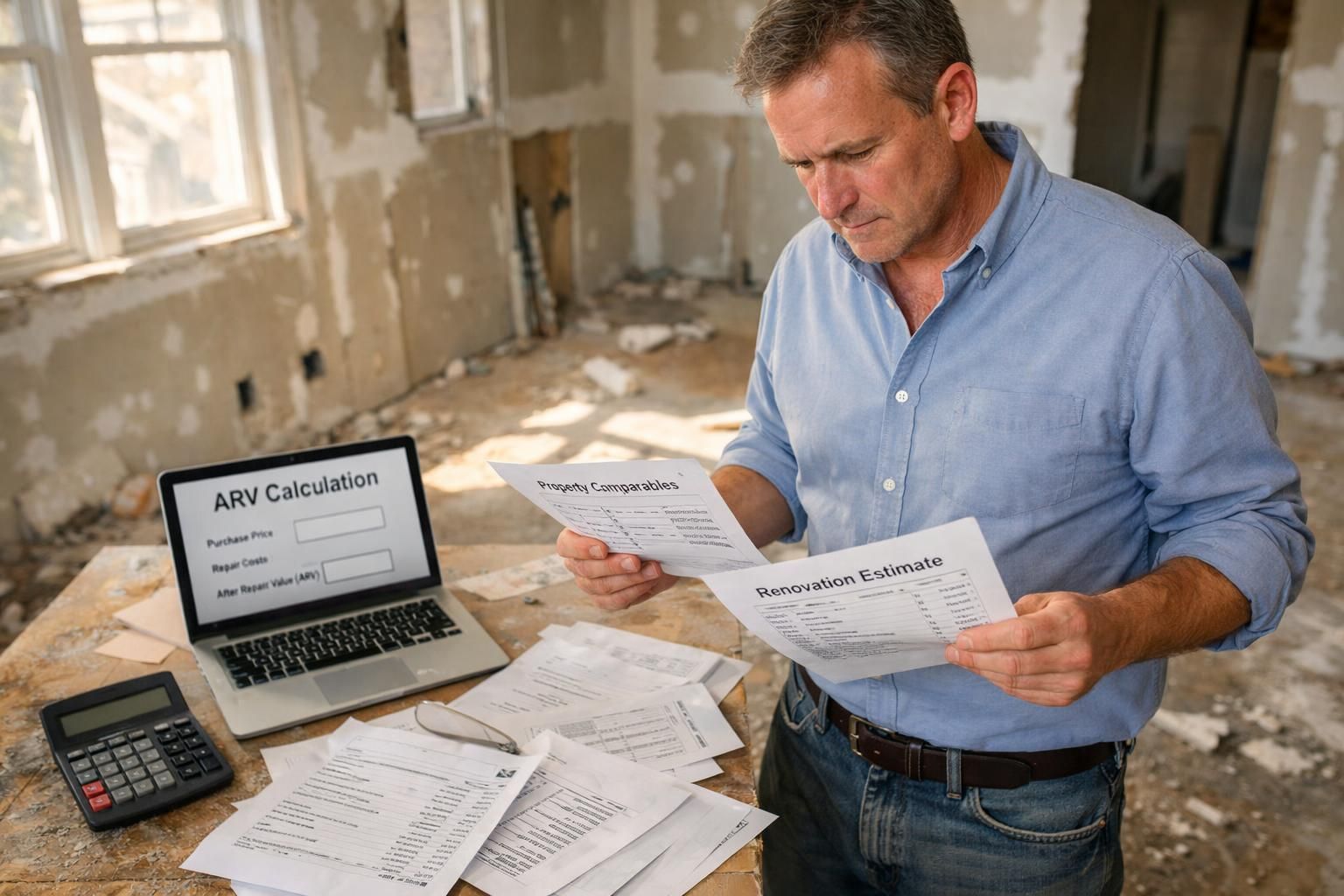
Master the calculation of After Repair Value with advanced techniques. Learn how to leverage comps and tools for maximum investment profitability!
After Repair Value: Advanced ARV Techniques
New to house flipping? Start with our House Flipping Guide.
Many real estate investors struggle to estimate property value after renovations. A wrong calculation of After Repair Value can lead you to overpay or miss a profitable deal. 1 Every dollar counts, and using precise ARV techniques is key for house flippers and commercial real estate professionals who want an edge in the market.
This guide will break down advanced strategies with tips on using comps, renovation cost estimates, and cutting-edge tools like ARV calculators. 3
With experience working alongside top real estate agents and analyzing sales comparables on multiple listing services (MLS), I have seen how strong market knowledge shapes investment success.
You need reliable facts, not guesswork, when buying a fixer-upper or seeking short-term financing from hard money lenders. 2 Keep reading to learn how you can apply proven tactics and increase your profit margin step by step.
Key Takeaways
- After Repair Value (ARV) is the estimated market value of a property after all renovations, guiding investors on purchase price, renovation strategy, and maximum allowable offer. Hard money lenders often finance up to 65% of ARV, making accuracy vital for securing funding.
- The 70% Rule helps set a safe purchase price by advising you to pay no more than 70% of ARV minus repair costs. For example, if ARV is $250,000 and repairs are $55,000, do not pay over $120,000 for the property.
- Use recent comps from MLS data—preferably renovated homes within one mile and sold in the last 90 days—to calculate an accurate ARV. Adjust for home size (within ±250 sq ft), age (within five to ten years), and condition.
- Advanced methods include using digital ARV calculators like DealMachine or Omni Calculator. Automated valuation models (AVMs) such as HouseCanary help process sales data and estimate returns quickly.
- Common mistakes are using outdated comps or ignoring hidden costs like taxes or delays. Double-check figures with spreadsheets and consult local real estate professionals before finalizing your investment decision.
What is After Repair Value (ARV)?
After Repair Value, or ARV, sets your project's expected market value after all renovations are complete. This figure guides investors and agents in deciding the property purchase price and shaping a successful fix and flip strategy.
Definition and importance in real estate investing
After Repair Value, or ARV, means the estimated market value of a property once all repairs and renovations are complete. Use sales data from comparable properties in your area to arrive at this figure.
This method sets ARV apart from annual rental value because it focuses strictly on resale market price after improvements.
You need an accurate ARV to guide both your purchase price and renovation strategy for any fix-and-flip project. Hard money lenders often lend up to 65% of the calculated after-repair value, making correct valuation vital for securing financing.
Relying on tools such as MLS data, real estate agent Comparative Market Analysis (CMA), and investor formulas lets you protect profit margins and avoid overpaying for investment properties.
Estimate your maximum allowable offer through the ARV formula so you can make decisions quickly in competitive markets like those tracked by Rocket Mortgage® or Janover Network.
How ARV impacts fix-and-flip strategies
Understanding ARV shapes your entire fix-and-flip approach. 1 Market value, profit margin, and maximum purchase price all depend on accurate after-repair value calculations. You typically use the 70% Rule: offer no more than 70% of ARV minus estimated renovation costs.
For example, if a property's ARV is $250,000 and repairs cost $55,000, you should not pay over $120,000 for the fixer-upper property. This buffer helps offset holding costs like insurance or taxes as well as closing fees.
Lenders play a crucial role in shaping your strategy through their financing limits. 2 Private money lenders or hard money loans often cap lending at 65% of ARV; this restricts how high you can bid on an investment property listed on the multiple listing service (MLS).
Some real estate investors in hot housing markets may stretch to 75%-80% of ARV but face reduced profit margins and greater risk from market trends. Accurate forecasting with tools such as ARV calculators or spreadsheets allows you to spot potential errors before making offers—a key step in safeguarding returns for real estate professionals using value-add strategies to boost rental income or resale price.
Back to topHow to Calculate ARV: A Step-by-Step Guide
Calculating after-repair value gives you a powerful edge in house flipping and investment property decisions. Use an ARV calculator with recent sales data from the multiple listing service to set your maximum bid price and protect your profit margin.
Step 1: Analyze comparable properties (comps)
Use recent comps from the multiple listing service (MLS) or trusted real estate agents to establish market value. 3 Select renovated properties that sold within one mile, preferably in the same neighborhood, and closed within the past 90 days.
If inventory is low, you may stretch your search window up to six months. Look for properties with a size difference of no more than 250 square feet and an age gap of only five to ten years compared to your subject property.
Scrutinize each comp's condition, construction style, finish quality, features, and amenities. For example, four similar renovated homes recently sold at an average price of $175,000; this figure becomes crucial in setting after-repair value (ARV).
Calculate price per square foot by dividing total sales prices by total living area—such as $150,000 divided by 1,400 sq ft equals $107/sq ft. Apply this rate to your investment property; if it measures 1,420 sq ft at $107 per sq ft its projected ARV stands at $151,940. 2 This method gives investors concrete data for forecasting returns and setting maximum bid price on fix and flip deals or other real estate investments.
Step 2: Account for renovation and repair costs
Obtain at least three itemized estimates from licensed contractors before finalizing your renovation budget. 3 Cosmetic updates such as new kitchen cabinets, countertops, appliances, paint, landscaping, light fixtures, and backsplashes often impact property value in a fix-and-flip scenario.
Structural repairs like roof replacements, HVAC upgrades, plumbing fixes, electrical work, or correcting foundation issues add to renovation costs and are vital for accurate after-repair value (ARV) calculations.
Factor holding expenses into your analysis; these can include utilities like water and electricity as well as insurance premiums while the property is under improvement. Overestimate slightly to prepare for unforeseen damages or hidden issues that may arise during renovations—structural damage frequently increases final totals.
Underestimating repair costs can erode profit margins and diminish investment returns. Expert Sidney Richardson suggests working with real estate professionals who use MLS data or ARV calculators for precise project appraisal.
This approach supports informed decisions regarding purchase price and ensures compliance with both bridge loan requirements and commercial real estate financing standards.
Step 3: Apply the 70% rule for maximum purchase price
To apply the 70% rule, multiply the after-repair value (ARV) by 70%. Subtract estimated renovation costs from this number to arrive at your maximum allowable offer (MAO). For example, suppose a property's ARV is $151,940 and you estimate repairs at $20,000.
You would calculate ($151,940 x 0.7) - $20,000 = $86,358 as your top purchase price. This formula helps prevent overpayment in real estate investing and fix-and-flip projects. 4
Investors use this guideline to keep their total investment—purchase price plus repair cost—within 70% of market value after improvements. Hard money lenders often reference the same metric for financing decisions.
Some aggressive buyers may stretch up to 75% or even 80% of ARV in hot markets; however, doing so increases risk and reduces profit margin. The standard model leaves a crucial buffer for holding expenses, closing costs, unexpected repairs, or sudden shifts in market trends.
Start negotiations with an offer below MAO to improve returns on investment property while protecting against losses due to rising renovation costs or changing occupancy rates. 2
[How to Calculate ARV – In-Depth Guide](https://www.kdsdevelopment.net/articles/how-to-calculate-arv)
Use the ARV real estate formula: After-Repair Value equals Current Property Value plus the Value of Renovations. Start by researching local market trends and study recent comparable sales using multiple listing service (MLS) data.
The next step involves identifying true renovation costs through detailed estimates or contractor quotes. Combine these numbers to calculate your total investment in the property.
Apply tools such as ARV calculators, spreadsheets, or Comparative Market Analysis (CMA) to improve accuracy and speed up calculations. Real estate professionals often consult with local Realtors for insight on pricing and neighborhood shifts that impact property valuation.
Practicing this five-step process sharpens your skill at forecasting investment returns and protecting profit margins in a fix and flip project. Use the 70 percent rule as an investor's purchase rule to guide maximum property purchase price decisions, factoring in holding costs, closing costs, and hard money lender requirements for financing options like bridge loans or renovation mortgages.
Back to topAdvanced Techniques for ARV Estimation
Real estate investors use ARV calculators, review MLS data, and track real estate market trends to improve property valuation; explore these advanced options to boost your profit margin.
Using ARV calculators and spreadsheets
ARV calculators and spreadsheets give you a systematic way to estimate after-repair value and avoid overpaying for an investment property. 5 These tools automate the complex process of factoring in sales data, renovation costs, closing costs, and holding expenses.
DealMachine offers software that helps with both lead generation and acquisition management for your fix-and-flip projects. HouseCanary's Property Explorer makes it easy to analyze comparable properties by adjusting values based on local real estate market trends and property condition.
Automated valuation models (AVMs) such as those found on leading real estate websites support your manual calculations using up-to-date MLS data. You gain clearer profit margin projections since these ARV calculators incorporate detailed renovation cost breakdowns alongside current listing price information from the multiple listing service.
Practicing with these digital spreadsheets boosts your confidence in every ARV estimate, helping meet criteria set by hard money lenders or multifamily loan providers like Wall Street Prep or Wharton Online's analysis programs.
Use these resources to get accurate purchase price recommendations and maximize return on investment across diverse value-add strategy scenarios.
Leveraging market trends and data analysis
Tracking market trends and using data analytics enhances your ARV estimates and refines your investment strategies. 6 Here is a summarized breakdown for leveraging these tools in property valuation.
| Element | Key Insights | Practical Application |
|---|---|---|
| Market Trends |
|
|
| Data Analysis Tools |
|
|
| Key Valuation Factors |
|
|
| Expert Collaboration |
|
|
| Continuous Learning |
|
|
Implementing these practices helps you enhance your ARV estimates and adapt to shifting market realities. Using diverse data, technology tools, and community connections increases valuation accuracy for your investments.
Back to topCommon Mistakes to Avoid When Estimating ARV
Accurate after-repair value estimates shape your profit margin in property flipping and fix and flip projects. Small errors can lead to costly setbacks and missed opportunities.
- Relying on outdated or mismatched comps causes inaccurate property valuation. 7 Select comparable properties from the multiple listing service that match the subject's location, size, layout, and finish level within the last three to six months.
- Overestimating renovation cost impact leads to inflated ARV calculations. Only factor in improvements that align with local market value trends and buyer preferences highlighted by a real estate agent or forecast reports.
- Ignoring hidden or unforeseen holding costs such as permits, delays, closing costs, and labor shortages can erode your expected profit margin. Calculate all potential expenses before setting an investment property purchase price.
- Failing to use robust tools like an arv calculator or specialized spreadsheets limits precision in analysis. Leverage data-driven platforms such as Omni Calculator for multifamily loans or distressed commercial property deals to ensure accuracy.
- Not considering current real estate market trends can distort your figures if supply and demand shift rapidly. Analyze recent sales activity, new builds, and local economic factors for smarter forecasting using resources from a real estate investing & analysis certificate program.
- Skipping visits to comparable listings prevents you from confirming true property condition differences that affect value outcomes; always tour or consult with experienced local real estate professionals before finalizing estimates.
- Applying blanket rules such as the 70 percent rule without adaptability may cause you to miss out on nuanced apartment building investments or misjudge risk for hard money lenders who demand precise figures tied to actual rehabilitation needs.
- Failing to adjust for community impact measures such as neighborhood growth patterns or sustainability concerns may skew the perceived market value of an investment property over time; safeguard your returns through thorough research led by reputable analysts like Abdulrafay Moeen.
Takeaway: Scrutinize every step of ARV estimation using credible data sources, expert judgment, and reliable financial modeling tools to avoid critical mistakes that put deals at risk in dynamic real estate investing markets.
Back to topConclusion
Mastering After Repair Value can help you sharpen your investment strategy and boost returns. Use reliable property data, work with skilled contractors, and update yourself on market trends to limit risk.
Double-check numbers with ARV calculators or spreadsheets before you buy. Seek advice from a trusted real estate agent to refine your calculations. Applying these advanced tools gives you an edge in today’s competitive fix-and-flip market.
Back to topFAQs
1. What is after-repair value (ARV) in real estate investing?
After-repair value, or ARV, refers to the estimated market value of an investment property once all renovation costs are completed. Real estate professionals use this figure to guide decisions on purchase price and potential profit margin.
2. How do investors calculate ARV using advanced techniques?
Investors often use an arv calculator that incorporates recent sales data from the multiple listing service (MLS), current real estate market trends, and detailed property valuation methods. These tools help refine predictions about future property value.
3. Why is understanding holding costs important for fix and flip projects?
Holding costs include expenses like loan interest, taxes, utilities, and insurance that accrue while owning a property before its sale. Accurate tracking of these costs helps investors ensure their profit margin aligns with both renovation cost outlays and expected closing costs.
4. What role do hard money lenders play in financing properties based on ARV?
Hard money lenders provide short-term loans for real estate investment based largely on a property's projected after-repair value rather than just the initial purchase price or current condition. This approach allows more flexibility but requires precise forecasting by both lender and investor.
5. How can working with a real estate agent improve ARV accuracy for property flipping?
A skilled real estate agent accesses up-to-date MLS data to compare similar renovated homes in the area, providing insight into true market value post-renovation. Their expertise supports sound decision-making regarding offers, renovations needed for competitive positioning, and realistic expectations for final sale prices within current real estate market conditions.
References
- ^ https://www.masterclass.com/articles/after-repair-value-explained (2021-06-15)
- ^ https://www.wallstreetprep.com/knowledge/after-repair-value-arv/
- ^ https://www.housecanary.com/blog/arv (2025-06-30)
- ^ https://www.stessa.com/blog/arv-after-repair-value/
- ^ https://www.compmort.com/how-to-calculate-after-repair-value/ (2024-11-11)
- ^ https://www.researchgate.net/publication/319431948_Artificial_neural_network_in_property_valuation_application_framework_and_research_trend
- ^ https://www.talimarfinancial.com/top-10-mistakes-investors-make-when-estimating-arv-after-repair-value/