


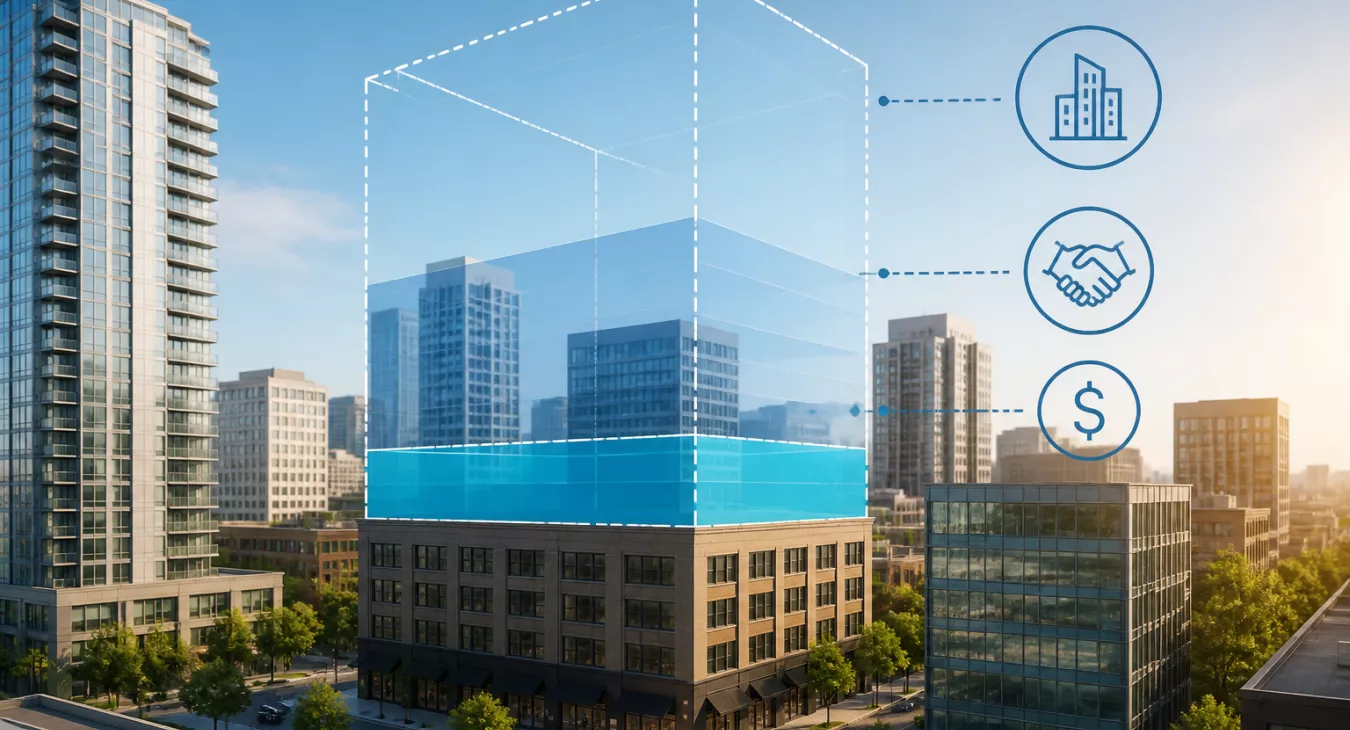
Discover air rights real estate investing: an alternative strategy for unlocking hidden value in urban markets. Learn how to leverage vertical space above
Table of Contents
- What Are Air Rights in Real Estate?
- How Air Rights Work in Development
- Buying and Selling Air Rights
- Air Rights Investment Opportunities
- Comparison: Air Rights vs. Other Development Strategies
- Air Rights in Urban Development
- Air Rights Regulations and Legal Framework
- Challenges and Considerations
- Air Rights Investment Metrics: Sample Deal Comparison
- Future of Air Rights in Real Estate
- Conclusion
- Frequently Asked Questions
Most real estate investors focus on what's on the ground — the building, the lot, the location. But here's what separates the pros from the crowd: some of the biggest urban deals involve something you can't walk on at all. The empty space above a property. Air rights real estate investing is a niche strategy, sure. But in constrained urban markets? It's where savvy developers unlock serious value. And if you're serious about your portfolio, you need to understand this. Most investors don't even know air rights exist — which means you've got an edge if you do.

What Are Air Rights in Real Estate?

Definition and Legal Framework
Air rights let you legally use, develop, lease, or sell the vertical space sitting above a property. Here's where it gets interesting: property ownership historically traced back to the Latin doctrine cuius est solum, eius est usque ad coelum et ad inferos — "whoever owns the soil owns up to heaven and down to hell." Modern law's gutted that principle considerably. But it's still the foundation for understanding how air rights became a separable property interest.
You can actually detach air rights from surface ownership and sell or lease them independently. A landowner holds the ground and building while transferring only the developable airspace above a certain height to another buyer or tenant. That's what makes them tradeable as an investment asset.
Air Rights vs. Traditional Property Rights
Fee simple ownership? That's full control — land, improvements, and everything above it legally. Air rights transactions work differently. The seller keeps the underlying land and existing structure but transfers only the right to build upward.
This creates legal complexity. But it also creates commercial value, especially in dense markets where buildable land costs $500+ per square foot and there's nowhere to go but up.
Don't confuse air rights with easements.
An easement grants you the right to use someone else's property for a specific purpose — think access roads or utility lines. Air rights represent actual ownership of developable vertical space. They're different animals, though they can coexist in complex development deals and sometimes get layered together in the same agreement.
Back to topHow Air Rights Work in Development

Airspace Measurement and Floor Area Ratio (FAR)
Here's what makes air rights actually work: Floor Area Ratio (FAR). It's a zoning metric that caps the total floor area you can build relative to lot size. So if you've got a 10,000-square-foot lot with a FAR of 10, you're allowed 100,000 square feet of building space. But what if your building only uses 30,000 square feet? That leaves 70,000 square feet of buildable potential sitting there — unused air rights that could be transferred to someone else.
FAR determines air rights value. In Manhattan? A single FAR unit can fetch hundreds of dollars per square foot. That's enormously valuable. And if you're evaluating an air rights opportunity, understanding FAR isn't optional—it's everything.
Transfer of Development Rights (TDR)
Transfer of Development Rights (TDR) programs let property owners monetize unused development capacity by selling it to buyers who want to build more densely elsewhere. The dual benefit is real: you preserve low-density neighborhoods—historic districts, green spaces—while funneling growth into designated receiving zones where it actually makes sense.
New York City's Landmark Transfer program is the gold standard. Landmarked building owners face restrictions on modifications or demolition. But they can sell that unused air rights to adjacent or nearby developers. Think about what that's enabled: some of NYC's most iconic supertall towers, the ones lining Billionaires' Row, wouldn't exist without this mechanism.
Air Rights Agreements and Easements
Air rights transactions get locked down through deed restrictions, easements, and development agreements filed with local land records. A solar easement protects light access to your property. A view easement keeps neighboring development from blocking your sightlines. These legal instruments cut both ways—they create value by protecting existing rights, but they can also limit what you do with purchased air rights.
Before you close on any air rights deal, you need proper title review and legal counsel. Don't skip this step.
Back to topBuying and Selling Air Rights

How Air Rights Are Valued
You need specialized appraisal methods to value air rights. Two approaches dominate the space:
- Comparable Sales Method: Look at what air rights actually sold for in your market recently — then calculate the per-square-foot price for unused FAR. This works great in Manhattan. Secondary markets? You'll struggle finding comps.
- Residual Land Value Method: Take your fully developed building's projected value, subtract construction costs and developer profit, then back into what air rights are actually worth. Use this when comparable sales data doesn't exist.
Manhattan air rights historically range from $200 to $600+ per square foot of unused FAR, depending on location and zoning. The spread is wild. Secondary markets run $20–$80, but you're also competing with fewer developers chasing those rights.
Real-World NYC Air Rights Examples
432 Park Avenue is the textbook case. The developer assembled air rights from multiple neighboring properties to hit that record 1,396-foot height — something impossible without TDR. Hudson Yards did the same thing, pulling development rights from the MTA's rail yard to stack massive commercial and residential towers.
And here's the kicker: St. Patrick's Cathedral sold roughly $200 million in air rights to finance 425 Park Avenue's development. Even religious institutions and nonprofits know how to monetize unused airspace.
Factors Affecting Air Rights Prices
- Zoning district and FAR limits — Higher allowable density equals more transferable square footage
- Proximity to receiving sites — TDR programs usually require geographic adjacency or close proximity
- Market demand for density — Strong housing or commercial markets make developers willing to pay
- Existing structure height — A taller building leaves less unused airspace sitting above it
- Municipal TDR program specifics — Some programs cap transfer amounts or restrict uses
Air Rights Investment Opportunities
Investment Strategies for Real Estate Investors
There's no single way to play air rights. Depending on your capital, market position, and risk appetite, you've got four distinct angles:
- Direct Purchase for Development: You're buying air rights from adjacent properties to expand your building's footprint or stack more floors. This one demands serious development chops and deep pockets.
- Buy and Hold for Appreciation: Grab undervalued air rights in emerging markets, then sit tight while surrounding density climbs. Think of it as land banking's quieter cousin.
- Brokerage and Assembly: Play middleman. You're pulling air rights from multiple owners, packaging them together, and flipping the bundle to a developer with real capital. This requires serious market intel and negotiation muscle.
- Passive Monetization: Own a low-density property in a high-FAR zone? Lease or sell those unused air rights and pocket the capital. Zero development headaches on your end.
New to alternative strategies? Start here. Our guide on commercial real estate investing shows you how air rights fit into the broader deal landscape you're already working in.
Risk Assessment and Due Diligence
Here's the hard truth: air rights carry risks that traditional property deals don't touch. Regulatory changes kill value overnight. A zoning amendment, a shift in TDR program rules, or new environmental restrictions can instantly tank what you could actually build with those air rights. Don't skip due diligence.
Your checklist needs to cover:
- Title search confirming transferability of air rights
- Zoning analysis confirming receiving site eligibility
- FAR calculation by a licensed architect or planner
- Review of any existing easements or deed restrictions
- Legal counsel experienced in local land use law
- Comparable sales analysis or formal appraisal
And this is where your team really matters. Complex transactions like air rights demand the right players in the room—the wrong advisor or lawyer costs you real money.
Our resource on building a real estate investing team breaks down who to call first when you're entering unfamiliar territory.
Back to topComparison: Air Rights vs. Other Development Strategies
| Strategy | Mechanism | Cost Level | Complexity | Liquidity | Best For |
|---|---|---|---|---|---|
| Air Rights Purchase | Buy unused FAR from adjacent owner | High ($200–$600+/sq ft in NYC) | Very High | Low | Urban high-rise developers |
| TDR Program | Municipal transfer of density rights | Medium–High | High | Low–Medium | Historic preservation zones |
| Density Bonus | Earn extra FAR via affordable housing or amenities | Low–Medium | Medium | N/A (no transfer) | Mixed-income developers |
| Variance | Zoning board approval for exceptions | Low (legal/admin fees) | Medium | N/A | Smaller-scale developers |
| Land Assemblage | Combine multiple parcels for larger development | Very High | High | Medium | Large-scale ground-up developers |
Air Rights in Urban Development

Examples in Major U.S. Cities
New York City's got the most mature air rights market in the country. But there's serious money being made in other markets too, and you should know where.
- Chicago: The Chicago Landmark TDR Ordinance lets owners of landmarked properties sell development rights to nearby receiving sites. Michigan Avenue deals are the textbook examples here.
- Seattle: Downtown zones allow you to purchase TDRs and push density above base FAR limits. The city's actively pushing this as part of its housing affordability strategy—and it's working.
- Washington, D.C.: Strict height limits kill air rights value in most places. That said, historic preservation TDRs remain active and worth tracking.
- Los Angeles: Incentive zoning programs deliver density bonuses in exchange for affordable housing. It functions like a TDR framework, just with different mechanics.
Look internationally and you'll see similar patterns. London uses development rights transfers through Section 106 agreements. Tokyo's high-density commercial corridors rely heavily on a complex air rights system that moves massive value year after year.
Addressing Land Scarcity Through Air Rights
When land is scarce and expensive—which is most coastal metros right now—air rights solve a real problem. They let you add housing without grabbing more ground-level real estate. That matters.
Housing shortages keep intensifying. Policymakers now see TDR programs as smart-growth infrastructure. Density goes where pipes and transit already exist. Sensitive or historic areas stay protected. Everybody wins.
Want to understand how density trends hit your residential returns? Our guide on investing in small multifamily rentals breaks down the real numbers.
Back to topAir Rights Regulations and Legal Framework

Federal, State, and Municipal Layers
Three distinct governmental tiers control air rights. Each one operates with different authorities and concerns — and they don't always align.
- Federal: The FAA controls navigable airspace starting at 500 feet above ground in urban areas. Below that? You've got presumptive rights as a property owner. But here's the catch — state and local governments can still regulate what happens down there.
- State: This is where air rights get recorded as actual real property interests. State property law governs how you convey them. The problem is consistency — some states have solid statutory frameworks backing TDR programs, while others are still relying on decades-old case law to figure it out.
- Municipal: Most of the real action happens here. Zoning codes set your FAR limits, define receiving zones, establish transfer ratios, and determine who's eligible. This is where you'll spend your time negotiating.
Emerging Regulations: Drone and Low-Altitude Airspace
Low-altitude airspace is becoming a real asset class. Drone delivery, urban air mobility (UAM), autonomous aerial vehicles — these aren't just buzzwords anymore.
The FAA is actively writing rules around UAS operations below 400 feet. That's a new category of airspace with genuine commercial value. Several cities are already moving forward with frameworks for leasing and licensing low-altitude corridors over private property. This creates entirely new air rights investment opportunities. We're talking about the next decade of deal flow.
Back to topChallenges and Considerations
Air rights investing comes with real pain points. Don't jump in without understanding what you're actually up against:
- Illiquidity: You're looking at a tiny buyer pool—basically just developers who need rights for a specific site they're assembling. Forget about quick exits. Stock markets and traditional real estate both beat air rights when you need liquidity.
- Valuation uncertainty: Outside of NYC, there's almost no comp data to anchor a valuation. You're basically guessing. Overpay? It happens constantly in this space.
- Regulatory risk: A city council meeting can torpedo your entire thesis. They change FAR limits, kill a TDR program, restrict transfers—sometimes with zero advance warning.
- Long holding periods: Don't expect a payoff anytime soon. Years can pass before the right development project even shows up in your receiving area.
- Legal complexity: You'll need lawyers who actually know local land use law inside out. The documents are specialized and recording gets messy.
Honestly? If you want something straightforward, the BRRRR method gives you way clearer benchmarks and a liquid market of buyers and sellers. Air rights demand that complexity premium—but if you're in the right market, the upside justifies it. That's the real trade-off.
Back to topAir Rights Investment Metrics: Sample Deal Comparison
| Market | Price per FAR Sq Ft | Typical Deal Size | Holding Period | Estimated ROI | Risk Level |
|---|---|---|---|---|---|
| Manhattan (NYC) | $250–$600+ | $10M–$200M+ | 1–5 years | 15–40% | High |
| Chicago CBD | $80–$150 | $2M–$30M | 2–7 years | 10–25% | Medium–High |
| Seattle Downtown | $60–$120 | $1M–$15M | 3–8 years | 8–20% | Medium |
| Secondary Markets | $20–$60 | $250K–$5M | 5–10 years | 5–15% | Medium–Low |
Look at Manhattan and you're staring at $250–$600+ per FAR sq ft. That's the premium play — deals run $10M–$200M, you're holding 1–5 years, and if everything lines up you're looking at 15–40% ROI. But you're taking on serious risk to get those returns. Chicago CBD's more reasonable. You'll pay $80–$150 per FAR sq ft, deals are $2M–$30M, and the 10–25% ROI over 2–7 years feels less like gambling and more like actual investing. Secondary markets? They're slower — 5–10 year holds, smaller cap gains (5–15%), but the entry price of $20–$60 per sq ft keeps your risk in check.
Note: These ROI estimates come straight from reported transactions and market research. Your actual numbers will depend on deal structure, how long you're willing to hold, and what the market decides to do while you're sitting on it.
Back to topFuture of Air Rights in Real Estate
Urban housing shortages are getting worse. Municipalities are under real pressure to squeeze more density into already-developed areas, and that's making TDR programs politically viable in ways they weren't before. Add in climate and sustainability mandates — planners now have to funnel growth into urban cores with existing transit infrastructure instead of sprawling into greenfield sites — and you've got a dynamic that fundamentally increases air rights value. Several macro trends are converging here, and they're all pointing the same direction.
Then there's the tech angle. Proptech platforms are starting to aggregate air rights data, which means you can actually identify transferable development capacity across large urban areas without spending weeks on research. BIM and 3D zoning visualization tools let developers model the value of air rights acquisitions before they write the check. Are you seeing how this shifts the game? These tools are breaking down the information asymmetry that used to lock out smaller players. Air rights used to be a closed shop for sophisticated institutional money.
For investors looking to diversify beyond conventional strategies, air rights represent a genuinely differentiated asset class. Don't sleep on this space. If you want to explore the broader market of alternative real estate investments, check out fractional real estate investing platforms and review the fundamentals in our commercial real estate investing for beginners guide before scaling into more complex transactions.
Back to topConclusion
Air rights real estate investing isn't for everyone. High complexity. High potential reward. And meaningful barriers to entry that keep most retail investors completely off the field. But here's the thing: for investors willing to build expertise, assemble the right team, and actually navigate the regulatory maze, air rights deliver genuine alpha in markets where ground-level deals have already been bid to death. The fundamentals work. Scarce land, growing urban populations, and increasing policy support for density-based solutions all but guarantee continued demand for unused vertical space. You're building a differentiated portfolio? Air rights deserve a seat at that table.
Start with zoning. Understand the framework in your target market — really understand it. Build relationships with local land use attorneys and planners. Study comparable transactions before you write a check. The best real estate investing courses will give you foundational knowledge, sure. But air rights mastery? That comes from doing deals, not just reading about them.
Back to topFrequently Asked Questions
Can you own the air above your property?
Yeah, you can—but there's a ceiling on it, literally. You've got legal rights to the airspace directly above your land up to whatever height your local zoning allows for actual structures and activities. The FAA takes over around 500 feet in urban areas. Below that? Local zoning laws run the show. They decide what you can build in that space and whether you can sell or transfer those rights to someone else.
How are air rights different from easements?
These are fundamentally different animals. Air rights are actual ownership of vertical development capacity. You can buy them, sell them, trade them independently of the underlying land. An easement is totally different—it's just permission to use someone else's property for a specific purpose like access, light, or running utilities. There's no ownership involved. Both show up as encumbrances on title, but air rights carry way more investment weight because you actually own the space.
What's FAR and how does it relate to air rights?
Floor Area Ratio. It's the zoning number that tells you exactly how many square feet of building you're allowed to construct on a lot. When a property is built out to less than its maximum FAR, that gap is pure opportunity—that's your air rights. Those unused square feet get sold or transferred to developers who want to build bigger on adjacent sites. FAR drives every single air rights deal. It's the math that makes everything work.
How do I invest in air rights?
Start by hunting for underbuilt properties in high-density zones—places where the existing structure is nowhere near the FAR ceiling. Then check if your target city even has a TDR (Transfer of Development Rights) program and learn the rules cold. You'll need a land use attorney and an appraiser who actually understands air rights—don't use a generalist. Get in front of local developers actively assembling sites because they're your actual exit strategy. And honestly? For most investors starting out, partnering with an experienced developer on a specific project beats speculative air rights purchases every time. Grab our guide on how to start a real estate investing business for the broader context you'll need to spot real opportunities.
What are the biggest risks in air rights investing?
Three killers: illiquidity (you've got maybe five buyers instead of fifty), regulatory change (zoning can get rewritten and nuke your entire position), and overpaying because comparable transaction data barely exists outside major metros. Long hold times make it worse—capital locked up for years waiting for development that might never happen. Your defense? Rigorous due diligence. Conservative valuation assumptions. Working exclusively with seasoned legal counsel and appraisers. That's it.
Back to top