

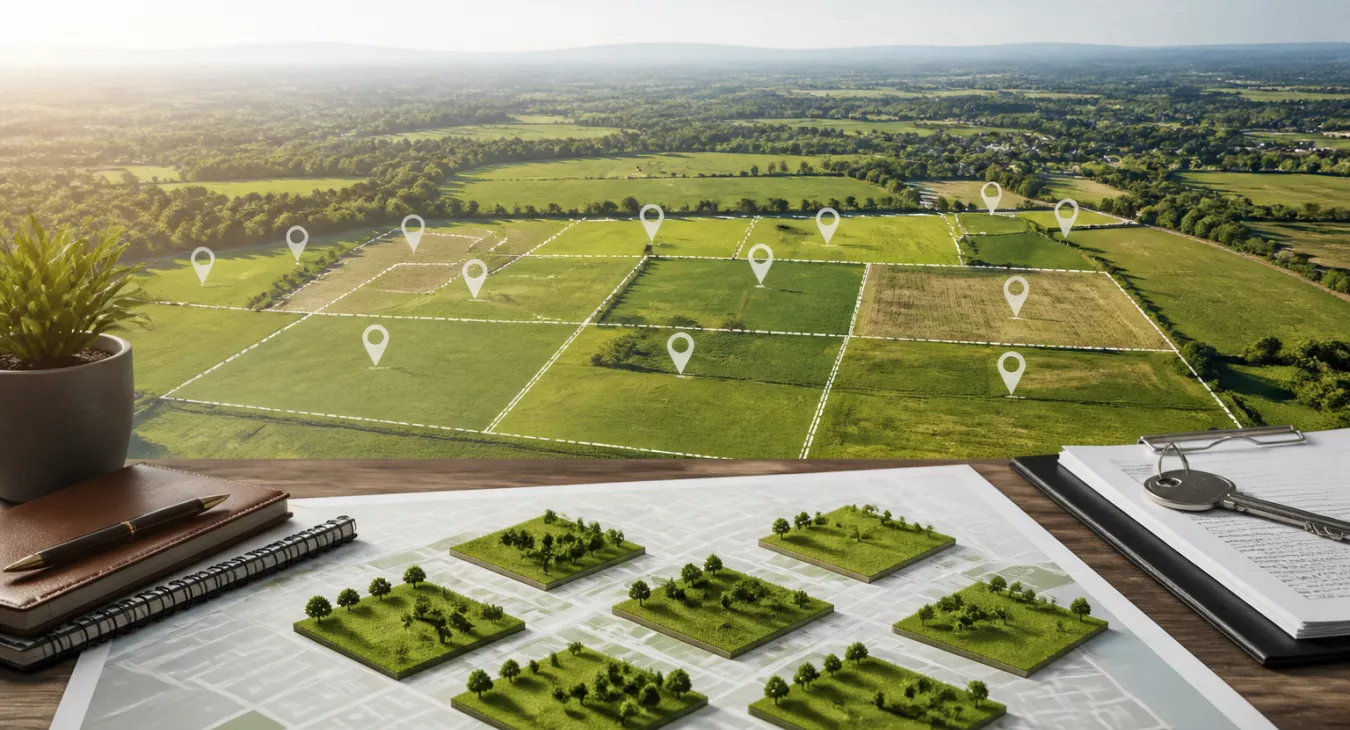
Master bulk land buying strategy: acquire multiple properties, negotiate better deals, and unlock outsized returns. Complete investor guide.
Products and Tools Mentioned in this Post

BatchSkipTracing
BatchSkipTracing provides real estate investors with fast, accurate skip tracing to find property owners and motivated sellers. Bulk processing and competitive pricing.
Table of Contents
- What's Bulk Land Buying?
- Why Investors Choose the Bulk Land Strategy
- Key Risks and Challenges
- Essential Due Diligence Before a Bulk Purchase
- Strategic Approaches to Bulk Land Investment
- Bulk Land Investment Across Different Market Types
- Real-World Perspective: Applying the Strategy
- Is Bulk Land Buying Right for You?
- Conclusion
- Frequently Asked Questions
Bulk land buying — acquiring multiple parcels in a single transaction — is how serious investors compress years into months. You skip the one-lot-at-a-time grind and unlock development possibilities that don't exist at single-parcel scale. The negotiating leverage alone changes the game. And the returns? They can be outsized. But here's the thing: it's genuinely complex. You need more capital. Due diligence gets deeper. You'll face risks most single-parcel investors never encounter. So before you write a check, you need a real exit strategy. This guide breaks down exactly how bulk land deals work, what they actually cost, where the landmines are buried, and how to structure something that won't fall apart under pressure.

What's Bulk Land Buying?
Definition and Key Characteristics
Bulk land buying means you're acquiring multiple parcels — typically adjacent or close together — in one negotiated deal or a coordinated series of closings. One seller, one ownership group, one transaction. The magic word here is consolidated purchasing power. Instead of paying retail for individual lots, you negotiate a package price that reflects volume, the seller's urgency to exit cleanly, and the fact that they're dealing with one serious buyer instead of chasing ten retail offers.
You might be buying a handful of rural lots next to each other. Or a couple hundred acres spread across multiple deeds from the same family. The common thread? You're getting a negotiated discount compared to what those parcels would sell for one at a time on the open market.
Bulk vs. Single Plot Acquisition

It's a real tradeoff. Bulk purchases eat more capital and demand heavier due diligence. But you get economies of scale and negotiating leverage you'll never find in a single-plot buy. A lone rural lot? Retail pricing. Why? Lots of retail buyers want it. Now take 20 contiguous lots. That buyer pool shrinks dramatically. That scarcity is your edge.
Types of Bulk Land Purchases
- Master-planned development assemblages: Large contiguous tracts you're acquiring for ground-up residential or mixed-use development, often requiring rezoning before you can break ground on vertical construction.
- Subdivision plays: Buy an oversized parcel or cluster, split it into smaller lots, and flip them raw or improved with utilities and roads already in place.
- Agricultural portfolio acquisitions: You're picking up multiple farm parcels from a retiring operator or estate. Lease them to farmers, improve the land, or just hold for appreciation.
- Commercial land banking: Accumulate plots along a corridor you believe will hit commercial or industrial demand, then resell to developers once the market moves in your direction.
- Wholesale bulk packages: Score distressed or tax-delinquent land portfolios at steep discounts and flip them fast to end buyers or other investors.
Why Investors Choose the Bulk Land Strategy
Cost Savings and Negotiation Power
Here's what makes bulk land buying attractive right out of the gate: per-unit price drops. When someone's liquidating — an estate sale, a retiring farmer, a developer who bought too much — they'll often take a serious haircut just to avoid months of individual lot sales, marketing costs, and the headache of uncertainty. You've got leverage. Bring proof of funds and a tight closing timeline, and suddenly you're not just another buyer.
What counts as a real discount? Land wholesalers typically need to buy at 30% or more below market value (2025 data) to move deals with meaningful assignment fees. That's your benchmark.
And it gets better. Cash offers or short due-diligence windows shift negotiation dynamics in your favor even more. Bulk sellers aren't just motivated by price — they're sweating estate deadlines, annual property tax drains, or partnership drama. A prepared buyer with multiple value props beyond money? That's your edge.
Higher Appreciation Potential
Land's been appreciating steadily. According to USDA's August 2025 report, U.S. farm real estate hit $4,350 per acre in 2025 — up 4.3% from $4,170 the year before. U.S. cropland? $5,830 per acre, a 4.7% year-over-year jump. Pastureland came in at $1,920 per acre, up 4.9%.
Buy a bulk portfolio at a discount to these benchmarks. You're sitting on immediate equity that compounds over time.
Development Flexibility
This is where bulk really separates from single-lot deals. Contiguous acreage lets you execute strategies that one-lot holders simply can't touch. Run a major rezoning play. Phase development to smooth out cash flow. Carve off portions to fund growth while keeping your core position. Land institutional joint-venture partners who need minimum acreage thresholds.
Single-lot guys don't get these options.
Long-Term Wealth Building
If you've got patient capital, bulk land is a leveraged bet on regional growth. Watch for the infrastructure triggers — highways, airports, data centers, logistics hubs. When they land, land in the path reprices hard. And it's the bulk holders with large contiguous tracts who capture most of that upside, because they're the ones who can hand developers the scale they actually need in one transaction.
Back to topKey Risks and Challenges

High Initial Capital Requirements
Land financing plays by different rules than residential mortgages. Much different. Conventional lenders are asking for 35–50% down for raw land, 25–35% for unimproved lots with some utilities, and 20–25% for improved lots that already have roads and utilities. And if you're shopping for rates right now? Farm Credit associations and rural lenders are quoting 6.5–8.5% for fixed-rate land loans as of mid-2026. Your credit score needs to be at least 700 for raw land, though you might squeeze down to 660–680 on improved parcels. Now scale that across a multi-parcel bulk acquisition. The equity you're going to need? It adds up fast.
Liquidity and Time-to-Sell Issues
Raw and rural land doesn't have the buyer depth of residential property. Bulk packages? Even fewer interested parties. You could be holding for years before you hit your target exit price. That's the real gut-check here — rental properties are printing cash while they sit on the market. Undeveloped land is just eating costs. Property taxes, loan interest, maintenance expenses. Zero income unless you lock in agricultural leases, timber contracts, or something similar to offset the drag.
Due Diligence Complexity
Each parcel carries its own mess.
Title history, encumbrances, boundary disputes, access problems — they're all lurking in the details. One problem plot can tank your entire portfolio or force a renegotiation at the worst moment. And your workload scales with parcel count. Title work, surveys, legal review — it all multiplies. Skip the due diligence on even one property and you're opening yourself up to liability that won't show up until years down the line.
Market and Regulatory Risks
Zoning is decided locally, and every jurisdiction writes its own playbook. What "A-1" means in one county could be something completely different fifty miles away. Setbacks, subdivision thresholds, variance standards — none of it's standardized nationally. Before you assume a bulk parcel can be subdivided or converted to higher use, get the specific zoning rules for that jurisdiction in writing. We dive into the full mechanics of this in our investor's guide to rezoning strategy.
Environmental risks deserve the same attention. Wetland determinations are still unsettled after Sackett v. EPA (2023), which created a "continuous surface connection" standard for federal jurisdiction. But here's what you need to know: states like California, Washington, Minnesota, Wisconsin, Virginia, New Jersey, and New York regulate wetlands independently. A shift in federal jurisdiction won't necessarily change what you owe locally. Always talk to an environmental attorney who knows the specific state before you bank on federal wetland guidance.
Back to topEssential Due Diligence Before a Bulk Purchase

Bulk land due diligence isn't just your single-parcel checklist times 50 or 100 parcels. You need a systematic approach that digs into each individual property while also looking at the whole portfolio at once. Here are 12 checkpoints that separate savvy bulk investors from the ones who inherit problems.
| Checkpoint | What to Verify | Impact If Missed |
|---|---|---|
| Title clarity | Clean chain of title for each parcel; no breaks or gaps | Unmarketable title; inability to sell or finance |
| Encumbrances and liens | Outstanding mortgages, tax liens, judgment liens, easements | Inherited debt; reduced property value |
| Seller's legal authority | Right to convey all parcels; no missing heirs or co-owners | Partial title; future partition litigation |
| Water access | Surface water rights, well permits, water district availability | Unbuildable or unfarmed land; development failure |
| Road and site connectivity | Legal access easements; deeded road frontage or recorded ROW | Landlocked parcels with no legal ingress/egress |
| Land-use restrictions | Current zoning in each jurisdiction; overlay districts; deed restrictions | Blocked development; costly variance process |
| Soil quality and terrain | NRCS soil surveys; percolation or soil-profile tests where applicable | Unbuildable or low-yield agricultural land |
| Future government plans | Eminent domain corridors; public utility easements; comp plan designations | Forced sale at below-market condemnation value |
| Conversion feasibility | Agricultural-to-residential or other use-change requirements | Stranded land use; rollback tax liability (jurisdiction-specific) |
| Litigation history | Pending or historical boundary disputes, easement claims, quiet-title actions | Inherited litigation; clouded ownership |
| Physical boundaries | Current ALTA/NSPS survey; stakes match deed descriptions | Encroachments discovered post-closing |
| Environmental conditions | Phase I ESA; wetland delineation; flood zone determination | Remediation liability; unbuildable land; lender rejection |
Water Access — A Critical Variable
Water rights confuse more bulk investors than anything else. And here's the kicker: in all 17 western prior-appropriation states, water doesn't automatically come with the land. It's a separate legal interest entirely — you have to get it conveyed separately in the deal. Texas groundwater plays by different rules altogether under the "rule of capture" doctrine. Even back east, where riparian rights stick to the property, you still need to independently verify that you can actually access reliable water for agriculture or development. The myth that "you can always drill a well" costs investors real money. That's simply not true in Colorado, Arizona, New Mexico, Washington, Oregon, and Idaho, where exempt-well rules, closed basins, or administrative moratoriums block new drilling. Call the state engineer's office or water authority for every single parcel on your list.
Using Skip Tracing to Find Motivated Sellers
Finding motivated bulk sellers before the portfolio hits the market is where you gain your real edge. Our BatchSkipTracing review covers tools that'll help you track down owners of large rural parcels, out-of-state holders, and estate executors who might be ready to move on a discounted bulk deal — way before any other buyer shows up.
Back to topStrategic Approaches to Bulk Land Investment

Market Research and Selection
Pick the right market, and everything else gets easier. Bulk land in a high-growth corridor with real infrastructure investment plays completely differently than bulk acreage rotting in a declining rural county. You need to dig into the regional comp plan. Look for proximity to announced major employers or logistics facilities. Track permit data to see where residential and commercial development demand is actually heading. Want a systematic framework for valuing what you find? Our guide to raw land valuation methods walks through five approaches investors use to price vacant properties.
The price swings between markets are brutal. As of 2026, remote unimproved rural land nationally runs somewhere between $1,500 to $2,500 per acre. But development-stage vacant land? State averages tell a wildly different story. You're looking at roughly $2,200 per acre in New Mexico versus approximately $65,000 per acre in Massachusetts. Your market choice locks in your capital requirement, your buyer pool, and your entire appreciation thesis right from day one.
Financial Modeling and ROI Estimation
Build models that capture all the carrying costs — property taxes, loan interest, survey fees, legal fees, insurance, any site maintenance — and stack them against realistic exit scenarios. You want three outcomes minimum: a conservative hold-and-sell-as-is, a moderate-return subdivision play, and an optimistic rezoning-and-development case. Probability-weight each one honestly. Investors who model only the best case consistently overpay.
When you're using debt on a bulk purchase, financing structure becomes everything. Rolling proceeds from a prior land deal? A 1031 exchange lets you defer capital gains taxes by reinvesting in like-kind real property. And here's the timeline that matters: Under 2026 rules, you've got 45 calendar days from closing the relinquished property to identify your replacement in writing. Then you've got 180 calendar days total to close the acquisition. The standard rule lets you identify up to three replacement properties, or more under the 200% value rule. Land qualifies as like-kind real property under IRC §1031 when you're holding it for investment or business use — not as dealer inventory for resale. Don't skip the qualified intermediary and tax counsel before you structure anything.
Phased Development Strategy
You don't have to sell everything at once. That's the real power of bulk land ownership — you can phase your development or disposition strategically. Dump the peripheral or least-valuable parcels first to recover capital, then hold the core acreage while the market matures and the numbers improve. You also get to test the local market's appetite without committing to full development infrastructure costs upfront.

Negotiation Tactics
Preparation, speed, and flexibility — that's the winning combination in bulk land deals. Most portfolio sellers are managing pain: estate settlements, tax delinquency, partnership disputes. For them, a clean certain close is worth real money off the asking price. Here's what actually moves the needle:
| Use Factor | Description | Why It Works |
|---|---|---|
| Volume discount | Buying all parcels in a single transaction | Eliminates seller's marketing, carrying, and transaction costs for remaining lots |
| Cash purchase | No financing contingency; proof of funds at offer | Removes lender timeline risk; fastest possible closing |
| Quick closing | Committing to a defined, short due-diligence window | Reduces seller's uncertainty; particularly valuable in estate or tax situations |
| Seller motivation | Identifying the underlying reason for the sale | Allows tailoring the offer structure (timing, terms) to what the seller actually needs |
| Market conditions | Buying in a period of reduced buyer competition | Larger buyer pool means less seller urgency; timing into slower markets increases use |
| Contiguous parcel assembly | Demonstrating that the assembled tract unlocks development options | Frames your offer as solving the seller's problem, not just extracting a discount |
Offer structure shifts seller psychology in measurable ways. Check out our breakdown of range offers vs. blind offers for tactical specifics on structuring initial bids for land acquisitions.
Back to topBulk Land Investment Across Different Market Types
Agricultural Land Investment
Here's what's undeniable: agricultural bulk purchases have the clearest national benchmarks in the game. The USDA's 2025 data shows cropland averaging $5,830 per acre nationally. Pastureland sits at $1,920. But that's just the average—regional variation is enormous. Productive Corn Belt cropland trades at multiples of these numbers. Meanwhile, arid western rangeland can be well below pastureland averages.
And here's what most investors miss: agricultural land carries jurisdiction-specific regulatory considerations that'll bite you if you don't understand them before purchase. Agricultural use classifications differ by state. Tax treatment programs—California's Williamson Act, Tennessee's Greenbelt law, Texas's agricultural exemption—aren't uniform. Restrictions on converting to non-agricultural uses? They vary significantly, sometimes even by county. Get this wrong and you're looking at unexpected tax rollback liability the moment you change the land's use. Always verify the specific rules in your jurisdiction with a local attorney before closing.
Residential Development Zones
Bulk purchases in residential development corridors—those areas transitioning from rural or agricultural to suburban—can generate serious appreciation if the regulatory path to subdivision actually works. Want to know what determines success? Three things. Local subdivision ordinance. Infrastructure availability—roads, water, sewer, or septic capacity. Timeline and cost of the approval process. These aren't national standards. County level or municipal level—that's where the real rules live. Commission a pre-application meeting with the local planning department before you commit capital. Period.
But what if you've found promising parcels and don't want to deploy full capital yet? Our guide to lease options and rent-to-own strategies walks you through how option agreements control land for a defined period while you complete due diligence and secure entitlements—without writing the full check upfront.
Commercial and Mixed-Use Properties
Bulk acquisition of commercial land requires the largest capital commitment. You're talking retail corridors, interchanges, employment centers. But when market timing aligns, the returns are the strongest you'll see. Mixed-use bulk plays are even better. Retail, office, residential, hospitality—land that can support all of them offers maximum flexibility if your primary development thesis changes. The trade-off? Due diligence gets complex. Traffic studies, environmental reviews, extensive infrastructure requirements. Commercial bulk land is a heavier lift than residential.
Partnership and Syndication Models
Most individual investors don't have the capital for meaningful bulk land positions. That's just reality. Syndication structures change the equation. Multiple investors contribute equity under a managing member's direction. Suddenly deals that would require institutional balance sheets become accessible. If you're evaluating fractional or syndicated real estate structures, our Ark7 review examines one model of fractional real estate ownership and exit strategy considerations—useful context when you're evaluating bulk land syndication terms.
Back to topReal-World Perspective: Applying the Strategy
The Cost Savings Case
Let's work through an actual scenario. A seller's sitting on 15 rural parcels—300 acres total at 20 acres each—assembled for a development deal that never happened. These parcels aren't unique. Similar land in the area moves at the national benchmark of roughly $2,000 per acre (smack in the middle of that 2026 $1,500–$2,500 range). Retail value? About $600,000. But here's where bulk buying gets interesting. A bulk buyer comes in with a 30% discount to market—that magic threshold where actual investor margins start to show up—and closes at $420,000. You've just acquired $600,000 in assets at a 30% haircut. That spread covers your due diligence, your carrying costs during the hold, and leaves real money for profit when you move the pieces.
Common Mistakes to Avoid
- Skipping individual parcel title work: Don't assume a portfolio is clean because a couple of parcels passed inspection. Every single deed needs its own title search. Period.
- Underestimating carrying costs: Property taxes pile up fast. Add loan interest and maintenance on 300 acres and these costs balloon. You've got to model them explicitly against your actual hold timeline.
- Assuming development rights: This one bites investors constantly. You can't just assume rezoning or subdivision approval will happen. Verify local regulations before you write the check, not after.
- Ignoring access: A landlocked parcel in your portfolio is basically worthless. Check for legal road access—not just whether you can physically get there—on every single parcel before closing.
- Overpaying on seller motivation: Yes, a motivated seller is gold. But the price has to reflect what's actually realistic in the market and development timeline, not some optimistic fantasy that never materializes.
And if you're also chasing distressed residential deals alongside land, you'll want to check out our breakdown on making offers on bank REO properties. The negotiation principles there transfer directly to motivated-seller land situations—especially knowing your walk-away number before the conversation even starts.
Back to topIs Bulk Land Buying Right for You?

Investor Profile Assessment
You need serious dry powder for this strategy. We're talking 35–50% down payment requirements on raw land financing, which immediately filters out most casual investors. But if you've got substantial liquid capital, genuine patience for multi-year holds with zero cash flow, and either direct development experience or solid relationships with land attorneys, engineers, and local planning officials — then bulk land investing might work. It's not appropriate if you need money back fast or can't handle the curveballs that due diligence throws at you (environmental issues, zoning complications, sudden deal kills).
When Bulk Strategy Makes Sense vs. Single-Property Approach
Bulk acquisition wins when three things align: your target market has clear growth catalysts that'll take years to price in across individual lots; the seller's distressed situation creates a real discount that single-lot buyers can't touch; and you've got the capital, patience, and expertise to manage the portfolio through a multi-year hold. Start with single properties if you're building your first land position, testing an unfamiliar market, or working with capital constraints where concentration risk could kill you.
And here's the thing — your capital isn't unlimited. Our analysis of paying off rental property vs. buying more gives you a framework for weighing opportunity costs across different asset classes.
Exit Strategies and Holding Period Expectations
Before you write the first check, you need an exit strategy. Ideally two or three of them.
Common exits look like this: sell the assembled portfolio to a developer at a premium over your per-acre basis; subdivide and move individual lots over time; farm it during the hold period for income; or execute a 1031 exchange into income-producing real estate once appreciation kicks in. Here's where most investors trip up though. Under current 1031 rules, land held as dealer inventory doesn't qualify for exchange treatment — only investment property does. Your holding structure and intent matter from day one, so get the tax strategy right early.
If you're more interested in faster turns — buy low, sell quick, repeat — our land flipping guide breaks down the mechanics for shorter holding periods.
Back to topConclusion
Bulk land buying works. You get price-per-acre discounts that single-lot purchases simply can't touch, plus development flexibility and long-term appreciation potential that makes spreadsheets sing. Why? Because bulk sellers operate on different timelines and motivations than retail sellers do. And assembled acreage unlocks development pathways—subdivision potential, entitlements, mixed-use scenarios—that scattered individual lots leave on the table.
Patient capital in land markets gets rewarded. History backs this up.
But here's what trips up most investors: the due diligence grind across multiple parcels is brutal. Land financing demands serious equity. Raw land ties up your cash for years before you see liquidity. This strategy doesn't forgive corner-cutting.
You need to nail three things. Master the research on comparable sales, zoning overlays, and market fundamentals. Verify every parcel—survey discrepancies, title issues, and environmental red flags won't fix themselves. And model your financials conservatively, because land appreciation doesn't compound like a BRRRR deal does.
Get those pieces right, and bulk land stays one of the most compelling strategies available to you.
Back to topFrequently Asked Questions
How much capital do I need to start bulk land buying?
It depends heavily on where you're buying. Here's the reality: most raw land lenders want 35–50% down, and you're looking at 6.5–8.5% interest rates from rural and Farm Credit shops. That's just the down payment. You've also got to budget for title work on every single parcel, surveys, environmental assessments, legal fees, and carrying costs while you're holding. Most bulk deals? Well into six figures minimum. Larger agricultural or development assemblages? You're talking seven figures or more.
Can I use a 1031 exchange to defer taxes on a bulk land sale?
Yeah, you can—but only if the land qualifies as investment or business property. Don't try this if you're holding it as dealer inventory. Under IRC §1031, land counts as like-kind real property. Here's the timeline you need to hit: identify the replacement property within 45 calendar days and close on it within 180 calendar days of your relinquished property closing. And don't skip this step—get a qualified intermediary and a tax attorney involved before you structure anything.
How do I verify water rights and access when buying multiple parcels?
Water rights are a parcel-by-parcel game. There's no universal answer. In the 17 western prior-appropriation states, water rights are completely separate from land ownership—they must be specifically conveyed in the deed. Texas? That's different. Groundwater follows the "rule of capture" doctrine. Then you've got Colorado, Arizona, New Mexico, Washington, Oregon, and Idaho restricting well drilling rights in parts of their states. For each parcel, contact the state engineer's office or water authority. Review existing well permits. Check water district agreements. Have a water rights attorney confirm the rights transfer with your deed.
What are the most common due diligence mistakes in bulk land transactions?
These kill deals fast. Investors assume title is clean across the entire portfolio without running individual title searches on every parcel. They miss legal road access issues (physical access isn't the same thing). They blow past local zoning and subdivision rules, then realize development isn't actually feasible. Carrying costs over a multi-year hold? Drastically underestimated. And here's the biggest one: they don't dig into why the seller is actually selling. That motivation? It's often your ticket to structuring a deal that works for both sides.
Is bulk land buying appropriate for first-time land investors?
Not really—not at meaningful scale. The due diligence complexity is serious. Capital requirements are steep. And you're locking money up for years before you see liquidity. Bulk land buying works best for investors who've already cut their teeth on single-parcel deals and who have solid relationships with local attorneys, surveyors, and title companies in their target markets.
Back to top