

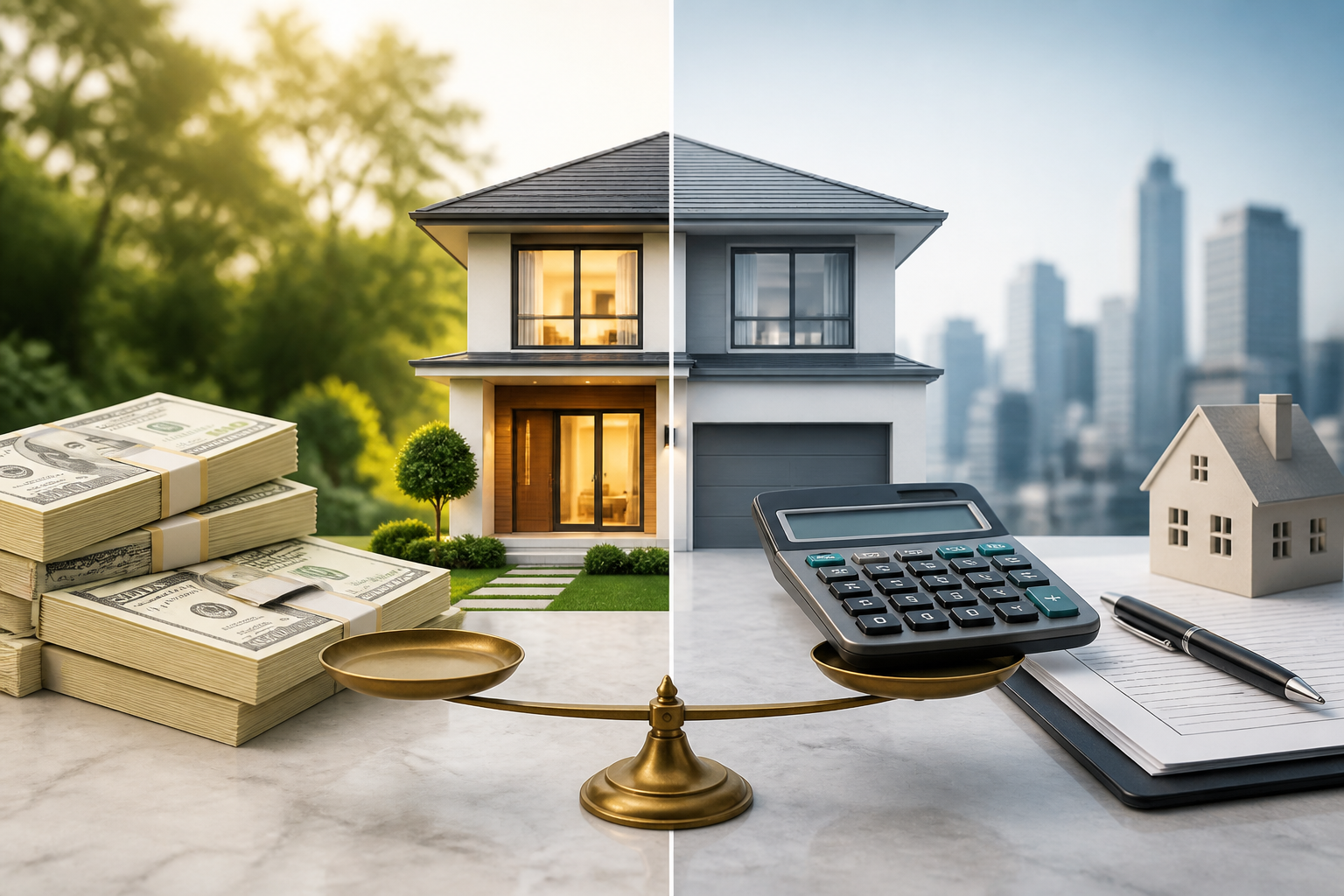
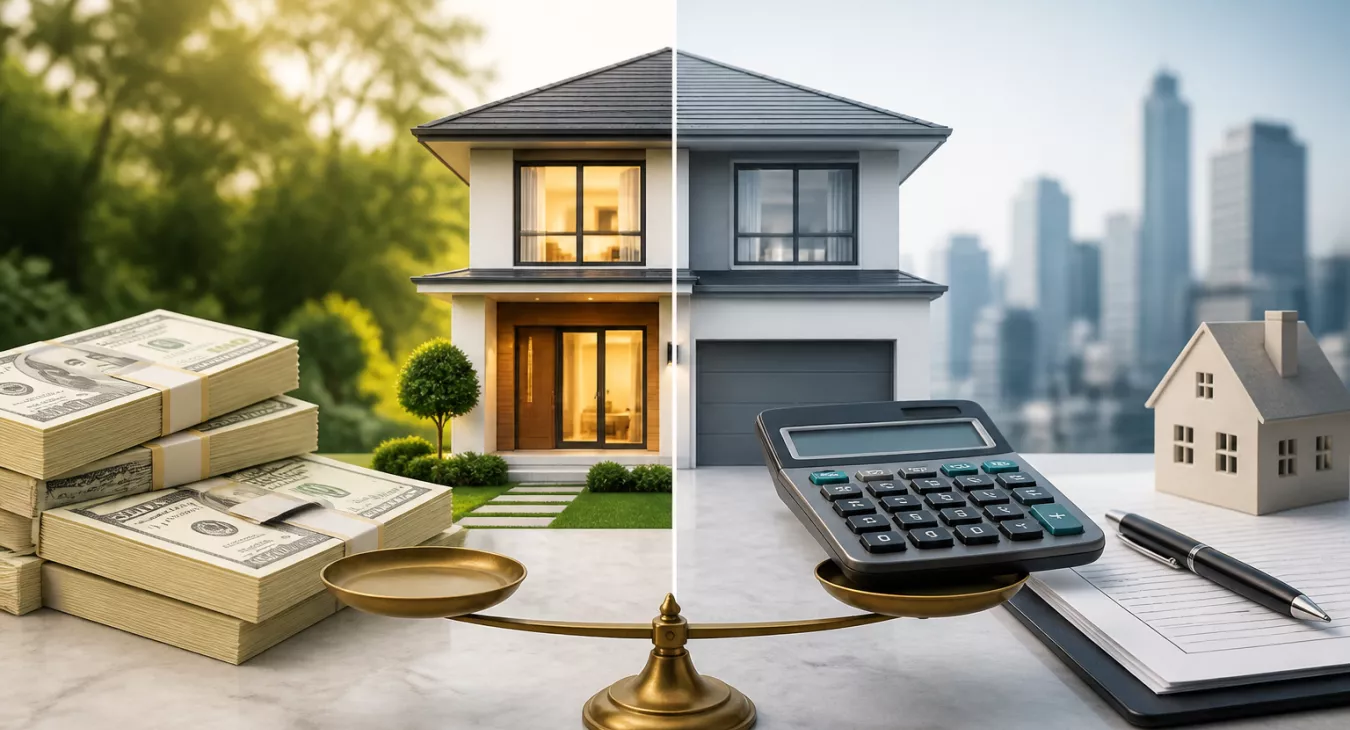
Compare buying a house with cash vs mortgage. Analyze costs, interest, and opportunity costs to make the best financial decision for your situation.
Table of Contents
- Quick Answer
- Cash vs. Mortgage: Side-by-Side Comparison
- Buying a House With Cash vs. Getting a Mortgage
- Advantages of Buying a House With Cash
- Disadvantages of Buying a House With Cash
- Advantages of Getting a Mortgage
- Disadvantages of Getting a Mortgage
- 30-Year Financial Scenario: $500K Home
- Buyer Profile Decision Matrix
- Other Homebuying Considerations
- Cash Offers vs. Mortgages: What's Right for You?
- Conclusion
- Frequently Asked Questions
Paying cash for a house feels clean. No debt, no interest payments, no lender breathing down your neck. But here's the thing — that's rarely the smartest move for real estate investors. Opportunity costs, liquidity risks, tax implications, and market timing all shift the math in ways that might surprise you. This in-depth buy house with cash vs mortgage analysis walks through every angle so you can actually make the numbers-backed decision that fits your portfolio.

Quick Answer
Cash kills your interest costs. You also get serious negotiating leverage—sellers move faster when you're not contingent on financing. But here's the trade-off: a mortgage keeps your capital working elsewhere. You can diversify into other deals, stocks, or opportunities while borrowed money funds your real estate.
There's no universally best move. What matters? Your net worth, income stability, risk tolerance, how many investment options you're juggling, and what rates look like right now. Are you sitting on $2M liquid and rates just dropped to 5%? A mortgage probably makes sense. You're holding 80% of your portfolio in one property with shaky income? Go cash and sleep at night.
High-liquidity investors in low-rate environments usually win with mortgages. Cash-rich buyers in scorching hot markets or anyone who values simplicity over optimization? All-cash is your answer.
Back to topCash vs. Mortgage: Side-by-Side Comparison
| Factor | All-Cash Purchase | Mortgage Purchase |
|---|---|---|
| Upfront Cost (on $500K home) | $500,000 | $100,000 (20% down) + closing costs |
| Monthly Payment | $0 (principal paid) | ~$2,528/mo (6.5%, 30-yr, $400K loan) |
| Total Interest Paid (30 yrs) | $0 | ~$510,000 |
| Time to Close | 7–14 days | 30–60 days |
| Negotiating Power | High (sellers prefer cash) | Moderate |
| Liquidity After Purchase | Low (capital tied up) | High (cash reserves preserved) |
| Tax Deductions | None on interest | Mortgage interest deductible (if itemizing) |
| Credit Impact | None | Positive (on-time payments build credit) |
| Qualification Requirements | None | Income, credit score, DTI ratio |
| Risk of Foreclosure | None | Yes, if payments are missed |
Buying a House With Cash vs. Getting a Mortgage
What's an All-Cash Offer?
No financing contingency. No lender approval. That's what an all-cash offer gives you — you're buying the property outright with liquid funds and the transaction moves forward without underwriting. You'll need to provide proof of funds (bank statement or brokerage account), and that's it. The money can come from your savings, liquidated investments, retirement accounts (watch those penalties), or proceeds from another property sale you just closed.
How Mortgages Work in Comparison
Here's the flip side: a mortgage is a loan secured by the property itself. You're typically putting down 3–20%, the lender covers the rest, and then you're repaying that loan plus interest over 15 or 30 years. The principal is what you actually borrowed. Your interest rate can be fixed or adjustable — that changes your monthly payment. Then there's the amortization schedule, which breaks down exactly how much of each payment goes to principal versus interest. And the LTV ratio (loan-to-value) — this one matters because it determines whether you're paying PMI. For investors, mortgage financing is often called using leverage — controlling a large asset with just a fraction of its total value.
Back to topAdvantages of Buying a House With Cash

No Mortgage Interest or Fees
This is the money part. Finance a $500,000 home at 6.5% over 30 years, and you're looking at roughly $510,000 in interest payments alone. That means you'd pay nearly double the original purchase price just to borrow the money. Skip the mortgage entirely, and you've locked in savings no investment return can touch.
More Negotiating Power
Sellers love cash offers. Why? Financing contingencies blow up deals constantly — they're the #1 reason transactions fall apart. In a hot market especially, cash buyers win even at lower numbers. Want proof? Many sellers will take 3–5% off asking just to eliminate the risk, putting thousands back in your pocket before closing.
Faster Closing Process
Seven to fourteen days. That's your timeline with cash instead of the 30–60 day mortgage slog.
In competitive markets, this speed is everything. Investors flipping properties, sellers facing time crunches, anyone hunting in a bidding war — they all benefit. You also cut carrying costs and reduce your market exposure window.
Ownership Certainty and Peace of Mind
There's something powerful about owning a home outright. No monthly payment hanging over your head. No foreclosure risk. No lender telling you what insurance you must carry or maintenance you must complete. For retirees living on fixed income or anyone weathering financial uncertainty, owning free and clear is real security — and frankly, investors tend to undervalue this benefit.
No Monthly Mortgage Payments
That $2,528/month mortgage payment on the example above? It stays in your pocket instead.
Suddenly, your cash flow picture changes dramatically. Rental investors see NOI and cap rate jump immediately. Owner-occupants free up capital to invest elsewhere or simply breathe easier month to month.
Back to topDisadvantages of Buying a House With Cash

Opportunity Costs and Lost Investment Potential
Here's the real kick in the teeth with cash purchases: opportunity cost. You've got $500,000 sitting in a house instead of working for you elsewhere. Put that same $500K into the S&P 500 while financing the property instead? You're looking at roughly 10% annual returns historically — that balloons to around $8.7 million over 30 years (before taxes). And even if you factor in your mortgage interest costs, the compounding power of capital in diversified markets typically crushes the "return" you'd get from saving on interest alone. Of course, this math changes depending on where rates are versus what the market's actually returning.
Liquidity Concerns and Emergency Reserves
A half-million dollars locked into one illiquid asset? That's not a position most investors want to be in. What happens when life throws you a curveball — medical emergency, job loss, or a killer investment opportunity lands in your lap? Getting that cash out means refinancing, a HELOC, or selling the place. All of those take time. All of those cost money. Most financial advisors recommend keeping 6–12 months of living expenses liquid after any major purchase like this.
No Tax Deductions for Mortgage Interest
This one stings. Homeowners carrying mortgages can deduct interest on loans up to $750,000 (that's post-2017 law) when they itemize. Say you're in the 24% tax bracket paying $25,000 in annual interest — that's a $6,000 tax break every single year. Cash buyers? You get zero. And yeah, that deduction's worth less than it used to be after the standard deduction jumped under the Tax Cuts and Jobs Act, but it's still real money.
Reduced Financial Flexibility
You've got all your eggs in one basket now. A real estate portfolio concentrated in a single market means if property values tank, your entire nest egg takes the hit. Serious investors who understand creative financing for house flips know something most cash buyers don't: flexibility and liquidity beat debt elimination in markets that move fast. That optionality is worth real money.
Back to topAdvantages of Getting a Mortgage

Use Your Money
Put down $100K on a $500K home. The property appreciates 10% to $550K. You've just made a $50K gain on your $100K investment — that's a 50% return on invested capital. Now flip that scenario: buy the same property all-cash and you're looking at just 10% returns. That's leverage. This is how experienced investors actually build portfolios at scale, not through appreciation alone.
Build Credit History
Want to know the fastest way to build real credit? Get a mortgage and pay it on time. Years of consistent payments dramatically boost your FICO score, which means cheaper money on your next deal — whether that's business financing or your third investment property. And frankly, a strong credit profile separates the serious investors from the rest.
Tax Deductions on Mortgage Interest
High earners who itemize can slash taxable income with mortgage interest deductions. But here's what really matters for your portfolio: rental property investors deduct all mortgage interest as a business expense. You don't hit any standard deduction cap. This benefit is a genuine wealth accelerator for investment properties.
Maintain Liquidity and Invest Elsewhere
You don't put down $500K. You put down $100K and keep the rest. Now you've got $400K sitting in your account ready to move. Business opportunities, additional properties, stock positions, or just emergency reserves — capital flexibility exists. That's often the difference between investors who catch momentum and ones who watch deals pass by.
Back to topDisadvantages of Getting a Mortgage
Total Interest Cost Over Time
Here's where it gets real. On a $400,000 mortgage at 6.5% over 30 years, you're looking at approximately $510,000 in interest alone—more than the original loan itself. Bump that rate to 7.5% and you're paying over $600,000. Even at a favorable 5%, that's roughly $373,000 in pure interest. This is exactly why rate environment matters so much when you're weighing cash vs. leverage in your investment decision.
Qualification Requirements and Closing Costs
Lenders want proof. They'll verify your income, pull your credit score (620 minimum, but 680+ if you want decent rates), calculate your debt-to-income ratio (should stay under 43–45%), and order an appraisal. Then come the closing costs—typically 2–5% of the loan amount. On a $400K loan? That's $8,000–$20,000 in fees right there. These friction costs are real money and they belong in your total cost analysis.
Risk of Negative Equity and Foreclosure
Market drops hit leveraged buyers hard. You can end up underwater—owing more than the property's worth. We saw this play out across the country during the 2008 crisis. Foreclosure risk is manageable if you're financially stable, but it's a genuine threat that cash purchasers never have to sweat.
Back to top30-Year Financial Scenario: $500K Home
| Scenario | All-Cash Purchase | 20% Down + Mortgage (6.5%) |
|---|---|---|
| Upfront Cash Out | $500,000 | $100,000 + ~$12,000 closing costs |
| Total Interest Paid | $0 | ~$510,000 |
| Tax Deduction Savings (24% bracket) | $0 | ~$60,000–$90,000 over loan life |
| $400K Invested @ 8% Avg Return (30 yrs) | N/A (capital deployed) | ~$4,024,000 |
| Net Cost After Investment Growth | $500,000 (minus appreciation) | Much lower if investments outperform interest rate |
| Estimated Home Value @ 4% Annual Appreciation | ~$1,620,000 | ~$1,620,000 (same asset) |
Here's the reality: the mortgage strategy wins on paper for buy-and-hold investors. But there's a catch. You've got to actually deploy that $400K you're keeping in the bank—and not in some 2% savings account. Put it to work. When you can generate 8% returns elsewhere while borrowing at 6.5%, you're printing money over 30 years. The numbers don't lie. All-cash? You're leaving $4 million on the table. That said, if your "deployed capital" just sits idle, you've made a terrible mistake.
Back to topBuyer Profile Decision Matrix
What's your situation? The financing strategy that crushes it for one investor might be terrible for another. Here's how different buyer profiles should actually think about cash versus debt.
| Buyer Type | Recommended Approach | Key Reason |
|---|---|---|
| Retiree on fixed income | Cash (if available) | No mortgage payment means you sleep at night. Risk plummets when there's no lender breathing down your neck. |
| Active real estate investor | Mortgage or hybrid | Leverage is your best friend here. Why tie up $300K in one deal when you can put 25% down and deploy the rest across three more properties? Your ROI compounds faster. |
| First-time buyer, limited savings | Mortgage | You probably don't have $200K sitting around anyway. A mortgage gets you in the door and builds credit history while you're building equity. |
| High-income earner, itemizes taxes | Mortgage | That mortgage interest is deductible. Meanwhile, your capital earns better returns elsewhere—usually 8-12% in other deals or market instruments versus the 5-7% you're paying in interest. |
| Cash-rich buyer in competitive market | Cash offer | You win. Cash offers beat financed offers in bidding wars. You also negotiate harder discounts because sellers know you close in 7 days, not 45. |
| Risk-averse buyer near retirement | Cash or large down payment | Debt heading into your lower-income years is a trap. Minimize what you owe when you can't replace income easily. |
Other Homebuying Considerations

Current Interest Rates and Market Conditions
The math completely changes depending on rates. At 3–4%, borrowing's cheap—so cheap that taking a mortgage and investing the difference elsewhere actually makes sense. But push rates up to 7–8% and suddenly avoiding that interest expense looks like a solid guaranteed return compared to what you'd make elsewhere. You need to constantly benchmark the current mortgage rate against the after-tax return you'd realistically earn on your next-best investment option.
State of the Local Housing Market
Cash is most powerful in a seller's market. Multiple offers? That's where your all-cash position becomes a serious negotiating weapon. Flip to a buyer's market with high days on market and the script flips entirely. Sellers get flexible. Financing contingencies stop being deal-breakers. The state of the local market should directly drive how much premium you're willing to pay for the certainty of a cash offer.
Hybrid Approaches
Here's the strategy most investors overlook: the hybrid approach. Put down 40–50% instead of going all-cash or minimum down. You'll slash your monthly obligations. You'll keep liquidity intact. And you'll still hold a smaller mortgage for tax purposes. This isn't about splitting the difference—it's about winning negotiations with substantial cash while keeping reserves in your pocket.
Hidden Ownership Costs
Cash or financed? Doesn't matter. You're still paying property taxes, homeowner's insurance, HOA fees, and maintenance. Most investors budget 1–2% of home value annually for upkeep. That $500K property? You're looking at $7,500–$10,000 just in annual maintenance. These costs hit your P&L regardless of how you structured the purchase. Build them into your total ownership budget from day one.
Back to topCash Offers vs. Mortgages: What's Right for You?

Here's how to think through this decision:
- Your net worth is sitting mostly in cash? A mortgage actually works better. You'll diversify into market investments instead of locking everything into real estate. That's how you avoid the trap of being over-leveraged in one asset class.
- Competitive market, and you've got the cash on hand? Speed wins deals. Your negotiating power is real. Sometimes that edge justifies the opportunity cost of deploying your capital this way.
- Carrying high-interest debt or running thin on emergency reserves? Mortgage financing keeps your liquidity intact. You need that cushion.
- Building a rental portfolio? Mortgages crush cash purchases on cash-on-cash returns. Leverage is your friend here. And if you're scrappy about it, there are solid ways to acquire investment properties even with limited capital.
- Getting close to retirement or already there? Killing that mortgage payment gives you something cash returns can't buy: peace of mind. The security matters more than squeezing out a few extra percentage points.
Conclusion
Here's the truth: there's no universal right answer. Your financial position, your goals, and which market you're operating in all matter differently depending on who you are.
Cash purchases? They're clean. You close fast, skip the interest payments entirely, and know exactly what you own with zero lender risk. But you're also freezing capital that could be working harder elsewhere — and that's a real cost most all-cash buyers don't fully account for.
Mortgages do the opposite. They let you control multiple properties simultaneously, preserve dry powder for better deals down the road, and leverage tax deductions most investors ignore. The flip side: you're committed to payments for 15 or 30 years, you need to qualify (which costs time and money), and rising rates kill your returns faster than you'd think.
For most active investors scaling a portfolio, mortgages win.
And if you're buying one property to sleep soundly at night? Cash probably makes sense. But run your specific numbers. Pull your actual interest rate options, calculate what that capital could earn elsewhere, talk to your CPA about the tax angle — because the right move for a 4% mortgage environment looks completely different than a 7% one.
Back to top
Frequently Asked Questions

Do you need good credit to buy a house with cash?
No credit required. That's the whole point of a cash purchase — you sidestep the entire lender gauntlet. No credit checks. No income verification. No debt-to-income ratios to worry about. You show proof of funds and move straight to closing. For investors with non-traditional income streams or anyone carrying credit baggage, this is a game-changer.
How much more will you pay with a mortgage compared to cash?
Let's run the numbers on a real scenario. Say you're financing $400,000 at 6.5% over 30 years. You're paying roughly $510,000 in interest alone. That means the actual cost to borrow that $400,000? About $910,000. And that's before closing costs ($8,000–$20,000). But here's the thing — if your cash can earn returns above that 6.5% mortgage rate, financing suddenly looks smarter on a spreadsheet.
Can you get a better deal paying with cash?
Absolutely. And sellers know it. Cash kills their biggest headaches — appraisals come in low, financing contingencies fall apart, lenders drag their feet. You eliminate all that friction. In slower markets or when a seller's under time pressure, you're looking at 3–5% discounts off asking price. The leverage is real. Don't leave that negotiating power on the table.
What happens to your liquidity after an all-cash purchase?
It evaporates. You drop $500,000 on a house, and that capital's locked up — accessible only through refinancing, a HELOC, or selling. That's the hidden cost nobody talks about. You need to keep 6–12 months of living expenses liquid after closing, plus reserves for maintenance and unexpected repairs. Draining your cash position to own a home free-and-clear creates financial fragility most people don't anticipate.
What if you've got cash but your credit's a mess?
Cash solves that problem instantly. Rather than choking on a subprime mortgage and paying 8–10% interest, you eliminate the debt entirely. That said — think strategically. If your cash pile represents most of your net worth, pause. Spend 12–24 months rebuilding credit with secured cards and installment loans instead. Your credit score can improve meaningfully, and you won't have all your eggs in one property.
Back to top