

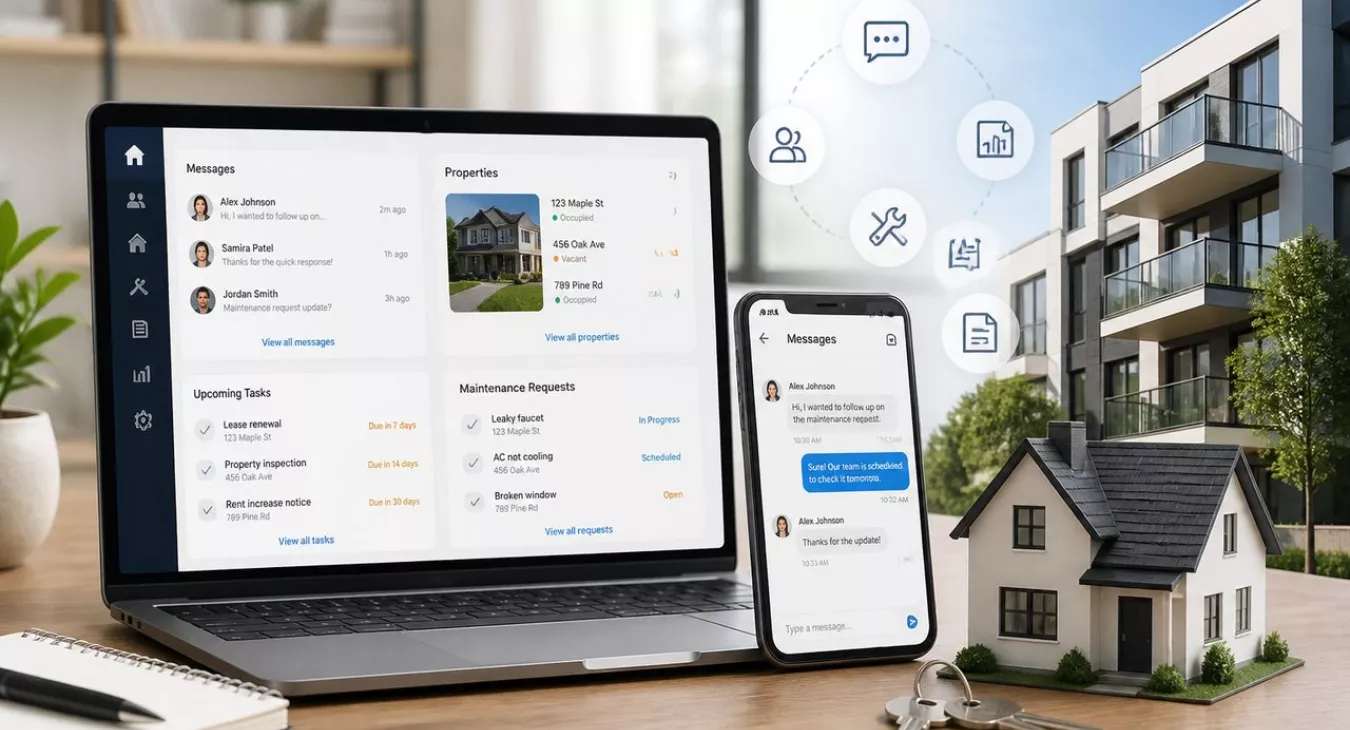
Discover the best real estate CRM for landlords. Streamline tenant management, automate communications, and eliminate manual coordination tasks.
Products and Tools Mentioned in this Post

TenantCloud
TenantCloud offers landlords and property managers a complete solution for rent collection, tenant screening, lease management, and maintenance tracking.
Contactually
Contactually is a real-estate-ready CRM with list building, skip tracing, calling, texting, automated follow-up, project management and websites under one login.
Table of Contents
- What's a Property Management CRM for Landlords?
- Key Features to Look for in a Landlord CRM
- Top Property Management CRMs for Landlords in 2026
- Feature Comparison Matrix
- Benefits of Using a CRM for Landlord Tenant Management
- Cost of Property Management CRM Software in 2026
- How to Choose the Right CRM for Your Landlord Portfolio
- Implementation Tips and Best Practices
- Conclusion
- Frequently Asked Questions
Here's the thing: a real estate CRM for landlords and tenant management isn't like those transaction-focused sales CRMs everyone talks about. It's built for relationships that last years, not deals that close in 90 days. You're managing tenants, prospects, vendors, and owners simultaneously. And that's a completely different beast.
New to long-term rental? Start with our Long-Term Rental Investing Guide.
Want to know the real payoff? The right CRM kills the busywork. No more chasing rent payments manually. No more lost maintenance requests buried in your inbox. No more back-and-forth emails that eat up 15 hours a week. A solid platform automates communication, tracks payments, coordinates maintenance, and keeps your entire portfolio organized in one place.
This guide breaks down every feature that actually matters, compares the leading platforms without the marketing BS, and gives you a real framework for picking and rolling out the right system for your portfolio size and strategy.
Back to topWhat's a Property Management CRM for Landlords?
A property management CRM pulls everything together in one place: prospective tenants, current tenants, vendors, maintenance contractors, and property owners (if you're managing on behalf of others). It's built for a completely different job than a traditional real estate CRM. Those sales-focused systems? They're designed to move contacts through a transaction pipeline toward a single closing event and then — done.
But here's the difference. When a tenant moves in, your relationship doesn't end. It restarts on a 12-month cycle, sometimes longer. Rent collection. Maintenance requests. Lease renewals. Move-outs. A purpose-built landlord CRM tracks all of that. A generic sales CRM doesn't.
Why Spreadsheets Fail at Scale
About 80% of individual landlords self-manage their properties without hired help. That's according to a 2026 industry report. And here's what matters more: research on landlord demographics shows the average individual landlord owns just 1.89 rental units. Most landlords are small operators running spreadsheets and email.
One or two units? You're fine. Five or more? The system breaks. Missed follow-up emails with applicants. Rent reminders that go out late—or never arrive at all. Maintenance requests buried three threads deep in text messages. No audit trail when a tenant dispute explodes six months later.
The admin burden compounds with every unit you add. For investors scaling portfolios using strategies like BRRRR, this becomes a real constraint. Communication and tracking slowdowns eat into your expansion timeline and cap rate assumptions. Want to model whether a bigger portfolio still pencils out? Our BRRRR Calculator lets you stress-test returns before you commit capital.
Back to topKey Features to Look for in a Landlord CRM
Here's the thing: not every platform labeled a "property management CRM" actually covers all of these features. Use this list as your checklist when you're sitting through product demos.
Lead Capture and Prospect Management
Every inquiry needs to go somewhere. Zillow, Apartments.com, Facebook Marketplace, your own website — they should all funnel into a single pipeline. A solid landlord CRM handles the tedious stuff: automated lead routing, immediate auto-responders, and showing scheduling without you lifting a finger. Listing syndication to major ILS platforms (Zillow, Trulia, Rent.com, HotPads) from one dashboard? That's how you stop double-posting the same unit.
Tenant Communication Portals and Multi-Channel Messaging
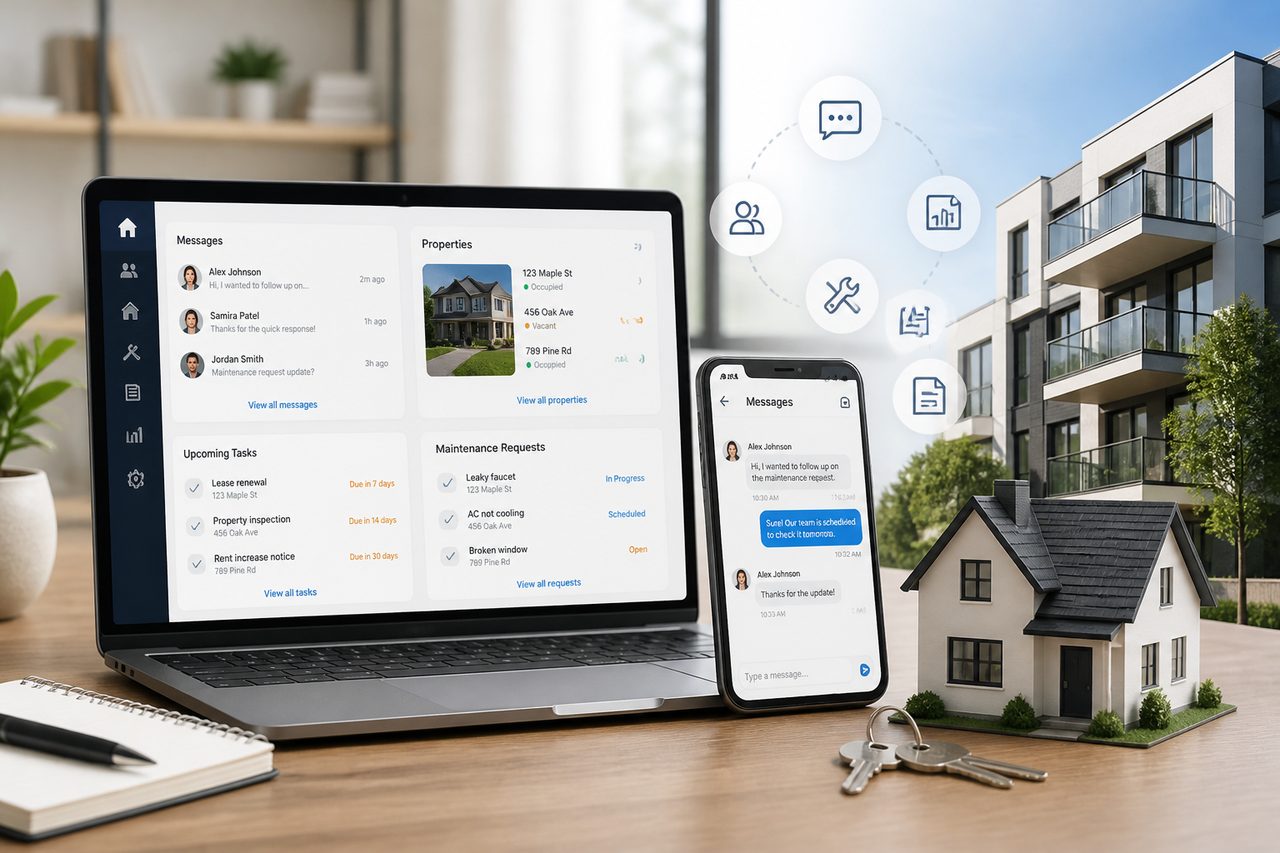
Tenants today don't want to call you. They want self-service. A decent portal lets them pay rent online, submit maintenance requests, upload documents, and message you without ever picking up the phone. On your end, look for multi-channel outreach: email, SMS, in-app messaging, and ideally chat. Everything logged with a timestamp — because disputes happen, and you'll need that paper trail.
And here's what actually matters for tenant communication: response time drives satisfaction and retention more than you'd think. Systems that fire off an automated acknowledgment while you're drafting a real response? They keep you looking professional even when you're drowning in work. Use templated messages for the repetitive stuff — rent reminders, lease renewal notices, move-in instructions. Nothing gets forgotten that way.
Rent Collection and Online Payment Processing
Online rent collection with auto-pay enrollment is one of the best ROI moves you can make in any landlord CRM. When tenants set up ACH auto-pay, late payments crater. You need ACH transfers, credit and debit cards, and ideally cash payment networks for tenants without bank accounts. Automatic late-fee calculation, NSF handling, and payment history reports should all be there.
Tenant Screening Automation
Don't make applicants jump through hoops in multiple places. Integrated screening — background checks, credit reports, eviction history, income verification — keeps everything inside the platform. The smart systems let applicants authorize and pay for their own screening report. That cuts your costs and keeps you squarely in Fair Housing compliance. The Fair Housing Act protects seven federal classes (race, color, religion, sex, national origin, disability, and familial status). Your screening criteria must apply to everyone the same way, or you're opening yourself to liability.
Lease Management and Renewal Automation
Digital lease generation, e-signatures, and automated renewal workflows — this is table stakes now. Set it up so the CRM alerts you 60–90 days before expiration and triggers a renewal offer automatically. When the tenant doesn't respond? The system escalates through follow-ups on its own. Don't rely on your mental to-do list for this.
Maintenance Request Tracking and Vendor Management
Tenants submit. The CRM routes. Work gets tracked. That's the flow. Photos and invoices stay in the system. The tenant gets notified when it's done. On the vendor side, you need contact directories, insurance certificate tracking, and payment records all in one place. If you're handling property restoration or renovation work, some platforms scale into project-level tracking with milestones and budget allocation — though this varies widely depending on what you're paying for.
Accounting, Financial Reporting, and Owner Dashboards
Real-time cash flow visibility changes everything when you're deciding which properties to hold and which to sell. Income and expense tracking, Schedule E report generation, bank reconciliation, owner statements — all critical. The system should integrate with QuickBooks or whatever accounting software you're already using via API. CSV export alone isn't enough. Take that CRM data and run it through our Rental Property Calculator or Cap Rate Calculator to verify whether each unit is actually hitting your targets.
Mobile App and Remote Access
A mobile app isn't optional anymore. You need to approve applications, review maintenance requests, and send messages from the parking lot, from your truck, from anywhere. Don't just check that an app exists. Test whether core workflows actually work on mobile — approving an application, responding to a maintenance request, collecting a payment. A stripped-down mobile version is worthless.
Compliance, Documentation, and Audit Readiness
Your CRM becomes your audit file. Timestamped communications, signed leases in the cloud, screening decision records, maintenance histories — all of it matters the moment a tenant dispute goes to a housing authority or court. Platforms should store documents indefinitely and export records in standard formats. Tenant data privacy is a bigger deal every year. SOC 2 compliance, encryption at rest and in transit — ask vendors about their security certifications directly.
Back to topTop Property Management CRMs for Landlords in 2026
Here are the realistic options for most landlords and property managers. Need something more specialized? Our Best CRM for Real Estate Property Managers guide goes deeper into the property management software category.
Buildium — Best Overall for Growing Portfolios
Want everything in one place? Buildium is one of the most complete platforms on the market. Lead management, online leasing, rent collection, maintenance tracking, accounting, owner portals—it's all there. You can start with a small portfolio and scale into a company managing hundreds of units without switching systems. Check our full Buildium Review for 2026 for the detailed feature breakdown. Pricing is unit-based and tiered, so hop over to Buildium's site for current plan costs—they adjust periodically.
TenantCloud — Best for Cloud-Based Simplicity and Cost-Consciousness
A generous free tier for small landlords. Paid plans stay affordable even if you're managing up to 50 units. TenantCloud handles listings, applications, screening, rent collection, and basic accounting without unnecessary complexity. Solo landlords appreciate the straightforward interface—there's not much of a learning curve. Our TenantCloud Review covers what it does well and where it falls short. And if you're torn between Buildium and TenantCloud, our Buildium vs. TenantCloud comparison will help you decide.
Aptly — Best for AI-Powered Leasing
Aptly (formerly Knock CRM's AI leasing product) automates the top of the leasing funnel: lead response, scheduling, and follow-up. It uses AI-driven communication to handle the repetitive work. If you're drowning in inquiries and want to cut leasing agent workload, this shines. But it's not for solo landlords who need full accounting and property management features built in.
RealPage — Best for Large Operators
This is enterprise-grade territory. Revenue management, yield optimization, deep analytics alongside CRM and property management. If you're running 200+ units, you already know about this one. For most individual landlords? It's overkill—and the implementation complexity plus pricing will make you regret it.
Knock — Best for Dedicated Leasing Teams
Knock CRM was built specifically for multifamily leasing teams. Lead tracking, leasing performance analytics, and team collaboration are the bread and butter. It integrates with property management systems rather than replacing them. This works great for management companies with dedicated leasing staff. Not so much for a solo landlord wearing all the hats.
Contactually — Best for All-in-One Communication and Outreach
Disclosure: KDS, the publisher of this site, teamed up to create Contactually. This is a separate, real-estate-ready platform—not the older Contactually CRM that Compass acquired. It's built for investors and landlords who want a single system for communication and relationship management. List building, skip tracing, CRM pipelines, workflows, texting, calling, email marketing, funnels, websites, and social posting. All one platform. Usage charges (calls, minutes, texts) stack on top of your plan price. There's no free tier. You'll get the most value if you're doing heavy outreach and follow-up automation—especially if you're acquiring new properties while managing existing ones. It won't replace dedicated accounting or maintenance modules, so bigger operations usually pair it with a property management backend. Check contactually.net for current pricing.
Other Strong Contenders
- Propertyware: Solid for single-family rental portfolios; maintenance and owner reporting shine here.
- LeadSimple: Process-focused CRM built for property management companies with strong workflow automation and team task management.
- Rentec Direct: Mid-market sweet spot. Accounting, tenant screening, and portals at competitive pricing.
- AppFolio: Full-featured for property management companies; minimum unit requirements lock out small landlords.
Looking beyond property management? Our Best Real Estate Investor CRM Systems 2026 guide covers investor-focused options across the board.
Back to topFeature Comparison Matrix
Here's the thing—pricing moves around constantly. So instead of listing dollar amounts that'll be outdated by next week, this table focuses on what each platform actually does and where it sits in the market. Want specifics? Hit up the vendors directly and get their current numbers in writing.
| Platform | Lead Management | Rent Collection | Tenant Screening | Accounting Integration | Best For |
|---|---|---|---|---|---|
| Buildium | ✓ Full pipeline + syndication | ✓ ACH, card, auto-pay | ✓ Integrated (TransUnion) | ✓ Native + QuickBooks export | Growing portfolios, PM companies |
| TenantCloud | ✓ Listings + applications | ✓ ACH, card | ✓ Integrated (partner) | ✓ QuickBooks sync | Small landlords, budget-conscious |
| Aptly | ✓ AI-automated follow-up | Partial (via integration) | Via integration | Via integration | High-volume leasing teams |
| RealPage | ✓ Enterprise-grade | ✓ Full suite | ✓ Integrated | ✓ Native GL | Large operators, 200+ units |
| Knock | ✓ Leasing-focused | Via PM integration | Via integration | Via PM integration | Dedicated leasing teams |
| Contactually | ✓ Pipeline + workflow automation | Not native | Not native | Via integration | Outreach-heavy landlords/investors |
| LeadSimple | ✓ Process-driven workflows | Via PM integration | Via integration | Via integration | PM companies with defined processes |
| Rentec Direct | ✓ Basic listing tools | ✓ ACH, card | ✓ Integrated | ✓ Native accounting | Mid-market landlords |
Benefits of Using a CRM for Landlord Tenant Management
Find and Retain Quality Tenants Faster
Prospective tenants hear back within minutes, not hours. That's what automated lead routing and instant acknowledgment messages do. Why does speed matter? Rental markets move fast, and with a Q2 2026 rental vacancy rate of 7.3%, qualified applicants have options everywhere. A CRM captures every inquiry and pushes it through a structured pipeline—so you don't lose quality leads just because you were busy managing something else.
Reduce Late Payments and Improve Cash Flow
Auto-pay enrollment is the single most effective tool for reducing late rent. Period. When tenants set up ACH auto-debit, you remove the behavioral friction of remembering to pay. Add automated rent reminders sent 3–5 days before due dates, and delinquency drops further. For a property generating the U.S. median asking rent of $1,531/month (Q2 2026 Census HVS data), even one fewer late payment per year meaningfully improves cash flow—and that's before you count the hours you don't spend chasing the money. Want to see how improved collection rates hit your actual return? Use our Cash-on-Cash Return Calculator to model it out.
Automate the Tenant Lifecycle
The best CRM implementations build workflows around the full tenant lifecycle—not just leasing:
- Prospect stage: Lead capture → auto-responder → showing scheduling → application invitation
- Screening stage: Application received → screening ordered → decision communicated → adverse action notice (if applicable) generated automatically
- Move-in stage: Lease generated → e-signature requested → security deposit collected → move-in checklist sent → welcome message triggered
- Tenancy stage: Monthly rent reminders → maintenance request routing → renewal alerts at 90/60/30 days
- Exit stage: Move-out checklist triggered → deposit disposition calculated → security deposit return processed within statutory deadline
Each touchpoint done manually? That's a decision and an action. Automated? It happens without you lifting a finger.
Reclaim Significant Time Every Week
Most landlords who ditch spreadsheets and email for a real CRM are shocked at how much administrative time vanishes. Sending rent reminders. Following up with applicants. Routing maintenance requests. Chasing lease signatures. These become background processes the system handles on its own. Self-managing landlords and property managers consistently report saving more than 20 hours per week once full automation kicks in across rent collection, communication, and maintenance workflows. The actual number shifts based on portfolio size and how many manual tasks you're replacing, but the pattern's always the same: bigger portfolio, bigger time recovery. That reclaimed time either goes toward acquisitions and scaling your portfolio, or it just disappears from your workload.
Scale Operations Without Proportional Headcount Growth
Here's the reality: 72.6% of independent landlords own 1–4 units. When you're scaling from 5 to 15 units, you face a hard question—do I hire a property manager or systematize? A well-implemented CRM is often the answer that lets you defer that hire while keeping service quality intact. Building to 10+ properties? Our Real Estate Portfolio Management guide digs into the systems decision in detail.
Gain Visibility Across Your Portfolio
Owner dashboards show you rent collection status, vacancy rates, open maintenance items, and financial performance across all units in real time. Instead of juggling three spreadsheets and two email threads to answer "how'd last month go," you've got one screen. This visibility matters most when you're deciding whether to hold, refinance, or sell—and it pairs well with tools like our Gross Rent Multiplier Calculator for quick portfolio-wide analysis.
Back to topCost of Property Management CRM Software in 2026
Pricing models vary significantly. And that variation matters—it's the difference between a predictable expense and a nasty surprise at renewal time.
Common Pricing Models
- Per-unit pricing: Buildium, AppFolio, and Propertyware all work this way. You pay per unit under management. The upside? It scales predictably. The downside? Once you hit 50+ units, that per-unit fee adds up fast.
- Per-user pricing: LeadSimple and some Knock tiers charge per seat instead. This model makes sense if your team headcount—not your unit count—is what really drives usage.
- Flat-rate tiered plans: TenantCloud and Rentec Direct carve out three or four tiers (basic, growth, premium) with unit caps baked into each. You get some predictability without the per-unit bleeding.
- Usage-based add-ons: Contactually bills you for communication usage—calls, texts, meeting minutes—stacked on top of your base plan. Want to control variable costs? This one lets you do it.
Hidden Costs to Budget For
- Setup and data migration: You've got tenant records, leases, and payment history scattered across spreadsheets or buried in an old system. Moving all that takes time. Some vendors charge for migration help; others leave you to figure it out solo.
- Tenant screening fees: These usually get passed to applicants, but don't assume that's automatic. Confirm who actually pays—applicants directly or you upfront with recoup.
- Payment processing fees: ACH runs $0.50–$2.00 per transaction. Credit cards? 2–3%. The platform might eat it, tenants pay it, or you foot the bill depending on your plan tier.
- Integration costs: Need QuickBooks linked? Your website connected? A third-party screening tool integrated? That might require a paid tier or charge you per connection.
- Training and support: Enterprise players like RealPage and AppFolio usually bundle implementation support in. Mid-market platforms give you self-serve docs and charge extra if you want live support.
Estimating ROI
Here's the framework that actually works: count the hours per month you waste on stuff a CRM automates—rent reminders, maintenance coordination, application follow-up, lease renewals. Multiply those hours by your hourly rate (or what you'd pay a property manager: typically 8–12% of collected rent). Now compare that number to your monthly platform cost. For most landlords with five or more units? The math clears quickly.
And there's more. Factor in vacancy cost reduction. The national median asking rent sits at $1,531 per month. That means every week your unit sits vacant costs you roughly $380. Faster leasing through automated follow-up? It pays for most platforms all by itself.
Want to model this out with your actual numbers? Our Rental Property Calculator lets you plug in your specifics and see projected cash flow, returns, and break-even metrics.
Back to topHow to Choose the Right CRM for Your Landlord Portfolio
Step 1: Assess Portfolio Size and Growth Trajectory
Four single-family homes? Your needs look nothing like a property management company running 150 units across multiple owners. Where are you actually standing right now—and more importantly, where do you want to be in three years? Migrating platforms mid-growth is a nightmare. It's worth buying slightly ahead of your current needs.
Step 2: Evaluate Team Structure and Workflow Needs
Solo operators need simplicity. Low maintenance overhead. Teams need something entirely different—user permissions, task assignment, performance tracking that actually works. Property managers handling third-party properties? They need owner portals and trust accounting built in. Each of these scenarios points toward a different platform.
Step 3: Map Your Existing Software Stack
Already running QuickBooks? Don't just assume the CRM will play nice—confirm it syncs bidirectionally instead of forcing you into manual exports. And if your maintenance coordinator swears by a specific app, check for integration before committing. The best CRM isn't the one with the shiniest interface. It's the one your entire workflow actually connects to without duplicate data entry eating your time.
Step 4: Use Trial Periods
Most platforms hand you 14–30 days free, or a free tier if your portfolio's small enough. TenantCloud stands out here—they've got a legitimate free plan that covers basic functionality. Don't just watch the demo (they all look good). Actually test the workflows that matter to you most. Run a tenant application through screening. Submit a maintenance request from the tenant side. Pull a financial report. That's when you'll see whether it actually works or just looks polished.
Step 5: Evaluate Support Quality
Head straight to Capterra or G2 and dig into the reviews—not the star ratings, but what people actually say about support responsiveness. A platform that ghosts you when you've got a tenant locked out, a rent payment that failed, or a lease needing immediate correction? That's a serious operational risk you can't afford. Look for live chat or phone support during business hours at a minimum—anything less is a red flag.
Back to topImplementation Tips and Best Practices
Data Migration: Clean Before You Import
Garbage in, garbage out. That's the iron law of CRM implementation, and it starts with your data migration strategy. Before you move tenant records from spreadsheets into your new system, deduplicate contacts, standardize address formats, and audit every lease date. A CRM stuffed with inconsistent data creates exponentially more headaches than your old spreadsheets ever did. Block out two weeks minimum for a serious data cleanup sprint before go-live.
Phased Rollout vs. Hard Cutover
Managing five units or fewer? A hard cutover works. Move everything at once over a weekend and you're done. But if you're running 50+ units with an active team, a phased rollout is your friend. Start with new properties or a small subset of units, then expand gradually. Why? Because nothing kills momentum faster than having half your portfolio trapped in the old system and half in the new one with no clear end date.
Key Metrics to Track After Launch
- Lead response time: Target under 5 minutes for initial auto-response, under 2 hours for personalized reply
- Time-to-lease: Days from vacancy posting to signed lease
- Late payment rate: Percentage of rent collected on or before due date
- Maintenance resolution time: Days from request submission to work completion
- Auto-pay enrollment rate: Percentage of tenants on ACH auto-pay
Month one is your baseline measurement window. Lock in those numbers so you've got something real to compare against in Q2 and Q3.
Change Management for Teams
Here's what actually kills CRM rollouts: your team won't use it. Staff who've spent years organizing their lives around email folders and spreadsheet tabs don't wake up excited about change. They'll resist unless you answer the only question that matters to them: what's in it for me?
Don't train people on features. Train them on pain elimination. Show the maintenance coordinator she'll never get an 11pm tenant text again. Show the leasing agent his response time will drop by 60%. Find the power user on your team — the person who's already thinking ahead — and make them your internal go-to during transition.
For more on managing rental properties at scale with the right technology stack, our Best Rental Property Management Apps for 2026 guide covers the broader app market.
Back to topConclusion
Here's the reality: about 80% of individual landlords self-manage their properties. Most rely on spreadsheets, email, and text messages. These tools don't scale. They don't create the audit trails that protect you when a dispute happens. A real CRM fixes this. It automates your entire tenant lifecycle — from first inquiry all the way through renewal. Auto-pay cuts late payments. You get real-time financial data without digging through six different apps. And you build documentation that actually holds up in court. All of this happens without hiring more staff.
What's your portfolio size? If you're running 5–50 units, Buildium or TenantCloud will handle almost everything you need without breaking the budget. But if communication automation and tenant outreach matter just as much as rent collection, test drive Contactually alongside your property management tool. Got a dedicated leasing team? Knock or Aptly are built for that workflow. Managing 100+ units? You need RealPage or AppFolio — anything less leaves money on the table.
Don't pick based on which sales rep gave the smoothest demo. Free trial your top two. Run the same test workflows through both. Make your call based on what you'll actually use every single day.
Back to top
Frequently Asked Questions
What's the difference between property management software and a CRM?
Property management software handles the full operational stack: rent collection, accounting, maintenance, lease management, and owner reporting. A CRM? It's laser-focused on relationships and communication—lead tracking, follow-up sequences, tenant communication, pipeline visibility. And here's the thing: many modern platforms (Buildium, TenantCloud) actually do both. Standalone CRMs like LeadSimple and Contactually handle the relationship layer while integrating with separate property management backends for the operational heavy lifting.
Do I need a CRM if I've fewer than 10 units?
Maybe. It really comes down to how much time you're burning on manual work. The average individual landlord owns just 1.89 units—most small operators stick with spreadsheets. But here's what I see: even at 3–5 units, automated rent reminders and digital lease management save you several hours monthly and kill the late-payment headache. TenantCloud's free tier lets you test it for basically nothing.
Can I integrate my CRM with my accounting software?
Most property management CRMs sync with QuickBooks (Online and/or Desktop), and some have native accounting built in. One critical thing to verify: is the integration bidirectional or export-only? One-way exports force you into manual reconciliation hell. And if your accounting's complex—multiple entities, trust accounts for third-party owners—don't settle for a QuickBooks sync. Go with native GL capabilities like Buildium or RealPage instead.
How long does it take to implement a new CRM?
Solo landlord with under 10 units coming off spreadsheets? 1–2 weeks to migrate data, configure settings, and get tenants into the portal. A 50–100 unit PM company with staff involved? 4–8 weeks is realistic for full rollout plus training. Enterprise platforms like RealPage and AppFolio will eat up 2–4 months with a formal implementation project. Data migration quality is everything—clean data cuts your timeline dramatically.
What if I'm already using property management software — do I still need a CRM?
Depends entirely on what you're already doing well. Your current software nails rent collection, maintenance, and accounting but has garbage lead management and communication automation? Bolt on a dedicated CRM (LeadSimple, Contactually) via API integration and fix that gap. But if you're on Buildium or something full-featured, its built-in CRM might be enough. Before you add another system and all the integration headaches that come with it, audit what's actually missing from your current workflow.
Back to topMore on long-term rentals: explainers
- Best CRM for Real Estate Property Managers: Tenant & Maintenance Tracking
- Can You Use a Business Loan to Buy Rental Properties?
- Why Landlords Should Require Renter's Insurance: Legal and Financial Protection
- Build-to-Rent Development Strategy: New Construction for Investors
- Buying Properties with Tenants In Place: Benefits & Considerations
- Landlord Tenant Court Records: Using Eviction Data for Property Leads
See our guide: “Long-Term Rental Investing: A Practical Buy-and-Hold Guide” →