

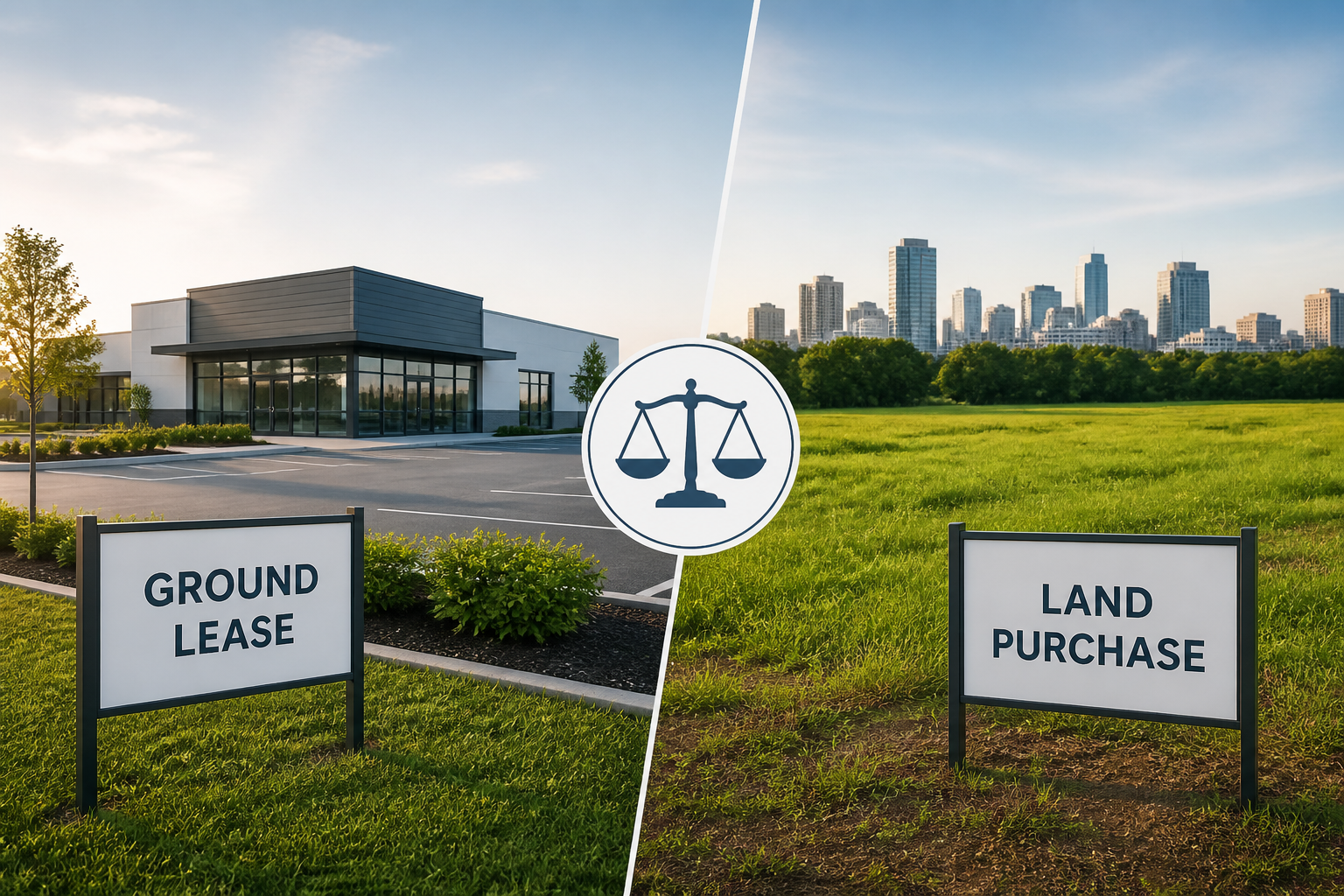
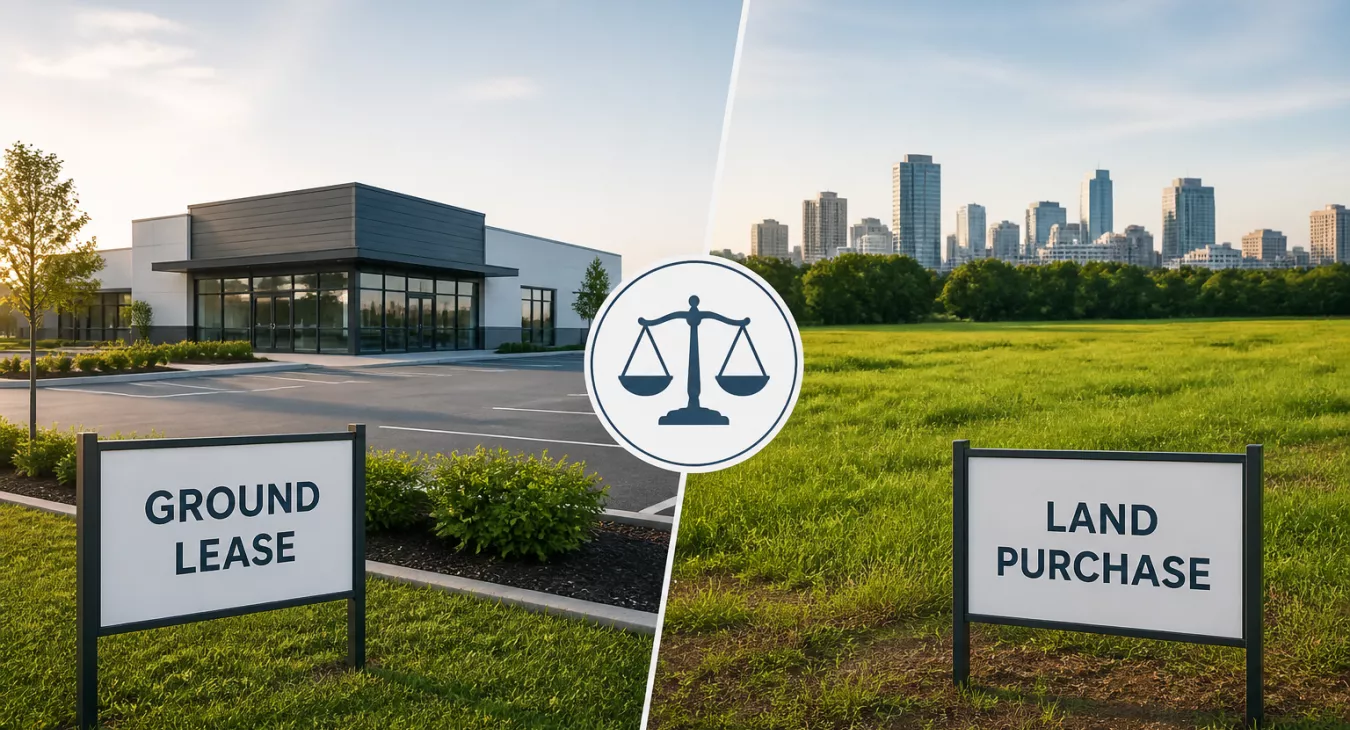
Compare ground lease vs land purchase for investors. Explore capital needs, ownership, tax implications, and long-term returns to choose the right strategy
Table of Contents
- Quick Comparison: Ground Lease vs Land Purchase at a Glance
- What's a Ground Lease?
- What's a Land Purchase?
- Ground Lease vs Land Purchase: Key Financial Differences
- Critical Lease Terms Every Investor Must Understand
- Tax Implications for Investors
- Investor Advantages: Ground Leases
- Investor Advantages: Land Purchase
- Risks and Challenges: Ground Leases vs Land Purchases
- Market Trends and Institutional Investor Activity
- Investor Decision Framework: Which Strategy Fits Your Situation?
- Conclusion: Choosing the Right Strategy for Your Investment Goals
- Frequently Asked Questions
Few decisions shape a real estate investor's long-term returns more definitively than the choice between entering a ground lease arrangement and purchasing land outright. On the surface, both strategies offer exposure to real property — but they deliver fundamentally different risk profiles, capital requirements, tax treatments, and exit pathways. Understanding the ground lease vs land purchase investor equation isn't about finding a universal winner; it's about matching the right structure to your capital position, time horizon, risk tolerance, and portfolio objectives. This guide breaks down each approach feature by feature, so you can make a more informed, strategic decision.
New to long-term rental? Start with our Long-Term Rental Investing Guide.

Quick Comparison: Ground Lease vs Land Purchase at a Glance
Skip the MBA-speak. The table below shows what actually matters—the stuff that'll tank or make your deal. Each row is a lever. Pull the wrong one, and your returns, financing, and exit options all suffer.
| Feature | Ground Lease | Land Purchase (Fee Simple) | Investor Impact |
|---|---|---|---|
| Ownership of Land | Landowner retains title | Investor holds fee simple title | This determines whether you're building wealth or renting it. |
| Typical Term | 50–99 years; 99-year most common | Permanent / indefinite | When that lease expires, everything you built reverts. That's the clock ticking. |
| Upfront Capital Required | Lower (improvements only) | Higher (land + improvements) | Less capital down means better cash-on-cash initially—but watch the fine print. |
| Ownership of Improvements | Tenant during lease; reverts at expiration | Investor owns permanently | Reversion risk is the ground lease's biggest gotcha. Your building walks away. |
| Operating Cost Structure | Typically triple-net (NNN): tenant pays taxes, insurance, maintenance | Owner responsible for all costs | NNN looks clean, but you're exposed to tenant volatility. Every cost spike hits your income. |
| Land Depreciation | N/A (tenant doesn't own land) | Land isn't depreciable under IRS rules | Raw land doesn't depreciate for either party. Not a tax play. |
| Building Depreciation (Improvements) | Tenant depreciates improvements over lease term | 39-year MACRS straight-line for nonresidential | Fee simple? You get a real tax shield. That's 39 years of depreciation working for you. |
| Rent Escalation | Every 5–10 years; CPI-linked or fixed step-ups | No rent; mortgage payment is fixed (if fixed-rate) | Escalation builds income but also kills tenant IRRs. Your tenant's pain is your gain—until they leave. |
| Financing Accessibility | Leasehold mortgages — harder to obtain, typically higher rates | Fee simple financing — broadly accessible | Leasehold deals are tough to finance. You'll pay more, and fewer lenders will touch them. |
| Exit Flexibility | Limited; leasehold interest may be less liquid | High; can sell, refinance, or 1031 exchange freely | Need to move capital fast? Fee simple wins. Leasehold? You're stuck. |
| Appreciation Upside | Landowner captures land appreciation | Investor captures both land and improvement appreciation | Land value doubles in 15 years? Landowner gets it. You get the building. That's the trade-off. |
| Control Over Land Use | Subject to lease restrictions | Maximum flexibility (subject to zoning) | Want to reposition or redevelop? Fee simple lets you move. Ground lease? You're negotiating. |
What's a Ground Lease?

Definition and Structure
You're leasing the land. You own everything on top of it—the building, improvements, tenant improvements—but when that lease expires, it all reverts to the landowner. That's the reversionary right, and honestly, it's the biggest risk you'll face in a ground lease deal. Here's the basic setup: an investor (you, the tenant) leases land from a landowner and builds or operates improvements on that property. Most commercial ground leases are structured on a triple-net (NNN) basis, which means you're covering property taxes, insurance, and every maintenance cost. No landlord subsidies here.
Typical Lease Terms and Duration
Ground leases typically run 50 to 99 years, with 99-year terms being the industry standard in commercial real estate. Why so long? You need time to amortize development costs, get financing locked in, and actually make money. But here's where it gets tricky. Rent escalation is built in at intervals of every 5–10 years—either as fixed percentage step-ups (think 20–25% per 10-year period) or as CPI-linked annual adjustments. And those escalations compound. Over decades, a seemingly modest 3% annual bump becomes a meaningful pressure on your cash flow. Study those clauses carefully.
Who Uses Ground Leases
Commercial real estate runs on this model—retail centers, hotels, office buildings, industrial facilities, and increasingly multifamily developments in expensive urban markets where land costs eat your entire acquisition budget. Institutional players like REITs, pension funds, and life insurance companies love being the landowner. They get stable, bond-like income streams without the operational headaches. Developers and operating businesses use ground leases differently. They get access to prime locations without dropping capital on land acquisition. Want to see how this model generates passive income at scale? Check out our breakdown of cell tower lease income and what land investors actually earn.
Back to topWhat's a Land Purchase?

Fee Simple Ownership Explained
You own everything. With fee simple, you hold outright ownership of the land plus any improvements on it. No lease expiration date. No reversion risk. No rent payments to some superior landowner hovering in the background. Fee simple is the cleanest form of real property ownership you can get — it gives you the right to develop, use, sell, mortgage, lease, or pass it down to your heirs without asking anyone's permission. Subject to local zoning and land-use regs, obviously, but that's it.
Complete Ownership Rights and Long-Term Structure
This is why investors love it. Maximum flexibility. You can develop the land, hold it vacant, sell it, refinance the improvements, execute a 1031 exchange, or leave it to your kids — all without lease restrictions or a landlord's consent holding you up. But here's the thing: land itself carries no depreciable basis under IRS rules. Your tax advantage in fee simple ownership comes 100% from the improvements you build, not from the land value itself. The distinction matters for your ARV calculation and your overall hold strategy. Want to dig deeper? Check out our full comparison of fee simple ownership vs. leasehold for investors.
Back to topGround Lease vs Land Purchase: Key Financial Differences

Upfront Capital Requirements
Here's the thing: a ground lease keeps your cash in your pocket on day one. You're not dropping $2–3M on raw land in Manhattan or $500K in Austin just to start building. Instead, you fund improvements and development only. In pricey urban markets, land eats up 30% to 60% of your total project cost — that's real money you could deploy elsewhere. A fee simple purchase? You're fronting both land and development costs, which crushes your equity efficiency right out of the gate.
The numbers matter here. 2025 USDA data puts average U.S. farm real estate at $4,350 per acre, cropland at $5,830 per acre, and pasture at $1,920 per acre. Commercial zoned land? It's a different beast. No national government index exists because values swing wildly by market. You need local appraisals and comps — that's the only intel worth trusting.
Lease Payment vs Ownership Costs
Ground rent isn't a loan payment. It's an annual obligation to the landowner, and it typically runs 6%–11% of the land's unimproved fair market value per year — roughly 7%–8% in urban markets and 5%–7% in suburban or rural settings. Here's the tax play: it's fully deductible as a business expense, unlike that non-depreciable land component eating into your fee simple returns. But here's the catch. Escalation clauses are built into most leases, which means your rent climbs over time and squeezes your operating margins the longer you hold the deal.
Financing and Mortgaging Challenges
Need capital? Fee simple land is easy to finance. Banks, credit unions, insurance companies, CMBS lenders — they're all in. But a leasehold mortgage? That's where it gets tight. Lenders demand that remaining lease term exceed the loan term by 10–25 years minimum, that the lease has lender-protection language, and that the landowner agrees to a non-disturbance agreement. You're looking at a smaller lender universe, higher rates, and tighter covenants. Want to dig deeper into loan structure decisions? Check out our analysis of 15-year vs. 30-year mortgage terms for investors.
Long-Term Return on Investment
Early cash-on-cash returns favor the ground lease. You've got less equity tied up in land, so your percentage returns look prettier year one through year five. Then reality sets in. The landowner keeps all land appreciation. Your improvements revert to the owner at lease expiration. Your terminal value tanks as the lease runs out. Fee simple flips this script — you capture both land appreciation and improvement equity, building real wealth over two decades or more. The trade-off is obvious: lower early returns for dramatically higher long-term upside.
Back to topCritical Lease Terms Every Investor Must Understand

Your ground lease return isn't determined by the headline rent. It's locked in the fine print—the specific contractual language that shifts risk between you and the landowner. Miss these details, and you'll leave money on the table or expose yourself to unnecessary downside.
| Lease Term | Definition | Investor Risk Level | Negotiation Priority |
|---|---|---|---|
| Subordination Clause | Landowner's interest subordinated to tenant's lender; lender can foreclose on entire property | High (for landowner) | Critical — lenders often require it |
| Non-Disturbance Agreement | Lender agrees not to terminate lease upon foreclosure | High (for tenant/lender) | Essential for leasehold financing |
| Rent Escalation Formula | CPI-linked or fixed step-up every 5–10 years | Medium–High (for tenant) | High — caps and floors protect both parties |
| Reversion Clause | Improvements transfer to landowner at lease expiration | High (for tenant near term end) | Critical — negotiate renewal options early |
| Assignment Rights | Tenant's ability to transfer leasehold interest to a buyer or lender | Medium (for tenant) | High — restrictions impair exit options |
| Use Restrictions | Permitted property uses defined in the lease | Medium (for tenant) | Medium — flexibility for repositioning |
| Default and Cure Provisions | Timeline and remedies if tenant defaults on rent or covenants | Medium (both parties) | High — lender cure rights essential |
| Renewal Options | Tenant's right to extend lease at predetermined or re-negotiated terms | High (for tenant) | Critical — determines terminal value |
New to lease structures? You need to understand how lease option strategies work. The same contractual mechanics show up in related deals like land contracts, and they affect your long-term outcome just as much.
Back to topTax Implications for Investors
Depreciation: The Core Tax Difference
Here's where the two strategies split dramatically on taxes. Buy a property in fee simple? You depreciate the improvements — not the land — over 39 years using the MACRS straight-line method for nonresidential real property. Land has zero depreciable basis. Now, Qualified Improvement Property (QIP) — those certain interior improvements to nonresidential buildings — that's different. It gets 15-year MACRS straight-line depreciation. And here's what matters right now: in 2025, bonus depreciation for qualifying property sits at 40%, phasing down 20% per year through 2026 (20%) and vanishing entirely in 2027. Don't sleep on Section 179 either. The 2025 cap is $1,250,000, with phase-out kicking in at $3,130,000 of property placed in service. These numbers change annually. Talk to your tax advisor before you model your deal.
Ground Lease Tax Treatment
You're a tenant on a ground lease? Your annual rent is straight-up deductible as an ordinary business expense. That's real money back against your operating income. Any improvements you build get depreciated over their useful life or your lease term — whichever ends first. The landowner's position is cleaner in some ways. Ground rent received counts as ordinary income, sure. But here's the kicker: they're holding an appreciating asset without any depreciation recapture headaches. The tenant owns all those improvements, so that's the tenant's recapture problem, not theirs.
Depreciation Recapture on Sale
This is where a lot of investors get surprised. You exit a fee simple deal and you've got depreciation recapture staring you down. Unrecaptured Section 1250 gain — that's your real property depreciation — gets taxed at up to 25%. But there's more. Section 1245 recapture on personal property components you've identified through cost segregation studies? That hits you at ordinary income rates — potentially 37% in 2025. Those recapture taxes can absolutely crush your net proceeds. Model this before you commit to an exit. Both ground lease leasehold interests and fee simple properties can generally qualify for 1031 exchange treatment, though the mechanics aren't identical. Always confirm with a qualified intermediary before assuming you can defer.

Investor Advantages: Ground Leases
Capital Efficiency and Predictable Income
Here's what makes ground leases so attractive to investors. On the landowner side? You get capital efficiency paired with predictable income. No development capital required. Zero construction risk. And your rent keeps climbing regardless of how the tenant's business performs. It's the bond-like stability most real estate investors crave.
Now flip to the tenant investor's angle. You access prime locations without dropping millions on land acquisition. That capital flows into the actual income-producing improvements instead. It's the difference between reaching a 7% cap rate or being priced out entirely.
Landowners typically value ground lease income using cap rates, and the numbers vary sharply based on tenant quality. Investment-grade or credit-tenant ground leases typically trade at cap rates of 4.5%–5.5%, while non-credit-tenant ground leases command 7%–11% cap rates. The overall range for investor/landowner valuation spans roughly 3.65%–6% for high-quality, long-duration ground leases. Better tenant credit? Lower cap rate. Shorter term or shakier tenant? You're looking at double digits.
Portfolio Diversification and Lower Entry Barriers
Want to own land in Manhattan's core, Scottsdale's resort district, or Fifth Avenue retail? Ground leases make it possible with a fraction of the equity you'd need to buy fee simple. You participate in high-barrier markets without the massive capital commitment. That capital stretches further — across more markets, more asset classes, more diversification. And if you're sourcing these deals, you'll need real data. Our review of data aggregator platforms for land investors breaks down the tools that actually work for this research.
Back to topInvestor Advantages: Land Purchase
Appreciation Upside and Generational Wealth
Total return potential. That's the real reason fee simple land outperforms over the long haul. You're capturing appreciation on both the land itself and any improvements you make — and that compounding effect becomes serious money over 20, 30, or 40 years. In markets that are actually growing, land appreciation alone can crush income returns. And here's the kicker: fee simple ownership is built for generational plays. Hold it in a trust, an LLC, or a family limited partnership, and you've got estate planning advantages that leasehold investors simply don't get.
Exit Strategy Flexibility
Fee simple gives you optionality that leasehold can't touch. You want to sell? Refinance and pull equity? Run a 1031 into another deal? Convert to a ground lease and keep collecting while you stay on title? All on the table. You could even carve off air rights or easements for a partial cash injection.
Leasehold's different story.
Every year that ticks by, that remaining lease term gets shorter, and so does your liquidity. The structure itself locks you out of certain exit moves. If you're serious about building a resilient portfolio across challenging asset classes, factor in turnkey real estate strategies alongside fee simple land — that's how you actually diversify.
Back to topRisks and Challenges: Ground Leases vs Land Purchases

Ground Lease Risks
- Reversion risk: When the lease expires, everything you've built transfers back to the landowner. You lose your entire improvement investment if you can't negotiate a renewal option before signing.
- Rent escalation exposure: Ground rent resets every 5–10 years — tied to CPI or fixed step-ups — and it can spike your carrying costs to the point where the project doesn't pencil anymore in year 15 or 20.
- Leasehold financing complexity: Banks hate lending on leaseholds. They'll demand the lease structure to be airtight, require non-disturbance agreements, and set minimum remaining terms — which shrinks your lender options and can kill a refinance when you need it most.
- Limited control over land: The lease agreement can restrict what you do with the property. Want to modify the building or redevelop? You'll need the landowner's permission, and that control—or lack thereof—constrains your value-add plays.
Land Purchase Risks
- High capital requirement: Buying land outright costs real money upfront. Your equity ties up substantially more capital, which tanks your initial cash-on-cash return and limits the capital you can deploy elsewhere.
- Market volatility: Land prices move with interest rates, economic cycles, and local absorption. A recession or rate spike cuts your property value and your refinancing capacity in one shot.
- Holding costs: Taxes, insurance, and debt service hit your P&L every single month—occupied or not. Ground lease structures push most of that burden to tenants through NNN arrangements, which is why landowners sleep better at night.
- Liquidity constraints: Real estate doesn't move fast. Unloading a large fee simple parcel takes time, and you'll probably take a haircut on the price if you need to exit quickly. That's why savvy investors use budgeting tools built for real estate investors to model liquidity scenarios.
Market Trends and Institutional Investor Activity
Ground leases are pulling in serious institutional capital these days. REITs built specifically around ground lease ownership — sometimes called "land banks" — have popped up as a distinct institutional vehicle. They offer bond-like income with real estate inflation protection baked in. The appeal is especially strong in high-land-cost markets where developers need capital efficiency and landowners want passive, long-duration income. Rising construction costs and interest rate sensitivity have reinforced this preference. Developers increasingly favor ground lease structures that reduce total project capitalization.
Fee simple land in primary markets? Scarcity continues to drive strong appreciation fundamentals for long-term holders. But here's what you need to know if you're exploring fee simple strategies in growth markets: local zoning constraints matter. Can you actually rezone the land to unlock additional value? That's the real question. Environmental factors matter too, especially wetland identification. They affect both your purchase feasibility and what uses are actually permitted under ground leases.
Here's the current cap rate landscape for context. Commercial real estate across major asset classes — the metrics you'll use to value both fee simple and ground lease properties — was tracking at approximately multifamily ~5.2%; Class A industrial 5.0%–5.5%; Class A office 6.0%; and retail anchor 6.5%–8.0% as of Q2 2026. Use these benchmarks when you're evaluating whether a specific ground lease's yield is actually competitive.
Back to topInvestor Decision Framework: Which Strategy Fits Your Situation?
There's no one-size-fits-all answer here. Your best move depends on what you're actually working with—available capital, how long you plan to hold, your risk tolerance, whether you need income now, and what you're building toward in your portfolio. The matrix below cuts through the noise and helps you figure out which structure makes sense for your specific deal.
| Investment Factor | Favors Ground Lease | Favors Land Purchase |
|---|---|---|
| Available Capital | Limited equity; seeking use on improvements | Sufficient capital to fund land + improvements |
| Investment Timeline | Medium-term income focus (10–30 years) | Long-term wealth accumulation (30+ years) |
| Income Priority | Stable, predictable rental income (landowner side) | Appreciation plus income over full hold |
| Control Requirements | Comfortable with lease-imposed restrictions | Requires full development and use flexibility |
| Risk Tolerance | Lower risk on landowner side; higher on tenant side | Comfortable with market value volatility |
| Financing Access | Strong sponsor able to navigate leasehold complexity | Prefers conventional, accessible financing |
| Tax Strategy | Rent deductibility; improvement depreciation by tenant | Full MACRS depreciation; cost segregation eligible |
| Exit Planning | Comfortable with limited exit optionality | Requires maximum liquidity and 1031 flexibility |
| Investor Type | Institutional; income-focused; prime-location developer | Individual; family office; generational wealth strategy |
If you're in a landlord-friendly state, fee simple deals are going to work harder for you. Check out our 2026 ranking of the most landlord-friendly states—it shows you exactly where the laws actually back your position.
Back to topConclusion: Choosing the Right Strategy for Your Investment Goals
It all comes down to priorities. Ground leases give you capital efficiency, steady income, and access to prime locations you might not otherwise reach. The catch? You're trading away control, appreciation upside, and—here's the real killer—your improvements revert to the landowner when the lease ends. Fee simple purchases are the opposite play. You get maximum ownership rights, full appreciation participation, and complete exit flexibility. But they demand serious upfront capital, and you're fully exposed to market swings and holding costs with no one else to share the burden.
Landowners love ground leases. Why? Bond-like income over decades while the land appreciates underneath, zero development headaches, no property management. For tenants, it's a different story entirely. Ground leases unlock deals that fee simple pricing would kill—but only if you negotiate hard and model the numbers obsessively over 20, 30, or 50 years ahead. Fee simple buyers take the straighter path to wealth. Patient capital wins. Market discipline too.
There's no "best" answer here.
The right move is whichever aligns with your actual capital, your return targets, your stomach for risk, and your timeline. Before you sign anything—ground lease or purchase agreement—get a real estate attorney in the room to comb through the terms. Have your CPA run the tax scenarios specific to your situation. And stress-test this thing with a financial advisor who'll run the numbers under recession, rate spike, and worst-case scenarios.
Back to topFrequently Asked Questions
Can I refinance a ground lease?
Yes. But here's the catch — it's way more complicated than refinancing a standard fee simple deal. Lenders won't touch a leasehold mortgage without solid non-disturbance and recognition agreements from the landowner. They'll also demand that your remaining lease term significantly exceed the loan term. Want to refinance in year 25 of a 40-year lease? Good luck. That's when costs spike and options disappear. Your best move is locking in strong refinancing protections and renewal options the moment you execute the lease.
What happens when a ground lease expires?
Everything reverts. Buildings, infrastructure, improvements — it all goes back to the landowner per the reversionary rights clause. You walk away with zero residual interest. That's the brutal math. Now, if you negotiated renewal options during lease signing, you might extend the term, but expect to pay higher rent when you do. This reversion risk is exactly why ground lease tenants need to nail down renewal options upfront and model what that terminal value actually looks like.
Is a ground lease a good investment?
Depends on which side you're on. Landowners? A well-structured ground lease with a strong tenant and escalating rent can print money long-term — especially in markets with rising land values and high development risk. For tenants, it's smarter. You gain access to a location you couldn't otherwise afford, and you're not burning capital on land acquisition. Just make sure the lease terms protect your downside and give you flexibility to refinance and extend when you need it.
Back to top