

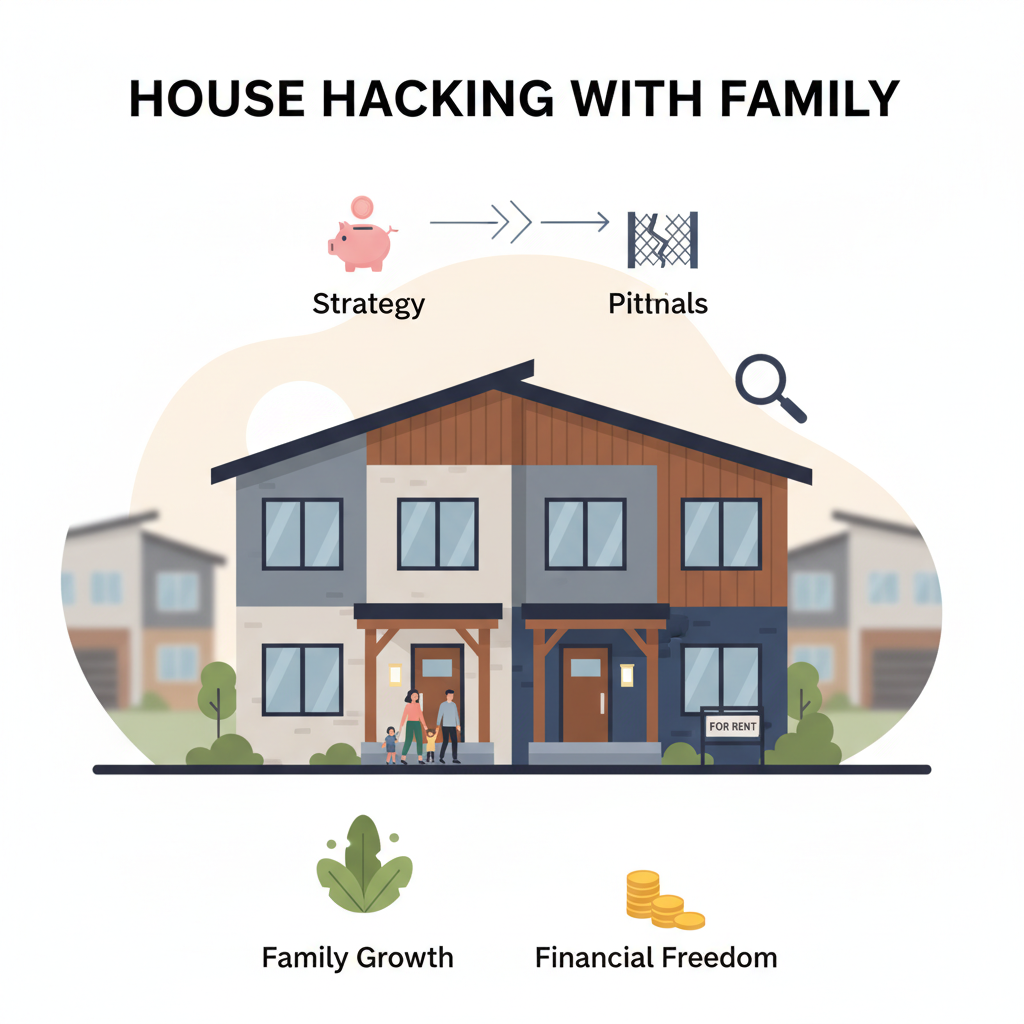
Learn house hacking with family strategies to cut housing costs in half. Discover financial benefits, pitfalls, and relationship tips to avoid costly mista
Table of Contents
- what's House Hacking With Family?
- House Hacking Strategies for Families
- Financial Benefits of Family House Hacking
- Pros and Cons of House Hacking With Family
- Getting Started: Step-by-Step Guide
- Is Family House Hacking Right for You?
- Real Family House Hacking Stories
- Conclusion
- Frequently Asked Questions
Your mortgage payment could be cut in half. Or gone entirely. Meanwhile, you're building multi-generational wealth with people you actually trust. That's house hacking with family, and it's working for thousands of households right now—it's not some theoretical exercise. But here's the thing: it can torch a family relationship faster than you'd think if you're not careful going in. This guide breaks down every major strategy, the real financial outcomes you should expect, and the relationship dynamics that kill most family house hacking deals before they generate a single dollar of profit.
New to single-family investing? Start with our Single-Family Investing Guide.

what's House Hacking With Family?
At its core, house hacking means generating rental income from your primary residence—income that either cuts your housing costs or wipes them out entirely. But when family's involved, the equation changes. You're looking at co-investors, tenants in adjacent units, or relatives pulling labor on a live-in renovation. Need the full breakdown? Read House Hacking: The Complete Beginner's Guide to Living for Free in 2026.
This isn't the same as renting to strangers. Family deals come with informal agreements, murky financial boundaries, and emotional risk you'll never see with unrelated tenants. That's the trade-off. On the flip side? Built-in trust, real flexibility, and access to pooled resources that unlock deals you couldn't close alone. Why do families actually do this? Three reasons: slash housing costs dramatically, build equity together, and keep loved ones nearby without tanking your financial independence.
Back to topHouse Hacking Strategies for Families

Family house hacking isn't one-size-fits-all. Your property type, family dynamics, risk tolerance, and long-term goals all determine which strategy actually works for you. Here's what works best.
Multi-Family Home With Family Members as Tenants
This is the bread and butter. You buy a duplex, triplex, or small apartment building and park a family member in one unit while renters pay market rate on the others. Picture this: you and your sibling each take a unit in a triplex. The third unit brings in a market-rate tenant. You're splitting the down payment burden, reducing mortgage qualification risk, and both parties build equity simultaneously. Want to know how to scale this? The Ultimate Guide to Making Money With Multifamily Rentals lays it all out.
Accessory Dwelling Units (ADUs)
Detached backyard cottages. Garage conversions. Basement suites. ADUs crush it for multi-generational plays. Your aging parents move into the ADU and keep their independence while staying nearby. Or your adult kid comes home post-college, pays below-market rent, and actually saves money instead of hemorrhaging it in a shared apartment.
You're looking at $800–$1,800/month in rental income depending on your market. That's real offset against your primary mortgage.
Renting Out Portions of the Primary Residence
A finished basement with its own entrance. An in-law suite. Even spare bedrooms. This is your lowest-friction entry point if you already own a home and have dead space sitting there. You're clearing $600–$1,200/month. Why wouldn't you?
Live-In Flip With Family Labor
Buy distressed, move in, renovate using your family's actual skills, then sell or refinance. The Section 121 exclusion—$250K per person, $500K married—wipes out capital gains if you've lived there two of five years. Construction skills in the family? Design chops? Project management experience? That cuts your renovation costs dramatically and improves your margins.
Our complete house flipping guide walks through the execution mechanics.
Garage and Yard Space Rentals
Lower commitment. Higher flexibility. Rent out garage space for storage ($100–$300/month), a driveway slot for RV or boat parking, or backyard land for a tiny home or glamping setup. These work best as supplemental income while you're building toward bigger multi-unit plays.
| Strategy | Initial Investment | Monthly Income Potential | Management Complexity | Best For |
|---|---|---|---|---|
| Multi-family with family tenants | $30K–$80K down | $1,200–$3,500 | Moderate–High | Siblings, adult children with income |
| ADU rental | $50K–$150K build cost | $800–$1,800 | Low–Moderate | Multi-generational households |
| Basement/in-law suite | $10K–$40K renovation | $600–$1,200 | Low | First-time house hackers |
| Live-in flip | $20K–$60K purchase + reno | $0 during reno; equity at exit | Very High | Families with construction skills |
| Garage/yard space | Minimal ($500–$2K) | $100–$500 | Very Low | Supplemental income, beginners |
Financial Benefits of Family House Hacking

The numbers don't lie—this is where house hacking separates itself from the usual wealth-building noise. Picture a family buying a $400,000 duplex with just 5% down on an FHA loan. Their PITI hits around $2,600/month. Now they rent the second unit for $1,500. That cuts their actual housing cost to $1,100/month. You're living cheaper than a one-bedroom apartment in most mid-sized cities. Fast-forward five years. They've knocked down principal, captured appreciation, and pocketed roughly $84,000 in housing cost savings against renting. That's real equity while they slept.
Then the tax side kicks in. Deduct mortgage interest on the rental portion. Depreciation. Repairs. Insurance. Property management. A smart family house hacker can shelter $4,000–$8,000 in taxable income every single year just from depreciation. And here's the kicker—the Section 121 exclusion lets you pocket a chunk of sale profits tax-free when you exit. Pure buy-and-hold investors? They don't get that. Want to explore how this stacks against the BRRRR method instead? Check out this comparison of BRRRR vs. house hacking.
| Family Scenario | Initial Property Price | Rental Income | Annual Savings vs. Renting | Net Worth Built (5 Years) |
|---|---|---|---|---|
| Couple + duplex, one unit rented | $380,000 | $1,400/mo | $16,800 | $145,000+ |
| Siblings co-own triplex | $520,000 | $2,800/mo (2 units) | $22,000 each | $200,000+ (shared) |
| Parents + ADU for adult child | $450,000 + $90K ADU | $1,100/mo | $13,200 | $160,000+ |
| Live-in flip, family labor | $220,000 (distressed) | $0 during reno | $40K–$80K equity at exit | $120,000–$200,000 |
Pros and Cons of House Hacking With Family

You need an honest ledger before moving forward with this. Yes, the advantages are real—but so are the complications. Most families gloss over the messy parts and regret it later. For a deeper dive into how house hacking actually builds long-term wealth, check out House Hacking: Live Free and Build Wealth.
| Category | Advantages | Disadvantages | Mitigation Strategies |
|---|---|---|---|
| Financial | Shared down payments, reduced housing costs, pooled income for qualification | Blended finances create legal exposure; family loans get complicated | Formal agreements, separate accounts, LLC ownership |
| Relational | Built-in trust, flexible arrangements, mutual support | Boundary violations, resentment over contributions, conflict escalation | Written expectations, regular check-ins, clear exit terms |
| Practical | Reliable tenants, lower vacancy risk, proximity for childcare/eldercare | Harder to evict family, awkward enforcement of rules | Treat arrangement as business; use lease agreements even with family |
| Legal | Familiar counterparties, easier communication | Zoning violations, IRS scrutiny on below-market rents, gift tax issues | Consult CPA and attorney; charge market-rate or document rationale |
Here's what most people miss: kids growing up in house hacking situations absorb attitudes about tenants and money they'll carry forever. And this cuts both ways. Done right—with calm parental execution, clear boundaries with tenants, and transparent family conversations about money—it builds financial literacy and normalizes deal-making as a normal part of life. Done poorly? You're teaching them that real estate creates stress, that family relationships blur dangerously with business, and that money causes lasting resentment. The difference comes down to intentionality.
Back to topGetting Started: Step-by-Step Guide

Here's the reality: you can't move from concept to closing without methodical preparation. Throw family into the mix, and it gets messier fast.
Step 1: Assess Your Family's Situation Honestly
Start here, not at the property search. Have the uncomfortable conversation first—before anyone gets emotionally attached to a deal. Who's handling the maintenance calls at 2 a.m.? What happens if your brother loses his job and can't pay rent? Does someone want out in three years? These questions feel awkward now. They feel a lot worse when you're trying to refinance or sell.
Step 2: Understand Financing Options
FHA loans give you 3.5% down on owner-occupied properties up to four units. That's the good news. Conventional financing requires 5–20% down depending on unit count, and both credit profiles get pulled if family members are co-borrowers. Here's what most people miss: rental income from your existing units counts toward qualification—typically at 75% of market rent. Want to layer in more aggressive strategies? This guide on BRRRR vs. house hacking order of operations walks you through the sequencing.
Step 3: Research Zoning and Legal Requirements
ADU regulations don't follow any universal standard. Some cities actively push ADU development with permitting incentives. Others bury them under setback requirements or HOA restrictions that kill the whole strategy. And short-term rentals? Airbnb bans are spreading fast. Verify zoning before you even make an offer. Check for business license requirements, rental permits, everything. One more thing: if you're charging family rent below market rate, document why. The IRS loves auditing below-market family rental arrangements.
Step 4: Address Insurance and Legal Structure
Your standard homeowner's policy won't cut it once you've got rental units. You need landlord liability coverage or an owner-occupied landlord policy instead. An LLC can shield you from liability—but be careful. Some lenders won't finance into an LLC, meaning you'll have to close in your name and transfer it after. And get a real estate attorney to draft this stuff properly: co-ownership agreements, buy-sell provisions, lease agreements. Yes, even for family members.
Step 5: Screen Tenants and Set Boundaries
Write it down. Whether your tenant is your cousin or a stranger, a written lease changes the dynamic instantly. For non-family renters, run the standard checks: credit report, income verification (aim for 3x monthly rent minimum), rental history. Your family tenants? Same process. It protects everyone from fuzzy expectations about who pays for what, who enters when, and what happens if someone stops paying.
Back to topIs Family House Hacking Right for You?

Not every family can pull this off. You're looking at a specific combination: financial reserves, personality compatibility, and the ability to handle stress without blowing up the relationship.
| Assessment Area | Key Questions | Green Light Indicators | Red Flags |
|---|---|---|---|
| Financial readiness | Do you have reserves beyond the down payment? | 6+ months expenses saved, stable income | Stretched thin on down payment alone |
| Relationship health | Can you have hard money conversations with this family member? | History of resolving conflict productively | Existing financial tension or resentment |
| Legal alignment | Are all parties willing to sign formal agreements? | Openness to documentation and structure | Resistance to "making it official" |
| Long-term vision | Do you agree on a 5–10 year plan? | Shared exit strategy and timeline | Vague or mismatched expectations |
| Commitment level | Are you ready to be a landlord? | Willingness to learn property management | Expecting passive income with no effort |
Here's the hard truth: if your family members have a track record of boundary issues, money problems, or poor communication, stop right here. And I mean that. The FIRE community's graveyard is full of deals that worked on paper but destroyed relationships that took years to rebuild. No amount of offset mortgage payments is worth that.
Back to topReal Family House Hacking Stories

The Sibling Duplex
Phoenix, 2019. A brother and sister dropped $340,000 on a duplex with 10% down—$34,000 split between them. Each took one unit. Here's where it gets real: their combined monthly outlay was just $2,100 ($1,050 per person on mortgage and expenses). Meanwhile, comparable units in the neighborhood were renting for $1,600+. Fast forward five years and the property's sitting at roughly $490,000. They've each banked over $75,000 in equity.
But this story matters because of what almost broke them. Year two hit them with a $6,000 HVAC replacement bill, and suddenly co-ownership dynamics got ugly. They credit one decision for surviving it: getting a co-ownership agreement drafted before closing. You want to know why so many sibling partnerships fail? They skip this step.
The Multigenerational ADU Setup
Pacific Northwest family. One ADU, $112,000 build cost via cash-out refi. Their 72-year-old mother moves in at $750/month—below market, sure, but documented in writing (this matters). The monthly rental income alone offset the refinance payment bump. And they sidestepped $3,800/month in assisted living costs while their mom got better care.
The property appreciated over $200,000 since. They call it "the best financial decision we've made—and the hardest relationship test we've passed." That's honest. It's not all arbitrage and appreciation.
The Reluctant Landlord Who Got It Right
Midwest couple bought a four-plex for $425,000 in 2021. They live in one unit. The other three generate $2,850/month in rental income against a $2,600 mortgage payment. They're essentially living free while equity stacks up.
Here's the wrinkle: one of those three tenants is the wife's adult brother. And it works. Why? Because they don't treat him like family—they treat him like every other tenant. Same lease, same $950/month payment, same late fees, same expectations. Their take is blunt: "The minute you make exceptions, it falls apart." They're right.
Back to topConclusion
House hacking with family works. It's one of the most powerful wealth-building tools available to everyday households—capable of dramatically reducing housing costs, accelerating equity accumulation, and strengthening family financial ties when executed with clarity and structure. But here's what separates winners from disasters: the families who succeed treat it as a business first and a family arrangement second, not the other way around. They document everything. They have hard conversations early. And they plan for exits before they need them. Ready to scale beyond your first property? The BRRRR multifamily guide shows you what's next.
The opportunity is real. So is the complexity. Go in prepared, and this strategy can change your family's financial trajectory for generations.
Back to topFrequently Asked Questions
Can I charge family members below-market rent when house hacking?
Technically, yes. But here's where it gets sticky with the IRS. Charge below-market rent to a family member, and the agency might reclassify your whole property as a personal residence instead of a rental. That kills depreciation deductions, repair write-offs—the good stuff. If you're set on below-market pricing, sit down with a CPA before you close. Get the arrangement documented properly so you understand exactly what you're giving up.
What financing options work best for family house hacking?
FHA loans dominate the 2–4 unit space. You're looking at just 3.5% down, and they require owner occupancy—which family house hacking satisfies perfectly. Conventional loans work too if your credit's solid. Here's the thing: if multiple family members are on the note, every single one gets underwritten. The good news? Lenders will typically count existing tenant income toward your qualifying income. And gift funds for down payments? Totally allowed—you'll just need the right paperwork to prove it's a gift, not a loan.
Do I need a lease agreement with family members?
100% yes. A written lease isn't optional here—it's your protection. It sets expectations in writing, keeps both parties accountable, and creates the documentation trail the IRS wants to see if you're claiming rental deductions. More importantly, it gives you a legal playbook if things go sideways. You're proving this is an arm's-length transaction, not some informal family arrangement.
What's the biggest mistake families make when house hacking together?
Skipping the exit strategy conversation. Most families get laser-focused on closing and initial cash flow, then completely ignore what happens when someone wants out. One partner gets transferred for work. Another decides to buy solo. Boom—now you're in a dispute over who keeps the property, what buyout terms apply, how the sale happens. These conflicts destroy families and tie up capital for years. Before you close, get a co-ownership agreement signed that spells out buyout terms, sale triggers, and how disputes get resolved.
Can house hacking with family affect my children long-term?
Absolutely. And it cuts both ways. Kids raised around house hacking typically develop real financial literacy, understand real estate mechanics by osmosis, and think like entrepreneurs before they're teenagers. But mismanaged situations—visible financial stress, boundary problems, parents fighting over money—that breeds anxiety. The win is treating this like a legitimate family business, not a side hustle. Keep physical boundaries tight between family and tenant spaces. Model professional, respectful relationships with your renters. Your kids are watching.
Back to top