

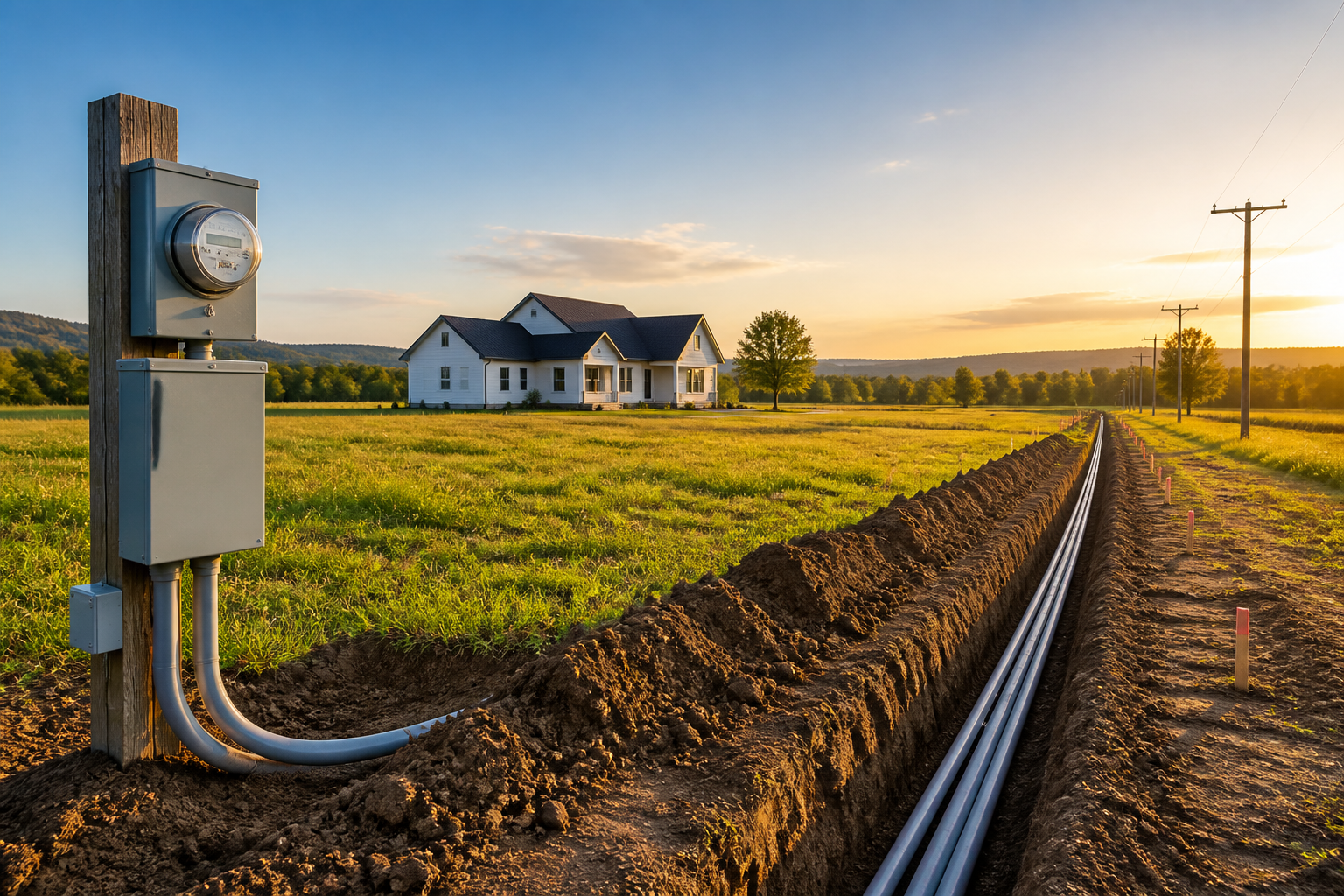
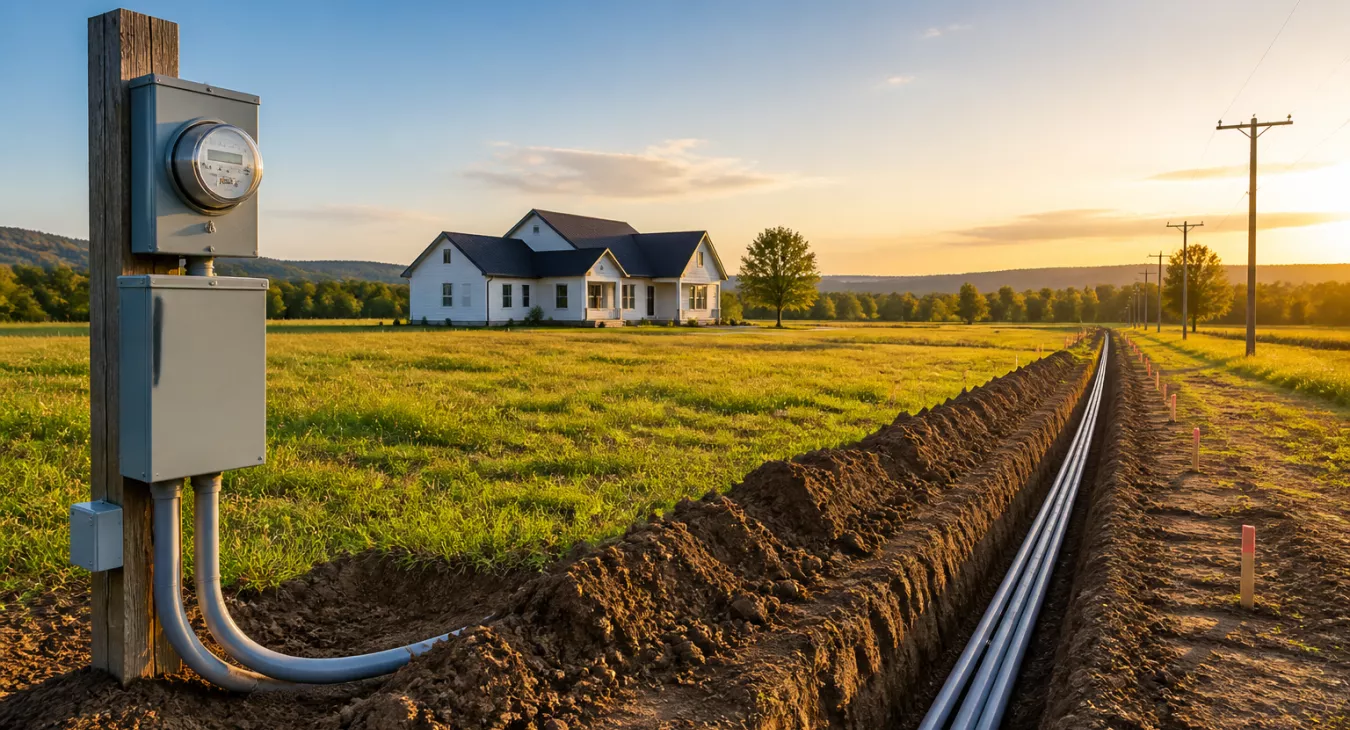
Learn how much it costs to run electricity to land with our 2026 budget guide. Get accurate pricing, cost factors & steps to connect power to your property
Table of Contents
- What Does It Cost to Run Electricity to Land?
- Factors That Affect Electricity Installation Costs
- Cost Breakdown: What You're Actually Paying For
- How Much Does It Cost to Run Power at Different Distances?
- Step-by-Step Process for Bringing Electricity to Your Land
- Regional Variations in Electricity Installation Costs
- Ways to Save Money on Electricity Installation
- Hidden Costs and Unexpected Expenses
- Conclusion
- Frequently Asked Questions
Electricity to raw land. It's one of the most consequential infrastructure decisions you'll make as a real estate investor — and honestly, one of the most unpredictable. Unlike a roof replacement or a kitchen remodel, the cost to bring power to a parcel can swing from a few thousand dollars to well over $40,000 depending on a single variable: how far you're from existing power infrastructure. Whether you're developing a parcel for resale, building a homestead, or evaluating land for your next flip, understanding these costs before you close can make or break your deal. This guide breaks down everything you need to know in 2026 terms, with real numbers and a step-by-step process to get power to your property.

What Does It Cost to Run Electricity to Land?
Overview of Average Costs
Distance, terrain, and your utility company's tariff rules drive the price. That's the real answer. For a standard 500-foot run, Angi reports an average total cost of $12,250 as of July 2026. And here's where it gets interesting: if power lines already run near your property line, you're looking at roughly $1,000 or $5–$15 per linear foot (as of August 2026). But push that distance out to a mile from the grid? You'll easily hit $40,000 or more (as of April 2026).
Most deals you'll see land in the $6,000–$14,000 ballpark for standard residential installations. Rural properties or anything with complications? Budget $20,000–$30,000 minimum. The only way to lock in a real number is getting a service estimate from your local utility—we'll walk you through that below.
Cost Range by Installation Type
| Installation Type | Typical Cost Range | Key Characteristics | Timeline |
|---|---|---|---|
| Basic / Close proximity | $2,500–$5,000 | Near existing lines, minimal permits, fast installation | 2–4 weeks |
| Mid-range | $6,000–$14,000 | Moderate distance, standard requirements | 4–6 weeks |
| Complex / Remote | $15,000–$30,000+ | Far from infrastructure, difficult terrain, extensive permits | 6–12 weeks |
Want to factor in the full economics? Consider rezoning potential, site access, and other infrastructure costs too. Our guide on how much it costs to rezone a property walks you through the whole entitlement and infrastructure picture.
Back to topFactors That Affect Electricity Installation Costs

Distance from Existing Power Lines
Here's the reality: distance kills your budget. Overhead line extensions run $5–$15 per linear foot in 2026, but underground runs cost $10–$25 per linear foot. That's 60%–100%+ more expensive than overhead for identical distance. And here's where most investors get tripped up: many utility companies do cover the first 100–200 feet of line extension before they bill you. But that's a tariff-specific policy, not a universal rule. Some cooperatives and utilities include a free-service allowance of 100–200 feet (as noted by Landopia, 2026) — so you've got to confirm this with your specific provider before you run any proforma numbers.
Terrain and Ground Conditions
Rocky soil will destroy your timeline and budget. So will heavily wooded land, slopes, and high water tables. Standard trenching costs $5–$12 per linear foot in 2026. But throw in rock, roots, or clay? You're looking at significantly higher costs and specialized equipment you didn't budget for. On top of that, the conduit itself adds another $4–$8 per linear foot.
Required Electrical Service Size
Amperage requirements directly hit your bottom line. You need 200 amps for most new residential builds, and that service panel upgrade costs $750–$2,000 for labor and parts as of July 2026. Going commercial or agricultural? Then you're looking at engineering assessments and transformer upgrades that'll push costs even higher.
Voltage, Transformer, and Pole Requirements
If your nearest transformer sits more than roughly 150 feet away from your service point, you're installing a new one. And that's expensive. A residential transformer installation runs $3,000–$20,000+ installed (2026). Overhead lines come with their own headaches. Utility poles cost $1,200–$5,600 each installed (2026) and typically space out 125–300 feet apart depending on urban or rural location (2026). Picture a 1,000-foot overhead run through rural land — you're probably installing three to four new poles before you even touch a wire.
Local Permits and Regulations
Permit costs swing wildly by jurisdiction. HomeGuide reports electrical permit costs of $50–$350 for a line extension (2026). But Angi places the broader range at $500–$2,000 (July 2026) when you factor in inspections and local fees. Don't assume someone else's county data applies to yours. Call your local building department and get actual numbers.
Back to topCost Breakdown: What You're Actually Paying For


| Component | Low Cost | Average Cost | High Cost |
|---|---|---|---|
| Initial grid connection | $1,500 | $4,000 | $12,000 |
| Trenching and conduit | $1,000 | $3,500 | $10,000 |
| Meter base and service panel | $600 | $1,900 | $5,000 |
| Transformer and service drop | $800 | $3,000 | $8,000 |
| Permits and inspections | $200 | $1,200 | $3,500 |
| Right-of-way work | $0 | $800 | $3,000 |
| Equipment delivery | $100 | $800 | $2,500 |
| Contingency (5–10%) | $200 | $1,200 | $4,000 |
That meter box hanging on your property? It's separate from the service panel and'll run you $500–$2,100 installed (2026). And if you're going overhead, don't forget the meter pole—the smaller pole that ties service lines straight into your breaker box. That's another $500–$2,200 installed (2026). Labor's the real variable here. Electricians charge $50–$130+ per hour in 2026, and they'll be billing you throughout the entire project.
Back to topHow Much Does It Cost to Run Power at Different Distances?

| Distance from Existing Lines | Typical Cost Range | Primary Cost Factors |
|---|---|---|
| Under 100 feet | $2,500–$5,000 | Minimal trenching, quick installation |
| 100–500 feet | $5,000–$10,000 | Standard trenching, straightforward access |
| 500–1,000 feet | $8,000–$15,000 | Extended lines, increased labor |
| 1,000–2,000 feet | $15,000–$25,000 | Major trenching, possible transformer upgrade |
| Over 2,000 feet | $25,000–$40,000+ | Extensive work, specialized equipment needed |
Here's what you're actually looking at in real dollars. A 500-foot overhead run? You'll drop $4,000–$7,500 (2026). Go underground at that same distance and you're looking at $5,000–$12,500 (2026). And then there's the quarter-mile problem. Before You Buy Land reports $13,000–$66,000 for a 1,320-foot overhead extension (July 2026) — that massive spread exists because terrain kills your budget. Soft soil? You're on the lower end. Rocky ground or wetlands? Expect to pay top dollar. For a full 1,000 feet of line, either overhead or underground, you're banking on $5,000–$25,000+ (2024 data, Turner & Son Homes).
Back to topStep-by-Step Process for Bringing Electricity to Your Land

Step 1: Identify Your Electric Utility Company
Walk the road frontage and find the nearest utility poles. That's your starting point. The utility company's name is printed right on the transformer — or just ask a neighbor. Here's the thing: rural land almost always gets served by electric cooperatives, not the big investor-owned utilities. Why does that matter? Cooperatives write their own line-extension tariffs and policies, which changes your entire timeline and cost structure.
Step 2: Contact the Utility and Request a Service Estimate
Call the new service department. Get it in writing. They'll want a site address, parcel number, and a site plan showing meter placement. And you need to know exactly what the utility covers versus what's on you. Service estimates cost nothing, but the clarity is priceless — it prevents scope creep and surprise bills later.
Step 3: Determine Your Electrical Needs
A weekend cabin pulls different power than a commercial ag operation. Load calculations determine your amperage and voltage requirements. Get this wrong and you're oversizing the transformer or undersizing your service panel — both expensive mistakes. A licensed electrician at $50–$130+ per hour (2026) will right-size your system. Invest that upfront.
Step 4: Obtain Necessary Permits
Most jurisdictions require separate permits for utility work and on-site electrical work. You're looking at $50–$350 for a basic electrical permit (2026), but that's the floor. Don't assume. Call your local building department and confirm — in many areas, permits and inspections combined hit $500–$2,000 (July 2026).
Step 5: Prepare the Land and Right-of-Way
Does the line cross your neighbor's property? Then you need an easement agreement — and that gets messy fast. Legal costs pile up. Delays happen. But here's what you can control: clear trees and obstacles from the proposed corridor yourself. DIY that groundwork and you'll save real money on installation costs.
Step 6: Trenching and Line Installation
Underground service is your biggest expense after the connection fee. Trenching runs $5–$12 per linear foot (2026), and conduit adds $4–$8 per linear foot (2026). Do the math on a 500-foot run and you're looking at $4,500–$10,000 just for digging and pipe. This absolutely requires a licensed electrician — no cutting corners here. The utility connects at the pole; your electrician handles everything on your side of the property line.
Step 7: Transformer and Service Panel Installation
The utility owns the transformer and installs it. Your electrician installs the meter base, and if you need one, a meter pole at $500–$2,200 installed (2026). They'll also run your service panel. One constraint: the transformer must sit within 150 feet of your service point (2026).
Step 8: Final Inspection and Activation
The building department inspects everything. Once it passes, the utility energizes the line — usually within a few business days. From first call to power-on? Standard projects take 2–8 weeks. Complex rural setups stretch to 12 weeks. Plan accordingly.
Back to topRegional Variations in Electricity Installation Costs

Utility costs are local. Period. State regulations, existing infrastructure density, terrain, and whether you're dealing with a regulated utility or a rural electric co-op all move the needle on your final cost. And here's the critical part: don't just copy one state's pricing to another and hope it sticks. It won't.
Texas is the perfect case study. The deregulated market there means pricing and installation procedures shift not just region to region but depend on which retail provider covers your specific property. You might drop $2,500 for a parcel already close to existing lines in a suburban corridor. But buy remote Hill Country acreage? You're looking at $30,000 or more.
Rural land costs more per foot. That's because utilities have to string longer spans between poles, spread costs across fewer customer accounts, and navigate rougher terrain. The gap is real. Before You Buy Land reports overhead line extensions in rural areas running $10–$50 per foot beyond the utility's free-service allowance (July 2026). Compare that to $5–$25 per foot for overhead service closer to the road (2026). That's double, sometimes triple.
Buying land in unfamiliar territory? Treat utility feasibility the same way you'd approach wetland delineation costs and soil assessments—as mandatory pre-purchase homework.
Back to topWays to Save Money on Electricity Installation
- Buy land close to existing infrastructure. This is the single most effective cost-reduction strategy: proximity to power lines. A parcel 50 feet from the road with power at the lot line? It's worth significantly more than a parcel 1,000 feet back, even if the listing price looks identical on paper.
- Choose overhead over underground where allowed. Underground service costs 60%–100%+ more than overhead (2026). Unless aesthetics, local code, or terrain force your hand, go overhead. It's the budget-friendly default for a reason.
- Do your own site prep. Tree clearing, brush removal, and staking the line path don't require a licensed electrician. You can handle this work yourself. Showing up with a cleared corridor reduces billable labor hours—and that adds up fast on these projects.
- Bundle utility installations. Bringing in water, gas, or telecommunications at the same time? Coordinate trenching across all utilities in one shot. A single trench costs the same whether it holds one conduit or four.
- Start permitting early. Permit delays won't cost you money directly, but carrying costs will. Submit applications the day your site plan is finalized—not next week.
- Ask about utility assistance programs. Rural electric cooperatives and state rural development programs often offer cost-share or loan programs for line extensions. Call the cooperative's member services department directly and ask what's available.
Once the land's developed, utility cost structures matter for tenant relationships too. Check out our guide on how to charge tenants for utilities to understand the landlord side of things.
Back to topHidden Costs and Unexpected Expenses
Contingency Budget
Buried debris, unmarked utilities, and unexpected rock outcroppings are common on rural land that hasn't been disturbed in decades. That's why you need to budget 5–10% above your contractor's estimate for unforeseen site conditions. This isn't pessimism — it's industry standard practice, and you'll see why the moment your excavator hits something unexpected.
Soil and Terrain Surprises
Hit rocky ground? You're looking at pneumatic hammers or rock saws for trenching. Those tools don't come cheap, and they'll push your cost per linear foot well above the standard $5–$12/ft baseline (2026). High water tables add another layer of complexity — you'll need specialized conduit sealing and likely face additional inspections that slow the timeline and burn through your budget.
Equipment Delivery in Remote Areas
Transformers, poles, wire spools — everything gets physically hauled to your site. Poor road access in remote parcels creates real logistics headaches. Equipment delivery and hauling for remote installations can easily add $100–$2,500 to your project cost, sometimes more depending on how far out you actually are.
Easement and Right-of-Way Complications
Does the power line cross land you don't own? You'll need a written easement from that landowner. And here's the problem — if they're uncooperative, your entire project can stall or you'll have to reroute, which adds significant distance and cost. Resolve easement questions before you close on the land. Don't find this out afterward.
Infrastructure Upgrade Requirements
The utility's existing infrastructure near your property might already be running at or near capacity. When that's the case, the utility can require you to fund an upgrade to the local distribution line before they'll even extend service to your parcel. This expense can dwarf your original estimate. Always ask specifically whether the serving transformer or substation has capacity during your initial service inquiry — that one question can save you tens of thousands.
When Grid Connection Isn't the Answer
Extremely remote parcels more than a mile from existing power infrastructure where grid connection exceeds $40,000? Off-grid alternatives deserve serious consideration. A complete off-grid solar and battery storage system can run $15,000–$30,000 for a simpler rural setup (April 2026), or $45,000–$65,000 for a full professional installation (2026). Here's what matters though — the federal residential solar tax credit (Section 25D) expired December 31, 2025 under the One Big Beautiful Bill Act. No federal credit for solar systems installed in 2026 or later. State incentives vary wildly, so verify current programs in your state before you run the numbers.
If you're evaluating land investments broadly, our rehab cost estimation guide by property type and our overview of the land flipping business provide useful companion context for total development cost estimation.
Back to topConclusion
Distance. That's the main driver of your electric service cost. But layer in terrain, utility company rules, local permits, and your service size requirement — and suddenly you're looking at a much wider range. In 2026, you're budgeting $2,500 minimum for a simple connection near existing lines. Remote rural parcels? You could hit $40,000 or beyond. The $12,250 average for a 500-foot run is solid. Just don't treat it as gospel without a formal estimate from your utility.
Here's what separates smart investors from the rest: call your local utility before you close on raw land. This step costs you nothing and could save your entire deal. A free service estimate exposes costs — or kills the project outright — long before you sign papers. You need to bake electricity installation into your acquisition analysis the same way you'd account for wetland delineation costs or rezoning fees. The investors doing this due diligence first are the ones protecting their cap rate.
Back to topFrequently Asked Questions
Who pays for running electricity to raw land?
The property owner foots the bill for everything beyond what the utility company covers for free. Most utilities cover the first 100–200 feet (check your specific provider's tariff), but after that? You're paying. Some utilities bill you the full extension cost. Others split it with you. Get the policy in writing before you budget — this is non-negotiable.
Can I install the electrical service myself?
No. The utility company won't allow it. Their licensed crews handle everything from the pole to the meter — that's locked down tight. You can't touch that side. On your property, though, the panel, conduit, and wiring must go in via a licensed electrician, and the local building department has to inspect it before the utility energizes anything. Here's the catch: you can do the site prep work yourself and save some cash there.
How long does electricity installation typically take?
Two to eight weeks in most cases. That's from your initial utility contact to power activation.
But throw in a remote location? New poles needed? Transformer upgrades? Easement negotiations? Multiple inspections? You're looking at 6–12 weeks minimum, sometimes longer. Permitting delays kill most timelines. Start this process early — ideally before you even close on the land.
What if my land is very remote and far from existing power lines?
This is where grid connection economics fall apart. Once you're a mile or more from the nearest power line, running electricity to your property can cost over $40,000 (April 2026). At that price point, you need to run the numbers on alternatives. Off-grid solar and battery storage? Simple setups run $15,000–$30,000, while full professional installations land between $45,000–$65,000 (2026). A generator bridges the gap during construction phases and costs way less upfront. Don't default to grid connection just because it sounds standard — compare all three.
Are there government assistance programs for rural electricity installation?
Yes, but it's complicated. Some rural electric cooperatives tap into federal rural development programs through the USDA's Rural Utilities Service. The problem? Availability, eligibility, and funding shift constantly by state. Call your state's rural electric association and your county's rural development office directly — they'll know what's actually available right now. Generic internet searches won't cut it because these programs update and disappear all the time.
Back to top