


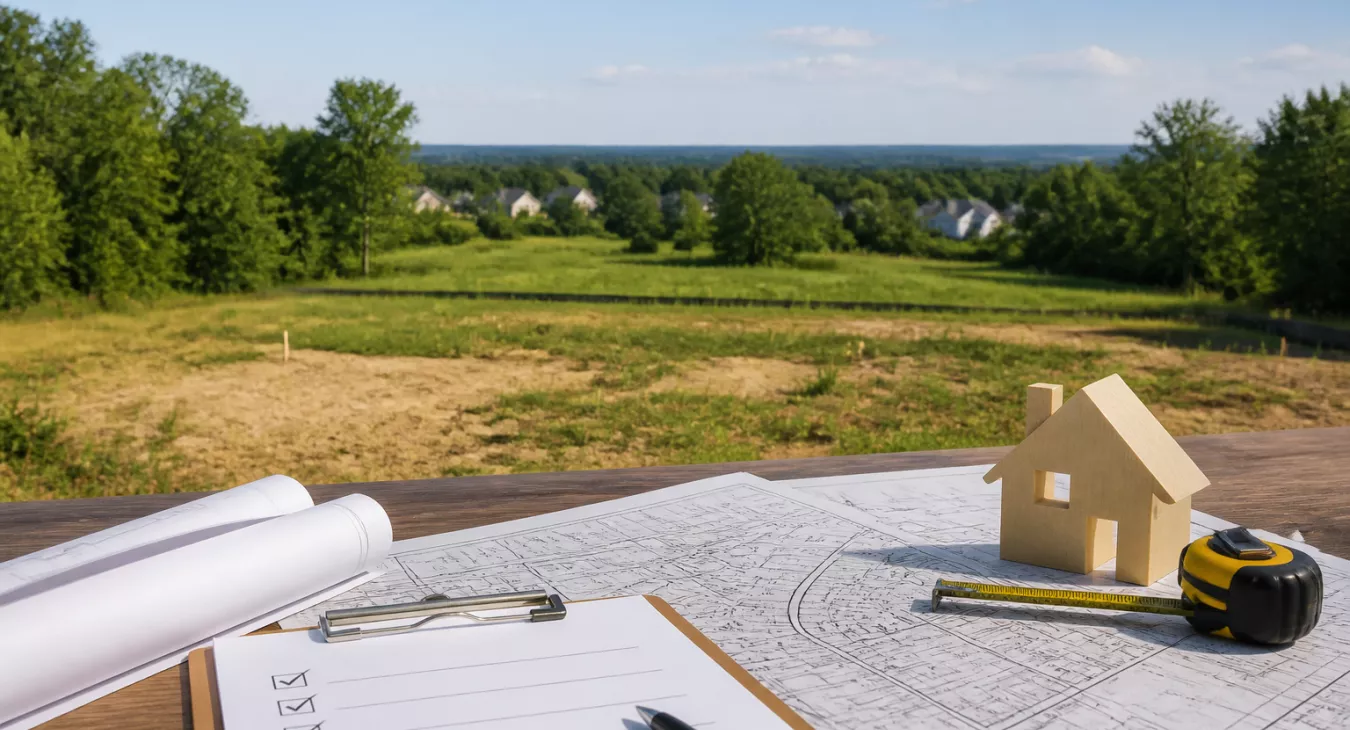
Learn how to know if a land is buildable before investing. Complete due diligence checklist covering zoning, soil, access & environmental factors.
Table of Contents
- What Does "Buildable Land" Actually Mean?
- Step 1 — Zoning Regulations and Verification
- Step 2 — Soil Testing and Percolation Tests
- Step 3 — Setbacks and Easements
- Step 4 — Access and Infrastructure
- Step 5 — Environmental and Flood Zone Considerations
- Step 6 — Topography, Grading, and Terrain
- Step 7 — Permits and Approvals Process
- Step 8 — Title Search and Legal Issues
- Buildability Due Diligence Checklist
- Professional Services: Who to Hire and What They Assess
- Common Reasons Land Is Unbuildable — and Options When It Isn't
- Online Tools for Self-Checking Buildability
- Due Diligence Timeline: Offer to Closing
- Remediation Options for Marginally Unbuildable Land
- Post-Purchase Recourse If Land Proves Unbuildable
- Conclusion
- Frequently Asked Questions
Buy raw land without checking if it's actually buildable? That's how you end up losing six figures. A parcel that looks perfect on Google Earth might be completely unbuildable — zoning restrictions, contaminated soil, wetland overlays, environmental setbacks. None of that shows up on satellite imagery. And here's the thing: knowing how to verify a land is buildable before you close isn't some nice-to-have. It's the entire game. This checklist takes you through every due diligence category that matters, with concrete steps, expert guidance, and real talk about what changes depending on where you're investing.

What Does "Buildable Land" Actually Mean?
Legal and Regulatory Definition
A parcel is buildable when it clears every legal, physical, and regulatory hurdle needed to snag a building permit and actually construct something on it. That's zoning compliance, minimum lot dimensions, adequate access, septic or sewer hookup capability, and environmental clearance. But here's the thing: what you see isn't what you get. An overgrown lot sitting in a subdivision? Could be deed-restricted to zero construction. That gorgeous hillside with views? Might be smack in a fault zone or protected wetland buffer.
Why It Matters Before You Buy
Closing day and finding out the land's unbuildable? That's a total loss on your acquisition cost with zero recourse. Raw land transactions don't come with the seller disclosure protections you'd get on a residential purchase. And verifying buildability upfront gives you serious negotiating leverage. Confirmed constraints mean you've got legitimate grounds to renegotiate the price or walk away clean within your contingency window. For a complete roadmap on protecting yourself before you sign, check out our Real Estate Due Diligence Checklist Before Closing.
Back to topStep 1 — Zoning Regulations and Verification
Understanding Zoning Districts
Zoning is your first and most critical buildability filter. It's what determines whether you can build residential, commercial, agricultural, or industrial on a parcel. Here's the trap: zoning code letters aren't standardized nationally. That "R-1" designation? It could mean a 6,000-square-foot minimum lot in one municipality and a full acre next door. And you can't just guess. Look up the actual ordinance text yourself — don't rely on anyone else's interpretation.
How to Check Your Property's Zoning
- Start with the municipality's planning or zoning department website. Search by parcel number or address.
- Pull the official zoning map and read the ordinance text itself. You're looking for permitted uses, dimensional standards, and overlay districts.
- Pick up the phone or walk into the planning counter. Ask them directly: "Is this parcel a conforming, buildable lot under current zoning?"
- Get it in writing when you can. Email confirmation counts.
Common Zoning Restrictions to Verify
- Minimum lot size: Your parcel has to meet or exceed the required square footage or acreage for that district. Keep in mind: this number changes from one jurisdiction to the next.
- Frontage requirements: Most zoning districts require a minimum amount of lot frontage on a public road. The exact number varies by location, so verify it locally.
- Use limitations: Agricultural zoning might prohibit residential construction entirely, or it might allow only one dwelling per 5 acres. You need to know which.
- Previous structures: An old building foundation doesn't automatically mean new construction is allowed on that same parcel under today's zoning. Don't assume continuity.
Step 2 — Soil Testing and Percolation Tests

Why Soil Quality Is a Deal-Breaker
No public sewer? Then your soil has to handle an on-site septic system. That's just the baseline. Soil bearing capacity also drives foundation design and construction costs—and poor drainage or expansive clay can blow your budget wide open or kill the deal entirely. We've seen properties with bad soils cost an extra $40,000 to $100,000+ in remediation.
What's a Perc Test — and When Is It Used?
A percolation test answers one question: how fast does water drain through the soil? This rate tells you whether a conventional septic drainfield will actually work. The test typically takes 24 to 48 hours from start to finish and you should order it before you remove contingencies on a land purchase. Here's the catch—not every state even uses perc tests. Virginia, Delaware, and several others rely on soil-profile classification by a licensed soil scientist instead. So before you spend the money, confirm which method your target county requires.
Cost and Implications
A standard perc test runs $750 to $1,900 in 2025, with a national average around $1,300. Simple single-hole tests might cost as little as $300. But complex or large sites? You could hit $3,000 or more. And here's the hard truth: a failed perc test kills most deals. No approved septic design means no building permit, full stop. Some sites can be saved with alternative systems—mound systems, engineered drainfields—but you're looking at substantial additional cost and a separate approval process. Always call your local health department first to confirm what alternatives they'll actually allow.
Back to topStep 3 — Setbacks and Easements
Understanding Setback Requirements
Setbacks are the minimum distances a structure must sit back from property lines, roads, water features, and other boundaries. Here's the problem: every jurisdiction sets its own distances. Front, rear, and side setbacks in one county can look completely different from the one next door. You need to grab the specific dimensional table from the local zoning ordinance. Then overlay it on a scaled survey of your parcel.
That's how you find your actual "building envelope" — the only area where you can legally place a structure.
What Are Easements and How Do They Restrict Buildability?
An easement gives a third party the right to use a portion of your property for a specific purpose. This shrinks your usable land instantly. Common types include:
- Utility easements: Reserved for power lines, gas pipelines, or water mains — you can't build permanent structures within these corridors.
- Drainage easements: Prevent you from blocking natural or engineered drainage paths.
- Access easements: Let neighbors or the public cross your parcel.
- Conservation easements: Permanently restrict development on portions of the land, sometimes the entire property.
And here's what kills deals: easements reduce your effective buildable square footage. They can shift your building envelope entirely. Before you commit capital, pull all recorded easements through the county recorder's office or request them during your title search. Don't skip this step.
Back to topStep 4 — Access and Infrastructure
Road Access and Frontage
Landlocked parcels are dead on arrival. No matter what the zoning says, a parcel with no legal access to a public road is effectively unbuildable for practical purposes. You need deeded frontage on a public road or a recorded access easement — verify this before you go any further. And if you're counting on private road access, make sure it's legally documented and properly maintained. Check your local zoning ordinance for minimum frontage requirements — these are set at the municipal level and they matter.
Utility Availability
Here's what you actually need to know: water, sewer, electric, and gas. Is it at the lot line or do you need to extend it?
- Is the service available at the lot line, or does the main line need to be extended?
- who's responsible for the cost of extension — the developer or the utility?
- What are the connection fees and tap fees?
Important: Utility extension costs swing wildly depending on where you are, which utility company you're dealing with, and how far away the line is. Don't trust those online ranges — they're almost always outdated or utility-specific. Call each provider directly for current tariff schedules and extension estimates before you sign anything. It's the only way to get real numbers.
No public water? Then check if a private well is allowed. But here's where it gets tricky. In Colorado, Arizona, New Mexico, Washington, Oregon, and Idaho, well-drilling rights hit serious roadblocks from closed basin rules or exempt-well caps. Western water law runs on prior appropriation — meaning water rights don't automatically come with the land. This is state-specific and complicated. You need a local water attorney in those regions, period.
Back to topStep 5 — Environmental and Flood Zone Considerations
FEMA Flood Zone Classifications
Is your land in a FEMA Special Flood Hazard Area (SFHA)? That's the first thing to determine — especially if you're financing with a federally backed loan. Zones A and AE hit hardest: they mandate flood insurance and impose strict construction elevation requirements that'll tank your projected returns if you don't account for them upfront. Start with FEMA's Flood Map Service Center, but don't rely on it alone. FIRM maps lag reality. A surveyor can pull an Elevation Certificate for true site-specific data. Here's the thing: raw vacant land itself won't qualify for National Flood Insurance Program coverage, so the real impact is what you'll pay to build and insure once the structure's up. That cost difference between a non-flood parcel and a Zone AE property can easily swing your deal economics.
Wetlands and Environmental Restrictions
Wetlands kill deals. A parcel can go from fully developable to completely unbuildable the moment a wetland delineation comes back dirty. The 2023 Sackett v. EPA decision tightened federal Clean Water Act jurisdiction — now it only covers wetlands with continuous surface connection to navigable waters. Sounds like a win for developers, right? Not so fast. The EPA and Army Corps proposed new rules in November 2025, and the law's still settling. And here's what really matters: California, Washington, Minnesota, Wisconsin, Virginia, New Jersey, and New York don't wait for Washington to make up its mind. They regulate wetlands independently. That Supreme Court ruling? Could mean nothing in those states. Before you write an offer on any parcel with wet areas or suspicious hydrology, hire a qualified professional to do the wetland delineation. Don't skip this step.


Phase I Environmental Site Assessment
Any parcel with commercial or industrial bones needs a Phase I Environmental Site Assessment. No exceptions. You're looking at $2,200 to $4,000 for standard sites as of 2026, with industrial-history properties pushing toward the higher end. Those costs climbed roughly 11% between 2018 and 2023 thanks to inflation and stricter ASTM E1527-21 standards. But the real kicker? If Phase I uncovers recognized environmental conditions (RECs), you're buying a Phase II next — soil and groundwater sampling that runs substantially higher. No lender touches it without Phase II results. Neither should you.
Back to topStep 6 — Topography, Grading, and Terrain
Steep slopes kill deals. Bedrock near the surface kills deals. Poor drainage? Same story. Any of these three will absolutely tank your construction budget or make the whole project unfeasible.
Here's the hard number: slopes over 15–20% demand engineered retaining walls, custom foundations, and serious grading work. And that's expensive. We're talking five-figure bumps to your hard costs before you even break ground.
But it gets worse. If subsurface bedrock is shallow, you're looking at rock excavation or blasting. That alone can run $30,000–$75,000+ on foundation work. Have you actually walked the site yet? Don't skip this step.
Pull the topographic data first—most county GIS portals or USGS have it online. Then bring a builder or civil engineer to the property before you commit to an offer. This isn't a solo mission. You need boots on the ground and professional eyes assessing what's underneath.
And here's the thing: your local jurisdiction will likely require formal grading and drainage plans as part of permit approval anyway. Better to know the scope now than get sticker shock during permitting.
Back to topStep 7 — Permits and Approvals Process
Types of Permits and Typical Timelines
Your deal passes every environmental test, the soil report's clean, and the phase one came back perfect. You're not done yet. That parcel still has to clear the permitting gauntlet—and this is where deals get killed.
Here's what you're likely looking at:
- Building permit: Required for any new structure. You submit your plans, the jurisdiction reviews them for code compliance, and you wait. It's not automatic approval.
- Grading and land disturbance permit: Most jurisdictions require this before you move a single cubic yard of dirt.
- Conditional use permit (CUP): Your proposed use is allowed in the zone—but only by exception. Approval is discretionary. They can deny it.
- Variance: Your project doesn't meet dimensional standards like setbacks or lot coverage. Approval standards? They vary wildly by jurisdiction.
Timelines are all over the place. Straightforward projects in permit-ready jurisdictions might move in a few weeks. But complex cases or politically sensitive zoning? You're looking at months. Sometimes longer.
Do yourself a favor: hit up the local planning staff before you're deep into underwriting. Pre-application meetings exist for a reason. They'll flag fatal flaws while you can still walk away without bleeding capital.
Back to topStep 8 — Title Search and Legal Issues
Courthouse records don't lie. A thorough title search will surface recorded liens, deed restrictions, covenants, easements, and encumbrances that can tank your buildability plans. Here's the thing: deed restrictions—sometimes buried by a prior developer—might prohibit uses that current zoning would actually allow. And this happens more often than you'd think.
Don't rely on a seller's representation of clean title. Period.
Hire a real estate attorney or title company to conduct the search yourself. Then—and this is critical—seriously consider purchasing an owner's title insurance policy. Even a diligent search can miss defects that'll cost you thousands down the line. Why risk it? For a deeper look at due diligence processes relevant to property transactions, see our article on How to Evaluate a Real Estate Syndicator Like a Pro: Due Diligence Checklist.
Back to topBuildability Due Diligence Checklist
| Category | Item to Verify | Where to Check | Confirmed? |
|---|---|---|---|
| Zoning | Parcel is zoned for intended use | Municipal planning/zoning office | Yes / No / Pending |
| Zoning | Meets minimum lot size for the district | Zoning ordinance text | Yes / No / Pending |
| Zoning | Meets minimum road frontage requirement | Zoning ordinance text | Yes / No / Pending |
| Soil / Septic | Perc test passed (or soil classification approved) | County health department | Yes / No / Pending |
| Soil / Septic | Septic system design approved or public sewer available | County health / utility provider | Yes / No / Pending |
| Access | Legal deeded access to public road | Title search / county records | Yes / No / Pending |
| Utilities | Electric service available at lot line | Utility provider | Yes / No / Pending |
| Utilities | Water source confirmed (public or permitted well) | Utility provider / state water authority | Yes / No / Pending |
| Environmental | Not in FEMA Special Flood Hazard Area (or cost acceptable) | FEMA Flood Map Service Center | Yes / No / Pending |
| Environmental | No wetlands or wetland delineation completed | Qualified wetland professional | Yes / No / Pending |
| Environmental | Phase I ESA completed (if prior non-agricultural use) | Environmental consultant | Yes / No / N/A |
| Title / Legal | Title search completed; no fatal encumbrances | Title company / real estate attorney | Yes / No / Pending |
| Title / Legal | No deed restrictions prohibiting intended use | Title search / courthouse records | Yes / No / Pending |
| Survey | Boundary survey completed and building envelope confirmed | Licensed surveyor | Yes / No / Pending |
| Topography | Slope and terrain compatible with intended structure | GIS topo data / site visit with engineer | Yes / No / Pending |
| Permits | Pre-application meeting with planning staff completed | Municipal planning department | Yes / No / Pending |
Professional Services: Who to Hire and What They Assess
| Professional | What They Assess | Typical Cost (2025–2026) | When to Engage |
|---|---|---|---|
| Licensed Land Surveyor | Boundaries, easements, encroachments, building envelope | $500–$1,200 for parcels under 1 acre; $70–$140 per acre on large tracts running 50–100 acres; $2,500–$15,000+ if you need an ALTA survey | Before you kill contingencies |
| Civil / Geotechnical Engineer | Soil bearing capacity, slope stability, drainage, foundation feasibility | Varies by scope — check with local firms for quotes | Jump on this early if the terrain's tricky |
| Soil Scientist / Septic Designer | Soil profile, perc test, septic system design | Perc test runs $750–$1,900 on average; complex sites hit $3,000+ | Do this ASAP. A failed perc test kills the entire deal |
| Environmental Consultant | Phase I ESA, wetland delineation, contamination screening | Phase I ESA typically runs $2,200–$4,000 | Get one for any parcel with prior industrial/commercial use or wet ground |
| Real Estate Attorney | Title review, deed restrictions, water rights, contract terms | Market and complexity dependent | Before you sign anything |
| Local Builder / General Contractor | Construction feasibility, site access, utility tie-in costs | Most will give you a preliminary look for free | Once zoning checks out and soil testing's clean |
| Land-Specialized Broker | Market knowledge, comparable sales, local regulatory context | Commission-based | Bring them in before or when you're ready to make an offer |
Common Reasons Land Is Unbuildable — and Options When It Isn't

You've found a deal that looks solid on paper. The price is right. The location checks out. Then your soil engineer calls with a failed perc test, or your title search uncovers a deed restriction that kills your whole play. What now?
Not every unbuildable situation is a dead end. Some obstacles are fixable — if you know what you're looking at and you've got the stomach for the remediation costs. Others? Walk away. This table breaks down the six most common killers, what they actually mean for your project, and whether you can realistically solve them.
| Issue | Implication | Potential Remediation | When to Walk Away |
|---|---|---|---|
| Failed perc test | You can't get a septic permit, which means no building permit. Period. | Alternative septic systems exist — mound systems, engineered drainfields — but your jurisdiction has to allow them first | If your local health department won't approve alternatives or the cost blows your numbers |
| Zoning nonconformity | Your intended use is prohibited. Maybe the lot's too small, maybe it lacks road frontage, maybe the zone just doesn't allow what you want to build | You can request a rezoning or variance. Just know it's discretionary and not guaranteed to happen | Once planning staff tells you there's no realistic path forward, believe them |
| Wetlands coverage | Building in wetland areas is prohibited or heavily restricted. This one kills deals fast. | Mitigation banking might reduce the restricted area. A jurisdictional delineation can sometimes shrink what counts as wetland. Every state plays by different rules though. | If wetlands sit under your building envelope, you're done |
| Landlocked parcel | No legal road access means no permits. Lenders won't touch it either. | Negotiate an access easement from the neighboring property owner. It's tough but possible. | If your neighbor won't budge and there's no other way to access the land |
| Deed restriction | A private restriction stops your use cold. Zoning doesn't matter — the deed controls. | Try to get the restriction legally modified or released by whoever benefits from it | If it's perpetual and the beneficiary refuses to cooperate |
| Environmental contamination | Phase II testing found soil or groundwater problems. You can't develop until it's cleaned up. | Work up a remediation plan. You might negotiate who pays for cleanup and who carries the liability. | If remediation costs more than the land is worth, or if cleanup is technically impossible |
Online Tools for Self-Checking Buildability
Don't drop money on professionals before you've done some basic homework. These free, publicly available tools let you screen deals fast:
- County GIS portal: Most counties publish interactive GIS maps showing zoning, parcel boundaries, floodplains, wetland approximations, and aerial imagery. Just search "[county name] GIS" and you'll find yours.
- FEMA Flood Map Service Center (msc.fema.gov): Need to know your flood zone? Look it up by address here.
- USGS National Map (apps.nationalmap.gov): Topographic data and elevation profiles live on this site.
- EPA's EnviroMapper: This screens for Superfund sites and environmental hazards in your area.
- NRCS Web Soil Survey (websoilsurvey.nrcs.usda.gov): Check soil types and how they'll handle septic systems and construction loads.
Here's the thing though: These tools catch obvious problems. They're not substitutes for a real engineer, surveyor, or environmental assessment. Use them to spot red flags early and kill deals that don't pencil. But don't skip the licensed professionals on anything you're actually moving forward with.
Back to topDue Diligence Timeline: Offer to Closing
Raw land needs time. You're looking at 30 to 60 days minimum for due diligence, though complex parcels often demand 90 days or more. And here's the thing—negotiate that contingency window before you sign anything. Don't leave it to chance.
Here's how it typically plays out:
- Days 1–5: Sign the purchase contract with real contingency language built in. Order your title search immediately. Pull the county GIS and zoning records while you're at it.
- Days 3–10: Get a surveyor locked in and schedule the perc test. Call the county health department first—some counties have 2–4 week wait times, and you don't want surprises.
- Days 7–15: Walk the site with your builder or civil engineer. Then hit up the utility providers. You need real numbers on service availability and what extensions actually cost.
- Days 10–20: Perc results come back. If environmental risk is a concern, order your Phase I ESA now.
- Days 15–30: Survey's in your hands. Your attorney reviews the title search. Get zoning confirmation in writing from the planning department.
- Days 20–45: Phase I ESA arrives (if you ordered it). Complete any follow-up calls with specialists you need.
- Days 45–60: Compile everything. Make your call—move forward, renegotiate the deal, or walk away using your contingency.
Remediation Options for Marginally Unbuildable Land
Not every buildability problem kills the deal. Some issues come with a price tag — and that's where your math needs to be sharp. Can you remediate it cheaper than the land costs? That's the real question.
You've got options. Failed perc test? Alternative septic systems exist. Wet or sloped site dragging you down? Grading and drainage improvements can fix it. Zoning doesn't play nice with your plan? Sometimes a rezoning or variance gets you there.
Here's the hard truth: never buy land contingent on a rezoning or variance unless planning staff has basically told you it's happening. And I mean clear, documented indication — not a casual "yeah, that might work." Discretionary approvals get denied for reasons you can't control. You end up holding a stranded asset instead of a development site.
Back to topPost-Purchase Recourse If Land Proves Unbuildable
You discover the land won't build after closing. Your recourse? It exists, but don't expect a home run. You've got three potential plays here.
First, fraud or misrepresentation claims against the seller — but only if they knew about the defect and buried it intentionally. Second, you can go after the real estate professional who failed to disclose material facts they should've known. Third, title insurance might cover you if the unbuildability traces back to a title defect the policy actually covers.
Want more context on regulatory obligations that stick with you throughout ownership? Check our Fair Housing Compliance Checklist for Landlords.
But here's the real talk: litigation is expensive, messy, and uncertain. Prevention beats litigation every single time. The due diligence steps outlined in this article exist to protect your deal before you sign — not to fix it after closing.
Back to topConclusion
You need to dig into zoning, soil conditions, access, utilities, environmental constraints, title, and topography. Methodically. No single factor tells you whether a parcel's actually buildable — and no online tool replaces someone walking the property with boots on the ground. The most successful land investors treat due diligence as non-negotiable. They don't skip it. Period.
Here's what separates winners from bag holders: they build the checklist into every single offer, negotiate contingency periods long enough to do the work right, and bring in qualified professionals at each stage. And they do this even on deals that look obvious at first glance. The verification cost? It's always pennies compared to owning land you can't develop.
Back to top
Frequently Asked Questions
How long does land due diligence typically take?
Straightforward parcels? Plan for 30 to 60 days. But if you're dealing with environmental assessments, wetland delineations, or rezoning inquiries, you're looking at 60 to 90 days minimum — sometimes longer. Here's what matters: negotiate a contingency period that actually gives you time to finish. Rushing due diligence is one of the most common and costly mistakes land buyers make, and it's completely avoidable.
Can I check land buildability myself without hiring professionals?
Start with the free stuff. County GIS maps, the FEMA Flood Map Service Center, USGS topographic data, and the NRCS Web Soil Survey are all publicly available and worth screening before you drop money on professionals. And you should screen them. But here's the reality: self-screening is just a preliminary filter. Zoning interpretations, soil assessments, wetland delineations, title searches, and environmental reviews require licensed professionals. Lenders, courts, and permit offices won't accept anything less.
What happens if a perc test fails?
The soil won't drain fast enough for a conventional septic drainfield. That's what a failed perc test means. Some jurisdictions allow alternatives — mound systems, aerobic treatment units, drip irrigation systems — but they're pricier to install and maintain. In other counties? A failed perc with no approved alternative is a dead deal. No septic approval means no building permit. Before you invest another dollar in a failed-perc parcel, call the local health department and find out what your options actually are.
Does prior construction on land guarantee current buildability?
Zoning codes change. A lot. That structure that used to sit on your parcel? It might not meet current zoning requirements anymore. And the prior construction tells you nothing — nothing — about current setback compliance, whether the original septic system was even properly permitted, or whether environmental conditions have shifted since then. Treat every parcel like it's never been built on. Verify your buildability factors from the ground up.
Who's responsible for telling me if land is unbuildable — the seller or my agent?
Most states require sellers and agents to disclose known material defects, and buildability constraints probably qualify. But here's the catch: sellers might not know about all the constraints. Disclosure standards vary wildly by state. Raw land transactions often get way fewer seller-disclosure protections than improved property sales. Don't rely on disclosures alone. Conduct your own independent professional due diligence regardless of what the seller or listing agent tells you. If you're the agent representing a buyer in a land deal, recommending appropriate due diligence isn't optional — it's required.
Back to top