

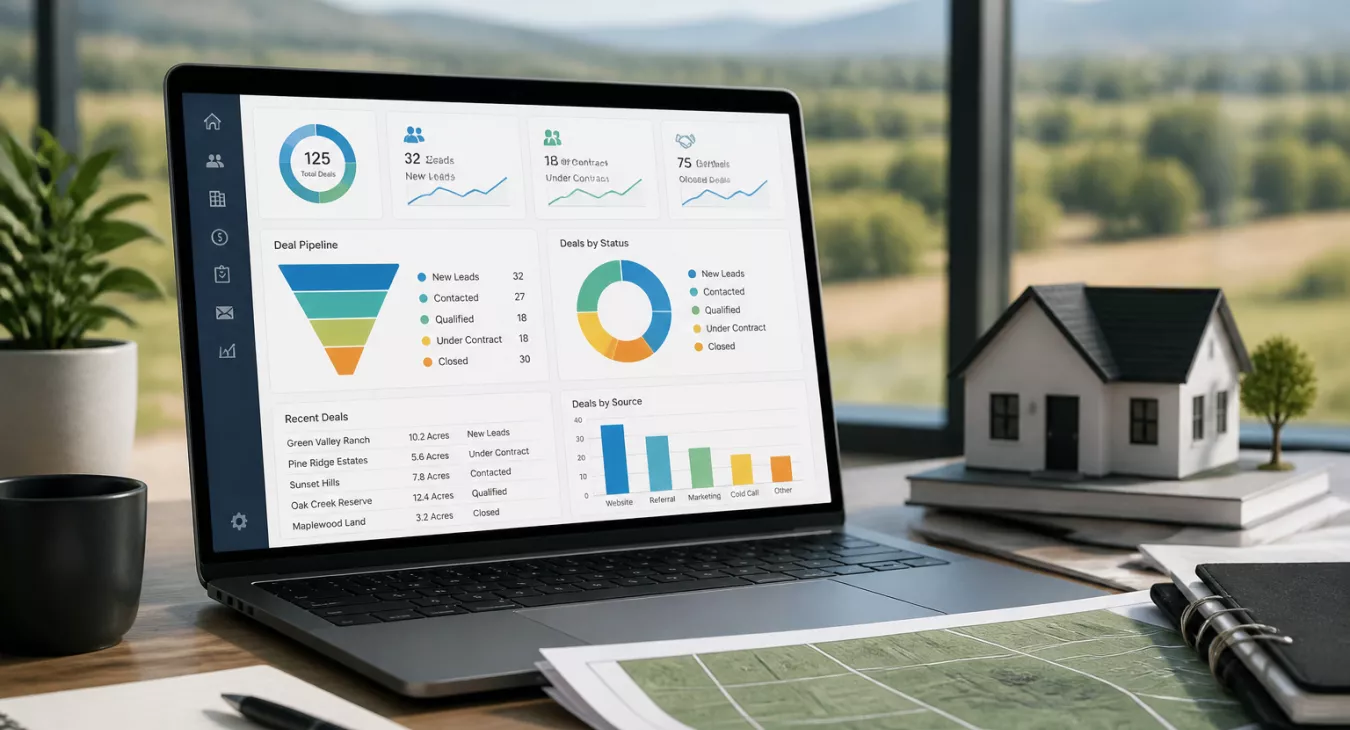
Master land investor database management with the right CRM. Track deals, contacts & properties efficiently—keep nothing lost in the field.
Products and Tools Mentioned in this Post

Propstream
Detailed information on Propstream. Get How-To's, reviews, Comparisons, and much more.

Follow Up Boss
Follow Up Boss is a real estate CRM that helps agents manage leads, automate follow-up, and increase conversions. Streamline your sales process today.
Wise Agent
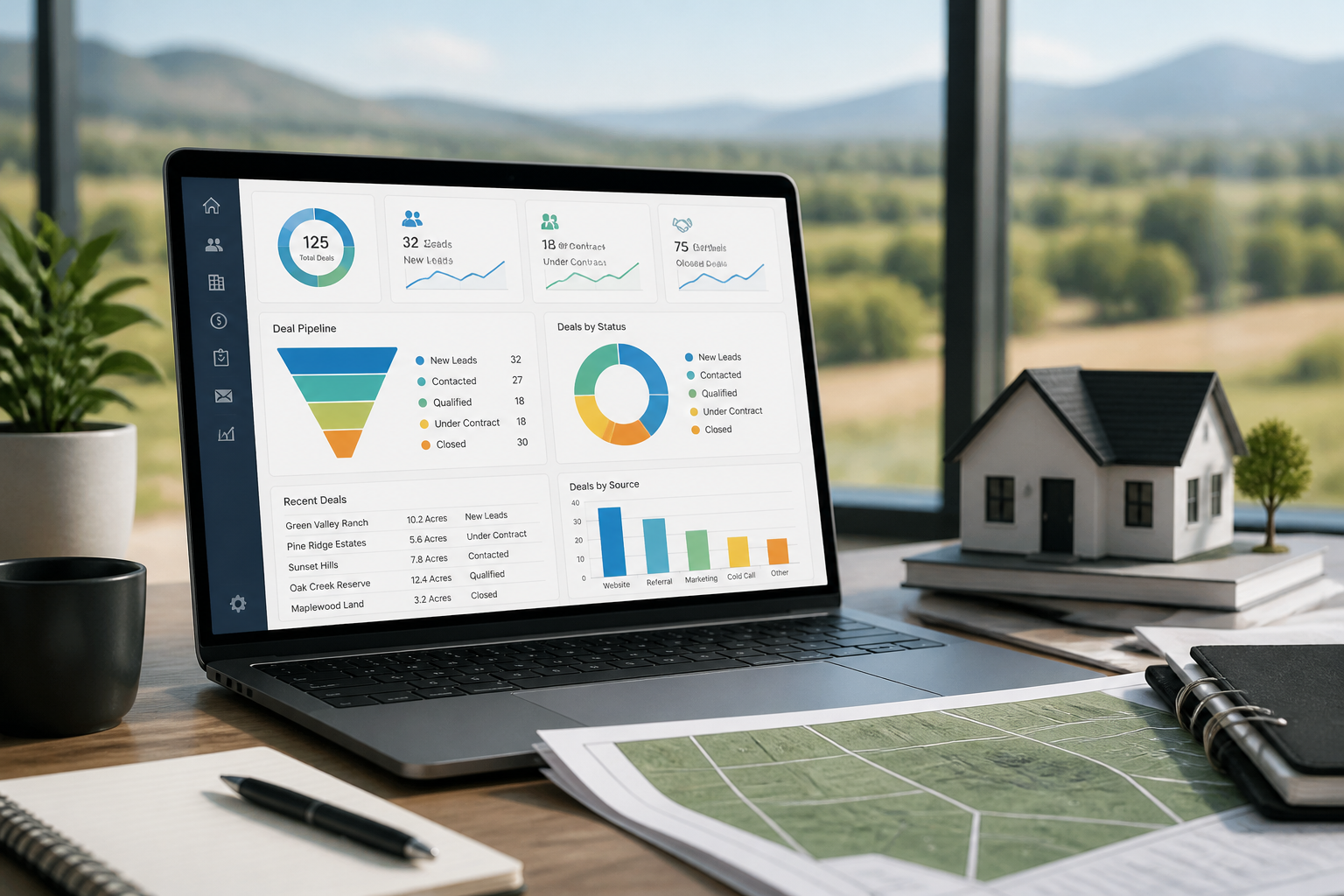
Wise Agent is a comprehensive real estate CRM offering contact management, transaction tracking, email marketing, and automation tools for agents and brokers.
Table of Contents
- What's a Land Investor Database Management CRM?
- Key Features to Look for in a Land Investor CRM
- Top CRM Platforms for Land Investors
- Picking the Right CRM for Your Land Investment Business
- Implementing Your CRM: A Step-by-Step Roadmap
- CRM Best Practices Specific to Land Investing
- Conclusion
- Frequently Asked Questions
Try managing a land investment portfolio without a purpose-built CRM. You'll know the terrain exists, but critical details? They get lost in the field. Land deals aren't like residential transactions at all. Your holding periods stretch six to twelve months. Ownership records are fragmented across county assessor databases. And the same parcel can involve multiple heirs, easement holders, or municipal stakeholders — suddenly you're juggling three different conversations about one piece of dirt. A properly configured land investor database management CRM centralizes all of this complexity. Everything lives in one queryable system. Deals keep moving. Relationships stay intact. This guide walks you through what to look for, which platforms actually deliver, and how to implement a setup that sticks.

What's a Land Investor Database Management CRM?
Definition and Core Purpose
A CRM (Customer Relationship Management) system for land investors is your centralized nerve center. It tracks every contact, property, communication, and deal stage across your entire pipeline — nothing gets lost. A spreadsheet won't cut it. You need enforced data structure, automated follow-up sequences, and visibility into which deals are actually close to closing. That matters when you're in a multi-month negotiation with a motivated seller in some rural county three hours from your office.
How It Differs from Standard Real Estate CRM
Most residential CRMs are built for speed. List, offer, close — 30 to 60 days, done. Land investing doesn't work that way. Your timeline stretches. Your data model is completely different.
You need fields for acreage, zoning classification (and trust me, zoning codes vary wildly by jurisdiction — never assume county A's code means the same thing in county B), soil type, road access status, utility availability, watershed boundaries, and holding cost per acre per month. Can you customize Follow Up Boss or HubSpot for this? Sure. But they're not land-ready out of the box. For a full breakdown of CRM options across all investor types, check out our guide to the Best Real Estate Investor CRMs in 2026.
Why Land Investors Need Specialized Solutions
Your lead sources are completely different from residential. County tax assessor records. Delinquent tax lists. Expired MLS listings. Not IDX feeds.
And the parcel-level data you're managing doesn't fit neatly into a standard "property address" field. Neither do your seller relationships. You're often dealing with trusts, LLCs, or families with undivided ownership interests — multiple stakeholders tied to a single property. Your contact records need to reflect that complexity.
If you're pulling from public records, our breakdown of the County Tax Assessor Database is essential reading before you set up your system.
Back to topKey Features to Look for in a Land Investor CRM

Land-Specific Data Fields and Property Mapping
Parcel ID (APN), acreage, county, zoning designation (always labeled by jurisdiction), GPS coordinates, access type, and estimated hold period — your CRM needs all of these. Don't settle for a generic system that treats land like residential. You want integrated map views. They're critical when evaluating proximity to utilities or comparable sales in a target county. But here's the real win: visualizing your entire portfolio geographically shows you patterns you'd miss in a spreadsheet.
Contact and Pipeline Management
Land deals aren't simple. You've got a seller, their attorney, a title agent, and a potential buyer all attached to one property record. Your CRM should handle that seamlessly — one property, multiple contacts, zero confusion. The pipeline stages you need look like this: Lead → Verified → Offer Sent → Under Contract → Due Diligence → Closing → Sold/Hold. Each stage triggers automated tasks and time-based follow-up reminders built for land deal timelines, not quick residential flips.
Automation and Workflow Optimization
Six to twelve months is typical for a land deal cycle. Manual follow-up? That'll kill your productivity. The best setups use automated SMS and email drip sequences tied to deal stage changes. When a lead moves from "Verified" to "Offer Sent," the system automatically schedules a seven-day follow-up call and queues SMS reminders — zero manual input required.
Integration Capabilities
Your CRM lives or dies based on how cleanly it connects to your lead sources. PropStream's what most land investors use. The Essentials plan runs $99/month for 25,000 property exports monthly. Step up to the Pro plan at $199/month and you get a second team member plus free skip tracing — that's real money saved as you scale. Without skip tracing included? You're looking at $0.12–$0.15 per record as of March 2026. And here's what matters: your CRM should import all this contact data cleanly without spawning duplicate records everywhere. Need alternatives? Check our DealMachine Alternatives for Land Investors comparison.
Back to topTop CRM Platforms for Land Investors
The pricing data you see below is current as of the dates listed. But don't take it at face value—reach out to vendors directly and confirm what you'd actually pay before signing anything.
| Platform | Starting Price | Land-Specific Features | Automation | Best For |
|---|---|---|---|---|
| REsimpli | $149–$599/month (as of June 2026) | Strong — built by investors, for investors. Custom fields and list management work straight out of the box. | High — drip campaigns, SMS, and task automation all built in | Active land investors, wholesalers |
| HubSpot CRM | Free to $800/month (as of June 2026) | Minimal land features right away. You'll customize it yourself. | High automation on paid plans | Tech-savvy investors who want full customization |
| Follow Up Boss | $99–$149/user/month (as of Feb 2026) | Weak for land. It's built for residential agents chasing MLS deals. | Medium | Agent-investor hybrids with MLS activity |
| Wise Agent | $32/month (as of June 2026) | Low — basic fields only | Medium | Solo investors on tight budgets |
| Agora | $749/month (as of Feb 2026) | Medium — geared toward CRE investor relations and capital tracking | High | Enterprise portfolios with equity partners |
Want more granularity? The Best CRM for Real Estate Investors 2026 guide breaks down features side-by-side across different investor profiles.
Back to topPicking the Right CRM for Your Land Investment Business

Step 1: Audit Your Current Workflow
Start here. Document exactly how a deal moves from raw lead to closed transaction right now. Where're you bleeding deals? Most investors lose them at the verification or offer stage — that's where automated reminders hit hardest on ROI. Track down where data vanishes, count your manual follow-up touchpoints, and be honest about what's actually working in your current process.
Step 2: Define Must-Have vs. Nice-to-Have Features
A solo operator working twenty leads monthly doesn't need what a team does running county-by-county acquisition across three states. Your non-negotiables? Custom property fields (parcel ID, acreage, access type), multi-contact linking per property, automated follow-up sequences, and clean CSV import from PropStream. Built-in skip tracing, direct mail integration, investor portal access—nice. But you can layer those in with external tools at lower cost.
Step 3: Evaluate Budget Against Deal Volume
Here's what you're looking at. Standard real estate CRMs run $49–$150/month per user as of February 2026, and AI-heavy or lead-gen platforms? They'll hit $400+ monthly. Then add PropStream on top—active investors typically spend $150–$300/month all-in as of January 2026, with high-volume teams running $500/month or more. Do the math. Your total data and CRM stack gets benchmarked against deal volume and profit per transaction. Closing two land deals annually at solid margins? A $500/month stack is absolutely justifiable.
Step 4: Plan for Integration and Data Migration
This is where most implementations fail. Dirty data kills everything. Before you migrate from spreadsheets, standardize your parcel ID format, deduplicate contacts, and lock down field-naming conventions your team will actually stick to. And here's the pro move: use that 14–30 day trial period to run a real import of fifty to one hundred actual records before you're locked in. Test it. Don't guess.


Implementing Your CRM: A Step-by-Step Roadmap
- Configure custom fields first. Don't import anything yet. Build out your property record template with the essentials: APN/parcel ID, acreage, county and state, zoning (labeled by jurisdiction), road access (yes/no/type), utility status, acquisition source, and deal stage. This becomes your data foundation.
- Import contacts in batches. Your hottest leads go in first, not your entire historical database. Why? It surfaces immediate wins and builds team confidence fast. You need early wins with any new system.
- Build pipeline stages that match your actual deal flow. Generic "Lead → Prospect → Customer" stages are useless for land deals. You need real decision points: seller verified, comps pulled, offer approved, title ordered, closing scheduled. Map what actually happens in your business.
- Set up automation sequences before going live. A CRM that requires manual task creation for every follow-up? It'll be abandoned in thirty days. Build your follow-up cadences into the platform first. Let the system work for you from day one.
- Establish a data hygiene schedule. Monthly reviews matter. Archive stale leads or re-engage them. Dead weight obscures your real opportunities and kills team morale.
Running developed properties alongside your land portfolio? Our Best Property Management Software 2026 guide and Best Landlord Software for Small Portfolios 2026 article cover tools that integrate with most CRMs through Zapier or native API connections.
Back to topCRM Best Practices Specific to Land Investing
Automate for Long Deal Timelines
Land deal cycles move slow. Really slow. Build drip sequences that run for up to twelve months — not the thirty-to-sixty-day setups you'd use for residential. A seller who's unmotivated in January? By August, carrying costs have piled up enough to change their mind. Your CRM should keep that relationship warm automatically without you lifting a finger.
Use Lead Scoring for County Prioritization
Some counties crush it. Others don't. Configure lead scoring to weight delinquent tax history, days on market for comparable parcels, and how far away the owner lives. This approach lets you triage a massive imported list and focus your outreach on sellers most likely to say yes. Our article on finding off-market land deals through expired listings walks you through building these targeting filters.
Document Every Stakeholder Interaction
Land deals with multiple heirs or co-owners? One undocumented conversation can blow up your deal six months down the line. Log every call, email, and text in your CRM — ideally with auto-logging from your phone or email provider. It's not just smart practice. It protects you if the deal gets disputed later.
Track Holding Costs Per Parcel
Vacant land prices swing wildly across the country. We're talking $2,200 to $65,000 per acre as of February 2026 depending on location. That means your carrying cost difference between markets is massive. Your CRM needs a dedicated field (or linked spreadsheet) for monthly holding costs — taxes, insurance, loan interest — tied to each parcel. You need this data to time your exit and calculate what you'll actually offer.
On the financing side, things get real fast. Land loan interest rates hit 6.5%–10% as of August 2026, depending on your lender and property type. Most lenders want 700+ credit scores and DTI ratios at 43% or lower. Raw land typically requires 35%–50% down in reality (the FDIC's supervisory minimums sit at 15%–35%, but individual lenders routinely exceed those). Your CRM should capture these financing specifics at the deal level. You can't afford surprises in due diligence.
Back to topConclusion
A well-configured land investor database management CRM isn't a luxury. It's the operational infrastructure that separates investors closing five to ten deals per year from those stuck at one or two. The right platform does four things: centralizes your property data, automates your follow-up sequences, connects to your lead sources, and surfaces the deals most worth pursuing right now. Start by auditing your current workflow. Choose a platform that supports land-specific data fields and long-cycle automation. Implement with clean data from day one — don't cut corners here. And here's the thing: the carrying costs of disorganization compound just as surely as the interest on your land loans. Missed follow-ups. Lost leads. Duplicated outreach. They all add up. For budget planning alongside your CRM build-out, the Best Free Budgeting Apps for Real Estate Investors is a practical starting point.
Back to topFrequently Asked Questions
What makes a CRM specifically useful for land investors versus residential investors?
Here's the hard truth: a residential CRM won't cut it for land deals. You need custom property fields built for what actually matters — parcel ID, acreage, access type, zoning by jurisdiction. Land investors also deal with multi-stakeholder contact linking and automation sequences that stretch across six to twelve months. That's a completely different deal cycle than residential flips.
And your data sources are entirely different. You're pulling from county assessor records and tax delinquency lists, not MLS feeds. Most off-the-shelf CRMs assume you're working with listed properties.
How much should I budget for a land investor CRM stack?
Solo operator? Plan on $49–$150/month for the CRM platform itself (February 2026 benchmarks). But that's just the start.
You'll add data sourcing — PropStream is $99–$199/month depending on your plan (June 2026). That puts your total stack at $150–$350/month before you layer in skip tracing add-ons. Want to scale faster? Enterprise platforms like Agora start at $749/month (February 2026), and honestly, if you're running serious volume, that ROI pencils out.
Can I use a general CRM like HubSpot for land investing?
Sure. But you're signing up for months of custom work. HubSpot's free tier handles basic pipeline and contact management fine enough, and paid tiers go up to $800/month (June 2026) with advanced automation unlocked. Here's the catch: you're building every land-specific field, workflow, and pipeline stage from the ground up.
Compare that to an investor-focused platform like REsimpli where the infrastructure's already there. That's the real value proposition.
What data should I import first when setting up a new CRM?
Your active pipeline. Start there.
Deals currently under contact, in negotiation, or in due diligence — that's where you'll see immediate value. It also forces you to clean your highest-priority data first instead of getting bogged down. Cold leads and historical contacts? Import those later once you've validated your field structure and pipeline stages against real deals you're actually working.
How do I handle CRM records for properties with multiple owners or heirs?
Build one property record as your primary object, then link multiple contact records to it — one contact per stakeholder with their own communication history. Every interaction lives at the contact level. Use a custom field to flag their role: seller, heir, attorney, title agent, whatever.
This single practice prevents the deal-killing scenario where you lose a property because a critical heir never got contacted or a conversation wasn't documented. It happens. Don't let it happen to you.
Back to top