


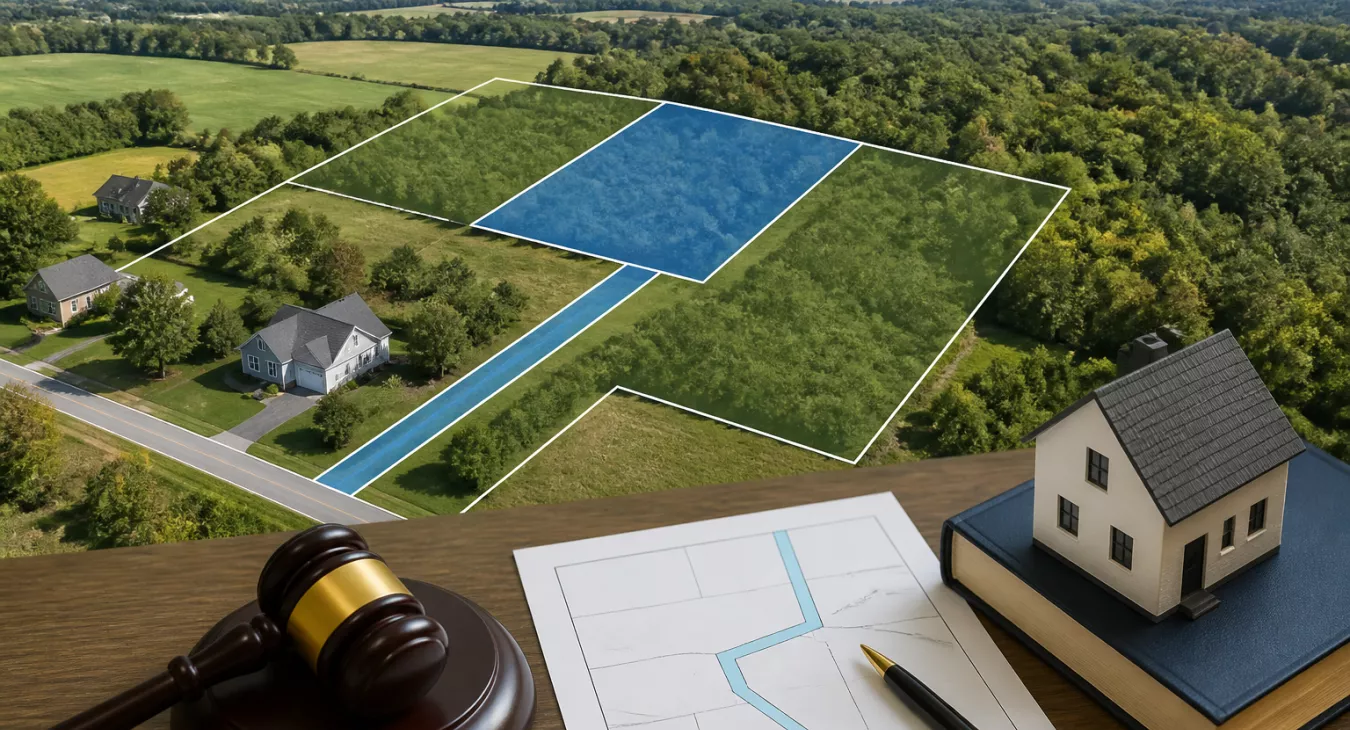
Learn landlocked property access rights investing essentials. Discover how to evaluate legal access, assess risk, and unlock discounted property opportunit
Table of Contents
- What's a Landlocked Property?
- Investment Opportunity Analysis: Why Landlocked Properties Matter
- Types of Access Solutions and Easements
- Due Diligence Framework: Before You Buy
- Negotiating Access: A Step-by-Step Strategy
- Legal Remedies When Negotiations Break Down
- Financing Challenges and Solutions
- Development and Use Considerations
- Pros and Cons: Full Risk Assessment
- State-Specific Investing Considerations
Landlocked properties sit at one of real estate investing's most misunderstood intersections. Significant discount potential on one side. Serious legal and financial risk on the other. A parcel with no legal access to a public road can trade at a fraction of comparable properties — creating genuine opportunity for investors who actually understand how access rights work. But get it wrong, and you may own land you can't build on, finance, or sell. You need to know what due diligence is required and when to walk away. This guide gives you the legal framework, negotiation tactics, and investment analysis you need to evaluate landlocked property access rights investing with clarity and confidence.

What's a Landlocked Property?
Definition and Legal Implications
A landlocked parcel has no legally recognized access to a public road. Notice the word "legally"—it matters. Sure, there might be a gravel path cutting across a neighbor's land. Maybe that neighbor's been okay with you crossing for twenty years, no problem. But without a recorded easement, a statutory right of way, or a court order, the parcel is landlocked in the eyes of the law. And that's all that counts to lenders, title insurers, and future buyers.
The consequences are real and they're costly. No documented access means no building permit, no utility hookup, no conventional mortgage, and no resale to anyone who needs financing. Start by understanding the legal description of a property. That's how you spot whether access is actually recorded or just assumed.
How Properties Become Landlocked
It happens more often than you'd think. Here are the usual suspects:
- Subdivision without access reservation: An owner subdivides land and sells interior lots without recording easements to the road. The perimeter parcels move fast. Interior lots? Those get discovered years later with no legal path out.
- Inheritance and estate division: Heirs partition a family farm. Someone gets the back parcel and relies on informal permission to cross a sibling's property—permission that disappears the moment the sibling sells or family drama hits.
- Tax sale and foreclosure: A property gets severed from a larger parcel during a tax sale. The recorded deed creates a new landlocked parcel. Nobody caught it. This overlaps with tax lien investing research, where title issues are the norm, not the exception.
- Road abandonment: The municipality vacates a public road. Overnight, accessible parcels become landlocked.
- Metes-and-bounds error: A deed has a drafting mistake. The parcel ends up surrounded by private land with no strip conveyed to the road.
About 15–20% of rural parcels created through later subdivision are landlocked because nobody formalized the access. That's higher than most investors realize, and it should be on your radar.
Common Misconceptions About Landlocked Properties
The biggest mistake? Thinking a physical path is a legal right. A worn track across a neighbor's field doesn't give you anything unless the law recognizes it. That's one trap. The other trap is assuming landlocked status is permanent—it's not. Most of these situations are solvable. But the fix takes documented legal process, not a handshake.
Back to topInvestment Opportunity Analysis: Why Landlocked Properties Matter
The Price Discount Advantage
Here's the bottom line: landlocked parcels trade at a steep discount. Real money is left on the table, and that's where your edge comes in. The actual numbers vary depending on who you ask, but they're consistent enough to matter:
- Investors are seeing 24%–45% discounts below market value on comparable accessible land (as of 2025).
- Professional appraisers peg it at 50%–75% below market (as of 2024) when they're valuing landlocked comps.
- And in rural raw land? You can find discounts running 50%–80% below market value (as of July 2025).
Look, these aren't guaranteed numbers. What you actually get depends on state easement law, how realistic your shot at access really is, your relationship with neighboring owners, and what local demand actually looks like. But take the conservative end—24% off. If you can document access at a reasonable cost, you've got the foundation for a real deal analysis.
Risk-Return Profile for Investors
Landlocked property is complicated. Most people won't touch it. That's the entire opportunity. You're operating in the same space as probate investors—where profit flows to whoever has the skills and stomach to solve the problem that scared everyone else away.
Who actually wins in this space?
Land assemblers, rural recreational buyers looking to consolidate holdings, adjacent landowners expanding their own parcels, and developers with enough runway to spend 6–18 months sorting out access before pouring concrete.
Back to topTypes of Access Solutions and Easements

Before you write an offer on a landlocked parcel, you need to understand the five main categories of access rights. Each one comes with different legal requirements, costs, timelines, and actual odds of success — and they'll make or break your deal.
Recorded Express Easements
This is the gold standard. An express easement is a written agreement that's signed, notarized, and recorded in the county deed records. It gives your landlocked parcel the legal right to cross a specific strip of the neighboring parcel to reach a public road. The beauty? It runs with the land, so it survives when either property changes hands. If one already exists on the property you're looking at, pull the documents and verify three things: Is it appurtenant (attached to your parcel, not just to the old owner)? Is the route clearly described? And does a current survey show the easement?
Easement by Necessity
When no express easement exists, this is the most common legal path forward. Courts in most states recognize an easement by necessity if two conditions are met: the parcel was once under common ownership with an adjacent parcel that has road access, and that common ownership was severed in a way that left one parcel landlocked. According to Cornell Law's Legal Information Institute (as of September 2025), both parcels must have been under common ownership at the time of division — this unity-of-ownership requirement is the trigger across virtually all U.S. jurisdictions.
Florida codifies this in Florida Statutes § 704.01 (as of 2025–2026) with a statutory private condemnation mechanism. Other states rely on common law, but what counts as "necessity" varies by jurisdiction — some require strict necessity, others just reasonable necessity.
And here's something that changes the game: the Idaho Supreme Court ruled in Easterling v. Clark, 574 P.3d 349 (2025), that a four-year statute of limitations doesn't kill an easement by necessity. The easement survives even if nobody's been using it for years. That tells you these easements are treated as inherent to the land itself, not as time-limited claims.
Implied Easements
An implied easement emerges from the circumstances of a property's division, even without any express language in the deed. Courts dig into the facts: Was the crossing used openly before the properties split up? Was that use apparent and continuous? Is it reasonably necessary to enjoy the landlocked parcel? These are harder to establish than necessity easements because they're heavily dependent on the original conveyance's specific facts.
Prescriptive Easements
You acquire a prescriptive easement by using another owner's land openly, continuously, and without permission for a statutory period. Sound familiar? It's similar to adverse possession, but you're only getting the right of use, not title. The required period ranges from 5 to 20 years depending on state law (as of 2026). California requires 5 years under Civil Code § 1007 (as of January 2026), while Washington State and Oregon each require 10 years (Washington, as of 2024) and 10 years (Oregon, as reviewed September 2025) respectively.
That "without permission" part is critical. If the neighbor gave permission, the use isn't hostile and the clock stops running. Don't assume a long-used informal path is a legal prescriptive easement — you need documentation that all statutory elements are met and either litigated or formally agreed upon.
Statutory and Administrative Easements
Some states let a landlocked owner petition a court for a forced easement with compensation paid to the neighboring property owner. Think of it as a private condemnation action. Florida's § 704.01 is the textbook example. But here's the thing: these processes vary wildly by state, so confirm your jurisdiction's statute before you assume this option is available to you.
Easement Types Comparison Matrix
| Easement Type | Key Legal Requirement | Cost Range | Timeline | Relative Certainty | Best Use Case |
|---|---|---|---|---|---|
| Recorded Express Easement | Written agreement, recorded in deed records | Attorney drafting + negotiation (varies widely by market) | Days to months (negotiation-dependent) | Highest — binding on successors | All situations; preferred solution |
| Easement by Necessity | Prior common ownership + landlocking severance | Litigation costs (qualitatively: significant; no verified national benchmark) | Months to years (court process) | High if unity-of-ownership is proven | Prior common ownership is documented |
| Implied Easement | Apparent prior use before severance | Litigation costs (qualitatively: significant) | Months to years | Moderate — fact-dependent | Historical use is well documented |
| Prescriptive Easement | Open, continuous, hostile use for statutory period (5–20 years by state) | Litigation costs (qualitatively: significant) | Years to decades before claim matures; then litigation | Lower — element-specific, fact-intensive | Long-standing documented use history |
| Statutory/Administrative | State statute enabling forced easement with compensation | Court filing + compensation to neighbor (varies by state) | Months to years | Moderate — state-specific; not available everywhere | No negotiation possible; statute available |
Note: Cost figures for litigation are intentionally qualitative — no reliable verified national benchmark exists. Consult a local real estate attorney for jurisdiction-specific estimates before budgeting.

Due Diligence Framework: Before You Buy

Evaluating a landlocked parcel? You're working with a fundamentally different animal than a standard property deal. The problem — no legal access — might be impossible to solve at a price that keeps your deal alive. That's why the due diligence here has to be relentless.
Due Diligence Checklist
| Step | Document / Action | Why It Matters |
|---|---|---|
| 1 | Full chain-of-title search (30–60 years minimum) | Establishes whether unity of ownership ever existed (easement by necessity threshold) |
| 2 | Certified survey with adjoining parcel boundaries shown | Confirms physical access routes and distances; aerial images are insufficient |
| 3 | County deed records — search for recorded easements, covenants, rights-of-way | May reveal an existing easement that was overlooked or not disclosed |
| 4 | County planning/zoning department review | Confirms required minimum road width, surface type, and access standards for intended use — check locally; these vary by jurisdiction |
| 5 | Review subdivision plat (if applicable) | Reveals whether access was intended, reserved, or omitted at the time of subdivision |
| 6 | ALTA/NSPS Land Title Survey | Identifies all exceptions, encumbrances, and access limitations |
| 7 | Title insurance with ALTA Endorsements 17 and 17.1 | Endorsement 17 covers access; 17.1 covers pedestrian/vehicular access specifically |
| 8 | Identify all neighboring owners who control potential access routes | Multiple blocking owners dramatically complicates negotiation and litigation |
| 9 | Utility availability research | Water, sewer, electric, and gas connections require their own access paths; road access alone doesn't guarantee utility access |
| 10 | Environmental review (wetlands, floodplain, contamination) | Landlocked parcels sometimes border wetlands; see our wetlands identification guide |
Title Insurance and ALTA Endorsements
Here's the trap most investors miss: standard title policies carve out exceptions for anything that doesn't show up in public records. No legal access? Potentially not covered. That's where ALTA Endorsement 17 comes in — it specifically insures the right to access and exit your land. Endorsement 17.1 goes tighter, covering vehicular and pedestrian access from a named street. But they're not automatic. You have to ask for them explicitly.
What's the bill? Title insurance runs somewhere between $350 and $3,500 nationally, with a national average around $1,600 for both lender's and owner's policies (2025). Florida charges $5.75 per $1,000 for the first $100,000, then $5.00 per $1,000 above that on owner's policies (2026). And Texas — they just cut rates by 6.2% effective March 1, 2026, according to the Texas Department of Insurance. On top of that, the title search or examination fee — a separate cost at closing — typically hits $150 to $500 (March 2026).
Don't compromise on this one. If the title company won't write Endorsement 17 on a landlocked parcel, stop right there. That's not just a minor gap — it's a serious warning sign about what you're actually buying.
Back to topNegotiating Access: A Step-by-Step Strategy

Talking to your neighbor is almost always faster and cheaper than fighting it out in court. But it only works if you show up prepared, patient, and realistic about the relationship you're walking into.
Preparation Before First Contact
- Identify every owner whose land lies between your parcel and the nearest public road. Pull county assessor records for all intervening parcels. You might need cooperation from one owner—or several. Either way, you need to know who you're dealing with.
- Commission a survey showing the proposed access route. Show up with a physical map displaying the shortest, least-intrusive path. Specifics beat vague requests every time. Your neighbor needs to see exactly what you're asking for.
- Research the neighbor's situation. Family owner protecting quiet enjoyment? Developer who speaks transactional? Corporate entity managing a portfolio? Your pitch changes entirely depending on who's listening.
- Know your legal position. Easement by necessity applies if prior common ownership is documented. The neighbor can refuse—but they'll lose in court anyway. Deliver that reality respectfully, and suddenly you've got leverage.
Negotiation Structure
A one-time cash payment for a recorded easement is clean. Ongoing annual payments? Structurally weak. Here's why: a license can be revoked anytime. A recorded easement runs with the land forever. Compensation tracks the actual burden—easement width, surface work required, impact on their use, local land values. There's no national price guide for easements. The range is genuinely all over the map depending on state, parcel size, and location. Before you sit down across the table, hire a local appraiser or attorney to pin down a defensible number. You'll need it.
When Negotiations Fail
Document everything. Courts want to see good-faith attempts before they'll order an involuntary easement—so keep that paper trail clean. And don't threaten or ultimatum early on. Save the pressure play for later, after you've proven you tried the cooperative route.
Back to topLegal Remedies When Negotiations Break Down

Your neighbor won't budge on access. You've offered reasonable compensation. Now what? If your legal analysis supports an easement by necessity claim, litigation becomes your play. But here's the catch: you've got to prove unity of prior ownership followed by a severing conveyance that leaves one parcel landlocked. That's not optional. The documentation in your chain of title has to be bulletproof.
State-Specific Variations in Access Rights
Access law isn't federal. It's state law. Sometimes it's even county-specific. How easements get established, what "necessity" actually means, procedural requirements — it all changes depending on where your property sits.
- Florida: Florida Statutes § 704.01 gives landlocked owners a private condemnation mechanism. You can petition the circuit court for a statutory way of necessity, and the servient landowner gets compensated. It's faster than some states.
- Idaho: The Idaho Supreme Court's 2025 ruling in Easterling v. Clark is a win for landlocked owners. It confirmed that a four-year statute of limitations doesn't kill an easement by necessity. That's stronger protection than you get in many other states.
- Minnesota: Minnesota Statute § 117.031 sets the bar for attorney fees in eminent domain cases. The final award has to beat the condemning authority's last offer by more than 40% and exceed $25,000 before mandatory fees kick in. While this applies mainly to government takings, it directly impacts the economics of forced-easement litigation under eminent domain procedure.
- Virginia: A 2025 eminent domain reform package overhauled the game. Most provisions take effect July 1, 2025. Title production requirements apply to offers dated January 1, 2026 or later.
Don't try to DIY this. An attorney licensed in your jurisdiction isn't optional. This isn't general legal research territory — you need local counsel who knows the specific rules where your property actually sits.
Back to topFinancing Challenges and Solutions
Here's the hard truth: landlocked properties kill deals. Most lenders won't touch a loan without documented legal road access (as of July 2025). That's your conventional mortgages, FHA loans, commercial real estate financing — all of it. Why? Simple. If you default and they need to liquidate, they're stuck holding an asset with maybe three qualified buyers in a fifty-mile radius.
Financing Option Comparison
| Financing Type | Availability for Landlocked Parcels | Key Requirements | Relative Cost | Best For |
|---|---|---|---|---|
| Conventional Mortgage | Generally unavailable without documented legal access | Recorded easement or public road frontage required by underwriting guidelines | Lowest (if available) | Post-access-resolution acquisitions |
| Portfolio Lender / Local Bank | Sometimes available with strong borrower profile | Lender discretion; may require title endorsement and access plan | Moderate; higher rates than conventional | Experienced investors with bank relationships |
| Cash Purchase | Always available; eliminates lender restrictions | None — no financing contingency | Capital-intensive; opportunity cost of tied-up capital | Sophisticated investors with liquidity; best negotiating position |
| Seller Financing / Land Contract | Available when seller agrees | Negotiated directly; seller retains equitable title risk | Variable; often higher interest rate | Situations where seller wants income stream; buyers without conventional access |
| Hard Money / Private Lender | Possible; lender-specific underwriting | Higher LTV restrictions; short terms; focus on exit strategy | Highest rate; significant origination fees | Short-term hold while access is established; flip strategies |
Cash is king here. You sidestep lender approval entirely, close in days instead of weeks, and you've got all the leverage in negotiations. But there's a cost: you're locking serious capital into an illiquid, legally murky asset. And if you've got the sophistication to explore assumable mortgage structures on adjacent accessible properties? Our assumable mortgages guide breaks down those creative financing angles for more complex deal structures.
Back to topDevelopment and Use Considerations
Legal access is just the first hurdle. Your actual ability to build depends on whether that access meets local standards for what you're trying to do. Here's the catch: these standards vary by county and municipality. What works in one jurisdiction won't fly in another. Before you assume a certain width, surface type, or grade will pass muster, you need to verify with the local planning or building department—no exceptions.
Minimum easement width. Surface type. Turnaround radius for fire trucks. These aren't suggestions. Residential, agricultural, and commercial uses each have different requirements. You might need gravel, asphalt, or a fully improved surface depending on the jurisdiction and use type. Miss these standards and your building permits get denied. Full stop. It doesn't matter that you have a legal easement if the access doesn't meet code.
Utility Access Complications
Here's where most investors stumble. A vehicular easement and utility access are completely separate animals. Just because you can drive across someone's land doesn't mean you can run electric lines, water mains, or sewer pipes there. Each utility—electric company, water authority, sewer district—might demand its own recorded easement agreement. And they've got their own engineering standards that often contradict what you need. Budget for this as a separate line item.
In rural deals, it gets messier. Well and septic feasibility requires its own analysis. And in western states? Water rights don't automatically transfer with the land. You need to check your specific state's water law before you assume a domestic well is even an option. Don't skip this step.
Zoning determines what you can actually build. Our guide on how to find out what zoning a property has walks you through the research process for your jurisdiction.
Back to topPros and Cons: Full Risk Assessment

Advantages for the Right Investor
- Significant purchase price discounts — You're looking at 24–80% below what comparable accessible land fetches, depending on your market and how likely access actually is
- Reduced competition — Most buyers and agents quit before they start. That's your edge as a specialist.
- Privacy and seclusion — Genuine landlocked parcels sit surrounded by private land, creating natural buffers. That's huge if you're thinking recreational use, hunting, or conservation plays.
- Land assembly use — An adjacent owner who needs to cross your parcel might pay a premium to buy you out, or you structure a partnership deal. It happens.
- Negotiation flexibility — Sellers on these deals are typically motivated. They'll accept creative terms and conditions that'd never fly on accessible property.
Significant Drawbacks and Constraints
- Financing limitations — Cash or creative financing. That's your reality until access gets legally locked in.
- Litigation risk and cost — Access disputes mean attorney fees, court delays, and outcomes you can't predict. Don't underestimate this one.
- Neighbor relationship dependency — Your property's entire value might depend on one person playing nice. That's a vulnerability.
- Resale challenges — The buyer pool is thin. And conventional lenders won't touch it without proven, recorded access rights.
- Development restrictions — Zoning approval and building permits demand access that actually meets local standards. A recorded easement isn't enough.
- Utility complication — Separate easements for water, power, sewage? Each one requires negotiation and adds hard costs to your deal.
State-Specific Investing Considerations
Texas Market Specifics
Texas throws you some curveballs. Municipal Utility Districts (MUDs) and Public Utility Districts (PUDs) control infrastructure in most developing suburban and exurban areas. Here's the thing: a landlocked parcel sitting outside an active MUD? You've got no realistic shot at water, sewer, or road infrastructure—even if easement status looks clean on paper. Extraterritorial Jurisdiction (ETJ) zones around Texas cities add another layer, imposing development regulations that can lock down your use before annexation ever happens. And then there's groundwater law. Texas runs on the rule of capture (modified by groundwater conservation districts), which means water rights aren't just another line item—they're a completely separate, locally controlled analysis you can't skip.
Some good news: Texas title insurance rates dropped 6.2% as of March 1, 2026, according to the Texas Department of Insurance. That's a real cost savings for buyers, even if modest. Want the bigger picture on tax implications? Check our property tax guide for investors—it breaks down high-tax jurisdictions including major Texas metros.
State Variation in Access Laws — Key Reference Points
| State | Prescriptive Easement Period | Statutory Way of Necessity | Notable Access Law Feature | Source / Date |
|---|---|---|---|---|
| California | 5 years (Civ. Code § 1007) | Common law; no single dedicated statute | Short prescriptive period; strong common law necessity doctrine | January 2026 |
| Washington | 10 years | Common law | Standard unity-of-ownership necessity doctrine applies | 2024 |
| Oregon | 10 years | Common law | Standard necessity doctrine; verify local requirements | Sept. 2025 |
| Florida | Verify locally | Yes — § 704.01 (private condemnation with compensation) | Explicit statutory mechanism; relatively clear process for forced access | 2025–2026 |
| Idaho | Verify locally | Common law | Easterling v. Clark (574 P.3d |