

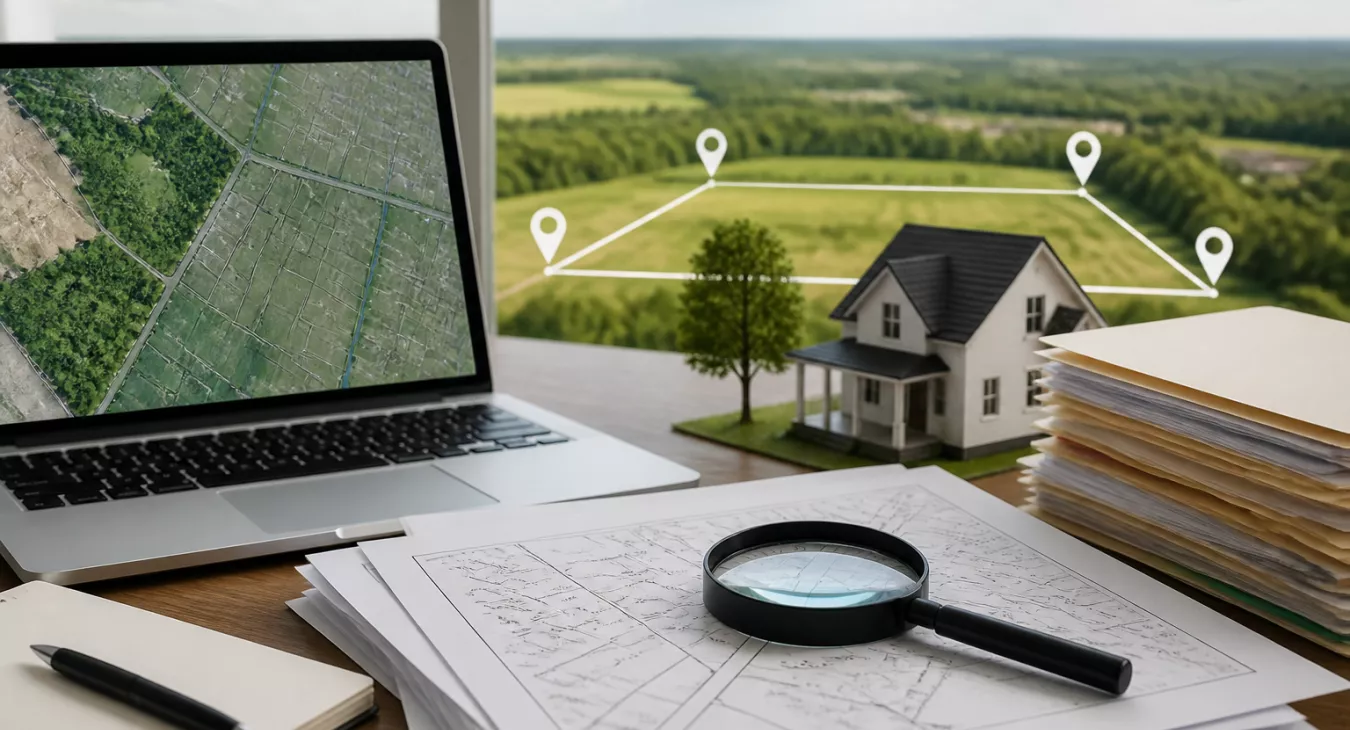
Master public records search for land investing with essential tools and techniques to verify ownership, identify liens, and ensure clean title before buyi
Products and Tools Mentioned in this Post

Table of Contents
- Understanding Public Records in Land Investing
- How to Access Public Land Records Online
- Key Information Found in Land Records
- Public Records Search by Geographic Region
- Best Practices for Land Investing Research
- Cost and Access Considerations
- Using Property Data for Investment Decisions
- Tools and Resources for Full Searching
- Conclusion
- Frequently Asked Questions
Here's the truth: every solid land deal begins in the public record, not at the closing table. You're either flipping a rural parcel for quick profit or assembling a long-term portfolio. Either way, public records are your only reliable source for ownership history, liens, easements, and whether that title's actually clean. A public records search for land investing isn't optional—it's non-negotiable due diligence. Without it, you're flying blind. Check out the fundamentals of flipping vacant land for profit if you want to see how this plays out in real deals.

Understanding Public Records in Land Investing
What Are Public Land Records?
Government agencies maintain public land records. They document who owns real property and how it's been used over time. Here's the thing: in the U.S., these records aren't centralized. About 3,000 county recorder and assessor offices hold them scattered across the country — there's no single national database you can tap into. That matters. It means the data you're hunting for almost always lives at the county level.
Two categories make up what you'll actually find. First, there are instruments — deeds, mortgages, releases, easements, and liens recorded in chronological order. Second, you've got assessment data: ownership info, parcel identifiers, and the government's valuation. Both are public and both matter for your investment thesis.
Why Public Records Matter for Investors
Does the seller actually own what they're selling? Does a lien or easement attach to this parcel and survive closing? What's the government's taxable value estimate? The public record answers all three. No amount of comps research or drone footage gets around this — you need to verify the legal and financial foundation before you move forward. After you've identified the best markets for land investing in 2026, dig into the title and tax records for the specific parcel you're underwriting.
Types of Public Records Available
- Deeds: Transfer documents establishing current and historical ownership.
- Mortgages and Deeds of Trust: Loans secured by the property.
- Liens: Mechanic's liens, judgment liens, IRS federal tax liens, and HOA liens.
- Easements: Rights of access or use granted to third parties.
- Plats and Survey Plans: Legal boundary descriptions and subdivision maps.
- Tax Records: Assessed value, tax history, and delinquency status.
- Zoning and Land Use Documents: Permitted uses — which vary by jurisdiction and are never standardized nationally.
| Record Type | Information Provided | Investment Relevance | Typical Access |
|---|---|---|---|
| Deed / Title Instrument | Grantor, grantee, legal description, conveyance date | Confirms ownership chain and transfer history | County recorder portal (usually free to view) |
| Mortgage / Deed of Trust | Lender, loan amount, recording date | Reveals existing debt encumbering the parcel | County recorder portal (usually free to view) |
| Liens (Judgment, Mechanic's, Tax) | Creditor, amount, recording date | Liabilities that may survive the sale | County recorder + state court records |
| Easements & Covenants | Parties, scope, duration, affected portion of parcel | Use restrictions and third-party access rights | County recorder portal |
| Plat / Survey Plan | Boundary dimensions, lot number, subdivision layout | Confirms legal description matches physical land | County recorder or surveyor's office |
| Tax Assessment Record | Assessed value, owner of record, tax payment history | Identifies delinquencies and informs price analysis | County assessor portal (usually free) |
How to Access Public Land Records Online

Government Online Portals and Systems
Every U.S. county now has some form of online access to deed indexes and parcel data. Here's the catch: quality varies wildly. Some counties give you fully searchable document images for free. Others? They'll show you an index and make you drive down to the courthouse or pay for a certified copy to see the actual deed. The baseline rule is simple — online viewing of deeds and parcel data costs nothing in most states, but certified copies run a per-page fee that differs by county.
Start with the county assessor's website. That's where you'll find owner-of-record lookups by address, parcel number (APN), or owner name. Then hit the county recorder's site to pull the recorded instruments tied to that parcel. Want a step-by-step breakdown? Check out our guide on how to download county assessor data for land investing.
Search Methods and Key Parameters
Most portals support several search inputs:
- Parcel ID / APN: This is your precision tool. Use it whenever you've got it.
- Owner Name: Good for portfolio searches, but name variations and trust/LLC structures will trip you up.
- Property Address: It's convenient, sure. But you'll often get duplicates if the county's data is messy.
- Legal Description / Book and Page: Some older county systems still run on this — you'll need it if your APN search tanks.
Subscription vs. Ad Hoc Access
Doing one-off deals? The free county portals are plenty. But if you're running a portfolio or screening multiple counties, that's where third-party aggregators shine. These platforms pull county data across multiple jurisdictions into one searchable dashboard. You'll pay monthly or annual fees, which saves you serious research time — though their data only updates as often as they sync with each county. And here's what matters: Zillow and similar consumer platforms have real limitations for land research. Purpose-built land data platforms and county portals still beat them for title-level accuracy.
Back to topKey Information Found in Land Records

Property Title and Ownership Details
You're looking for every owner in the chain of title going back 40–60 years minimum (some states demand longer). Most deeds should trace cleanly from grantor to grantee. But gaps? Those "wild deeds" are deal killers. And they're more common than you'd think in rural or distressed properties.
Once you've learned the core terminology of land investing, reading deed language gets much easier. The real question is: how's the title held? Individual ownership, tenancy in common, joint tenancy, LLC, trust, or corporate entity — each one changes your exit strategy and your closing timeline.
Heirs' property situations are their own beast. Multiple heirs holding undivided interests without a formal estate settlement? You need a real estate attorney on this. No shortcuts.
Encumbrances and Liens
Any recorded claim against the property (besides the current deed) is an encumbrance. For a complete breakdown, check out our guide on researching property liens before buying land. Common ones you'll see:
- Mortgages and deeds of trust (unreleased loans from prior sales are your problem now)
- Federal and state tax liens (searchable via IRS EFTS and state equivalents)
- Judgment liens (county and state court records)
- Mechanic's and materialman's liens (watch for these on improved or partially developed parcels)
- Easements for utilities, roads, or drainage
Survey Plans and Property Boundaries
The legal description in that deed controls. Not the address. Not the GPS pin. Not what the seller told you over coffee.
Pull a current survey or plat and compare it directly to the legal description. Boundary disputes, encroachments, gap parcels — they all reveal themselves when you do this work upfront. This step alone has saved investors six figures on problem deals.
Tax and Valuation Records
County assessor records show you the assessed value, the owner name on file for tax bills, and the payment history. Tax delinquency matters because what happens after delinquency is state-specific — and these rules aren't interchangeable.
Here's the critical part: as of 2026, nine states — Alaska, Arkansas, Kansas, Nevada, New Mexico, North Carolina, Utah, Virginia, and Washington — have zero post-sale redemption period after a tax sale closes. That means the sale is final. Wyoming? Four years to redeem. Most states sit somewhere between one and two years. And Wyoming allows up to four years for a former owner to reclaim the property. The differences are dramatic, and they hit your ROI hard. The 2023 Supreme Court decision in Tyler v. Hennepin County is still reshaping how surplus equity gets handled after tax sales. Statutes change regularly. Always verify the current law for the exact state and property class you're working with.
Back to topPublic Records Search by Geographic Region

United States: State and Local Repositories
Here's the reality: U.S. property records are scattered across roughly 3,000 county offices with zero federal consolidation. That means your search strategy can't be one-size-fits-all. You need to drill down to the state and county level.
Most states have built a statewide portal or GIS-based parcel viewer. But the actual recorded instruments—the documents that matter—still sit at the county recorder's office. Want to know which resources you'll actually need?
- County Assessor / Treasurer Websites: Ownership, assessed value, and tax status.
- County Recorder / Register of Deeds: Recorded instruments (deeds, mortgages, liens, easements).
- State GIS / Parcel Viewer: Boundary visualization; varies in data currency.
- BLM General Land Office (GLO): Federal land patents, township plats, and historical survey records for public-domain states.
- USGS National Map: Topographic and boundary context for rural parcels.
And here's the kicker: a handful of states, including Texas, are non-disclosure states. They don't publish recorded sale prices. If you're trying to pull comps from public data, that's a real problem.
For specifics, check out our guide on how to find land for sale in Colorado. It walks through that state's county-level search resources step by step.
International Options
International land registries aren't created equal. The UK's HM Land Registry lets you run online title searches for pocket change. New Zealand's Landonline system hands you title and survey data through a government portal. Many countries run on a Torrens title system—where the government's register is the final word on who owns what. That's fundamentally different from the U.S. recording system, where the government just files your documents but doesn't guarantee the title itself. Before you invest internationally, know which system you're dealing with. It changes everything about your due diligence.
Back to topBest Practices for Land Investing Research

Conducting a Thorough Title Search
A proper title search traces ownership and recorded encumbrances through the full chain of title. Most transactions go through a licensed title company or real estate attorney who'll conduct this and issue a title commitment. But before you pay for that formal report, here's the move: do a preliminary search yourself using county portals. It'll save you thousands in wasted due diligence on garbage deals.
Here's how to do it:
- Identify the APN / parcel ID from the assessor's site.
- Pull the current deed from the recorder to confirm the vesting owner and legal description.
- Search for all recorded instruments tied to the parcel (search both grantor/grantee indexes).
- Check for open mortgages, unreleased liens, and recorded easements.
- Pull the tax record to verify payment status and confirm no delinquency.
- Review the plat or survey if the legal description references one.
- Order a formal title commitment before closing.
Red Flags in Public Land Records
| Record Finding | What It Means | Investment Impact | Required Action |
|---|---|---|---|
| Gap in chain of title | One or more transfers not recorded or missing grantor/grantee link | Possible unmarketable title; uninsurable without resolution | Engage title attorney; may require quiet title action |
| Unreleased mortgage from prior owner | Prior loan was paid off but release was never recorded | Appears as lien on title; will block clean transfer | Require release or payoff verification before close |
| Federal or state tax lien | IRS or state revenue agency claim against prior owner | Survives sale in many circumstances; must be resolved | Contact IRS or state agency; negotiate lien release or payoff |
| Multiple heirs listed on deed | Undivided interest ownership among several parties | All heirs must consent; any holdout can force partition litigation | Confirm all interest holders; obtain all signatures at closing |
| Recorded easement over buildable area | Third-party right (utility, access, drainage) across key portion | Restricts development; may significantly reduce value | Map easement against intended use; consult attorney on extinguishment options |
| Tax delinquency showing in assessor record | Unpaid property taxes; may be in redemption period or post-sale | Outstanding taxes typically survive sale; creates immediate liability | Verify exact delinquency amount and state redemption status before proceeding |
| Deed conveyed for $1 or nominal consideration | May indicate gift, related-party transfer, or distress sale | Unclear market basis; possible fraudulent conveyance | Research context; confirm no pending creditor claims |
Common Mistakes to Avoid
- Relying solely on the seller's representation of title without independent verification.
- Skipping the lien search because the land "looks unencumbered."
- Assuming zoning classification letters (R-1, A-1, etc.) mean the same thing across different counties — they don't.
- Ignoring easements that don't appear to affect the parcel today but will restrict future development.
- Treating non-disclosure state sales data as equivalent to disclosure-state comparables.
Here's the thing: understanding how zoning and land use restrictions affect your investing strategy is just as critical as the title search itself. Both need to be locked down before you commit any capital.
Back to topCost and Access Considerations
Fee Structures
Here's the good news: county portal searches are free. But certified copies? They'll charge you per page, and the rate depends on which county you're in. Then there's the curveball — formal open-records requests under statutes like Colorado's CORA. That's when agencies start billing you for staff research time. Take San Juan County, Colorado as an example. Their CORA research rate runs $41.37 per hour (first hour free) as of July 1, 2025, while the document recording fee is a flat $43.00 per document regardless of page count (effective July 1, 2025). Every county does this differently, so pull the recorder's current fee schedule before you assume anything.
Federal land records are a different beast. The Department of the Interior and USGS will waive fees automatically if they're under $50. Cross the $250 threshold? Treasury and FinCEN rules say you may need to pay upfront.
Third-party data aggregators charge subscription fees. The price swings based on coverage and features. Are you running 20 deals a month? The time savings usually pays for itself. But if you're doing occasional lookups, stick with the county portals.
Delivery Timelines and Accessibility
Online portal searches hit instantly. You want certified copies in your hand? Mail requests take several business days to two weeks depending on how backed up the county is. Physical office visits work if you need same-day access to indexed documents and can actually talk to staff. Don't assume every county office runs normal hours. Rural counties especially operate on a skeleton crew and limited schedules — call first or you'll waste a trip.
Back to topUsing Property Data for Investment Decisions

Analyzing Records for Value Assessment
Tax assessment records give you the county's take on value. Not market value, but a solid benchmark. Sales history from deeds — assuming your state records the purchase price — shows exactly what previous buyers actually paid. Want to build a defensible pricing baseline? Track land sales history across comparable parcels in the same county.
Public records inform valuation in multiple ways. And here's where it gets interesting with real numbers behind it.
The USDA NASS 2026 land values report (released July 31, 2026) painted a clear picture: the U.S. average farm real estate value (land plus buildings) hit $4,500 per acre nationally. But that masks huge variation. Cropland averaged $6,020 per acre — the first time it's broken the $6,000 barrier — a 3.3% jump from 2025. Where does your market stack up? The Corn Belt? $8,590 per acre in 2026. Out in Connecticut and California? You're looking at $14,600 and $14,100 per acre respectively — entirely different ball game.
One caveat: these figures are farm real estate only. Non-agricultural vacant land doesn't have a reliable national dataset, so you're assessing it the old-fashioned way through local comparable sales.
For a broader comparison between land and other asset classes, see land vs. residential real estate investing: returns, risk, and best use case.
Identifying Investment Opportunities Through Records
Tax delinquency records are gold for land investors. A parcel with unpaid taxes? That usually means an absentee owner or someone highly motivated to move it. But here's what you absolutely need to know first: state redemption periods vary wildly, and they matter for your timeline and exit strategy.
As of 2026, nine states have zero post-sale redemption periods. Delaware gives you 60 days. Wyoming? Four years. Most states cluster somewhere between one and two years. The gap between these rules can shift your entire acquisition and disposition strategy. Always verify current law with a local attorney — statutes change.
Want a more sophisticated edge? Look into how AI tools are transforming real estate investing in 2026, including platforms that merge public records data with market analytics for faster decision-making.
Back to topTools and Resources for Full Searching

Official Government Portals
- County Assessor / Recorder Websites: Your primary source — and they're free in most jurisdictions.
- BLM General Land Office (glorecords.blm.gov): Want historical federal land patents and survey plats? This is where public-domain states store them.
- USGS National Map (apps.nationalmap.gov): Topographic context and boundary layers. Essential for understanding what you're actually looking at.
- State GIS Portals: Most states maintain a statewide parcel viewer — just search "[state name] GIS parcel viewer" and you'll find it.
- PACER (pacer.gov): Federal court records, bankruptcy filings, federal judgment liens. All in one place.
Third-Party Aggregators and Data Tools
Here's where things speed up. Third-party platforms pull county data from multiple jurisdictions and layer in search features, skip-tracing, and owner contact data. They're game-changers for land wholesaling and bulk acquisition strategies — because manually searching hundreds of parcels across three states? That's not scaling.
Batch uploads, owner contact append, comp analysis. You get the tools to move fast. And once you've pulled the raw records, purpose-built real estate calculators turn that data into actual investment decisions — ARV, cap rate, cash-on-cash return. Numbers that matter.
Don't sleep on water rights research in western states. It's one of the biggest blind spots in land investing. Our guide on how to find available water and check aquifer access covers specialized due diligence tools that most investors skip entirely.
Back to topConclusion
Here's the truth: a disciplined public records search is your best defense in land investing due diligence. It costs nothing. Maybe a few bucks for certified docs, but that's it. And you don't need special access—just internet. Compare that to market analysis or site visits, and you realize records searches reveal things those methods simply can't touch.
But here's where most investors stumble. Every state and county plays by different rules. Redemption periods, disclosure requirements, fee structures, recording systems—they're all over the map. You need to know your jurisdiction inside and out, or you'll miss something critical.
Start every potential acquisition the same way.
Assess the title chain. Check for open encumbrances. Verify tax status. Confirm the legal description actually matches the physical parcel. This isn't busywork—it's the habit that separates investors who dodge expensive surprises from those who learn those lessons the hard way, often after they've already cut a check.
Back to topFrequently Asked Questions
Are U.S. property records truly free to access?
Here's the short answer: yes, mostly. Deed indexes and parcel data are free online in most states. Want a certified paper copy? That'll cost you per-page fees, and every county sets their own rates. Some older counties with minimal digital infrastructure still require you to show up in person or mail in a request — usually just nominal fees. And if you're using a third-party aggregator like Zillow or MLS databases? They're charging subscription fees. But remember — the underlying government data is public record, period.
What's the difference between a Torrens title system and a recording system?
Two completely different animals. The Torrens system — used in Minnesota, Hawaii, and internationally in the UK, Australia, and New Zealand — has the government issue a certificate of title that's basically conclusive proof of ownership. The register guarantees the title. That's powerful. But most U.S. states use a recording system instead. Here's the catch: the county just records whatever documents you hand them. They don't guarantee those documents are valid. That's exactly why title insurance exists — it fills that gap.
How do I find out if a property has delinquent taxes?
Hit the county assessor or treasurer website first. Search by APN or owner name. Look for any outstanding balance, delinquency notation, or tax sale status flagged on the record. Don't stop there, though. Always call or visit the county office directly to confirm the current amount owed. Third-party databases lag. Recent payments or corrections might not show up for weeks.
Can I rely on online records alone for a title search before closing?
No. That's a mistake investors make too often. A preliminary online search? Perfect for pre-offer due diligence. But it's not a substitute for a formal title search run by a licensed title company or attorney before you close. Online portals have indexing delays. Data gaps exist. Court-filed liens don't always show up immediately. And here's why it matters: title insurance requires a professional search, and it's your only recourse if a defect slips through.
What should I do if I find a gap in the chain of title?
Stop everything. Call a real estate attorney right now. A gap in the chain of title — that's a period where you can't trace ownership from grantor to grantee through recorded instruments — typically tanks the title's insurability without fixes. You've got options. Quiet title action is the heavy artillery: a court proceeding to establish clear ownership. Some states let you use affidavits of heirship. Or negotiate with the seller to cure the defect before closing. Pick one and don't proceed without it.
Back to top